


Eurasian Nuthatch
Wood Nuthatch · Sitta europaea
By the Birdfact teamChecked by Nathan Cope
On this page13 sections
How to recognise it
The Nuthatch is a small, solidly built bird with a bold mask and attractive colours. Read this section for more identification tips.
What do Nuthatches look like?
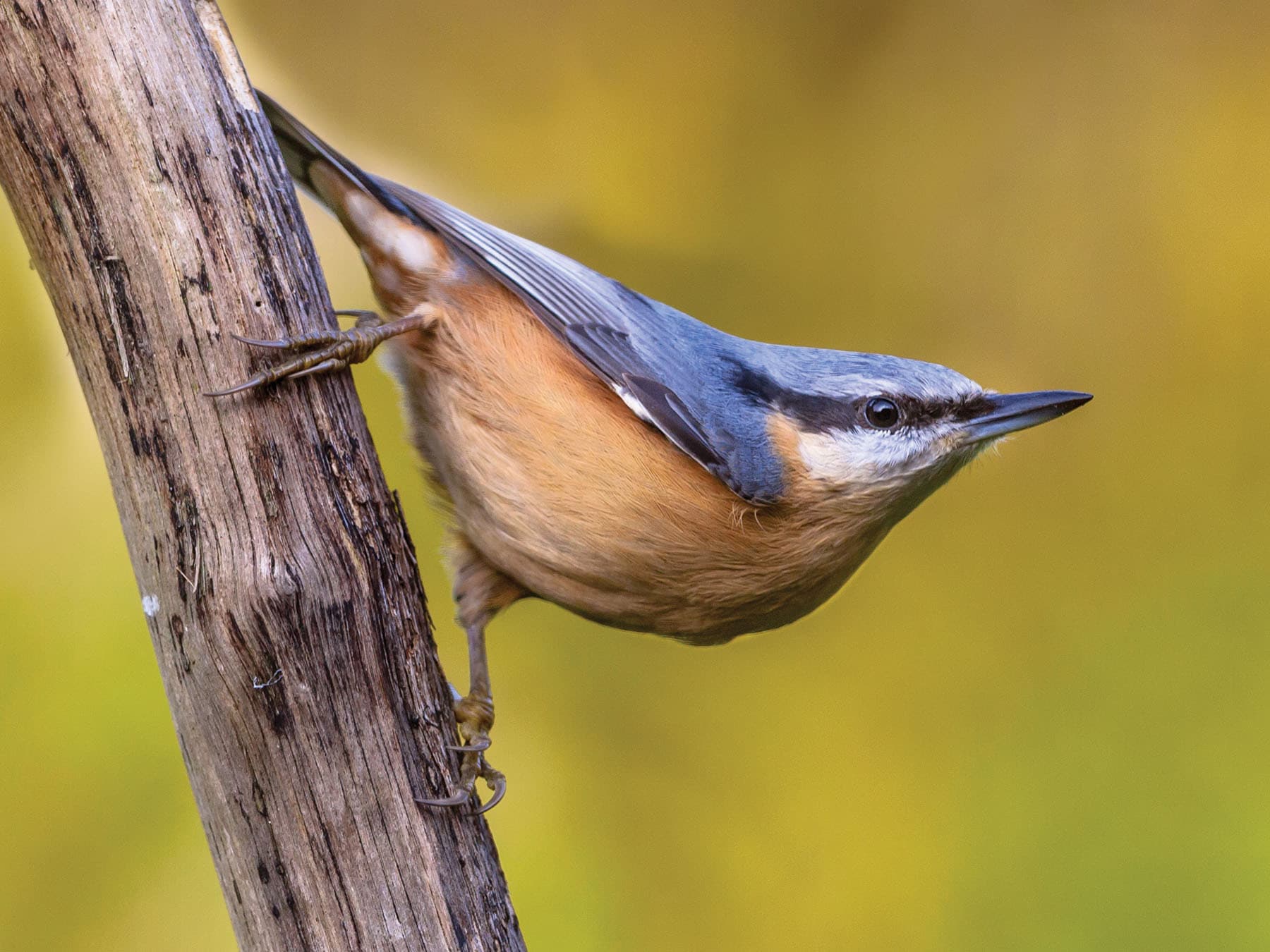
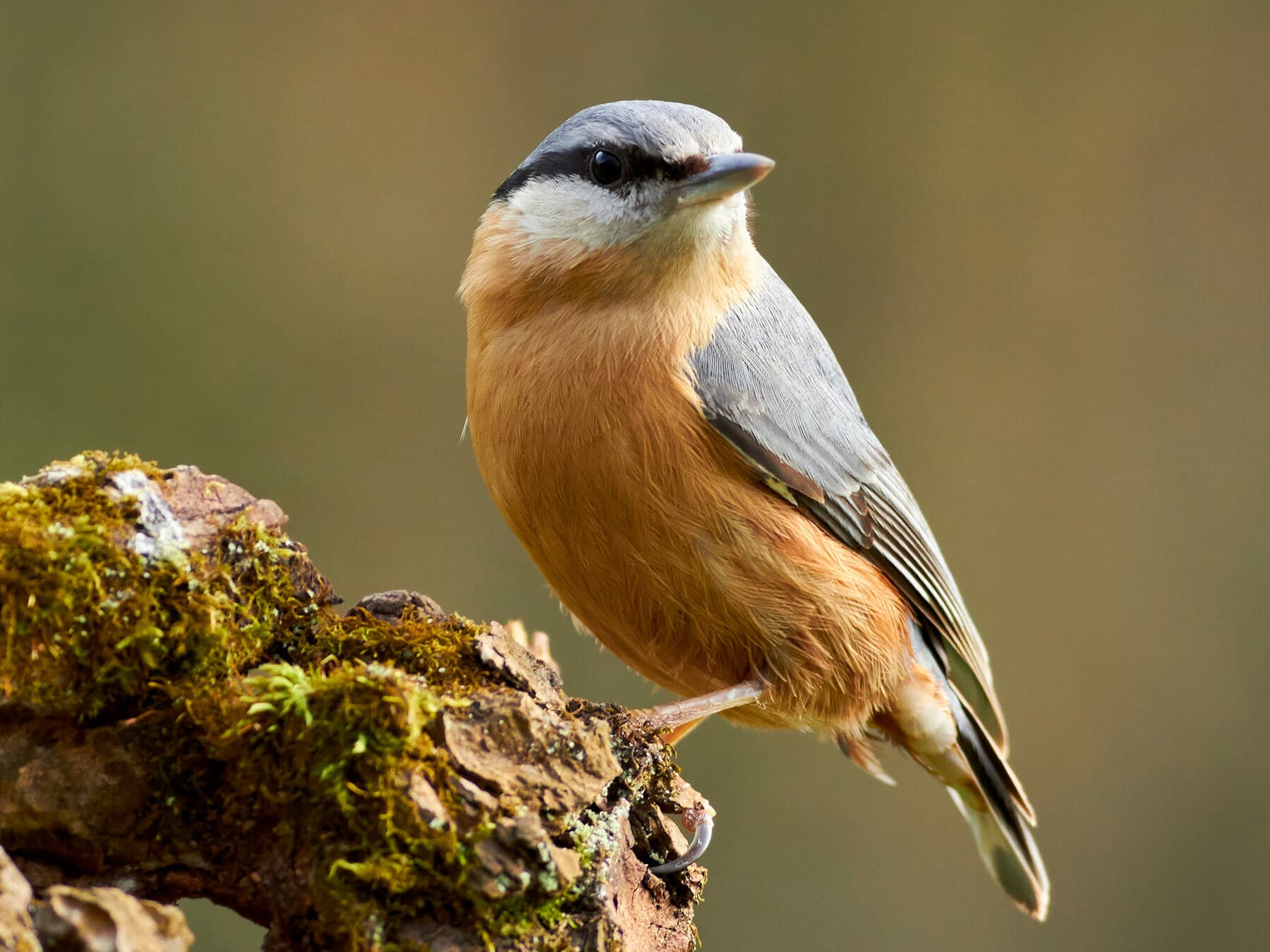
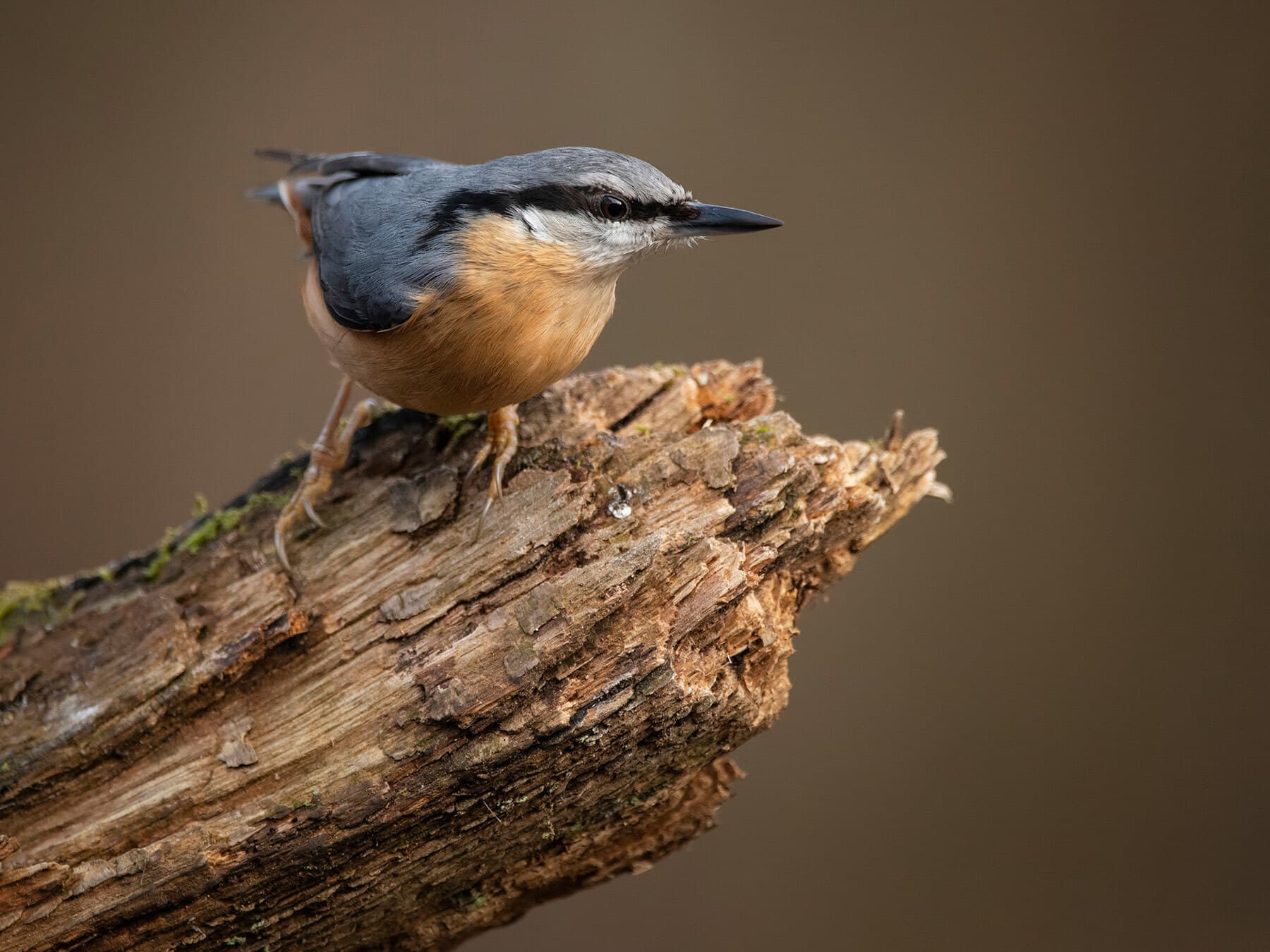
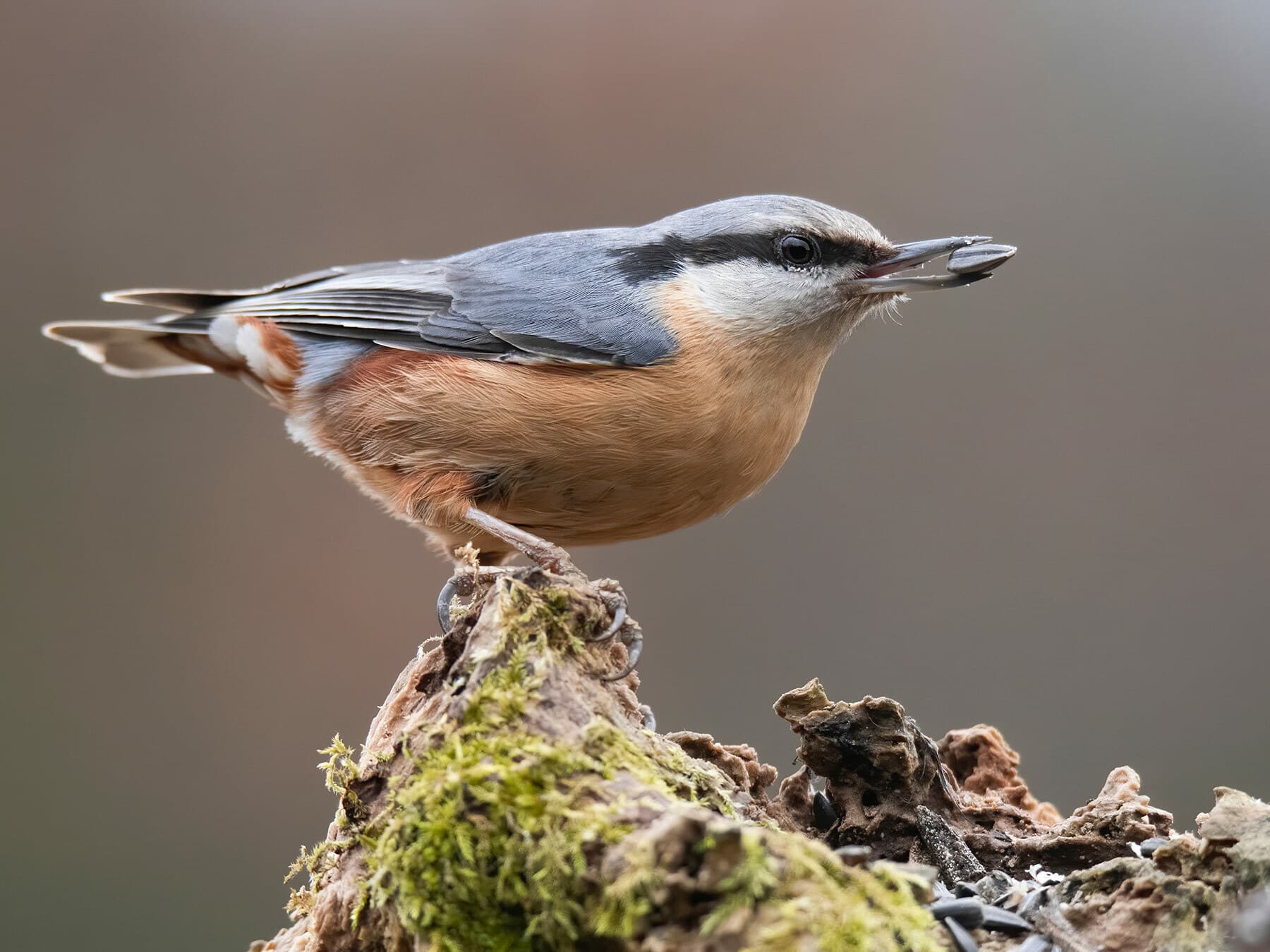
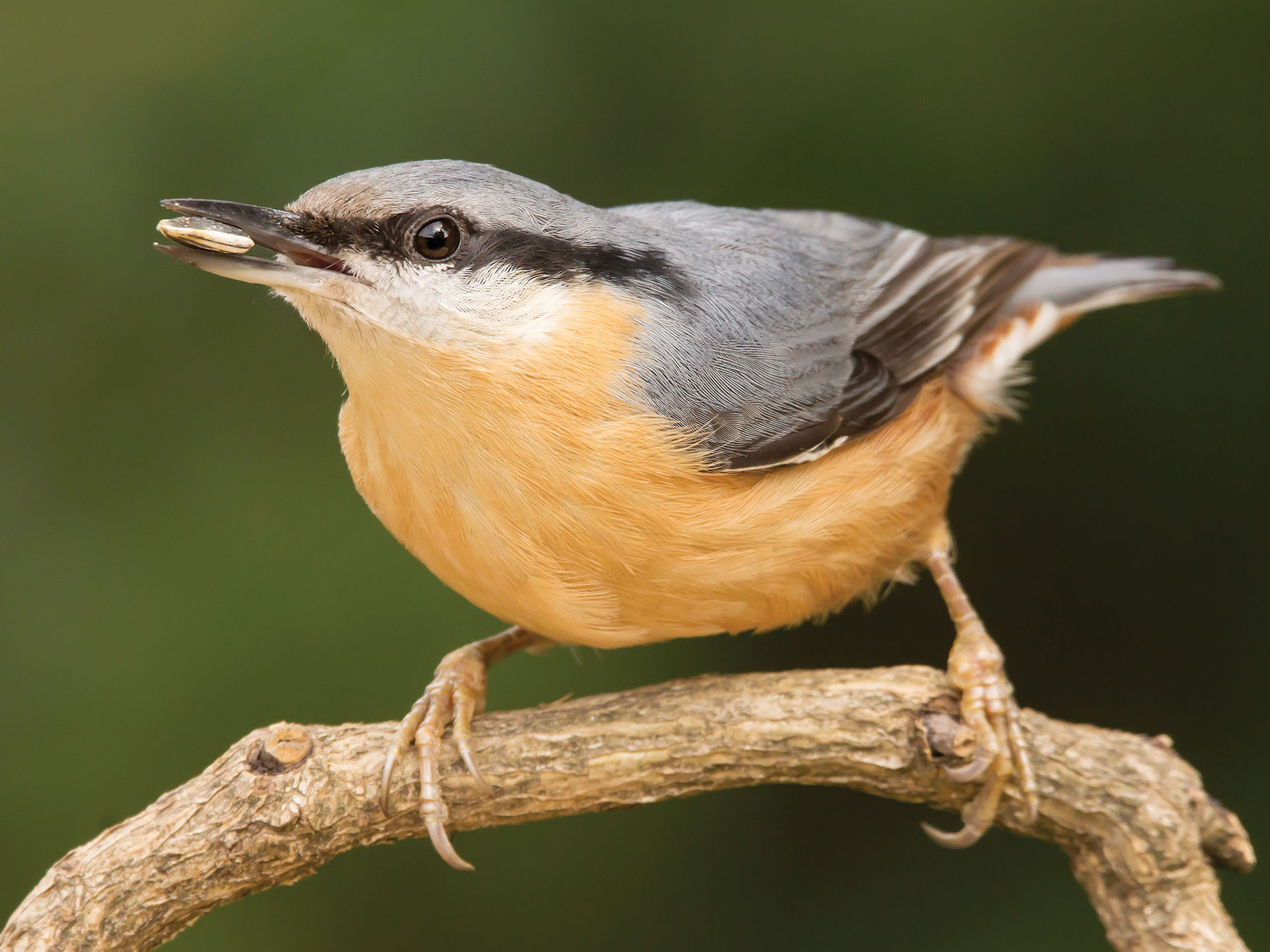
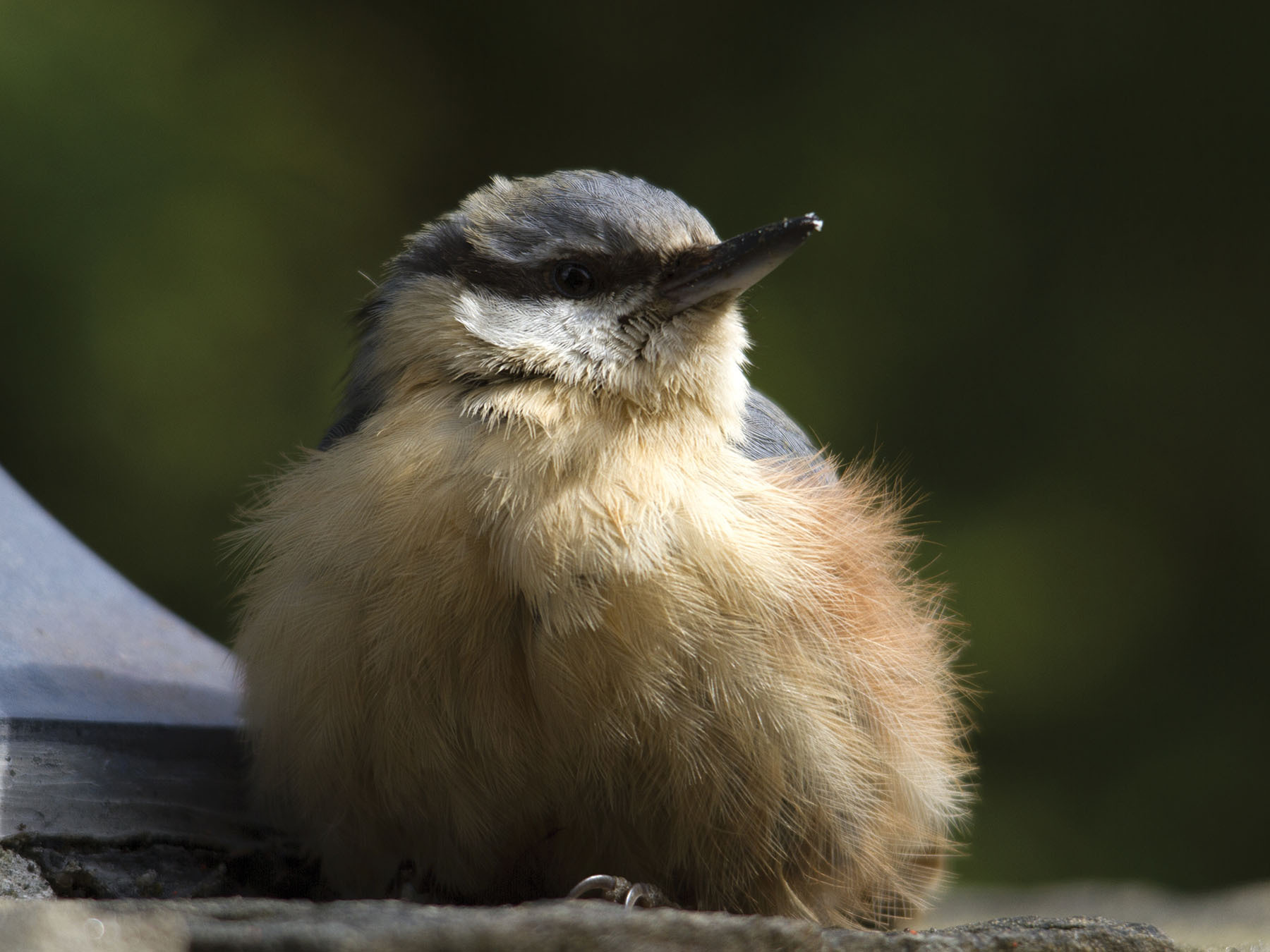
The Nuthatch is a small bird with short legs and a fairly long, straight bill. These birds are grey-blue above and chestnut brown below. A bold black mask is visible from the base of their bill, through their eye, and to their shoulder. A white cheek patch is visible below this prominent marking.
Female Nuthatches are difficult to distinguish from males, although careful observation may reveal a brown (not black) stripe on their face and slightly paler plumage above and below. Juvenile birds are very similar to adult females but have duller plumage.
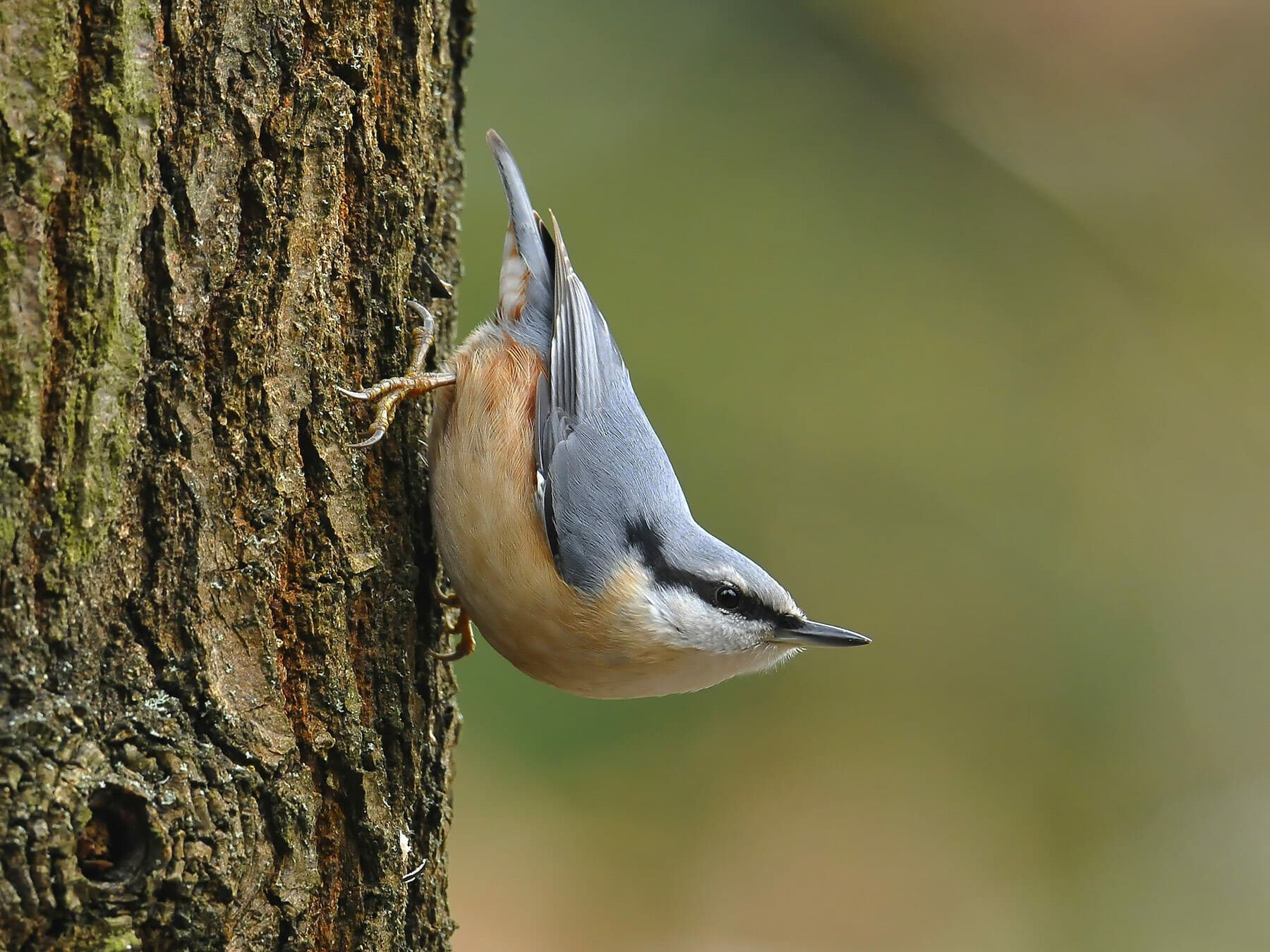
There is only one species of Nuthatch in the UK. These birds resemble Woodpeckers as they clamber about on trees. However, they are easily distinguished by their short tails and grey and chestnut plumage.
How big are Nuthatches?
Nuthatches are small birds, slightly larger than a Robin.
Length
Nuthatches in the UK have a body length of 12 to 17 centimetres.
Weight
Most female Nuthatches weigh 20 to 24 grams. Males are slightly heavier, although the difference is unnoticeable in the field.
Wingspan
Adult Nuthatches have a wingspan of 22 to 27 centimetres, and males have slightly longer wings.
Its size
Adults- Length
- 12–14.5 cm
- Wingspan
- 22.5–27 cm
- Weight
- 18–27 g
Its song and calls
Nuthatches are highly vocal little birds, frequently producing loud whistling and piping songs and calls.
What sound does a Nuthatch make?
The Nuthatch’s song is rather variable in speed and length. It consists of repeated whistled ‘wee-wee-wee’ notes. These birds also call frequently to maintain contact or express alarm and excitement.
- Song0:00 / 1:03
Recorded in Normandie, France · February 2023
- Call0:00 / 0:57
Recorded in Surrey, England
Aubrey John Williams / The British Library Board · Wikimedia Commons · CC BY-SA 4.0
When and where to see it
OctoberHere all year
Most recorded in October
- 1. Neath Port Talbot2.7%
- 2. West Dunbartonshire2.1%
- 3. Powys2.0%
- 4. Stirling2.0%
- 5. Wrexham1.9%
Each dot is a county, state or province: the bigger and darker, the larger the bird’s share of that place’s bird records that month. Grey dots: no regular records. The ringed point is the centre of the bird’s records this month; the arrow shows how it moved since last month, and the dashed loop its path through the year. “Arrivals” colours places where it becomes regular this month (orange) or is in its last regular month (grey). GBIF eBird Observation Dataset, 2019–2024. Map data: Natural Earth, US Census Bureau; place centres © OpenStreetMap contributors.
In your area
See when the Eurasian Nuthatch is recorded in your county, state or province.
How often the Eurasian Nuthatch turns up in the UK through the year, from birdwatchers' records.
United Kingdom
Resident · all year · most records in March
Show as a table
| Month | United Kingdom |
|---|---|
| January | 0.54% (regular) |
| February | 0.55% (regular) |
| March | 0.56% (regular) |
| April | 0.49% (regular) |
| May | 0.27% (regular) |
| June | 0.33% (regular) |
| July | 0.35% (regular) |
| August | 0.41% (regular) |
| September | 0.39% (regular) |
| October | 0.35% (regular) |
| November | 0.43% (regular) |
| December | 0.49% (regular) |
Recorded regularly in
Worldwide: recorded regularly in 53 countries
Countries where it was recorded in at least 3 of the 6 years 2019–2024. Linked countries have their own bird list.
Europe (41)
- Åland Islands
- Albania
- Andorra
- Austria
- Belarus
- Belgium
- Bosnia & Herzegovina
- Bulgaria
- Croatia
- Czechia
- Denmark
- Estonia
- Finland
- France
- Germany
- Greece
- Hungary
- Italy
- Kosovo
- Latvia
- Liechtenstein
- Lithuania
- Luxembourg
- Moldova
- Montenegro
- Netherlands
- North Macedonia
- Norway
- Poland
- Portugal
- Romania
- Russia
- San Marino
- Serbia
- Slovakia
- Slovenia
- Spain
- Sweden
- Switzerland
- Ukraine
- United Kingdom
Africa (1)
Asia (11)
- Armenia
- Azerbaijan
- China
- Georgia
- Iran
- Japan
- Kazakhstan
- Mongolia
- South Korea
- Taiwan
- Turkey
Data: EOD – eBird Observation Dataset (Cornell Lab of Ornithology), accessed via GBIF.org, CC BY 4.0. Records from 2019–2024, aggregated and filtered by Birdfact. How these lists are made
The Nuthatch is Widespread in the UK and elsewhere in Europe and Asia. Keep reading to learn about their favourite habitats and where to look for these active little birds.
What is the habitat of a Nuthatch?
Nuthatches are most abundant in deciduous woodlands, although they are also common in gardens, parks, and other wooded areas.
What is the range of a Nuthatch?
Nuthatches are widespread in England and Wales, extending only into the South of Scotland. They are absent from Northern Ireland, the Republic of Ireland, the Fenlands and extensive arable farmlands in the northeast of England.
Elsewhere the Nuthatch is widespread in Europe and ranges across Asia to Japan. There is also a population in Northwest Africa.
Where do Nuthatches live?
Nuthatches spend their entire lives in territories of about one to ten hectares (2.5 - 25 acres). They spend most of their time in trees, although they occasionally descend to the ground to forage, especially in the colder months.
How rare are Nuthatches?
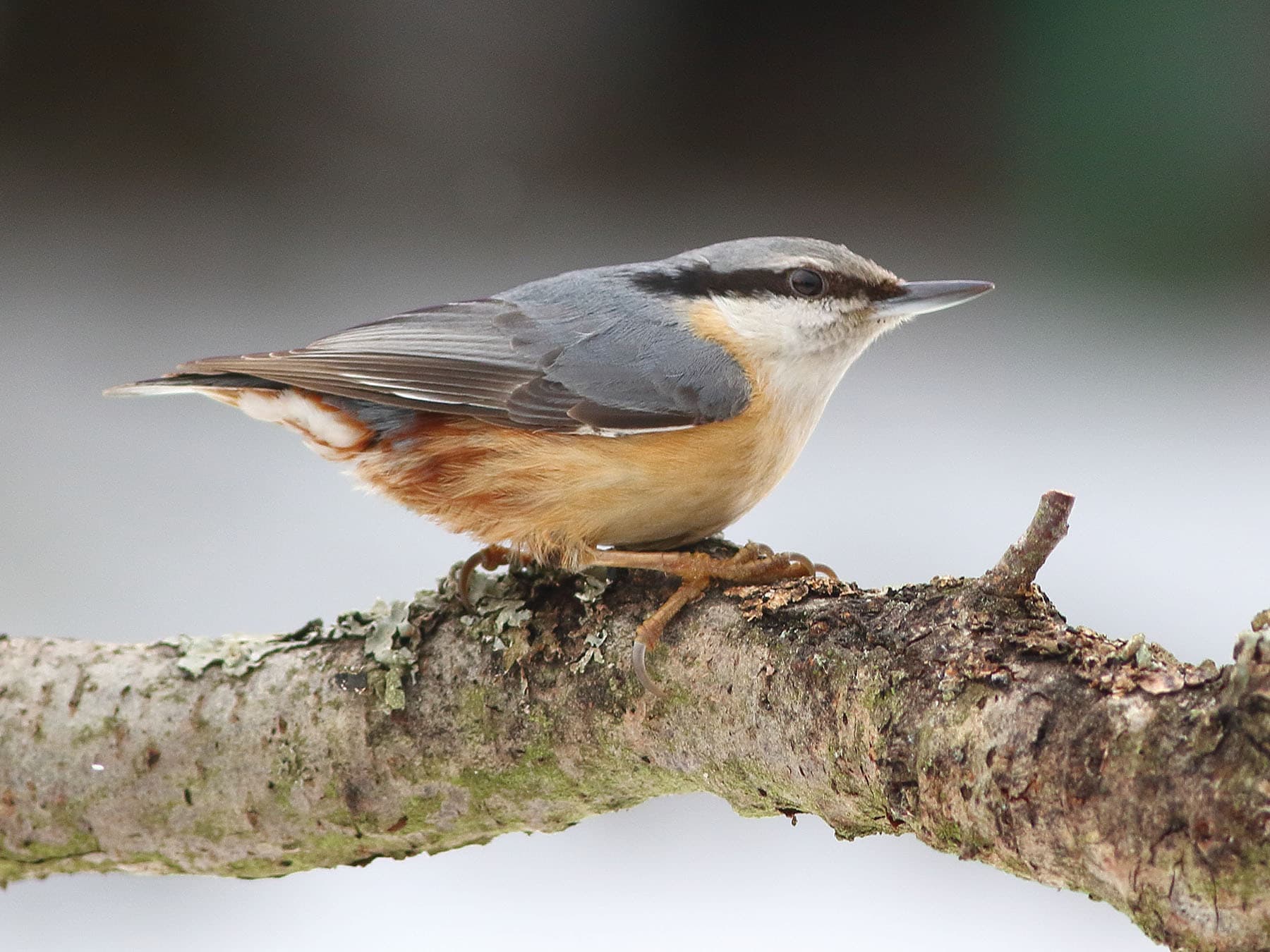
The Nuthatch is a common bird in the UK. They may have been more numerous when woodlands were more widespread, although they have adapted well to suburban areas, and their populations have increased significantly in the last few decades.
Where can you see Nuthatches in the UK?
Birdwatchers can spot Nuthatches in well-wooded areas in England, Wales, and the south of Scotland. Look out for them clambering on the trunks and branches of mature trees. These birds often turn up at garden bird feeders, particularly in the winter.
Signs and spotting tips
The nuthatch can be mistaken for a small woodpecker as it runs up and down tree trunks. Its ringing blows resounding from the tops of trees can alert an observer to its presence.
Nuthatches are generally tolerant of humans and will regularly visit bird tables in the winter, where they will cause chaos scattering seed everywhere and scaring off other birds.
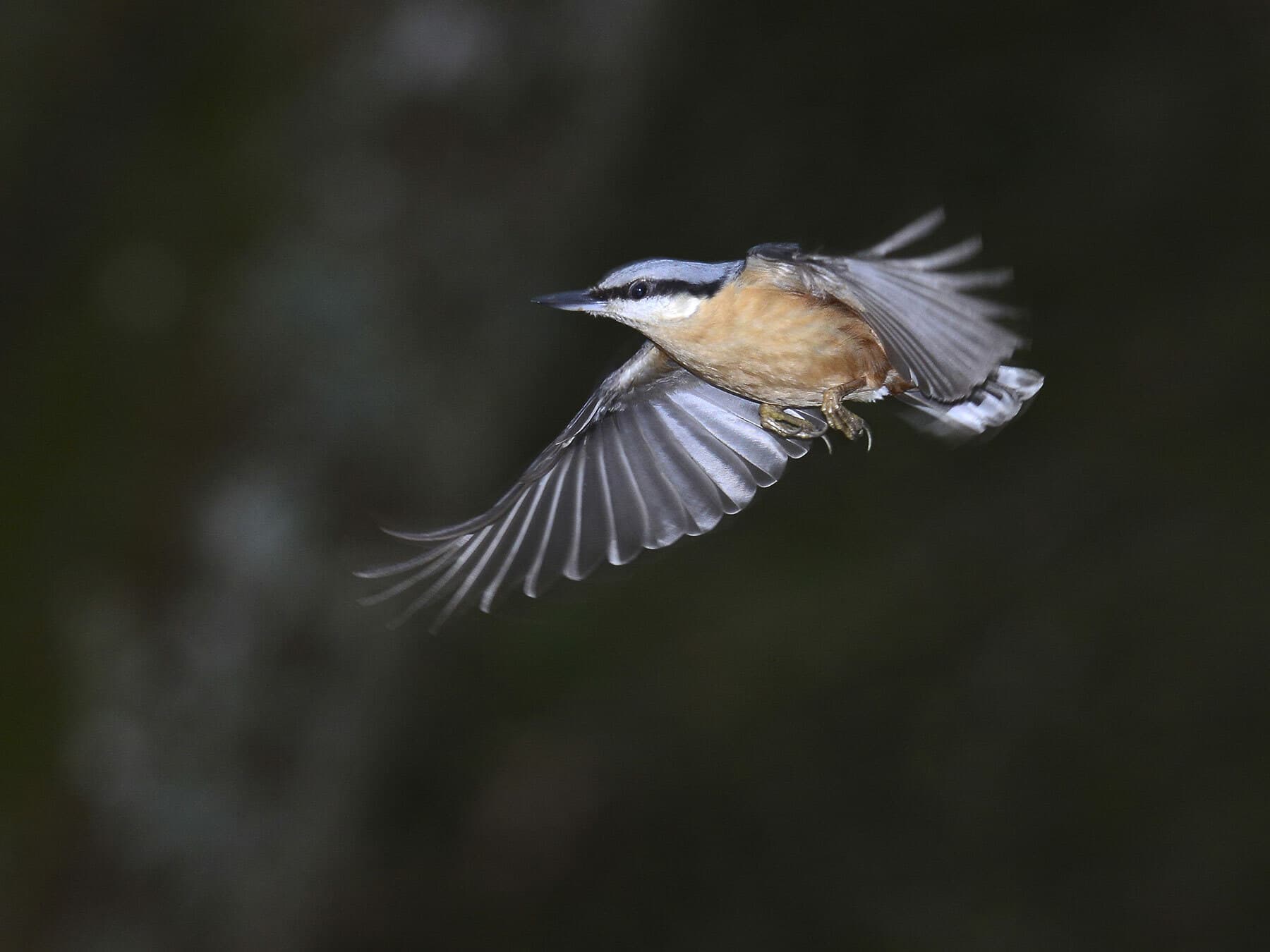
The bird’s flight is straight over short distances on short, rounded wings, and slightly undulating over longer distances. Its silhouette is distinctive with no neck, large head and long bill.
Migration
Do Nuthatches migrate?
Nuthatches can be seen throughout the year in the United Kingdom. Adults are highly sedentary, although juveniles must disperse from their natal area to claim their own territories.
Are Nuthatches native to the UK?
Nuthatches are native to the United Kingdom, although their population has expanded into previously unoccupied areas of Scotland.
What it eats
These birds have a varied diet and some clever ways of accessing and storing food. Continue reading to learn more about the Nuthatch’s diet.
What do Nuthatches eat?
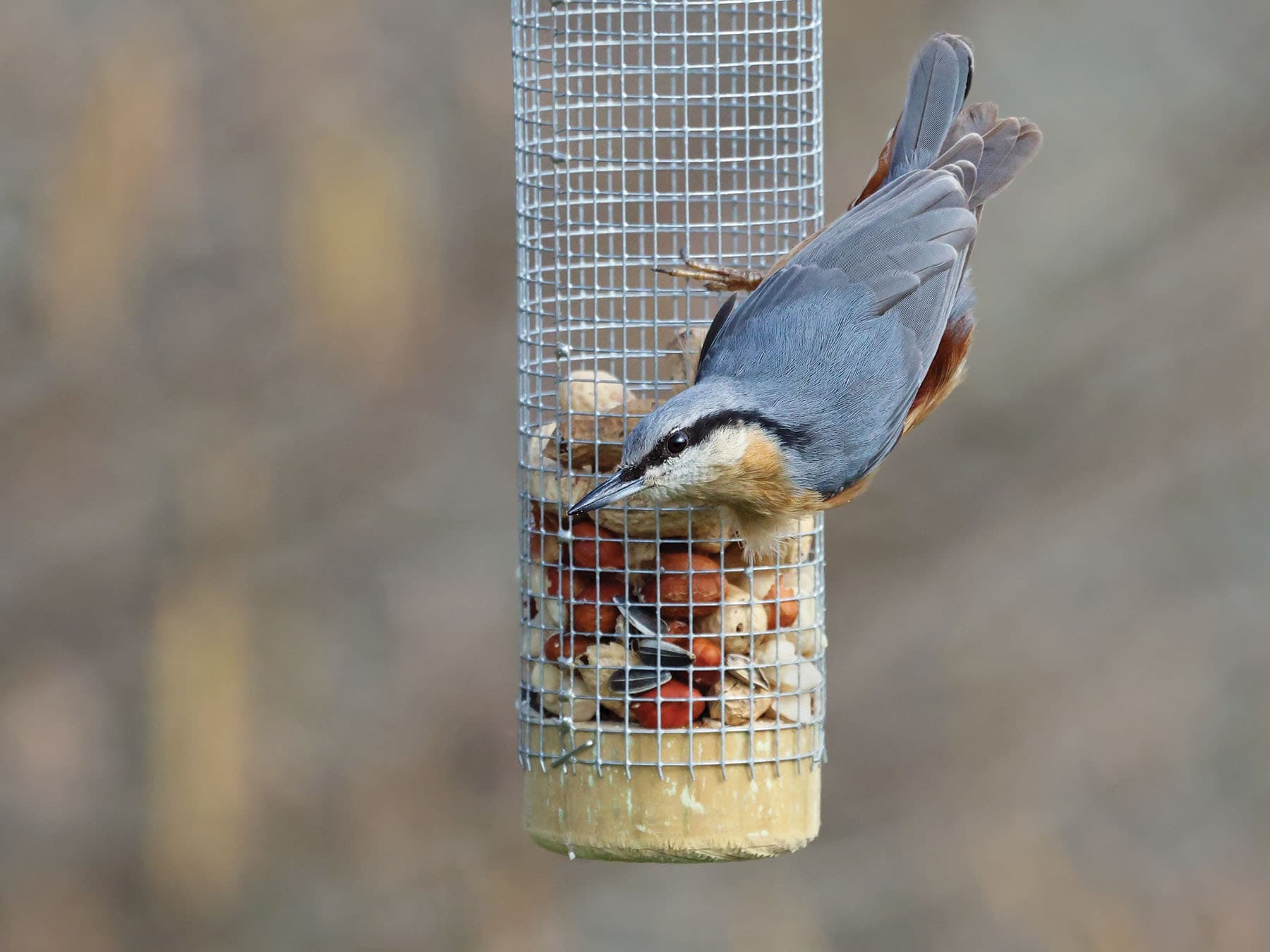
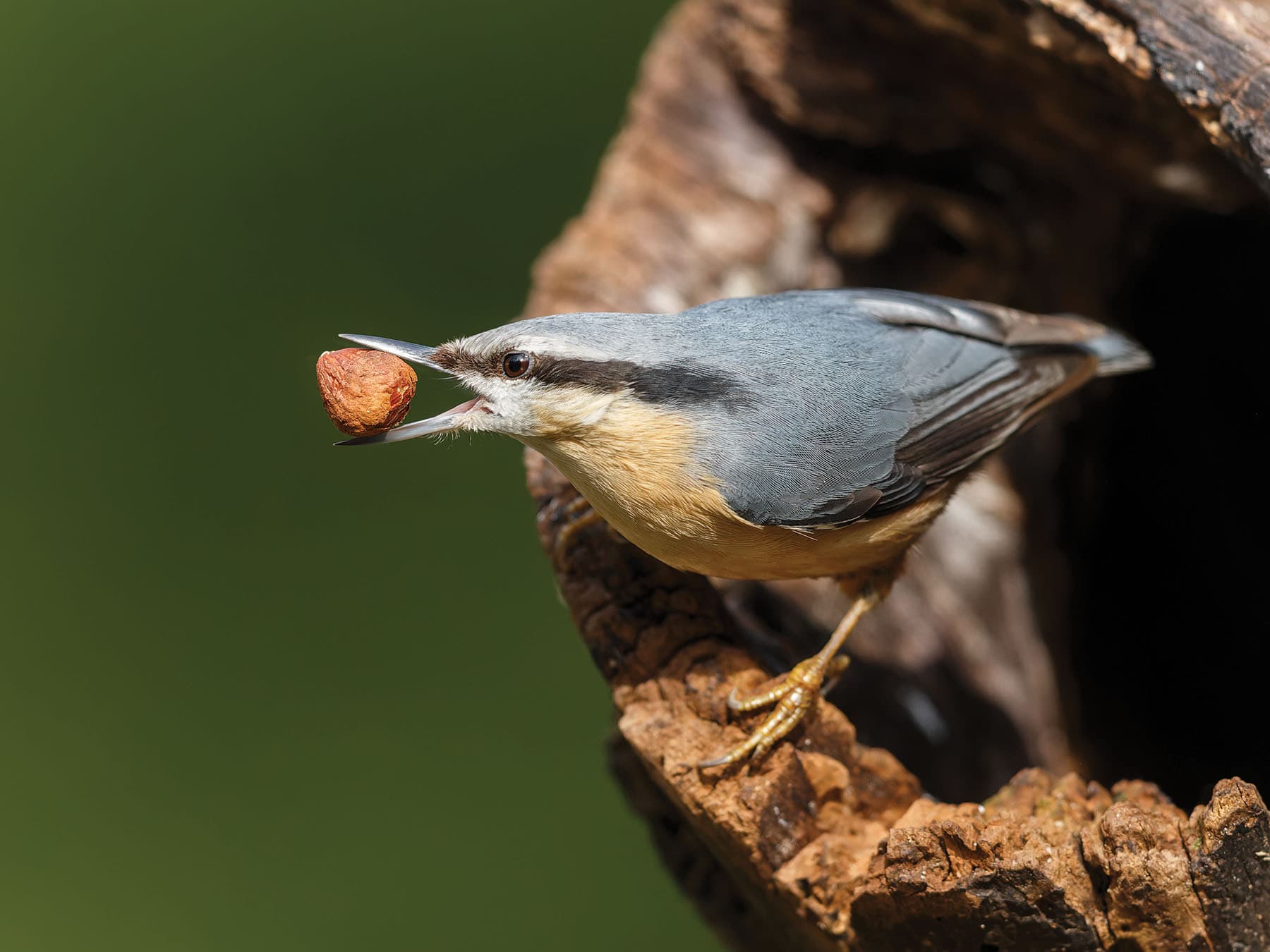
Nuthatches are primarily insectivorous, preferring caterpillars, beetles and other insects found on the trunks and branches of trees. Acorns, nuts, beech mast, and seeds become increasingly important in the winter when invertebrates are less abundant.
The Nuthatch has a clever way of cracking tough nuts. It wedges them into small crevices and then pecks at them to gain access. They also store excess food in cracks and crevices for leaner times.
What do Nuthatch chicks eat?
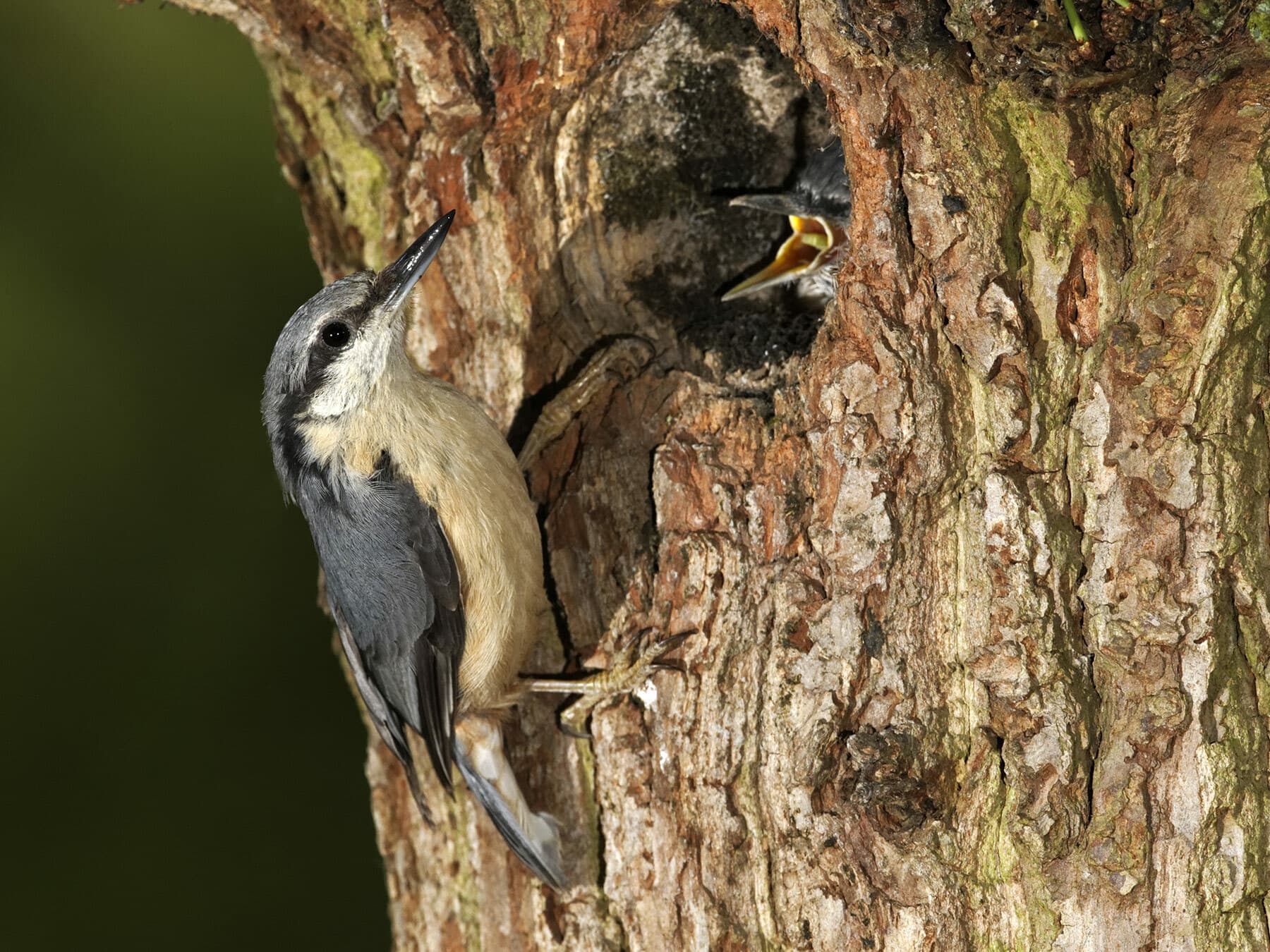
Baby Nuthatches eat insects supplied by their parents. The young birds will be fed by their parents for up to two weeks after fledging the nest.
Nesting and breeding
Nuthatches usually lay their eggs in March, and pairs have a single brood in the breeding season.
Where do Nuthatches nest?
Nuthatches are cavity nesters that use natural tree holes, particularly in larger deciduous trees. They will also use small nest boxes and can be encouraged to nest in your garden by providing such a space. They often line the entrance with mud to create a passage of just the right size.
What do Nuthatch eggs look like?
Nuthatch eggs are white with reddish-brown markings. They lay large clutches, usually of six to eight eggs. Each egg measures approximately 20 millimetres long and 14 millimetres wide.
Do Nuthatches mate for life?
Nuthatch pairs remain in their nesting territories throughout the year and generally pair for life. However, genetic studies have shown that they occasionally stray and mate with neighbouring birds.
Behaviour
The Nuthatch has a big personality, which is especially evident in its interactions with other birds around a food source.
Are Nuthatches aggressive?
Nuthatches can be rather aggressive and will dominate other birds at feeders. They are also territorial towards other Nuthatches and will chase intruders from their territory if warning calls and displays aren’t effective.
Where do Nuthatches sleep at night?
Nuthatches sleep in holes in trees and other cavities. They will also roost in artificial nest boxes.
Lifespan and predators
How long do Nuthatches live?
Nuthatches have an average lifespan of about two years, although they can live for over twelve years in exceptional circumstances.
What are the predators of Nuthatches?
The Sparrowhawk is the greatest threat to adult Nuthatches by day, although they are also vulnerable to nocturnal hunters like the Tawny Owl. Their eggs and chicks are well-protected within their nests but may fall prey to birds like the Great-spotted Woodpecker.
Are Nuthatches protected?
Nuthatches enjoy the protection of the Wildlife and Countryside Act of 1981 in the United Kingdom.
Are Nuthatches endangered?
Nuthatches are not endangered in the UK. They have a green conservation status, and their populations are expanding northwards, possibly due to climate change and the support of garden bird feeders.
Conservation
The Eurasian Nuthatch is currently listed as Least Concern by the IUCN. Its population is stable across much of its range, benefiting from widespread woodland habitats. However, local declines may occur due to forest fragmentation and loss of mature trees.
Conservation efforts focus on maintaining diverse woodland ecosystems.
More photos
3 photos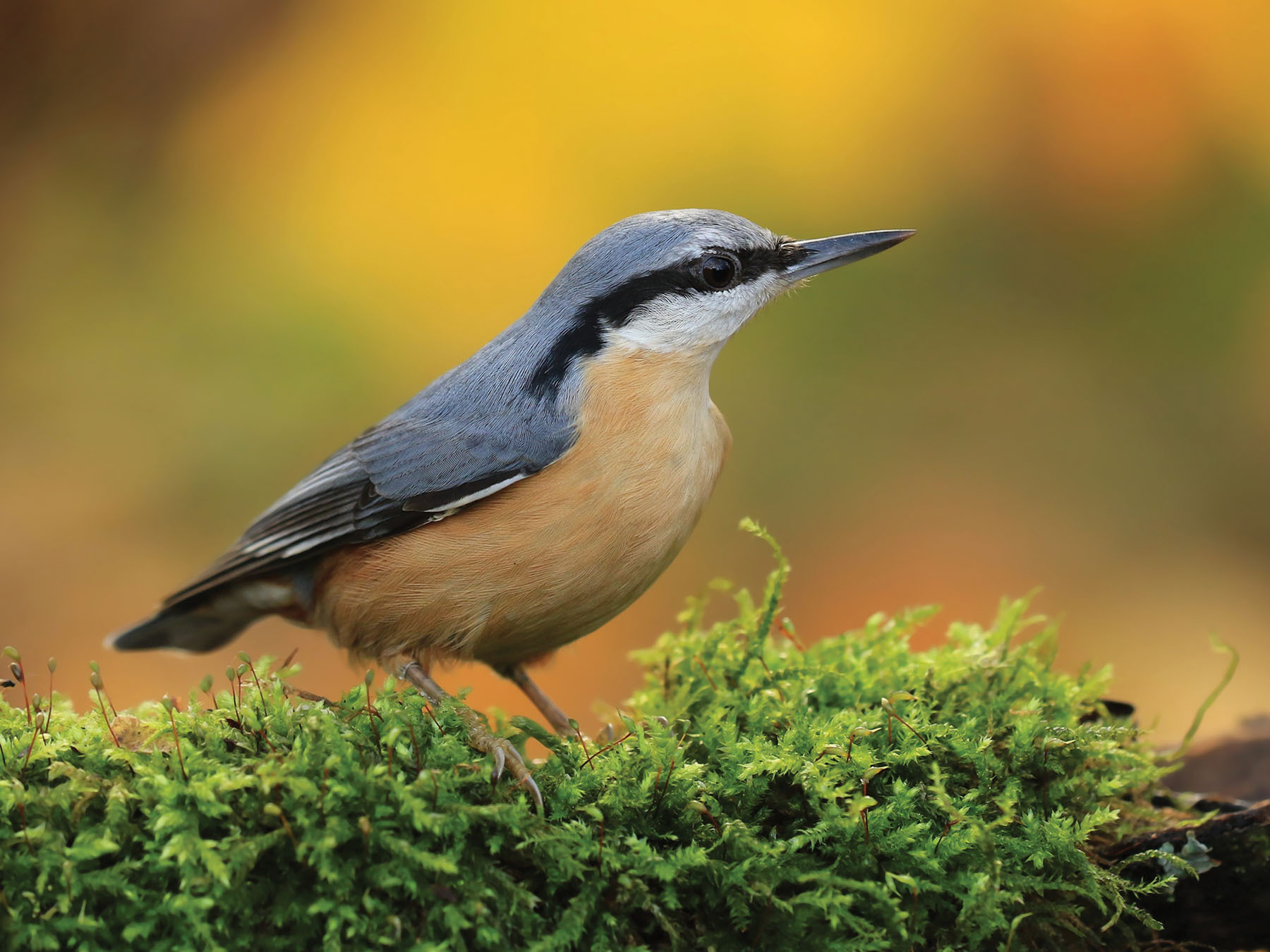
Quick facts
- Length
- 12–14.5 cm
- Wingspan
- 22.5–27 cm
- Weight
- 18–27 g
- Lifespan
- 2–3 years · oldest recorded 12 years
- Family
- Nuthatches
- Migration
- Resident
- Global status (IUCN)
- Least Concern
- World population
- 20,000,000 - 50,000,000 mature individuals
- Population trend
- Stable
- Also called
- Wood Nuthatch
- Scientific name
- Sitta europaea
Questions
2How to attract Nuthatches
Nuthatches are not the most common garden birds in the UK, but they are often attracted to offerings of peanuts and sunflower seeds.
They may visit a bird table, but they will also happily cling to hanging mesh feeders or eat fat or peanut butter smeared on a tree trunk. Adding a shallow birdbath and a purpose-made nest box can also improve your chances of attracting these birds.
Are Nuthatches friendly birds?
Nuthatches can be decidedly unfriendly towards other birds, particularly at bird feeders. They are also quick to fight with neighbouring Nuthatches.
Sources
4- 1BirdLife International. 2018. Sitta europaea. The IUCN Red List of Threatened Species 2018: e.T103879804A132199203. Source (opens in a new tab)
- 2EBCC (2015)
- 3BirdLife International. 2018. Sitta europaea. The IUCN Red List of Threatened Species 2018: e.T103879804A132199203. Source (opens in a new tab)
- 4Fransson et al., EURING list of longevity records for European birds (2010)

Checked by
Nathan Cope, founder and editor
Nathan founded Birdfact and leads its writers and contributors in the UK, the US and Canada. He has watched and studied birds for more than ten years, and checks every article and species guide before it’s published.