Species Profile
Marbled Godwit
Limosa fedoa
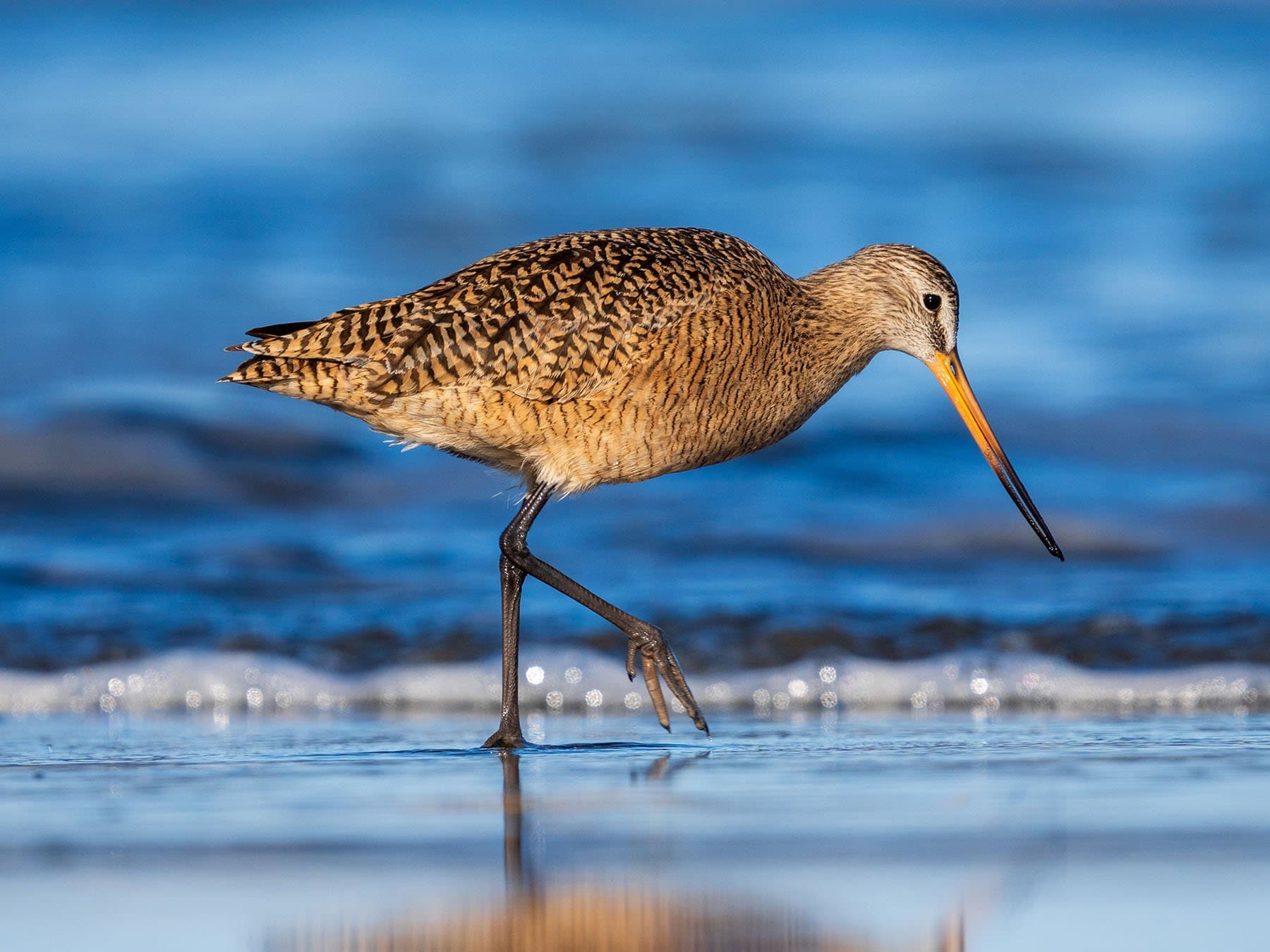
Marbled Godwit foraging in shallow water, showing mottled brown plumage, long dark legs, and a distinctive long, upturned bill with an orange base.
Quick Facts
Conservation
VUVulnerableLifespan
5–15 years
Length
40–50 cm
Weight
240–520 g
Wingspan
70–88 cm
Migration
Long-distance Migrant
North America's largest godwit, the Marbled Godwit carries a bill up to 13 cm long — slightly upturned, bicoloured orange-and-black, and built for probing deep into tidal mudflats and prairie wetlands alike. Its warm tawny-cinnamon plumage is unmistakable year-round, and in flight the blazing cinnamon underwing lining flashes like a signal flag. Once so abundant on the Minnesota prairies that 19th-century naturalists complained of the noise, this species was uplisted to Vulnerable on the IUCN Red List in 2024.
Think you've spotted a Marbled Godwit?
Upload a photo and we'll confirm it instantly
Confirm with a PhotoAppearance
The Marbled Godwit is the largest of the four godwit species on average, and one of the biggest shorebirds in North America — exceeded in size only by the curlews. Adults are richly buff-brown overall, a warm tawny-cinnamon tone that gives the species its name. The upperparts are mottled and barred in dark brown, white, and cinnamon; the underparts are paler buff with dark barring across the breast and flanks that intensifies during the breeding season.
The most diagnostic feature in flight is the bright cinnamon underwing lining, visible year-round and unmistakable at any distance. The bill is exceptionally long — 8 to 13 cm — slightly upturned, and bicoloured: orange-pink at the base and blackish at the tip. Bill colour shifts seasonally, with the base more intensely orange during breeding and pinkier in non-breeding plumage. The legs are long and blue-grey, and in flight the feet extend noticeably beyond the tail.
In breeding plumage, adults show heavier dark barring across the breast, belly, and flanks, with rust tones intensifying. In non-breeding plumage, the underparts become plain and unbarred, retaining only a pale cinnamon wash — but the overall warm brownish tone persists year-round, distinguishing the Marbled Godwit from the paler, greyer non-breeding plumages of other godwits. Juveniles closely resemble non-breeding adults but have fresher, more neatly patterned feathers with a slightly buffier tone and less distinct barring.
Females are noticeably larger than males — a clear example of reversed sexual size dimorphism typical of many shorebirds. The average weight of 45 females was 391 g compared to 326 g for 40 males, and females also have longer bills and tarsi. Plumage is essentially identical between the sexes, making size the most reliable field distinction.
Identification & Characteristics
Male Colors
- Primary
- Buff
- Secondary
- Brown
- Beak
- Orange
- Legs
- Blue-grey
Female Colors
- Primary
- Buff
- Secondary
- Brown
- Beak
- Orange
- Legs
- Blue-grey
Male Markings
Bright cinnamon underwing lining; long bicoloured upturned bill (orange-pink base, dark tip); warm tawny-buff plumage with dark mottling; blue-grey legs extending beyond tail in flight
Tail: Short, buff-brown tail with faint dark barring; feet extend well beyond tail tip in flight
Female Markings
Identical plumage to male but noticeably larger body, longer bill, and longer tarsi; size is the most reliable field distinction between sexes
Tail: As male; short buff-brown tail with faint dark barring
Attributes
Understanding Attributes
Rated 0–100 based on research and observation. A score of 50 is average across all bird species. These attributes are relative and don't necessarily indicate superiority.
Habitat & Distribution
During the breeding season, Marbled Godwits are strongly associated with shortgrass prairies and wet meadows in the northern Great Plains. They prefer native grassland with sparse to moderate vegetation — green needle grass, western wheatgrass, blue grama, and little bluestem — adjacent to a complex of semipermanent, seasonal, and temporary wetland ponds. Grazed or recently burned grasslands are often preferred, as these provide the short, open sward the species requires. The species is area-sensitive, requiring blocks of at least 100 hectares of grassland; territories in North Dakota regularly exceed 200 acres.
Approximately 70% of the global population breeds in the Prairie Pothole Region of the north-central United States and south-central Canada — primarily Montana, North and South Dakota, Minnesota, and the Canadian provinces of Alberta, Saskatchewan, and Manitoba. A small isolated population breeds along the southwest coast of James Bay in Ontario and Quebec. The subspecies L. f. beringiae breeds in a restricted area of the Alaska Peninsula around Ugashik Bay, in wet tundra, lowland meadows, and coastal marshes — a markedly different habitat from the prairie-nesting nominate subspecies.
The largest wintering concentrations occur along the Pacific Coast from British Columbia south through California — particularly Humboldt Bay and Elkhorn Slough — to Baja California and Mexico. Significant numbers also winter along the Gulf Coast (Texas, Louisiana, Florida) and the Atlantic Coast from New Jersey southward. In Washington State, a notable wintering population uses Willapa Bay and Grays Harbor; once considered a very rare visitor, recent counts have exceeded 1,500 birds. Some birds reach Central America and northern South America as far as Peru, though most winter north of Panama.
During migration, the species uses a wide variety of coastal and inland wetland habitats: tidal mudflats, sandy beaches, estuaries, salt marshes, shallow coastal ponds, and wet agricultural fields. Key stopover sites include the Bear River Migratory Bird Refuge at Great Salt Lake, Utah, and Controller Bay, Alaska, used by the beringiae subspecies as a final staging area before returning to breeding grounds.
Where to See This Bird
Explore regional guides for locations where this bird has been recorded.
Diet
The Marbled Godwit's diet shifts dramatically with season and location — a flexibility unusual even among shorebirds. On the breeding grounds, the primary foods are insects, especially grasshoppers and other Orthoptera, along with aquatic plant tubers, leeches, earthworms, and occasionally small fish. Birds glean insects from upland vegetation or pick them from the ground, and probe in shallow wetlands for aquatic prey.
During migration, the species makes a dietary switch that sets it apart from virtually every other shorebird: rather than eating aquatic invertebrates at stopover sites, Marbled Godwits forage almost exclusively on aquatic plant tubers — particularly sago pondweed (Potamogeton pectinatus) — at inland wetlands. They use the upturned bill to clip and extract tubers from underwater stems, a technique more reminiscent of a diving duck than a sandpiper. This behaviour has been documented at key stopover sites including the Bear River Migratory Bird Refuge at Great Salt Lake, Utah.
On the wintering grounds, the diet shifts again to marine invertebrates: polychaete worms, small bivalves, crabs and other crustaceans, and molluscs. The long, slightly upturned bill is well suited to probing deep into soft intertidal sediment, and birds can locate buried prey entirely by touch. Foraging occurs both by day and night on the coast, with tidal state dictating timing more than light levels.
Behaviour
Marbled Godwits are gregarious outside the breeding season, roosting in large flocks on salt meadows at high tide and foraging alongside Willets, Whimbrels, Long-billed Curlews, and Hudsonian Godwits on tidal mudflats. On the breeding grounds, however, they are strongly territorial — males hold large territories exceeding 200 acres in North Dakota, encompassing both upland nesting habitat and diverse wetland foraging areas. This area-sensitivity means prairie fragmentation hits the species particularly hard.
Foraging is primarily tactile. Birds wade slowly through shallow water or walk across mudflats, inserting the bill deep into soft substrate — sometimes submerging the entire head — to locate prey by touch. They can work water up to 13 cm deep. On the coast, foraging is tightly synchronised with tidal cycles: birds feed at low tide and roost at high tide, and this pattern continues through the night. Night foraging is routine on coastal wintering grounds, with birds navigating by touch rather than sight.
On the breeding grounds, males perform elaborate aerial displays — slow, circling flights up to 90 m above the territory, calling loudly throughout. Both sexes mob potential predators boldly, flying toward rather than away from intruders. Incubating birds may sit motionless even when approached closely, relying on cryptic plumage for concealment. A specific contact call is given when an individual joins a flock, believed to reduce aggression from other birds.
Calls & Sounds
The Marbled Godwit is one of the noisier large shorebirds, particularly on the breeding grounds where its calls carry across open prairie long before the bird comes into view. The species' very name 'godwit' is believed to be onomatopoeic — derived from the bird's characteristic call — and the word appears in English as far back as 1544, when naturalist William Turner mentioned it in his writings.
The primary call is a loud, raucous, nasal 'kerreck' or 'god-wit' — a hoarse, repeated 'ger-whit' with a rising, undulating quality. A coarser nasal 'kwek' is also described as a common flight call. Both calls are delivered with considerable volume and carry well across open habitats. On the breeding grounds, 19th-century naturalist Thomas Roberts described large breeding aggregations in Minnesota as 'so constant and insistent in their attentions to the traveller on the prairies, and so noisy that it became at times an actual nuisance' — a vivid illustration of the species' vocal character.
The alarm call is a sharp, repeated 'rad-i-ca', given by both sexes in response to perceived threats. Males call loudly and continuously during their aerial display flights over the breeding territory — slow, circling flights up to 90 m above the ground. A specific contact call is given when an individual joins a flock, thought to reduce aggression from resident birds. Calls are used for mate attraction, territorial advertisement, alarm signalling, and flock cohesion, making the Marbled Godwit one of the more acoustically complex members of the sandpiper family.
Flight
In flight, the Marbled Godwit is immediately recognisable by its blazing cinnamon underwing lining — a warm, rich orange-buff colour that contrasts with the darker upperparts and is visible from a considerable distance. This feature is present year-round and is the single most reliable in-flight identification mark, distinguishing the species from all other godwits and large shorebirds at a glance. The upperwing is more uniformly brown with faint cinnamon barring, lacking the bold white wingbars of the Hudsonian Godwit.
The flight silhouette is distinctive: a large, long-billed shorebird with a long neck, long legs that extend well beyond the tail, and broad, pointed wings. The slightly upturned bill is visible even at distance and helps separate the species from the similarly sized Long-billed Curlew, whose bill curves strongly downward. The overall impression in flight is of a large, warm-brown wader with an almost heron-like bulk compared to smaller sandpipers.
Flight style is direct and powerful, with steady wingbeats — not the erratic, twisting flight of smaller waders. During migration, birds travel in loose flocks. On the breeding grounds, males perform slow, circling display flights up to 90 m above the territory, calling continuously, with a more buoyant, deliberate wingbeat than typical transit flight. When flushed from a roost, flocks rise together and may circle before resettling, often calling loudly throughout.
Nesting & Breeding
Marbled Godwits arrive on their breeding grounds in April or May and breed once per year between May and August. They form monogamous pairs for the season; while pairs do not remain together over winter, males and females frequently return to the same territory year after year and often re-pair with the same mate. The male makes several shallow scrapes in the ground with his feet, and the female selects which one to use. Both birds then line the chosen scrape with dry grasses, lichen, moss, or leaves — occasionally with a slight canopy of grass arched overhead. Nests are placed in shortgrass prairie, often in surprisingly open situations with little overhead cover, and may be far from water.
Clutch size is almost always 4 eggs (rarely 3 or 5). Eggs are pale buff or olive-green with small dark brown or purplish-grey spots and scrawls, measuring 5.2–6.6 cm long by 3.6–4.2 cm wide. Both parents share incubation duties over a period of 21–26 days. Incubating birds may sit motionless even when approached closely, relying on their cryptic plumage to avoid detection.
Chicks are precocial — covered in down, eyes open, and able to walk and attempt to feed within hours of hatching. Young leave the nest within 1–2 days. Both parents tend and protect the young for the first 15–26 days, after which the female typically departs, leaving the male to care for the chicks until they fledge at approximately 26–30 days after hatching. Nest success is highest in areas with large amounts of grassland, low levels of cropland-grassland edge, and high wetland density. Predators near developed areas include raccoons and skunks; parents will mob both actively.
Lifespan
The typical lifespan of a wild Marbled Godwit falls between 5 and 15 years, with most birds that survive their first year likely living somewhere in the middle of that range. The oldest confirmed individual on record reached at least 29–30 years — banded as an adult at Humboldt Bay, California, in July 1969 and identified again at Huntington Beach, California, in May 1998. This is an exceptional lifespan for a shorebird of this size, and suggests that individuals that avoid the main mortality risks can survive for decades.
The principal causes of mortality include predation (particularly of eggs and chicks by raccoons, skunks, and raptors), collision with vehicles and power lines, and habitat-related starvation during migration or on degraded wintering grounds. Early mowing of grasslands can kill incubating adults directly. First-year birds face the highest mortality rates, as with most long-lived shorebirds; those that survive to adulthood benefit from strong site fidelity and accumulated knowledge of reliable stopover and wintering sites.
Compared to related species, the Marbled Godwit's potential longevity is broadly similar to other large godwits. The Bar-tailed Godwit has a confirmed maximum of around 32 years, while the Black-tailed Godwit reaches at least 23 years in the wild. The combination of low annual reproductive output (typically one clutch of four eggs per year) and high potential longevity is characteristic of the Scolopacidae family as a whole.
Conservation
The Marbled Godwit was uplisted from Least Concern to Vulnerable on the IUCN Red List in 2024 — a significant change that most field guides and competitor websites have yet to reflect. The uplisting followed an estimated 20–49% reduction in population over the past three generations (approximately 1994–2021), driven by accelerating declines documented in shorebird migration monitoring data (Smith et al. 2023). The global population is estimated at approximately 270,000 mature individuals, with the beringiae subspecies numbering only around 2,000–3,000.
The primary threat on breeding grounds is conversion of native prairie grassland to cropland. With roughly 70% of the global population breeding in the Prairie Pothole Region, continued grassland loss to agriculture is the single greatest driver of decline. The species has already been extirpated as a breeder from Wisconsin, Iowa, Nebraska, and much of Minnesota — states where it was historically abundant. Tidal mudflat habitat on wintering grounds has also been significantly reduced; in San Francisco Bay alone, intertidal area shrank from around 20,000 acres to roughly 12,000 acres between 1800 and 2000.
Historical market hunting caused severe population crashes in the late 19th and early 20th centuries. Populations partially recovered after the Migratory Bird Treaty Act (1918) ended commercial hunting, but the species never regained its former range. Additional threats include insecticides reducing prey availability on breeding grounds, early mowing destroying nests, oil and gas development in North Dakota, and climate change altering migration timing and reducing intertidal foraging habitat through sea level rise.
The species is listed as a Bird of Conservation Concern by the US Fish & Wildlife Service, appears on the Partners in Flight Yellow Watch List (Continental Concern Score 14/20), and is designated a Species of Greatest Conservation Need in multiple states. Key conservation actions include protecting grassland-wetland complexes, rotational grazing management, and maintaining spill response capacity at key coastal wintering sites.
Population
Estimated: Approximately 270,000 mature individuals
Trend: Declining
Declining. Uplisted from Least Concern to Vulnerable on the IUCN Red List in 2024, reflecting an estimated 20–49% reduction over the past three generations (c.1994–2021). The species has been extirpated as a breeder from Wisconsin, Iowa, Nebraska, and much of Minnesota.
Elevation
Primarily lowland; breeds at low to moderate elevations in the Great Plains and at sea level on the Alaska Peninsula. Stopover sites include Great Salt Lake, Utah (c.1,280 m elevation).
Additional Details
- Family:
- Scolopacidae (Sandpipers & Snipes)
- Predators:
- Raccoons and skunks (eggs and chicks); raptors; vehicle and power line collisions in adults
- Egg colour:
- Pale buff or olive-green with dark brown and purplish-grey spots
- Subspecies:
- L. f. fedoa (nominate, Great Plains & James Bay); L. f. beringiae (Alaska Peninsula, described 1989)
- Clutch size:
- 4 eggs (rarely 3 or 5)
- Fledging age:
- 26–30 days after hatching
- Territory size:
- Exceeds 200 acres in North Dakota
- Incubation period:
- 21–26 days
- Key stopover sites:
- Bear River Migratory Bird Refuge (Great Salt Lake, Utah); Controller Bay, Alaska (beringiae subspecies)
Subspecies
Two subspecies of Marbled Godwit are currently recognised. The nominate subspecies, Limosa fedoa fedoa, breeds across the northern Great Plains from Montana and the Dakotas north through Alberta, Saskatchewan, and Manitoba, with a small isolated population at James Bay in Ontario and Quebec. This is by far the larger population, accounting for the vast majority of the estimated 270,000 mature individuals worldwide.
The second subspecies, Limosa fedoa beringiae, was only formally described in 1989. It breeds in a restricted area of the Alaska Peninsula, primarily around Ugashik Bay, and numbers approximately 2,000–3,000 individuals. Morphologically, beringiae birds are measurably smaller than nominate birds — with shorter legs and a shorter bill — differences attributed to long-term geographic isolation dating back to the Pleistocene, when the Beringia region was separated from the main continental landmass. The two subspecies also differ in breeding habitat: while fedoa nests in shortgrass prairie, beringiae breeds in wet tundra, lowland meadows, bogs, and coastal marshes.
Migration routes also differ between subspecies. Satellite telemetry has shown that beringiae birds winter along the Pacific Coast from Willapa Bay, Washington, south to Elkhorn Slough, California, and stage at Controller Bay, Alaska, during spring migration before returning to Ugashik Bay. Nominate birds follow more varied routes depending on breeding location, with some populations staging at Great Salt Lake, Utah, and others wintering along the Gulf of California or the US Gulf Coast.
Similar Species
The Marbled Godwit's most likely confusion species is the Long-billed Curlew (Numenius americanus), which shares similar size, warm cinnamon-brown colouring, and habitat preferences across much of the western United States. The key distinction is bill shape: the godwit's bill is slightly upturned, while the curlew's bill curves strongly downward — a difference visible at considerable range. The Long-billed Curlew also shows a more uniform cinnamon underwing without the godwit's rich barring on the upperparts.
Among the four godwit species, the Bar-tailed Godwit (Limosa lapponica) is the most similar in overall shape but is noticeably smaller, has shorter legs (the feet barely extend beyond the tail in flight), and lacks the bright cinnamon underwing lining. In non-breeding plumage, Bar-tailed Godwits are considerably paler and greyer. The Hudsonian Godwit (Limosa haemastica) is darker in breeding plumage with chestnut-red underparts, and in flight shows a distinctive white rump and dark (blackish) wing linings — the opposite of the Marbled Godwit's cinnamon underwing. The Black-tailed Godwit (Limosa limosa) is a vagrant to North America and is readily separated by its bold white wingbar, white rump, and black tail band.
In non-breeding plumage, the Marbled Godwit's retention of warm buff-brown tones year-round is the most reliable distinction from all other godwits, which become noticeably paler and greyer outside the breeding season.
Courtship & Display
Courtship on the breeding grounds is conspicuous and energetic. Males perform elaborate aerial displays to attract females and advertise territory, flying up to 90 m above the ground in slow, circling flights while calling loudly and continuously. These display flights — sometimes described as figure-eight patterns — can last for several minutes and are often the first indication that Marbled Godwits are present in an area. Males also actively chase rival males from their territories.
On the ground, paired birds engage in ritualised nest-scrape making displays: the male creates several shallow scrapes in the ground with his feet, and the female inspects each one before selecting her preferred site. This scrape-selection behaviour appears to be an important pair-bonding ritual, with both birds spending time at each potential nest site before a final choice is made. Once paired, birds line the chosen scrape together with dry grasses, lichen, moss, or leaves.
Pairs are monogamous within the breeding season. Although they do not remain together over winter, strong site fidelity means that the same male and female often return to the same territory in successive years and frequently re-pair. This long-term pair fidelity — maintained not through year-round association but through independent return to a shared location — is a recurring pattern in migratory shorebirds and suggests that familiarity with a territory and its resources confers a real reproductive advantage.
Birdwatching Tips
On the Pacific Coast of the United States and Canada, Marbled Godwits are most reliably found on tidal mudflats and sandy beaches from late July through April. In California, Elkhorn Slough (Monterey County) and Humboldt Bay are among the most productive sites, with birds present throughout winter. In Washington State, Willapa Bay — particularly the roost at Tokeland Marina — and Grays Harbor regularly hold over 1,000 birds in winter. Along the Gulf Coast, Bolivar Flats in Texas is a reliable site during migration and winter.
The warm tawny-cinnamon plumage and exceptionally long, bicoloured, slightly upturned bill make the Marbled Godwit one of the easier large shorebirds to identify. In flight, the blazing cinnamon underwing lining is diagnostic and visible from a considerable distance. The most likely confusion species is the Long-billed Curlew, which shares similar size and warm brown colouring but has a strongly decurved (downward-curving) bill. Among godwits, the Bar-tailed Godwit is smaller with shorter legs and lacks the bright cinnamon underwing, while the Hudsonian Godwit is darker in breeding plumage with a distinctive white rump and dark wing linings.
On the breeding grounds in the Prairie Pothole Region (North and South Dakota, Montana, Saskatchewan, Manitoba), look for birds in shortgrass prairie adjacent to wetland complexes from late April through July. The species is very vocal and will often fly toward observers while calling loudly — a behaviour that makes it easy to locate but can be startling. Low tide is the best time to observe foraging birds on the coast; at high tide, look for large roosting flocks in salt meadows or on sandy spits.
Did You Know?
- The oldest confirmed wild Marbled Godwit on record lived to at least 29–30 years. Banded as an adult at Humboldt Bay, California, on 10 July 1969, its band was read at Huntington Beach, California, on 23 May 1998 — an extraordinary lifespan for a shorebird.
- Unlike virtually every other shorebird species, Marbled Godwits switch to foraging almost exclusively on aquatic plant tubers — particularly sago pondweed (Potamogeton pectinatus) — during migration at inland stopover sites, clipping tubers from underwater stems with their upturned bills.
- The Alaskan subspecies (L. f. beringiae) was only formally described in 1989. Its morphological differences — shorter legs and a shorter bill than the nominate Great Plains subspecies — are attributed to long-term geographic isolation dating back to the Pleistocene era in the Beringia region.
- Male Marbled Godwits hold breeding territories exceeding 200 acres in North Dakota — one of the largest territory sizes recorded for any North American shorebird — which is why even modest prairie fragmentation can render otherwise suitable habitat unusable.
- In the late 19th century, Marbled Godwits were so abundant on the Minnesota prairies that naturalist Thomas Roberts described them as 'so noisy that it became at times an actual nuisance'. Market hunting and prairie conversion subsequently eliminated the species as a breeder from Wisconsin, Iowa, Nebraska, and much of Minnesota.
Records & Accolades
Largest Godwit
40–50 cm length
The Marbled Godwit is the largest of the four godwit species on average, and among the biggest members of the entire sandpiper family (Scolopacidae).
Longevity Record
29–30 years
The oldest confirmed wild Marbled Godwit was banded at Humboldt Bay, California in 1969 and identified again in 1998 — one of the longest lifespans recorded for any North American shorebird.
Vast Territory
200+ acres
Male Marbled Godwits hold breeding territories exceeding 200 acres in North Dakota — one of the largest territory sizes recorded for any North American shorebird.
Community Photos
Be the first to share a photo of the Marbled Godwit
Upload a PhotoIdentify Any Bird Instantly
- Upload a photo from your phone or camera
- Get an instant AI identification
- Ask follow-up questions about the bird
Monthly Birds in Your Area
- Personalised for your location
- Seasonal tips and garden advice
- Updated every month with new species