Species Profile
Hudsonian Godwit
Limosa haemastica
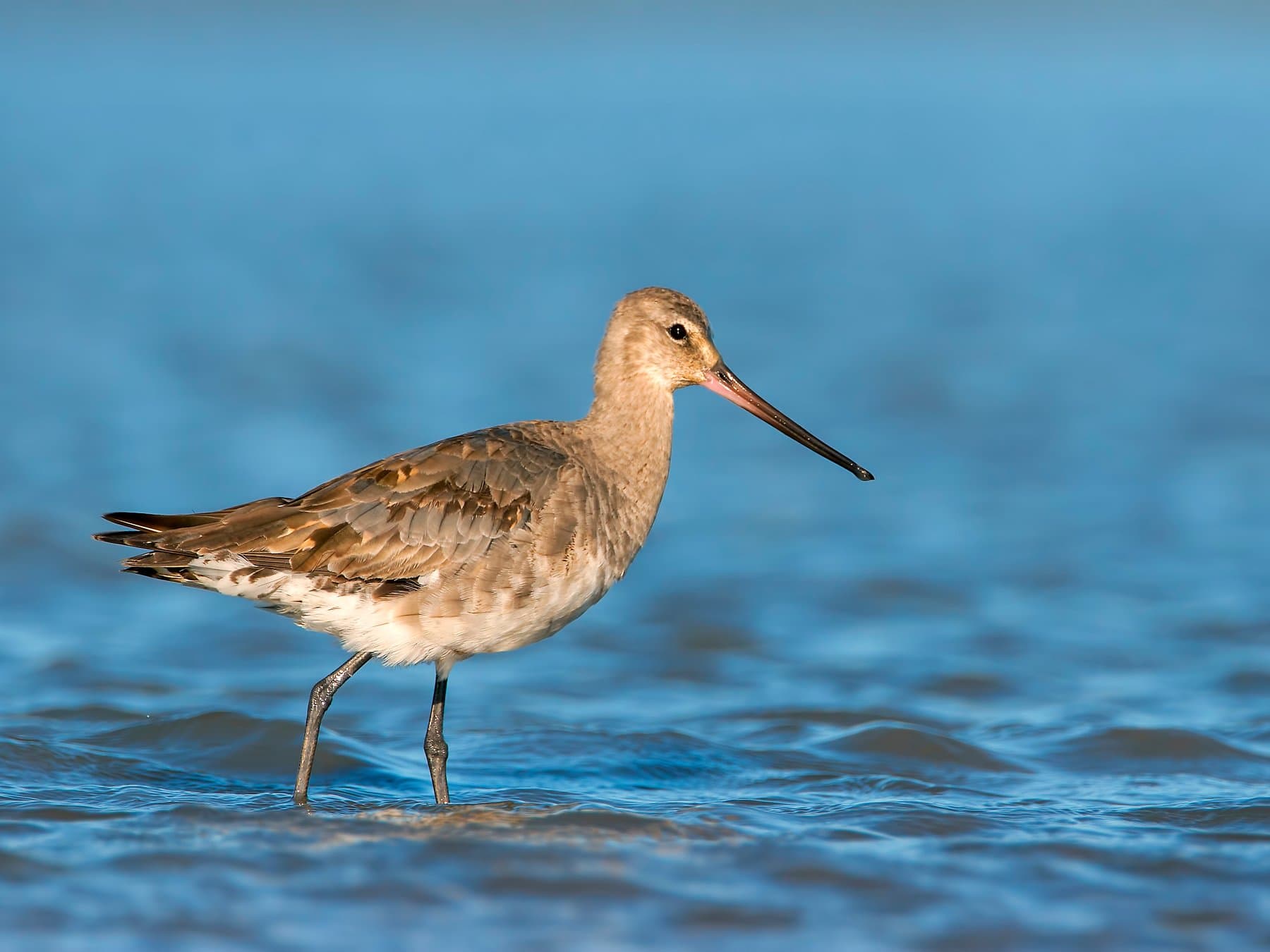
Hudsonian Godwit standing in shallow blue water, facing right. Features long, bicolored bill and brown-patterned plumage.
Quick Facts
Conservation
VUVulnerableLifespan
5–10 years
Length
36–42 cm
Weight
195–358 g
Wingspan
66–76 cm
Migration
Long-distance Migrant
Every autumn, Hudsonian Godwits vanish from North America almost entirely — not because they're rare, but because they fly non-stop from Hudson Bay to South America over the open Atlantic, covering up to 6,300 km in just four to five days. With their vivid brick-red breeding plumage, long upturned bills, and jet-black underwings flashing in flight, these are among the most dramatic long-distance migrants in the Western Hemisphere.
Think you've spotted a Hudsonian Godwit?
Upload a photo and we'll confirm it instantly
Confirm with a PhotoAppearance
The Hudsonian Godwit is the smallest of the world's four godwit species — yet still larger than a Willet and roughly crow-sized. It has long bluish-grey legs, a long neck, and the species' most immediately striking feature: a long bill that tilts gently upward, pink or orange-red at the base and darkening to black at the tip.
A pale whitish supercilium (eyebrow stripe) is visible above the eye in every plumage and every age, making it a useful constant when other features change with the seasons.
In breeding plumage, males are spectacular. The underparts are rich chestnut-red to brick-red, heavily barred with black and white from breast to vent, while the upperparts are a complex mosaic of black, brown, gold, and grey. The tail is black with a broad white band near the base, and the rump is white — both features that blaze in flight.
The most diagnostic field mark at any distance is the blackish underwing: the axillaries and wing linings are sooty black, contrasting sharply with the white rump and a narrow white wing stripe on the upperwing. No other godwit shares this combination.
In non-breeding plumage, adults become plain grey-brown above and whitish below, retaining the pale supercilium. Juveniles resemble non-breeding adults but are browner and more scaly-looking, with pale feather edges creating a scaled effect on the upperparts and a plain buffy-grey belly. Crucially, the black underwing and white rump remain consistent across all plumages and ages — making these the most reliable identification features regardless of season.
Females are noticeably larger and heavier than males, with a longer bill — a reversal of the typical pattern in shorebirds. In breeding plumage, females are paler overall: the underparts show a lighter rufous or chestnut tone with less intense barring, and the upperparts are less richly patterned. In non-breeding plumage, the sexes are essentially identical in colour, though the size difference remains.
Identification & Characteristics
Male Colors
- Primary
- Chestnut
- Secondary
- Black
- Beak
- Orange
- Legs
- Blue-grey
Female Colors
- Primary
- Brown
- Secondary
- Grey
- Beak
- Orange
- Legs
- Blue-grey
Male Markings
Black underwing (axillaries and wing linings), white rump, black tail with broad white basal band, narrow white wing stripe on upperwing. Bicoloured bill: pink-orange at base, dark at tip. Pale whitish supercilium in all plumages. Breeding males: rich chestnut-red underparts heavily barred black and white.
Tail: Black with a broad white band near the base; highly visible in flight.
Female Markings
Larger than male with longer bill. Breeding plumage paler than male: lighter rufous underparts with less intense barring, less richly patterned upperparts. Non-breeding plumage identical to male in colour. Black underwing and white rump present in all plumages.
Tail: Identical to male: black with a broad white band near the base.
Attributes
Understanding Attributes
Rated 0–100 based on research and observation. A score of 50 is average across all bird species. These attributes are relative and don't necessarily indicate superiority.
Habitat & Distribution
The Hudsonian Godwit breeds in scattered, disjunct locations across the sub-Arctic and boreal regions of North America. Three main subpopulations are recognised, each with its own breeding area and wintering destination. The largest breeds in the Hudson Bay Lowlands of Manitoba and Ontario, estimated at around 24,300 individuals; it winters primarily in Tierra del Fuego and southern Patagonia. The Mackenzie Delta population in the Northwest Territories (around 800 individuals) winters mainly around Samborombon Bay in northern Argentina. Alaskan breeders — roughly 15,750 individuals spread across Kotzebue Sound, Nome, the Yukon-Kuskokwim Delta, and Cook Inlet — winter on Chiloé Island and the adjacent Chilean mainland. An estimated 67–80% of the world's population breeds within the North American boreal forest.
On the breeding grounds, the species favours a mosaic of wet tundra and boreal forest near the treeline: peaty muskegs, wet sedge meadows, and open bogs with scattered black spruce and larch. Hummocks, shallow pools, and dwarf shrubs — including arctic birch, arctic willow, and bog rosemary — complete the typical breeding mosaic. During migration, birds use a wide variety of wetland habitats — shallow freshwater lakes, flooded rice fields, sewage lagoons, wet pastures, saltmarshes, and estuaries. Migrants have been recorded at Andean lakes up to 3,700 m (12,140 ft) in Bolivia. On the wintering grounds, the species forages primarily on large shallow tidal mudflats, deltas, and estuaries.
In North America, the best places to see Hudsonian Godwits are on the Great Plains in spring: Cheyenne Bottoms in Kansas and Lake Thompson in South Dakota regularly host flocks of dozens to hundreds of birds between late March and May. In Canada, the southern shores of James Bay in Ontario are the key autumn staging site, with peak numbers in August. In the UK, the species is a very rare vagrant — classified as a 'Mega' rarity by BirdGuides — with fewer than ten accepted records to the end of 2024. Notable occurrences include a bird in Cheshire in August 2024 (Britain's seventh record), one in Fife, Scotland in 2020, and one in Hampshire in 2025. Ireland has at least one accepted record, from Inishmore, Co. Galway in 2015. The species is also a rare vagrant to New Zealand (first recorded 1902, with usually fewer than three birds annually), Australia, and South Africa.
Diet
Insects dominate the diet on the breeding grounds, particularly flies and their larvae, along with beetles, mosquitoes, and grasshoppers. As birds move into coastal habitats during migration and onto the wintering grounds, the menu shifts toward marine invertebrates: polychaete and nereid worms, Baltic clams and other bivalves, small crustaceans including amphipods, and fiddler crabs. Small snails and earthworms are taken throughout the year wherever available.
The Hudsonian Godwit's bill is a precision foraging tool. The tip of the upper mandible is not rigid but flexible — a feature known as distal rhynchokinesis — allowing the bird to open just the tip of its bill while it is buried deep in mud, grasping prey without withdrawing the bill first. This adaptation lets the godwit reach invertebrates far deeper in the substrate than a rigid-billed bird could manage. Birds often wade so deeply that the entire head is submerged during a probe.
During migration, plant material becomes a significant dietary supplement. Tubers of dwarf spikerush and sago pondweed are actively sought and unearthed by grasping and twisting, and berries — crowberries and bilberries — along with seeds of rushes and pondweeds are also consumed. Undigested seeds found in the gizzard may serve as grinding aids for processing harder prey items. This dietary flexibility is important for fuelling the enormous fat reserves birds must accumulate before their long overwater flights.
Behaviour
Outside the breeding season, Hudsonian Godwits are sociable birds, gathering in flocks at staging and wintering sites that can number in the thousands. On the wintering grounds in Tierra del Fuego and Chiloé Island, birds roost communally on sand spits and rocky shorelines, often alongside other large shorebirds. At James Bay staging sites in Ontario, nearly 9,000 individuals have been recorded together — one of the most concentrated gatherings of this species anywhere in the world.
Foraging birds wade deeply, sometimes submerging the head entirely as they probe soft mud with their long bills. The feeding action is methodical: slow walking through shallow water or wet mud, the bill driven repeatedly into the substrate in a sewing-machine motion. Prey is also picked from the water surface and vegetation by sight, and a bird will occasionally run or fly a short distance to pursue something spotted at range. On the breeding grounds, daily commutes take birds between boggy nesting tundra and coastal salt marshes or tidal mudflats where feeding is more productive.
On the breeding grounds, males are conspicuously territorial and vocal, performing elaborate aerial displays to defend their patch and attract mates. Away from the breeding season, the species is generally quiet and unobtrusive, though birds in flight will call to one another. Hudsonian Godwits are alert and wary, typically flushing well before an observer gets close — a wariness that likely reflects centuries of hunting pressure, as the species was heavily targeted by market hunters in the 19th century.
Calls & Sounds
The Hudsonian Godwit's most characteristic call is a loud, rising two-syllable note rendered as kerreck or god-wit — and it is this call, first recorded in writing around 1416–17, that gave the species its English name. The call is similar to that of the Marbled Godwit but noticeably higher-pitched. Other calls include a soft chow-chow, a sharp nasal kip or ket, and a rising toe-wit (also written tow-it), which has been recorded from pairs on the breeding grounds.
Away from the breeding season, the species is generally quiet — most birds encountered on migration or at wintering sites call only infrequently, typically in flight when flushed or when joining or leaving a flock. This quietness, combined with the species' tendency to make long overwater flights that bypass most of North America, contributed to it being considered extremely rare until the mid-20th century.
On the breeding grounds, males are considerably more vocal. During aerial display flights, males produce sustained singing that continues through both the active wing-beating phase and the gliding descent. Both sexes may call together during joint display flights. The contrast between the species' near-silence on migration and its vocal intensity on the breeding grounds is striking — a bird that seems almost invisible for most of the year transforms into a conspicuous, singing presence on the tundra.
Flight
In flight, the Hudsonian Godwit is unmistakable if the underwing is visible. The sooty-black axillaries and wing linings — unique among the four godwit species — contrast sharply with the white rump and narrow white wing stripe above (see Appearance for full field mark detail). Birds fly with strong, direct wingbeats and a long-necked, long-billed silhouette that gives them a distinctive cross-shaped profile.
On migration, Hudsonian Godwits are capable of extraordinary sustained flight. In autumn, birds staging on the southern shores of James Bay, Ontario, depart on a nonstop overwater crossing of at least 4,500 km (2,800 miles) to northern South America — a single unbroken flight lasting four to five days. The maximum recorded distance for a single nonstop flight, tracked by satellite, is 6,300 km (3,900 miles). To achieve these crossings, birds accumulate massive fat reserves before departure, effectively doubling their body weight. During long overwater flights, birds travel at altitude, taking advantage of favourable tailwinds associated with passing weather systems.
At lower altitudes during migration stopovers, the flight style is strong and purposeful, with birds often arriving and departing in tight flocks. When flushed from a wetland, they typically circle once or twice before either resettling or departing in a direct line. The combination of large size, long bill, white rump, and black underwing makes any godwit in flight worth a second look — and the Hudsonian's underwing pattern closes the identification immediately.
Nesting & Breeding
Birds arrive on the breeding grounds between late April and early June, sometimes touching down while snow still covers the tundra. The species is presumed to be socially monogamous, with pair bonds sometimes persisting between seasons. Sexual maturity is reached at approximately three years of age — late by shorebird standards — and the generation time is estimated at 7.7 years.
The male makes several scrapes in drier portions of the territory; the female selects which one becomes the nest. Nests are shallow depressions set on a dry hummock within a sedge marsh, typically tucked under dwarf birch or other low shrubs. The cup is sparsely lined with twigs, dead leaves, sedges, bog rosemary, spruce needles, grasses, mosses, and lichens — averaging about 14 cm across and 4.3 cm deep. The clutch typically consists of four eggs (occasionally two or three), described as olive-grey, pearl grey, buffy olive, or greenish, with dark speckling or brown blotches. Both parents share incubation duties for approximately 22–25 days.
Chicks are precocial — active and covered in down at hatching — and leave the nest within hours. Newly hatched chicks are capable of swimming across pools and slow-flowing streams, a useful ability in the waterlogged tundra habitats where they hatch. Both parents tend and guard the chicks, which find their own food from the start. Young are able to fly at approximately 30 days. If the first nest is lost to predation, females may lay a replacement clutch. Adults typically depart the breeding grounds before juveniles, with males leaving as early as late June — one of the earliest departures of any long-distance migrant.
Lifespan
The oldest recorded Hudsonian Godwit lived to at least 6 years and 1 month, based on banding data. Typical lifespan in the wild is estimated at 5–10 years, based on banding recoveries and comparisons with similarly sized shorebirds. The species' late sexual maturity — birds do not breed until around three years of age — and long generation time of approximately 7.7 years mean that individuals must survive for several years before contributing to reproduction.
The main natural mortality factors include predation on the breeding grounds (eggs and chicks are taken by Arctic foxes, ravens, and jaegers), starvation during migration if key stopover sites are degraded or unavailable, and the inherent risks of long overwater flights. Historically, market hunting in the 19th century drove the species to very low numbers; the population has never fully recovered. The combination of low reproductive rate, high dependence on a small number of staging and wintering sites, and ongoing habitat loss makes the species particularly sensitive to additional mortality from any source.
Conservation
The Hudsonian Godwit is listed as Vulnerable on the IUCN Red List (2024) and as Threatened by COSEWIC in Canada (2019). In the United States, it was designated a Red Alert Tipping Point species in the 2025 State of the Birds report — a category reserved for species that have lost more than 50% of their population in the past 50 years and face ongoing steep declines. The global population is estimated at 41,000–77,000 individuals depending on the source and methodology, with BirdLife International's 2024 estimate placing it at 41,000–70,000 mature individuals.
The trend is sharply downward. Migration monitoring data from James Bay staging sites between 1995 and 2016 indicate a 6% annual decline — a cumulative loss of approximately 71% over roughly three generations. Wintering site counts at Tierra del Fuego show an estimated 4% annual decline from 2002 to 2018, equating to a 62% reduction over three generations, though numbers at Chiloé Island have been relatively stable.
The threats are multiple and interconnected. Climate change degrades Arctic and boreal breeding habitats through rising temperatures, increased fire risk, and invasive species, while also altering prey availability across the annual cycle. Unsustainable logging, mining, oil and gas extraction, hydroelectric development, and overgrazing by abundant geese — particularly in the Hudson Bay Lowlands — all degrade nesting habitat. The conversion of Great Plains wetlands removes critical spring refuelling habitat.
Wintering sites face their own pressures: human disturbance and aquaculture development (especially in Chile) threaten key sites in Tierra del Fuego and Patagonia. The species' entire global population passes through only a handful of staging and wintering sites, making it acutely vulnerable to localised habitat loss or disturbance at any one of these bottlenecks. Historically, market hunting in the 19th century decimated the species. It is now protected in the USA but may still be hunted in parts of Central and South America.
Population
Estimated: 41,000–77,000 individuals
Trend: Decreasing
Sharply decreasing. Migration monitoring at James Bay staging sites recorded a 6% annual decline from 1995–2016, equating to a cumulative loss of approximately 71% over three generations. The species has lost more than 50% of its global population in the past 50 years.
Elevation
Sea level to 3,700 m (recorded at Andean lakes in Bolivia during migration)
Additional Details
- Predators:
- On the breeding grounds, eggs and chicks are vulnerable to Arctic foxes, ravens, and jaegers (skuas). Adults may be taken by Peregrine Falcons and other raptors during migration. Historically, market hunting in the 19th century was the primary cause of population decline.
Similar Species
The Black-tailed Godwit is the Hudsonian's closest lookalike in structure, but the two are cleanly separated in flight by underwing colour alone: the Black-tailed shows a white underwing and broad white wing bar, while the Hudsonian's axillaries and wing linings are sooty black. At rest, the Black-tailed's bill is straighter and the legs are longer. The Bar-tailed Godwit is stockier, shorter-legged, and has a more strongly upturned bill; in flight it shows a barred tail, streaked rump (not clean white), and pale underwing. The Marbled Godwit of North America is larger, warm buffy-brown overall, and shows cinnamon wing linings in flight — the opposite of the Hudsonian's black underwing.
In the field, the Hudsonian Godwit's black underwing is the single most reliable separator from all congeners. At rest, the combination of slightly upturned bicoloured bill, pale supercilium, and (in breeding plumage) heavily barred chestnut underparts is distinctive. Non-breeding birds are plainer and can be confused with Black-tailed Godwit, but the bill shape — more strongly upturned in the Hudsonian — and the smaller overall size are useful supporting features. In North America, the Willet is sometimes confused with godwits at a distance, but is shorter-billed, shorter-necked, and shows a bold black-and-white wing pattern rather than the godwit's narrow white stripe.
Courtship & Display
Courtship begins as soon as birds arrive on the breeding grounds, even when snow still covers the tundra. The male's aerial display is one of the most elaborate of any North American shorebird. He spirals erratically upward on rapidly beating wings, then switches to an exaggerated 'butterfly' display: wings beating slowly above body level, the bird rocking side to side while singing continuously. The display culminates in a dramatic plummet toward the ground, pulling out about 9 metres (30 feet) above the surface, then gliding to perch atop a stunted spruce or hummock where he fans his tail and raises one wing to show the black-and-white pattern.
Males also dive toward females on the ground, opening the wings at the last moment to produce a winnowing sound. Once paired, both sexes may perform joint display flights together on trembling, downward-arched wings — a behaviour that appears to reinforce the pair bond. The male prepares several scrapes in drier parts of the territory, and the female makes the final selection of which scrape will become the nest. Pair bonds can persist through re-nestings within a season and sometimes carry over from one year to the next, though the species is presumed to be socially monogamous rather than strictly mate-faithful across all years.
Birdwatching Tips
Spring is the most reliable season to find Hudsonian Godwits in North America. From late March through May, flocks gather at key Great Plains wetlands — Cheyenne Bottoms Wildlife Area in Kansas and Lake Thompson in South Dakota are the standout sites. Arrive early in the morning when birds are most active at the water's edge.
In flight, the blackish underwing is the single most reliable field mark and separates the Hudsonian Godwit from all other godwits at a glance. The Bar-tailed Godwit has a barred tail and pale underwing; the Black-tailed Godwit has a broad white wing bar and white underwing. At rest, focus on the slightly upturned bicoloured bill (pink-orange base, dark tip) and pale supercilium.
In the UK, any godwit-sized shorebird in autumn — particularly on the Atlantic coast or at large estuaries — is worth checking carefully. Hudsonian Godwits have occurred in both spring and autumn, often associating with flocks of Black-tailed Godwits. Given fewer than ten UK records to date, finding one would be a genuine rarity. In New Zealand, the species turns up occasionally at coastal mudflats, most often in autumn (March–May), and is best separated from the common Bar-tailed Godwit by the black underwing and white rump in flight.
Did You Know?
- The Hudsonian Godwit was considered one of North America's rarest birds until the 1940s — not because it was truly scarce, but because it makes such long nonstop overwater flights in autumn that it bypasses most of the continent entirely. Large staging flocks were only discovered in northern Canada after World War II, eventually leading researchers to its wintering grounds in South America.
- Satellite-tracked individuals have made nonstop flights of up to 6,300 km (3,900 miles) in just four to five days — flying directly from Hudson Bay to South America over the open Atlantic. To fuel this feat, birds accumulate fat reserves so large they can effectively double their body weight before departure.
- The bill tip is not rigid: a feature called distal rhynchokinesis allows the godwit to flex just the tip of its upper mandible upward while the bill is buried in mud, opening it to grasp prey deep underground without withdrawing the bill first.
- Newly hatched chicks can swim across pools and slow-flowing streams within hours of hatching — a practical adaptation for a species that nests in waterlogged boggy tundra where water obstacles are unavoidable.
- The scientific name Limosa haemastica combines the Latin for 'muddy' (limosa, from limus, mud) with the Ancient Greek for 'bloody' (haimatikos) — a nod to both the bird's mudflat habitat and the male's vivid blood-red breeding plumage.
Records & Accolades
Marathon Migrant
Up to 6,300 km non-stop
Satellite-tracked individuals have flown non-stop from Hudson Bay to South America — up to 6,300 km in just four to five days over the open Atlantic Ocean.
Annual Distance
~32,000 km per year
The complete annual migration cycle covers nearly 32,000 km (20,000 miles), making this one of the longest migration circuits of any Western Hemisphere shorebird.
Community Photos
Be the first to share a photo of the Hudsonian Godwit
Upload a PhotoIdentify Any Bird Instantly
- Upload a photo from your phone or camera
- Get an instant AI identification
- Ask follow-up questions about the bird
Monthly Birds in Your Area
- Personalised for your location
- Seasonal tips and garden advice
- Updated every month with new species