


Northern Lapwing
Peewit, Green Plover · Vanellus vanellus
By the Birdfact teamChecked by Nathan Cope
On this page14 sections
How to recognise it
Lapwings are unmistakable waders. Read on to learn more about their size and identifying features.
What do Lapwings look like?
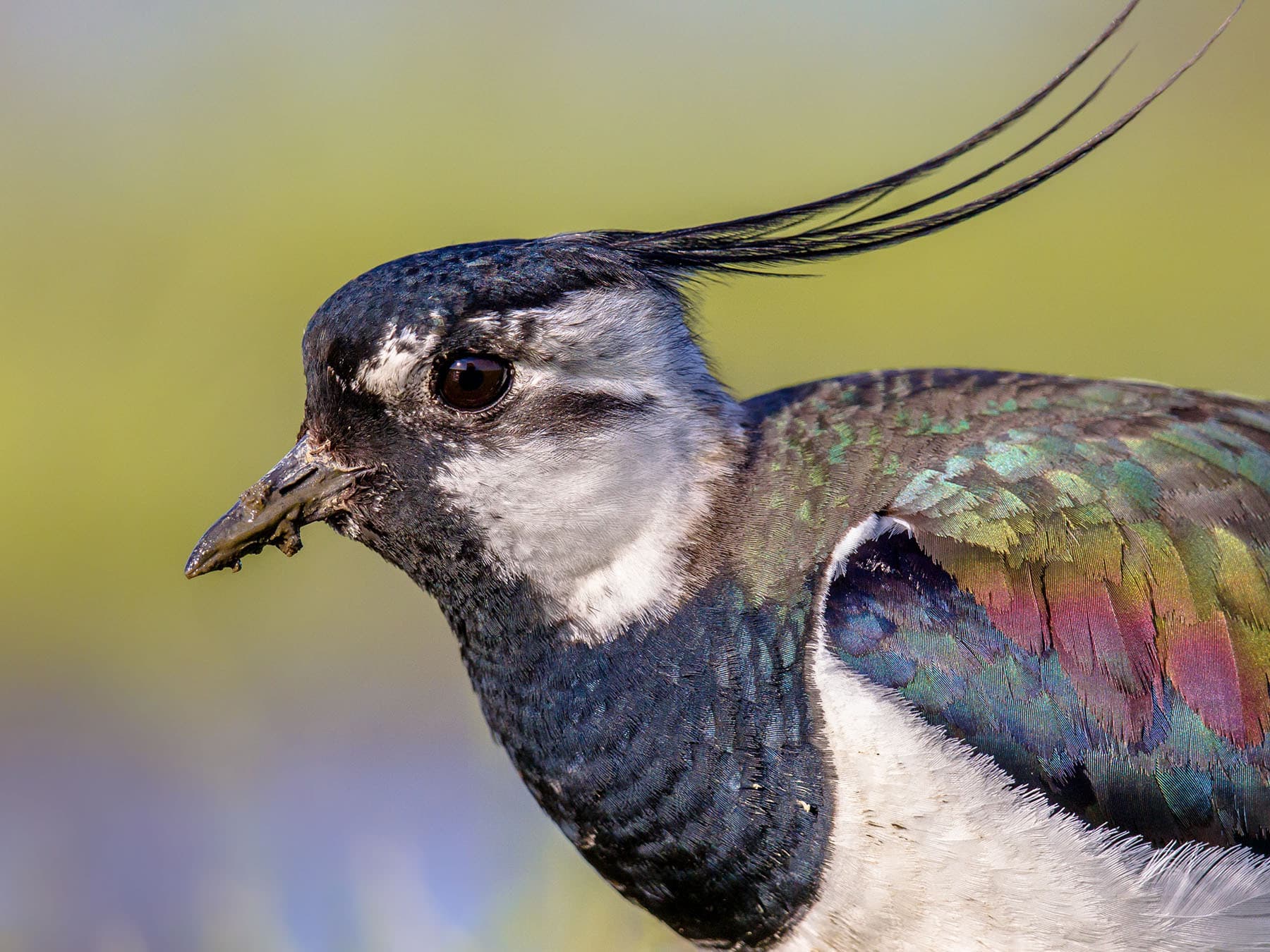
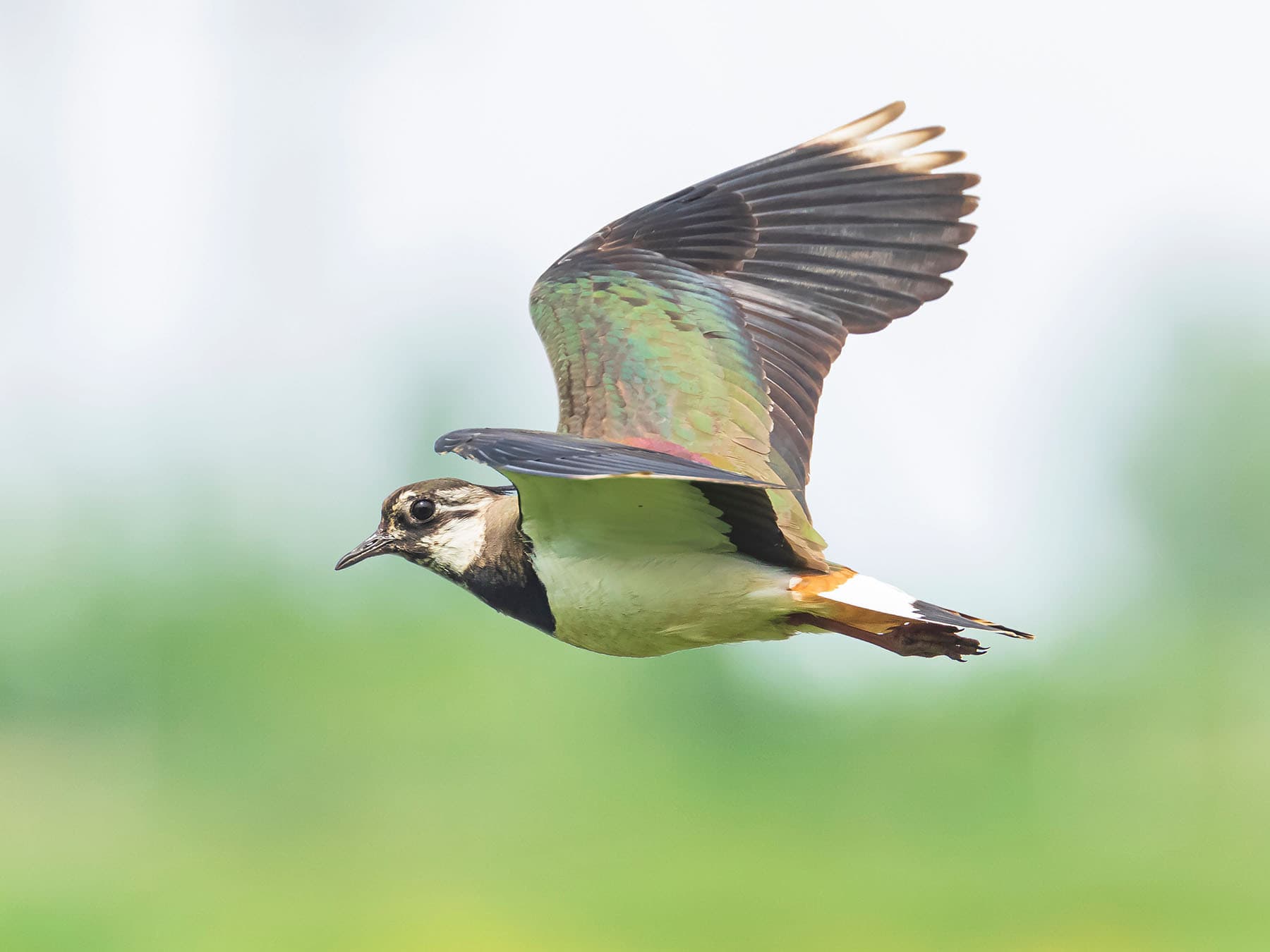
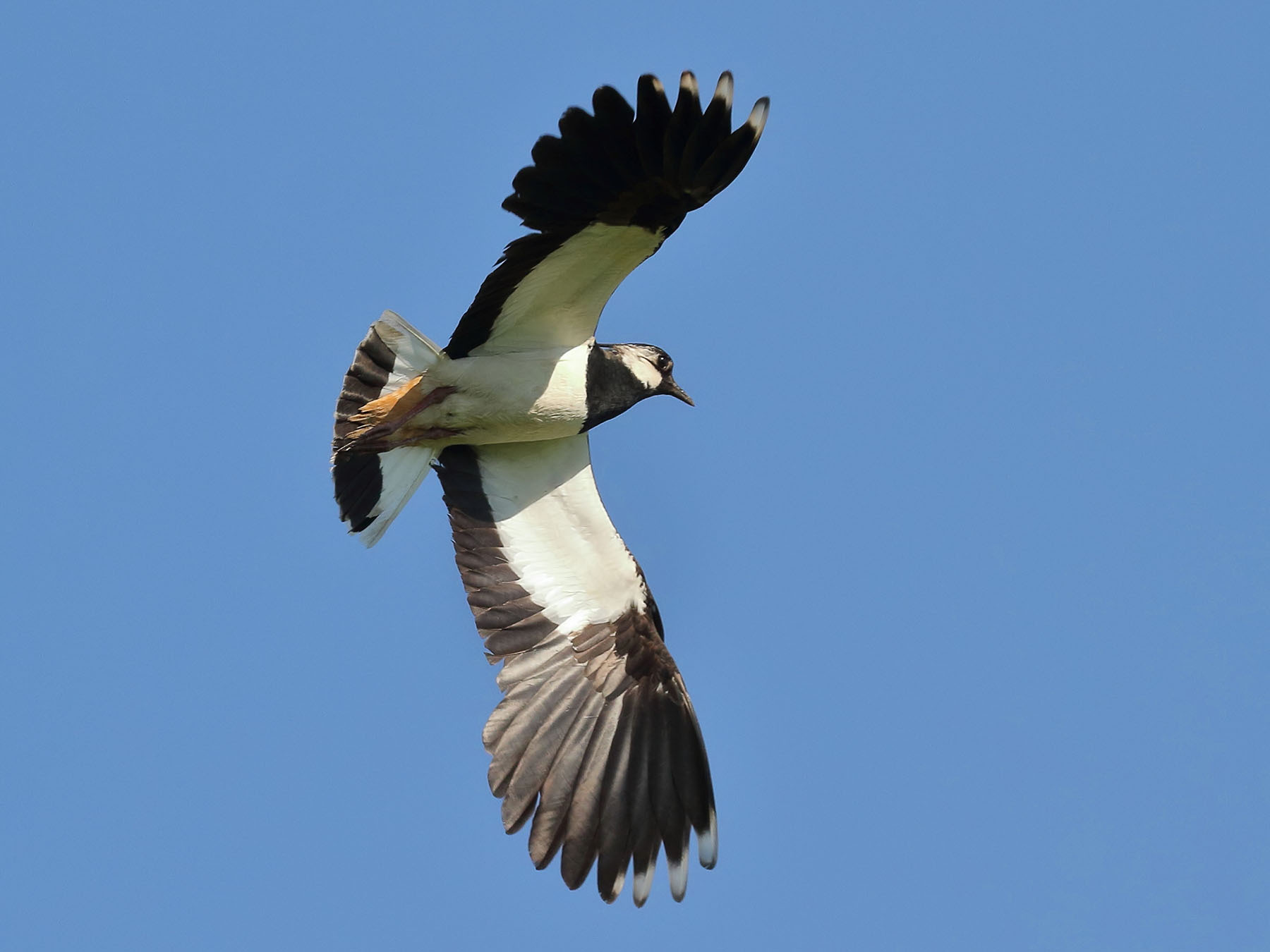
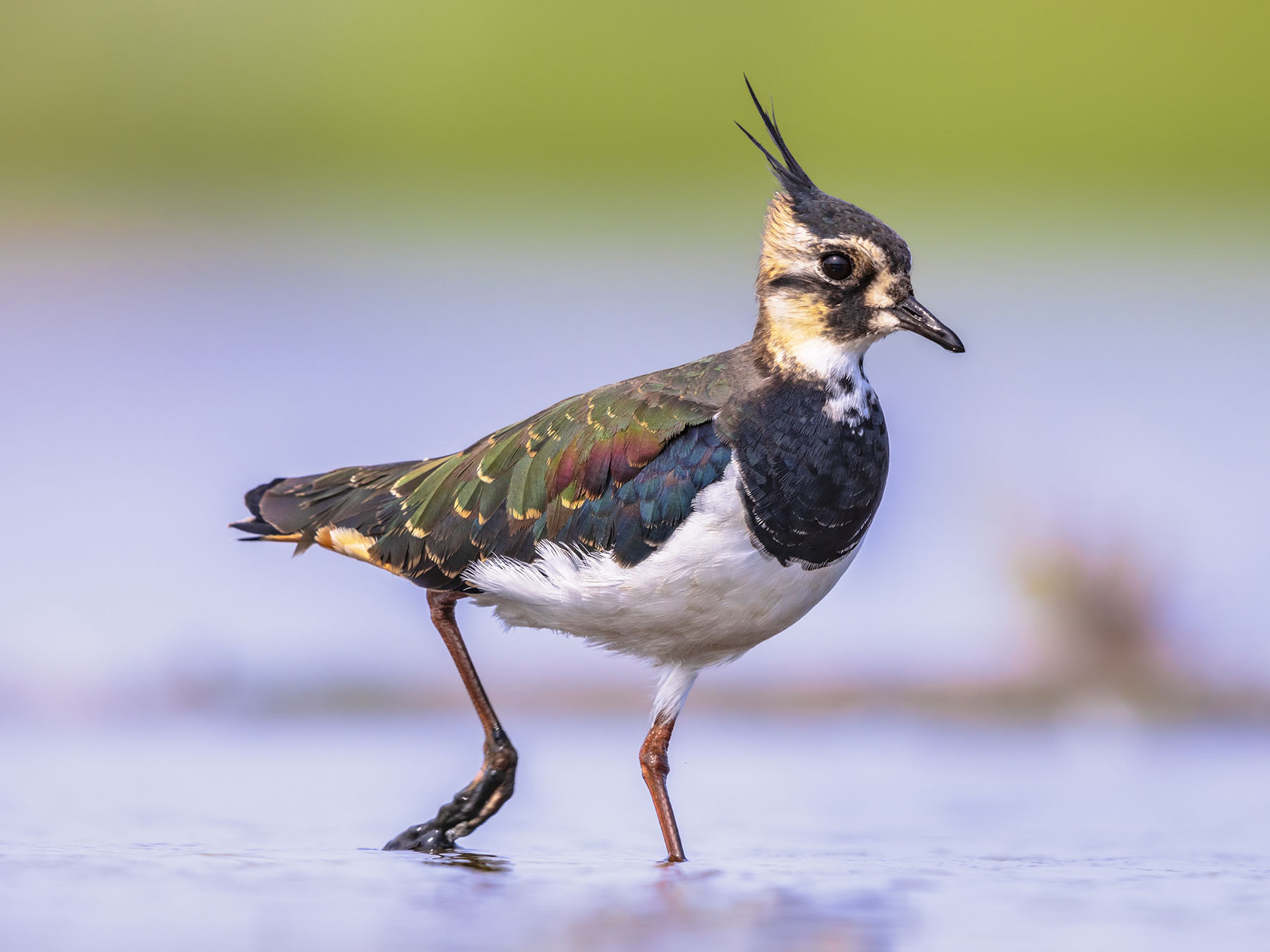
Lapwings are distinctive, long-legged birds with long crests and dark chest bars. Seen from below, Lapwings have bright white underparts that contrast with black flight feathers. They are greenish above and have white rumps visible only in flight.
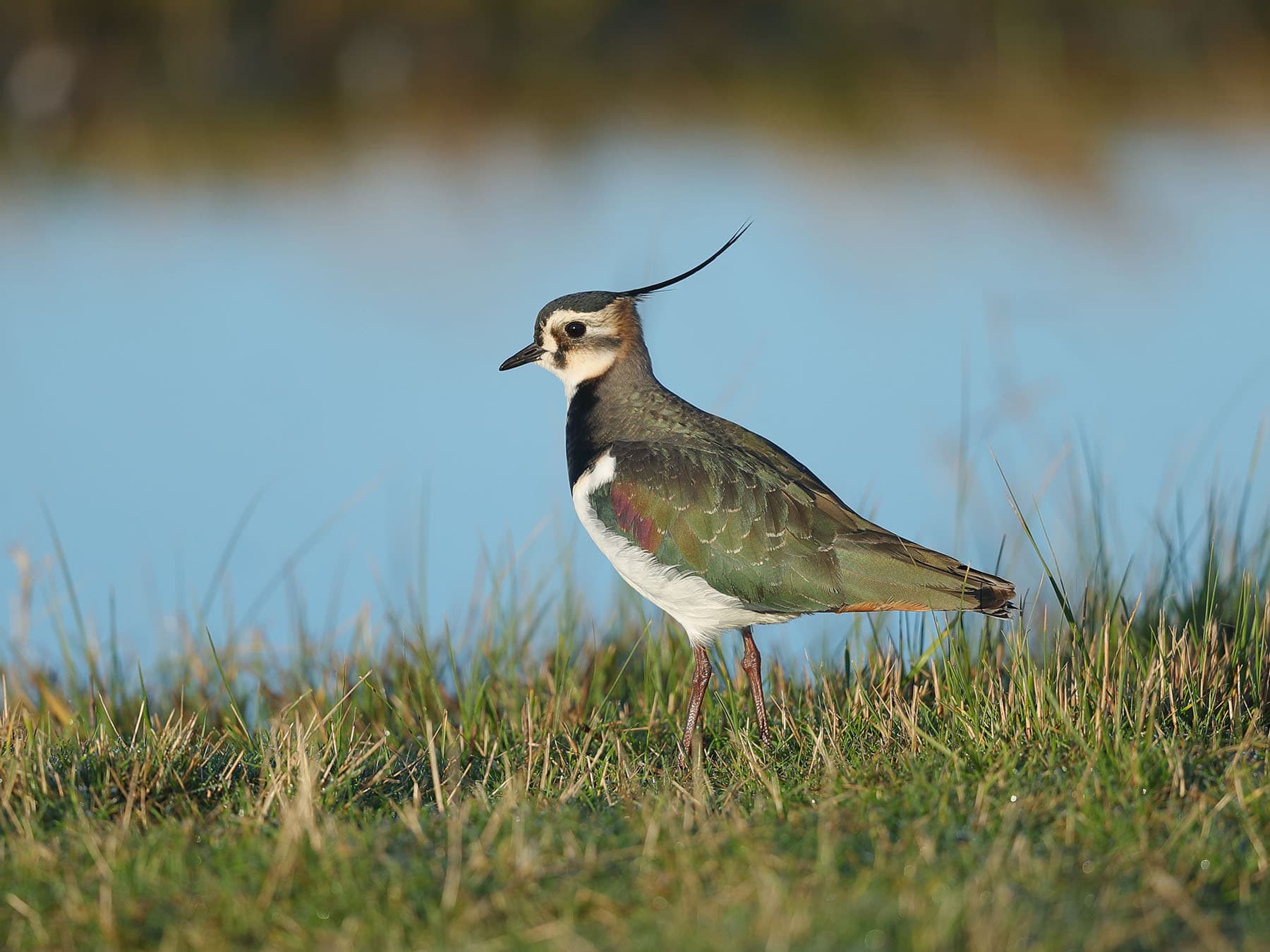
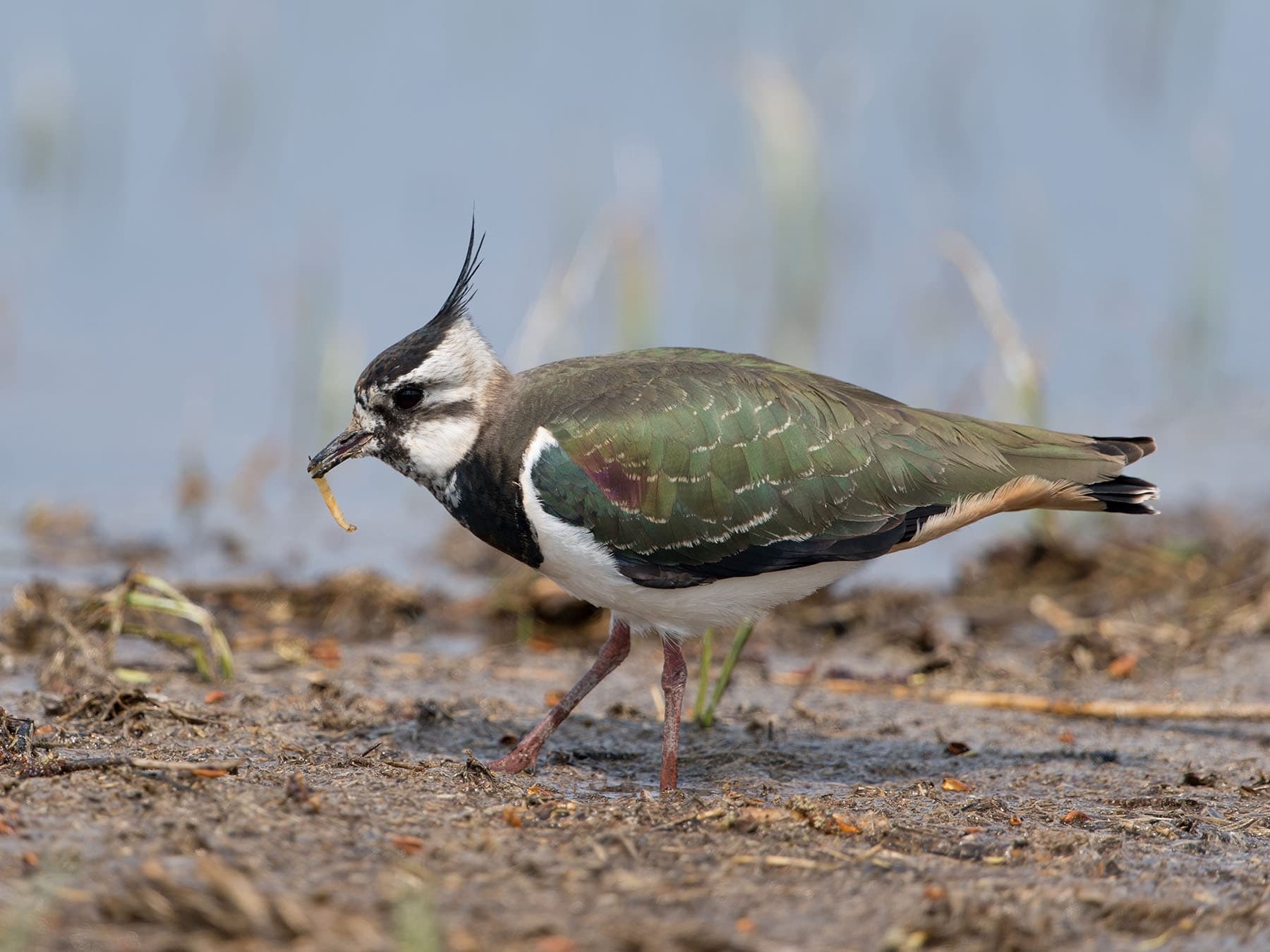
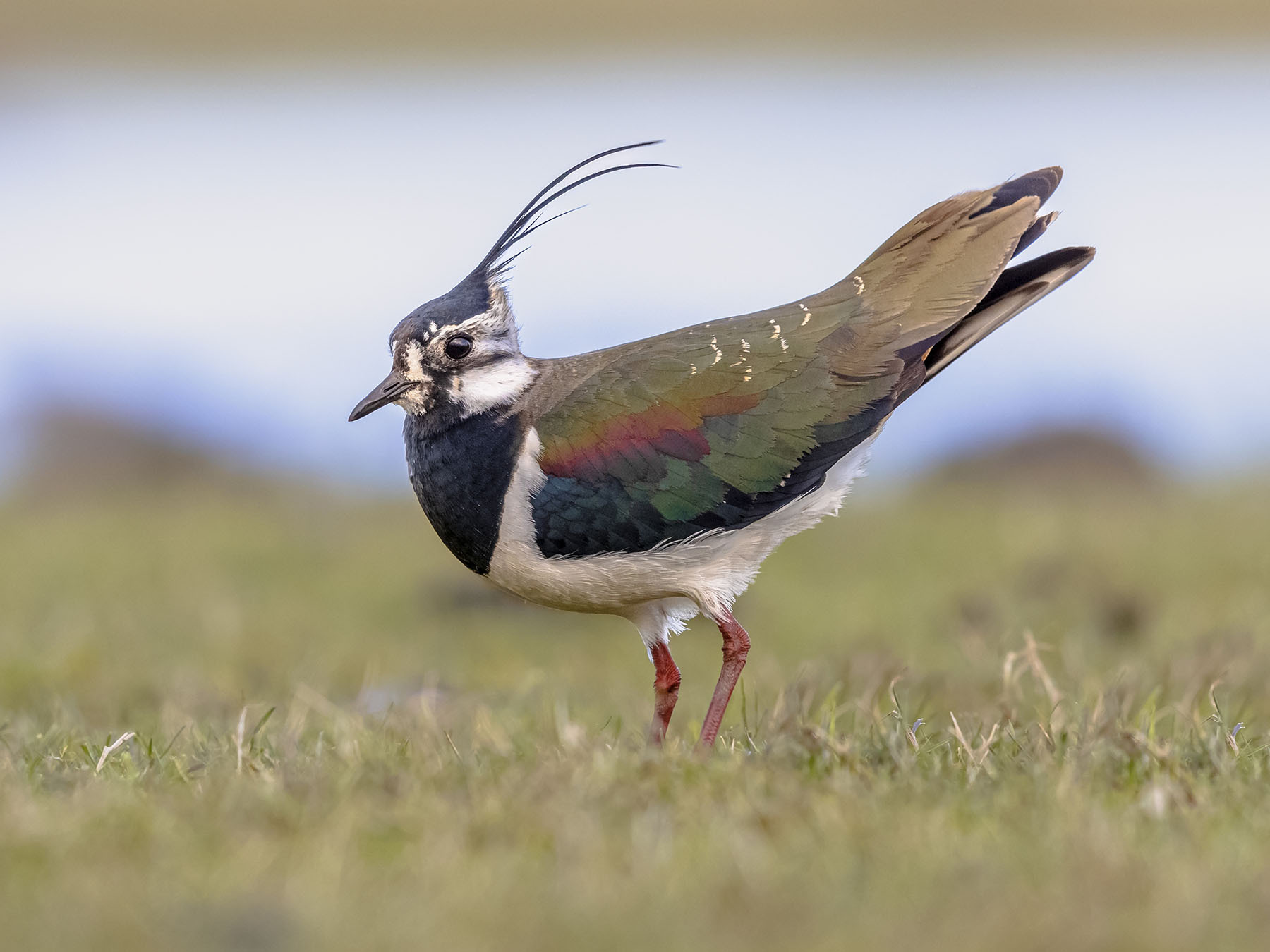
Standing birds show beautiful glossy green, bronzey plumage on their upper parts, which is most visible in good light. Their underparts are white, but a bold black bar extends around the chest and shoulders. The long, wispy black crest may be held flat in flight. Their short, straight bill is black, and their legs are pinkish.
Female Lapwings are very similar to males but have shorter crests. In the breeding season, females also differ by having more white on the face and throat.
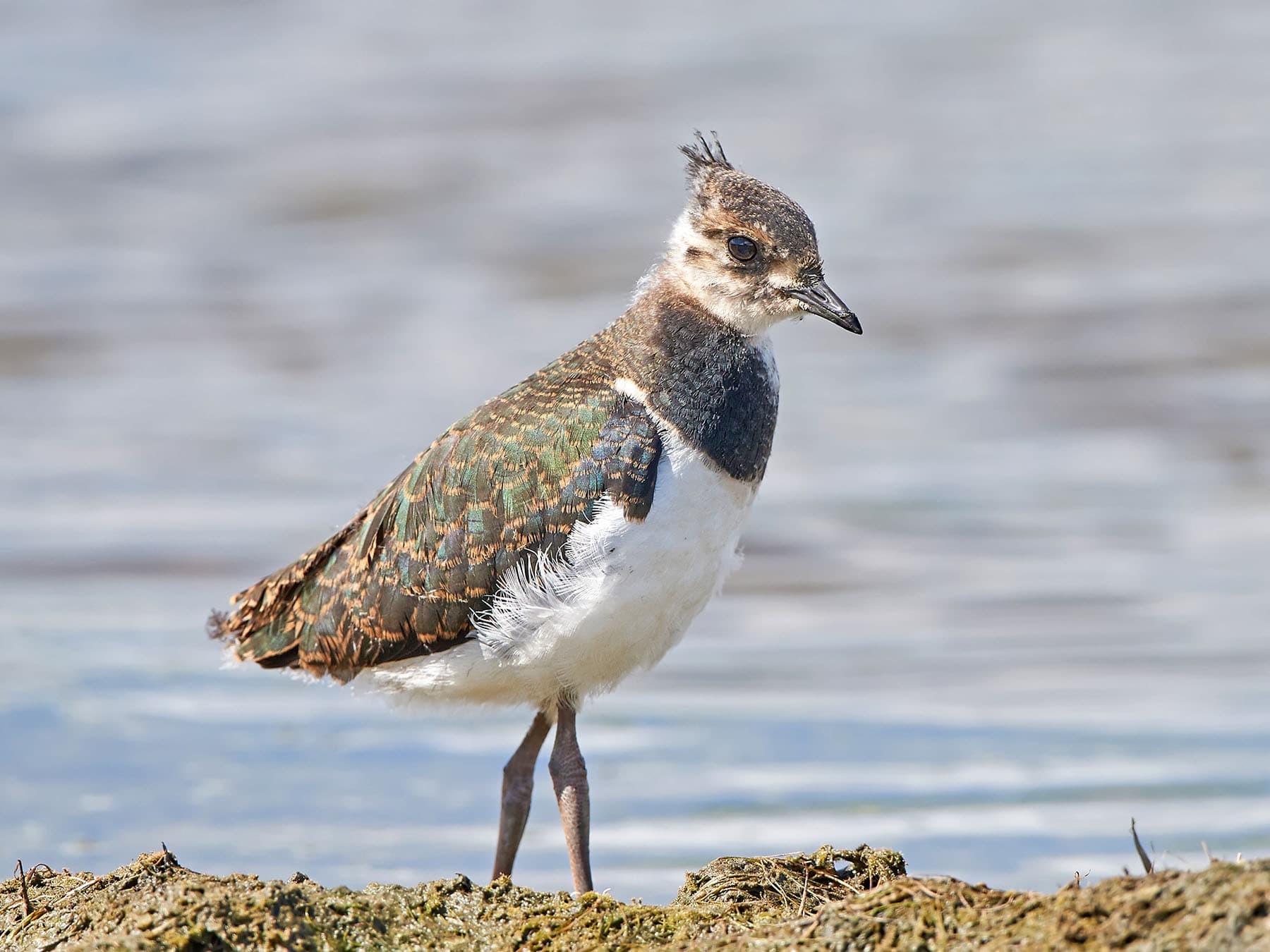
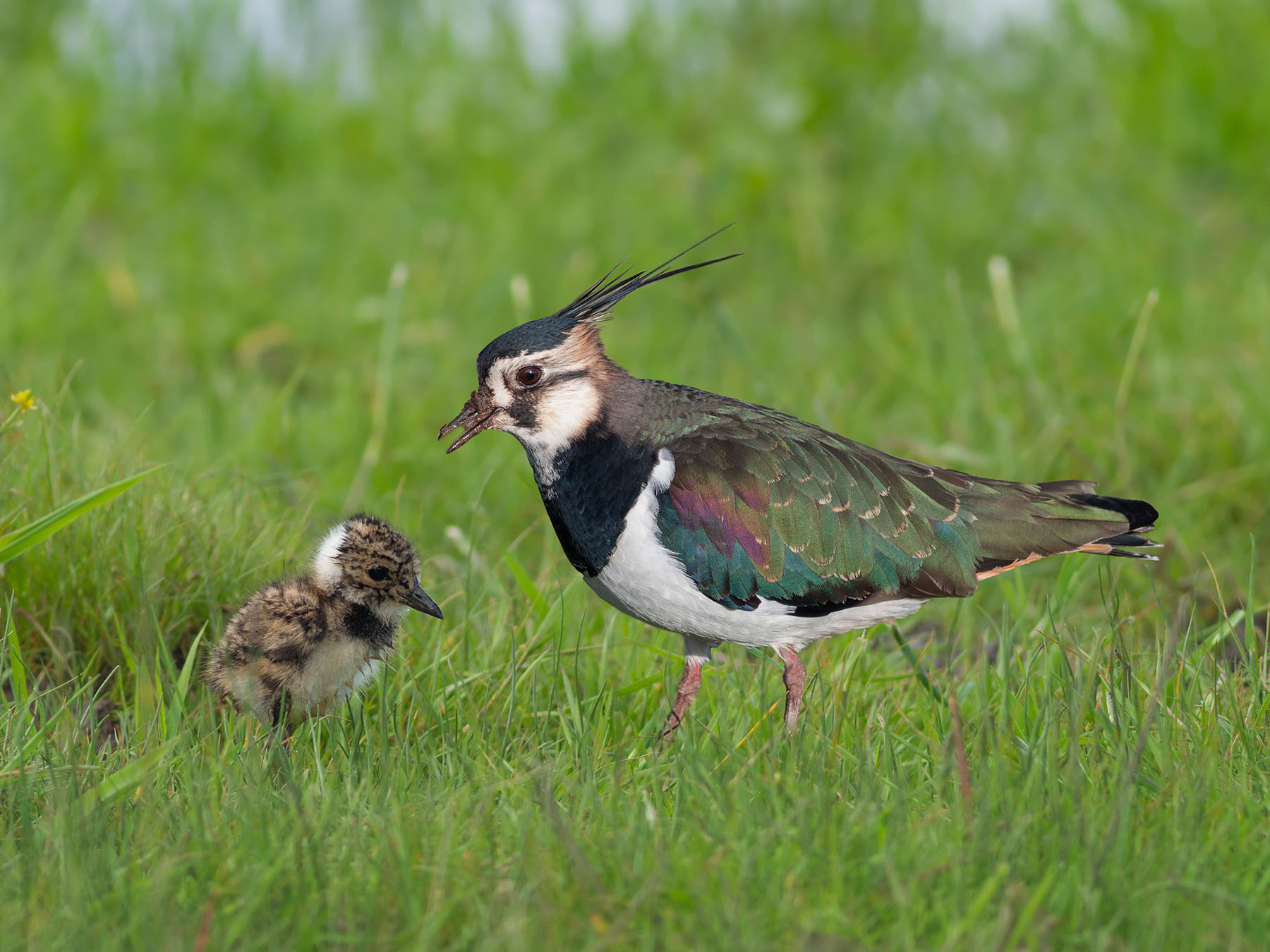
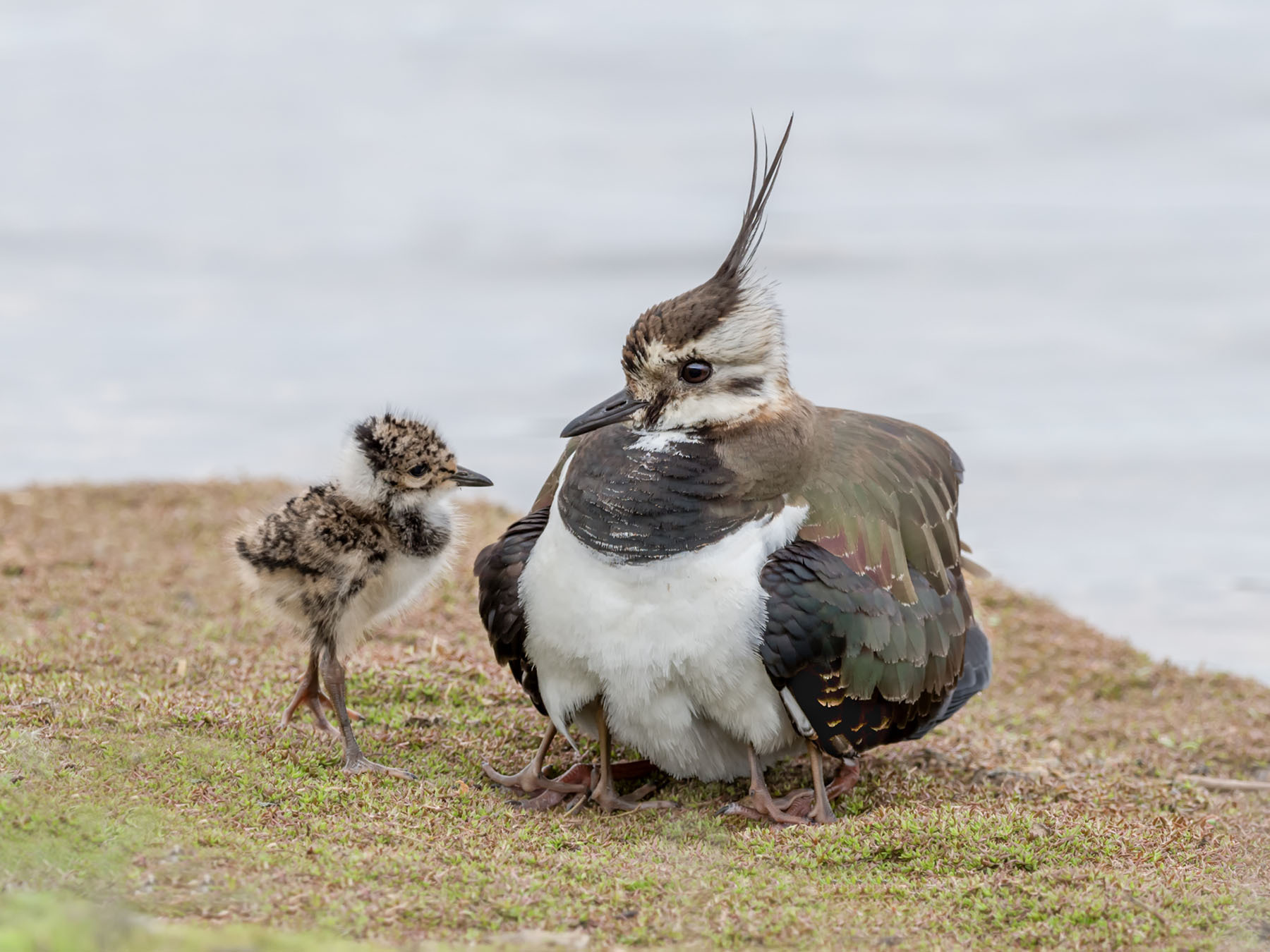
Lapwing chicks can be seen out and about near their parents from the day they hatch. The tiny youngsters are all legs and have mottled brown backs and crowns, with dark chests from an early age. As they mature, juveniles look increasingly like non-breeding adults but have paler breastbands and short crests.
How big are Lapwings?
Lapwings are pigeon-sized waders with stocky bodies and stout legs.
Length
Lapwings measure 28 to 31 centimetres in length. They stand about as tall as they are long.
Weight
Lapwings weigh 128 to 330 grams.
Wingspan
They have a long, broad wingspan of 82 to 87 centimetres.
Its size
Adults- Length
- 28–31 cm
- Wingspan
- 67–72 cm
- Weight
- 128–330 g
Its song and calls
Alternatively known as the Peewit, Lapwings have a distinctive call.
What sound does a Lapwing make?
Lapwings are vocal birds, particularly in the breeding season when males make impressive display flights while producing a strange, almost robotic call. These birds produce their characteristic ‘pee-wit’ calls when alarmed or to maintain contact.
- Song0:00 / 0:23
Recorded in Normandie, France · April 2024
- Call0:00 / 0:43
Recorded in Kalmar County, Sweden · May 2024
When and where to see it
OctoberHere all year
Most recorded in October
- 1. Stockton-on-Tees2.4%
- 2. Louth2.1%
- 3. Offaly1.7%
- 4. Rutland1.5%
- 5. South Lanarkshire1.5%
Each dot is a county, state or province: the bigger and darker, the larger the bird’s share of that place’s bird records that month. Grey dots: no regular records. The ringed point is the centre of the bird’s records this month; the arrow shows how it moved since last month, and the dashed loop its path through the year. “Arrivals” colours places where it becomes regular this month (orange) or is in its last regular month (grey). GBIF eBird Observation Dataset, 2019–2024. Map data: Natural Earth, US Census Bureau; place centres © OpenStreetMap contributors.
In your area
See when the Northern Lapwing is recorded in your county, state or province.
How often the Northern Lapwing turns up in the UK, Ireland, the United States and Canada through the year, from birdwatchers' records.
United Kingdom
Resident · all year · most records in January
Ireland
Resident · all year · most records in November
United States
Passage migrant · regularly Dec–Feb · most records in December
Canada
Passage migrant · regularly Nov · most records in November
Show as a table
| Month | United Kingdom | Ireland | United States | Canada |
|---|---|---|---|---|
| January | 0.98% (regular) | 0.91% (regular) | 0.001% | – |
| February | 0.90% (regular) | 0.62% (regular) | <0.001% (regular) | – |
| March | 0.76% (regular) | 0.33% (regular) | <0.001% | <0.001% |
| April | 0.78% (regular) | 0.32% (regular) | <0.001% | <0.001% |
| May | 0.85% (regular) | 0.31% (regular) | – | <0.001% |
| June | 0.84% (regular) | 0.37% (regular) | – | – |
| July | 0.91% (regular) | 0.50% (regular) | – | – |
| August | 0.91% (regular) | 0.52% (regular) | – | – |
| September | 0.84% (regular) | 0.60% (regular) | – | – |
| October | 0.83% (regular) | 0.80% (regular) | – | <0.001% |
| November | 0.89% (regular) | 1.0% (regular) | <0.001% | 0.001% (regular) |
| December | 0.93% (regular) | 0.89% (regular) | 0.003% (regular) | <0.001% |
Recorded regularly in
Worldwide: recorded regularly in 83 countries
Countries where it was recorded in at least 3 of the 6 years 2019–2024. Linked countries have their own bird list.
Europe (44)
- Åland Islands
- Albania
- Austria
- Belarus
- Belgium
- Bosnia & Herzegovina
- Bulgaria
- Croatia
- Czechia
- Denmark
- Estonia
- Faroe Islands
- Finland
- France
- Germany
- Greece
- Guernsey
- Hungary
- Iceland
- Ireland
- Isle of Man
- Italy
- Jersey
- Kosovo
- Latvia
- Lithuania
- Luxembourg
- Moldova
- Montenegro
- Netherlands
- North Macedonia
- Norway
- Poland
- Portugal
- Romania
- Russia
- Serbia
- Slovakia
- Slovenia
- Spain
- Sweden
- Switzerland
- Ukraine
- United Kingdom
Asia (33)
North America (2)
Data: EOD – eBird Observation Dataset (Cornell Lab of Ornithology), accessed via GBIF.org, CC BY 4.0. Records from 2019–2024, aggregated and filtered by Birdfact. How these lists are made
Lapwings have rather specific habitat requirements but occur across a wide geographical area. Continue reading to learn where you might spot these showy shorebirds.
What is the habitat of a Lapwing?
Lapwings are birds of open habitats with low grass cover. They prefer unimproved pastures and open wetlands but will use altered landscapes like cereal croplands and recently ploughed and fallow fields.
What is the range of a Lapwing?
Lapwings are widespread in the United Kingdom and the Republic of Ireland. They are absent only from parts of Wales, Northwestern England, and Western Scotland.
Elsewhere, Lapwings have an extensive global distribution in the summer that stretches across Asia to Siberia and China. Overwintering birds fly south to the North Coast of Africa, the Middle East, parts of the Indian Subcontinent, and Southeast Asia.
Where do Lapwings live?
Lapwings are generally terrestrial, although they may forage in shallow water. These birds do not perch in trees or anywhere above the ground.
How rare are Lapwings?
Lapwings are not rare, although their population has declined steadily since the 1970s, largely due to altered farming practices.
Where can you see Lapwings in the UK?
Lapwings can be seen virtually throughout the UK. Look for them in short pasture and recently ploughed lands, or in open wetlands with low vegetation.
Migration
Lapwings are highly migratory in parts of their global range, although this is not exactly true of the UK population.
Do Lapwings migrate?
Lapwings are partial migrants in the United Kingdom. Many remain near their breeding grounds throughout the year, while others migrate locally or cross the English Channel to Southern Europe.
Some Lapwings visit parts of Southwestern England and Wales in the winter only, and some birds visit Northeastern Scotland each year in the nesting season. Tens of thousands of birds may arrive from Continental Europe to escape harsh winters.
Tips for seeing it
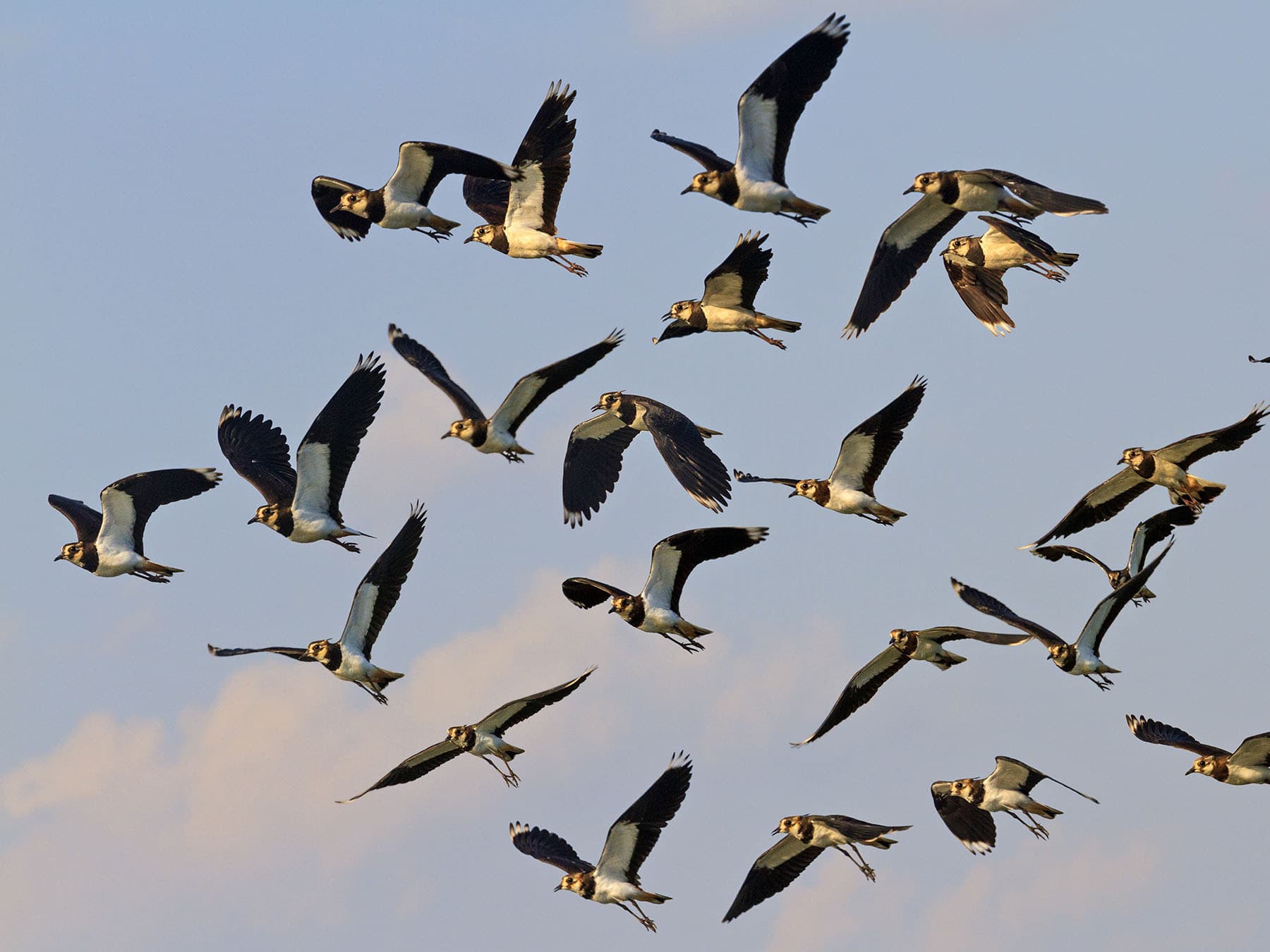
- Look for Northern Lapwings in open fields, pastures, and wetlands
- Listen for their distinctive 'peewit' call, which gives them one of their common names
- Observe their unique flight pattern with broad, rounded wings
- In the UK, watch for large flocks in coastal areas during winter
What it eats
Lapwings are insectivorous birds that search for live prey on the ground. Read on to learn more about their diet.
What do Lapwings eat?
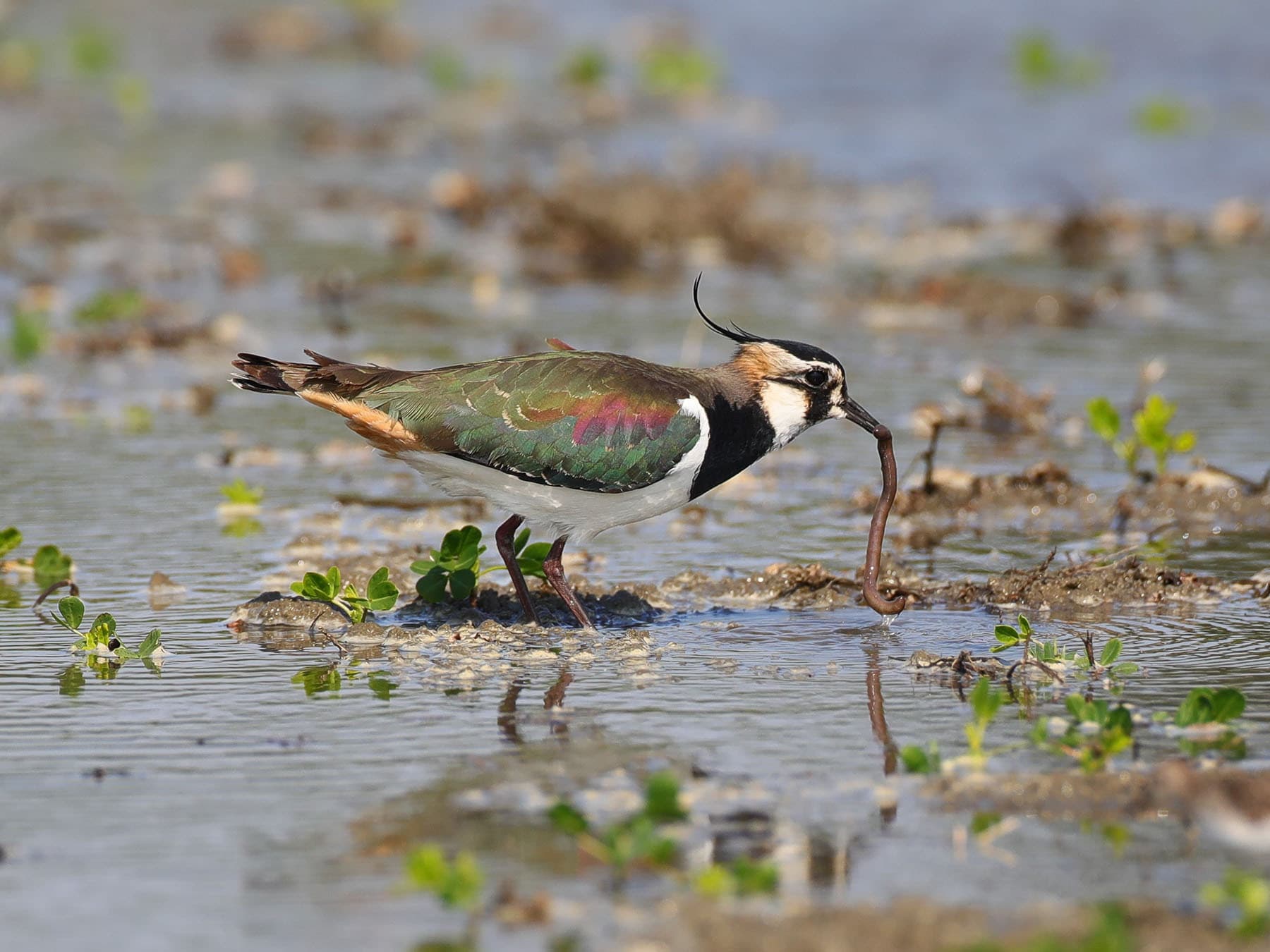
Lapwings feed on small invertebrates that live on and in the soil. Earthworms are a significant component of their diet, although they also feed on snails and various insects and their larvae.
What do baby Lapwings eat?
Baby Lapwings are precocial, which means they are well-developed when they hatch and can run and feed themselves on their first day. The downy chicks feed on tiny invertebrates picked from the ground.
Can you feed Lapwings?
Lapwings do not visit bird tables and are better left to forage for themselves. They would likely accept mealworms, although feeding them would be impractical.
Nesting and breeding
Lapwings nest from March to July, rearing just a single brood each year. Continue reading to learn more about their breeding biology.
Where do Lapwings nest?
Lapwings nest in suitable habitats across much of the UK. They choose open areas of rough pasture or spring crops where they can see predators from a distance. These ground-nesting birds construct a simple scrape and line it with plant material.
What do Lapwing eggs look like?
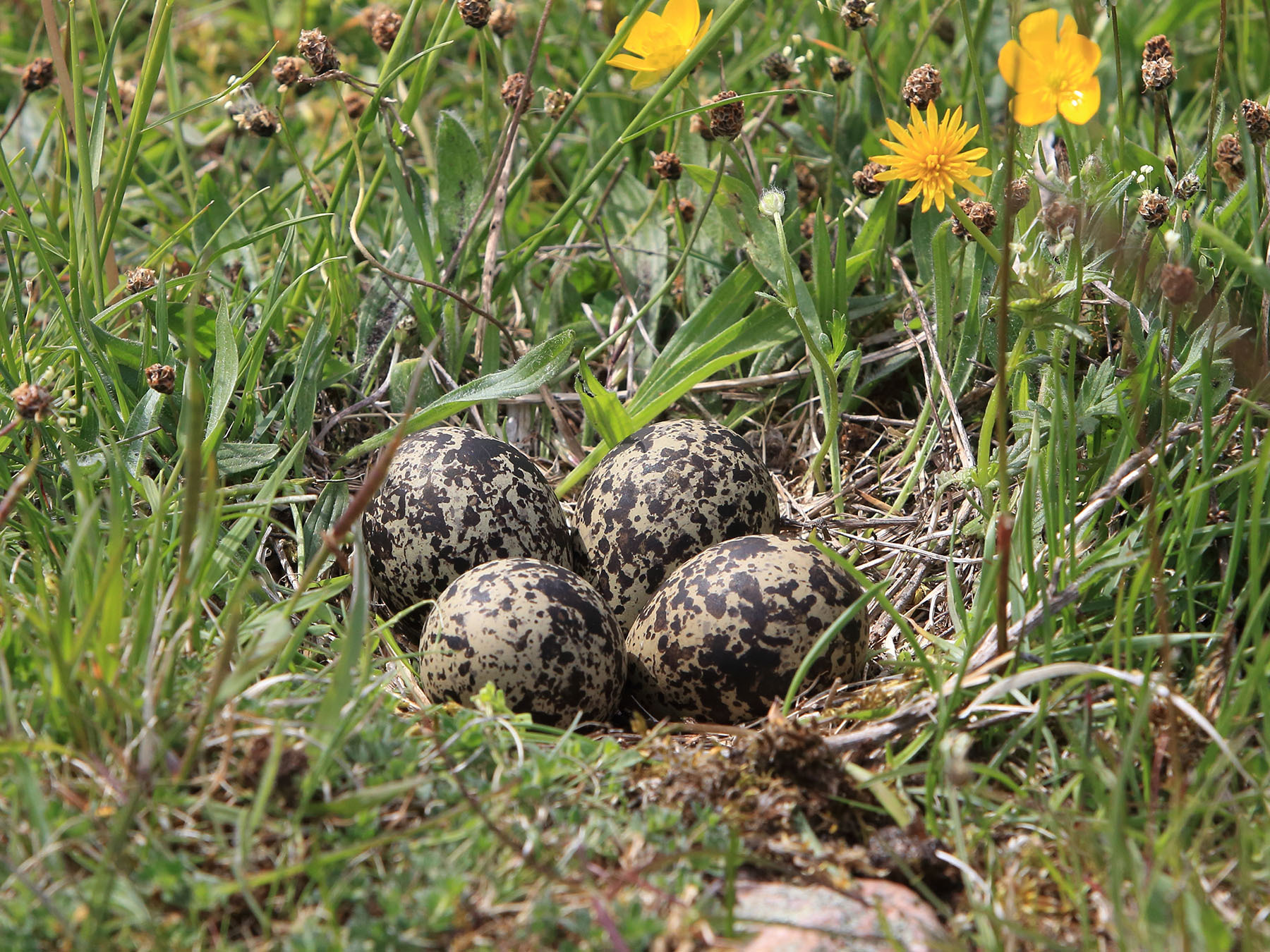
Lapwings eggs have excellent camouflage. They have a light brown ground colour and are heavily marked in black. These birds usually lay four eggs per clutch, each measuring about 47 millimetres long and 34 millimetres wide.
Do Lapwings mate for life?
Lapwings are usually seasonally monogamous, which means pairs remain together in the nesting season but find a new partner each year. However, males may have up to four different partners in a single season.
Behaviour
Lapwings display some fascinating behaviours. Males, in particular, put on quite a show when performing their death-defying display flights between March and May.
Are Lapwings aggressive?
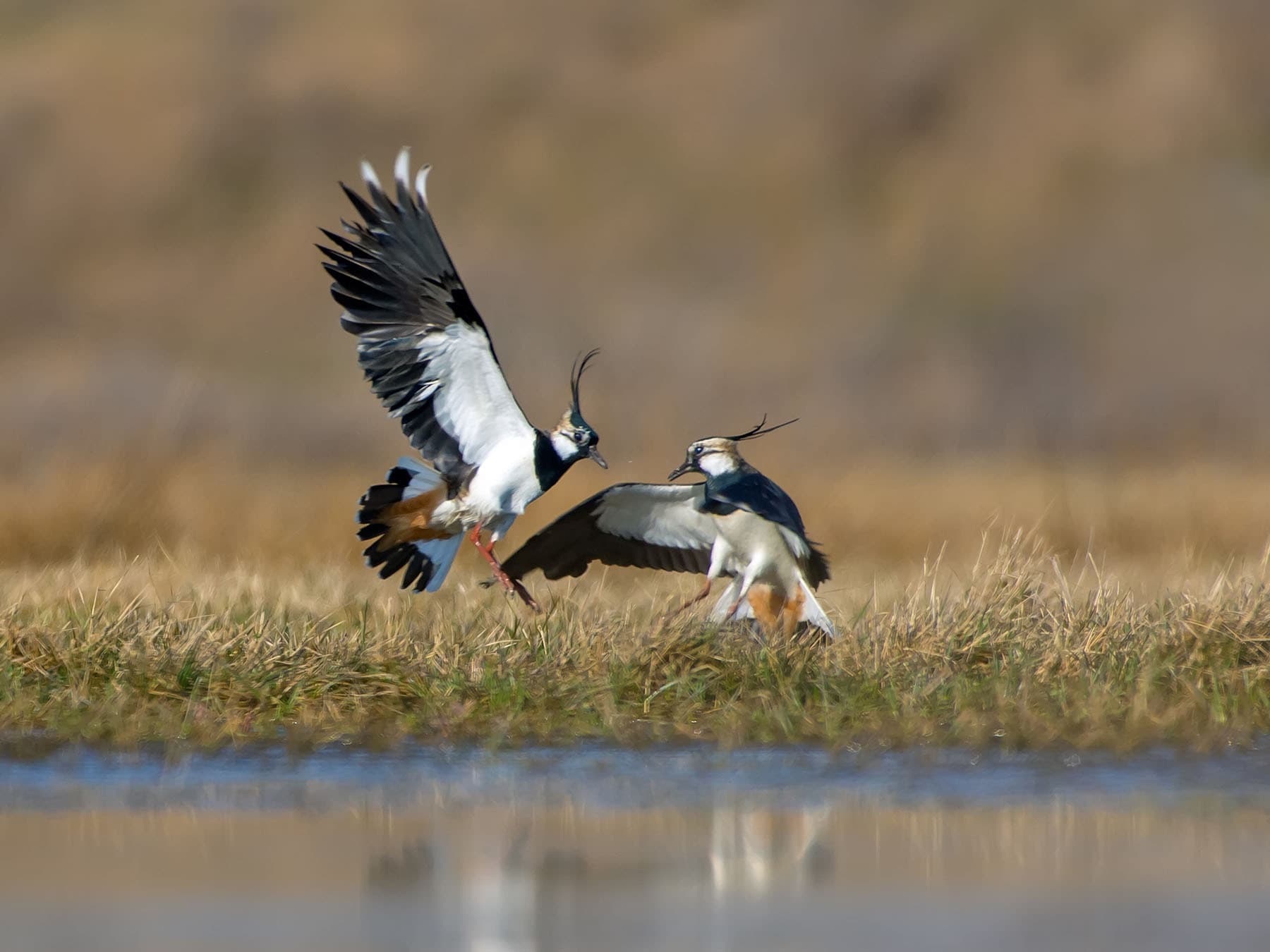
Lapwings can act highly aggressively toward people and livestock in the nesting season. They will start by calling excitedly and flying around in an agitated state. They will also hold their wings open in threat display and attempt to drive away anyone approaching their ground nest.
Where do Lapwings sleep at night?
Lapwings roost in open grassland and fields. These birds do not have a regular day/night sleep cycle and may become completely nocturnal in favourable conditions.
Lifespan and predators
Humans were once one of the Lapwings’ worst predators, although the introduction of the Lapwing Act in 1926 put an end to the rampant egg collection. Continue reading to learn about their lifespan and present-day predators.
How long do Lapwings live?
Lapwings live about four years on average, although they can live for up to 18 years.
What are the predators of Lapwings?
Adult Lapwings have few enemies, although predators like foxes and Marsh Harriers may catch them off-guard. However, these ground-nesting birds are vulnerable to many nest predators, including the fox, stoat, Grey Heron, and Carrion Crow.
Are Lapwings protected?
Lapwings in the United Kingdom are protected by the Wildlife and Countryside Act of 1981.
Are Lapwings endangered?
Lapwings are not endangered, although they are a priority conservation species in the United Kingdom. They are a red-list species of conservation concern due to severe historical population declines.
According to the IUCN, Lapwings are globally classified as Near Threatened because their population is decreasing moderately rapidly.
Conservation
The Northern Lapwing is classified as Near Threatened due to population declines across its range. Agricultural intensification, habitat loss, and changes in land management practices are primary threats.
Conservation efforts focus on protecting breeding habitats and promoting wildlife-friendly farming practices.
More photos
7 photos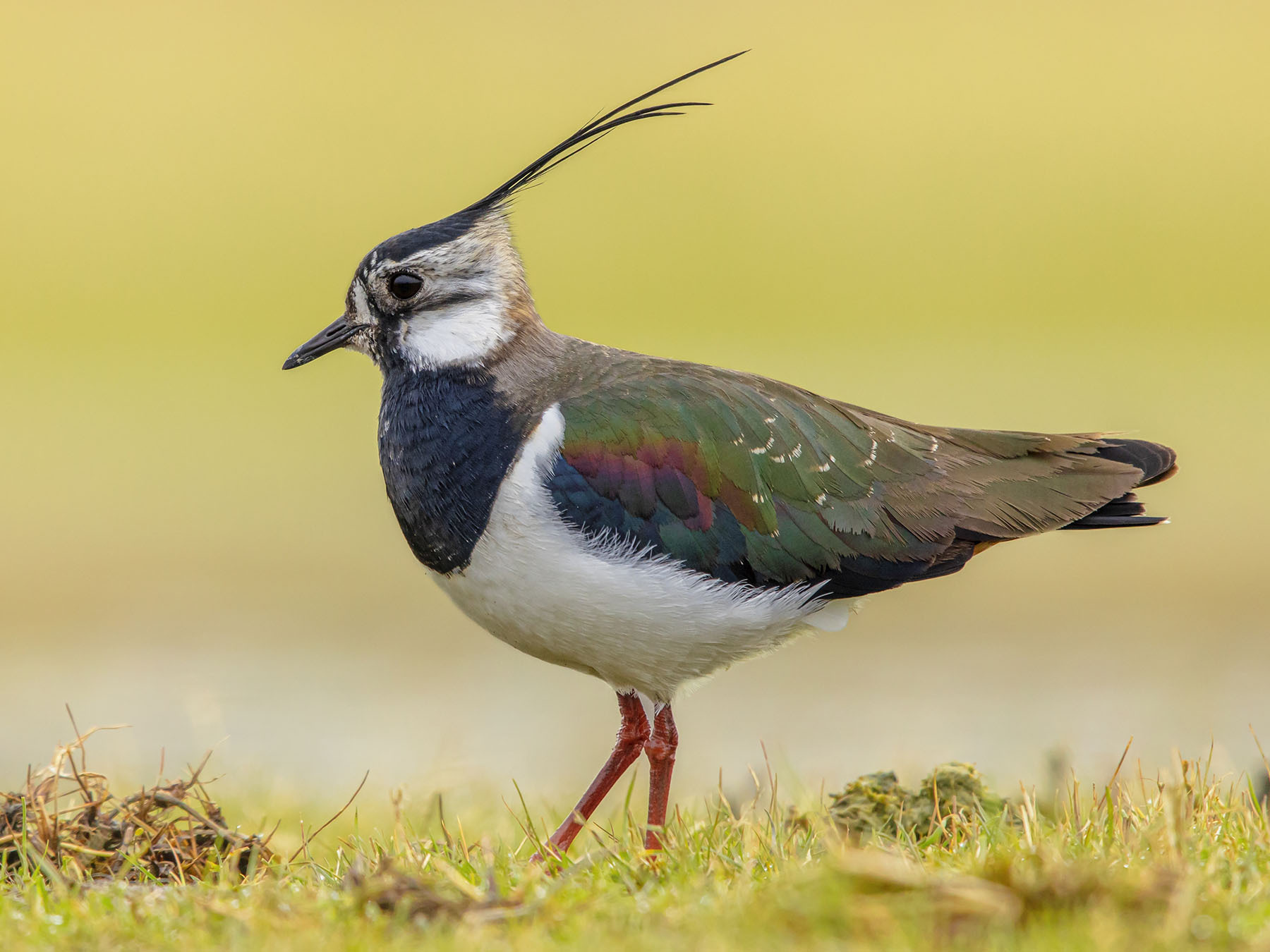
Northern Lapwing guides
1 guidesQuick facts
- Length
- 28–31 cm
- Wingspan
- 67–72 cm
- Weight
- 128–330 g
- Lifespan
- 6 years · oldest recorded 24 years
- Family
- Plovers & Lapwings
- Migration
- Partial migrant
- Global status (IUCN)
- Near Threatened
- World population
- 5,600,000 - 10,500,000 individuals
- Population trend
- Decreasing
- Also called
- Peewit, Green Plover
- Scientific name
- Vanellus vanellus
Questions
6What is another name for Lapwing?
Lapwings are often called peewits. This delightful name is onomatopoeic, referring to their characteristic two-noted call.
What are Lapwings called in Scotland?
Lapwings are common in Scotland, where they are also known as peewits or Green Plovers.
What is a flock of Lapwings called?
A group of Lapwings is called a deceit. This unusual name refers to their habit of feigning injury to protect their nests.
How many Lapwings are in the UK?
Nearly 100,000 Lapwing pairs nest in the UK, although their numbers may increase to over 600,000 individuals in the non-breeding season.
How do you attract Lapwing?
Lapwings are birds of open fields, so they rarely visit gardens. Farmers and large property owners can encourage these birds by maintaining low grassland with bare areas and some taller grass swards.
Do Lapwings fly at night?
Lapwings are active both during the day and night. They are particularly active on bright, moonlit nights, when they will forage, fly, and call.
Sources
4- 1BirdLife International. 2017. Vanellus vanellus (amended version of 2016 assessment). The IUCN Red List of Threatened Species 2017: e.T22693949A111044786. Source (opens in a new tab)
- 2Wetlands International (2015)
- 3Wetlands International (2012)
- 4Fransson et al. - EURING list of longevity records for European birds (2010)

Checked by
Nathan Cope, founder and editor
Nathan founded Birdfact and leads its writers and contributors in the UK, the US and Canada. He has watched and studied birds for more than ten years, and checks every article and species guide before it’s published.