Species Profile
Black-throated Blue Warbler
Setophaga caerulescens
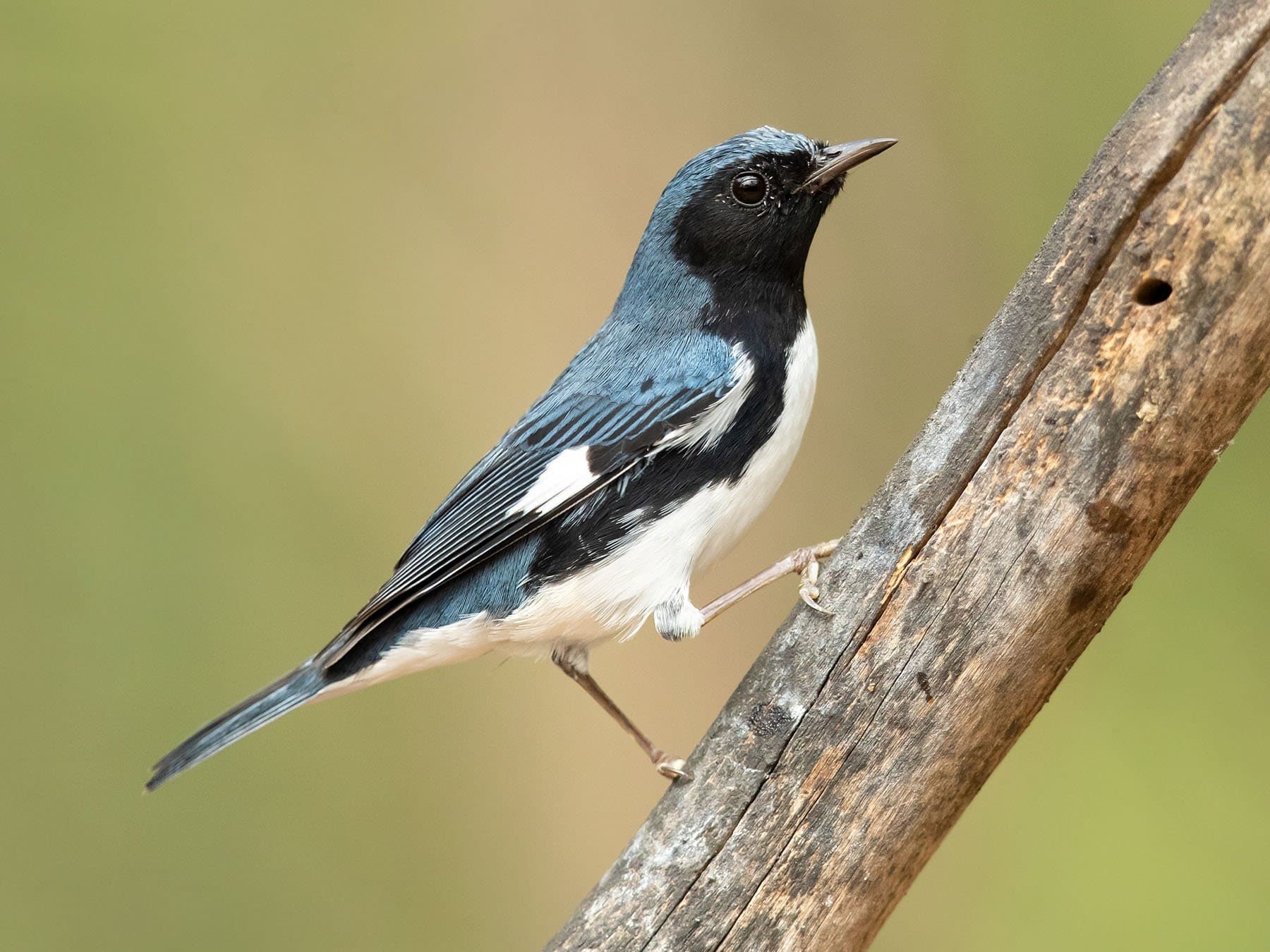
Black-throated Blue Warbler (male) perched on a weathered wooden branch, showing blue back, black throat, and white belly.
Quick Facts
Conservation
LCLeast ConcernLifespan
3–6 years
Length
11–13 cm
Weight
8.4–12.4 g
Wingspan
19–20 cm
Migration
Long-distance Migrant
The male Black-throated Blue Warbler is so strikingly different from his mate that Alexander Wilson and John James Audubon each described them as two entirely separate species — a mistake that stood for decades. He wears deep midnight blue above and jet black on the face and throat, with crisp white underparts and a small white wing patch that birders call the "pocket handkerchief."
Think you've spotted a Black-throated Blue Warbler?
Upload a photo and we'll confirm it instantly
Confirm with a PhotoAppearance
No other North American warbler holds its breeding plumage year-round quite like the male Black-throated Blue. While most warblers moult into a dull autumn dress, he retains his striking pattern in every season: deep midnight blue on the crown, back, wings, and tail — sometimes appearing almost navy or slate in shadow — with jet black on the face, throat, cheeks, and flanks, and crisp white underparts. A small but diagnostic white patch at the base of the primary feathers forms the so-called "pocket handkerchief" mark on the folded wing. Large white tail spots are visible in flight.
The species is sexually dimorphic to a degree unusual even among warblers. Two subspecies show distinct plumage differences. The nominate S. c. caerulescens, breeding across the northeast, has vivid, unstreaked navy-blue upperparts. The southern subspecies S. c. cairnsi, found in the higher-elevation southern Appalachians, has duller, greyish-blue upperparts with prominent black streaking on the crown and back, and larger white wing patches.
The adult female looks nothing like the male and is one of the more challenging female warblers to identify. She is olive-brown to greyish-olive on the upperparts, with pale buff to yellowish underparts, a whitish or cream supercilium, and a faint pale crescent below the eye. Her wings and tail are darker than her body, and her undertail coverts are white. Like the male, she carries the white wing patch — though it is smaller and can be faint or absent on the dullest immature females. When present, it is the single most reliable field mark separating her from other similarly coloured warblers. She has no wing bars. Immature males resemble adults but show greenish or brownish fringes on the back feathers as the blue adult plumage emerges.
In terms of build, the Black-throated Blue is medium-sized among warblers — relatively plump and compact, weighing approximately 8–12 g, larger than a Northern Parula but smaller than an Ovenbird. The bill is thin and pointed, typical of insectivorous warblers; legs and feet are dark grey.
Identification & Characteristics
Male Colors
- Primary
- Blue
- Secondary
- Black
- Beak
- Black
- Legs
- Grey
Female Colors
- Primary
- Olive
- Secondary
- Buff
- Beak
- Black
- Legs
- Grey
Male Markings
Deep midnight blue upperparts; jet black face, throat, and flanks; crisp white underparts; small white "pocket handkerchief" wing patch at base of primaries; white tail spots
Tail: Dark blue-black with large white tail spots visible in flight; white undertail coverts
Female Markings
Olive-brown upperparts; pale buff to yellowish underparts; whitish supercilium; small white wing patch at base of primaries (key field mark); no wing bars
Tail: Dark brown-olive; smaller white tail spots than male
Attributes
Understanding Attributes
Rated 0–100 based on research and observation. A score of 50 is average across all bird species. These attributes are relative and don't necessarily indicate superiority.
Habitat & Distribution
During the breeding season, the Black-throated Blue Warbler requires large, relatively undisturbed tracts of mature deciduous or mixed evergreen-deciduous forest with a dense, shrubby understory. It is a forest-interior specialist — it avoids edges and responds poorly to fragmentation. Key tree species in its breeding habitat include maples, birches, beeches, eastern hemlock, spruce, and fir. The understory shrub layer is critical: the species shows a strong preference for dense thickets of hobblebush, mountain laurel, rhododendron, and viburnum. Rhododendron bogs are particularly favoured nesting habitat. After breeding, adults and fledglings often move to shrubby early-successional habitats before migration.
The breeding range extends from the northern Great Lakes region (Michigan, Minnesota) east through the Canadian Maritime Provinces (Nova Scotia, New Brunswick, Quebec, Ontario), throughout New England, and south through the Appalachian Mountains to northern Georgia and Alabama. In the Appalachians, the species typically breeds at elevations of 800–1,600 m (2,600–5,250 ft). The nominate subspecies S. c. caerulescens occupies the northern part of this range; the southern subspecies S. c. cairnsi breeds in the higher-elevation southern Appalachians from West Virginia south to northern Georgia.
The wintering range is centred on the Greater Antilles — Cuba, Jamaica, Hispaniola, and Puerto Rico — with additional birds in the Bahamas, along the Caribbean coast of the Yucatán Peninsula, and occasionally in southernmost Florida. There is a notable pattern of migratory connectivity: the northern breeding population tends to winter in the western Caribbean (Cuba and Jamaica), while the southern cairnsi population tends to winter on eastern islands (Hispaniola and Puerto Rico).
For North American birders, the species is a reliable spring and autumn migrant along the entire eastern seaboard, from the Canadian Maritimes to Florida. It is rare but regular as a vagrant across western North America, with records from California, Oregon, Nevada, Arizona, and Colorado. In Europe, it has been recorded multiple times in the Azores and in Iceland — well into double figures across the Western Palearctic. It has not yet been recorded in Britain or Ireland, where it is classified as a "Mega" rarity by BirdGuides and remains one of the most anticipated Nearctic wood warblers yet to reach the British and Irish lists.
Where to See This Bird
Explore regional guides for locations where this bird has been recorded.
Florida
Maine
Maryland
North Carolina
District of Columbia
New Hampshire
New York
Virginia
Pennsylvania
Vermont
West Virginia
Ontario
Quebec
Diet
Caterpillars are the engine of the Black-throated Blue Warbler's breeding season — their abundance in the forest canopy in late spring and early summer is closely tied to the warbler's nesting schedule, and they are the single most important prey item for feeding nestlings. Other prey includes moths, crane flies, beetles, butterflies, flies, bugs, and spiders. Small snails are also taken. The species gleans prey from leaf surfaces and twigs, hovers to take items from the undersides of foliage, and will rob insects directly from spiderwebs — a foraging trick that saves the effort of catching prey in flight.
Females forage with particular intensity during nest-building and the weeks before egg-laying, spending up to 70% of daylight hours feeding. Males forage for around 30–32% of daylight hours under normal conditions, but increase this by roughly 20% when simultaneously singing to defend territories — a significant energetic cost. When feeding fledglings, males descend to the same foraging strata as females.
In winter, insects still make up around 95% of the diet, but the species supplements with berries, small fruits, seeds, and flower nectar. In the Dominican Republic, individuals have been recorded drinking "honeydew" — sweet, sugary droplets excreted by scale insects feeding on tree sap. Black-throated Blue Warblers will also visit hummingbird feeders for sugar water on the wintering grounds — a reminder of how opportunistic this species can be outside the breeding season.
Behaviour
Unlike the restless, flickering foraging style of many warblers, the Black-throated Blue works an area methodically and thoroughly before moving on — gleaning insects from leaf surfaces and undersides, hovering briefly to take items from the underside of foliage, and occasionally robbing insects directly from spiderwebs. Males typically forage higher (3–9 m) than females, a difference that persists even on the wintering grounds.
Territorial males are aggressive defenders of their 1–4 hectare breeding territories. When a rival approaches, the resident male flies toward the intruder with rapid chip calls, drooping wings, and a raised head. If posturing fails, all-out chasing ensues — sometimes covering 90 metres or more in circular patterns through the understory, with rivals occasionally knocking each other to the ground. Despite this intensity, the species is generally solitary outside the breeding season.
On the wintering grounds in the Caribbean, both sexes establish and defend individual feeding territories — an unusual degree of winter site fidelity for a small warbler. Males tend to occupy lower-elevation broadleaf forest, while females use shrubbier habitat at higher elevations. This sex-based habitat segregation on the wintering grounds is one of the more unusual aspects of the species' ecology, and means that males and females face quite different survival pressures during the non-breeding season.
Adults show strong fidelity to both breeding and wintering sites. At the long-term Hubbard Brook study site in New Hampshire, 66% of 313 marked males and 46% of 186 marked females returned to within 150 m of their previous breeding territory in subsequent years.
Calls & Sounds
The Black-throated Blue Warbler's song is one of the characteristic sounds of eastern hardwood forests in summer — a slow, buzzy, ascending series of 3–7 notes typically rendered as zee-zee-zee-zreeee or zoo-zoo-zoo-zee, with the final note slurring upward in pitch. Cornell Lab's memorable mnemonic is "I-am-so-la-ZEE," capturing both the rhythm and the distinctly unhurried, almost drowsy quality that sets it apart from the more urgent songs of many other warblers. Audubon described it as a "husky, rising zwee-zwee-zwee."
Males produce at least three distinct song types. The primary song (Type 1) is the ascending buzzy series described above, used for both mate attraction and territorial defence. A secondary song type (Type 2) consists of 2–5 notes that descend at the end — zee-zee-zhurrr — and is more variable across individuals and geographic areas. A third, more whistle-like song type is also produced, and males use an aggressive twittering trill during territorial confrontations. The purposes and contexts of some song types are not fully understood.
The call is a flat, hard ctuk or tink — a sharp chip note that carries well through dense understory. Flight calls are also given during nocturnal migration. Males are the primary singers; females chirp but do not typically sing. Males sing from perches throughout their home range, most intensively during the breeding season, but also during migration and on the wintering grounds. During mate-guarding, males sing softly just 3–4 m above the female while she is on the nest — a quieter, more intimate version of the territorial song that serves a very different social function.
Flight
Small and seemingly delicate, the Black-throated Blue Warbler crosses the Caribbean Sea twice a year — a water crossing of several hundred kilometres between Florida and the Greater Antilles, completed entirely at night. The compact, rounded-winged silhouette is typical of the wood warblers, with short, broad wings suited to manoeuvring through dense forest understory rather than sustained open-air travel. The wingbeat is rapid and slightly undulating, producing a bouncy, direct flight path over short distances. The white tail spots and white wing patch are visible in flight and can help confirm identification even on a briefly glimpsed bird moving through foliage.
During the day, migrants drop into any available woodland, park, or garden to feed and rest, often keeping to lower vegetation levels consistent with their year-round preference for the shrub layer. Radar studies have confirmed that the species participates in the broad nocturnal migration streams that move along the eastern seaboard each spring and autumn.
On the breeding grounds, territorial chases can be prolonged and acrobatic, with rival males pursuing each other through the understory in circular patterns covering 90 m or more, occasionally making physical contact. The species also hovers briefly and with precision to take insects from the undersides of leaves — a foraging technique that requires fine motor control and good spatial awareness in cluttered vegetation.
Nesting & Breeding
Breeding begins in late May or early June and can extend through July, with females capable of raising two, occasionally three, broods per season. Males arrive on the breeding grounds first to establish territories of 1–4 hectares. Females arrive later and explore potential nesting sites; males pursue them in short chases through the understory while establishing pair bonds. Once paired, 80% of returning birds nest with their previous year's mate — a high rate of mate fidelity for a migratory songbird.
The female selects the nest site — typically a fork in a dense understory shrub or sapling (laurel, rhododendron, yew, spruce sapling, or viburnum) within 1–1.5 m of the ground, well concealed by surrounding vegetation. She builds the cup-shaped nest over 3–5 days using strips of bark (often from white or yellow birch) and pieces of rotten wood, bound together with spiderweb and saliva, and lined with rootlets, pine needles, moss, and animal hair. The male may help gather materials but does not build.
Clutch size is 2–5 eggs, typically 3–4 (average 3.6). Eggs are creamy white with dark reddish-brown and grey speckles concentrated at the larger end, measuring approximately 1.5–1.9 cm long by 1.1–1.4 cm wide. The female incubates alone for 12–13 days. When disturbed at the nest, she may perform a broken-wing distraction display to draw predators away. Brown-headed Cowbird parasitism is rare, likely because the species nests deep in forest interior, away from the forest edges where cowbirds concentrate.
Chicks hatch naked with sparse grey down and closed eyes (which open at around four days). Both parents feed the nestlings. Young fledge at just 8–10 days but fly poorly at this stage and remain nearby, fed and protected by both parents for a further 2–3 weeks.
The male often becomes the sole caregiver for fledglings while the female begins a second nest. Young birds can breed in their first year after hatching, though first-year males may struggle to attract mates until their second year.
Lifespan
The typical lifespan of a Black-throated Blue Warbler in the wild is 3–6 years, though individuals regularly exceed this. The oldest recorded individual was a female banded in New Jersey in 1975 and recovered in Panama in 1985, at a minimum age of 9 years and 8 months — a longevity record that underscores the potential durability of small migratory songbirds when conditions are favourable.
Annual survival rates vary between the sexes and between seasons. On the wintering grounds, survival rates range from approximately 66% for females to 77% for males — a meaningful gap that suggests females face greater mortality risks during the non-breeding season, possibly related to their use of higher-elevation, more exposed wintering habitat compared to males. These figures are broadly comparable to other long-distance migratory warblers in the genus Setophaga, such as the Yellow Warbler, though direct comparisons are complicated by differences in study methodology.
The Hubbard Brook long-term study has provided some of the most detailed survival data available for any North American warbler. Key mortality factors include predation — primarily during the nesting season, with chipmunks and squirrels the main nest predators, whose populations fluctuate with mast seed production, creating year-to-year variation in breeding success.
Other key mortality factors include window and building collisions during migration, predation by free-roaming cats, and the cumulative energetic costs of two long-distance migrations per year. Young birds can breed in their first year, though first-year males may be less successful at attracting mates than older, more experienced individuals.
Conservation
The Black-throated Blue Warbler is listed as Least Concern by the IUCN (Red List 3.1), with an estimated global population of approximately 2.4 million mature individuals (Partners in Flight, 2019). The long-term trend is positive: the global population increased by approximately 163% between 1970 and 2014, and the species scores just 10 out of 20 on the Continental Concern Score, placing it in the low-concern category. Short-term monitoring also suggests a 10% increase in recent years.
However, the picture is not uniformly positive. Populations at the southern edge of the breeding range — particularly in North Carolina — have shown declines over the past two decades, and some long-term study sites, including Hubbard Brook in New Hampshire, have recorded more recent downward trends that may signal emerging pressures. The species likely experienced major historical declines when eastern North America was heavily deforested in the 18th and 19th centuries, and current populations are probably still in a long recovery from that period.
The primary ongoing threats are habitat loss and fragmentation. As a forest-interior specialist requiring large, unbroken tracts of mature forest, the species is particularly sensitive to the fragmentation that continues across its breeding range. On the wintering grounds, deforestation of tropical forest in the Caribbean threatens the habitat on which the species depends for six months of the year.
Shade-grown coffee plantations have emerged as an important supplementary wintering habitat. A more specific threat is the loss of eastern hemlock (Tsuga canadensis) to the invasive hemlock woolly adelgid (Adelges tsugae). This pest has been shown to negatively affect Black-throated Blue Warbler population ecology over multi-year periods at study sites where hemlock is a key component of breeding habitat. Climate change poses a further risk through phenological mismatch: warming temperatures are causing earlier leaf-out and caterpillar emergence. Birds are currently adjusting by shortening the interval between arrival and nest initiation, but this window may narrow as warming continues. Research published in 2020 found that spring migration is becoming earlier by 1.1 days per decade, with the rate of change increasing with latitude. Additional threats include window and building collisions during migration and predation by free-roaming cats.
Population
Estimated: Approximately 2.4 million mature individuals (Partners in Flight, 2019)
Trend: Increasing
Increasing. The global population grew by approximately 163% between 1970 and 2014 (Partners in Flight). Short-term monitoring also indicates a 10% increase. Some localised declines noted at the southern edge of the breeding range and at certain long-term study sites.
Elevation
Sea level to 1,600 m; breeding typically 800–1,600 m in the Appalachians
Additional Details
- Family:
- Parulidae (New World Warblers)
- Predators:
- Chipmunks and squirrels (nest predation); hawks and owls (adult predation); free-roaming cats
- Subspecies:
- S. c. caerulescens (northern); S. c. cairnsi (southern Appalachians)
- Clutch size:
- 2–5 eggs (typically 3–4)
- Fledging age:
- 8–10 days
- Broods per year:
- 1–3 (typically 2)
- Egg description:
- Creamy white with dark reddish-brown and grey speckles concentrated at the larger end
- Incubation period:
- 12–13 days (female only)
Research Significance
Few small songbirds have contributed as much to our understanding of avian ecology as the Black-throated Blue Warbler. Since 1969 — with intensive demographic monitoring beginning in 1982 — researchers at the Hubbard Brook Experimental Forest in New Hampshire's White Mountains have studied this species continuously for over four decades, generating a dataset that is essentially unmatched for any migratory passerine in North America.
The Hubbard Brook programme has produced landmark findings across multiple areas of ecology. Studies of the species' breeding biology established foundational data on extra-pair paternity, mate fidelity, and the relationship between caterpillar abundance and reproductive success. Research on migratory connectivity — linking specific breeding populations to specific wintering areas using stable isotope analysis and banding data — helped establish the field of full-annual-cycle ecology, which recognises that events on the wintering grounds can have carry-over effects on breeding performance the following summer.
Climate change research at Hubbard Brook has been particularly influential. A 2020 study found that spring migration is becoming earlier by 1.1 days per decade, with peak migration advancing by 0.5 days per decade and the rate of change increasing with latitude. The research also documented how birds are currently compensating for earlier leaf-out by shortening the interval between arrival and nest initiation. However, this adjustment window may narrow as warming accelerates, potentially creating a phenological mismatch between the warbler's nesting cycle and the caterpillar peak on which nestling survival depends. The Black-throated Blue Warbler has, in this sense, become a sentinel species for the broader impacts of climate change on migratory birds.
Sexual Selection And Mating
The Black-throated Blue Warbler is socially monogamous — pairs form at the start of each breeding season and cooperate to raise young — but the genetic reality is considerably more complex. Approximately 34–43% of offspring in 50–55% of nests are fathered by a male other than the female's social mate, giving the species one of the higher rates of extra-pair paternity documented among North American songbirds.
Males appear acutely aware of this risk. During nest-building and egg-laying — the period when the female is fertile — males engage in intensive mate-guarding, following the female everywhere and singing softly just 3–4 m above her when she is on the nest. Despite this vigilance, females regularly leave the territory to mate with neighbouring males. Older, more experienced males are more likely to sire extra-pair offspring in neighbouring nests, suggesting that female choice is driving the pattern rather than forced copulations.
The male's striking plumage may itself be a product of this sexual selection pressure. The deep midnight blue of the upperparts and the bold black-and-white face pattern are produced by structural coloration and melanin pigmentation respectively, and both are honest signals of male quality that females assess during mate choice. The intensity of the blue coloration varies between individuals and may reflect condition or age. The two subspecies differ in the extent of black streaking on the male's back — a difference that may reflect local adaptation to different forest types rather than sexual selection per se. It does, however, illustrate how plumage variation tracks ecological context across the species' range.
Birdwatching Tips
In the United States and Canada, the Black-throated Blue Warbler is a reliable breeding species across the northeastern states and the Appalachian Mountains from late May through July. The best places to find breeding birds are large tracts of mature forest with a dense rhododendron or mountain laurel understory — the Great Smoky Mountains National Park, Shenandoah National Park, the White Mountains of New Hampshire, and the Adirondacks of New York are all excellent sites. Look low: this species forages and nests in the shrub layer, typically below 3 m, and is far more likely to be found near the ground than high in the canopy.
During spring migration (late April to mid-May) and autumn migration (August to October), the species can turn up in almost any woodland, park, or garden along the eastern seaboard. Central Park in New York City is famous for its warbler fallouts during migration, and the Black-throated Blue is a regular participant. Florida is the key funnel point for birds heading to and from the Caribbean, making coastal Florida hotspots — such as Fort De Soto Park — excellent in both spring and autumn.
Identification is straightforward for the male: the combination of midnight blue upperparts, black face and throat, white underparts, and the small white wing patch is unique. The female is trickier, but the white "pocket handkerchief" wing patch — even when small — is the key field mark. Female Black-throated Blues lack the wing bars that most other olive-brown female warblers show, which helps narrow the field. In autumn, beware of female Tennessee Warblers and female Orange-crowned Warblers, which share the olive-buff colour scheme but lack the white wing patch entirely.
The song — a slow, buzzy, ascending "zee-zee-zee-zreeee" — is one of the easier warbler songs to learn, with a distinctly lazy, unhurried quality. Listen for it in the forest understory from late May onwards. For European birders, the species remains unrecorded in Britain and Ireland, but multiple records from the Azores and Iceland mean it is firmly on the radar as a potential future vagrant — worth checking any late-autumn Nearctic warbler carefully.
Did You Know?
- When Alexander Wilson described the Black-throated Blue Warbler in 1810, he listed the male and female as two separate species — a mistake John James Audubon later repeated. The male and female look so different that it took decades of careful observation before ornithologists confirmed they were the same bird.
- Despite following their mates obsessively during nest-building and egg-laying, male Black-throated Blue Warblers still lose the paternity battle roughly a third of the time: approximately 34–43% of offspring are fathered by a neighbouring male rather than the territorial male.
- The Black-throated Blue Warbler has been studied continuously at the Hubbard Brook Experimental Forest in New Hampshire since 1969, with intensive demographic monitoring since 1982 — making it one of the longest-running individual bird population studies in the world, and a cornerstone of our understanding of how climate change affects migratory songbirds.
- On their Caribbean wintering grounds, Black-throated Blue Warblers will visit hummingbird feeders for sugar water — a behaviour rarely associated with a bird that is almost entirely insectivorous during the breeding season, and one that illustrates just how opportunistic this species becomes when away from its summer territory.
- Male Black-throated Blue Warblers survive the non-breeding season at a meaningfully higher rate than females — approximately 77% annual survival versus 66% for females — suggesting that the sex-segregated wintering habitats the two sexes occupy impose very different mortality risks.
Records & Accolades
Most Studied Warbler
40+ years of continuous research
The Black-throated Blue Warbler has been studied at Hubbard Brook Experimental Forest, New Hampshire, since 1969 — one of the longest-running individual bird population studies in North America.
Most Dimorphic Warbler
Described as two species by Audubon & Wilson
The male and female look so different that both Alexander Wilson (1810) and John James Audubon independently described them as entirely separate species.
Year-round Blue
No seasonal plumage change
Unlike most warblers, the male retains his striking midnight blue, black, and white plumage year-round — making him identifiable in every season without the confusion of a dull winter plumage.
Community Photos
Be the first to share a photo of the Black-throated Blue Warbler
Upload a PhotoIdentify Any Bird Instantly
- Upload a photo from your phone or camera
- Get an instant AI identification
- Ask follow-up questions about the bird
Monthly Birds in Your Area
- Personalised for your location
- Seasonal tips and garden advice
- Updated every month with new species