


Whimbrel
Eurasian Whimbrel, Common Whimbrel · Numenius phaeopus
By the Birdfact teamChecked by Nathan Cope
On this page14 sections
How to recognise it
What do Whimbrels look like?
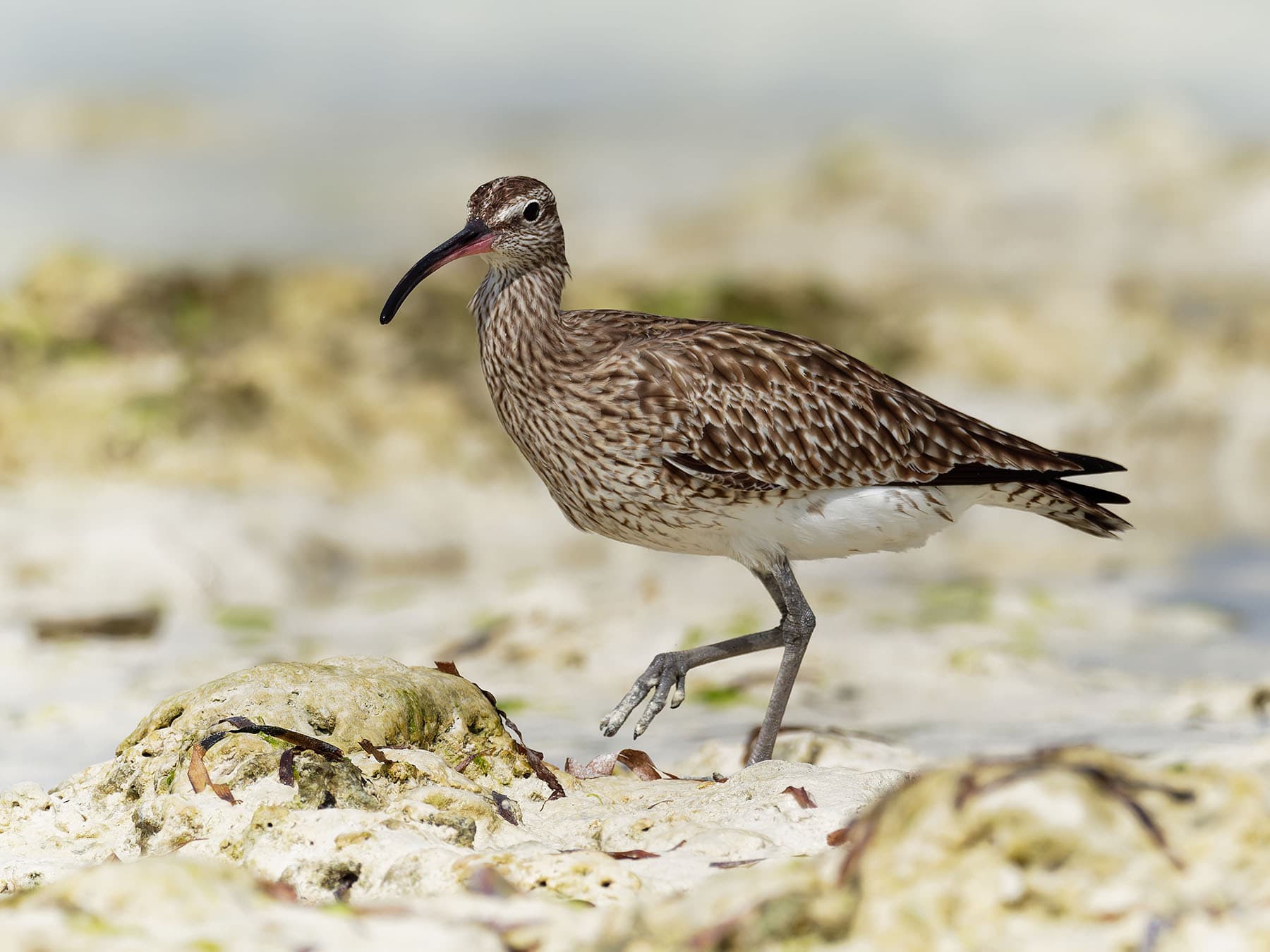
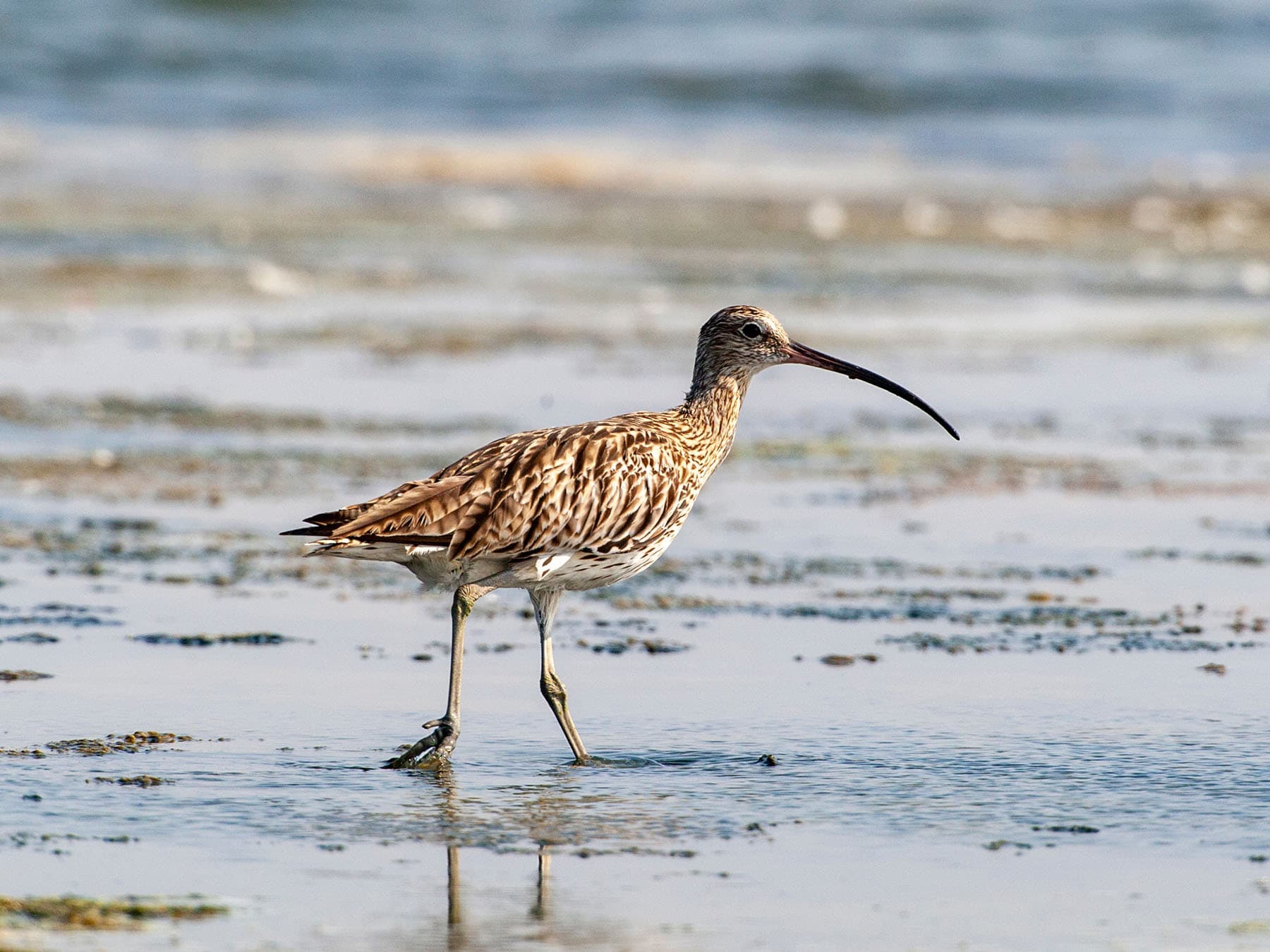
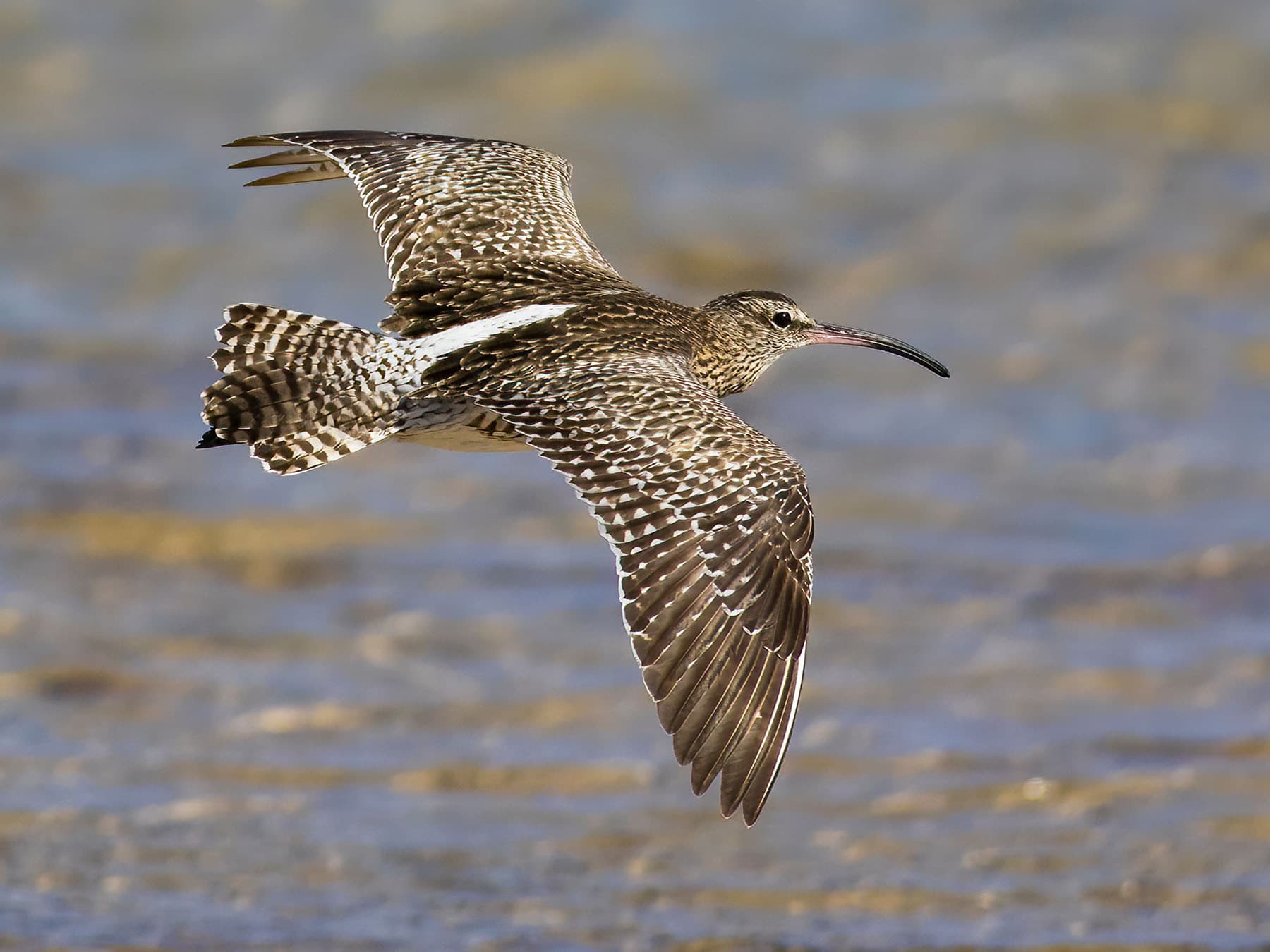
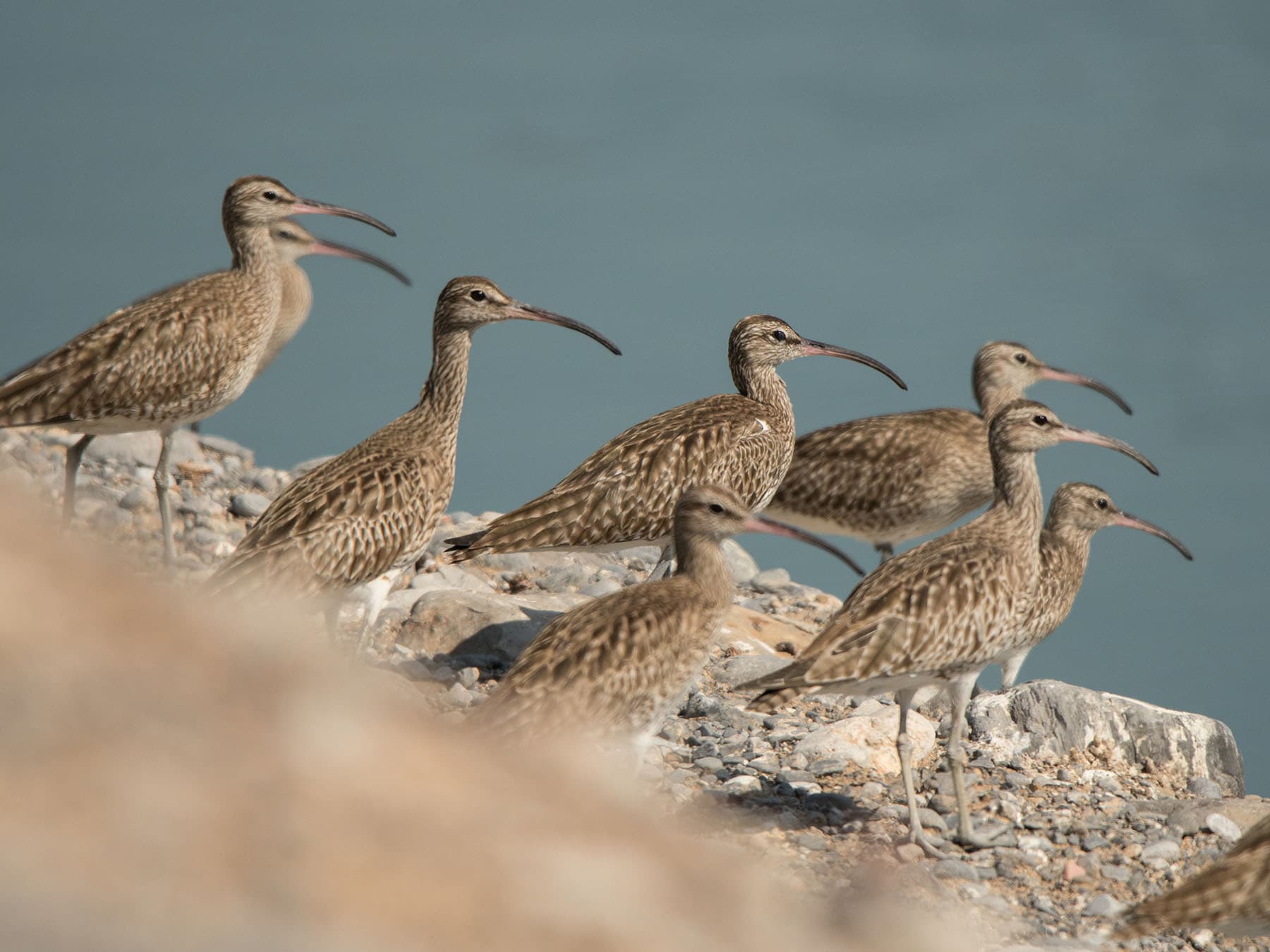
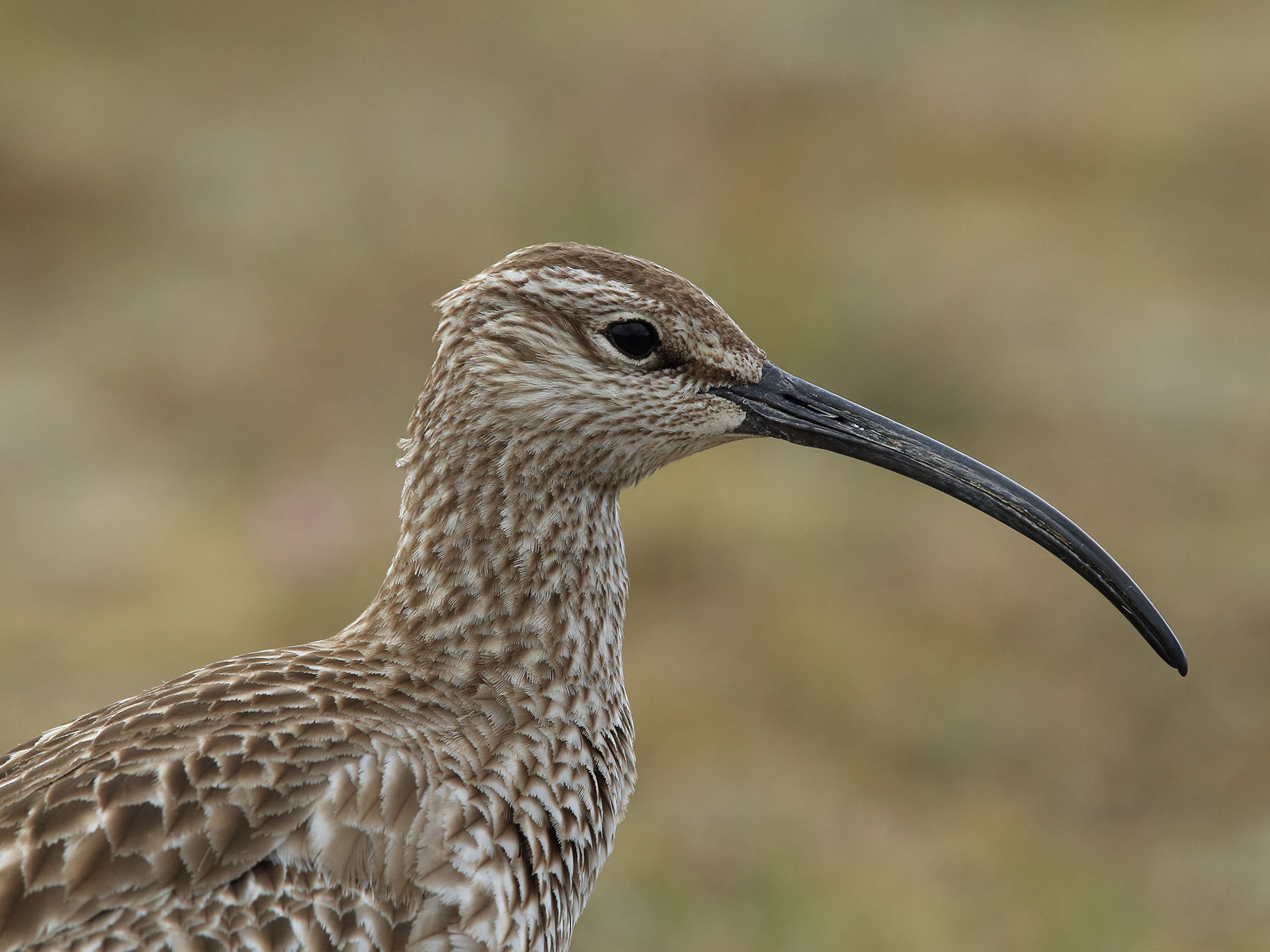
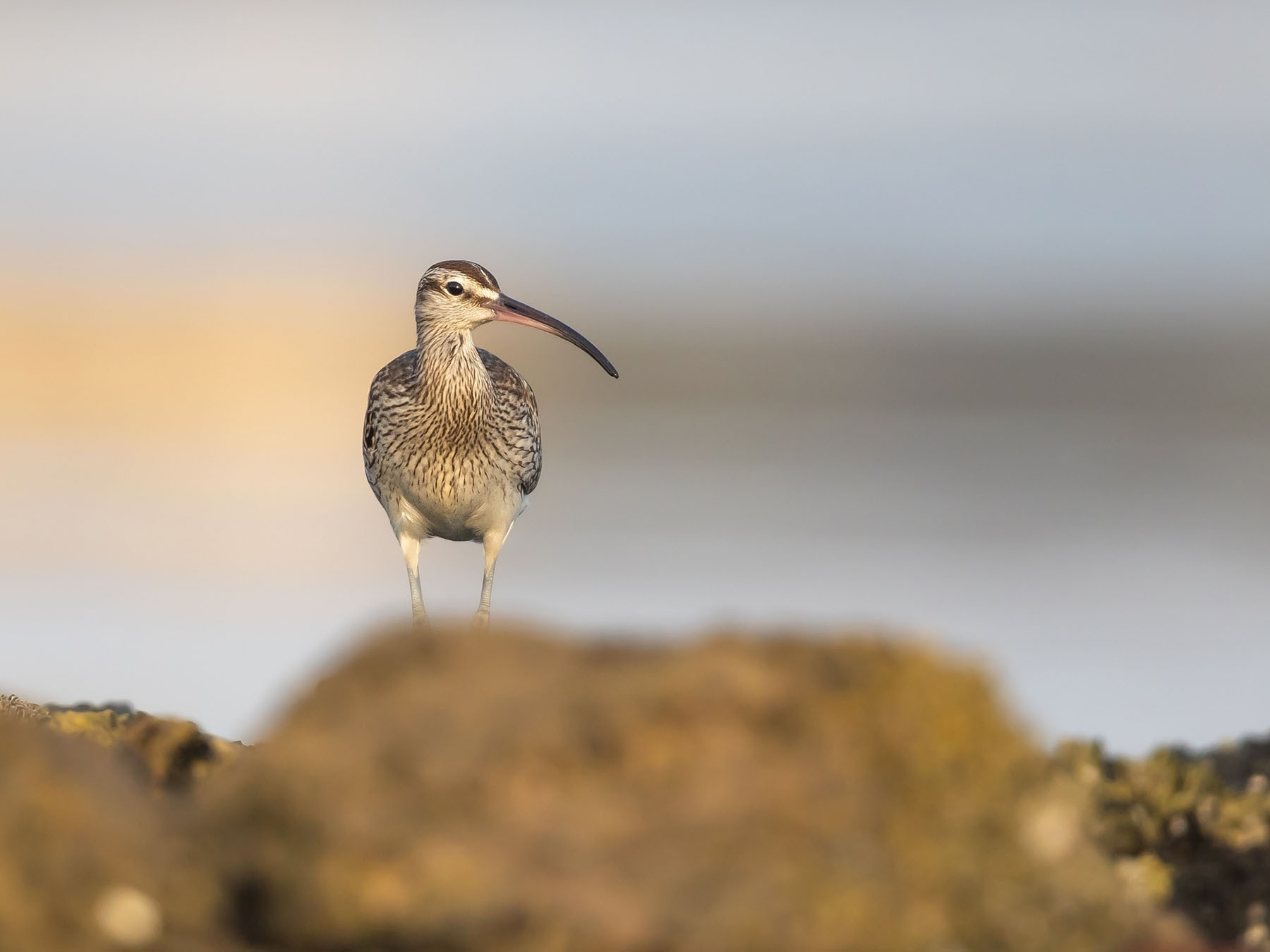
Whimbrels are large wading birds, similar in shape and colouring to curlews. They have brown upper parts, and paler white underparts, with an all-over marbled appearance. A dark crown is divided by a lighter brown stripe, and they have a prominent dark eye stripe.
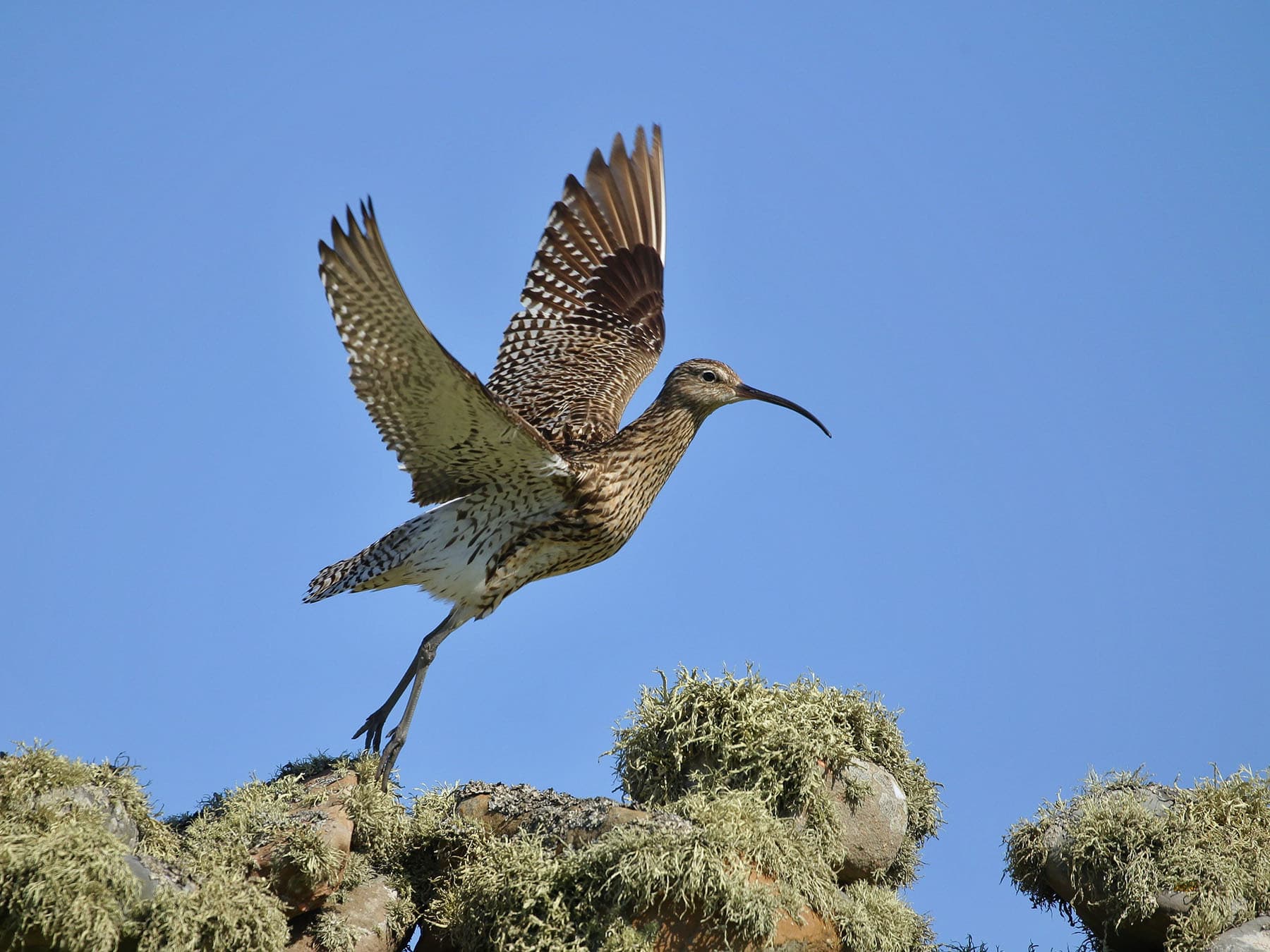
Whimbrels have a distinctive white V-shaped marking on their rump, which is visible in flight. Their long dark grey bill curves downwards near the tip, and their grey-blue legs are long and slender.
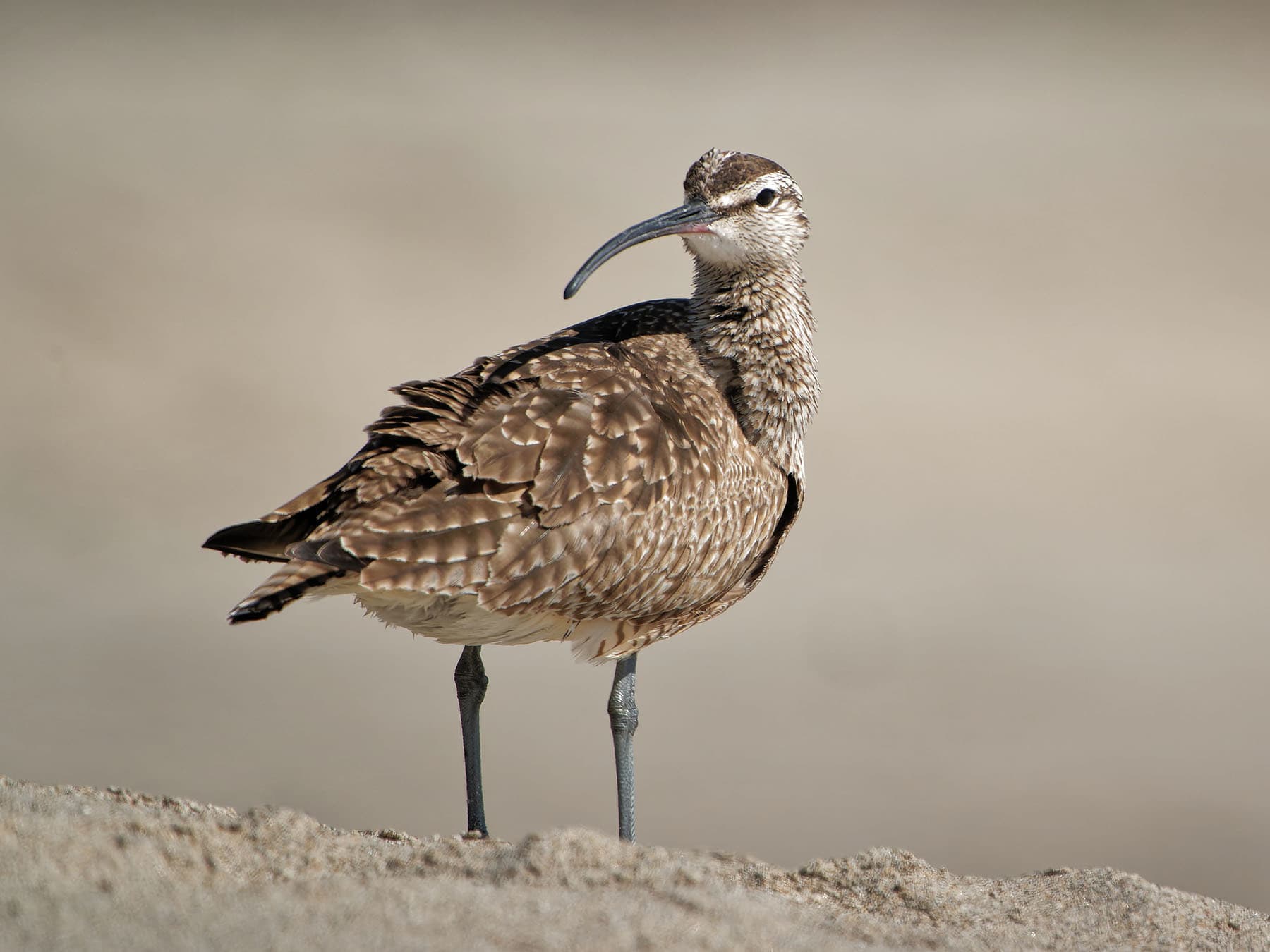
Females and male whimbrels are alike in markings and colourings, but it may be possible to tell them apart at close range as the female is slightly larger and heavier.
Juvenile whimbrels are smaller in size than adults, and have slightly shorter bills. Their markings are more defined than those seen on adult birds.
How big are Whimbrels?
Whimbrels are slightly smaller than their close relative, the curlew. Males and females are similar in size, with females slightly larger and heavier than their male counterparts.
- Length: 37 cm to 47cm (15 in to 19 in)
- Wingspan: 75 cm to 90 cm (30 in to 35 in)
- Weight: 270 g to 493 g (9.5 oz to 17.4 oz)
Its size
Adults- Length
- 40–46 cm
- Wingspan
- 76–89 cm
- Weight
- 270–493 g
Its song and calls
What sound does a Whimbrel make?
In flight, whimbrels make a distinctive monotone-pitch mellow call, which more often than not consists of exactly seven notes. In courtship or in defence of a nest site, a scream-like whistle is heard instead.
- Call0:00 / 0:12
Recorded in Súðavíkurhreppur, Iceland · July 2023
When and where to see it
OctoberLeaving
Most recorded in October
- 1. Pembrokeshire0.54%
- 2. Cork0.41%
- 3. Antrim0.23%
- 4. Merseyside0.21%
- 5. Cornwall0.15%
Each dot is a county, state or province: the bigger and darker, the larger the bird’s share of that place’s bird records that month. Grey dots: no regular records. The ringed point is the centre of the bird’s records this month; the arrow shows how it moved since last month, and the dashed loop its path through the year. “Arrivals” colours places where it becomes regular this month (orange) or is in its last regular month (grey). GBIF eBird Observation Dataset, 2019–2024. Map data: Natural Earth, US Census Bureau; place centres © OpenStreetMap contributors.
In your area
See when the Whimbrel is recorded in your county, state or province.
How often the Whimbrel turns up in the UK, Ireland, the United States and Canada through the year, from birdwatchers' records.
United Kingdom
Summer visitor · regularly Apr–Oct · most records in August
Ireland
Summer visitor · all year · most records in August
United States
Resident · all year · most records in August
Canada
Summer visitor · regularly Apr–Oct · most records in August
Show as a table
| Month | United Kingdom | Ireland | United States | Canada |
|---|---|---|---|---|
| January | 0.006% | 0.060% (regular) | 0.034% (regular) | 0.002% |
| February | 0.007% | 0.040% (regular) | 0.028% (regular) | <0.001% |
| March | 0.008% | 0.062% (regular) | 0.028% (regular) | 0.002% |
| April | 0.20% (regular) | 0.64% (regular) | 0.056% (regular) | 0.011% (regular) |
| May | 0.22% (regular) | 0.67% (regular) | 0.040% (regular) | 0.030% (regular) |
| June | 0.035% (regular) | 0.067% (regular) | 0.017% (regular) | 0.012% (regular) |
| July | 0.20% (regular) | 0.24% (regular) | 0.054% (regular) | 0.057% (regular) |
| August | 0.29% (regular) | 0.69% (regular) | 0.077% (regular) | 0.096% (regular) |
| September | 0.12% (regular) | 0.31% (regular) | 0.057% (regular) | 0.061% (regular) |
| October | 0.030% (regular) | 0.077% (regular) | 0.034% (regular) | 0.009% (regular) |
| November | 0.008% | 0.058% (regular) | 0.039% (regular) | 0.002% |
| December | 0.006% | 0.063% (regular) | 0.034% (regular) | 0.002% |
Recorded regularly in
Worldwide: recorded regularly in 173 countries
Countries where it was recorded in at least 3 of the 6 years 2019–2024. Linked countries have their own bird list.
Europe (40)
- Åland Islands
- Austria
- Belarus
- Belgium
- Bulgaria
- Croatia
- Czechia
- Denmark
- Estonia
- Faroe Islands
- Finland
- France
- Germany
- Gibraltar
- Greece
- Guernsey
- Hungary
- Iceland
- Ireland
- Isle of Man
- Italy
- Jersey
- Latvia
- Lithuania
- Malta
- Montenegro
- Netherlands
- Norway
- Poland
- Portugal
- Romania
- Russia
- Serbia
- Slovakia
- Slovenia
- Spain
- Sweden
- Switzerland
- Ukraine
- United Kingdom
Africa (33)
- Algeria
- Angola
- Cape Verde
- Comoros
- Côte d’Ivoire
- Djibouti
- Egypt
- Gabon
- Gambia
- Ghana
- Guinea
- Guinea-Bissau
- Kenya
- Liberia
- Madagascar
- Mauritania
- Mauritius
- Mayotte
- Morocco
- Mozambique
- Namibia
- Nigeria
- Réunion
- São Tomé & Príncipe
- Senegal
- Seychelles
- Sierra Leone
- Somalia
- South Africa
- Tanzania
- Tunisia
- Uganda
- Western Sahara
Asia (40)
- Azerbaijan
- Bahrain
- Bangladesh
- British Indian Ocean Territory
- Brunei
- Cambodia
- China
- Cyprus
- Georgia
- Hong Kong SAR China
- India
- Indonesia
- Iran
- Israel
- Japan
- Kazakhstan
- Kuwait
- Laos
- Lebanon
- Macao SAR China
- Malaysia
- Maldives
- Mongolia
- Myanmar (Burma)
- Nepal
- Oman
- Pakistan
- Philippines
- Qatar
- Saudi Arabia
- Singapore
- South Korea
- Sri Lanka
- Taiwan
- Thailand
- Timor-Leste
- Turkey
- United Arab Emirates
- Vietnam
- Yemen
North America (33)
- Anguilla
- Antigua & Barbuda
- Aruba
- Bahamas
- Barbados
- Belize
- Bermuda
- British Virgin Islands
- Canada
- Caribbean Netherlands
- Cayman Islands
- Costa Rica
- Cuba
- Curaçao
- Dominican Republic
- El Salvador
- Grenada
- Guadeloupe
- Guatemala
- Honduras
- Martinique
- Mexico
- Nicaragua
- Panama
- Puerto Rico
- St Kitts & Nevis
- St Martin
- St Pierre & Miquelon
- St Vincent & the Grenadines
- Trinidad & Tobago
- Turks & Caicos Islands
- United States
- US Virgin Islands
South America (12)
Oceania (14)
- Australia
- Cocos (Keeling) Islands
- Fiji
- Guam
- Marshall Islands
- New Caledonia
- New Zealand
- Norfolk Island
- Northern Mariana Islands
- Palau
- Papua New Guinea
- Solomon Islands
- US Outlying Islands
- Vanuatu
Antarctica (1)
- French Southern Territories
Data: EOD – eBird Observation Dataset (Cornell Lab of Ornithology), accessed via GBIF.org, CC BY 4.0. Records from 2019–2024, aggregated and filtered by Birdfact. How these lists are made
What is the habitat of a Whimbrel?
While breeding and raising young, whimbrels can be found on Arctic tundras, open moorlands, and uplands. Areas of dense vegetation are avoided, while shrubby areas and mossy lowlands offer suitable nesting and foraging spots.
Migration takes place along coastal wetlands, with whimbrels stopping off at various staging points along the shorelines of Britain to break their onward migration to Africa and beyond.
Mudflats, marshes and coastal wetlands provide whimbrels with foraging grounds for the energy-rich molluscs and crustaceans that help to power their long flights to their winter territories.
Typical winter habitats include tidal flats, coastal meadows, swamps, estuaries and sandy beaches.
What is the range of a Whimbrel?
Eurasian whimbrels breed in the Arctic circle, from Greenland and Iceland, across the Faroe Islands, Ireland, northern Scotland, and northern Norway, as far east as Siberia.
Migration takes Eurasian whimbrels south into Africa and into Asia, with wintering grounds extending around the coast of West Africa, East Africa, South Asia and into Australasia.
Where do Whimbrels live?
Whimbrels live on moorlands and uplands in northern Scotland, with Shetland hosting the majority of the UK’s breeding population of up to 470 pairs in the 1990s. Orkney, the Outer Hebrides and the extreme north of the Scottish mainland have also recorded established breeding grounds.
Ringing data shows us the winter destinations of whimbrels that breed in the extreme northern Scottish islands, and further north, in Iceland, with many of these birds spending winters in West Africa, with wintering grounds extending from Mauritania in the north to Benin and Togo in the south.
How rare are Whimbrels?
While an estimated 310 whimbrel pairs breed in the British Isles each year, only a small handful remain in the country all year round – only around 41 birds.
In 2009, migrating whimbrels were spotted in passage at 144 different sites, with a maximum of 1,551 whimbrels spotted at the peak migration period.
With these numbers, sightings are fairly rare, but in the correct environments, it would not be an extraordinary event.
Where can you see Whimbrels in the UK?
Whimbrels are limited to the northernmost extremes of Scotland’s offshore islands, with populations present on moorlands in Shetland, Orkney and the far north of the Scottish mainland.
During migration passage in spring and autumn, whimbrels pass along the coastlines all around the British Isles, and sightings in coastal wetlands are reported fairly regularly.
Migration
Do Whimbrels migrate?
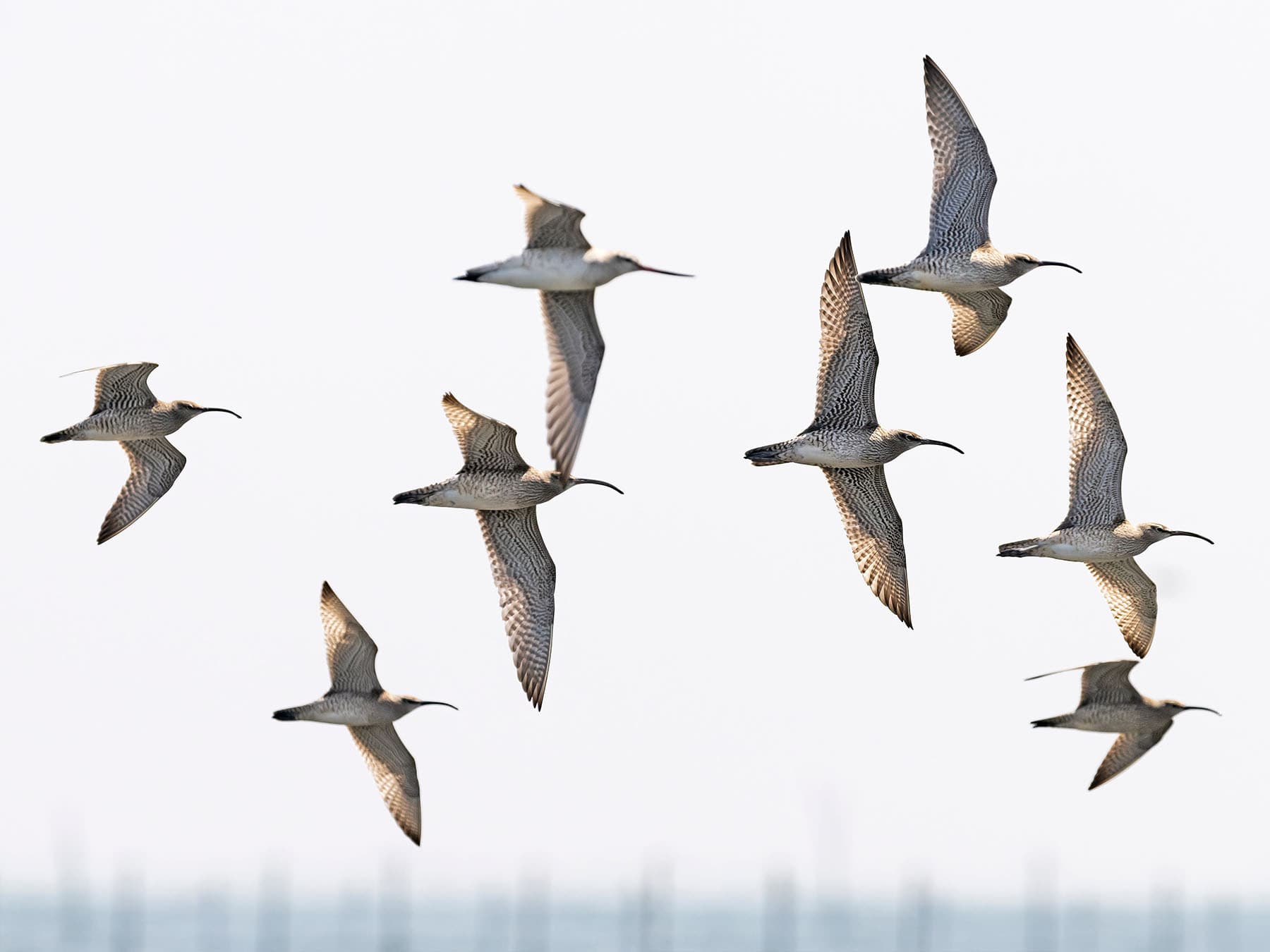
Eurasian whimbrels are a migratory species, spending breeding and non-breeding seasons a significant distance apart.
Winters are spent in southern Europe and northern Africa, and migration occurs in spring and autumn, with whimbrels arriving on their breeding grounds as far north as the Arctic Circle from March to April.
Tips for seeing it
- Look for Whimbrels along coastal mudflats, beaches, and estuaries during migration
- Listen for their distinctive, rippling call, often given in flight
- Observe their unique feeding behaviour, probing deeply into sand or mud
- In the UK, watch for them during spring and autumn migrations along the coast
- Use a spotting scope to appreciate their distinctive bill shape and plumage details
What it eats
What do Whimbrels eat?
On their wetland breeding grounds, whimbrels feed mainly on ground insects, snails and slugs, which they pick up with their bills. They also pick berries and flower buds from bushes.
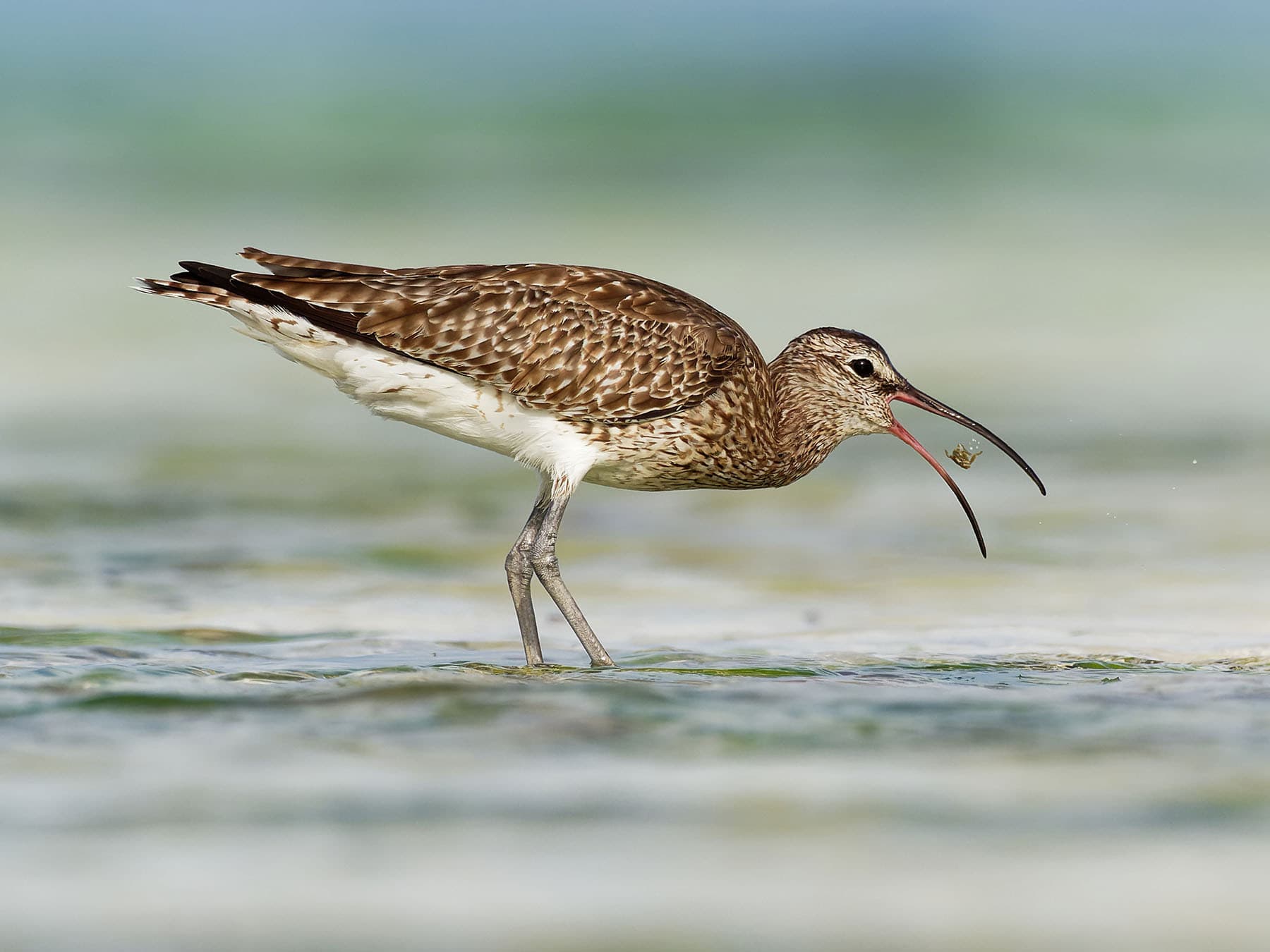
During migration, whimbrels pass across coastal wetlands, and their diet changes to incorporate more crustaceans, shrimps and molluscs. They catch these by plunging their long curved bills into mudflats and probing beneath the surface of the wet mud.
What do Whimbrel chicks eat?
Whimbrel chicks leave the nest shortly after being born and are not fed by parents at all. Instead, they quickly master the art of foraging for themselves, beginning with ripening berries and flying insects.
Nesting and breeding
Where do Whimbrels nest?
Whimbrels build nests on the ground, making a shallow scrape, which is then lined by the female with grass, mosses and lichen.
Tundras and moorland landscapes provide a suitable habitat for nesting whimbrels, with nests positioned in relatively open settings, rather than being concealed in any vegetation.
What do Whimbrel eggs look like?
Whimbrels’ eggs are pale green to olive green in colour and are streaked with brown markings.
Eggs, which measure 58 mm by 41 mm, are then incubated by both males and females for 24 to 28 days, with the female brooding for the majority of the time.
A typical clutch contains between 3 and 5 eggs, and usually, one single brood is raised each season.
Do Whimbrels mate for life?
Whimbrels are monogamous during the breeding season, and for many pairs, this bond continues in subsequent years.
It’s common for migrating whimbrels to return to a breeding ground they have successfully used in the past, and frequent reports exist of the same pairs reuniting to raise young together year after year.
Behaviour
Are Whimbrels aggressive?
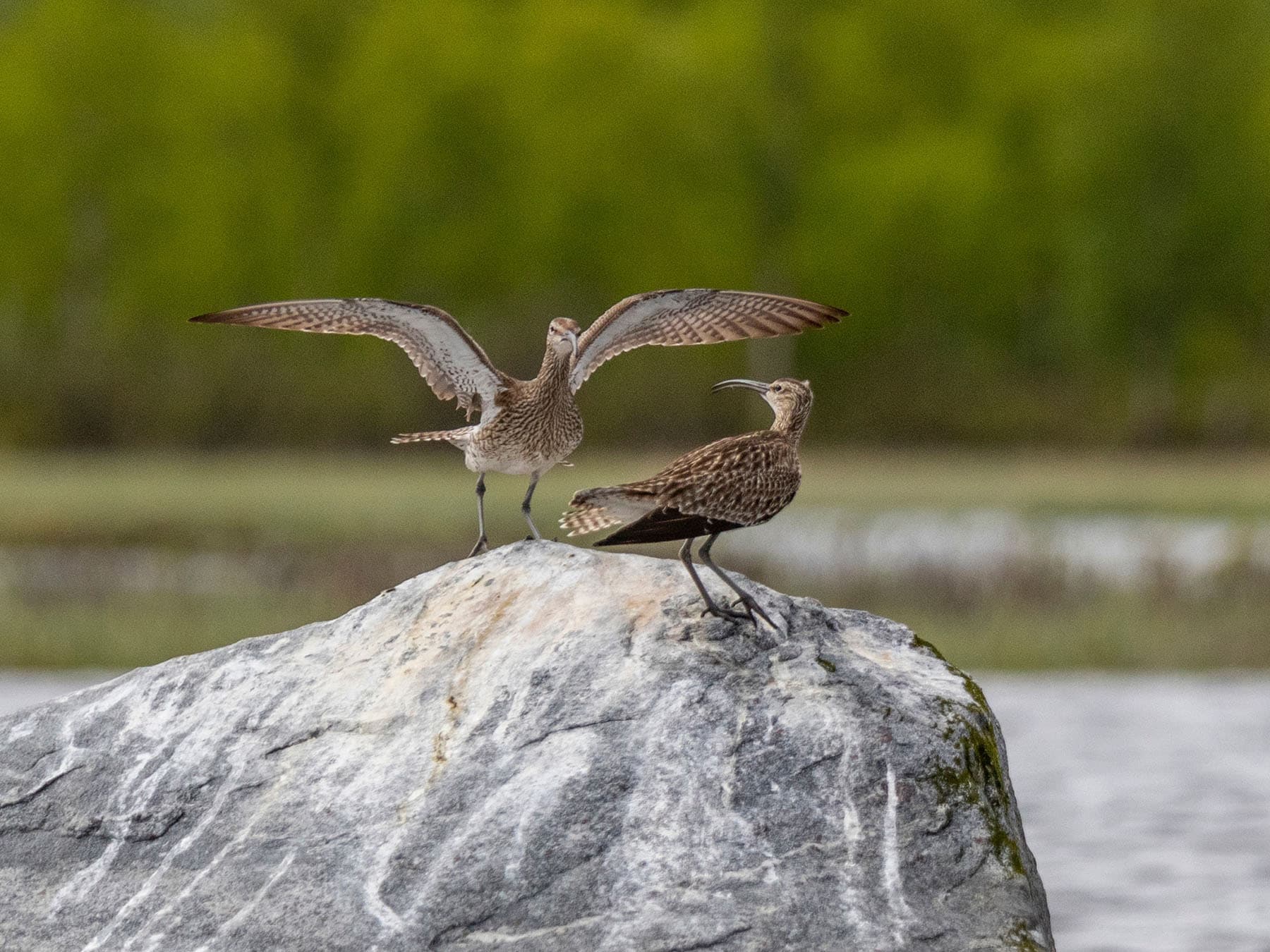
A fair amount of aggressive behaviour can be observed in breeding whimbrels, which fiercely defend their young and nest site against intruders.
When establishing a territory, clashes occur between competing males, and whimbrels have been observed to display aggressive behaviour towards humans that approach too closely.
Outside of the breeding season, whimbrels associate in large numbers on wetland shores to forage at low tide, and roost together at high tide.
Where do Whimbrels sleep at night?
Large flocks of whimbrels roost together communally outside of the breeding season, gathering at dusk on offshore islands, dunes, and marshes.
Lifespan and predators
How long do Whimbrels live?
A typical lifespan for a whimbrel is around 11 years, with breeding for the first time at two years. From ringing data, the oldest recorded whimbrel reached 24 years and 1 month.
What are the predators of Whimbrels?
Foxes and birds of prey are the leading predators of whimbrels. They are quite elusive birds, and are quite skilled at avoiding being preyed on.
Are Whimbrels protected?
Whimbrels are listed as a Schedule 1 species under the Wildlife and Countryside Act, 1981, which gives them protection against being knowingly killed, captured or injured, and protects any active nest sites and young from being disturbed.
Are Whimbrels endangered?
Whimbrels are a red list bird under the Birds for Conservation Concern guidance in the UK, meaning that their numbers have fallen to a worrying level.
Across Europe, the species is considered of least concern, although numbers have experienced a decline in recent decades, partly due to hunting along their migration routes.
Conservation
While currently listed as Least Concern, Whimbrel populations face threats from habitat loss, particularly in coastal areas and staging sites along migration routes. Climate change impacts on their Arctic breeding grounds are also a growing concern.
Conservation efforts focus on protecting key wetlands and coastal habitats.
Similar birds
Often mistaken for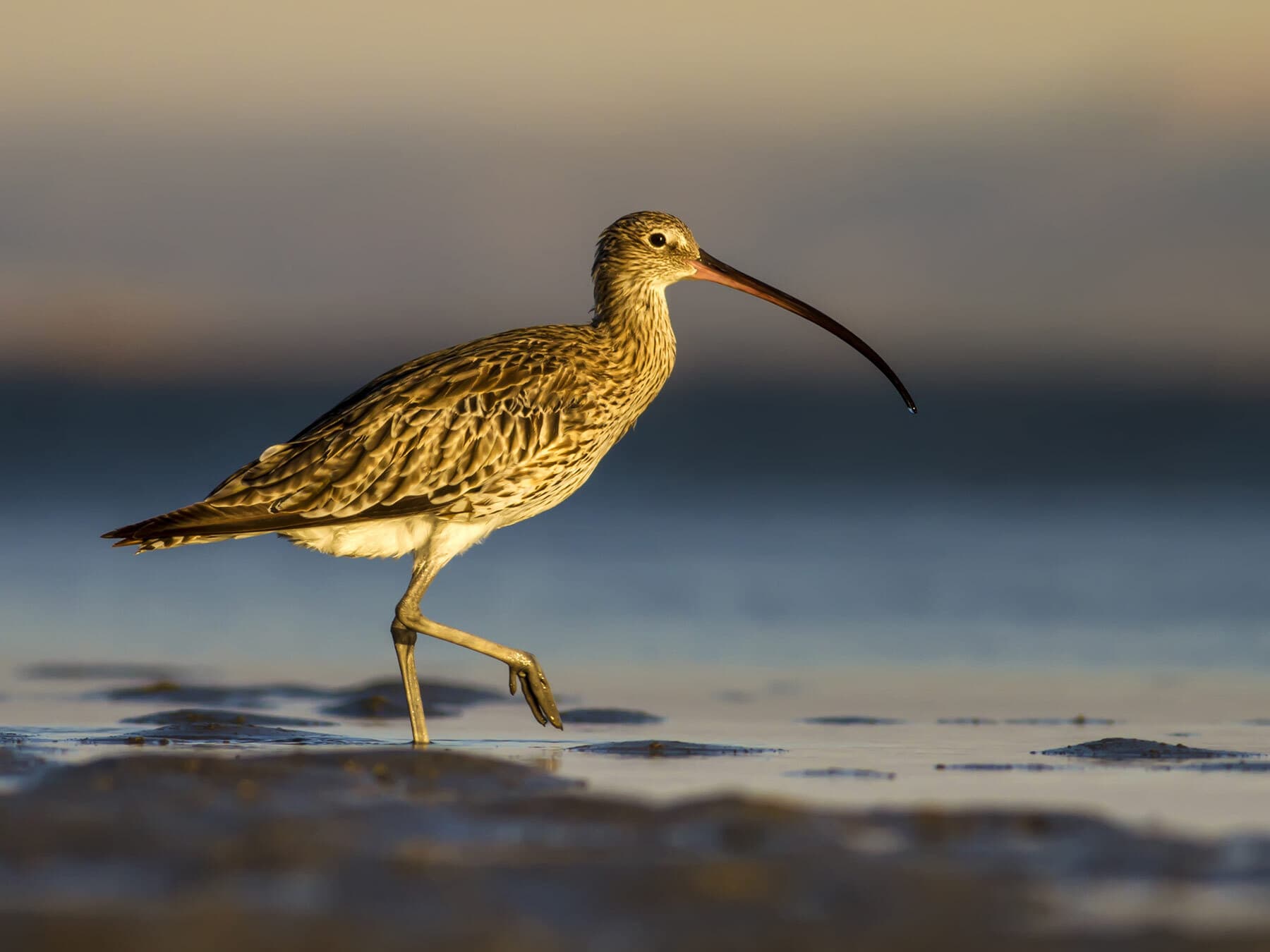
More photos
3 photos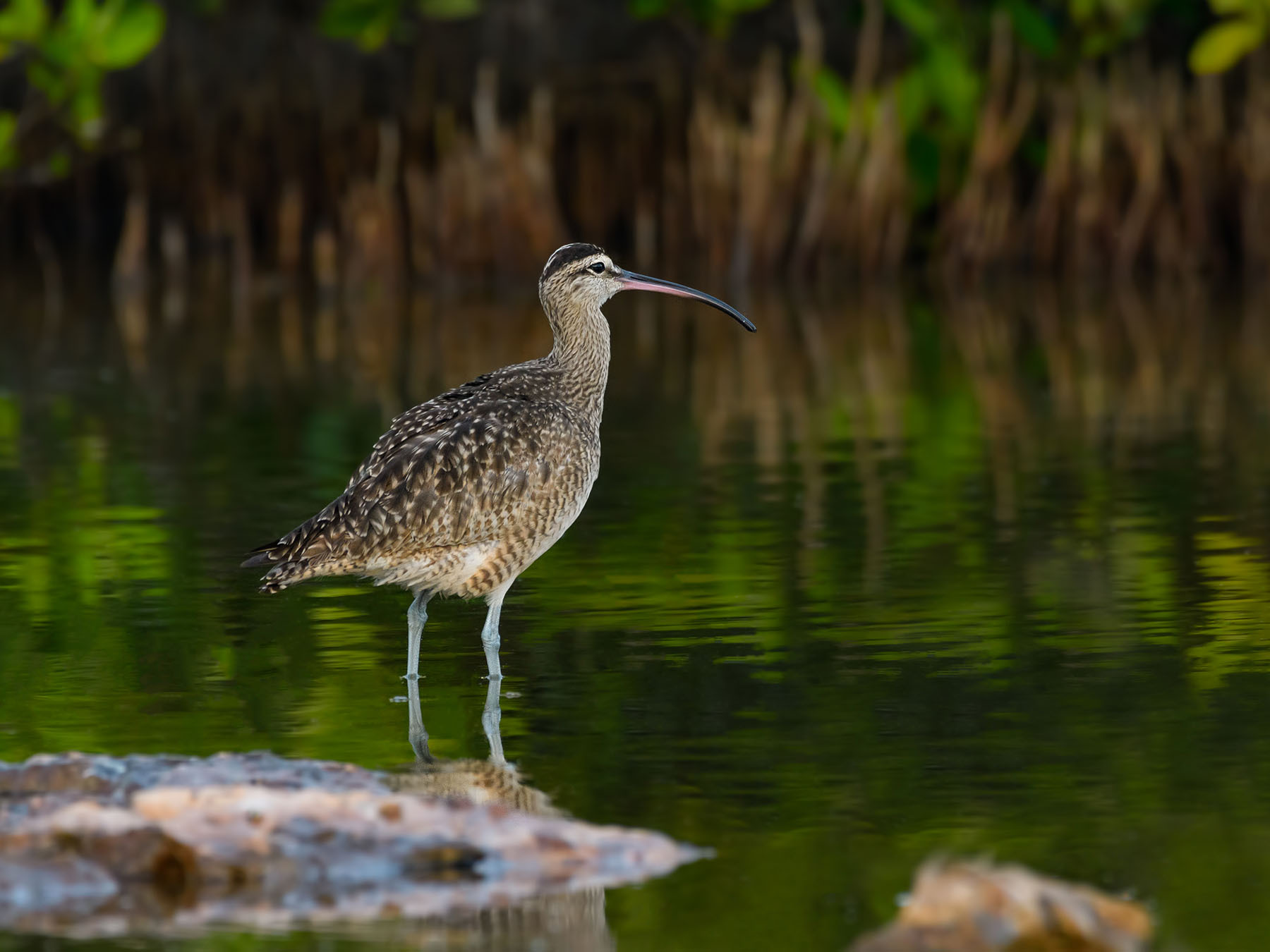
Quick facts
- Length
- 40–46 cm
- Wingspan
- 76–89 cm
- Weight
- 270–493 g
- Lifespan
- 11 years · oldest recorded 24.2 years
- Family
- Sandpipers & Snipes
- Migration
- Long-distance Migrant
- Global status (IUCN)
- Least Concern
- World population
- 1,000,000 - 2,300,000 individuals
- Population trend
- Decreasing
- Also called
- Eurasian Whimbrel, Common Whimbrel
- Scientific name
- Numenius phaeopus
Questions
1How fast do Whimbrels fly?
Whimbrels have a reputation as being strong fliers, displaying great endurance during their long-distance migrations.
One highly accomplished whimbrel, nicknamed Winnie, was tracked, completing a 5,000 km (3200 mi) distance in only 146 hours, racking up a speed of almost 22 miles per hour.
Sources
4- 1BirdLife International. 2016. Numenius phaeopus. The IUCN Red List of Threatened Species 2016: e.T22693178A86585436. Source (opens in a new tab)
- 2Wetlands International (2015)
- 3Wetlands International (2015)
- 4Robinson and Clark, The Online Ringing Report: Bird ringing in Britain & Ireland in 2011 (2012) Source (opens in a new tab)

Checked by
Nathan Cope, founder and editor
Nathan founded Birdfact and leads its writers and contributors in the UK, the US and Canada. He has watched and studied birds for more than ten years, and checks every article and species guide before it’s published.