
Wheatear
Northern Wheatear · Oenanthe oenanthe
By the Birdfact teamChecked by Nathan Cope
On this page13 sections
How to recognise it
What do Wheatears look like?
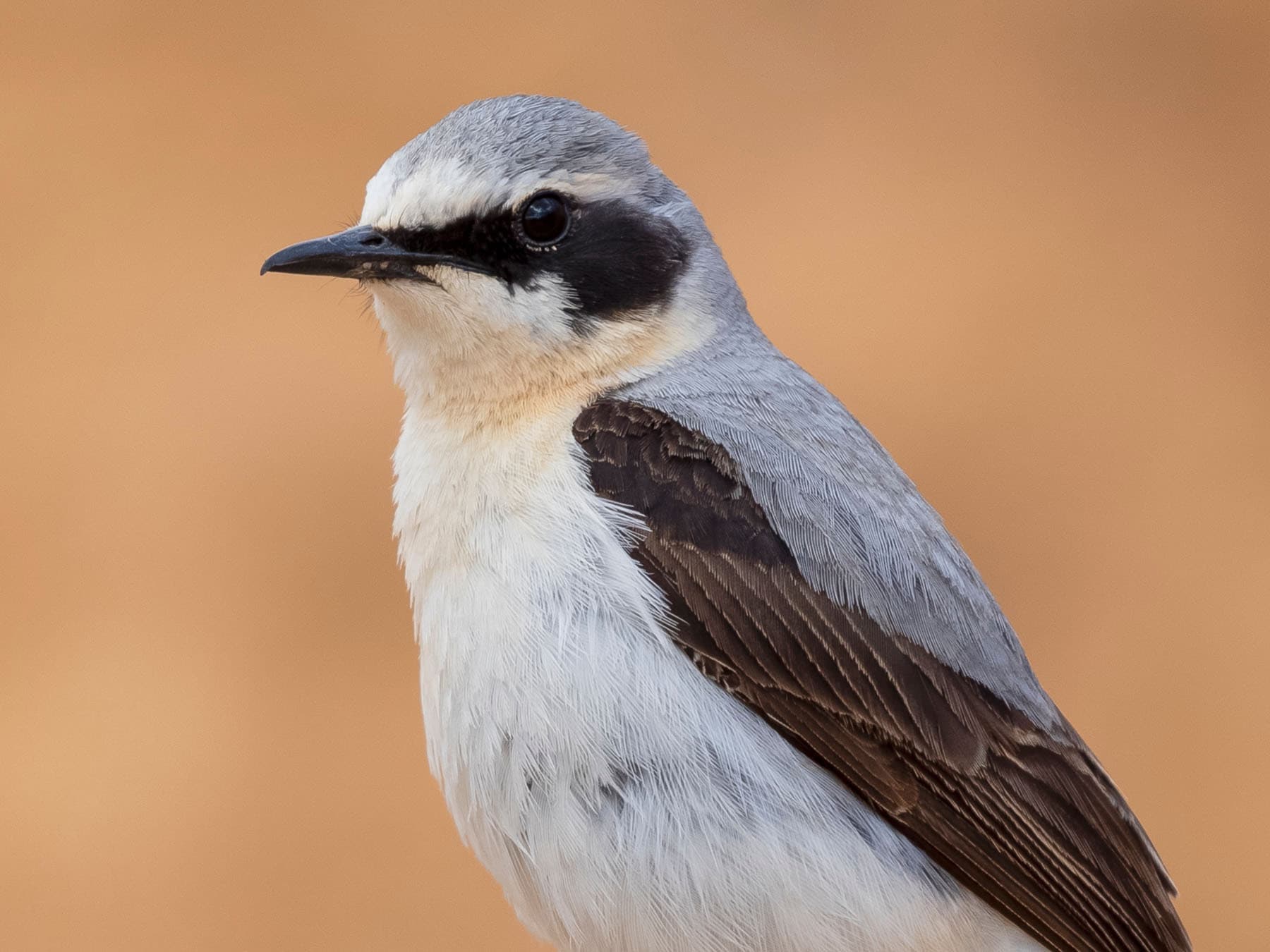
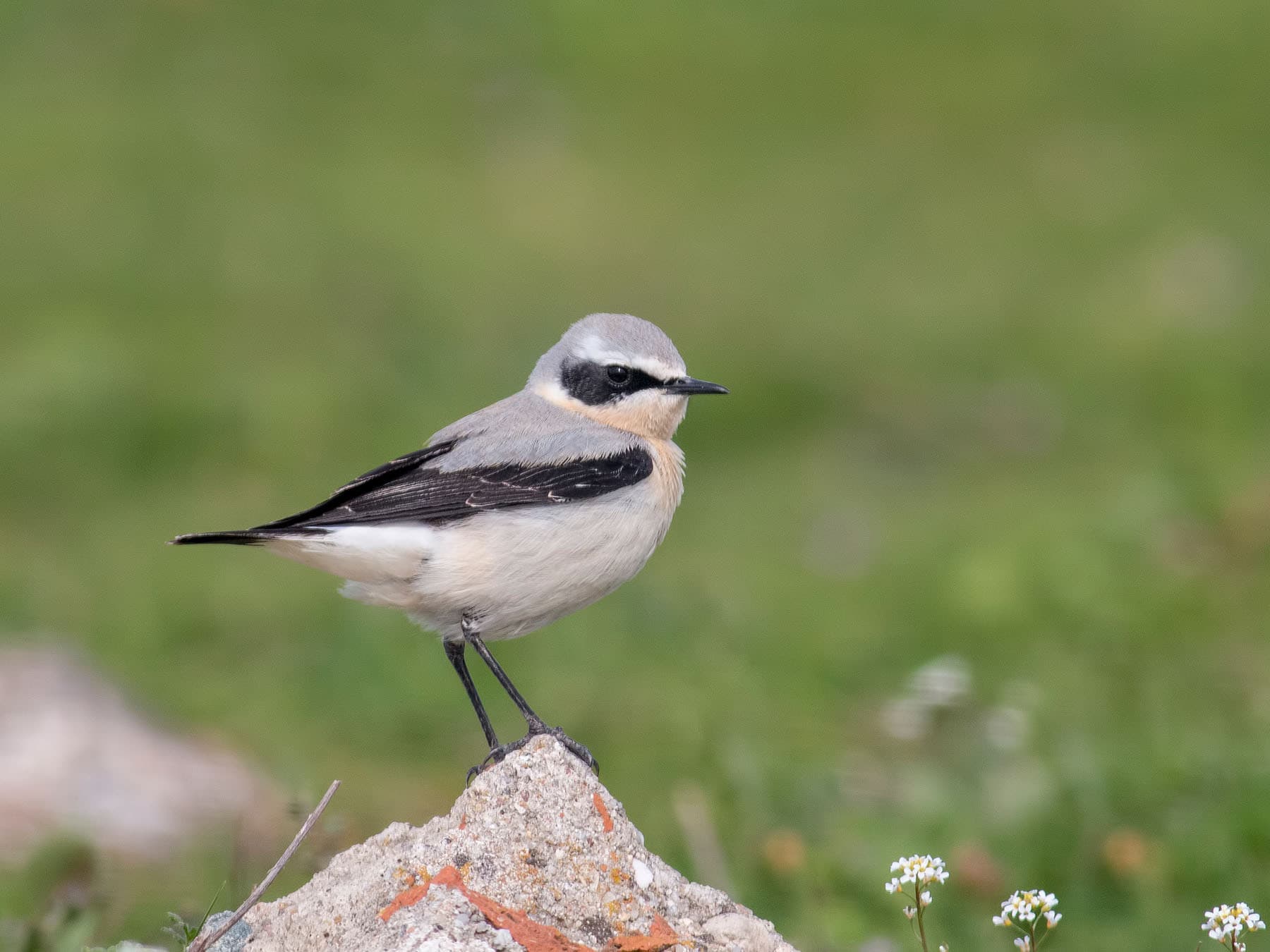
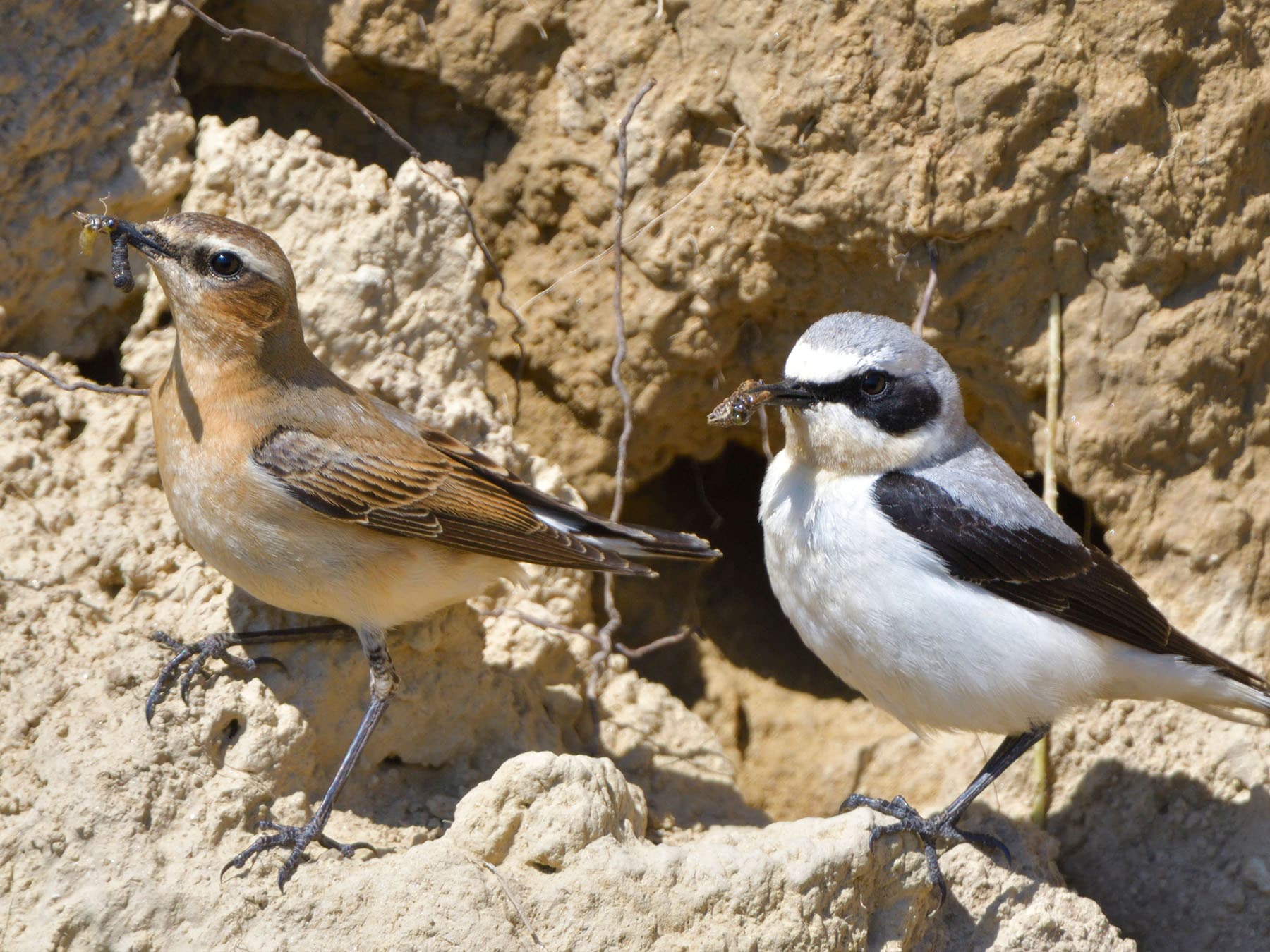
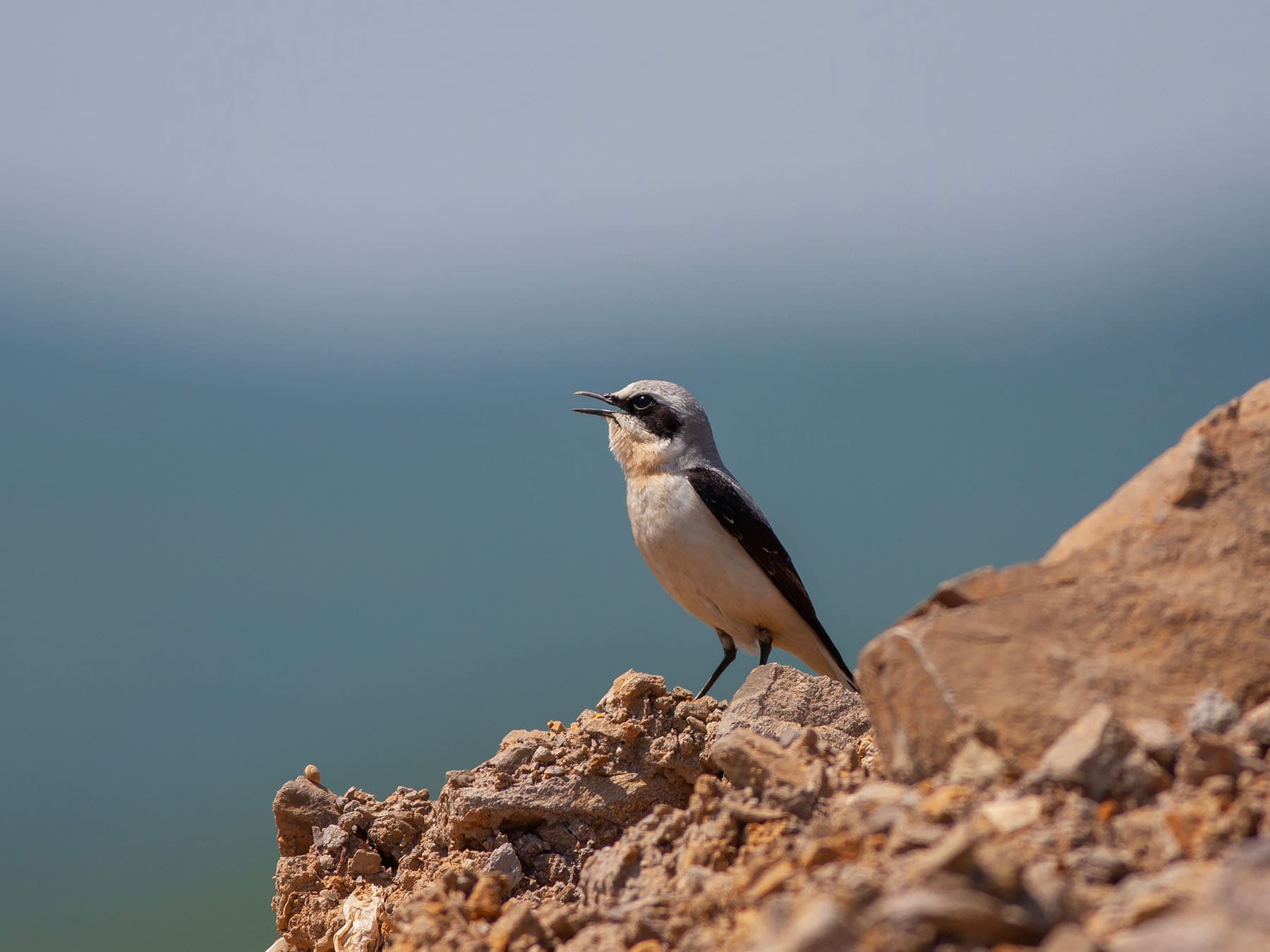
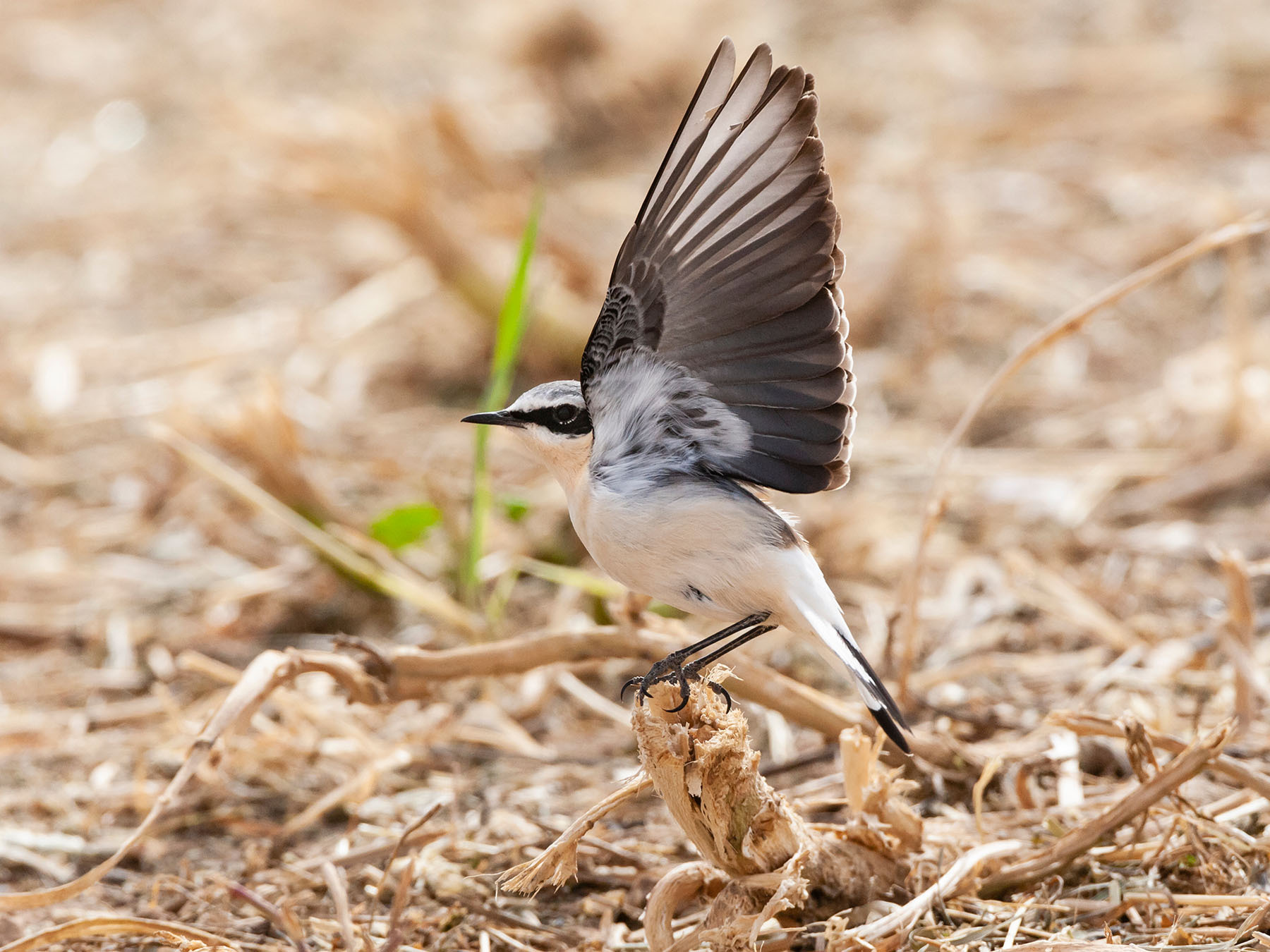
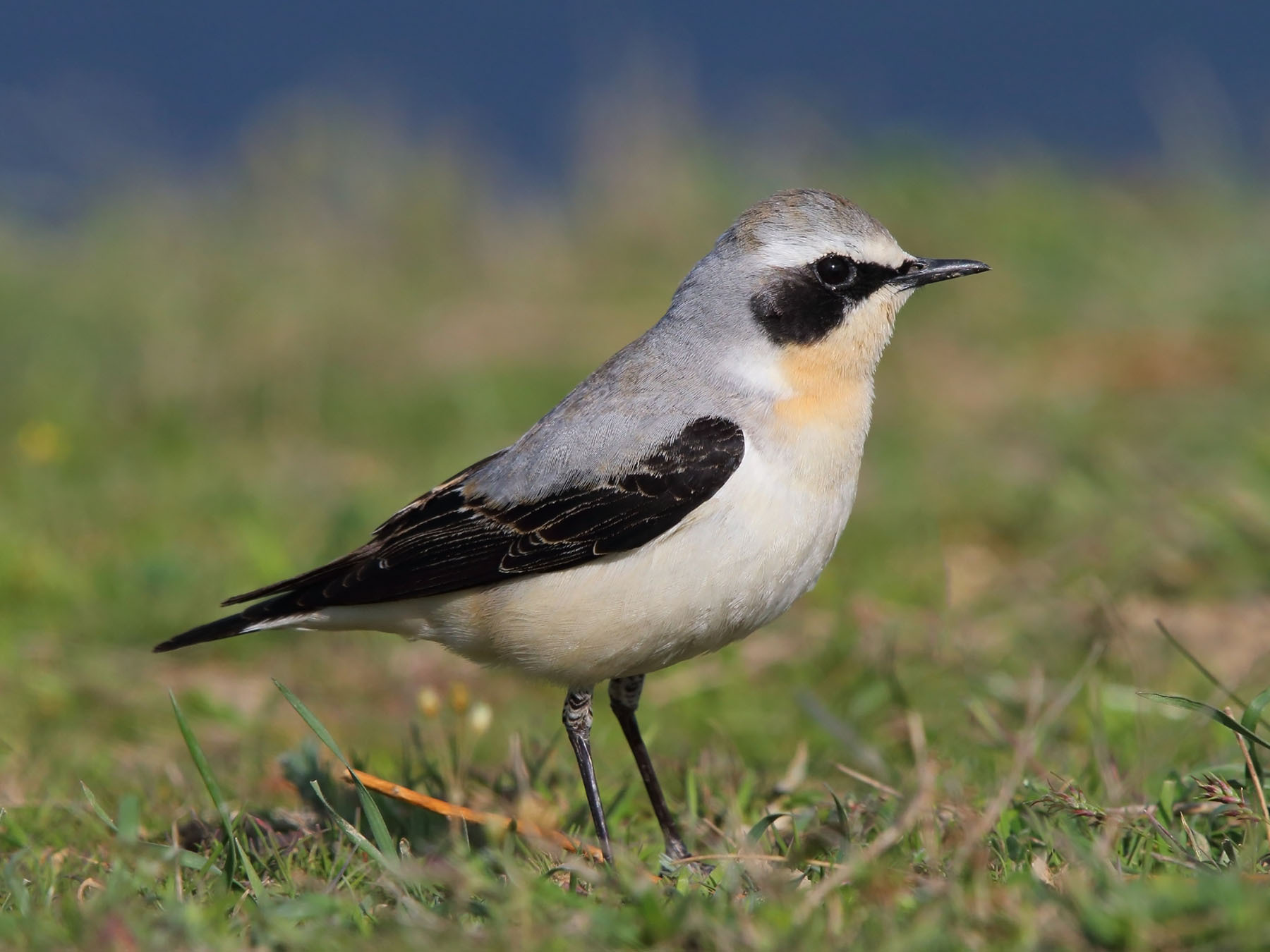
With a bandit-style black facial stripe, male wheatears certainly have a striking appearance. Other distinctive features include a white stripe above the eye and a grey crown. Their breast is pale orange, graduating into paler buff-white underparts.
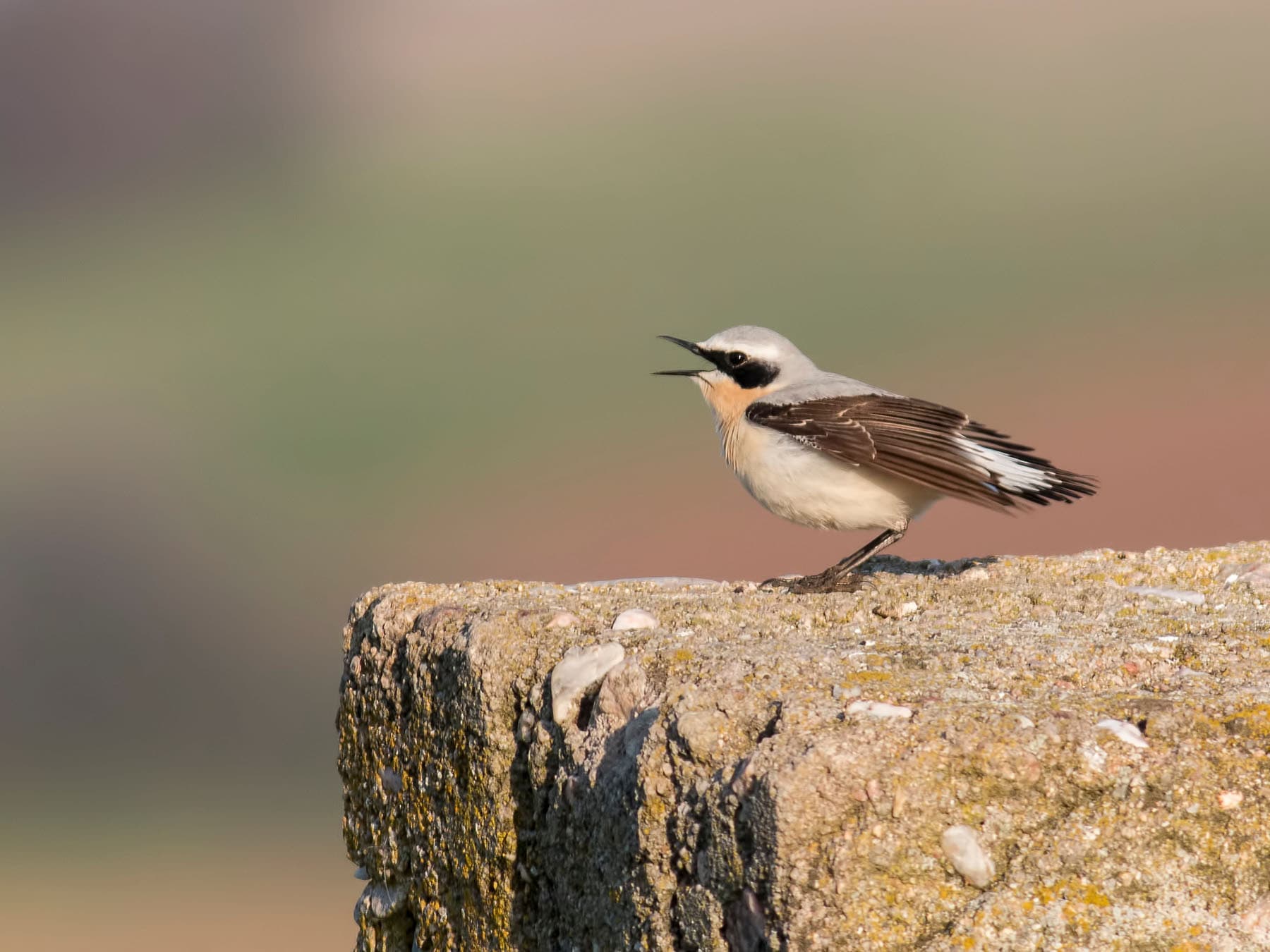
Male wheatears in breeding plumage have a grey back, black wings, and a contrasting white rump marked with a black T-shape on their tail.
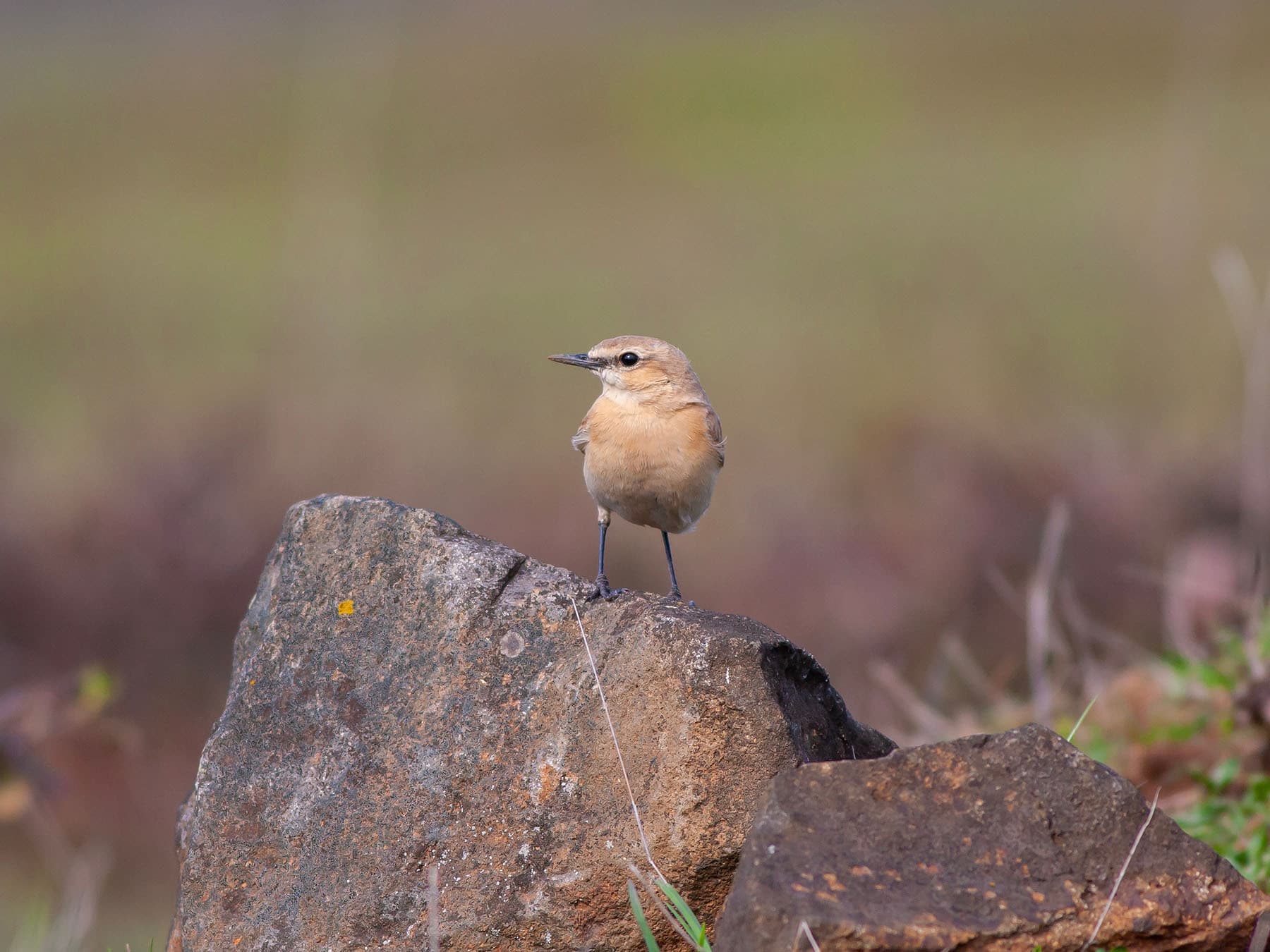
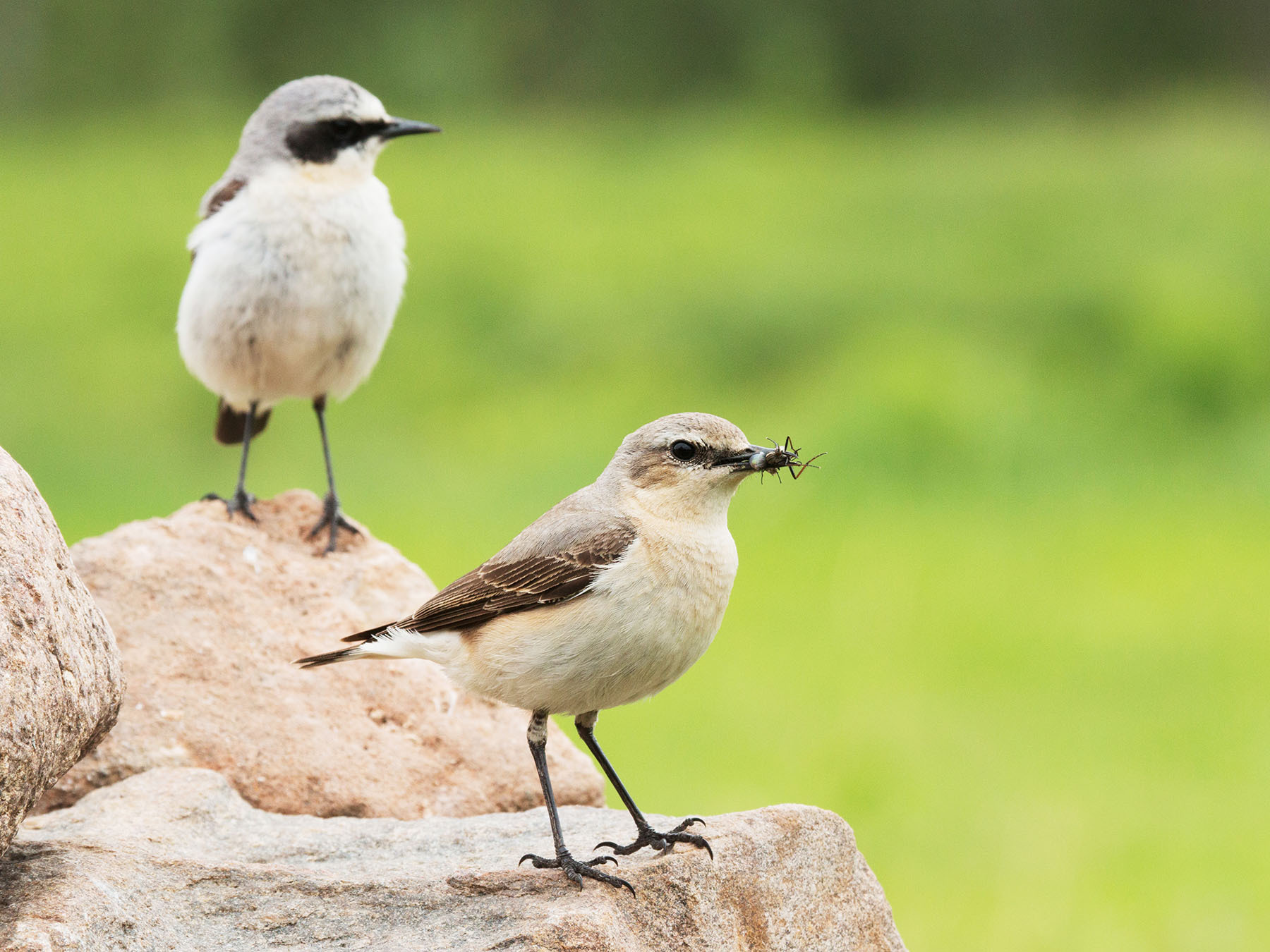
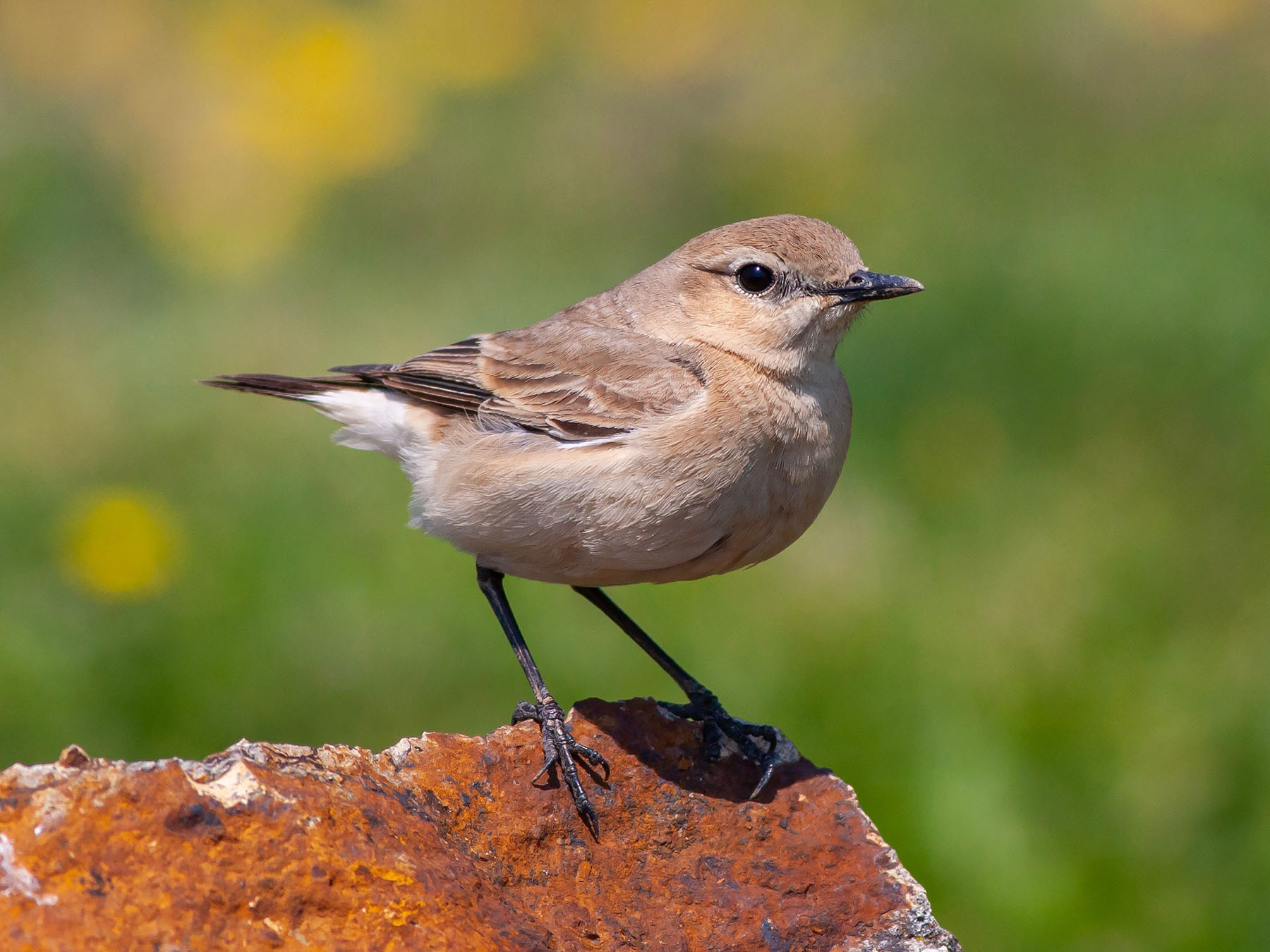
Females share the white and black tail markings and the orange-washed breast. Instead of black wings and black facial markings, those of female wheatears are dark brown, and rather than a pale grey crown and back seen on the male, the female’s are more of a dusty brown-grey shade.
Out of the breeding season, male wheatears moult into a non-breeding plumage and become less easy to distinguish from females, although the males’ wings remain black rather than dark brown.
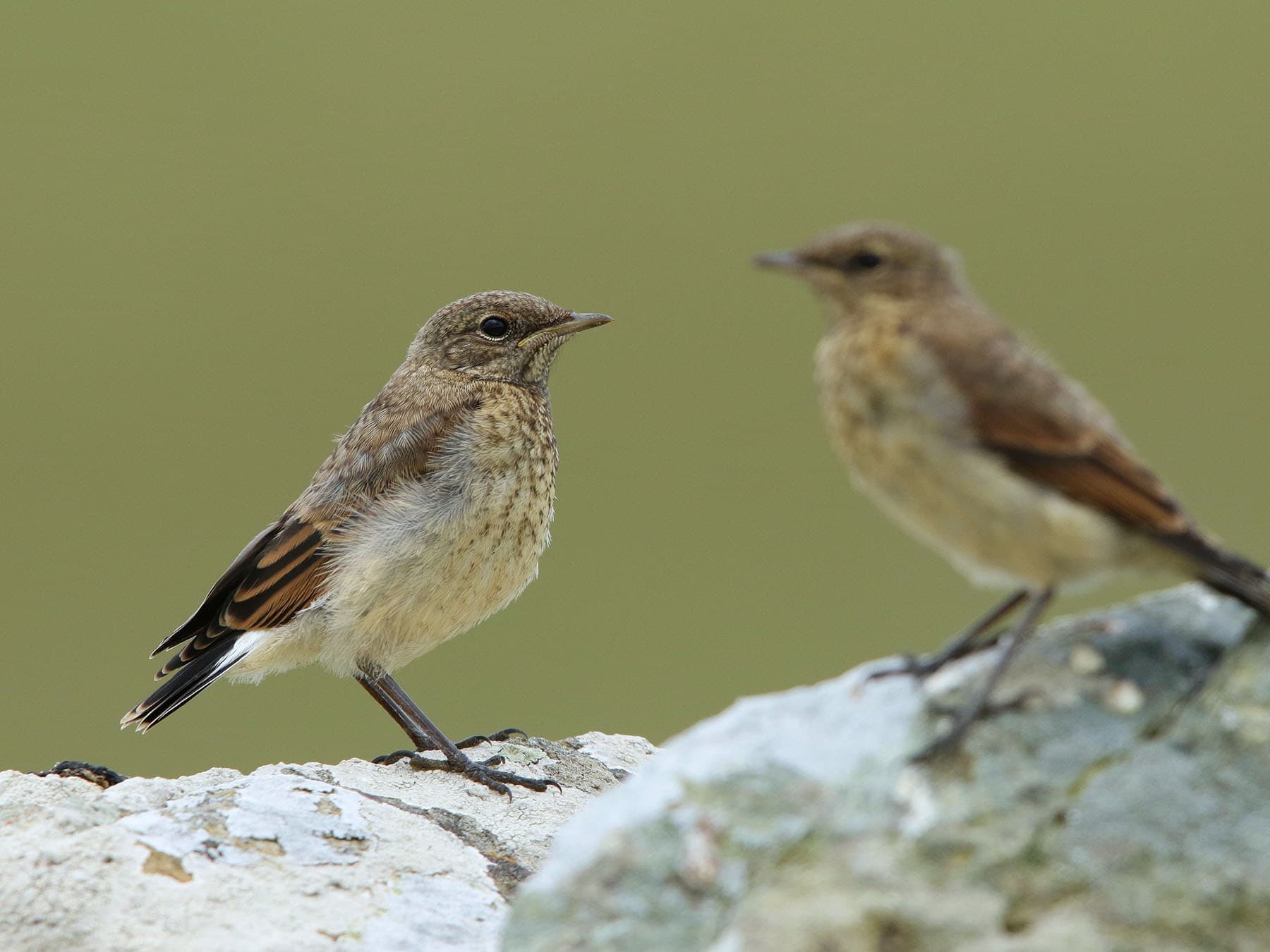
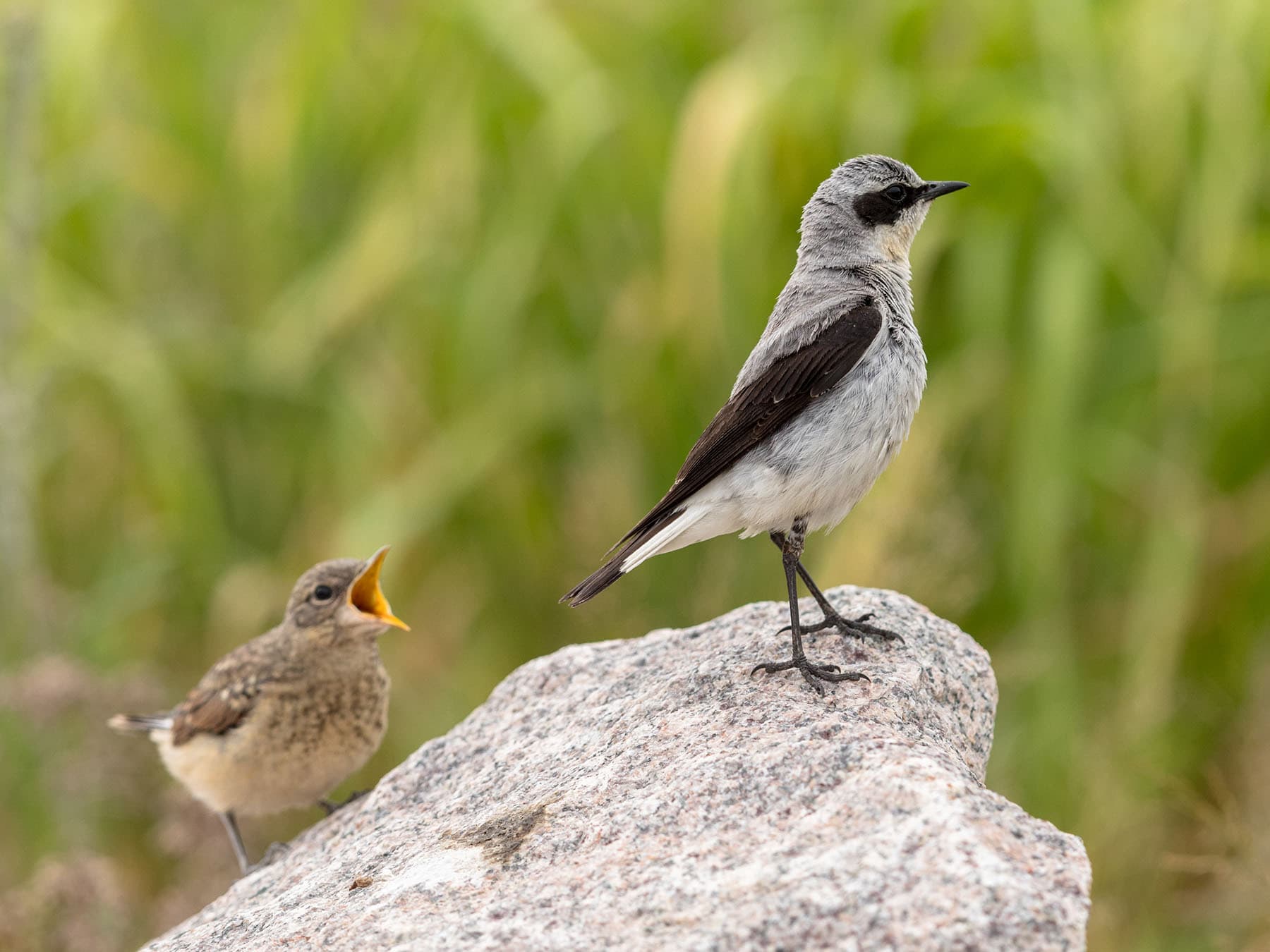
Juvenile wheatears look quite different from adults: they are speckled brown all over, with grey-brown underparts, brown wings, and a mottled grey-brown head.
How big are Wheatears?
Wheatears are slightly larger than robins, and roughly the same size as house sparrows. Males are slightly larger than females, with longer wing and tail measurements.
Overall measurement ranges for the species are as follows:
- Length: 14.5 cm to 16 cm (5.7 in to 6.3 in)
- Wingspan: 26 cm to 32 cm (10.2 in to 12.6 in)
- Weight: 17 g to 30 g (0.6 oz to 1.1 oz)
Its size
Adults- Length
- 14.5–16 cm
- Wingspan
- 26–32 cm
- Weight
- 17–30 g
Its song and calls
What sound does a Wheatear make?
Male wheatears have a number of distinct songs and subsongs that vary according to purpose and situation, including a territorial song, a conversational song and a perched song.
These cover an array of notes, from high pitched rapid notes, to repeated phrases, incorporating scratchy sounds and crackling noises.
Calls made by both males and females include a ‘tuc’ call given as alarm, and an excited ‘weet’ call, heard frequently during nest-building and defence of eggs or young.
- Song and calls0:00 / 2:15
Recorded in Kalmar County, Sweden · May 2024
- Call0:00 / 0:10
Recorded in Normandie, France · April 2023
When and where to see it
OctoberLeaving
Most recorded in October
- 1. Pembrokeshire1.2%
- 2. Shetland Islands0.98%
- 3. Orkney Islands0.92%
- 4. Bridgend0.60%
- 5. Derry0.60%
Each dot is a county, state or province: the bigger and darker, the larger the bird’s share of that place’s bird records that month. Grey dots: no regular records. The ringed point is the centre of the bird’s records this month; the arrow shows how it moved since last month, and the dashed loop its path through the year. “Arrivals” colours places where it becomes regular this month (orange) or is in its last regular month (grey). GBIF eBird Observation Dataset, 2019–2024. Map data: Natural Earth, US Census Bureau; place centres © OpenStreetMap contributors.
In your area
See when the Wheatear is recorded in your county, state or province.
How often the Wheatear turns up in the UK, Ireland, the United States and Canada through the year, from birdwatchers' records.
United Kingdom
Summer visitor · regularly Mar–Oct · most records in September
Ireland
Summer visitor · regularly Mar–Oct · most records in September
United States
Summer visitor · regularly May–Oct · most records in June
Canada
Passage migrant · regularly Jun–Oct · most records in September
Show as a table
| Month | United Kingdom | Ireland | United States | Canada |
|---|---|---|---|---|
| January | <0.001% | – | <0.001% | – |
| February | <0.001% | – | <0.001% | – |
| March | 0.11% (regular) | 0.13% (regular) | – | – |
| April | 0.38% (regular) | 0.41% (regular) | – | <0.001% |
| May | 0.28% (regular) | 0.46% (regular) | <0.001% (regular) | <0.001% |
| June | 0.14% (regular) | 0.30% (regular) | 0.003% (regular) | 0.001% (regular) |
| July | 0.13% (regular) | 0.44% (regular) | <0.001% (regular) | <0.001% (regular) |
| August | 0.32% (regular) | 0.51% (regular) | 0.001% (regular) | <0.001% (regular) |
| September | 0.47% (regular) | 0.53% (regular) | 0.002% (regular) | 0.007% (regular) |
| October | 0.16% (regular) | 0.24% (regular) | <0.001% (regular) | 0.005% (regular) |
| November | 0.004% | 0.005% | <0.001% | – |
| December | <0.001% | – | <0.001% | – |
Recorded regularly in
Worldwide: recorded regularly in 97 countries
Countries where it was recorded in at least 3 of the 6 years 2019–2024. Linked countries have their own bird list.
Europe (49)
- Åland Islands
- Albania
- Andorra
- Austria
- Belarus
- Belgium
- Bosnia & Herzegovina
- Bulgaria
- Croatia
- Czechia
- Denmark
- Estonia
- Faroe Islands
- Finland
- France
- Germany
- Gibraltar
- Greece
- Guernsey
- Hungary
- Iceland
- Ireland
- Isle of Man
- Italy
- Jersey
- Kosovo
- Latvia
- Liechtenstein
- Lithuania
- Luxembourg
- Malta
- Moldova
- Montenegro
- Netherlands
- North Macedonia
- Norway
- Poland
- Portugal
- Romania
- Russia
- Serbia
- Slovakia
- Slovenia
- Spain
- Svalbard & Jan Mayen
- Sweden
- Switzerland
- Ukraine
- United Kingdom
Africa (20)
Asia (24)
- Armenia
- Azerbaijan
- Bahrain
- China
- Cyprus
- Georgia
- India
- Iran
- Iraq
- Israel
- Jordan
- Kazakhstan
- Kuwait
- Kyrgyzstan
- Lebanon
- Mongolia
- Oman
- Palestinian Territories
- Qatar
- Saudi Arabia
- Tajikistan
- Turkey
- United Arab Emirates
- Uzbekistan
North America (4)
- Bermuda
- Canada
- Greenland
- United States
Data: EOD – eBird Observation Dataset (Cornell Lab of Ornithology), accessed via GBIF.org, CC BY 4.0. Records from 2019–2024, aggregated and filtered by Birdfact. How these lists are made
What is the habitat of a Wheatear?
Typical breeding habitats for wheatears are upland landscapes with sparse vegetation and rocky landforms. Grassy meadows, heathland, dry plains, steppe lands and tundra, are all characteristic breeding sites. Long grass and densely forested regions are avoided.
In winter, barren rocky land and cultivated fields provide the necessary foraging opportunities for wheatears, while large trees that offer shade are important in their non-breeding territories.
What is the range of a Wheatear?
Wheatears’ breeding range extends from Iceland in the west to Mongolia in the east.
Norway, Sweden, Finland and Russia form the northern extreme of their range, while the species regularly breed across the Pyrenees, the Alps, Greece, and Turkey. Breeding grounds are also established in Pakistan and Afghanistan.
Wheatears have a scattered presence in North America, with some breeding occurring in Alaska and in parts of northern Canada.
The non-breeding range of wheatears spreads from Mauritania and Mali in West Africa, to Sudan and Somalia in the east, and south to Tanzania. Less commonly, overwintering wheatears are observed as far south as Zimbabwe, Zambia and South Africa.
Where do Wheatears live?
According to population estimates in the 1990s, around 2 million breeding pairs of wheatears lived in Scandinavia, with up to 10 million more pairs in European Russia, and as many as 500,000 in Turkey.
Wheatear numbers in the Netherlands witnessed a dramatic decline of around 87 percent between 1990 and 2010, while in Germany the species now is threatened with extinction.
How rare are Wheatears?
Up to 280,000 wheatear pairs arrive in the UK to breed each year, remaining on their local territories between March and October.
During this time, and in the appropriate environments of rocky uplands, the species is considered relatively widespread, and sightings are not classed as anything too unusual.
Where can you see Wheatears in the UK?
The UK’s presence of wheatears reaches its peak in the summer, with arrivals of the species from March onwards, and departure for wintering grounds underway by October.
The highest concentrations of wheatears in the UK are found on open uplands throughout much of Scotland and Wales and also in northern, western and south-western England.
Some breeding occurs in southern and central England. You may also stand a chance of seeing the species in coastal regions during migration passage.
Migration
Do Wheatears migrate?
Wheatears are a fully migratory species, with almost the entire global population heading to sub-Saharan Africa in the autumn.
Where do Wheatears go in winter?
Central Africa, south of the Sahara, is the winter destination of the vast majority of the world’s wheatears, with a small population overwintering in Iraq.
Tips for seeing it
- Look for their distinctive white rump in flight
- Watch for their characteristic tail-bobbing behaviour
- Search open, rocky areas or short-grass habitats
- Listen for their sharp 'chack' call
- In the UK, observe coastal areas during spring and autumn migrations
What it eats
What do Wheatears eat?
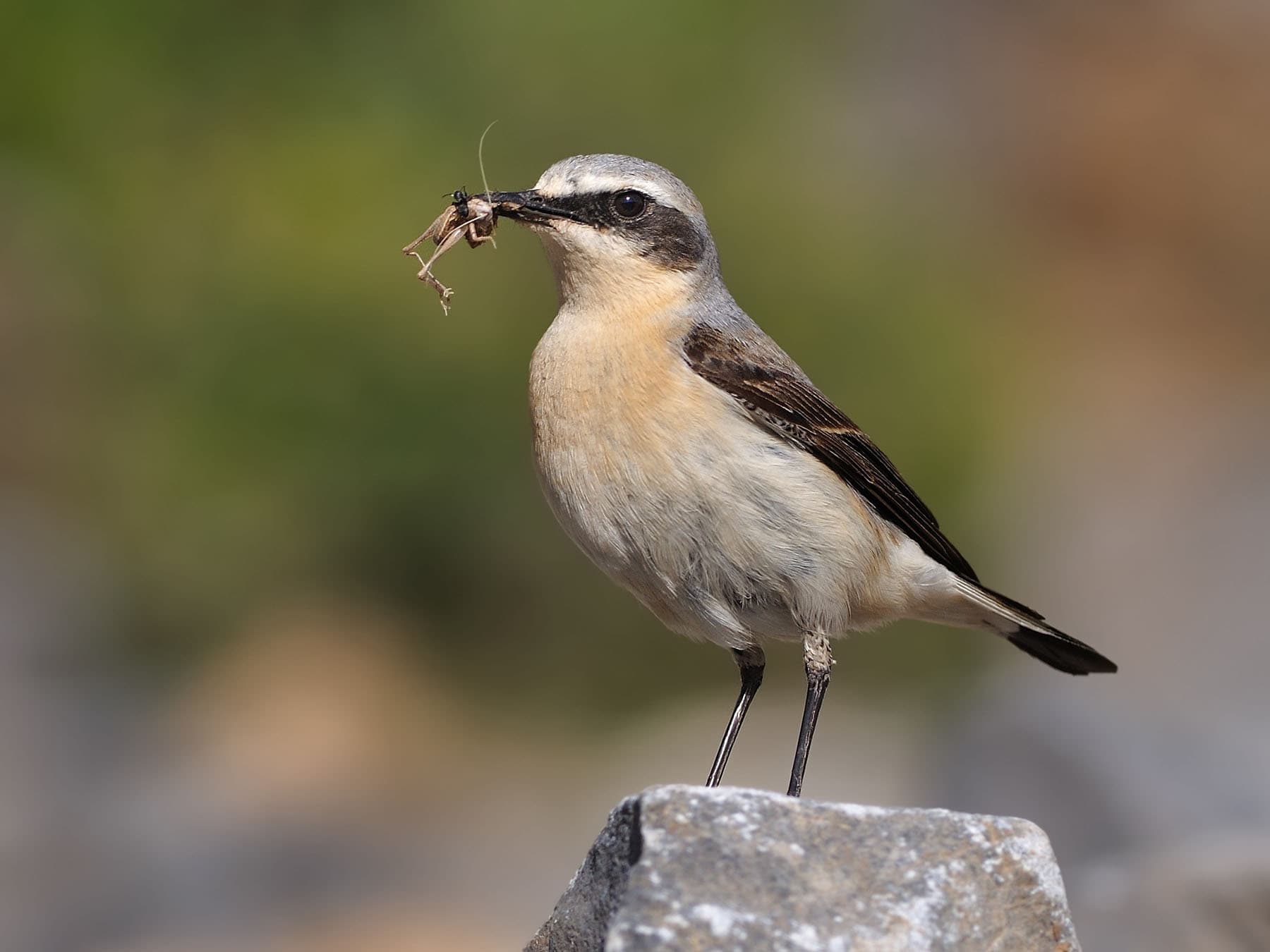
Wheatears spend a large proportion of their lives hopping on the ground, foraging in short grass or stony land for insects, larvae and spiders. They use a ‘hop and peck’ tactic to catch prey, particularly beetles, grasshoppers, woodlice, caterpillars, and sometimes snails.
In late summer and autumn, berries are also eaten, especially those growing on low shrubbery including blackberries, crowberries and bilberries. Rowan, juniper and elderberry are also taken, as well as a variety of seeds.
What do baby Wheatears eat?
Studies show that juvenile wheatears follow a similar diet to their parents, with spiders, larvae, bees, and beetles being fed. Within three weeks of fledging, young wheatears begin to have moderate success in catching their own prey.
Nesting and breeding
Where do Wheatears nest?
It’s most common for wheatears to use nest sites at or close to ground level, and abandoned animal burrows, cracks or crevices between rocks, gaps in wood piles, and hollows at the base of tree roots are the top choices.
Nest sites are chosen by females, and a complicated nest structure, featuring a foundation, a cradle and an inner cup are crafted using stems, roots, feathers, moss and animal hair.
What do Wheatear eggs look like?
Eggs are pale blue to blue-green, smooth and slightly glossy and mostly unmarked, although some slight red-brown speckling may be present.
The earliest clutches are laid in early May, and contain between 4 and 7 eggs. Females alone are responsible for incubation, although males remain nearby, and once the young have hatched (after 13 to 15 days), both parents work together to feed their hatchlings.
Do Wheatears mate for life?
A typically seasonally monogamous species, wheatear pairs raise up to two broods together before departing for their wintering grounds. Some examples of polygamous breeding have occasionally been observed.
Behaviour
Are Wheatears aggressive?
Territorial aggression may be witnessed during the breeding season with hostile displays to reinforce a territory or warn other males off a female mate.
Aggressive warning calls may be heard, and plumage displays, showing off the white tail rump, are characteristic of clashes between rival males.
Where do Wheatears sleep at night?
Wheatears roost singly in clumps of grass or tucked into heather tussocks, on low perches, or in crevices between or beneath rocks.
Lifespan and predators
How long do Wheatears live?
The typical lifespan of a wheatear is between 1 and 2 years, with breeding occurring for the first time at 1 year. Less than 2 percent of birds survive longer than 5 years, although the longevity record for the species was recorded in 2017 by a 10-year-old wheatear.
What are the predators of Wheatears?
As a ground-nesting species, wheatears are particularly vulnerable to predation by mammals and snakes that share their habitats, including foxes, weasels, badgers, and domestic cats.
Birds of prey, in particular merlins and peregrine falcons, are among the chief avian predators of juvenile and adult wheatears, while their nests and young hatchlings are commonly targeted by gulls, crows and ravens.
Are Wheatears protected?
As is typical for the majority of wild bird species that breed in the UK, wheatears are protected under the Wildlife and Countryside Act, 1981. This legislation makes it an offence to knowingly kill, injure or capture a wheatear, or to damage or destroy their nests and eggs.
Are Wheatears endangered?
Across their entire range, wheatears are classified as a species of least concern. However, in the UK, they are ranked in the Amber category as a Bird Species of Conservation Concern.
In Germany, wheatears are threatened with extinction, and their numbers have fallen dramatically in Sweden and the Netherlands.
Conservation
While globally listed as Least Concern, Wheatear populations are declining in parts of Europe due to habitat loss and agricultural intensification.
Climate change may affect their Arctic breeding grounds. Conservation efforts focus on maintaining suitable breeding and stopover habitats.
More photos
5 photos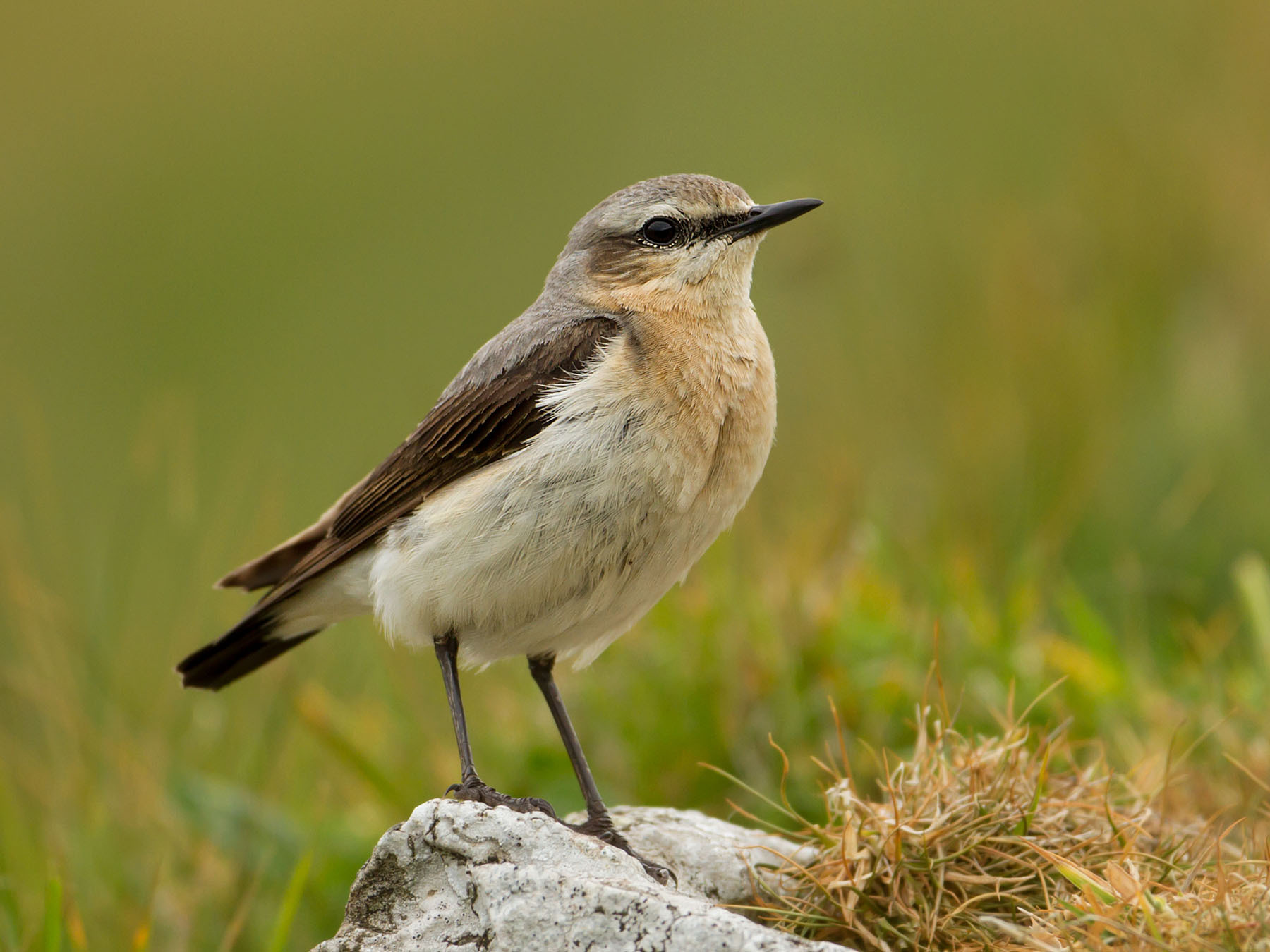
Quick facts
- Length
- 14.5–16 cm
- Wingspan
- 26–32 cm
- Weight
- 17–30 g
- Lifespan
- 1–2 years · oldest recorded 10.1 years
- Family
- Old World Flycatchers
- Migration
- Long-distance Migrant
- Global status (IUCN)
- Least Concern
- World population
- 10,600,000 - 31,500,000 mature individuals (Europe)
- Population trend
- Decreasing
- Also called
- Northern Wheatear
- Scientific name
- Oenanthe oenanthe
Questions
3How many Wheatears are there in the UK?
An estimated 280,000 pairs of wheatears arrive in the UK each spring ahead of the breeding season. By October, breeding is complete, and all of these visiting birds have departed for their African wintering territories.
How to attract Wheatears?
Wheatears seek a rather specific landscape for nesting, and are unlikely to turn up at your back garden feeders or in heavily residential areas. They live on rocky uplands, moors and heaths, and forage on cultivated fields and grassland meadows.
Why is it called a Wheatear?
Contrary to what you might initially think, the wheatear’s name has no association whatsoever with ears or wheat. Instead, the name’s roots lie in the Old English for ‘white’ and ‘arse’, referring to the white rump of the wheatear’s plumage.
Sources
4- 1BirdLife International. 2018. Oenanthe oenanthe. The IUCN Red List of Threatened Species 2018: e.T103773898A132192232. Source (opens in a new tab)
- 2EBCC (2015)
- 3BirdLife International. 2018. Oenanthe oenanthe. The IUCN Red List of Threatened Species 2018: e.T103773898A132192232. Source (opens in a new tab)
- 4Fransson et al., EURING list of longevity records for European birds (2010) Source (opens in a new tab)

Checked by
Nathan Cope, founder and editor
Nathan founded Birdfact and leads its writers and contributors in the UK, the US and Canada. He has watched and studied birds for more than ten years, and checks every article and species guide before it’s published.