


Water Rail
European Water Rail, Western Water Rail · Rallus aquaticus
By the Birdfact teamChecked by Nathan Cope
On this page13 sections
How to recognise it
What do Water Rails look like?
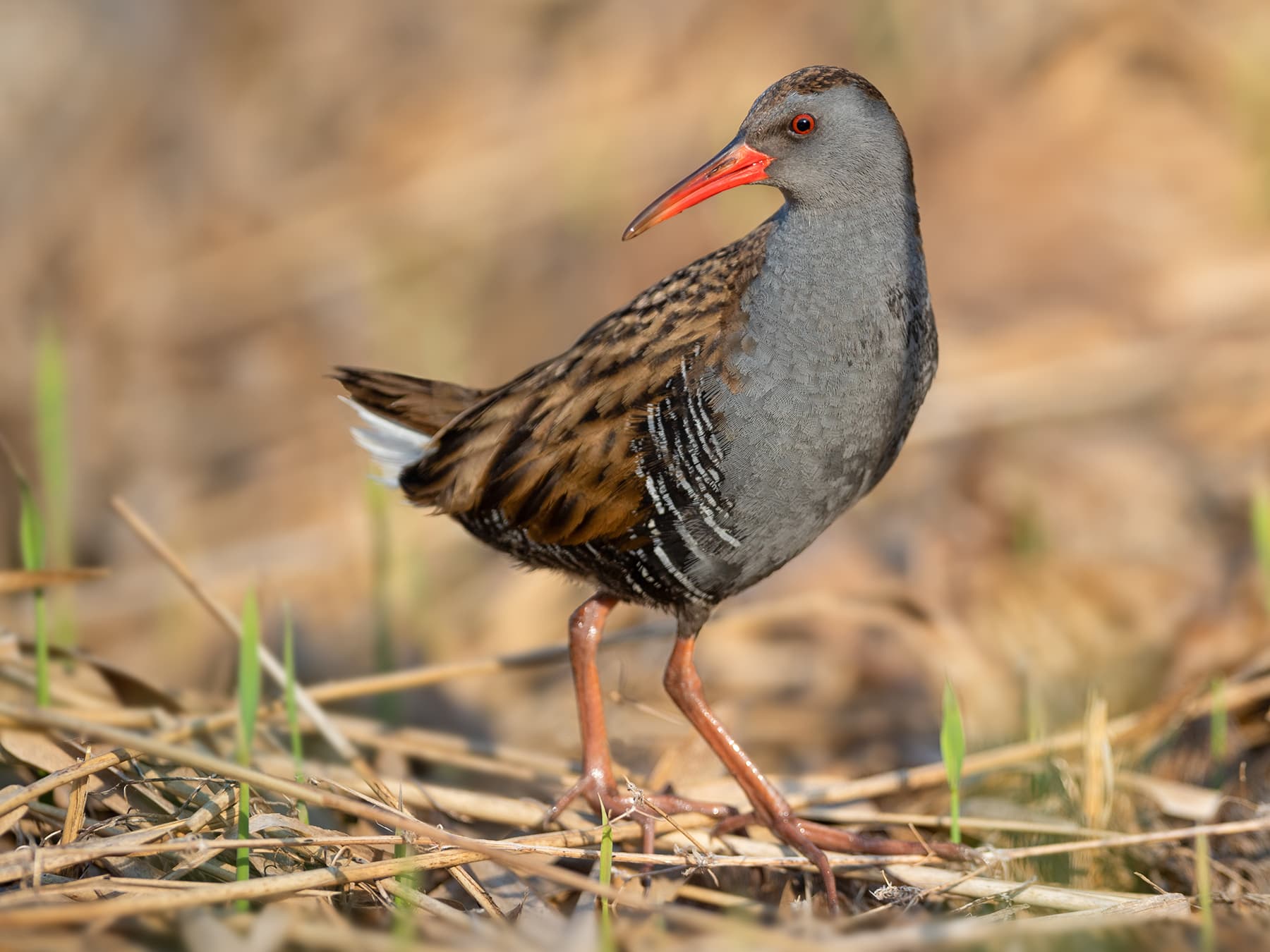
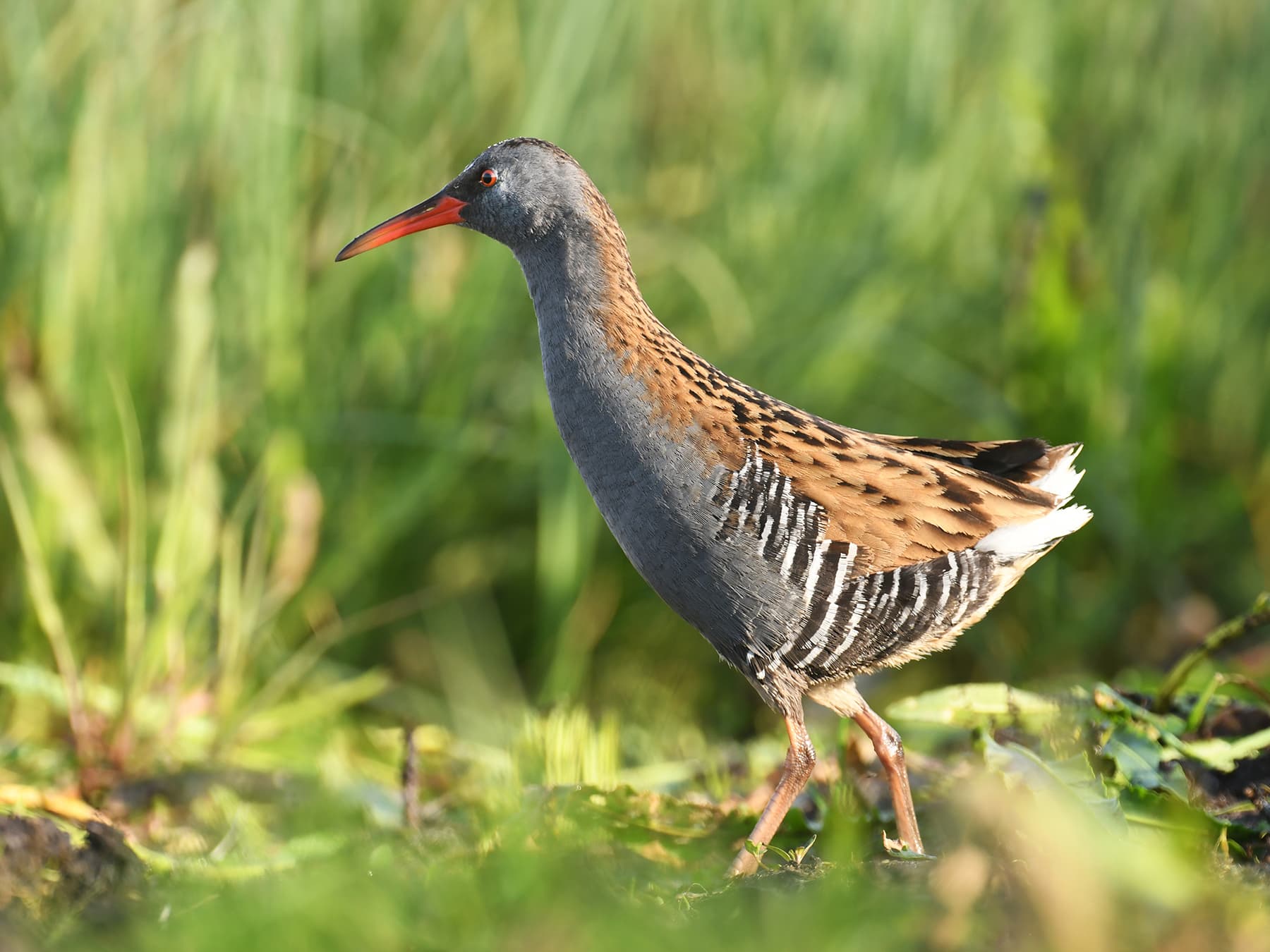
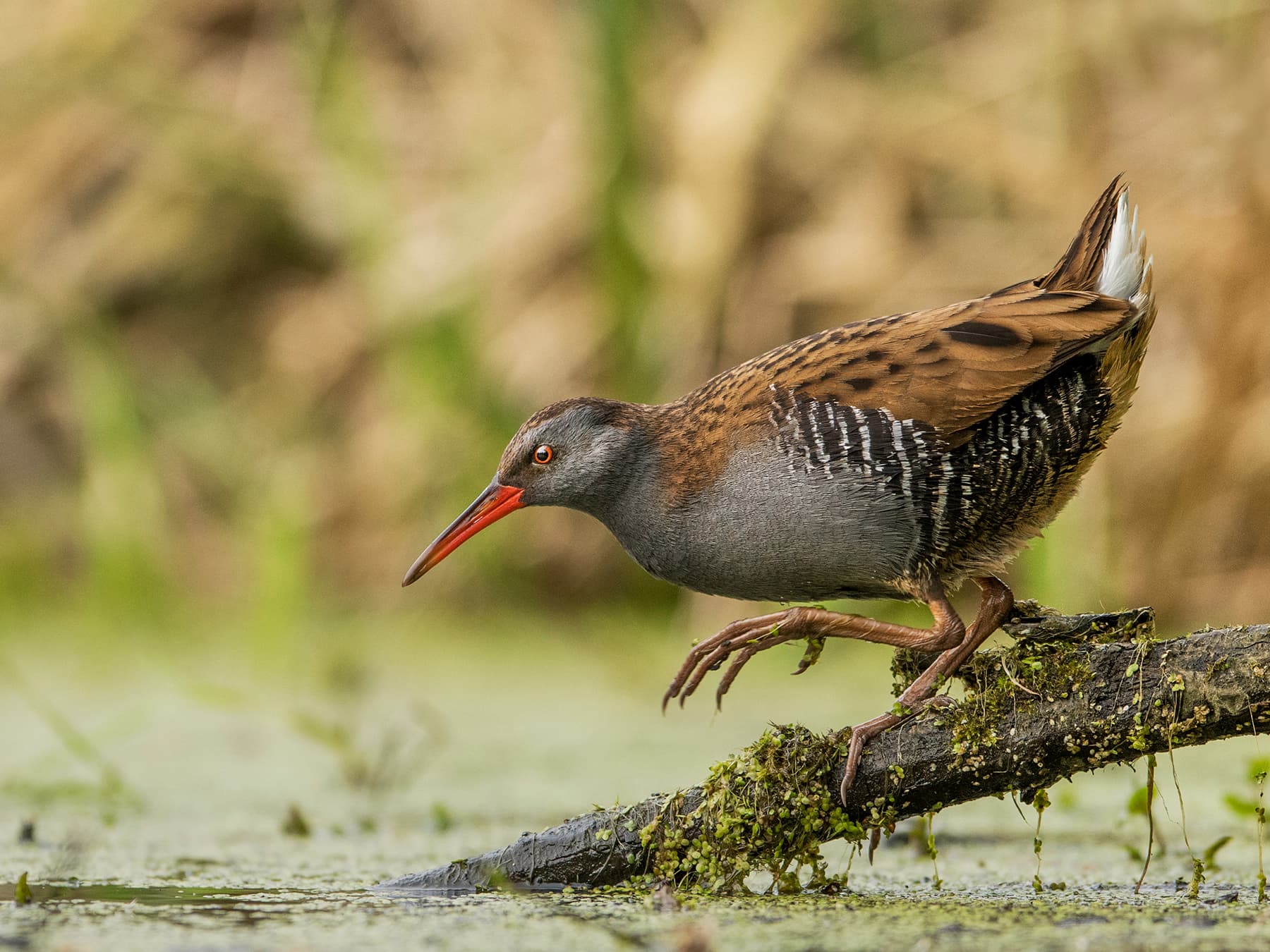
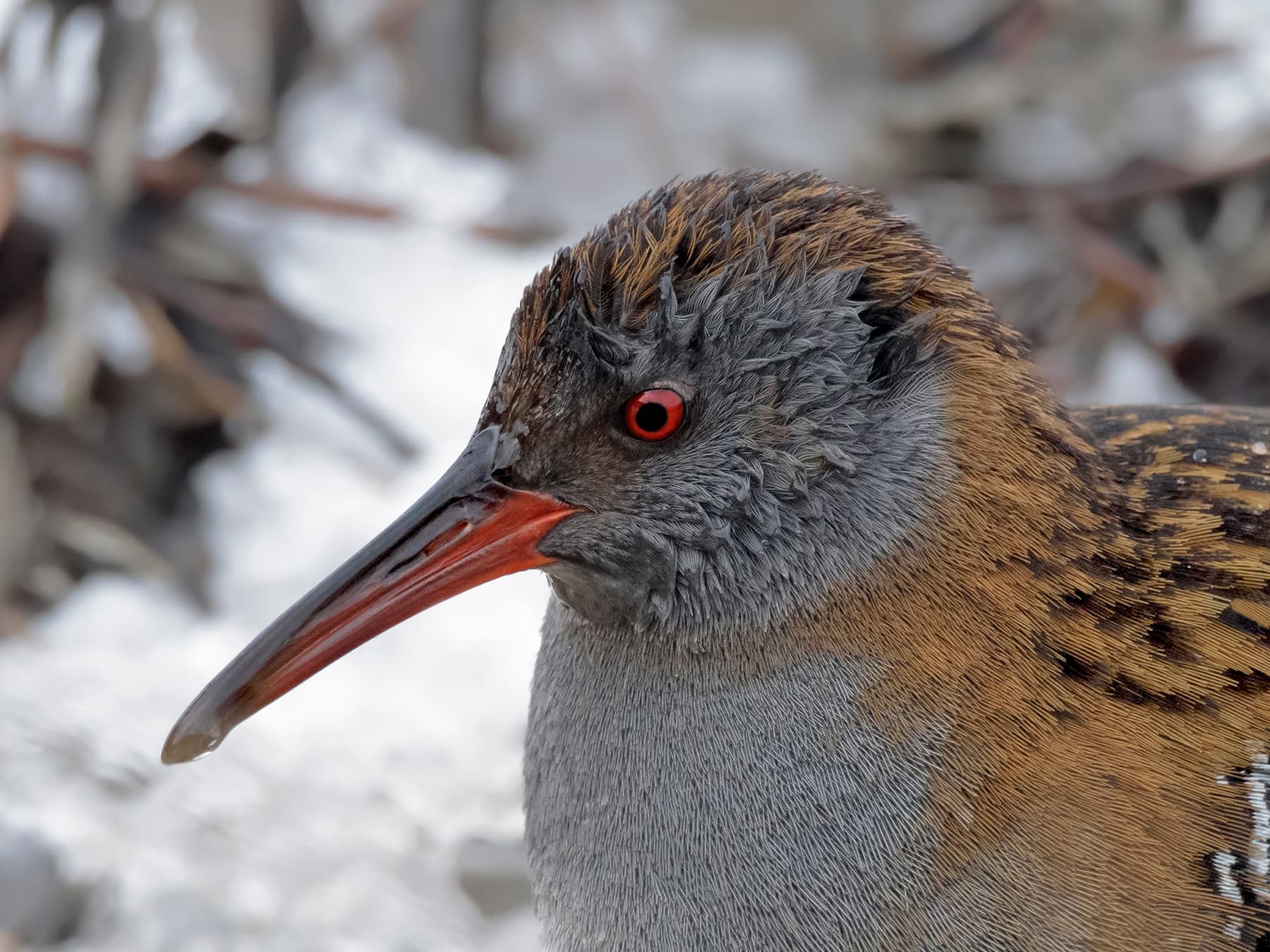
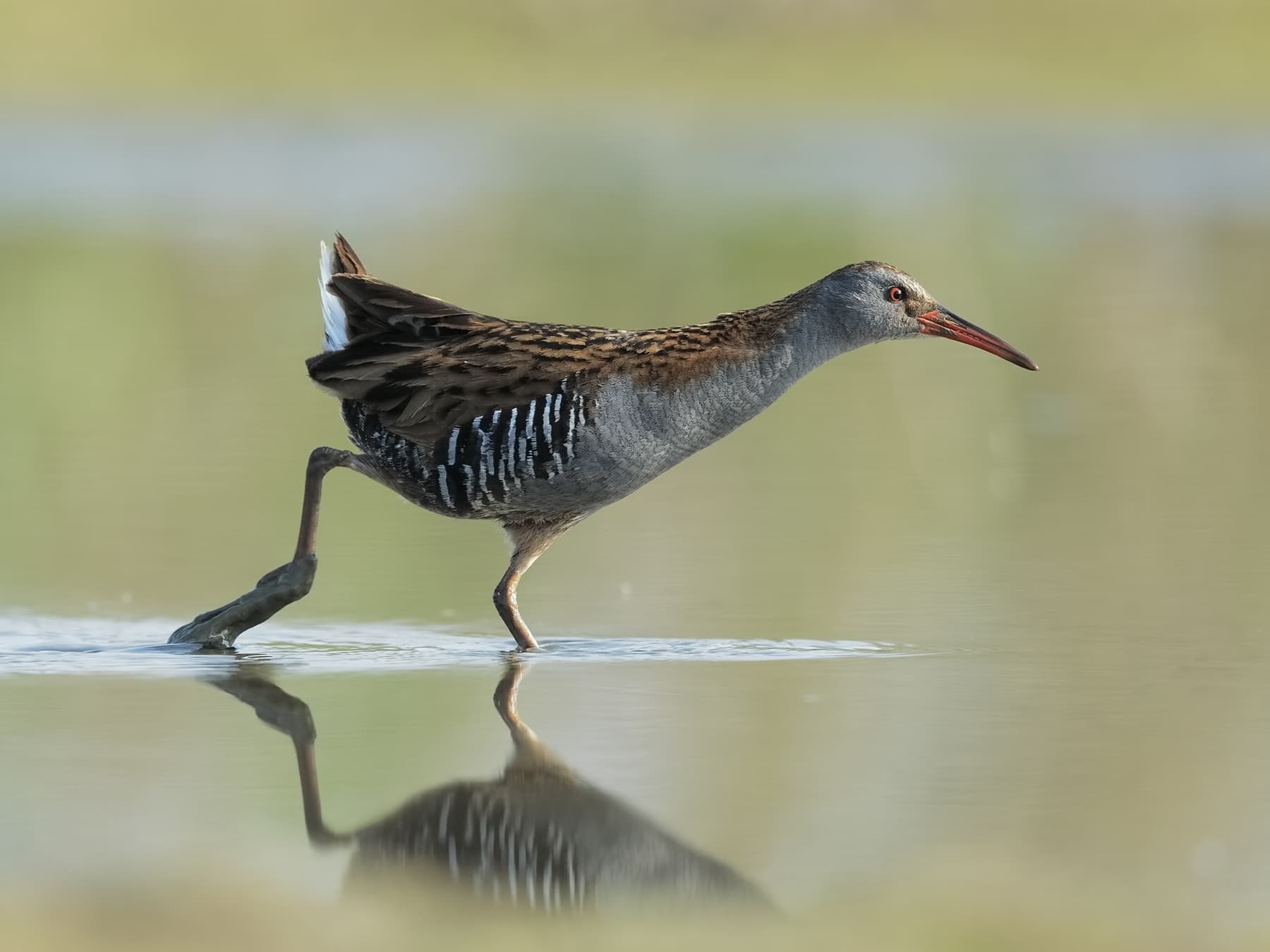
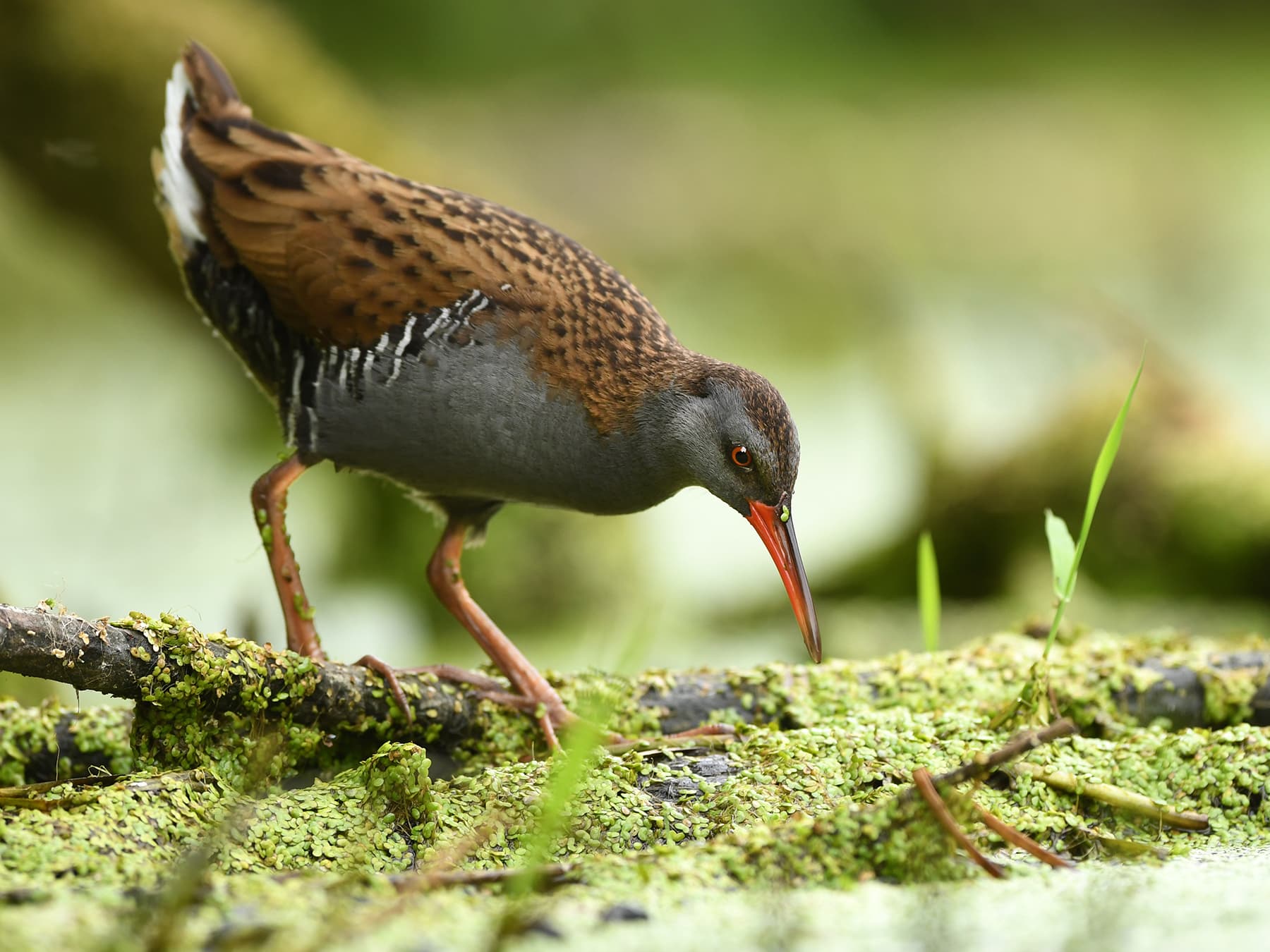
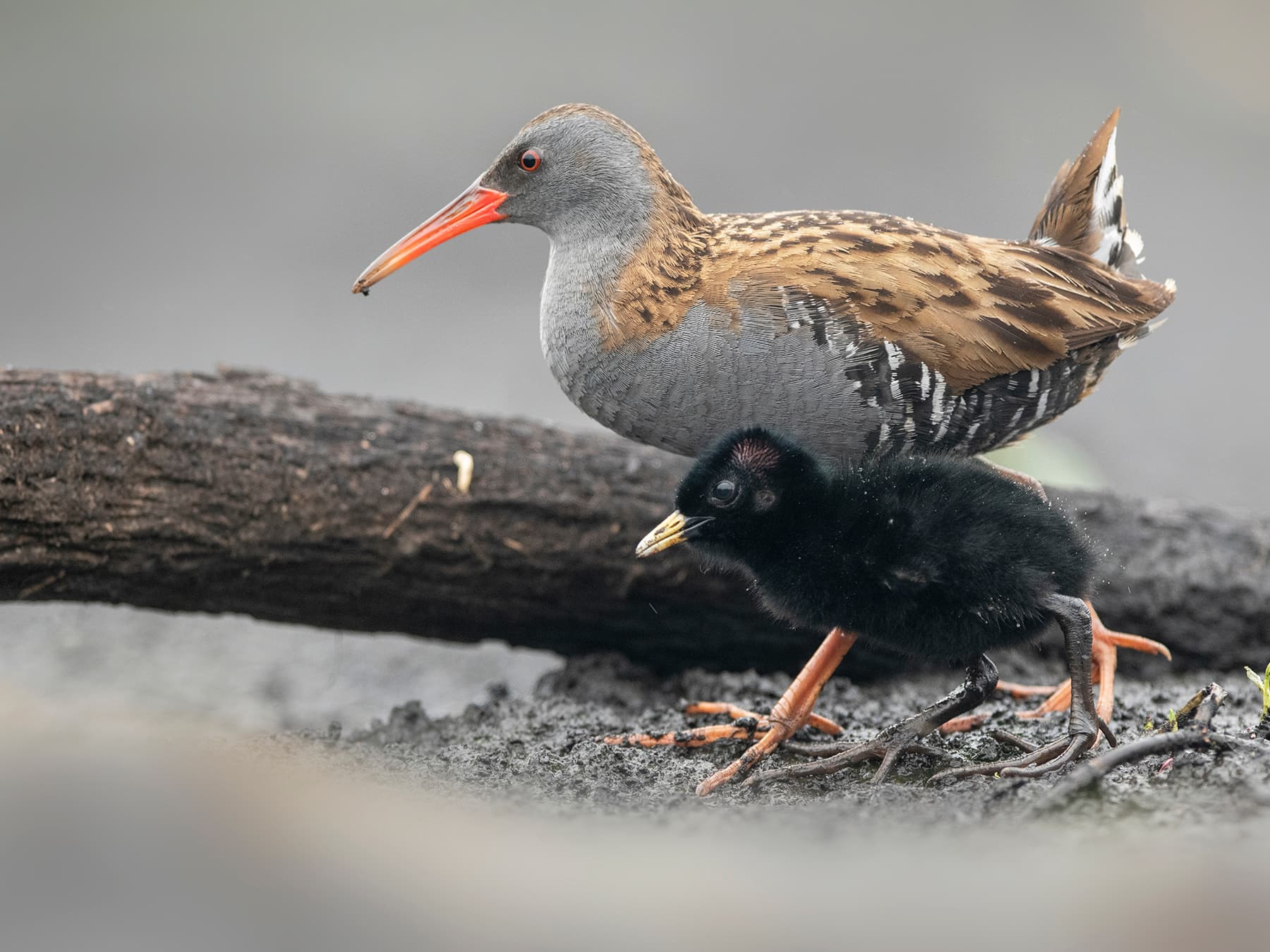
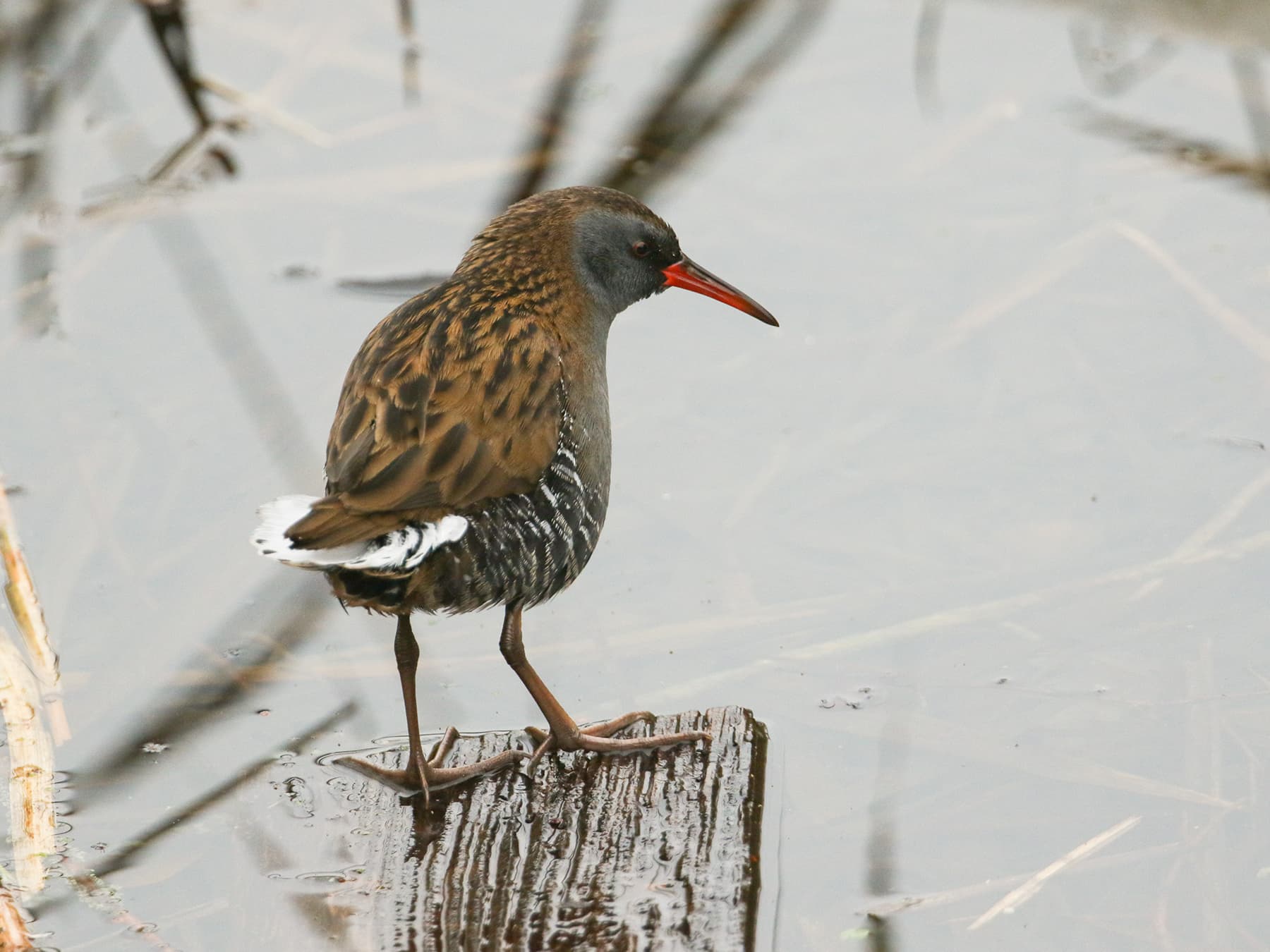
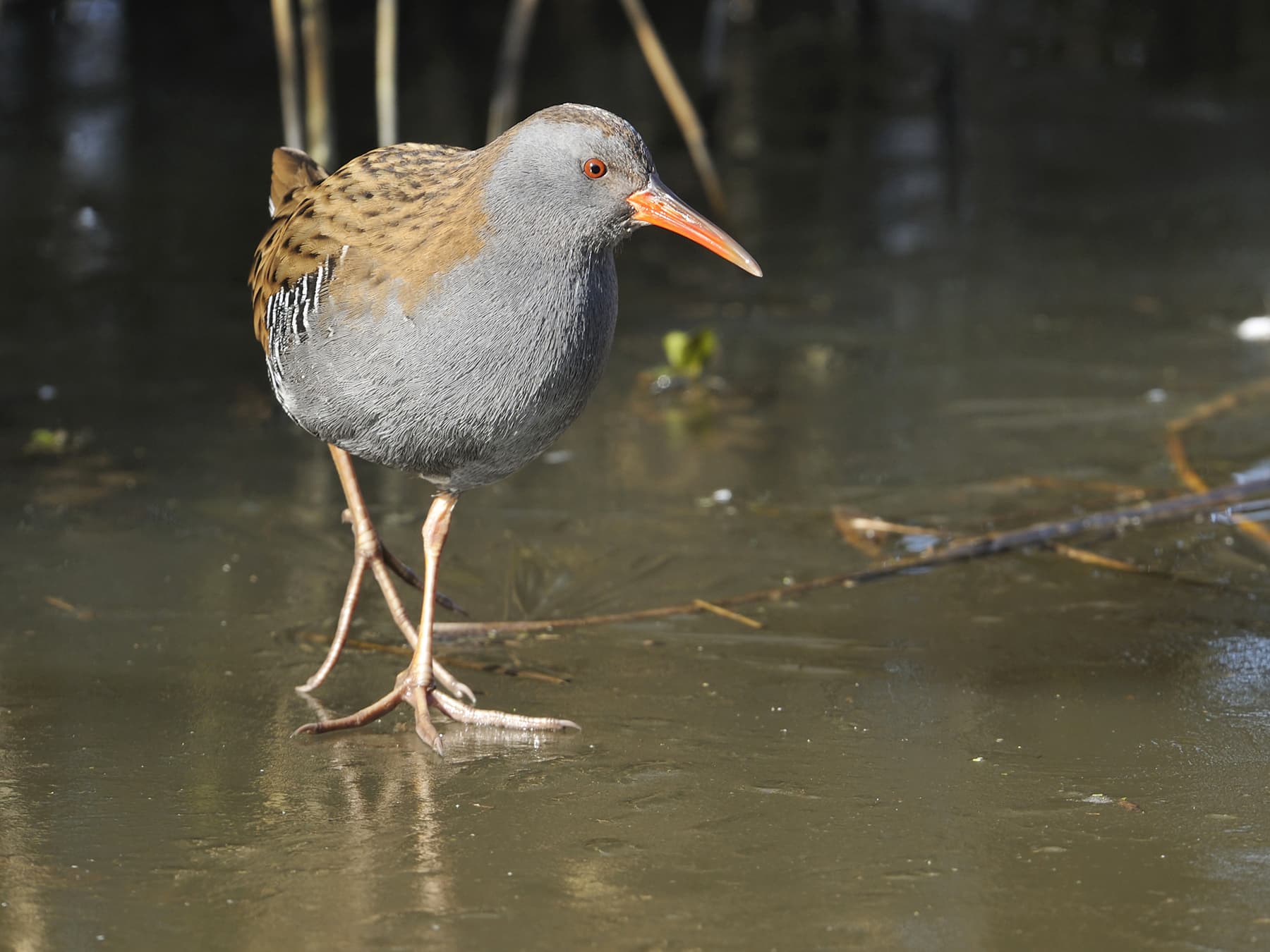
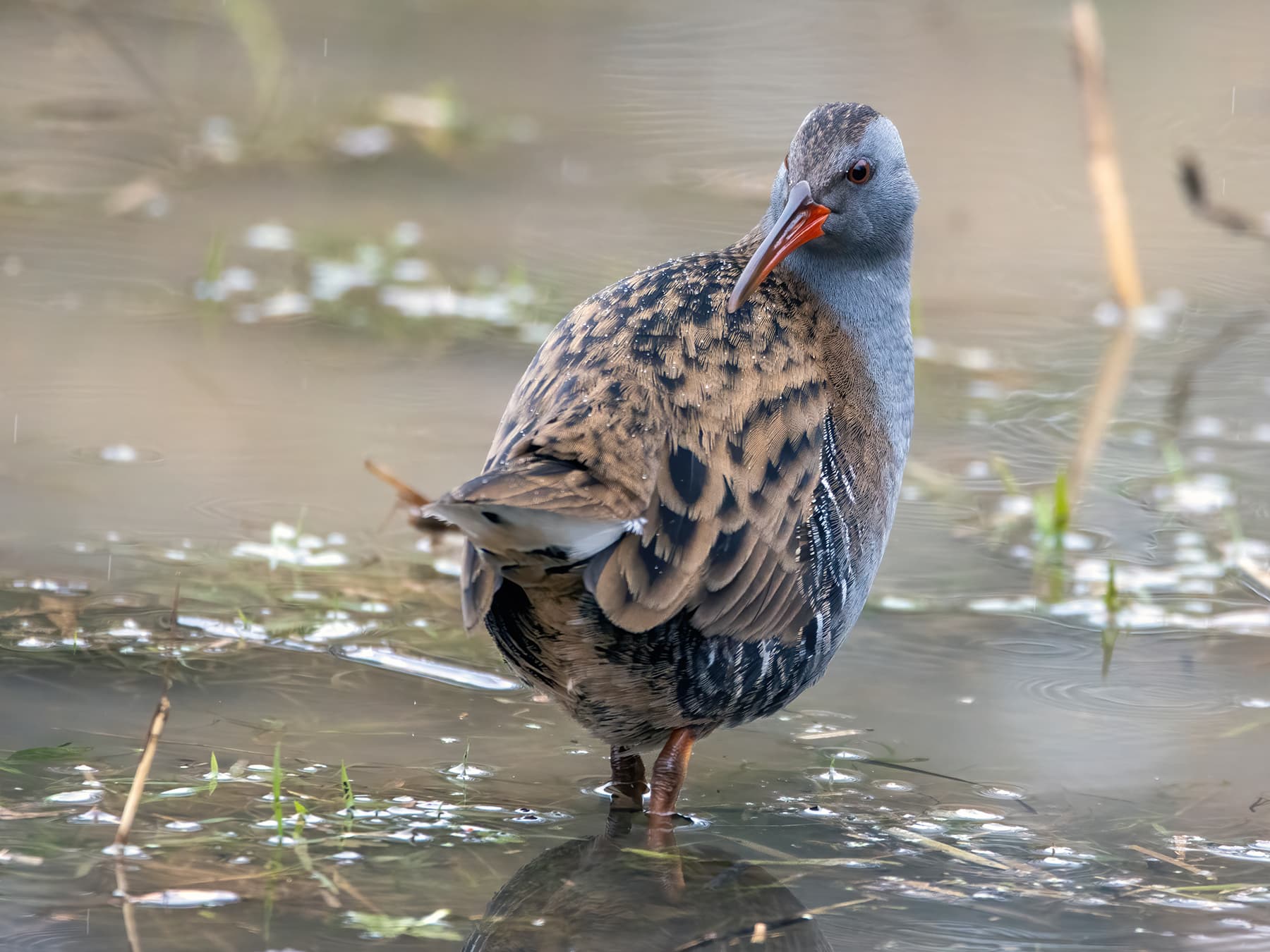
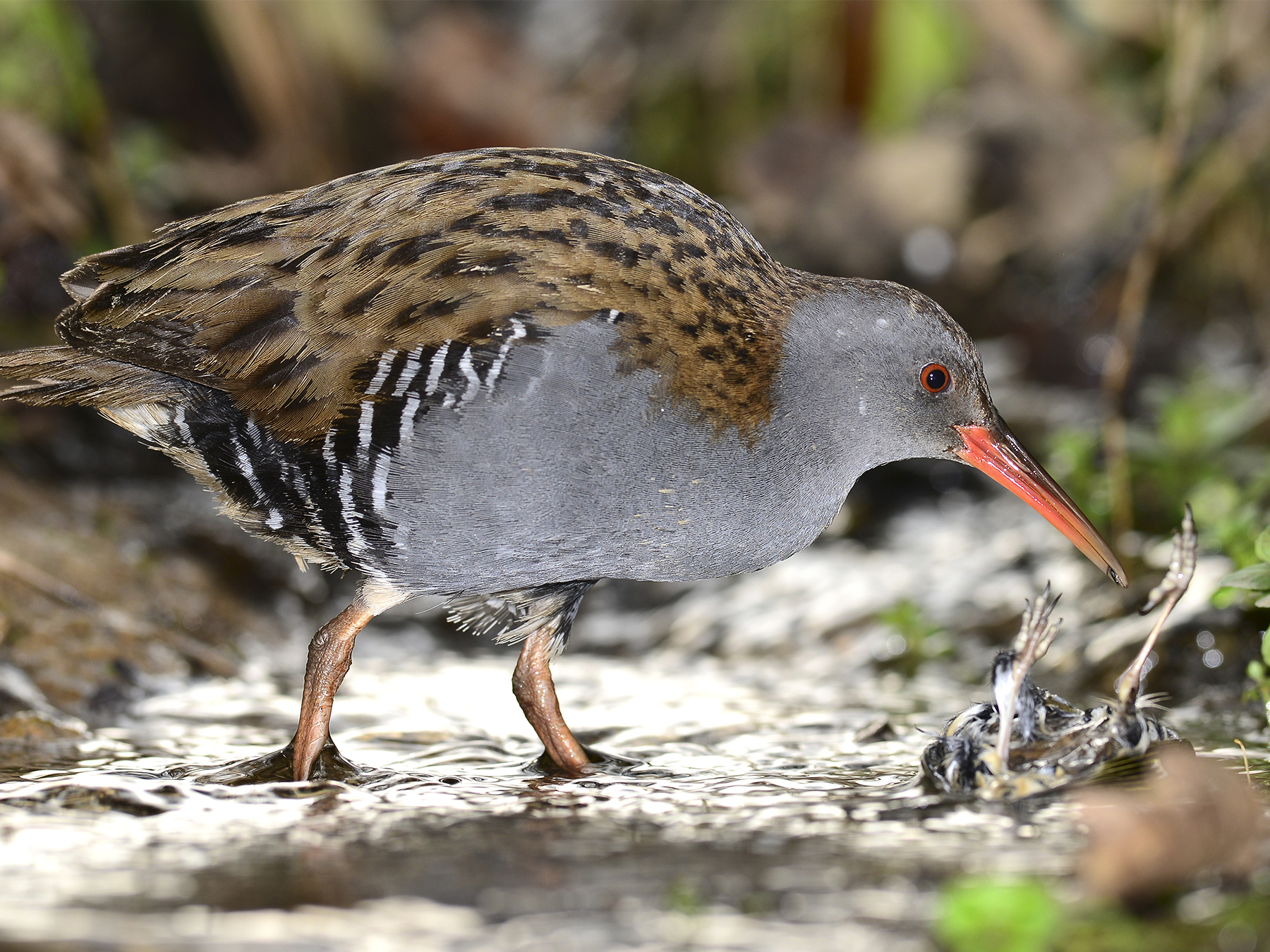
Male water rails have chestnut-brown and black upperparts, with a grey face and underparts. Their flanks are barred with black and white. Their bill is long, straight and red, and their legs are flesh coloured, but can appear brighter red in some subspecies. Their white undertail provides a useful way of identifying the species.
Females are similar in colouring and plumage to males, but are smaller and have a shorter bill.
Juveniles are duller in appearance, with the grey face and underparts seen in mature birds replaced with more of a buff-pale brown until their adult plumage develops.
How big are Water Rails?
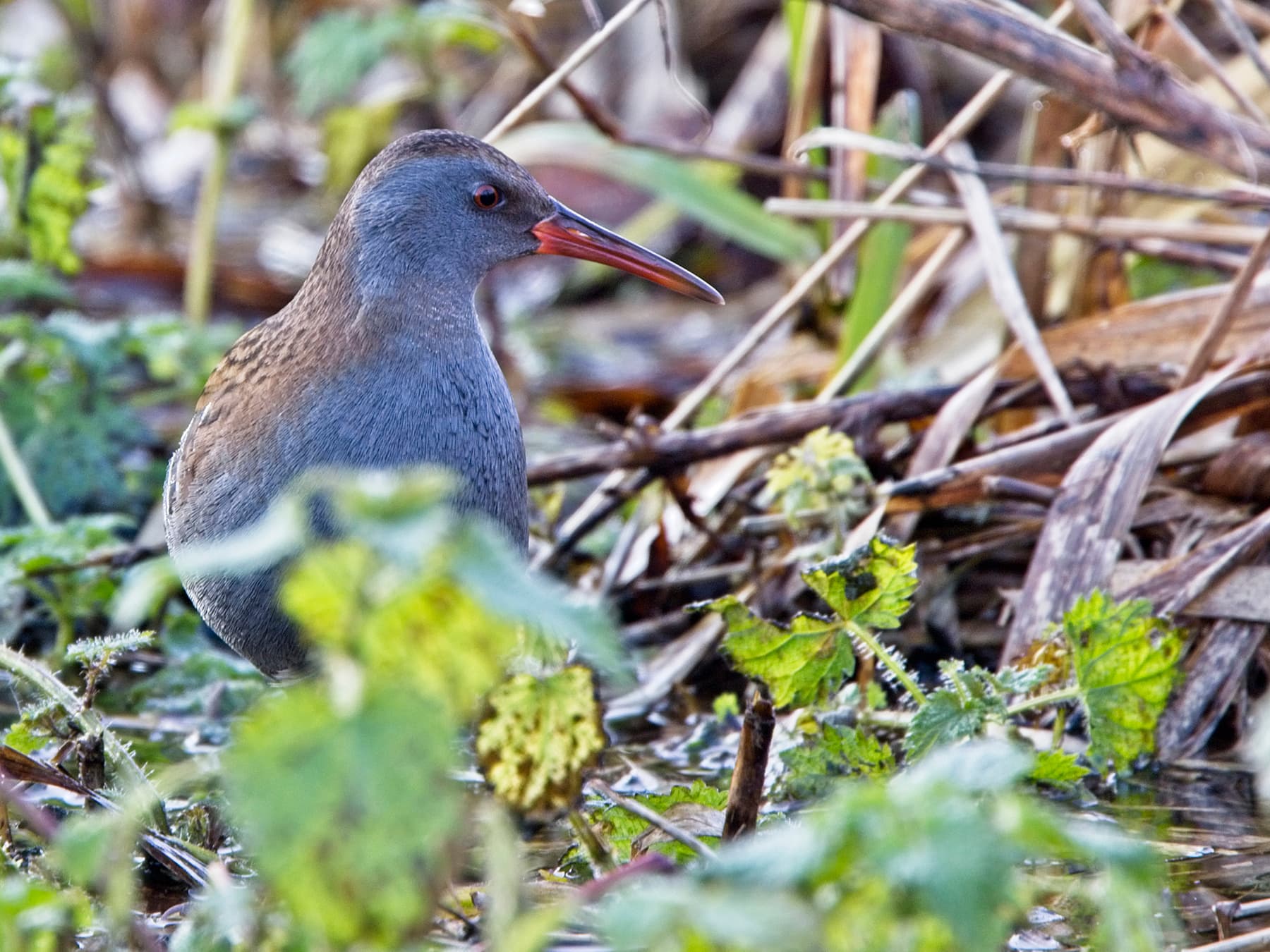
Water rails are relatively small members of the rail and crake family, which makes them quite difficult to spot, particularly when they are among the reeds and waterside vegetation in summer months.
Females are slightly smaller and lighter than males, with the measurement ranges for the species as follows:
- Length: 23 cm to 28 cm (9.1 in to 11 in)
- Wingspan: 38 cm to 45 cm (15 in to 17.7 in)
- Weight: 80 g to 180g (2.8 oz to 6.3 oz)
Its size
Adults- Length
- 23–28 cm
- Wingspan
- 38–45 cm
- Weight
- 90–170 g
Its song and calls
What sound does a Water Rail make?
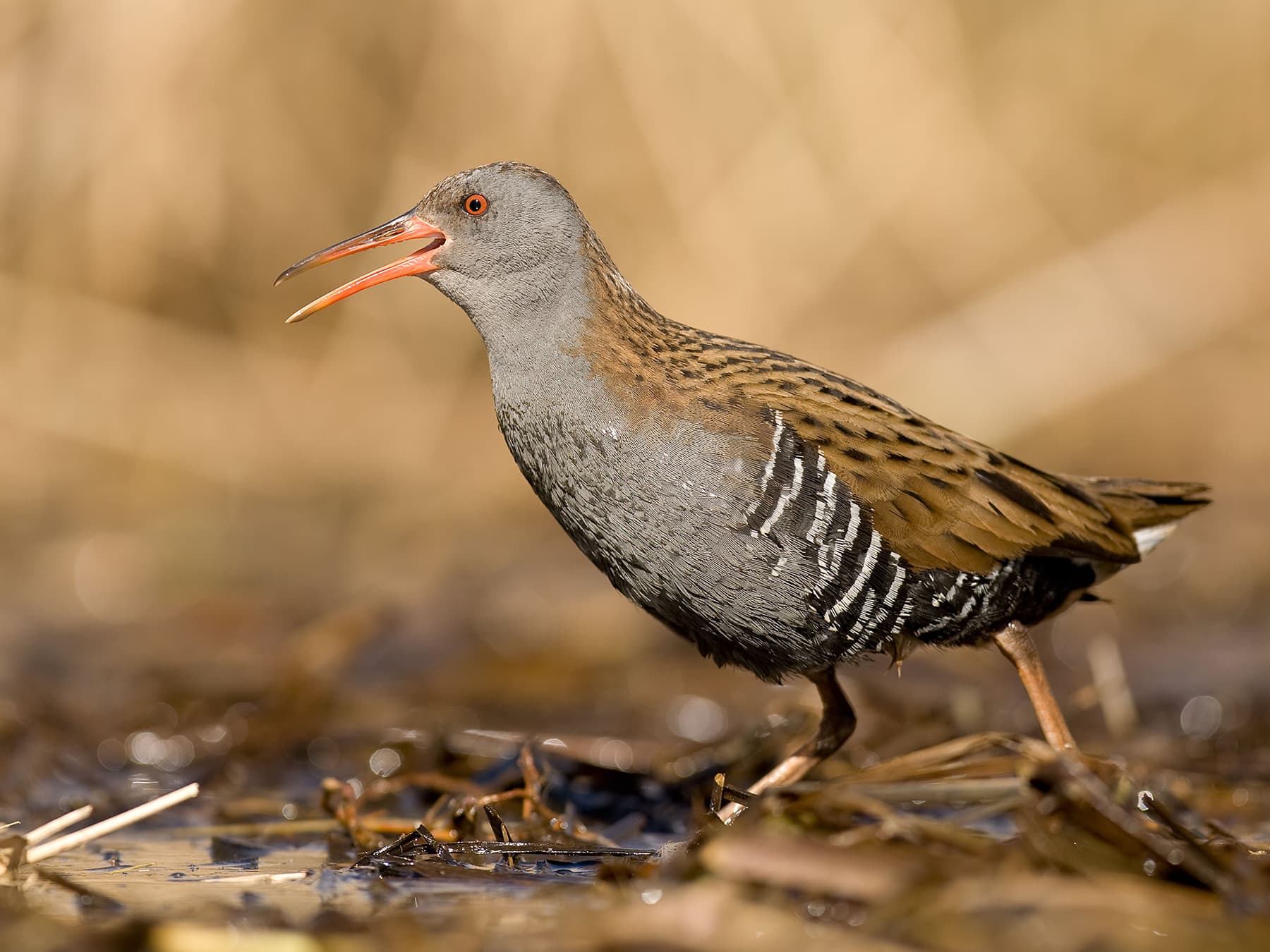
A water rail’s call is known as ‘sharming’ and is a series of low-pitched grunts followed by a higher pitched squeal, which is followed by a series of further guttural grunts.
This vocalisation is used as an alarm call, as well as to assert a territorial claim. A sharp whistle can be heard in flight.
- Song0:00 / 0:38
Recorded in Normandie, France · June 2021
- Call0:00 / 0:28
Recorded in Normandie, France · October 2024
When and where to see it
OctoberArriving
Most recorded in October
- 1. Pembrokeshire1.7%
- 2. Newport0.80%
- 3. Wexford0.76%
- 4. Vale of Glamorgan0.60%
- 5. Wicklow0.59%
Each dot is a county, state or province: the bigger and darker, the larger the bird’s share of that place’s bird records that month. Grey dots: no regular records. The ringed point is the centre of the bird’s records this month; the arrow shows how it moved since last month, and the dashed loop its path through the year. “Arrivals” colours places where it becomes regular this month (orange) or is in its last regular month (grey). GBIF eBird Observation Dataset, 2019–2024. Map data: Natural Earth, US Census Bureau; place centres © OpenStreetMap contributors.
In your area
See when the Water Rail is recorded in your county, state or province.
How often the Water Rail turns up in the UK and Ireland through the year, from birdwatchers' records.
United Kingdom
Resident · all year · most records in November
Ireland
Resident · all year · most records in November
Show as a table
| Month | United Kingdom | Ireland |
|---|---|---|
| January | 0.24% (regular) | 0.21% (regular) |
| February | 0.21% (regular) | 0.16% (regular) |
| March | 0.18% (regular) | 0.20% (regular) |
| April | 0.10% (regular) | 0.16% (regular) |
| May | 0.072% (regular) | 0.13% (regular) |
| June | 0.073% (regular) | 0.12% (regular) |
| July | 0.095% (regular) | 0.13% (regular) |
| August | 0.15% (regular) | 0.14% (regular) |
| September | 0.20% (regular) | 0.15% (regular) |
| October | 0.26% (regular) | 0.23% (regular) |
| November | 0.30% (regular) | 0.26% (regular) |
| December | 0.29% (regular) | 0.16% (regular) |
Recorded regularly in
Worldwide: recorded regularly in 73 countries
Countries where it was recorded in at least 3 of the 6 years 2019–2024. Linked countries have their own bird list.
Europe (46)
- Åland Islands
- Albania
- Austria
- Belarus
- Belgium
- Bosnia & Herzegovina
- Bulgaria
- Croatia
- Czechia
- Denmark
- Estonia
- Faroe Islands
- Finland
- France
- Germany
- Greece
- Guernsey
- Hungary
- Iceland
- Ireland
- Isle of Man
- Italy
- Jersey
- Kosovo
- Latvia
- Liechtenstein
- Lithuania
- Luxembourg
- Malta
- Moldova
- Montenegro
- Netherlands
- North Macedonia
- Norway
- Poland
- Portugal
- Romania
- Russia
- Serbia
- Slovakia
- Slovenia
- Spain
- Sweden
- Switzerland
- Ukraine
- United Kingdom
Asia (23)
- Armenia
- Azerbaijan
- Bahrain
- China
- Cyprus
- Georgia
- India
- Iran
- Iraq
- Israel
- Jordan
- Kazakhstan
- Kuwait
- Kyrgyzstan
- Lebanon
- Mongolia
- Pakistan
- Palestinian Territories
- Saudi Arabia
- Tajikistan
- Turkey
- United Arab Emirates
- Uzbekistan
Data: EOD – eBird Observation Dataset (Cornell Lab of Ornithology), accessed via GBIF.org, CC BY 4.0. Records from 2019–2024, aggregated and filtered by Birdfact. How these lists are made
What is the habitat of a Water Rail?
Water rails thrive in waterside locations, including alongside rivers, lakes and canals, as well as marshes, swamps and muddy wetlands.
Winter habitats include flooded gravel pits and scrubland, ditches, and even landfill sites.
What is the range of a Water Rail?
Water rails are year-round residents in much of western Europe from the British Isles in the west and France, Spain, Italy, Greece and along the north African coast in the south.
Into eastern Europe, eastwards from eastern Germany, they are temporary residents during the breeding season only, with this seasonal range extending across Central Asia into Siberian Russia,
Where do Water Rails live?
Due to their secretive nature and well-camouflaged plumage, gaining accurate population data on the number of water rails in different countries across their range is particularly difficult.
Populations in Iceland, Britain and France are considered stable.
How rare are Water Rails?
It’s estimated that there are more than 3,900 water rail pairs breeding in the UK, so although not the most common waterbird, they are not especially rare.
However, they are famously hard to spot, blending into their habitats so they remain undetected by predators, which makes catching sight of one particularly tricky, especially in summer when vegetation is at its most dense.
Where can you see Water Rails in the UK?
Water rails are widely distributed throughout England, Wales and Ireland, but less so in Scotland, with only a patchy presence in some lowland and coastal regions. In winter, numbers increase with the arrival of migrants from Russia and Eastern Europe.
Migration
Do Water Rails migrate?
Water rails are a partially migratory species, with many birds in the western parts of their range being year-round residents.
The further east they breed, the more likely that they will need to migrate to warmer regions when winter approaches.
In Europe, most populations breeding to the east of eastern Germany and Poland are only temporary residents and migrate south and west when local weather conditions become too harsh and lakes begin to freeze over.
Are Water Rails native to the UK?
Water rails are present in the UK all year round, and around 3,900 pairs breed in the British Isles.
Some migration within the UK occurs, with water rails breeding in the Scottish Highlands moving to more hospitable environments during winter months. The UK’s resident water rails are joined in winter by overseas migrants, particularly in southern and western parts of the country.
Tips for seeing it
- Listen for their distinctive pig-like squealing call, especially at dawn and dusk
- Look for movement in reeds and along the edges of wetlands
- Be patient and quiet; these birds are shy and may take time to emerge
- In the UK, visit wetland reserves like RSPB Minsmere or WWT Slimbridge for better chances of spotting
What it eats
What do Water Rails eat?
Water rails are omnivores and their diet varies seasonally: in autumn and winter, they tend to eat more plant matter, including shoots, roots, seeds, berries and fruit. They climb into the vegetation to take berries or fly into the branches and remove the fruit.
Earlier in the year, their diet is more animal-based, when they eat mostly small vertebrates including amphibians, fish, mammals and even other birds. Invertebrate prey includes worms, leeches, crayfish, shrimps, spiders, and other aquatic creatures.
What do baby Water Rails eat?
Young water rails are fed in the nest until they begin to independently forage for their own prey from around 5 days. Early diet includes larvae, worms, and small insects.
Nesting and breeding
Where do Water Rails nest?
Nests are constructed on or near water, concealed by vegetation, with a cup made from dead leaves and plant stems, built by both the male and female together.
Any nearby reeds or rushes may be pulled to form a loose canopy above the nest itself, in an attempt to provide an extra layer of protection and privacy.
When do Water Rails nest?
Water rails have an extended breeding season, lasting from March until August, during which two broods are usually raised.
What do Water Rail eggs look like?
A typical water rail clutch consists of between 6 and 11 eggs, which are smooth and glossy and off-white to pinkish-buff in colour, and marked with reddish blotches.
Eggs measure 36 mm × 26 mm (1.4 in × 1.0 in) and are incubated by both parents in turn, with the female taking the larger share of brooding duties.
Hatching occurs after 19 to 22 days.
Do Water Rails mate for life?
Water rails are seasonally monogamous, forming pairs early in the year and raising two broods together. Pair bonds do not normally last beyond the end of the breeding season.
Behaviour
Are Water Rails aggressive?
During the breeding season, water rails become highly territorial and protective of their mate, nest site, eggs and young and may attack any intruders.
Lifespan and predators
How long do Water Rails live?
The average lifespan for a water rail is around 6 years, but older individuals have been recorded, including one that reached 8 years and 9 months. Breeding takes place for the first time at one year of age.
What are the predators of Water Rails?
Mammals including mink and otters prey on water rails and their nests, while the species is also a common target for predatory reedbed birds, including bitterns and grey herons.
Are Water Rails protected?
The Wildlife and Countryside Act, of 1981, protects water rails from being deliberately killed, injured or caught and kept in captivity.
Are Water Rails endangered?
Although habitat loss, including destruction and reclamation of wetland areas, is a threat to the nesting sites of water rails, they are classed as a green status species on the British Birds of Conservation Concern list and are considered to be a species of least concern across their global range.
Conservation
While the Water Rail is listed as Least Concern globally, it faces localised threats from habitat loss due to drainage of wetlands and reed bed destruction. Climate change and water pollution also pose potential risks.
Conservation efforts focus on protecting and restoring wetland habitats across their range.
More photos
3 photos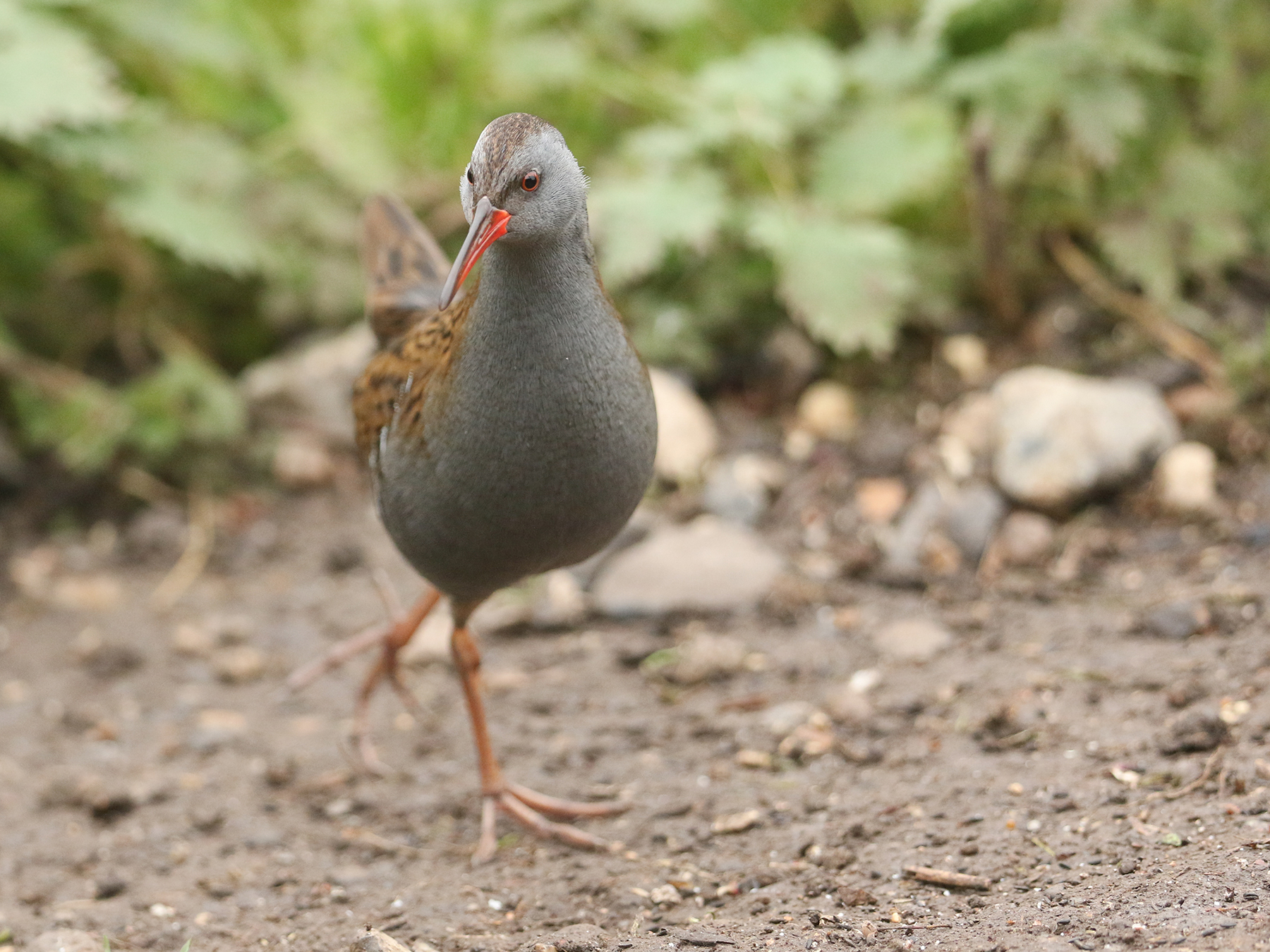
Quick facts
- Length
- 23–28 cm
- Wingspan
- 38–45 cm
- Weight
- 90–170 g
- Lifespan
- 6 years · oldest recorded 8.9 years
- Family
- Rails & Coots
- Migration
- Partial migrant
- Global status (IUCN)
- Least Concern
- World population
- 630,000 - 1,400,000 mature individuals
- Population trend
- Decreasing
- Also called
- European Water Rail, Western Water Rail
- Scientific name
- Rallus aquaticus
Questions
1Can a Water Rail fly?
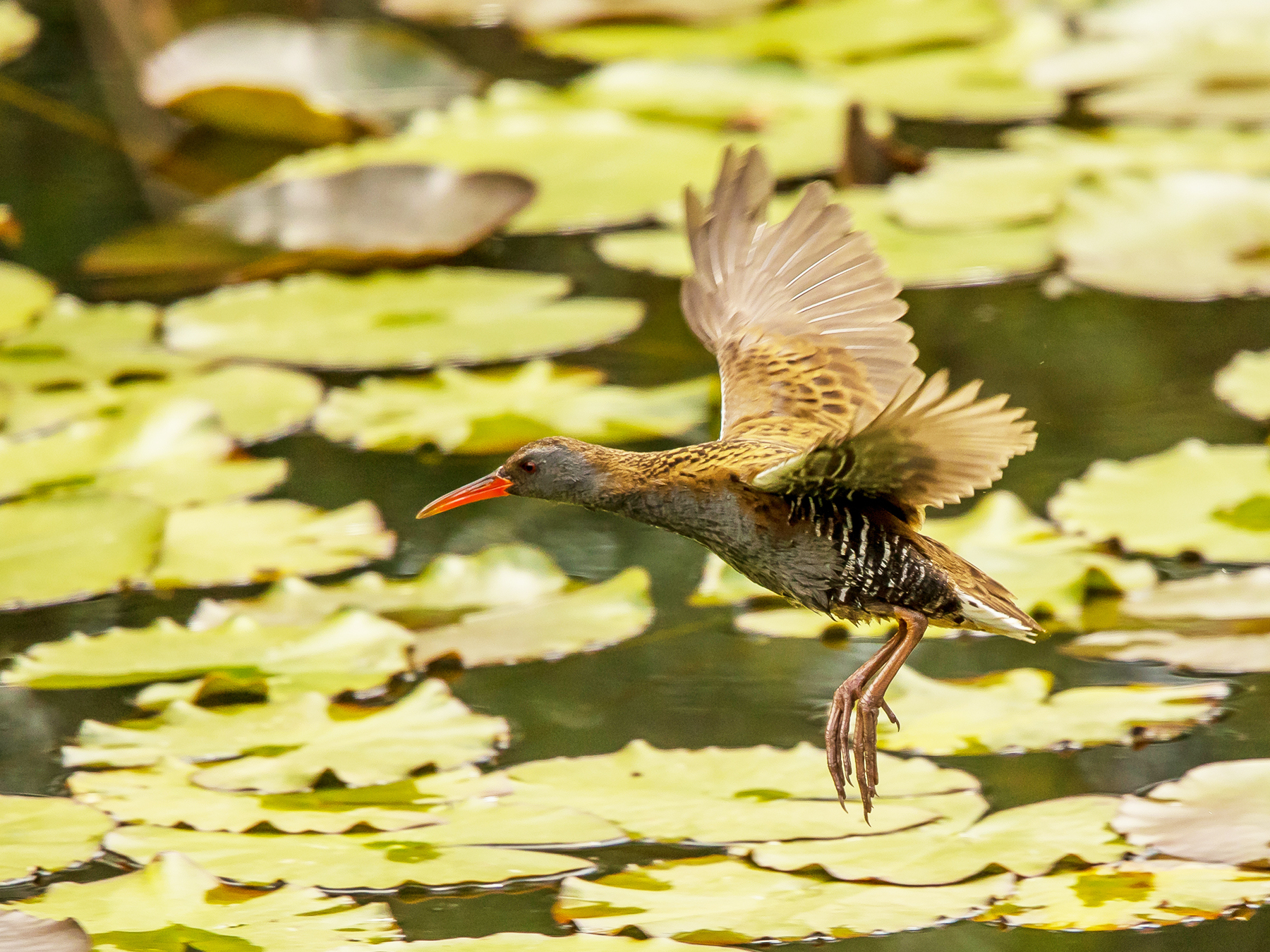
Water rails can fly, as well as being able to run quite fast on the shores of lakes and wetlands.
Some water rails migrate over considerable distances to reach warmer wintering grounds when their breeding territories become too cold to survive in.
Sources
4- 1BirdLife International. 2019. Rallus aquaticus (amended version of 2016 assessment). The IUCN Red List of Threatened Species 2019: e.T22725141A155533298. Source (opens in a new tab)
- 2Wetlands International (2015)
- 3BirdLife International. 2019. Rallus aquaticus (amended version of 2016 assessment). The IUCN Red List of Threatened Species 2019: e.T22725141A155533298. Source (opens in a new tab)
- 4Fransson et al., EURING list of longevity records for European birds (2010) Source (opens in a new tab)

Checked by
Nathan Cope, founder and editor
Nathan founded Birdfact and leads its writers and contributors in the UK, the US and Canada. He has watched and studied birds for more than ten years, and checks every article and species guide before it’s published.