


Tree Pipit
Eurasian Tree Pipit · Anthus trivialis
By the Birdfact teamChecked by Nathan Cope
On this page13 sections
How to recognise it
What do Tree Pipits look like?
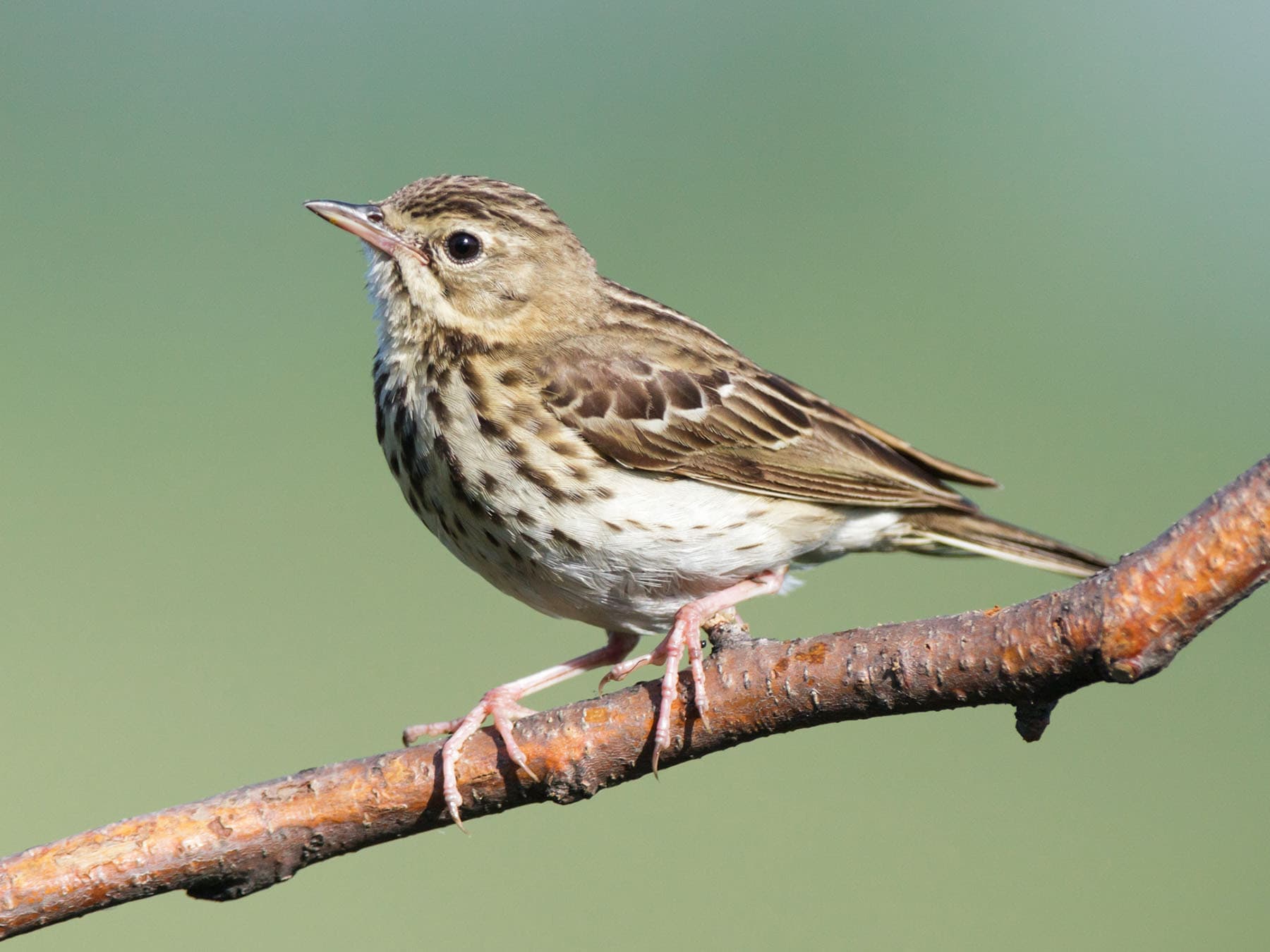
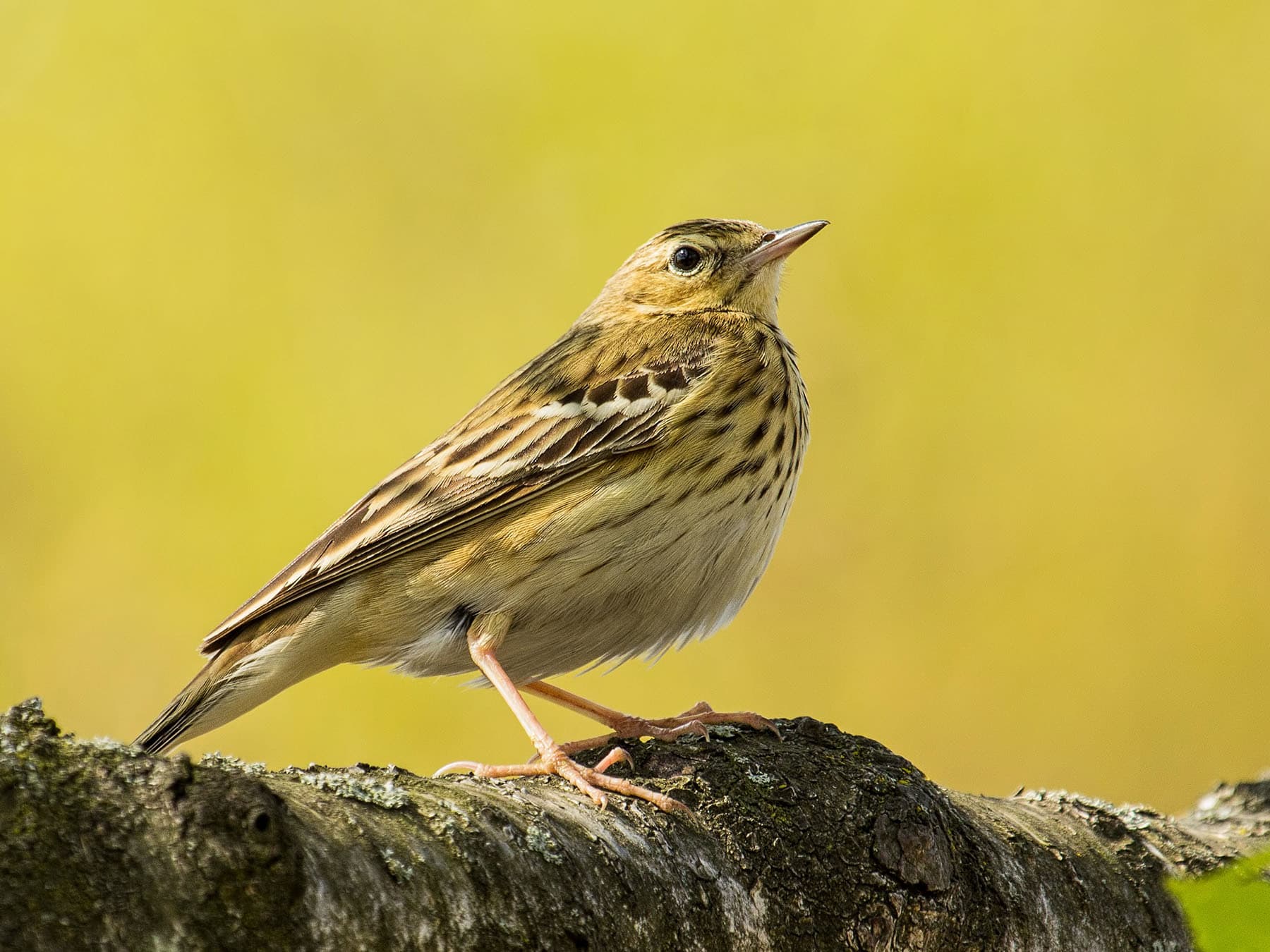
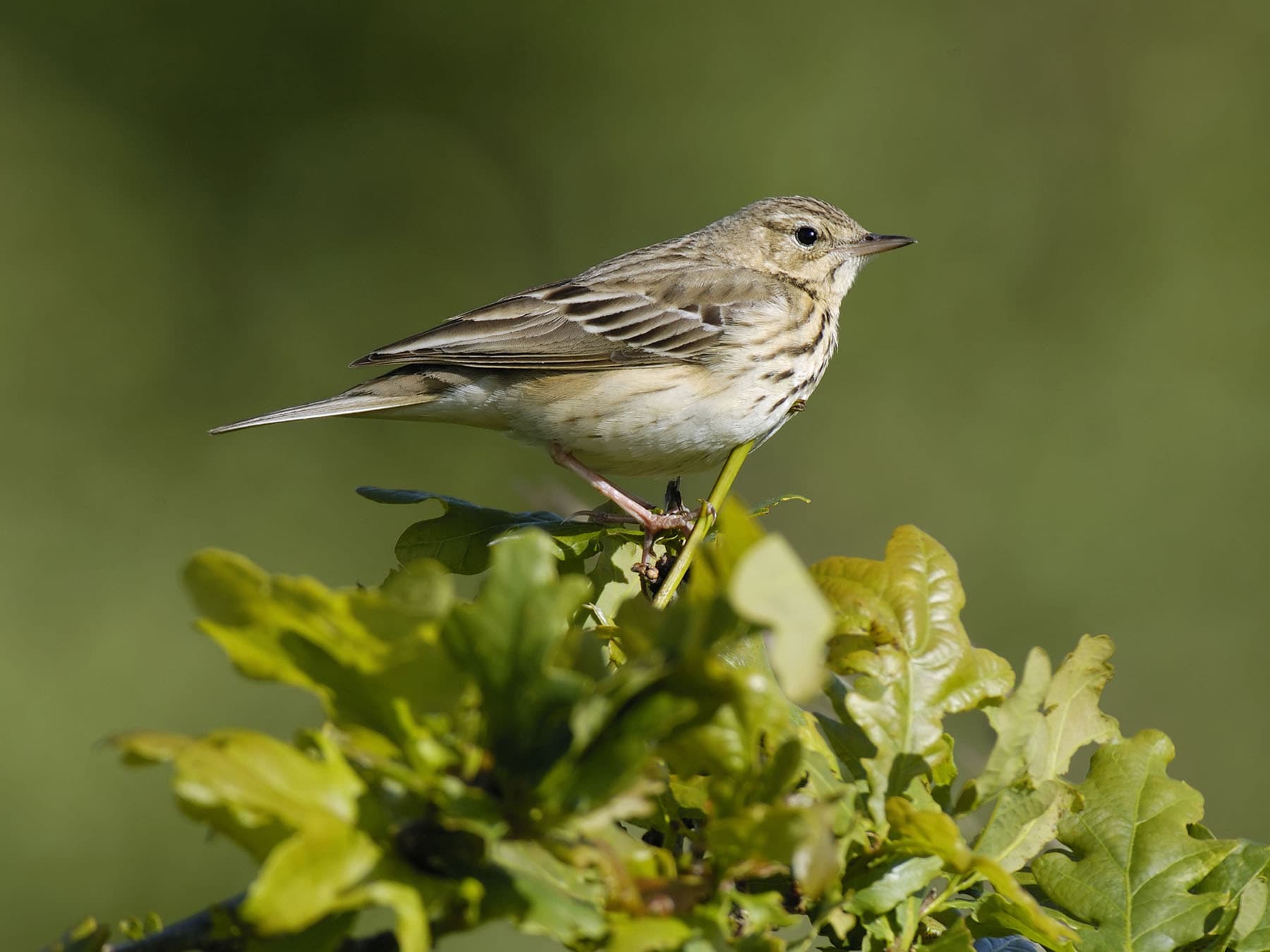
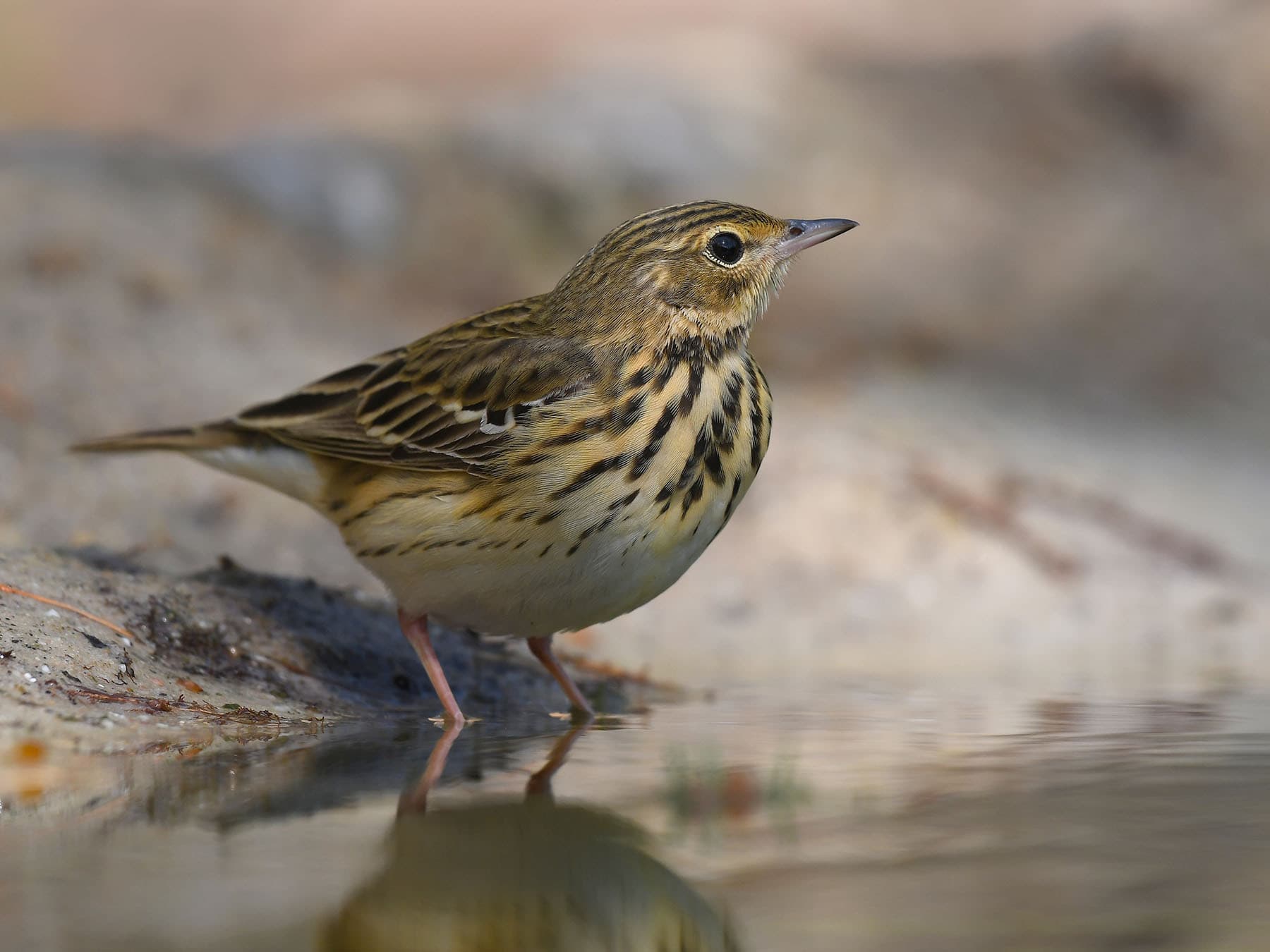
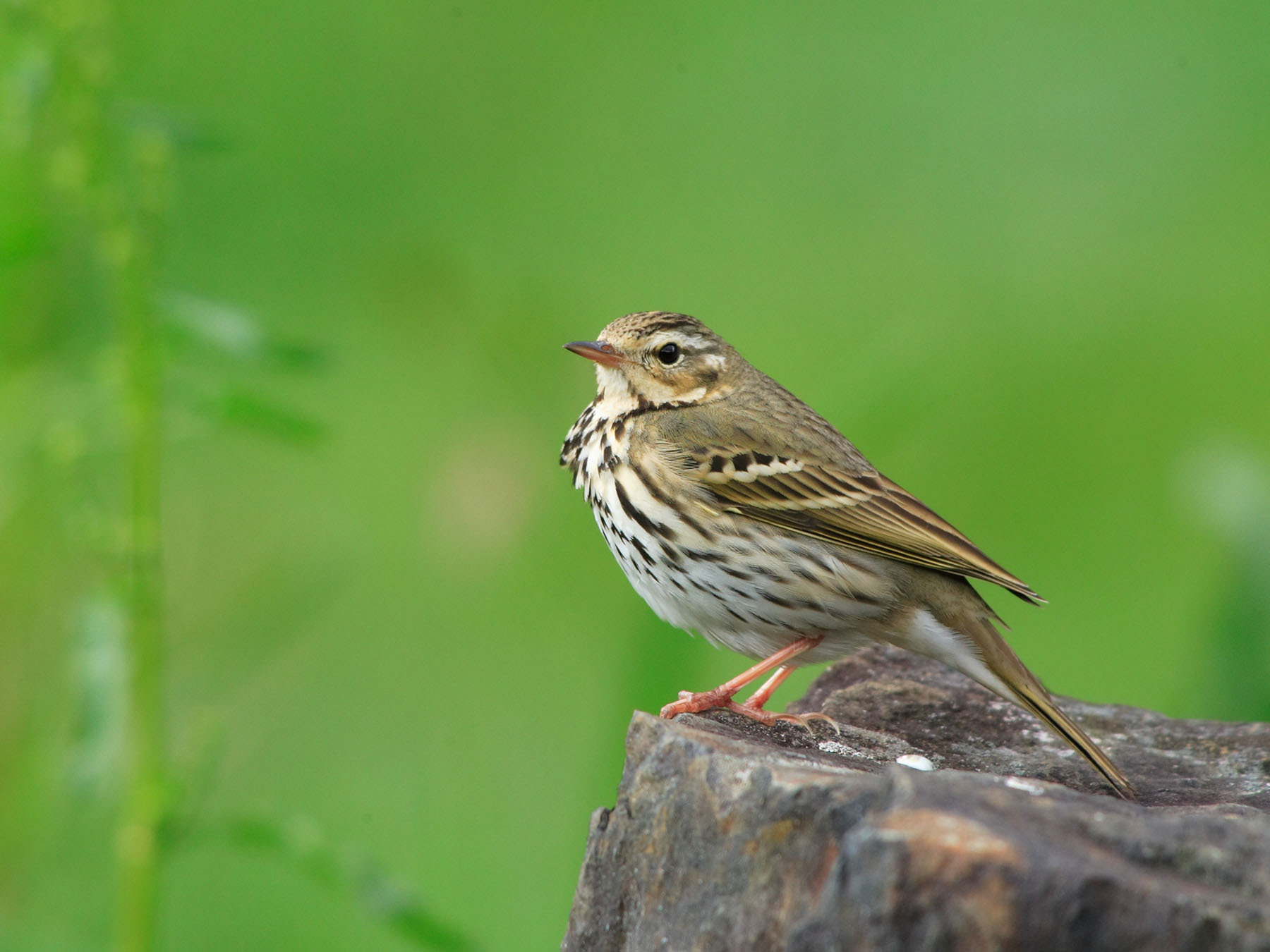
Tree pipits are medium songbirds with thrush-like markings: they have dark olive-brown backs and wings, pale yellowish flanks and off-white underparts that are spotted with dark markings.
Facial markings include a lighter eyebrow stripe, a pale throat and dark brown cheek stripes, while the crown is streaky brown and buff.
Male and female tree pipits are alike in markings as well as in size, with behaviour being the only key to distinguishing between the sexes. Both males and females have a heavy grey-pink bill, and pinkish legs.
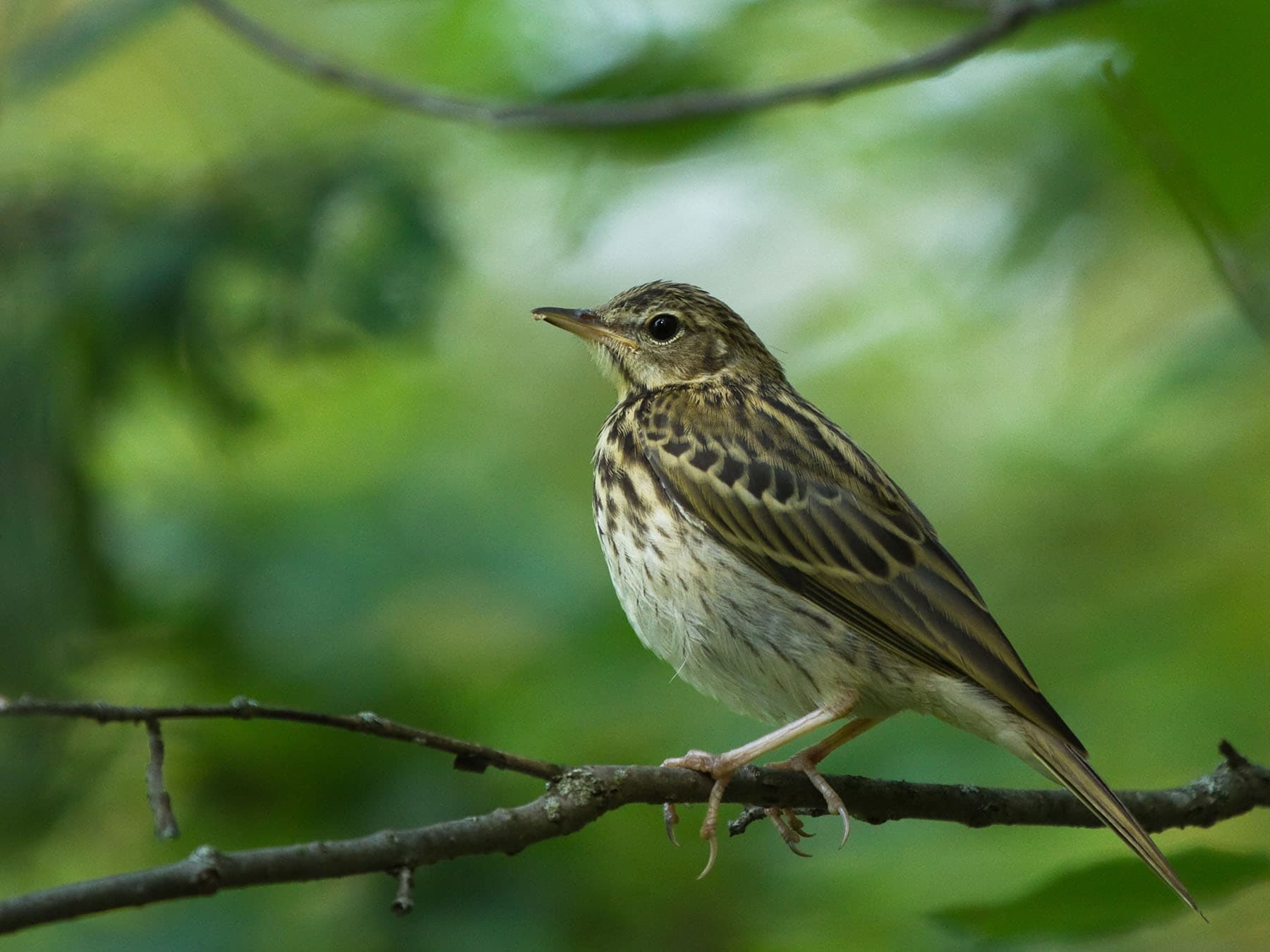
Juvenile tree pipits are similarly marked to adults, but are overall more brown than olive, and their wing feathers are edged with white, which gives their plumage a scaly appearance.
How big are Tree Pipits?
Male and female tree pipits are alike in size, with no obvious differences in length, wingspan or mass between the sexes. At first glance, tree pipits may look similar to song thrushes, but are considerably smaller, around the same size as a chaffinch.
- Length: 15 cm (5.9 in)
- Wingspan: 25 cm to 27cm (9.8 in to 10.6 in)
- Weight: 20 g to 25 g (0.7 oz to 0.9 oz)
Its size
Adults- Length
- 14–16 cm
- Wingspan
- 23–28 cm
- Weight
- 18–25 g
Its song and calls
What sound does a Tree Pipit make?
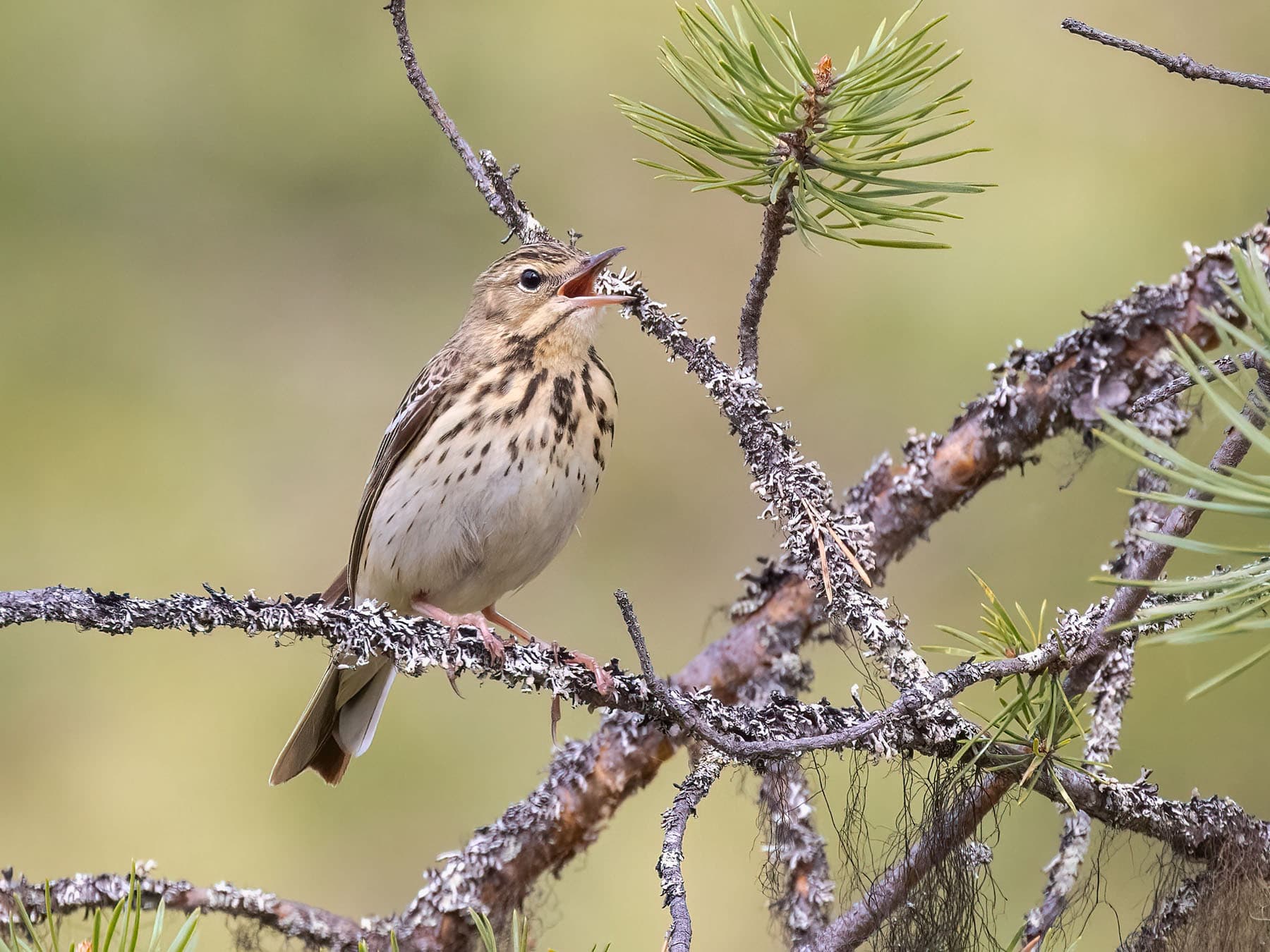
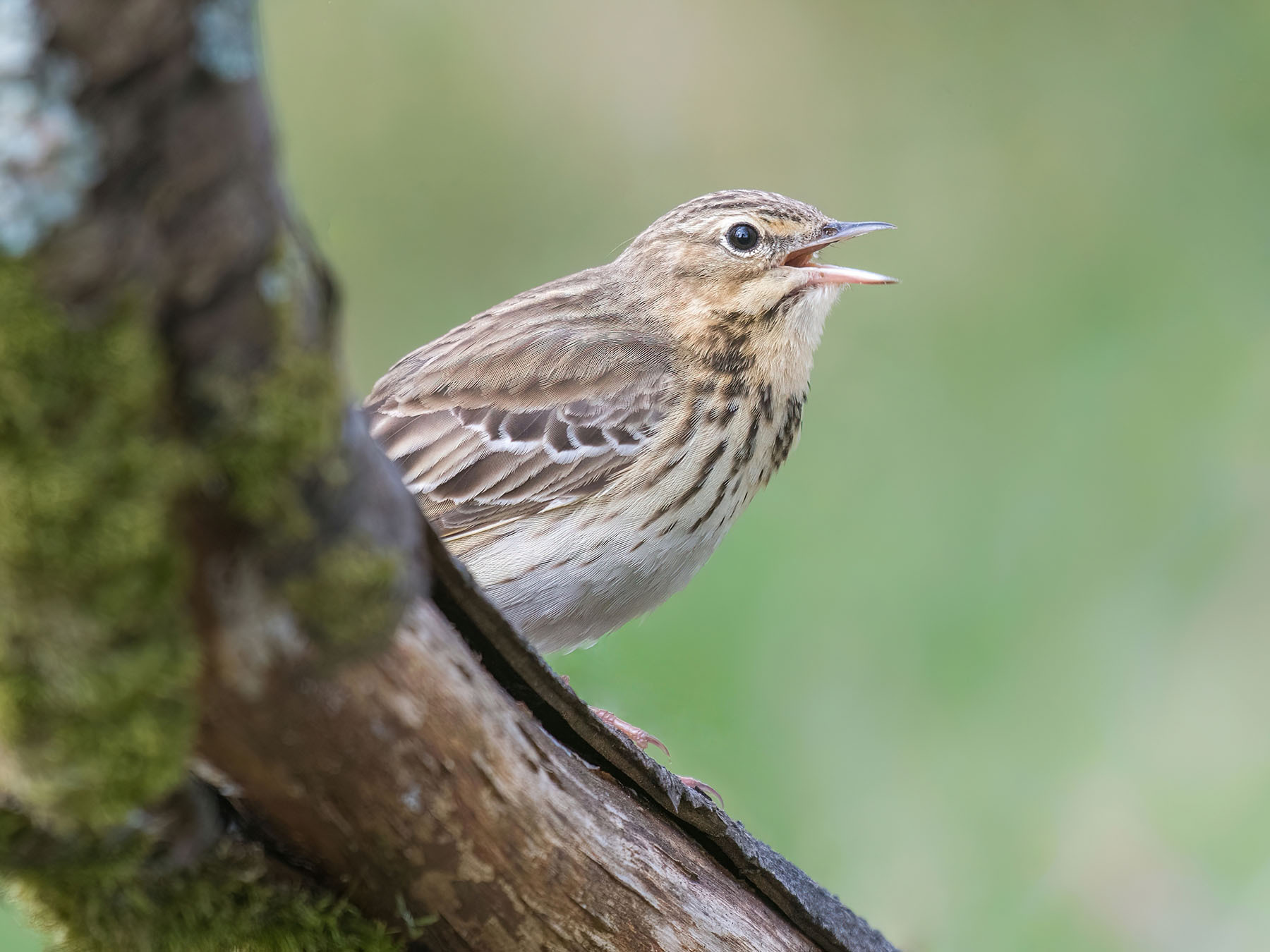
Tree pipit song is a delightful series of flowing trills, heard from treetops, but also the ‘song flight’ is a sight and sound to behold, when the whistling trilled song accompanies a dynamic aerobatic display of swirling flight, in attempt to attract a mate ahead of the breeding season.
- Song0:00 / 0:18
Recorded in Normandie, France · May 2023
- Flight call0:00 / 0:04
Recorded in Normandie, France · August 2024
When and where to see it
OctoberMostly absent
Most recorded in October
- 1. Shetland Islands0.12%
- 2. Newportunder 0.1%
- 3. East Riding of Yorkshireunder 0.1%
- 4. Cornwallunder 0.1%
- 5. East Sussexunder 0.1%
Each dot is a county, state or province: the bigger and darker, the larger the bird’s share of that place’s bird records that month. Grey dots: no regular records. The ringed point is the centre of the bird’s records this month; the arrow shows how it moved since last month, and the dashed loop its path through the year. “Arrivals” colours places where it becomes regular this month (orange) or is in its last regular month (grey). GBIF eBird Observation Dataset, 2019–2024. Map data: Natural Earth, US Census Bureau; place centres © OpenStreetMap contributors.
In your area
See when the Tree Pipit is recorded in your county, state or province.
How often the Tree Pipit turns up in the UK and Ireland through the year, from birdwatchers' records.
United Kingdom
Summer visitor · regularly Apr–Oct · most records in May
Ireland
Scarce · most records in September
Show as a table
| Month | United Kingdom | Ireland |
|---|---|---|
| January | – | – |
| February | – | – |
| March | 0.001% | – |
| April | 0.059% (regular) | <0.001% |
| May | 0.11% (regular) | 0.002% |
| June | 0.098% (regular) | – |
| July | 0.031% (regular) | – |
| August | 0.076% (regular) | 0.002% |
| September | 0.075% (regular) | 0.005% |
| October | 0.012% (regular) | <0.001% |
| November | <0.001% | – |
| December | <0.001% | 0.002% |
Recorded regularly in
Worldwide: recorded regularly in 97 countries
Countries where it was recorded in at least 3 of the 6 years 2019–2024. Linked countries have their own bird list.
Europe (43)
- Åland Islands
- Albania
- Andorra
- Austria
- Belarus
- Belgium
- Bosnia & Herzegovina
- Bulgaria
- Croatia
- Czechia
- Denmark
- Estonia
- Finland
- France
- Germany
- Greece
- Guernsey
- Hungary
- Ireland
- Isle of Man
- Italy
- Kosovo
- Latvia
- Lithuania
- Luxembourg
- Malta
- Moldova
- Montenegro
- Netherlands
- North Macedonia
- Norway
- Poland
- Portugal
- Romania
- Russia
- Serbia
- Slovakia
- Slovenia
- Spain
- Sweden
- Switzerland
- Ukraine
- United Kingdom
Africa (27)
Asia (27)
- Armenia
- Azerbaijan
- Bahrain
- Bangladesh
- China
- Cyprus
- Georgia
- India
- Iran
- Israel
- Japan
- Jordan
- Kazakhstan
- Kuwait
- Kyrgyzstan
- Lebanon
- Mongolia
- Nepal
- Oman
- Pakistan
- Palestinian Territories
- Qatar
- Saudi Arabia
- Tajikistan
- Turkey
- United Arab Emirates
- Uzbekistan
Data: EOD – eBird Observation Dataset (Cornell Lab of Ornithology), accessed via GBIF.org, CC BY 4.0. Records from 2019–2024, aggregated and filtered by Birdfact. How these lists are made
What is the habitat of a Tree Pipit?
Tree pipits’ preferred habitat is on the edges of forests, particularly birch or oak, close to moorland and open land with some isolated trees. Trees are needed as song perches, but dense tree cover is avoided. Foraging grounds of grasslands, heath, and bramble scrub are important.
Non-breeding habitats are similar to the landscapes in which tree pipits raise their young., including cultivated plantations, woodland clearances and open savannah.
What is the range of a Tree Pipit?
The British Isles forms the western boundary of the breeding range of tree pipits, which extends across northern Europe and into eastern Russia and Siberia.
To the south, breeding occurs throughout central Europe, as far south as northern Spain, parts of Italy, and into Turkey and the Middle East.
The non-breeding range lies in sub-Saharan Africa, from Senegal to Ethiopia, and as far south as Angola, Botswana, Namibia and northern South Africa. Some eastern breeding populations head to India.
Where do Tree Pipits live?
There are no countries that enjoy a year-round presence of tree pipits. Around 4 million pairs breed in Sweden, with up to 10 million pairs raising their young in European Russia.
How rare are Tree Pipits?
Over 100,000 pairs of tree pipits arrive to breed in the UK each spring, but numbers have fallen steeply since 1980.
Sightings are not especially uncommon in the western regions of England in spring, when their lilting song can be heard while they plummet through the skies in an impressive parachuting display.
Where can you see Tree Pipits in the UK?
Tree pipits are no longer as widespread as they were around 50 years ago, and most breeding populations in the UK are concentrated in the western and northern upland regions of England, in North Wales and throughout Scotland, with the species rarely spotted in southern and central England.
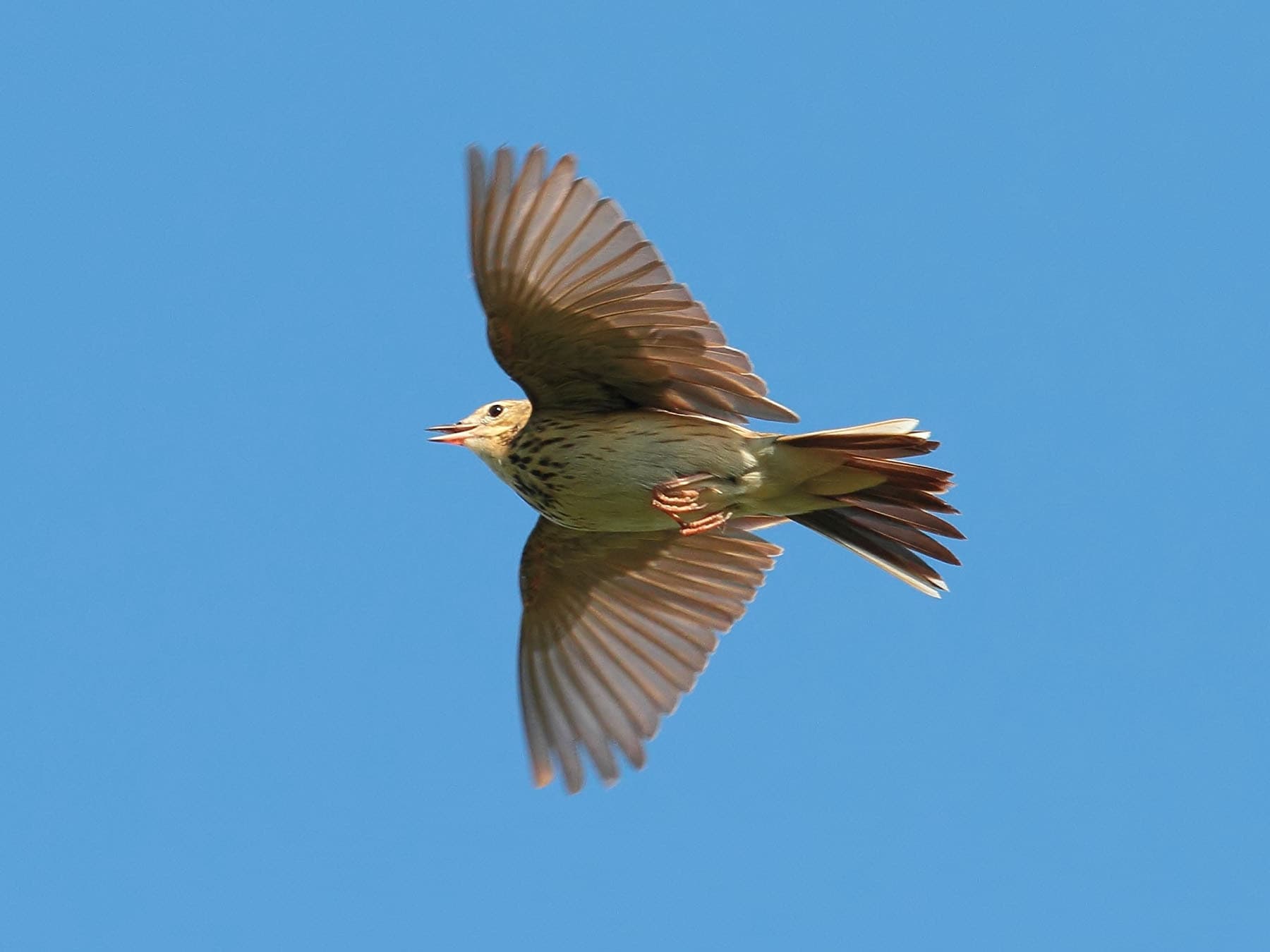
MIgration
Do Tree Pipits migrate?
Tree pipits are a fully migratory species, and maintain distinct breeding and non-breeding territories. From September until April, non-breeding tree pipits live in sub-Saharan Africa (and also, to a lesser extent, in India).
April to May is spent in migration passage, with the arrival onto spring breeding territories across northern Europe from late April onwards.
Two broods are raised in their breeding territories between May and August, before their return autumn migration flights during August and September.
Tips for seeing it
- Look for Tree Pipits in open woodland clearings or edges
- Listen for their characteristic song during the breeding season
- Observe their unique display flight for positive identification
- In the UK, watch for them in heathland and young conifer plantations
What it eats
What do Tree Pipits eat?
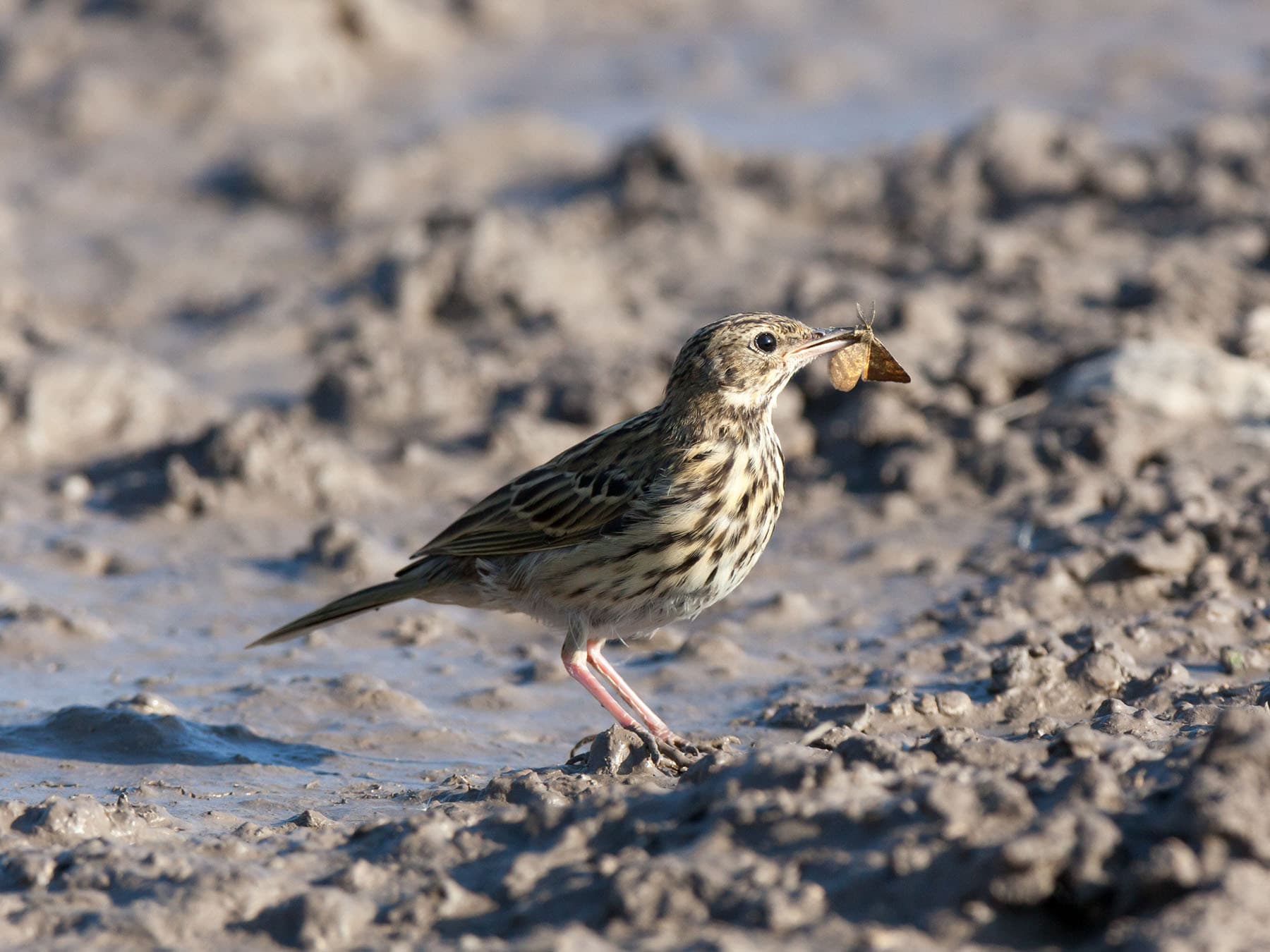
Primarily insectivorous, tree pipits eat mainly insects and invertebrates, although later in the year some fruit and seeds are also taken. Beetles, especially weevils, caterpillars, bugs, spiders, small flies, and earwigs are their chief prey.
Tree pipits forage on the ground through leaf litter for food, but can also occasionally be spotted probing tree trunks or branches in search of small insects.
Millet, pine and birch seeds, aspen buds, and berries are eaten, especially from autumn onwards.
What do Tree Pipit chicks eat?
Young tree pipits are fed by both parents while they are in the nest. Caterpillars and small, soft insects are the main sources of food. While adult tree pipits’ diet contains a large number of beetles, these do not feature in the early diet of their young.
Nesting and breeding
Where do Tree Pipits nest?
Tree pipits establish nesting sites in open woodland and scrubby ground, with a generously sized cup-shape nest formed in a dip in the ground. Females construct the nest alone, using dried grasses, leaves, and moss, and then line the cup with finer, softer grasses.
Do Tree Pipits nest on the ground?
Tree pipits always nest on the ground, with their nest site usually concealed at the base of a grassy tussock or tucked beneath brambles or bracken.
What do Tree Pipit eggs look like?
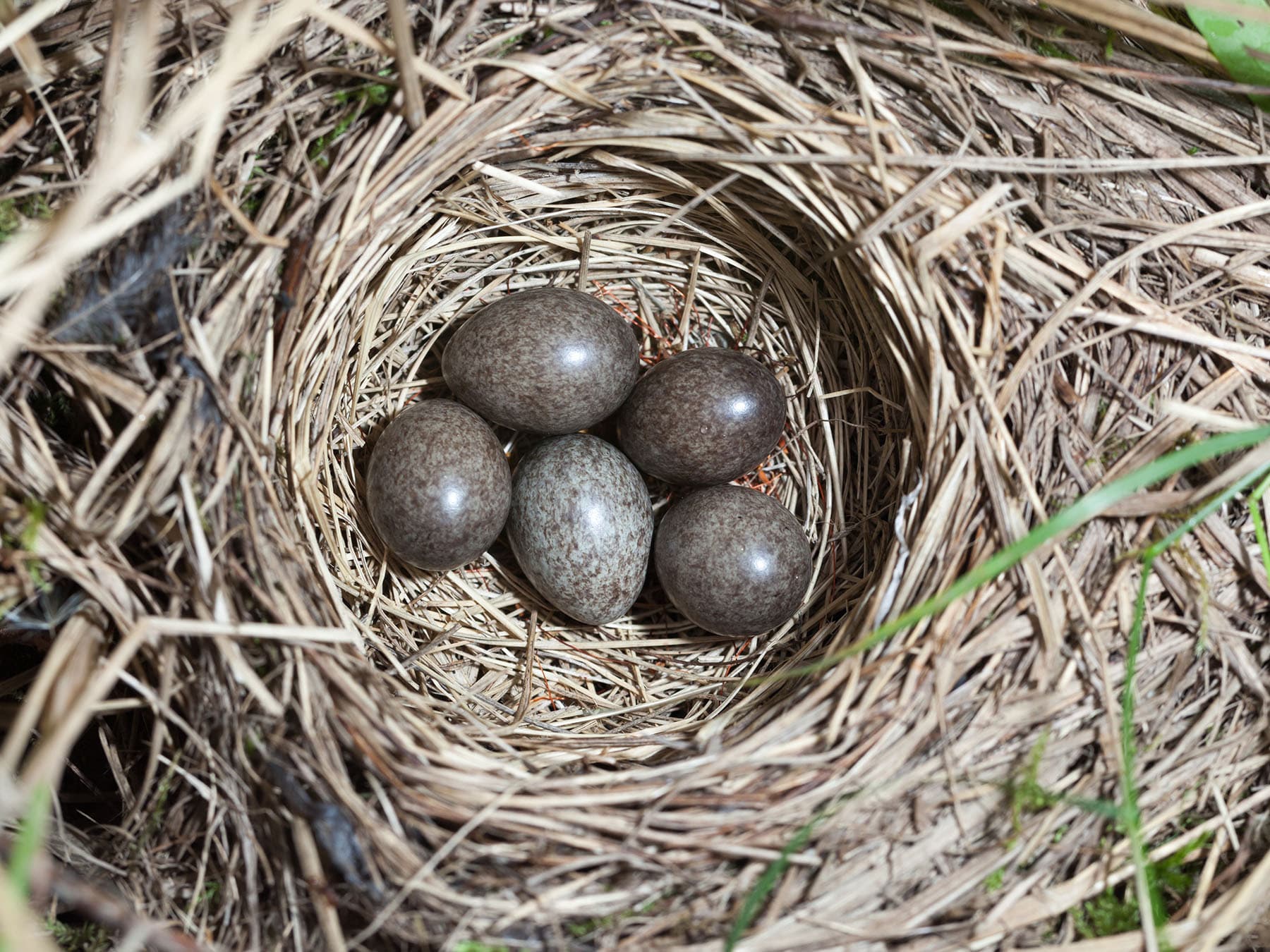
Tree pipits’ eggs are pale brown with darker brown marbled markings, measuring 20 mm by 15 mm (7.9 in by 5.9 in).
The earliest eggs are laid in May each year, with one to two clutches in a season, each of between 4 and 8 eggs, being typical. Incubation is by females alone, with young hatching after 13 to 15 days.
Do Tree Pipits mate for life?
Tree pipits are monogamous for the duration of the breeding season, pairing up once they arrive on their spring breeding grounds and raising two broods together.
Behaviour
Are Tree Pipits aggressive?
During the non-breeding season, small flocks of tree pipits form to migrate and forage together. Tree pipits are generally not especially sociable, but any territorial aggression – for example, the elaborate parachuting song flight – is limited to the courtship and nesting seasons.
Where do Tree Pipits sleep at night?
Spring and autumn migrations take place during the night as well as the day, but outside of these periods, tree pipits roost overnight in the branches of trees until first light, when their song can be heard in the dawn chorus.
Lifespan and predators
How long do Tree Pipits live?
The oldest recorded tree pipit was 6 years and 7 months. Average lifespans for the species, however, are lower, with 2 years being typical. Breeding occurs for the first time at one year of age.
What are the predators of Tree Pipits?
As ground nesters, tree pipits are vulnerable to a number of land predators, including foxes, badgers, hedgehogs, stoats and weasels. Tree pipit nests are also commonly chosen by cuckoos to host their eggs.
Are Tree Pipits protected?
The Wildlife and Countryside Act, 1981, offers protection to tree pipits against being intentionally killed, injured or taken into captivity. The Act also makes it illegal to knowingly disturb, damage or destroy a tree pipit’s nest site and eggs.
Are Tree Pipits endangered?
Classified with Red status on the UK Birds of Conservation Concern list, the future survival of tree pipits is at significant risk due to major contractions in breeding grounds due to habitat loss.
The availability of suitable nesting habitats has fallen by nearly 30 percent since the 1970s. Although overall across its range, the tree pipit is rated as a species of least concern, declines have also been recorded in Switzerland, the Netherlands and Finland.
Conservation
While the Tree Pipit is listed as Least Concern globally, it has experienced declines in parts of its range, particularly in Western Europe. Habitat loss and changes in land management practices are the main threats.
Conservation efforts focus on maintaining suitable breeding habitats and sustainable forestry practices.
Similar birds
Often mistaken for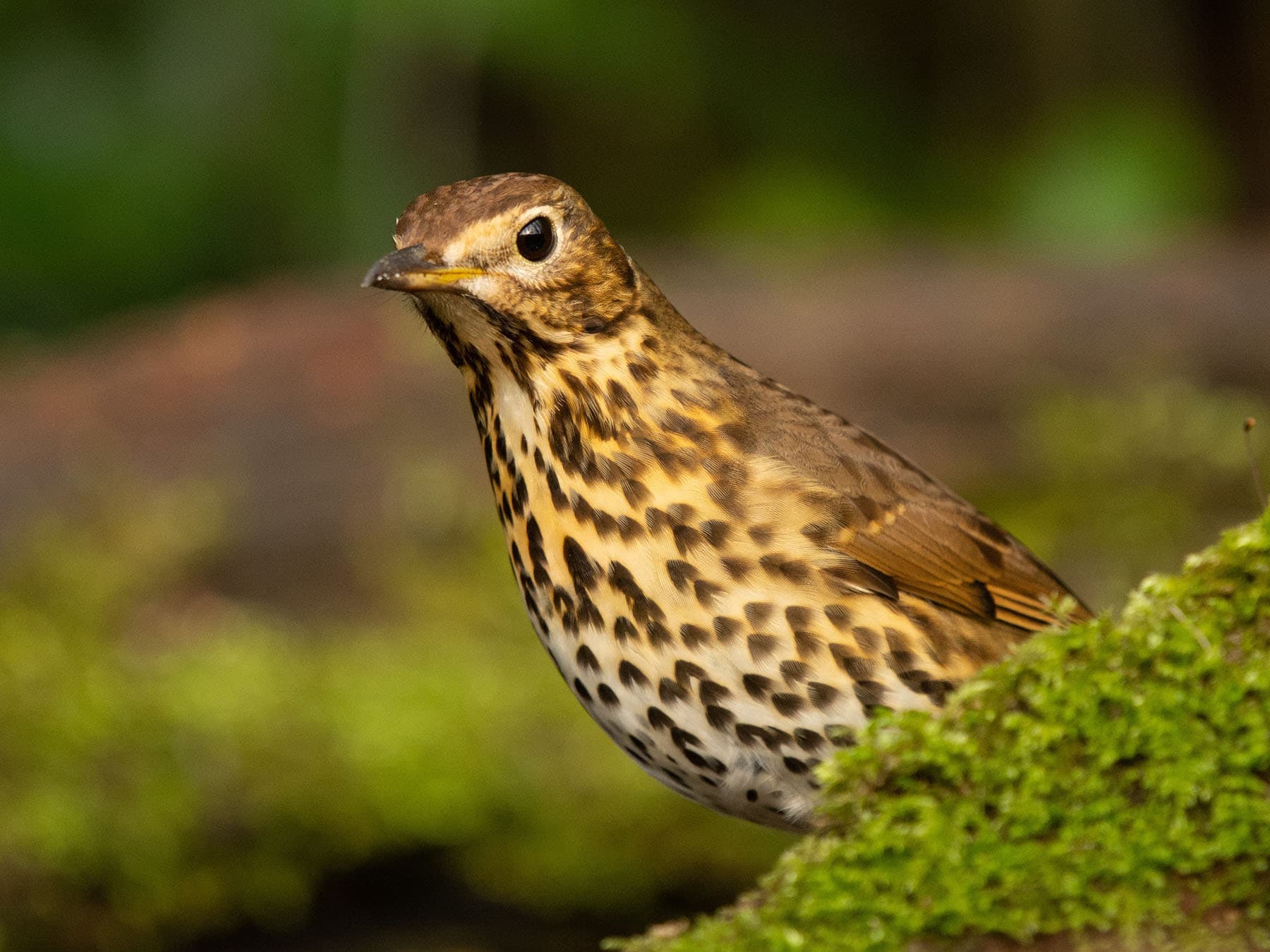
More photos
3 photos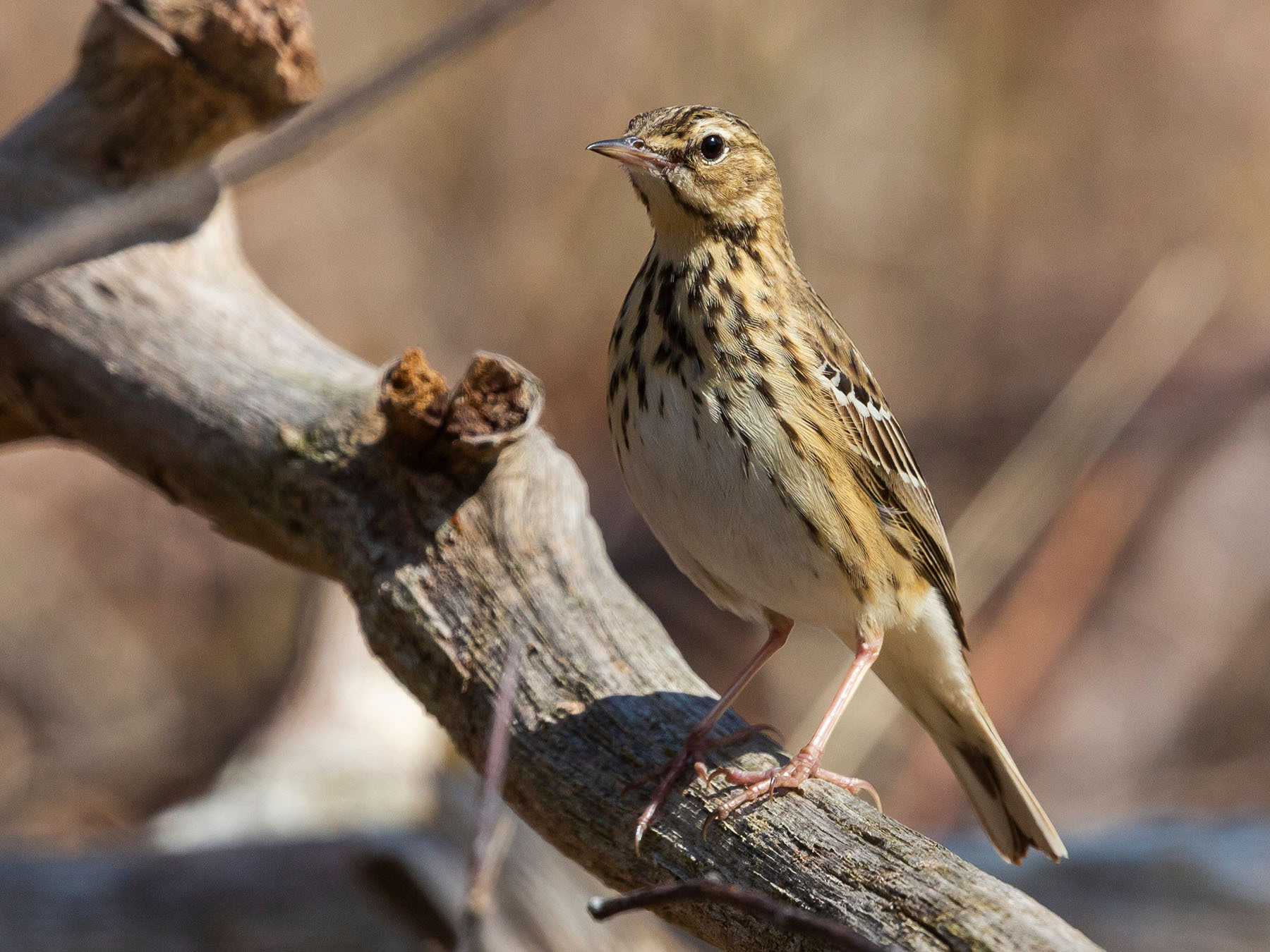
Quick facts
- Length
- 14–16 cm
- Wingspan
- 23–28 cm
- Weight
- 18–25 g
- Lifespan
- 3–5 years · oldest recorded 8.9 years
- Family
- Wagtails & Pipits
- Migration
- Long-distance Migrant
- Global status (IUCN)
- Least Concern
- World population
- 107,000,000 - 153,000,000 mature individuals
- Population trend
- Decreasing
- Also called
- Eurasian Tree Pipit
- Scientific name
- Anthus trivialis
Sources
4- 1BirdLife International. 2018. Anthus trivialis. The IUCN Red List of Threatened Species 2018: e.T22718546A131985523. Source (opens in a new tab)
- 2EBCC (2015)
- 3BirdLife International. 2018. Anthus trivialis. The IUCN Red List of Threatened Species 2018: e.T22718546A131985523. Source (opens in a new tab)
- 4Fransson et al., EURING list of longevity records for European birds (2010) Source (opens in a new tab)

Checked by
Nathan Cope, founder and editor
Nathan founded Birdfact and leads its writers and contributors in the UK, the US and Canada. He has watched and studied birds for more than ten years, and checks every article and species guide before it’s published.