Species Profile
Solitary Sandpiper
Tringa solitaria
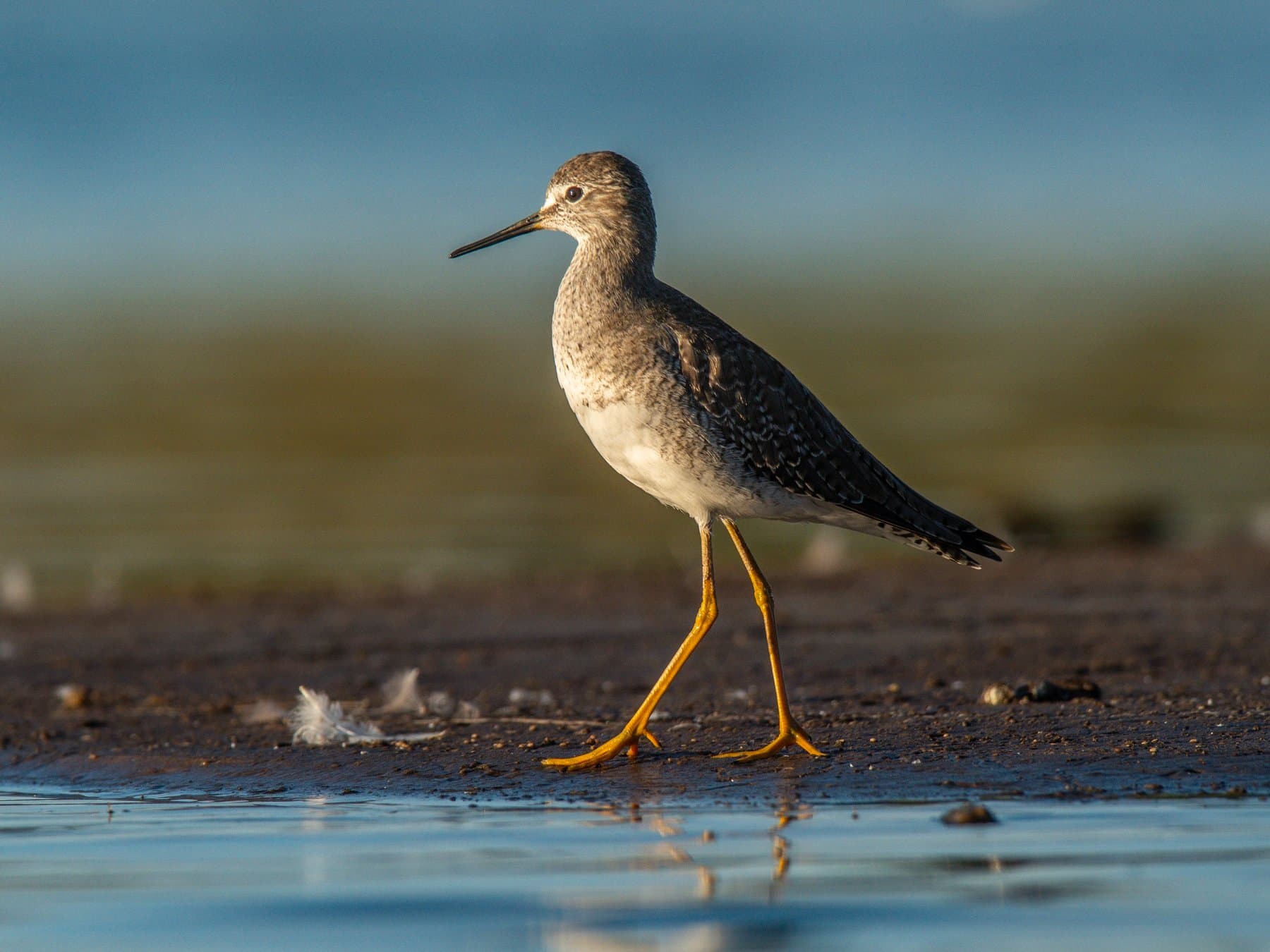
Solitary Sandpiper standing on a muddy shore next to water, showing grey-brown speckled plumage, white belly, dark beak, and yellow legs.
Quick Facts
Conservation
LCLeast ConcernLifespan
5–10 years
Length
19–23 cm
Weight
31–65 g
Wingspan
55–57 cm
Migration
Full migrant
Alone among North American shorebirds, the Solitary Sandpiper nests in trees — borrowing the abandoned nests of robins and waxwings high in boreal spruces rather than scraping a hollow in the ground. Add a swallow-like flight, entirely dark underwings, and a habit of throwing its wings straight up on landing, and this slender, white-spotted wader is unlike any other sandpiper on the continent.
Think you've spotted a Solitary Sandpiper?
Upload a photo and we'll confirm it instantly
Confirm with a PhotoAppearance
The Solitary Sandpiper is a slender, medium-sized wader measuring 19–23 cm in length, with a somewhat long neck, long straight bill, and wings that extend noticeably beyond the tail tip at rest. Adults have dark olive-brown upperparts neatly spangled with white spots — a pattern that gives the bird a distinctly dapper look in fresh breeding plumage. The head and breast are greyish and finely streaked with dark brown, fading to clean white on the belly and flanks.
The single most useful identification feature is the bold, complete white eye-ring, which stands out sharply against the dark head at any distance. The bill is straight, thin, and dark throughout. The legs are olive-green to greenish-yellow — a subtler tone than the bright yellow of the Common Sandpiper or the vivid orange-yellow of the Spotted Sandpiper.
In non-breeding (winter) plumage, the upperparts become mostly unspotted and the breast is washed with dull brown rather than streaked. Juvenile birds are heavily spotted above, with buff-tinged spots in the western subspecies visible through September. In flight, the species is immediately distinctive: the underwings are entirely blackish, contrasting sharply with the white belly — a combination unique among North American shorebirds. The rump and central tail feathers are dark, while the outer tail feathers are white and barred with black. There is no white wing-stripe.
The two subspecies differ subtly but consistently. The eastern T. s. solitaria has darker, more blackish upperparts with white or greyish-white spots and broad white bars on the tail. The western T. s. cinnamomea is distinctly larger, with lighter olive-brown upperparts, buff spots on juveniles, heavy mottling on the outer primary feathers, and narrower white tail bars. Female wing lengths average 132.5 mm (solitaria) and 140 mm (cinnamomea), compared to 127.5 mm and 134.65 mm respectively for males — females are measurably larger, an unusual reversal of the typical shorebird pattern.
Identification & Characteristics
Colors
- Primary
- Olive-brown
- Secondary
- White
- Beak
- Dark Brown
- Legs
- Green
Markings
Bold complete white eye-ring; dark olive-brown upperparts spotted white; entirely dark (blackish) underwings contrasting with white belly in flight; dark rump; white outer tail feathers barred black; no white wing-stripe
Tail: Dark central tail feathers; white outer tail feathers barred with black; dark rump — distinctive in flight
Attributes
Understanding Attributes
Rated 0–100 based on research and observation. A score of 50 is average across all bird species. These attributes are relative and don't necessarily indicate superiority.
Habitat & Distribution
The Solitary Sandpiper is almost exclusively a freshwater bird. It avoids tidal flats, salt marshes, and coastal habitats with a consistency that sets it apart from most other waders. On the breeding grounds, it inhabits muskeg bogs and peatlands with scattered open pools and ponds, surrounded by boreal coniferous forest — particularly black spruce. Preferred pools are shallow, typically 2.5–7.5 cm deep. Drained beaver ponds with extensive mud areas and standing dead trees are especially favoured, providing both foraging habitat and the elevated nest sites the species requires.
An estimated 85–90% of the global population breeds within the boreal forest of Canada — one of the world's largest intact forest ecosystems. The breeding range extends from western Alaska east to Labrador and Newfoundland, and south to the northern shores of the Great Lakes. In the contiguous United States, confirmed regular breeding is restricted to extreme northeastern Minnesota (Cook, Lake, Lake of the Woods, and Koochiching counties), with occasional records from central Oregon.
During migration, the species is remarkably adaptable. It turns up in flooded fields, drainage ditches, wet meadows, narrow marsh channels, sewage lagoons, flooded sod farms, and even large rain puddles in urban areas. Unlike most shorebirds, it actively seeks out small, temporary, and shaded wetlands rather than open mudflats. In the US, peak spring passage runs from late April to mid-May; autumn passage peaks from late July to early August, with adults moving first and juveniles following later in the season.
The wintering range extends from the extreme southern United States through Mexico, Central America, the Caribbean, and much of South America to central Argentina. The Amazon Basin is a key wintering area, particularly swamps and riverbanks. The species can be found at elevations up to around 1,200 m (4,000 ft) on both migration and the wintering grounds.
In the UK and Ireland, the Solitary Sandpiper is a very rare vagrant with over 30 accepted British records. The earliest documented record is a pre-1869 specimen from the Clyde River in Lanarkshire, Scotland. Subsequent records include an 1882 bird on the Isles of Scilly (St Mary's), an 1884 record near Marazion in Cornwall, and later occurrences in Devon, Kent, Lancashire, Hertfordshire, and Nottinghamshire. Most UK records fall between July and October, consistent with post-breeding dispersal. The species has also been recorded as a vagrant in Hawaii, with birds on the Big Island, O'ahu, and Maui.
Where to See This Bird
Explore regional guides for locations where this bird has been recorded.
Iowa
Illinois
Indiana
Kentucky
Michigan
Missouri
New Jersey
Ohio
Tennessee
Wisconsin
Alberta
Northwest Territories
Yukon Territory
Diet
Insects and their larvae make up the bulk of the Solitary Sandpiper's diet. Documented prey includes mosquito larvae, midge larvae, grasshoppers, caterpillars, beetles, dragonfly nymphs, hellgrammites, caddisfly larvae, water boatmen, and small flies. Beyond insects, it takes crustaceans (including small crayfish), spiders, worms, molluscs (extracting snails from their shells), and small clams. Occasionally it takes small vertebrates — shiners, tadpoles, salamanders, and small frogs — particularly in the tropics during winter.
Foraging is primarily visual rather than tactile. The bird walks slowly through shallow water or along muddy margins, picking prey from the surface or seizing it with a quick jab of the bill. It rarely probes into mud, unlike many of its relatives. It also hunts in wet leaf litter for terrestrial invertebrates and has been recorded gleaning insects from vegetation in drier conditions.
The most distinctive foraging technique involves vibrating or quivering one foot in the water or substrate while standing still. This foot-trembling disturbs small invertebrates from the bottom, which the bird then seizes as they attempt to flee. The same technique has evolved independently in several unrelated groups — including gulls, egrets, and thrushes — making it a striking example of convergent behaviour across very different bird families. The Solitary Sandpiper's use of this method is well documented and appears to be a consistent part of its foraging repertoire rather than an occasional quirk.
Preferred foraging sites are shallow — typically just a few centimetres of water — with soft mud or leaf litter beneath. The species shows a strong preference for shaded, wooded edges over open mudflats, which likely reflects both its prey preferences and its wariness of aerial predators.
Behaviour
True to its name, the Solitary Sandpiper is almost never seen in flocks. At every stage of its annual cycle — on the breeding grounds, during migration, and on the wintering grounds — it maintains a strongly territorial, solitary disposition. Even during migration, when most shorebirds travel in tight groups, this species moves alone or in very loose associations of two or three birds.
The most immediately obvious behaviour is a constant bobbing of the rear half of the body while foraging — a rhythmic teetering shared with the Common Sandpiper and Spotted Sandpiper, though the Solitary's bob is more of a full-body rock than a tail-pump. It also trembles its feet and tail while standing in shallow water, a behaviour linked to its distinctive foraging technique.
When flushed, the bird flies a short distance, calls sharply, and lands — then characteristically throws its wings straight up above its body before slowly lowering them. This wing-raising on landing is one of the most reliable field marks once you know to look for it. When alarmed in wooded habitat, it may fly almost vertically upward rather than away horizontally, an adaptation thought to suit its preference for enclosed, tree-lined wetlands where a horizontal escape route may be blocked.
Breeding territories can be large — up to 50 hectares (124 acres) — and males defend them vigorously. Outside the breeding season, the species shows little tolerance for conspecifics at feeding sites, typically displacing other individuals that approach too closely. This year-round aggression towards its own kind is unusual among waders and helps explain why it has never been recorded in the large, countable flocks typical of most migrating shorebirds.
Calls & Sounds
The Solitary Sandpiper's most characteristic call is a high, clear, rising whistle rendered as "peet-weet" or "peet-weet-weet" — sometimes transcribed as "tsee-weet!" or "pee-EET". It is typically a 2–3 note call, and the most important thing to know about it is how shrill it sounds compared to the superficially similar call of the Spotted Sandpiper: the Solitary's version is distinctly more piercing and urgent. When flushed, the bird often gives a longer, multisyllabic version of the call. During quiet foraging on migration, a single low "peet" has been recorded approximately once per minute, sometimes twice in quick succession.
The alarm call is a sharp, short "kleek". The species is generally quiet except when flushed or in flight, and it is not a persistent singer in the way of many passerines. However, on the breeding grounds the male becomes considerably more vocal. He calls repeatedly while perching on the tops of spruce trees and delivers a twittering song during his aerial courtship display, rising on quivering wings above the territory. He also performs a slow, undulating hovering song-flight over the nesting area.
Migration occurs mostly at night, and the flight call is the vocalisation most likely to be heard by observers — a thin, high whistle carrying well in still air. Experienced birders in North America learn to recognise the call as it passes overhead on autumn nights, a useful skill given how rarely the species is seen on the ground in numbers. The call pattern is described as flat to rising, of the chirp-and-whistle type, and is a reliable identification feature even without a visual.
Flight
In flight, the Solitary Sandpiper is unlike any other North American shorebird. The underwings are entirely blackish — a dark, uniform tone that contrasts sharply with the clean white belly. This combination is diagnostic: no other regularly occurring North American wader shows it. The rump and central tail feathers are dark, while the outer tail feathers are white and barred with black, creating a distinctive tail pattern visible from above. There is no white wing-stripe, which immediately separates it from the Spotted Sandpiper and most other small waders.
The flight style has been described as swallow-like — buoyant, somewhat erratic, and with a quality of lightness that seems at odds with the bird's stocky-looking body when perched. The wingbeats are rapid and the bird can change direction quickly. When flushed from cover, it typically rises steeply, calls sharply, and then drops back into cover a short distance away rather than flying a long distance.
The wings are relatively long and pointed for a bird of this size, with a wingspan of 55–57 cm — proportionally broad for a 19–23 cm bird. This wing shape suits both the species' agile, twisting flight through wooded wetlands and its long-distance nocturnal migration. Most migration is conducted at night, and the species is thought to cross the Atlantic on a direct route in autumn — a transoceanic flight that accounts for the occasional vagrant records in western Europe, including the UK. Unlike most shorebirds, it never migrates in large flocks; individuals travel alone, consistent with their year-round solitary temperament.
Nesting & Breeding
No other shorebird in North America nests in trees. The Solitary Sandpiper uses the abandoned nests of other passerine species rather than building its own — a strategy shared globally only with the Green Sandpiper (Tringa ochropus) of Eurasia, its ecological counterpart in the Old World. Favoured host species include American Robin, Rusty Blackbird, Canada Jay, Cedar Waxwing, Bohemian Waxwing, and Eastern Kingbird — all of which build sturdy, cup-shaped nests likely to survive a winter intact. The male identifies candidate nests; the female makes the final selection and modifies it by removing old lining and often relining with fresh material. Nests are typically placed in spruce or other conifers, sometimes in deciduous trees, at heights of 1.2–12 m (4–40 ft) above the ground, and up to 200 m from the nearest water.
The clutch consists of 3–5 eggs, usually 4. Eggs are pale greenish-white, heavily blotched and spotted with reddish-brown or purple markings, and measure approximately 3.4–3.9 cm long by 2.4–3.6 cm wide. Incubation lasts 23–24 days, with both parents sharing duties, though the precise division of labour is poorly documented. Only one brood is raised per year. Egg-laying begins in late May; in Ontario it may not begin until June.
Chicks are precocial — downy and mobile at hatching. Because the nest is elevated, chicks must jump or drop to the ground shortly after their down dries, then begin foraging independently while tended by one or both parents. Adults are not known to carry food to the young. The age at first flight is not well documented, reflecting how rarely active nests have been studied.
This tree-nesting strategy remained one of ornithology's great puzzles for nearly a century. Alexander Wilson described the species scientifically in 1813, but its nest went undiscovered for 90 years — until 1903. During that entire period, eggs and young of the Spotted Sandpiper were misidentified as those of the Solitary Sandpiper, a remarkable case of sustained ornithological confusion for one of North America's most widespread shorebirds.
Lifespan
Precise lifespan data for the Solitary Sandpiper are poorly known — a direct consequence of the species' solitary, dispersed habits, which make long-term individual tracking difficult. No specific maximum longevity record for this species appears in the USGS Bird Banding Laboratory database, and the species is not included in the EURING European longevity list. This is not unusual for a bird that breeds in remote boreal bogs, migrates alone at night, and winters scattered across tropical freshwater habitats from Mexico to Argentina.
Related Tringa sandpipers provide the best available comparison. The Wood Sandpiper (Tringa glareola) has a recorded maximum lifespan of around 11–12 years in Europe. The Common Greenshank (Tringa nebularia) has been recorded to at least 10 years. Based on these relatives, a wild Solitary Sandpiper likely lives somewhere in the range of 5–10 years under typical conditions, with exceptional individuals potentially reaching 10–12 years.
Mortality causes are not well documented but likely include predation during migration (raptors, particularly Peregrine Falcon and Merlin), nest predation on the breeding grounds, and the cumulative physiological costs of long-distance migration. The species' nocturnal migration strategy and preference for concealed, wooded wetland habitats may reduce predation pressure compared to shorebirds that migrate by day or roost on open mudflats. Climate-driven drying of boreal wetlands is a potential future threat to breeding success and, by extension, to population-level survival rates.
Conservation
The Solitary Sandpiper is listed as Least Concern on the IUCN Red List (assessed 2018), with a global population estimated at approximately 190,000 mature individuals (Partners in Flight, 2023). The overall population trend is listed as unknown — not because the species is in obvious trouble, but because its dispersed, solitary habits make it almost impossible to census reliably. Available survey data from the 1990s show variability without a confirmed directional trend. Partners in Flight rates the species 10–11 out of 20 on the Continental Concern Score, indicating low to moderate concern. It is listed as a USFWS Bird of Conservation Concern and is protected under the Migratory Bird Treaty Act in the United States.
The greatest current threat is destruction and degradation of habitat on both breeding and wintering grounds. In the boreal zone, deforestation and logging — particularly in western Canada — are increasing pressures. Urbanisation, agriculture, and energy development across the boreal region raise further concern. Because 85–90% of the global population breeds within the Canadian boreal forest, the fate of this ecosystem is closely tied to the fate of the species.
Climate change poses a longer-term threat that may prove more significant than direct habitat loss. A warmer, drier climate could dry the small, shallow ponds and muskeg pools where the species breeds, fundamentally transforming its habitat. The species' dependence on beaver ponds and boreal wetlands — both sensitive to temperature and precipitation changes — makes it potentially more vulnerable to climate shifts than its current Least Concern status might suggest.
On the wintering grounds, the species' solitary and dispersed nature actually provides some protection: unlike gregarious shorebirds that concentrate on coastal mudflats, the Solitary Sandpiper is too spread out across tropical freshwater habitats to be significantly affected by hunting or localised habitat loss.
Population
Estimated: Approximately 190,000 mature individuals (Partners in Flight, 2023)
Trend: Unknown
Unknown; population is very difficult to census due to the species' dispersed, solitary habits. No confirmed overall decline, but available survey data show variability. Partners in Flight Continental Concern Score: 10–11 out of 20.
Elevation
Up to approximately 1,200 m (4,000 ft) on migration and wintering grounds
Additional Details
- Family:
- Scolopacidae (Sandpipers & Snipes)
- Predators:
- Raptors (Peregrine Falcon, Merlin) during migration; nest predators on breeding grounds include corvids and mustelids
- Subspecies:
- Two: T. s. solitaria (eastern) and T. s. cinnamomea (western)
Subspecies
Two subspecies of Solitary Sandpiper are recognised, with distinct breeding ranges, migration routes, and subtle but consistent plumage differences. Tringa solitaria solitaria, the eastern subspecies, breeds from eastern British Columbia east to Labrador and Newfoundland and migrates largely east of the Rocky Mountains. Tringa solitaria cinnamomea, the western subspecies, breeds in Alaska and western Canada from northeastern Manitoba northwest to western Alaska, and migrates largely west of the Mississippi River. The two subspecies winter in different parts of Central and South America.
In the hand, the size difference is clear: female wing lengths average 140 mm in cinnamomea versus 132.5 mm in solitaria; male wing lengths average 134.65 mm versus 127.5 mm respectively. In the field, adults are difficult to separate, but juveniles are more straightforward. Juvenile cinnamomea shows buff-coloured spots on the upperparts (visible through September), lighter olive-brown tones overall, heavy mottling on the outer primary feathers, and narrower white bars on the tail. Juvenile solitaria has whiter spots, darker and more blackish upperparts, and broader white tail bars. Downy chicks of both subspecies are identical.
The western subspecies cinnamomea is the one most likely to produce vagrant records in western North America and, potentially, in the Pacific. The eastern subspecies is the one responsible for the occasional transatlantic vagrants that reach the British Isles, presumably carried east by autumn westerly winds during their southward migration — a route that mirrors the well-documented Atlantic crossing made by other American shorebirds such as the Buff-breasted Sandpiper and Pectoral Sandpiper.
Courtship & Display
The Solitary Sandpiper's courtship display is one of the more elaborate among North American waders, though it is rarely observed given the remoteness of the breeding grounds. Males arrive on territory in spring and begin displaying almost immediately. The primary aerial display involves the male rising slowly a few metres into the air on quivering, rapidly beating wings, with the tail spread so that only the white outer feathers are visible. He holds this hovering position while calling, then slowly descends to the same spot — a display that emphasises both the white tail pattern and the twittering song simultaneously.
Males also perform a slow, undulating hovering song-flight over the nesting territory, and call repeatedly from prominent perches at the tops of spruce trees. Before and after copulation, the male holds up a single wing — a brief but distinctive gesture. Copulation itself takes place near feeding locations rather than at the nest site, concentrated in a period of approximately five days before the first egg is laid.
Territories are large by sandpiper standards — up to 50 hectares (124 acres) — and males defend them against other males with persistent calling and aerial chasing. The female makes the final nest selection from candidates identified by the male, then modifies the chosen nest by removing old lining and adding fresh material. This division of roles — male prospecting, female deciding — is consistent with the reverse sexual size dimorphism of the species, in which females are measurably larger than males.
Birdwatching Tips
In the United States and Canada, the Solitary Sandpiper is most reliably encountered during migration — late April to mid-May in spring, and late July through August in autumn. Adults begin moving south surprisingly early; some are already heading back by late June, making this one of the first autumn migrants to appear. Look for juveniles from August into September.
The key to finding this species is thinking small and shaded. Forget the open mudflats where most shorebirds congregate. Instead, check the muddy margins of wooded streams, narrow drainage ditches, flooded corners of fields, sewage lagoons, and even large puddles in car parks or on farm tracks. The Solitary Sandpiper actively prefers enclosed, vegetated wetlands over open shores — a habitat preference that makes it easy to overlook if you're scanning the wrong places.
In the field, the constant rear-body bobbing is immediately apparent and narrows the field to a handful of species. The bold white eye-ring is the clincher — it stands out sharply at close range. If the bird flushes, watch for the entirely dark underwings contrasting with the white belly: no other North American shorebird shows this combination. Also watch for the characteristic wing-raising on landing — the bird briefly holds both wings straight up above its body before slowly folding them down.
The call is a reliable long-range identifier: a high, piercing "peet-weet" or "peet-weet-weet", noticeably shriller and more urgent than the similar call of the Spotted Sandpiper. Many birders hear the call before they see the bird.
In the UK, any July–October sighting of a small, dark-backed, white-spotted sandpiper at a freshwater site — particularly in the southwest — is worth scrutinising carefully. The species is a genuine rarity with over 30 accepted records, but it does turn up, and most records have come from exactly the kind of small, sheltered freshwater pools that casual observers might overlook.
Did You Know?
- The Solitary Sandpiper's nest went undiscovered for 90 years after the species was first scientifically described by Alexander Wilson in 1813. When the first confirmed nest was finally found in 1903, ornithologists realised that eggs and chicks previously attributed to this species had actually belonged to the Spotted Sandpiper all along.
- Out of approximately 85 sandpiper species worldwide, only two routinely nest in trees: the Solitary Sandpiper in North America and the Green Sandpiper in Eurasia. They are not each other's closest relatives — their tree-nesting habit evolved independently on opposite sides of the Atlantic.
- The Solitary Sandpiper uses a foot-trembling foraging technique — vibrating one foot in the water or substrate to flush invertebrates from the bottom. The same behaviour has evolved independently in gulls, egrets, and thrushes, making it one of the more striking examples of convergent foraging behaviour across unrelated bird families.
- When landing, the Solitary Sandpiper briefly holds both wings raised straight above its body before slowly lowering them — a behaviour so consistent and distinctive that it functions as a reliable field mark. When alarmed in wooded habitat, it may also fly almost vertically upward rather than away horizontally.
- An estimated 85–90% of the global Solitary Sandpiper population breeds within the Canadian boreal forest. Despite this dependence on one of the world's largest intact ecosystems, the species remains among the least-studied North American shorebirds — partly because it breeds in remote muskeg bogs, and partly because it never gathers in the large, countable flocks that make most shorebird surveys possible.
Records & Accolades
Tree Nester
1 of only 2 sandpipers worldwide
One of only two sandpiper species in the world that routinely nests in trees, using the abandoned nests of other birds rather than scraping a hollow on the ground.
90-Year Mystery
Nest undiscovered 1813–1903
Described scientifically in 1813, the Solitary Sandpiper's nest remained undiscovered for 90 years — one of the longest gaps between species description and nest discovery in North American ornithology.
Boreal Specialist
85–90% of population in Canadian boreal forest
The vast majority of the global population breeds within the Canadian boreal forest, one of the world's largest intact forest ecosystems.
Community Photos
Be the first to share a photo of the Solitary Sandpiper
Upload a PhotoIdentify Any Bird Instantly
- Upload a photo from your phone or camera
- Get an instant AI identification
- Ask follow-up questions about the bird
Monthly Birds in Your Area
- Personalised for your location
- Seasonal tips and garden advice
- Updated every month with new species