Species Profile
Sharp-tailed Sandpiper
Calidris acuminata
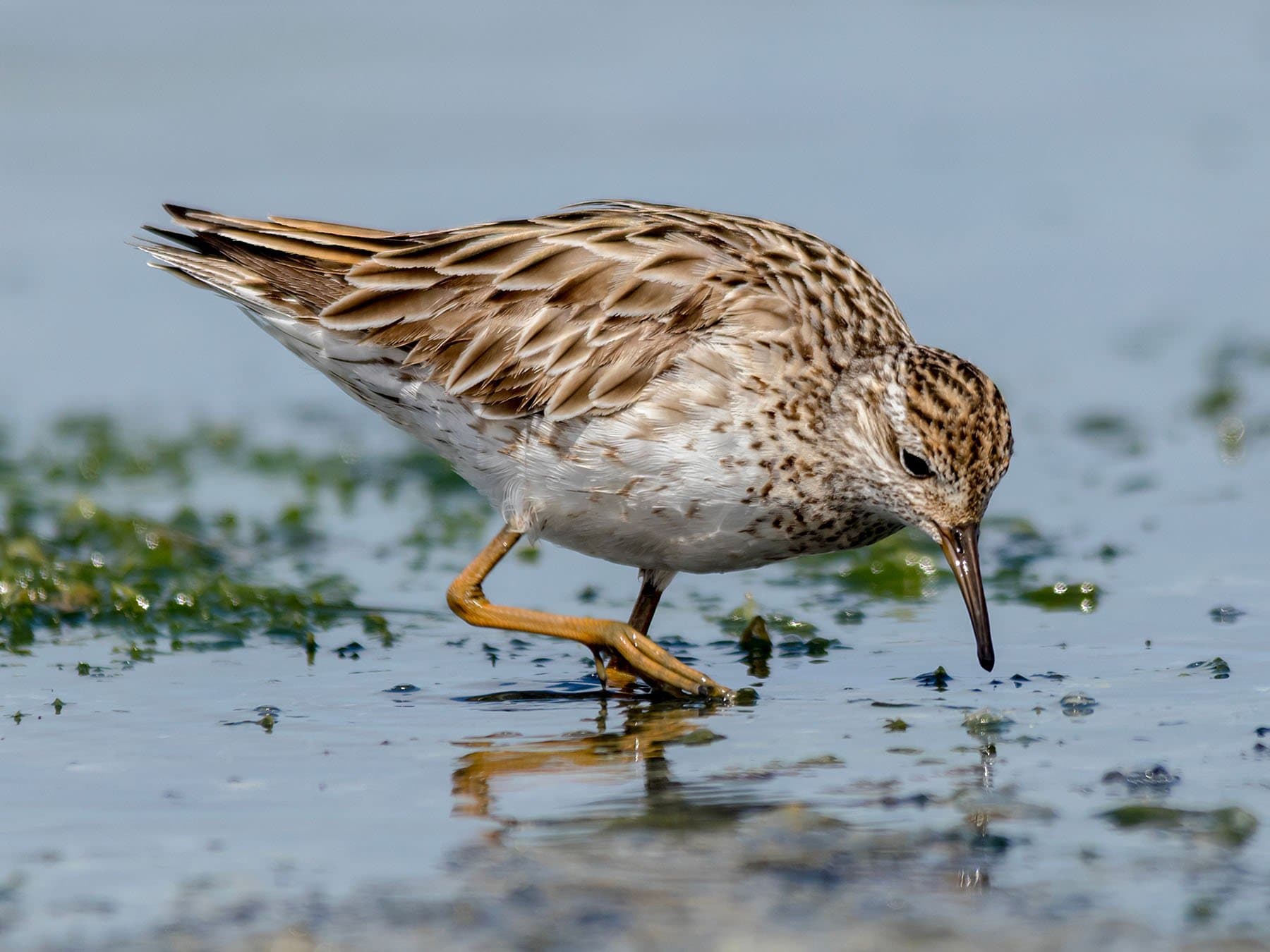
Sharp-tailed Sandpiper foraging in shallow water, showing brown and white mottled plumage, long dark beak, and yellow legs.
Quick Facts
Conservation
VUVulnerableLifespan
5–8 years
Length
17–22 cm
Weight
39–114 g
Wingspan
36–43 cm
Migration
Long-distance Migrant
A portly wader with a rich chestnut crown, bold white eyebrow, and arrow-shaped chevrons splashed across its flanks, the Sharp-tailed Sandpiper is best known for one of the most audacious migrations in the bird world. Juvenile birds — flying solo for the first time — detour thousands of kilometres east to Alaska before launching a presumed non-stop trans-Pacific flight of up to 9,800 km to reach Australia, entirely without parental guidance.
Think you've spotted a Sharp-tailed Sandpiper?
Upload a photo and we'll confirm it instantly
Confirm with a PhotoAppearance
Pot-bellied, flat-backed, and with a drawn-out rear end, the Sharp-tailed Sandpiper cuts an immediately recognisable silhouette among small waders — but it is the rich chestnut crown and bold white supercilium that catch the eye first. It measures 17–22 cm in length with a wingspan of 36–43 cm. Males weigh 53–114 g and females 39–105 g — a difference of roughly 15% in body size, though the sexes are essentially identical in plumage.
The most eye-catching feature is the rich chestnut (rufous) crown and nape, which contrasts sharply with a long, prominent white supercilium extending well behind the eye. A narrow white eye-ring is visible at close range. The lores and ear-coverts are brownish and slightly darker-streaked. In breeding plumage, the upperparts are dark brown with broad chestnut and whitish-buff fringes, producing a richly scaly, patterned effect. The mantle, scapulars, and tertials are mostly blackish-brown with paler fringes. The rump and uppertail-coverts are blackish, with white sides to the rump.
On the underparts, the chin, throat, and upper breast are tinged buffish and heavily streaked brown. The lower breast and flanks carry conspicuous dark chevron (arrow-shaped) markings on a white background — the single most reliable identification feature in the field. The tail is wedge-shaped with pointed central feathers, the feature that gives the species both its common name and its scientific epithet acuminata, meaning 'sharp' or 'pointed'. A narrow white wingbar is formed by the white tips of the greater and primary coverts.
The bill is dark grey to black, straight, and slightly shorter than the head length, with a paler olive-grey base on the lower mandible. The legs and feet are dull olive to yellowish-green. In non-breeding plumage, the bird appears considerably duller and more greyish-brown. The crown is less vivid, the mantle feathers have large brown centres with paler fringes, and the underparts are whitish with a greyish wash and narrow brown streaks on the neck and breast. The chevron pattern on the flanks largely disappears outside the breeding season.
Identification & Characteristics
Colors
- Primary
- Brown
- Secondary
- Chestnut
- Beak
- Black
- Legs
- Olive
Markings
Rich chestnut crown and nape; long bold white supercilium; dark chevron (arrow-shaped) markings on lower breast and flanks; wedge-shaped tail with pointed central feathers
Tail: Wedge-shaped with pointed central rectrices (the feature that gives the species its name); dark brown with white sides to the rump
Attributes
Understanding Attributes
Rated 0–100 based on research and observation. A score of 50 is average across all bird species. These attributes are relative and don't necessarily indicate superiority.
Habitat & Distribution
On its Siberian breeding grounds, the Sharp-tailed Sandpiper inhabits wet tundra with peat hummocks and lichen, favouring areas with wet peaty hollows, sedges, mosses, and drier hummocks covered with low shrubs. It nests in wetter tundra than most other small-to-medium shorebirds sharing the same range, a preference that likely reduces direct competition with species such as the Pectoral Sandpiper. The breeding range is relatively restricted: northeastern Siberia from the Lena Delta and Taymyr Peninsula east to the Kolyma River delta and Chaunskaya Bay in Chukotka.
Over 90% of the global population winters in Australia, where birds arrive from August onwards and peak in numbers between December and February. The species strongly prefers freshwater inland wetlands with grassy edges, but as ephemeral wetlands dry out, birds shift to coastal mudflats, saltmarsh, and brackish lagoons. Other recorded Australian habitats include sewage farms, flooded paddocks, mangroves, rice fields, and occasionally dry beaches. Birds are found throughout the continent, with the greatest concentrations in southeastern Australia.
In New Zealand, the Sharp-tailed Sandpiper is a regular migrant (classified as 'Native: Migrant'), present between September and April. It occurs mainly at tidal harbours and shallow lowland lakes, and has been recorded on Chatham Island, Raoul Island, the Snares, and the Auckland Islands. Numbers have declined sharply from up to 200 birds annually in the 1990s to as few as 30 birds in recent years — a trend that mirrors the global population decline.
In North America, the species is a rare but regular autumn migrant, primarily in Alaska, where juveniles stage from mid-August to late October. Smaller numbers occur along the Pacific coast from southern British Columbia to central California, mostly between late August and mid-November. In the UK, it holds 'Mega' rarity status, with approximately 32 accepted records by 2012, mostly between August and October from sites in England and Scotland including Kent, Lincolnshire, Somerset, and East Riding of Yorkshire. It is a very rare vagrant elsewhere in Europe, recorded in 11 countries, and has also been recorded in the Middle East, Central Asia, and — in 2018 — Mozambique, the first record for continental Africa.
Where to See This Bird
Explore regional guides for locations where this bird has been recorded.
Diet
Sharp-tailed Sandpipers are omnivorous, though invertebrates dominate the diet throughout the year. Aquatic insects and their larvae are the primary food source, supplemented by molluscs (including bivalves and snails), crustaceans such as shrimps, worms, and occasionally seeds and other plant material. The precise composition shifts with season and habitat: on the breeding tundra, terrestrial invertebrates are most important; on migration and in winter, aquatic prey predominates.
Foraging is primarily visual — birds peck and jab at the surface with rapid, shallow movements, picking off prey items from mud, wet grass, or shallow water. Soft substrate is targeted with rapid probing bill movements when buried invertebrates are the goal. On coastal mudflats, birds work the surface systematically before moving inland to wade the shallow margins of freshwater wetlands as the tide rises. After rain, birds have been recorded foraging in paddocks of short grass well away from any water, presumably targeting earthworms or surface invertebrates flushed to the surface.
The species also forages on dry or wet mats of algae, among rotting seaweed or seagrass on beaches, and on the edges of stony wetlands and exposed reefs — a dietary flexibility that helps birds exploit whatever food source is locally abundant. In Alaska, juvenile birds feed intensively during the pre-migratory fattening period, with some individuals doubling their body weight before departing on the trans-Pacific crossing. The fuelling rates achieved there are thought to be significantly higher than at alternative staging sites, which may explain why juveniles make the seemingly counterintuitive detour east before heading south.
Behaviour
Sharp-tailed Sandpipers are gregarious birds, typically foraging in flocks that can number in the hundreds, though these often fragment into scattered, loosely associated groups spread across a wetland. When feeding, birds frequently crouch low — a posture thought to reduce their visibility to aerial predators. Despite this wariness, the species can be surprisingly confiding around humans, sometimes allowing close approach at favoured wetland sites.
While foraging, the Sharp-tailed Sandpiper bobs its head and rear end — a behaviour shared with several other Calidris sandpipers. Foraging activity shifts with the tide: at low water, birds work intertidal mudflats; as the tide rises, they move inland to freshwater wetlands. This tidal rhythm is well documented at Australian coastal sites where the species winters in large numbers.
On the Siberian breeding grounds, males are highly territorial and vocal, performing elaborate aerial and ground displays to attract females. The mating system is polygynous — and possibly promiscuous — with males attempting to mate with multiple females entering their territory. Once mating is complete, males depart the breeding grounds during incubation, leaving all parental duties to the female. This means that by the time juveniles are preparing for their first migration, their fathers have already been gone for weeks.
An interspecific behaviour documented on the breeding grounds reveals a striking spatial relationship with the Pectoral Sandpiper: Sharp-tailed Sandpipers maintain a minimum nesting distance of at least 33 metres from Pectoral Sandpiper nests, even though the two species' territories overlap extensively. This spatial avoidance — apparently to reduce competition between two ecologically similar species — does not apply to other shorebird neighbours. This makes it a rare and well-documented example of interspecific territorial partitioning.
Calls & Sounds
A sharp whit-whit rising from a wetland margin is often the first sign that Sharp-tailed Sandpipers are present — the species' characteristic flight call, frequently doubled and given at take-off, where it is sometimes rendered as trit-trit. A softer trreep is also described, and in flight birds give soft twitters and a more melodious trrrt wiitiit that has been compared to certain calls of the Barn Swallow — an unexpected sonic reference for a wader.
The song, delivered on the breeding grounds, is unlike that of any other Calidris sandpiper. It includes a long, muffled trill and a low-pitched, aspirated hoop. During the male's aerial display flight, the inflated breast sac produces a dry, crackling warble — a sound generated by the sac itself rather than the syrinx, functioning as an acoustic advertisement of male quality that carries across the open tundra. During ground display, the male produces clicking notes in time with rapid wing-flicking movements, creating a percussive accompaniment to the visual performance.
An aggressive call used in antagonistic encounters between Sharp-tailed Sandpipers has also been recorded, distinct from the flight and display vocalisations. Males are most vocal on the breeding grounds during the courtship period in June and July. Outside the breeding season, the species is generally quieter, though the characteristic flight call is regularly given by migrating and wintering birds and is often the first indication of the species' presence at a wetland site.
Flight
Swift, direct, and capable of sustained overwater flight lasting days, the Sharp-tailed Sandpiper is built for distance rather than spectacle. The wings are moderately long and pointed, producing a streamlined silhouette, with rapid, fairly shallow wingbeats typical of the Calidris sandpipers. The narrow white wingbar — formed by the white tips of the greater and primary coverts — is visible in flight but less bold than in some related species. The white sides to the rump are visible as the bird banks, contrasting with the dark central rump and uppertail-coverts.
The wedge-shaped tail with pointed central rectrices is the species' namesake feature and can be seen at close range in good light, though it requires a direct view of the tail to appreciate. The pot-bellied body shape gives the bird a slightly front-heavy look in flight compared to slimmer waders such as the Wood Sandpiper.
When flushed, birds typically rise steeply and call loudly — the sharp whit-whit flight call is often the first indication of the species' presence. Migrating flocks of up to several hundred birds fly in loose, shifting formations rather than tight coordinated groups. The trans-Pacific migration undertaken by juveniles — a non-stop flight of up to 9,800 km — represents one of the most demanding overwater crossings of any small shorebird, requiring sustained flight over open ocean for days without rest or feeding.
Nesting & Breeding
Breeding takes place during the short Siberian summer, with egg-laying occurring in June. Males arrive first on the breeding grounds and establish territories, performing spectacular aerial courtship displays over small drier ridges adjacent to wetter tundra — floating back to the ground while vocalising. The mating system is polygynous, and possibly promiscuous; once mating is complete, males depart the breeding grounds during incubation and play no further role in raising young. See the Courtship and Display section for full details of the display repertoire.
Nests are shallow depressions on the ground, well hidden among dense sedges or low vegetation in wet tundra, lined with grass and willow leaves. Breeding density can reach up to 20 birds per km². The clutch is typically 4 eggs (range 3–4), olive-brown to yellow-olive in colour, either unmarked or with small-to-large brown spots — highly cryptic against the tundra floor.
The female incubates alone for 19–23 days. Chicks are precocial and leave the nest within a day of the last egg hatching, tended solely by the female. They are capable of flight at approximately 18–21 days old. The species raises a single brood per season. If a predator approaches the nest or chicks, the female may perform distraction displays to draw the threat away.
Lifespan
Surviving the first trans-Pacific migration is the greatest hurdle a Sharp-tailed Sandpiper will face — those that do may live for 5–8 years in the wild. No confirmed maximum longevity record has been published for the species, which reflects both the challenges of tracking birds across their vast flyway and the relatively small number of individuals that have been ringed and recovered. For comparison, the closely related Pectoral Sandpiper has a similar life expectancy, while larger shorebirds such as the Bar-tailed Godwit have been recorded living beyond 20 years.
Mortality is highest in the first year of life, when juvenile birds must navigate the extraordinary trans-Pacific migration entirely without experience or parental guidance. The Alaskan staging period is a critical window: birds that fail to accumulate sufficient fat reserves before departing face a greatly elevated risk of dying over the open ocean. Predation by raptors at staging and wintering sites, collisions with vehicles and aircraft, and hunting in parts of the flyway all contribute to adult mortality.
The species' declining population trend suggests that current survival rates are insufficient to offset losses — a pattern consistent with habitat degradation at key staging and wintering sites reducing the body condition of birds completing the annual cycle. Improved wetland management at Yellow Sea stopover sites and Australian wintering grounds is considered essential to stabilising survival rates across the flyway.
Conservation
The Sharp-tailed Sandpiper was uplisted to Vulnerable on the IUCN Red List in 2021, reflecting a population decline of approximately 45% over a 15-year period. The global population is estimated at 60,000–120,000 mature individuals, with a best estimate of 73,000 birds — a dramatic fall from earlier estimates of around 160,000. For context, the closely related Pectoral Sandpiper numbers approximately 1.5 million individuals, and the Curlew Sandpiper over 1 million; the Sharp-tailed Sandpiper's population is a fraction of either.
The primary bottleneck is the Yellow Sea coastline of China and South Korea, where vast intertidal mudflats serve as critical refuelling stopover sites for adults on southward migration. Reclamation of these mudflats for aquaculture and coastal development has dramatically reduced the available foraging habitat at this irreplaceable staging area. The loss of even a portion of Yellow Sea habitat can have cascading effects on the entire flyway population, as birds arrive at wintering grounds in poorer condition and with reduced fat reserves for the return migration.
On the Australian wintering grounds, threats include the clearing, draining, inundation, or infilling of freshwater wetlands, reducing foraging and roosting opportunities and impairing birds' ability to build up energy reserves before departing for Siberia. Habitat pressures are compounded by loss of riparian vegetation, invasive species, water pollution, and hydrological changes from water regulation. Direct mortality pressures include disturbance from residential and recreational encroachment, hunting, vehicle collisions, aircraft strikes, and predation. In New Zealand, numbers have collapsed from up to 200 birds annually in the 1990s to as few as 30 in recent years.
Conservation priorities include the legal protection of key Yellow Sea staging sites within the East Asian–Australasian Flyway framework, improved management of Australian freshwater wetlands, and continued monitoring of population trends across the flyway. The species' restricted breeding range in northeastern Siberia — while currently undisturbed — adds to its overall vulnerability.
Population
Estimated: 60,000–120,000 mature individuals (best estimate: 73,000)
Trend: Decreasing
Declining — estimated 45% reduction over 15 years, driven by Yellow Sea staging habitat loss and Australian wetland degradation. Uplisted to Vulnerable (IUCN) in 2021.
Elevation
Sea level to low tundra on breeding grounds; primarily lowland wetlands on migration and wintering grounds
Additional Details
- Family:
- Scolopacidae (Sandpipers & Snipes)
Courtship & Display
The Sharp-tailed Sandpiper has one of the most elaborate courtship repertoires of any Calidris sandpiper. Males arrive on the Siberian breeding grounds ahead of females and immediately begin displaying over small drier ridges adjacent to the wetter tundra where nesting will occur. The aerial display involves the male flying up and then floating slowly back to the ground while vocalising — a performance designed to advertise territory quality and individual fitness to any female within earshot.
The ground display is equally striking. The male perches on fairly dry tundra, lifts both wings partway up, then flicks them rapidly higher in time with clicking notes — a precisely coordinated visual and acoustic signal. During the aerial phase, the breast sac inflates and produces a dry, crackling warble unique within the genus, functioning as an acoustic signal of male quality rather than a conventional syrinx-produced song. No other Calidris sandpiper produces a comparable sound.
The mating system is polygynous, and possibly promiscuous: males attempt to mate with every female that enters their territory, and females may visit multiple males before settling to nest. A female may nest within a male's territory, move to another male's territory, or nest entirely outside any male's realm. Once mating is complete, males depart the breeding grounds entirely, leaving the female to incubate and raise the chicks alone.
Birdwatching Tips
In Australia, the best time to look for Sharp-tailed Sandpipers is between September and March, with peak numbers from December to February. Freshwater wetlands with grassy or sedgy margins are the most productive habitat — sewage treatment ponds, flooded paddocks, and shallow inland lakes are all worth checking. The species often associates with other waders, particularly Pectoral Sandpipers and other small waders in mixed flocks. At coastal sites, birds move between intertidal mudflats at low tide and freshwater wetlands at high tide, so timing a visit around the tidal cycle pays dividends.
In the field, the combination of chestnut crown, long white supercilium, and dark chevron markings on the lower breast and flanks is diagnostic. The chevrons are most vivid in breeding plumage (April–July); in non-breeding birds, look for the pot-bellied silhouette, prominent supercilium, and the wedge-shaped tail with pointed central feathers. The bill is straight and dark, with a slightly paler base — shorter than the head length.
The most likely confusion species is the Pectoral Sandpiper, which shares the chestnut-toned upperparts and streaked breast. The key differences: Sharp-tailed has chevron markings on the flanks (not just streaks), a more vivid chestnut crown, a more prominent supercilium, and a less sharply defined breast band. In flight, Sharp-tailed shows a slightly more tapered rear end and the pointed tail is visible at close range.
In Alaska, juveniles stage from mid-August to late October at coastal moist meadows and riverine mudbanks — particularly in western Alaska. In the UK, any sighting is a genuine rarity event; most records come from coastal wetlands in England between August and October, and should be reported to county bird recorders immediately.
Did You Know?
- The species was first described to science in 1821 from a specimen collected on Java, Indonesia — yet its nest was not discovered until 1957, a full 136 years later, when a nest was found in the Russian Far East. The remote Siberian breeding grounds and secretive nesting behaviour kept the species' reproductive biology a mystery for well over a century.
- For decades, the Sharp-tailed Sandpiper was assumed to be most closely related to the Pectoral Sandpiper due to their similar appearance and overlapping breeding range. Molecular studies have suggested that its true sister species may be the very differently-looking Broad-billed Sandpiper (Calidris falcinellus) — a striking case of convergent evolution potentially misleading taxonomists for generations.
- Juvenile Sharp-tailed Sandpipers are one of only two bird species known to have a migratory route unique to juveniles — the other being the European Honey-buzzard. Young birds fly approximately 2,300 km east to Alaska before launching a presumed non-stop trans-Pacific crossing of up to 9,800 km, all without parental guidance or prior experience.
- The global population has fallen from an estimated 160,000 birds to a best estimate of just 73,000 — a decline of approximately 45% in 15 years — driven largely by the reclamation of Yellow Sea mudflats that serve as the species' critical refuelling stopover on migration.
Records & Accolades
Epic Solo Migration
Up to 9,800 km non-stop
Juvenile Sharp-tailed Sandpipers are believed to undertake a non-stop trans-Pacific flight of up to 9,800 km from Alaska to Australasia — one of the longest overwater crossings of any small shorebird, made without parental guidance.
136-Year Nest Mystery
Described 1821, nest found 1957
The species was described to science in 1821, but its nest was not discovered until 1957 — a 136-year gap that reflects just how remote and secretive its Siberian breeding grounds are.
Dramatic Decline
~45% decline in 15 years
The global population has fallen from an estimated 160,000 to a best estimate of 73,000 birds in just 15 years, leading to its uplisting to Vulnerable on the IUCN Red List in 2021.
Community Photos
Be the first to share a photo of the Sharp-tailed Sandpiper
Upload a PhotoIdentify Any Bird Instantly
- Upload a photo from your phone or camera
- Get an instant AI identification
- Ask follow-up questions about the bird
Monthly Birds in Your Area
- Personalised for your location
- Seasonal tips and garden advice
- Updated every month with new species