


Greater Scaup
Bluebill, Broadbill · Aythya marila
By the Birdfact teamChecked by Nathan Cope
On this page13 sections
How to recognise it
What do Scaup look like?
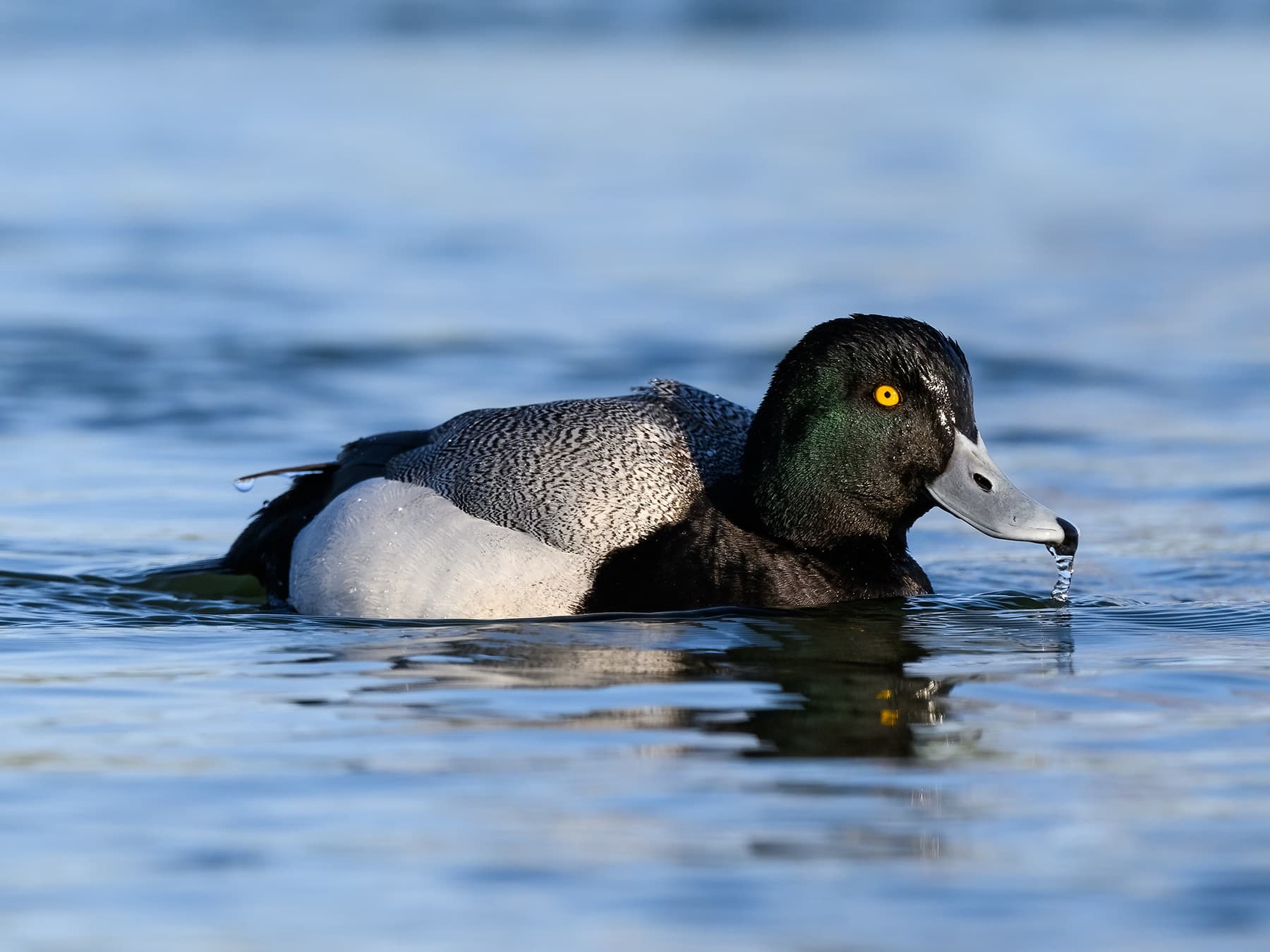
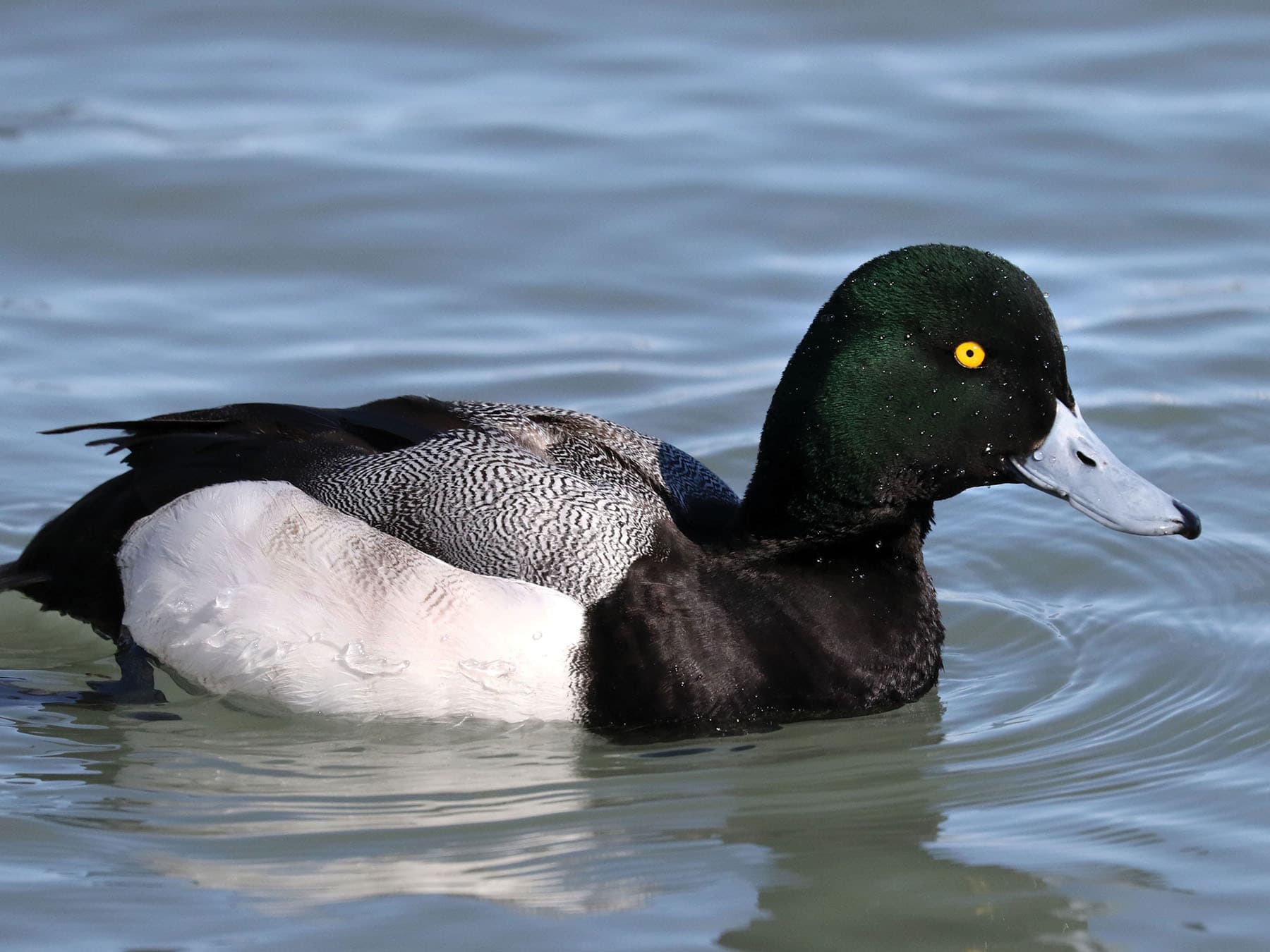
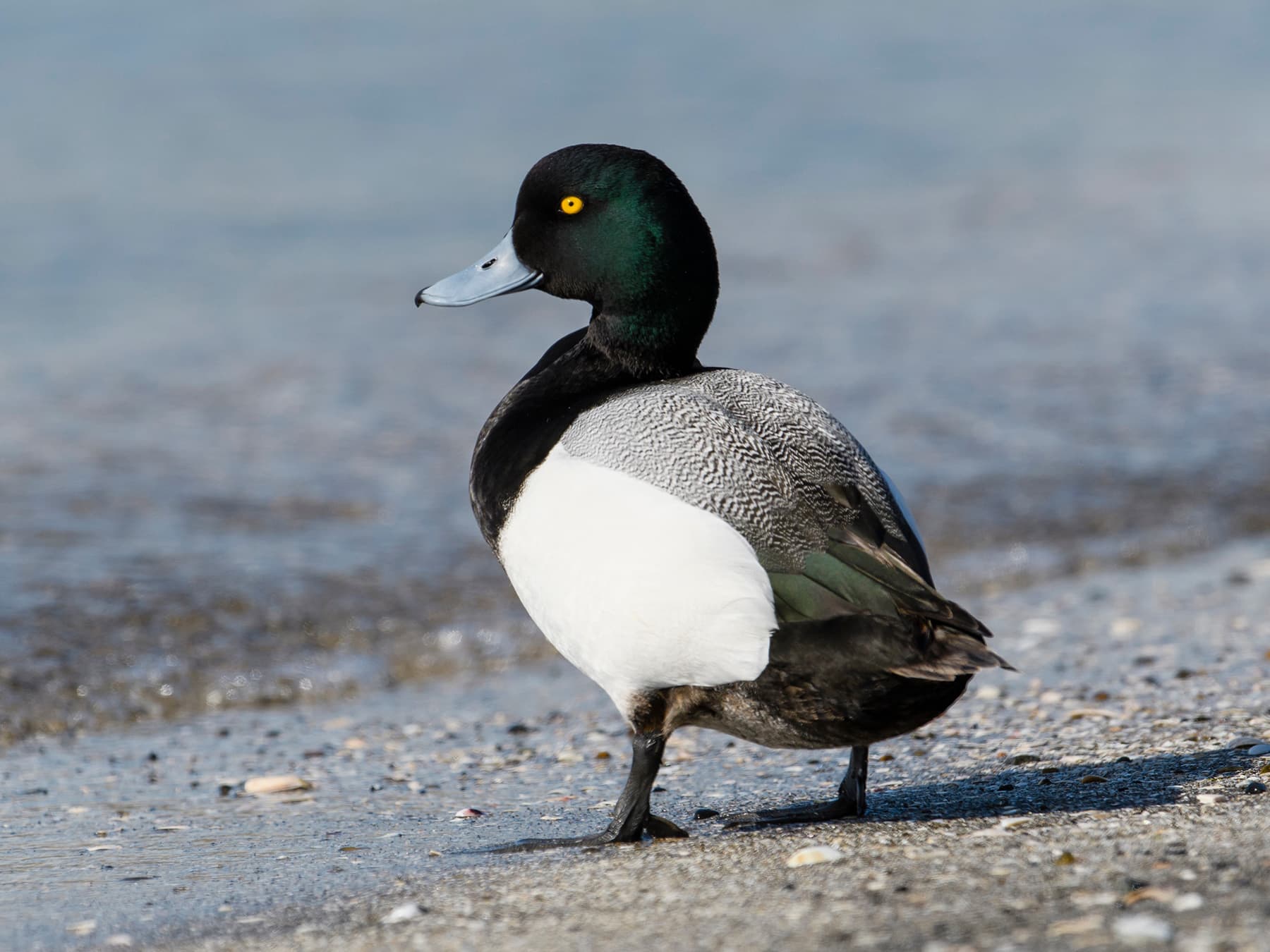
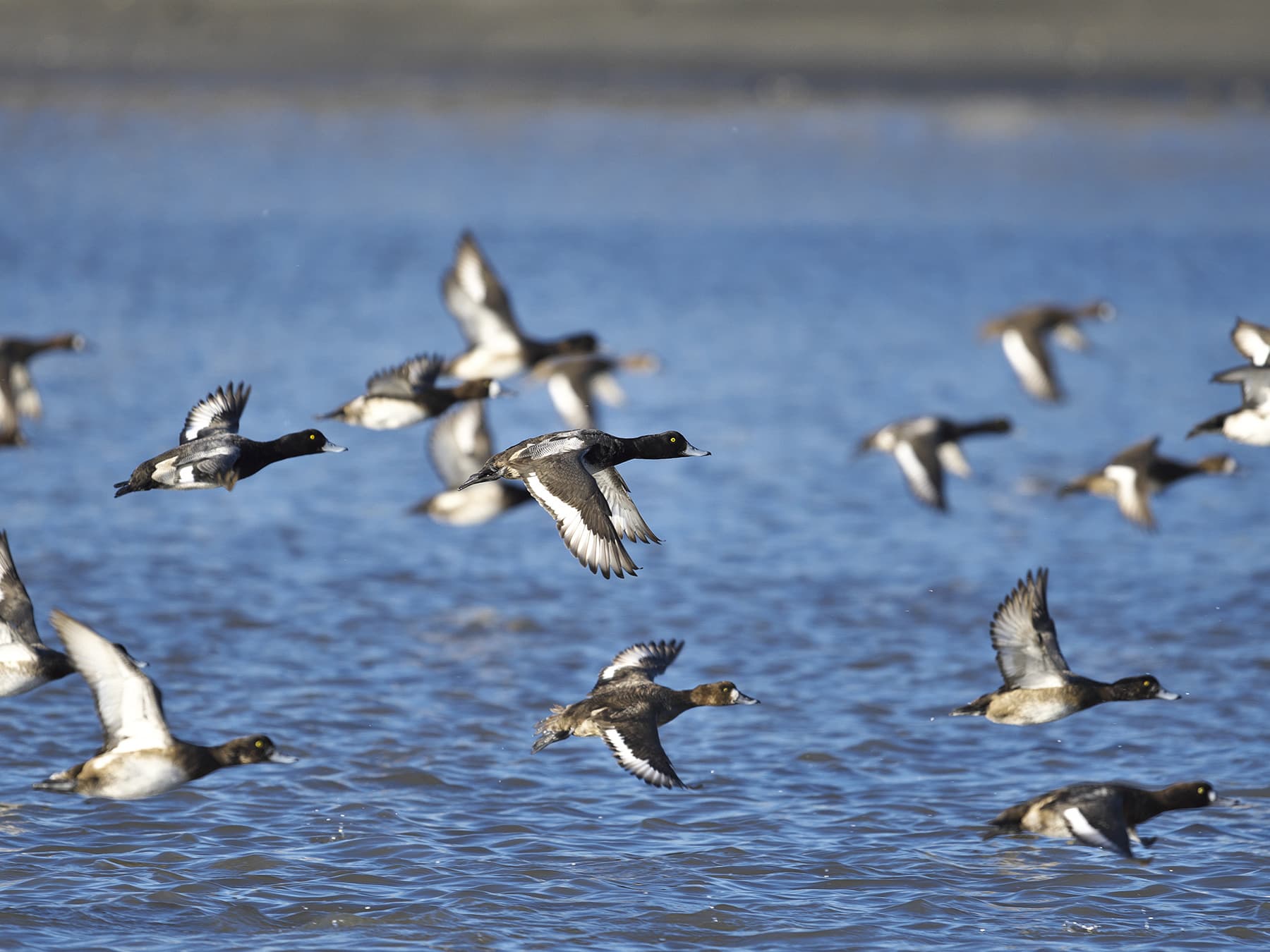
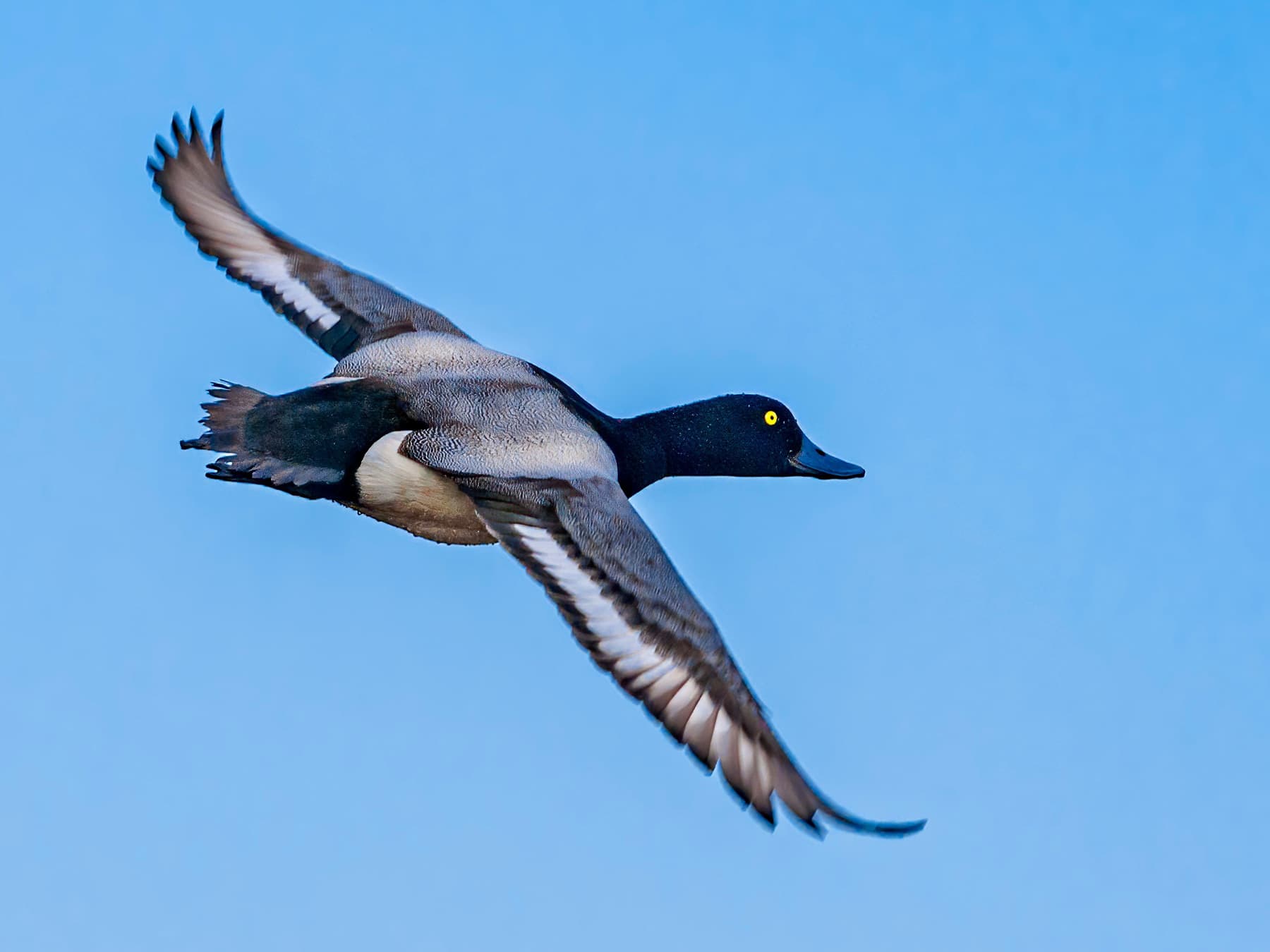
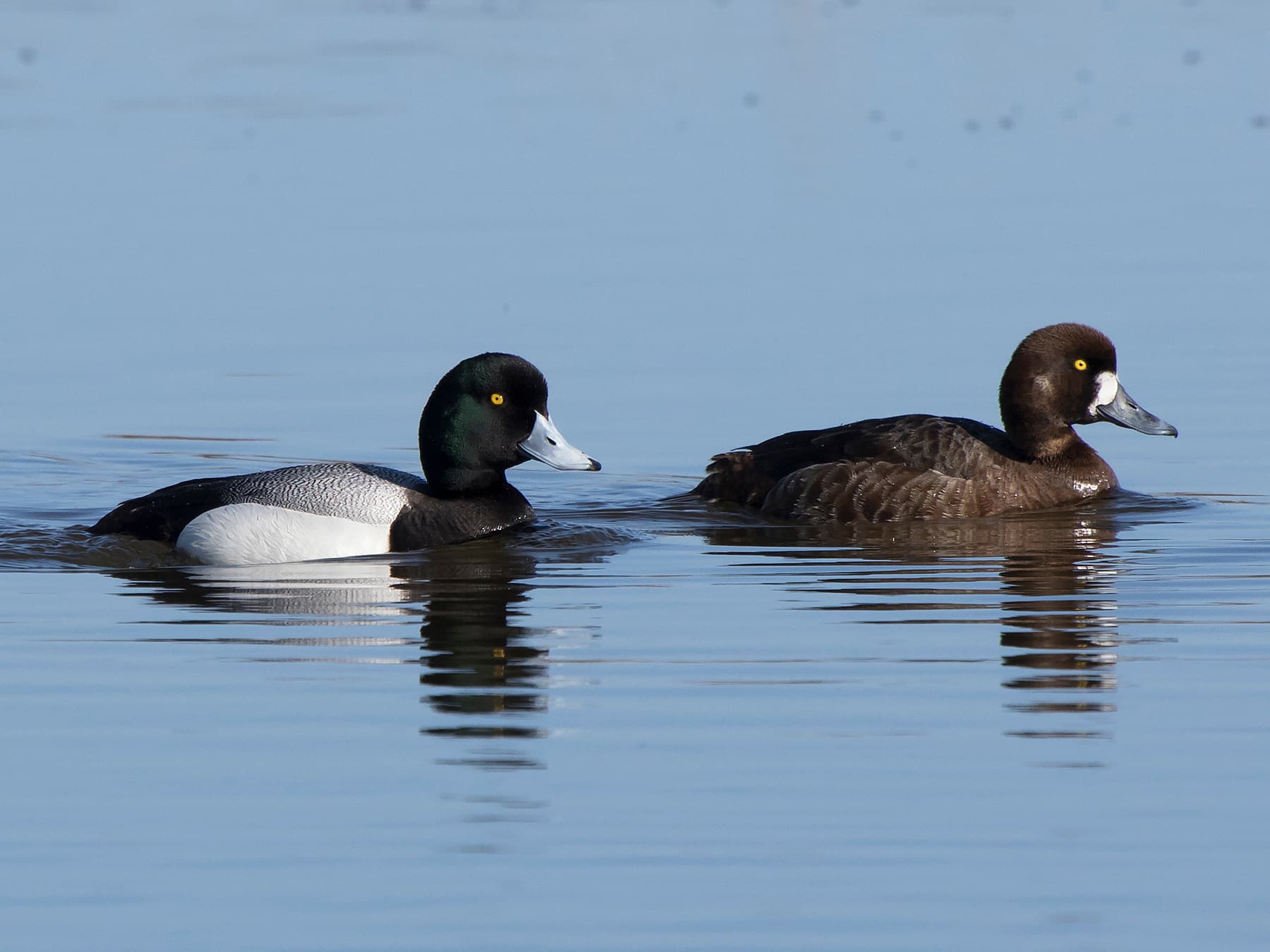
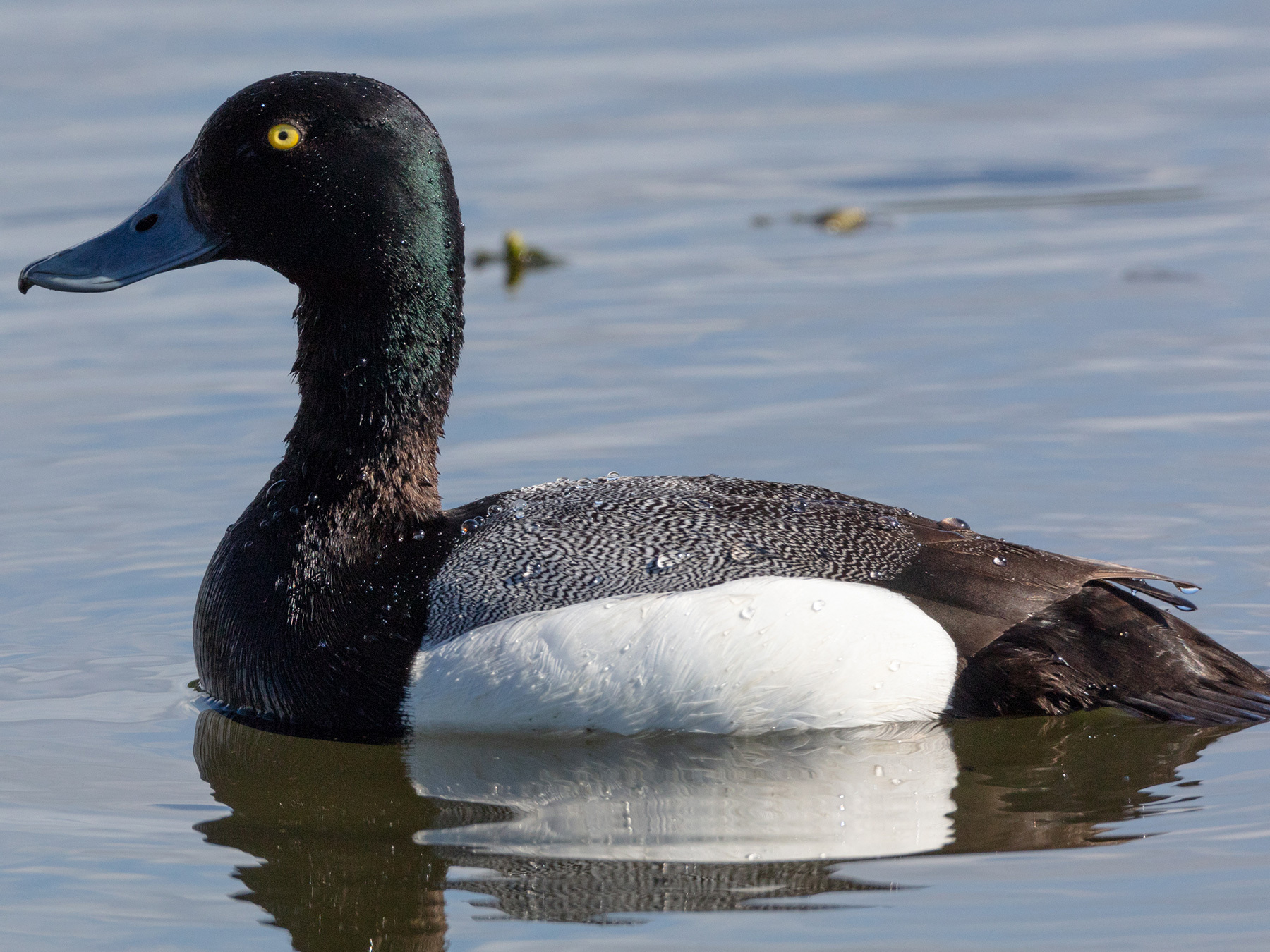
Adult breeding male greater scaup have a distinctive black and white plumage, with piercing golden eyes. Their black heads have a greenish tinge, and their neck, tail and breast are a rich, glossy black. Their belly and flanks are white and their back is pale, flecked with gray. A horizontal white bar runs across the lower edge of their black wings, which is clearly visible in flight.
A male scaup’s blue-gray bill gives them their common nickname, and features a large black ‘nail’ at the tip. Their feet and legs are olive-gray to a deep lead-blue.
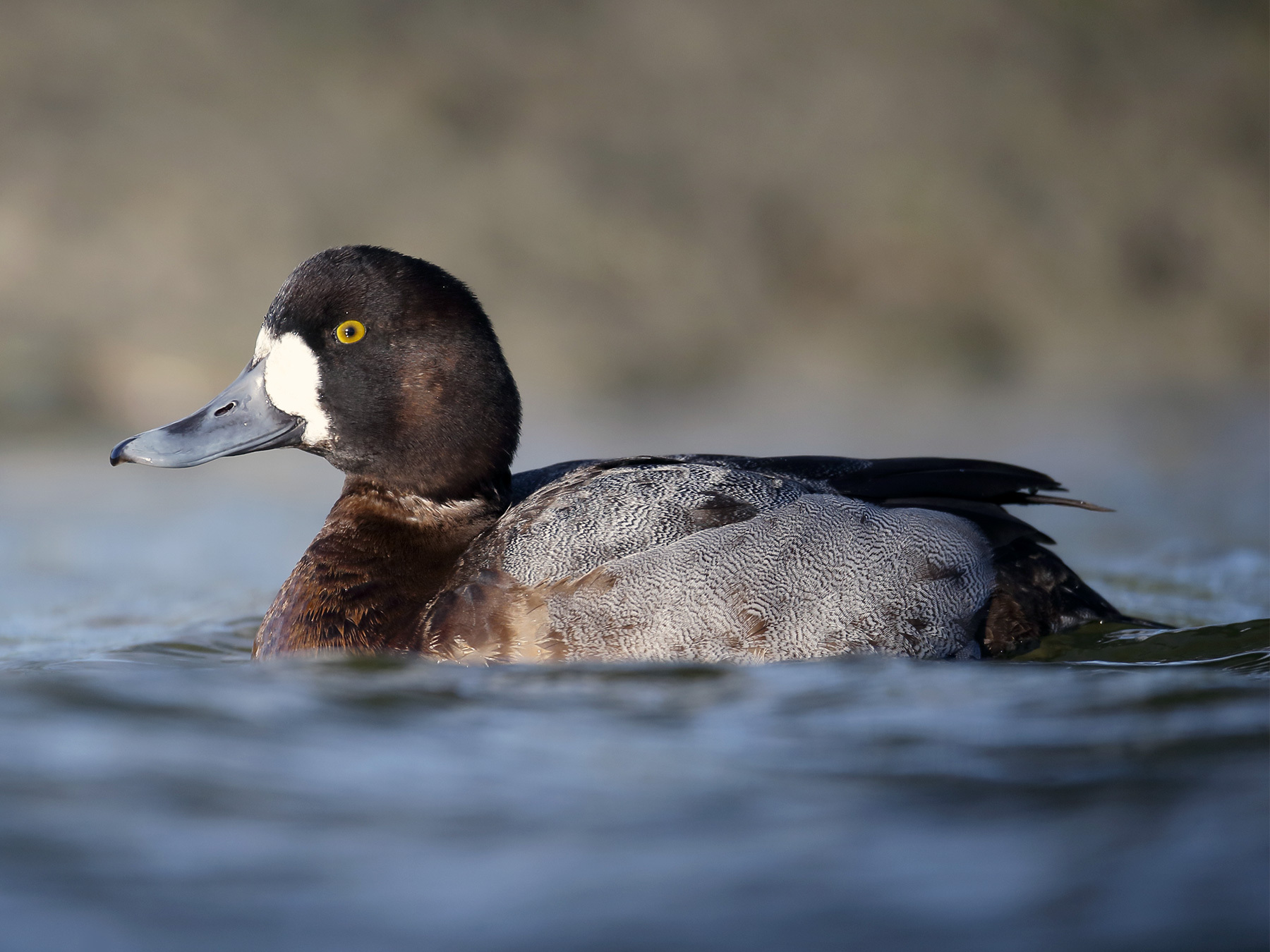
Before their young hatch, males depart from breeding grounds to undergo an annual molt into an ‘eclipse’ plumage, which is altogether browner than the bold black seen in breeding males. Their white flanks become heavily streaked with brown, and their bill becomes duller in color and develops some white patches around the base. Their eyes also become a more muted shade of yellow.
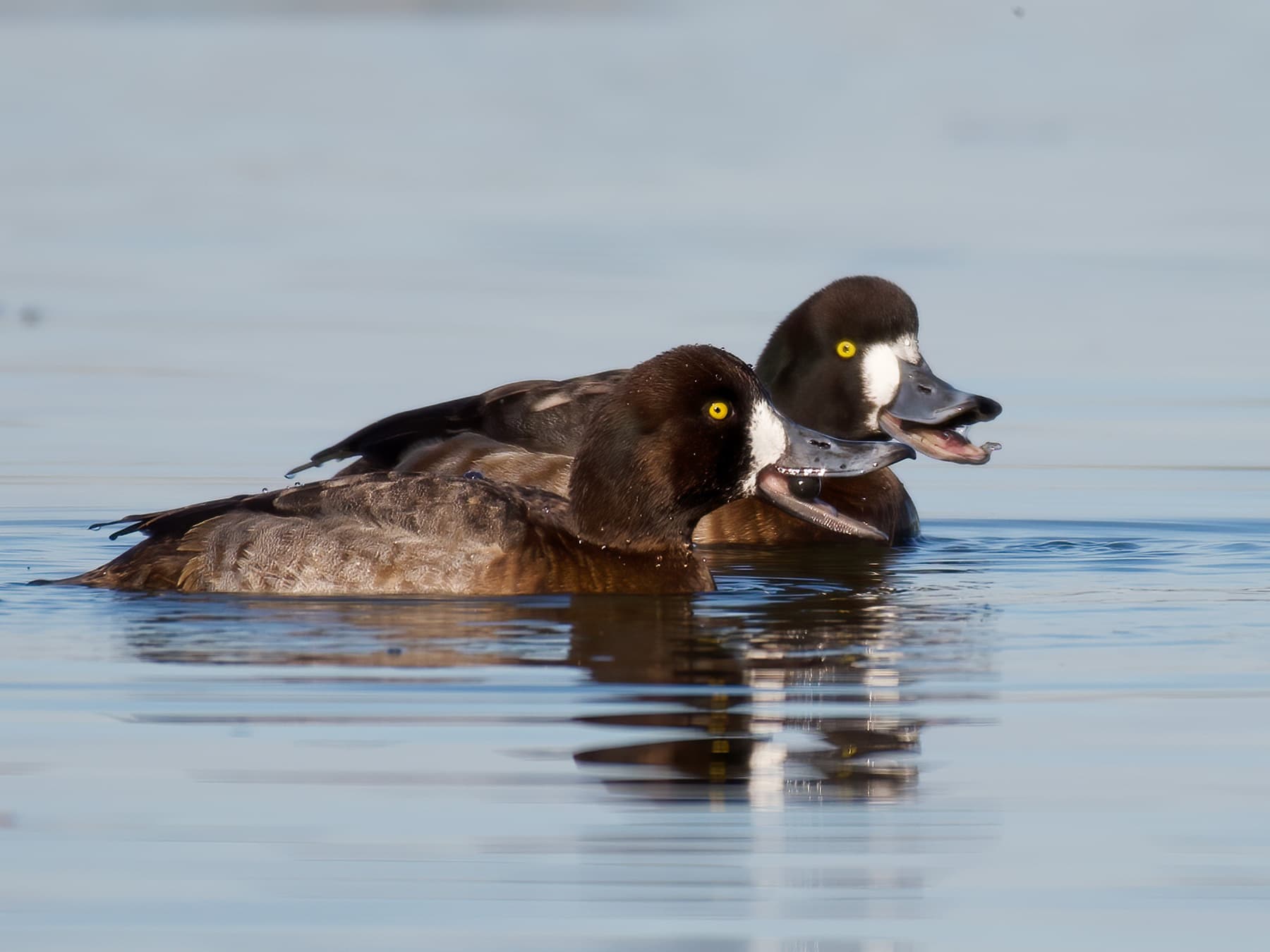
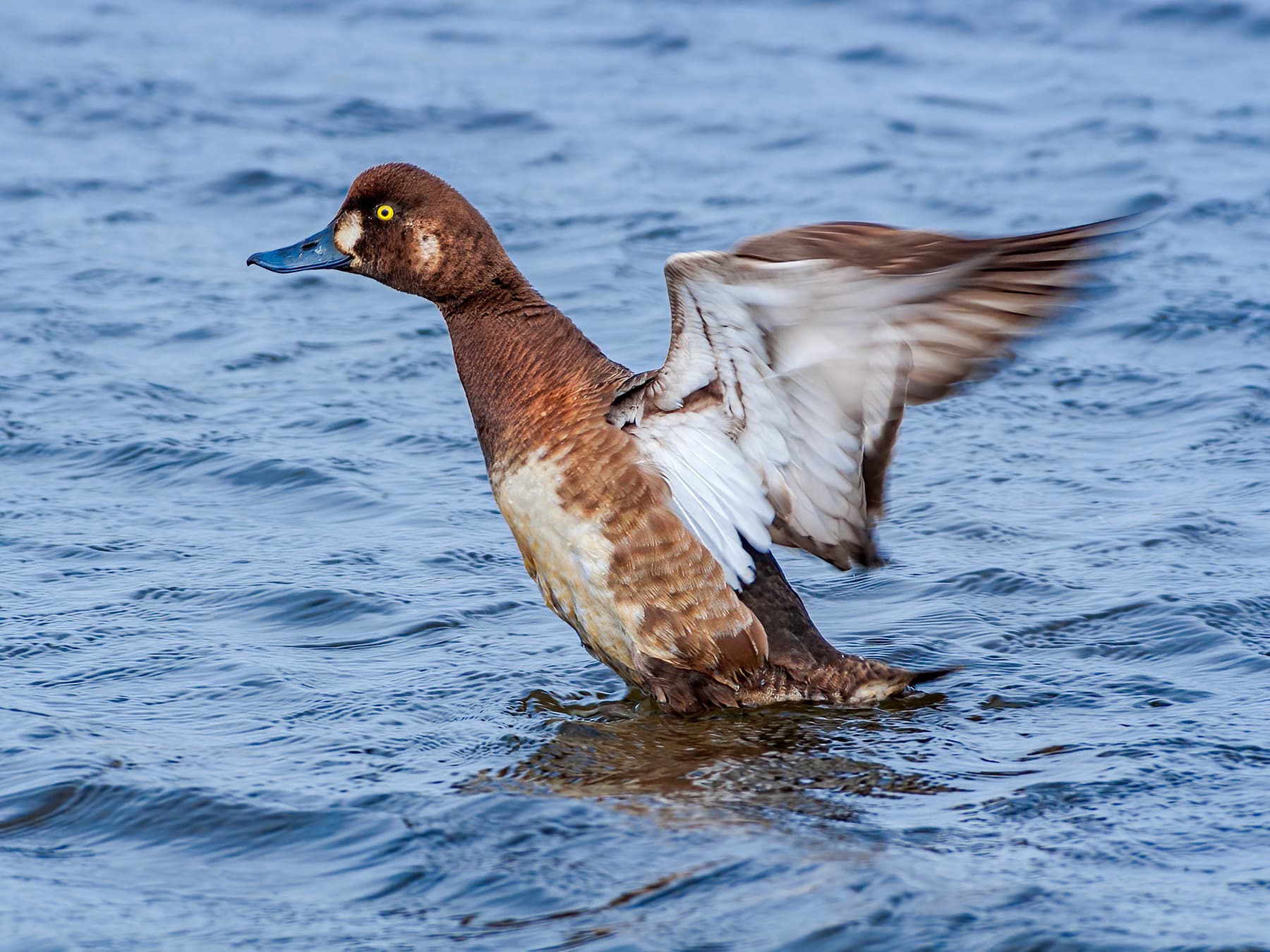
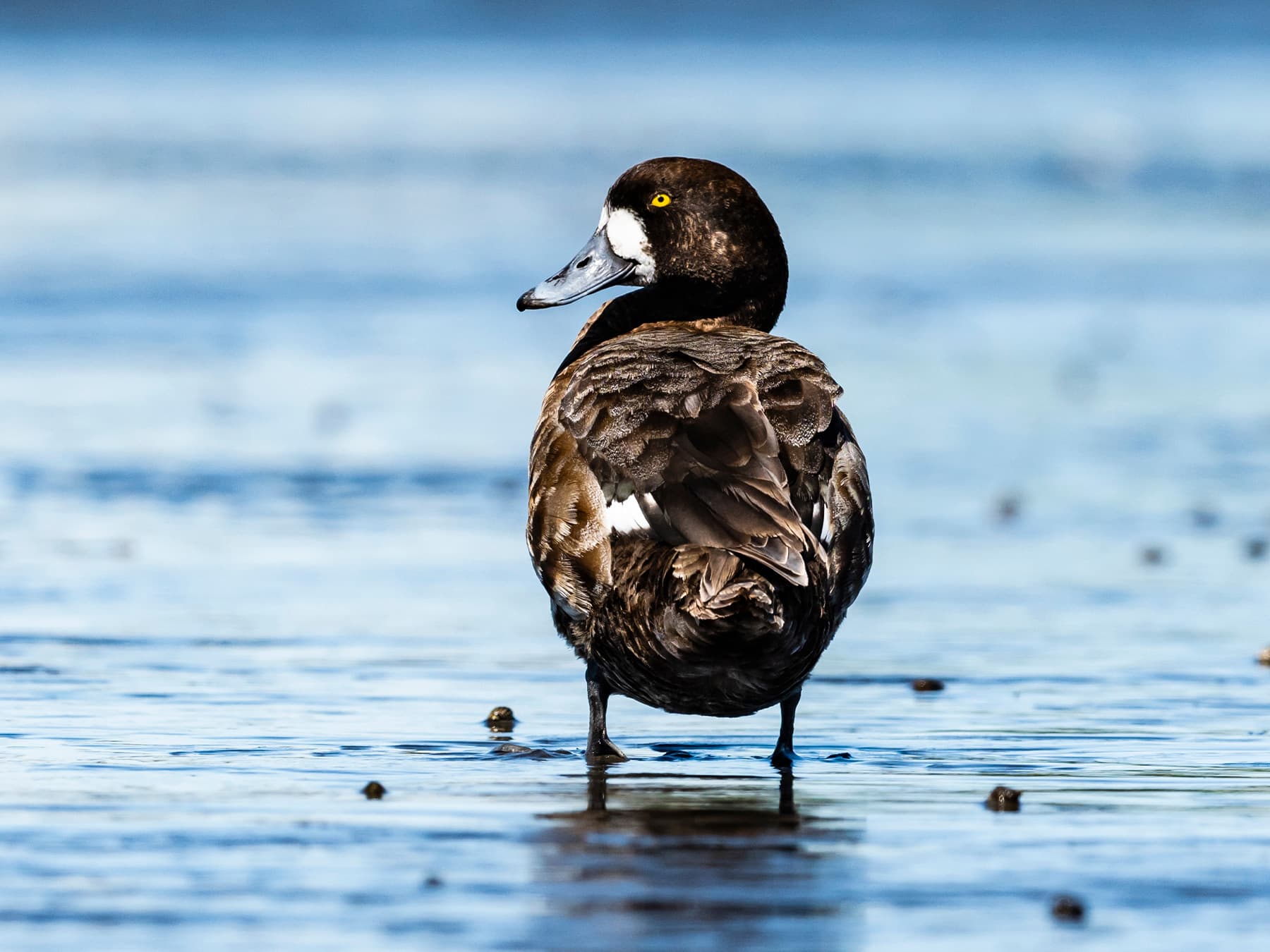
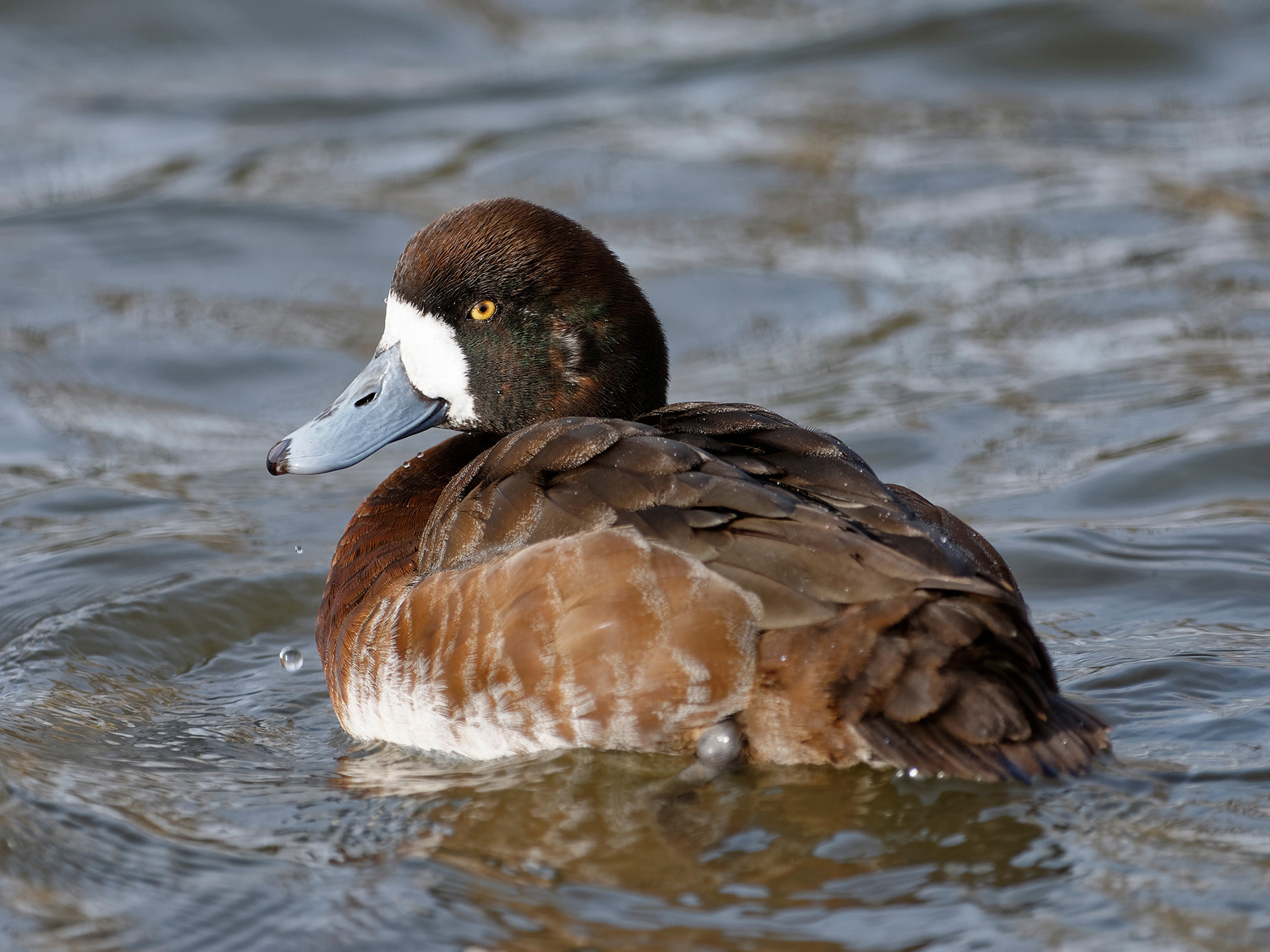
The plumage of female scaup is mainly a rich brown. Facial markings include a ring of white around the base of the bill. They are smaller in size than males, and can easily be told apart because of the difference in their colouring. In flight white bars can be seen along the length of the trailing edge of the wing.
Once females have raised their young, they molt into a brownish set of feathers, similar to their appearance earlier in the spring, but less vibrant and altogether more dull. In winter, a female scaup’s eyes may darken to a light brown from the pale yellow seen during the spring.
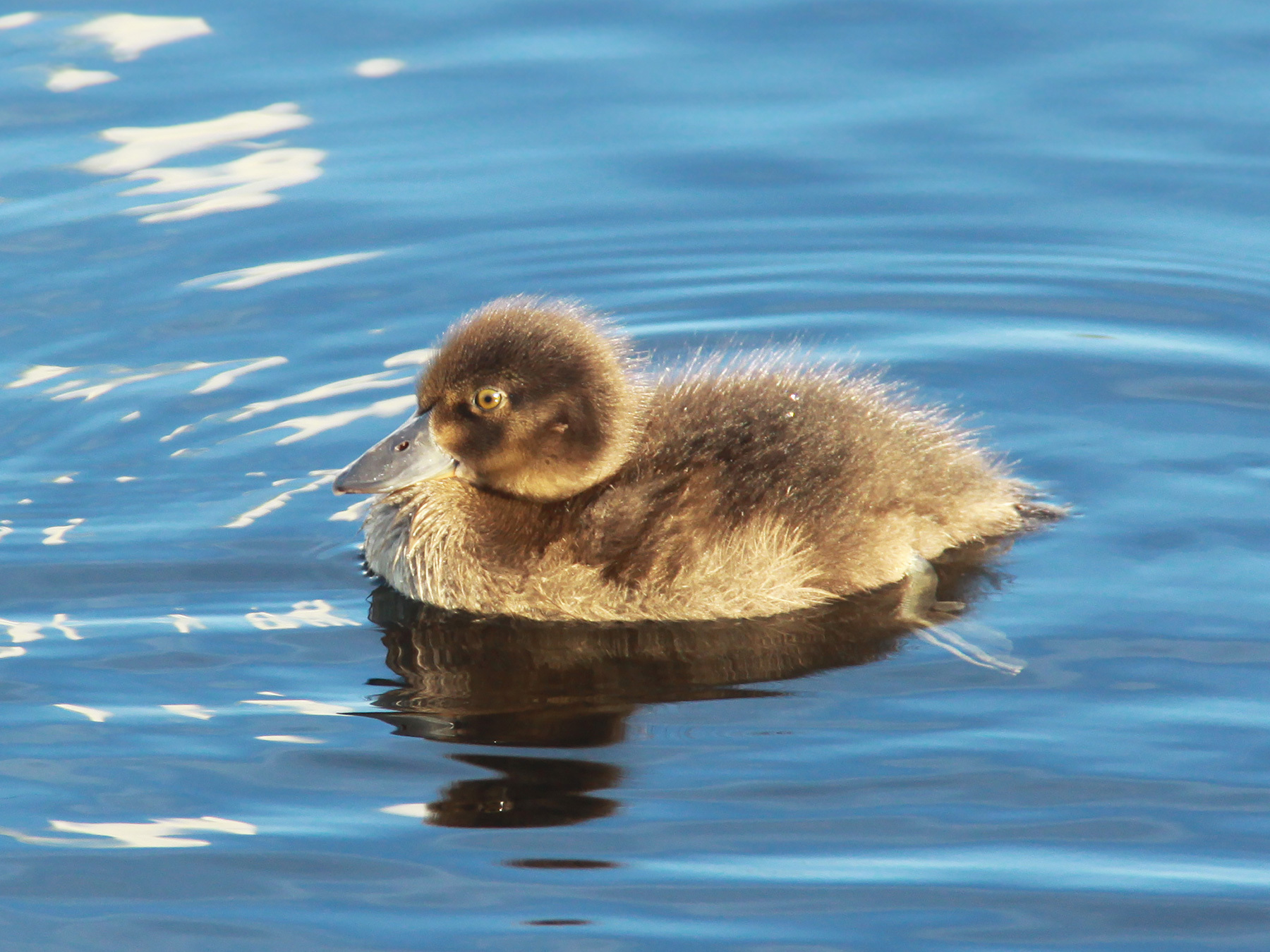
Juvenile scaup are similar in appearance to females, but have less vivid white facial markings and are a duller, paler shade of brown all over.
How big are Scaup?
Classed as a medium-sized duck, scaup are smaller in size than mallards. Females are smaller and lighter in weight than males.
- Length: 42 cm to 51 cm (16.5 in to 20.1 in)
- Wingspan: 67 cm to 78 cm (26.3 in to 30.7 in)
- Weight: 0.8 kg to 1.3 kg (28.2 oz to 45.9 oz)
Its size
Adults- Length
- 39–56 cm
- Wingspan
- 71–84 cm
- Weight
- 726–1360 g
Its song and calls
What sound does a Scaup make?
Not a particularly noisy duck species, a scaup’s vocalizations are usually limited to a croaking, hoarse series of notes that make a ‘scaup’ sound, which gives the species its name.
When and where to see it
OctoberArriving
Most recorded in October
- 1. Falkirk0.54%
- 2. Sligo0.34%
- 3. Wexford0.33%
- 4. Dumfries and Galloway0.30%
- 5. Highland0.29%
Each dot is a county, state or province: the bigger and darker, the larger the bird’s share of that place’s bird records that month. Grey dots: no regular records. The ringed point is the centre of the bird’s records this month; the arrow shows how it moved since last month, and the dashed loop its path through the year. “Arrivals” colours places where it becomes regular this month (orange) or is in its last regular month (grey). GBIF eBird Observation Dataset, 2019–2024. Map data: Natural Earth, US Census Bureau; place centres © OpenStreetMap contributors.
In your area
See when the Greater Scaup is recorded in your county, state or province.
How often the Greater Scaup turns up in the UK, Ireland, the United States and Canada through the year, from birdwatchers' records.
United Kingdom
Winter visitor · regularly Jul–Apr · most records in January
Ireland
Winter visitor · regularly Oct–Apr · most records in January
United States
Winter visitor · regularly Sep–Jun · most records in January
Canada
Winter visitor · regularly Sep–Jun · most records in January
Show as a table
| Month | United Kingdom | Ireland | United States | Canada |
|---|---|---|---|---|
| January | 0.078% (regular) | 0.097% (regular) | 0.17% (regular) | 0.47% (regular) |
| February | 0.064% (regular) | 0.054% (regular) | 0.16% (regular) | 0.41% (regular) |
| March | 0.046% (regular) | 0.061% (regular) | 0.13% (regular) | 0.38% (regular) |
| April | 0.022% (regular) | 0.028% (regular) | 0.050% (regular) | 0.23% (regular) |
| May | 0.004% | 0.004% | 0.021% (regular) | 0.082% (regular) |
| June | 0.001% | – | 0.032% (regular) | 0.029% (regular) |
| July | 0.004% (regular) | – | 0.008% | 0.017% |
| August | 0.005% (regular) | – | 0.007% | 0.017% |
| September | 0.012% (regular) | 0.004% | 0.011% (regular) | 0.056% (regular) |
| October | 0.033% (regular) | 0.044% (regular) | 0.042% (regular) | 0.26% (regular) |
| November | 0.050% (regular) | 0.088% (regular) | 0.094% (regular) | 0.40% (regular) |
| December | 0.062% (regular) | 0.063% (regular) | 0.12% (regular) | 0.36% (regular) |
Recorded regularly in
Worldwide: recorded regularly in 53 countries
Countries where it was recorded in at least 3 of the 6 years 2019–2024. Linked countries have their own bird list.
Europe (34)
Asia (12)
- Azerbaijan
- China
- Georgia
- Hong Kong SAR China
- India
- Japan
- Kazakhstan
- Philippines
- South Korea
- Taiwan
- Thailand
- Turkey
North America (6)
Oceania (1)
- US Outlying Islands
Data: EOD – eBird Observation Dataset (Cornell Lab of Ornithology), accessed via GBIF.org, CC BY 4.0. Records from 2019–2024, aggregated and filtered by Birdfact. How these lists are made
What is the habitat of a Scaup?
Scaup can be seen foraging during the breeding season on lakes, rivers, salt bays and estuaries. During spring and summer, they are present on lakes and bogs in semi-open landscapes, up to the fringes of boreal forest and extending into tundra regions.
Once winter arrives, scaup migrate southwards, moving away from inland wetlands towards more exposed coastal bays, lagoons, and estuaries. Some inland lakes attract large numbers of overwintering scaup, in particular North America’s Great Lakes region.
What is the range of a Scaup?
Greater scaup are the most northerly scaup species, breeding in Europe and Asia from Iceland and Scandinavia in the west, eastwards across northern Russia into eastern Siberia, and the Kamchatka Peninsula.
In winter, populations experience a southward shift, with coastlines around Britain and southern Scandinavia welcoming an influx of migrating birds, and sightings commonly reported at regions bordering the Baltic, Mediterranean, Black and Caspian seas, and the Persian Gulf.
North American scaup are more numerous than their European counterparts, and breed across Alaska and across north-central Canada. Winter populations are concentrated mainly along the Atlantic coast, but are also not uncommon along the length of the Pacific coast.
Inland, many winter arrivals can be spotted in the Great Lakes region once breeding has concluded in wetlands further north.
Where do Scaup live?
Alaska’s tundra landscapes support the majority of North America’s breeding scaup population. In Canada, Manitoba and the Northwest Territories are the key nesting grounds, while in Europe, Russia, Iceland and Sweden are home to the largest breeding populations of scaup.
How rare are Scaup?
Scaup are common across North America, and become more widespread in fall, although some local declines have been identified in recent years.
In the UK, although winter visitors are not particularly extraordinary or unusual, breeding scaup are not at all common, ranking at Britain’s rarest breeding duck species. Only one or two pairs attempt to raise their young in the UK each year.
Where can you see Scaup in North America?
Both lesser and greater scaup are present in North America, with the former species accounting for up to 80 per cent of the continent’s combined scaup population. Greater scaup breed in the northern extremes of Canada and Alaska. Once the breeding season ends, southward migration follows, mainly to the Atlantic coast states of Delaware, Maryland and Virginia.
Where can you see Scaup in the UK?
Winter offers the best opportunities to spot scaup in the UK, with up to 6,400 post-breeding arrivals to British waterways and wetlands, particularly in Scotland and Northern Ireland.
Lough Neagh and Lough Beg, in County Antrim, record large numbers of overwintering scaup each year, while coastal estuaries offer a chance of a sighting, in particular the Dee in Cheshire, the Solway Firth along the Scotland-England border and Scotland’s Firth of Forth and Moray Firth.
Migration
Do Scaup migrate?
Scaup are a fully migratory species of diving duck.
Freshwater habitats are preferred for breeding, with a switch to coastal settings in the winter. In parts of Iceland, the species may be resident all year round, while in certain Scandinavian regions migrations are limited to small movements from inland lakes to coastal waters.
Are Scaup native to North America?
Greater scaup are present in North America all year round, but are a migratory species and move between their breeding grounds in Alaska and northern extremes of Arctic Canada, and wintering grounds that are dotted along the Atlantic coast of the northeastern US, as well as along the Pacific coast and in the Great Lakes regions.
Are Scaup native to the UK?
A number of scaup do visit the UK in winter, but only breed in the British Isles on incredibly scarce occasions.
Tips for seeing it
- Look for large flocks on coastal bays and large lakes
- Observe diving behavior - they submerge for 20-30 seconds at a time
- Listen for the distinctive whistling call of males during the breeding season
- In North America, check for white wing patches to distinguish from Lesser Scaup
What it eats
What do Scaup eat?
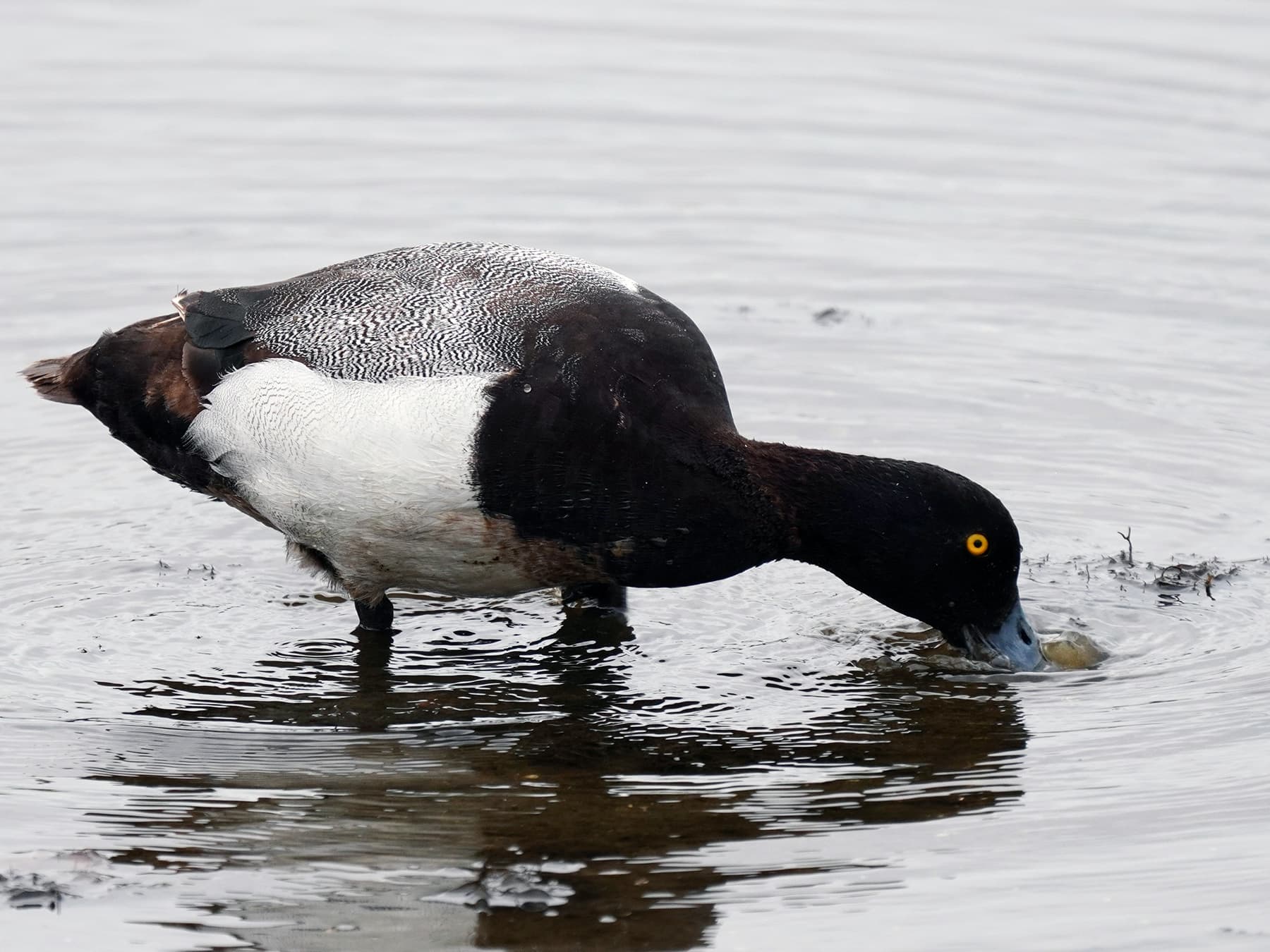
Scaup are diving ducks, and forage for prey and aquatic vegetation by swimming underwater. Large food items are brought to the water’s surface to be eaten, and feeding continues nocturnally as well as during daylight, with tidal patterns influencing feeding times.
A scaup’s diet varies according to the season, with mussels, oysters, clams and snails being of chief importance. In summer, on their freshwater breeding habitats, scaups eat more plant matter, including pondweed, wild celery, sedges and grasses, as well as insects, invertebrates and their larvae and crustaceans.
What do Scaup chicks eat?
Scaup ducklings are capable of feeding themselves as soon as they reach water for the first time, usually within 24 hours of hatching.
They begin with feeding from the water surface, taking insects and invertebrate larvae, but by their second week start to master shallow dives and expand their diet to include plant matter, crustaceans and molluscs.
Nesting and breeding
Where do Scaup nest?
Nests are built at ground level, amid dense vegetation cover offered by grasses and sedge and near to water. Small islands or floating platforms may occasionally be used.
The female creates a basic scrape in the ground, which is then lined with with plant matter and soft down.
When do Scaup nest?
In both the North American and Eurasian regions of their range, scaup nest from mid-to late May onwards, with early July being the peak time for hatching to begin.
What do Scaup eggs look like?
Scaup eggs are olive to light buff in color, and have some small pitting on the surface, but are generally plain and smooth and unmarked. Eggs measure 62 mm by 43 mm (2.4 in by 1.7 in) and a typical clutch consists of between 6 and 9 eggs.
Only one brood is raised each season, with incubation (by the female alone) lasting for between 23 and 28 days.
Do Scaup mate for life?
Like many duck species, scaup are seasonally monogamous, forming pairs while still on their wintering grounds. These bonds last until up to three weeks into incubation, when the males depart for molting grounds, leaving the female to raise the young alone.
It’s unlikely that a pair will remain bonded from one year to the next in the wild, although observations of mates in captivity breeding together in subsequent years have been recorded.
Behaviour
Are Scaup aggressive?
Some aggressive behavior may be apparent during courtship and breeding, but for the rest of the year, scaup are considered to be a relatively sociable and non-aggressive species, often joining large mixed species foraging flocks once they have finished raising their young.
Where do Scaup sleep at night?
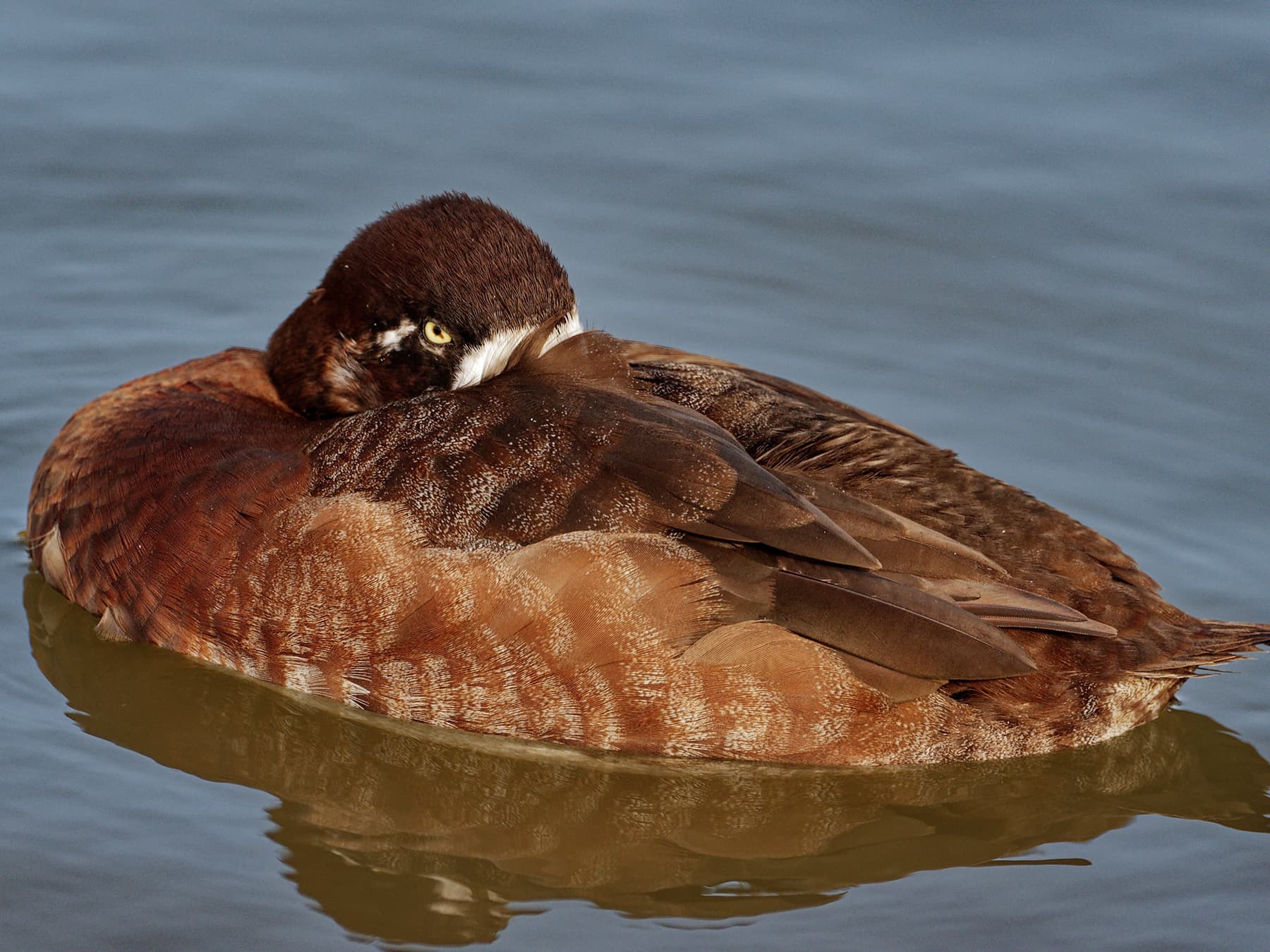
During both the day and night, scaups can be found sleeping on the water of large lakes and reservoirs, with their heads tucked under their wings.
Lifespan and predators
How long do Scaup live?
Scaup usually breed for the first time at 2 years. According to banding records, the maximum lifespan is 22 years and 1 month for a male and 19 years and 2 months for a female.
What are the predators of Scaup?
Among the leading predators of scaup are foxes, owls, skunks, raccoons and coyotes.
They are also one of the most common species hunted for sport by humans in the United States.
Are Scaup protected?
Scaup are a popular game bird in the US, but limits exist on when and how many can be shot at a time. They are also protected under the Federal Migratory Bird Treaty Act of 1918.
In the UK, scaup are registered as Schedule I birds under the Wildlife and Countryside Act, ng 1981, which offers their eggs, nest sites and young protection against being destroyed or damaged during the breeding season. It is illegal to knowingly kill, injure or capture the species.
Are Scaup endangered?
Across their global range, scaup are classed as a species of least concern, and are widespread and abundant across their distribution range, with population estimates of up to 5.1 million, the majority of which are resident in North America.
Greater scaup numbers are believed to be in decline, with factors such as oil pollution, sewage, habitat degradation and human activity all threatening their long-term survival.
Due to their highly rare status as a breeding bird in the UK, scaup have Red status on the British Birds of Conservation Concern list.
Conservation
While currently listed as Least Concern, Greater Scaup populations have shown declines in some regions. Threats include habitat loss, pollution in wintering areas, and climate change affecting breeding grounds. Conservation efforts focus on protecting key wetland habitats and monitoring population trends.
More photos
5 photos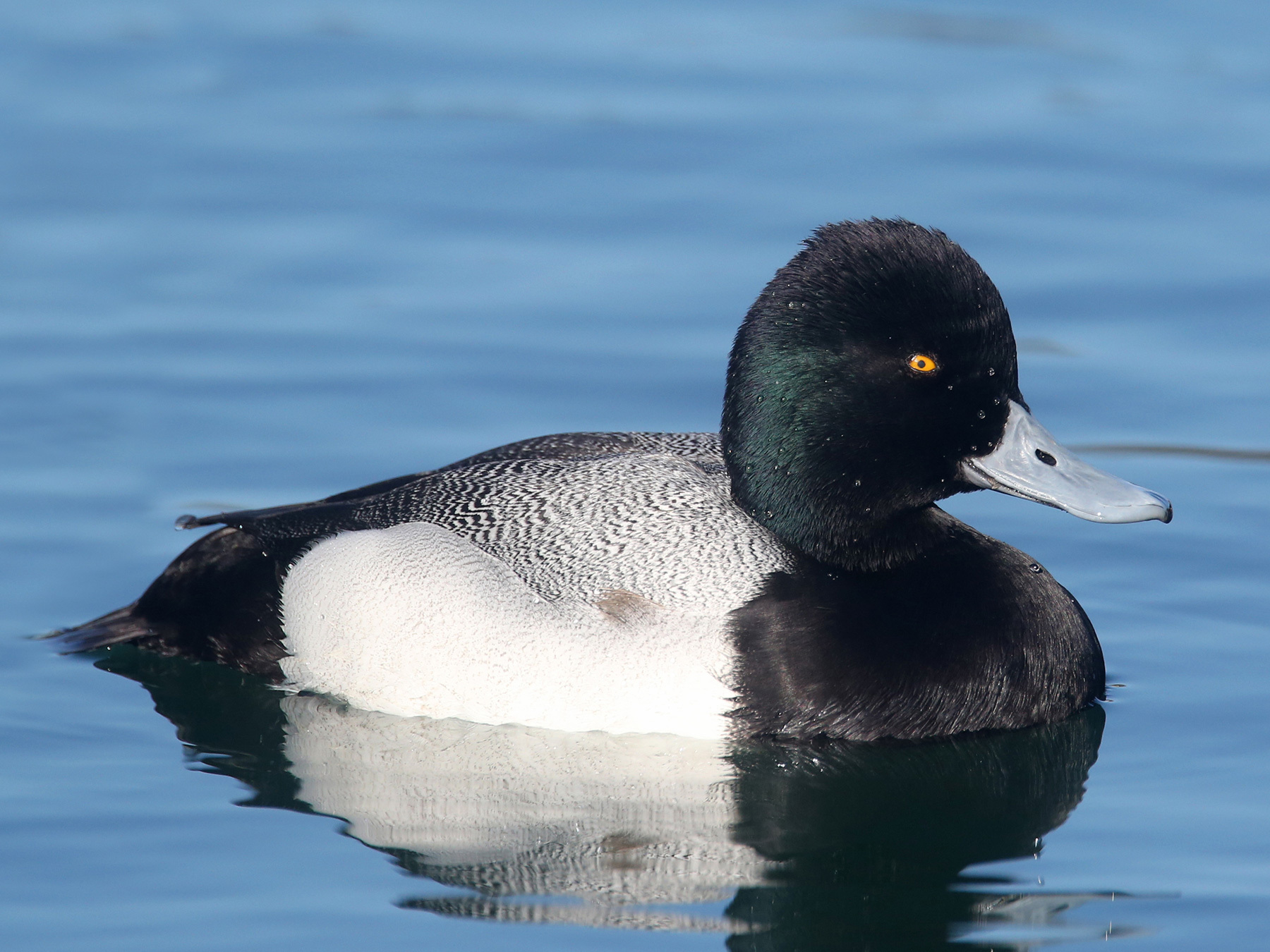
Quick facts
- Length
- 39–56 cm
- Wingspan
- 71–84 cm
- Weight
- 726–1360 g
- Lifespan
- 10–15 years
- Family
- Ducks, Geese & Swans
- Migration
- Long-distance Migrant
- Global status (IUCN)
- Least Concern
- World population
- 4,920,000 - 5,130,000 mature individuals
- Population trend
- Decreasing
- Also called
- Bluebill, Broadbill
- Scientific name
- Aythya marila
Questions
4Is a Scaup a duck?
Scaup are diving ducks that breed in the Arctic regions of northern Canada and Eurasia.
What kind of duck is a blue bill?
Bluebill is another name for a greater scaup, and a little bluebill is the common name for a lesser scaup. They are diving ducks that breed in the far northern extremes of Arctic Canada, Russia and Siberia and migrate south in winter.
How do you pronounce Scaup?
Scaup is pronounced ‘Scorp’, to rhyme with ‘warp’.
How do you know if a Scaup is lesser or greater?
Lesser scaups are usually marginally smaller than greater scaups, but the key differences between the two species are mainly found in their posture, appearance, and also in their geographical range.
Lesser scaup have a more upright posture, with an almost egg-shaped head and elongated neck. Greater scaup have more rounded heads and wider necks. The black nail at the tip of a greater scaup’s bill is noticeably wider than that of the lesser scaup.
While there is some overlap between the North American breeding territories of greater and lesser scaup, the latter species is confined to the Americas, while greater scaup also breed in the extreme northern regions of Europe and Central Asia.
In North America, lesser scaup are by far the dominant species, forming up to 89 percent of the combined total population of the two species combined.
Sources
3- 1BirdLife International. 2018. Aythya marila. The IUCN Red List of Threatened Species 2018: e.T22680398A132525108. Source (opens in a new tab)
- 2Wetlands International (2016)
- 3Wetlands International (2016)

Checked by
Nathan Cope, founder and editor
Nathan founded Birdfact and leads its writers and contributors in the UK, the US and Canada. He has watched and studied birds for more than ten years, and checks every article and species guide before it’s published.