


Sandhill Crane
Canadian Crane · Antigone canadensis
By the Birdfact teamChecked by Nathan Cope
On this page13 sections
How to recognise it
The Sandhill Crane is a distinctive bird, not easily confused with other species.
What do Sandhill Cranes look like?
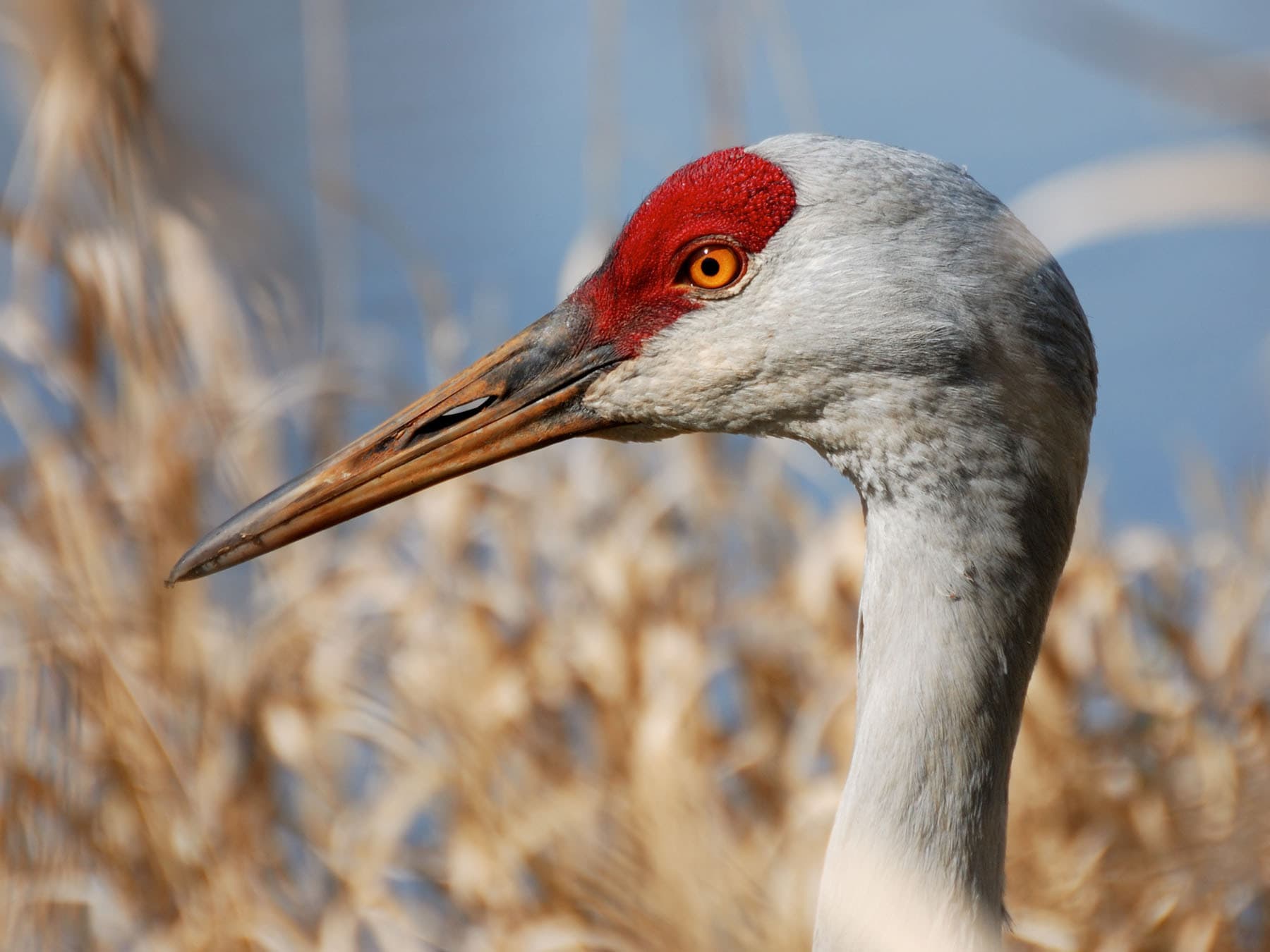
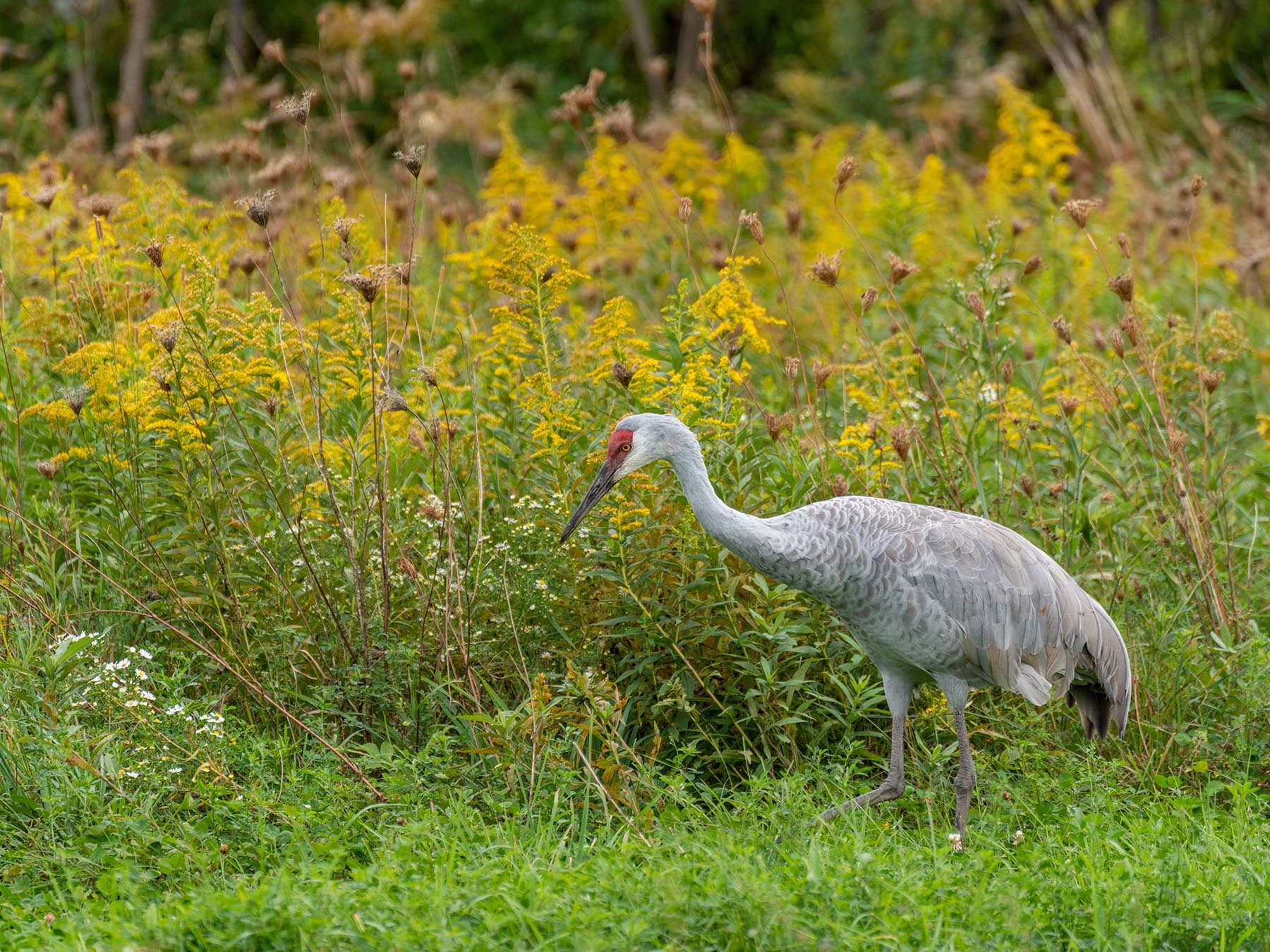
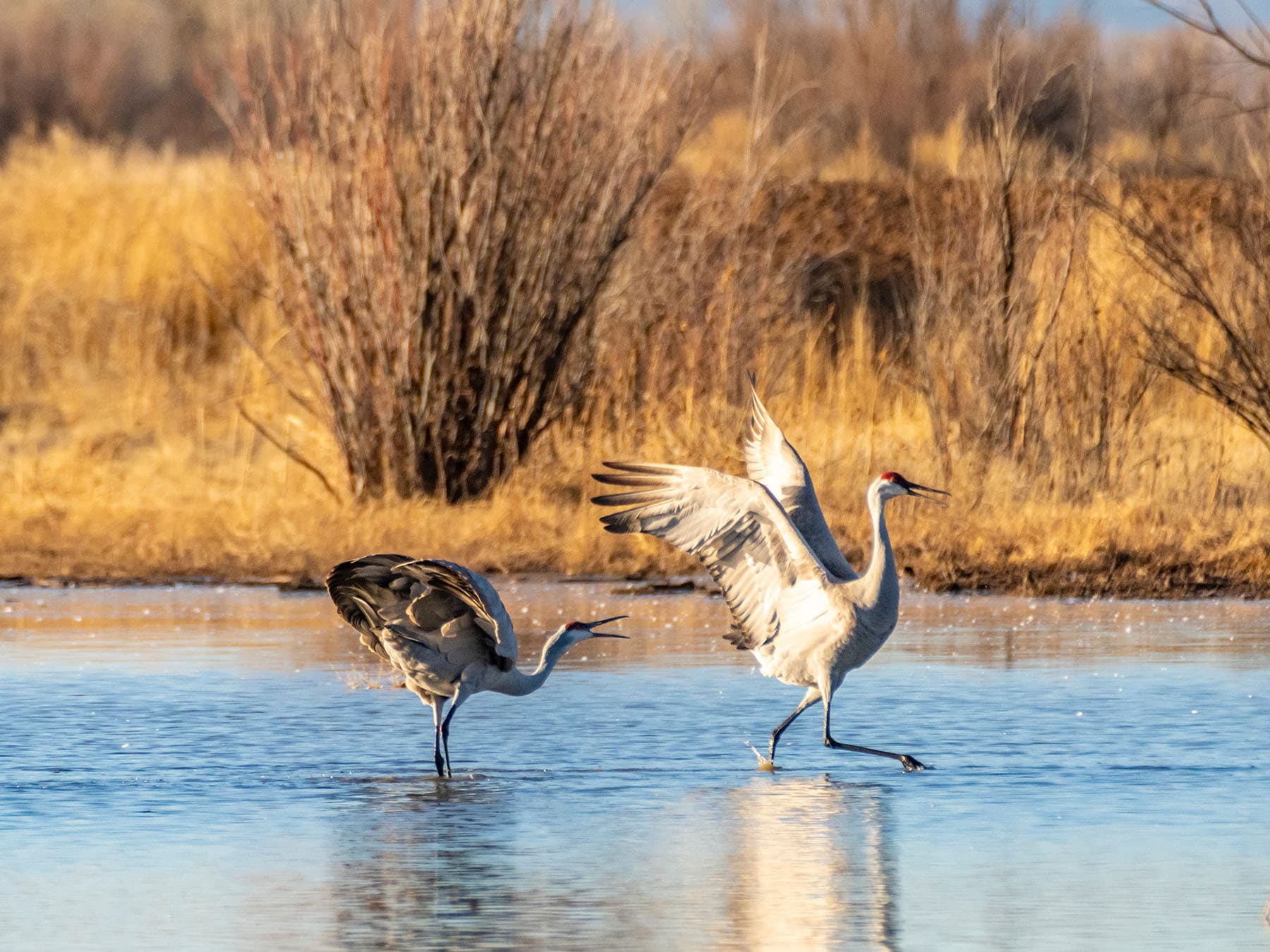
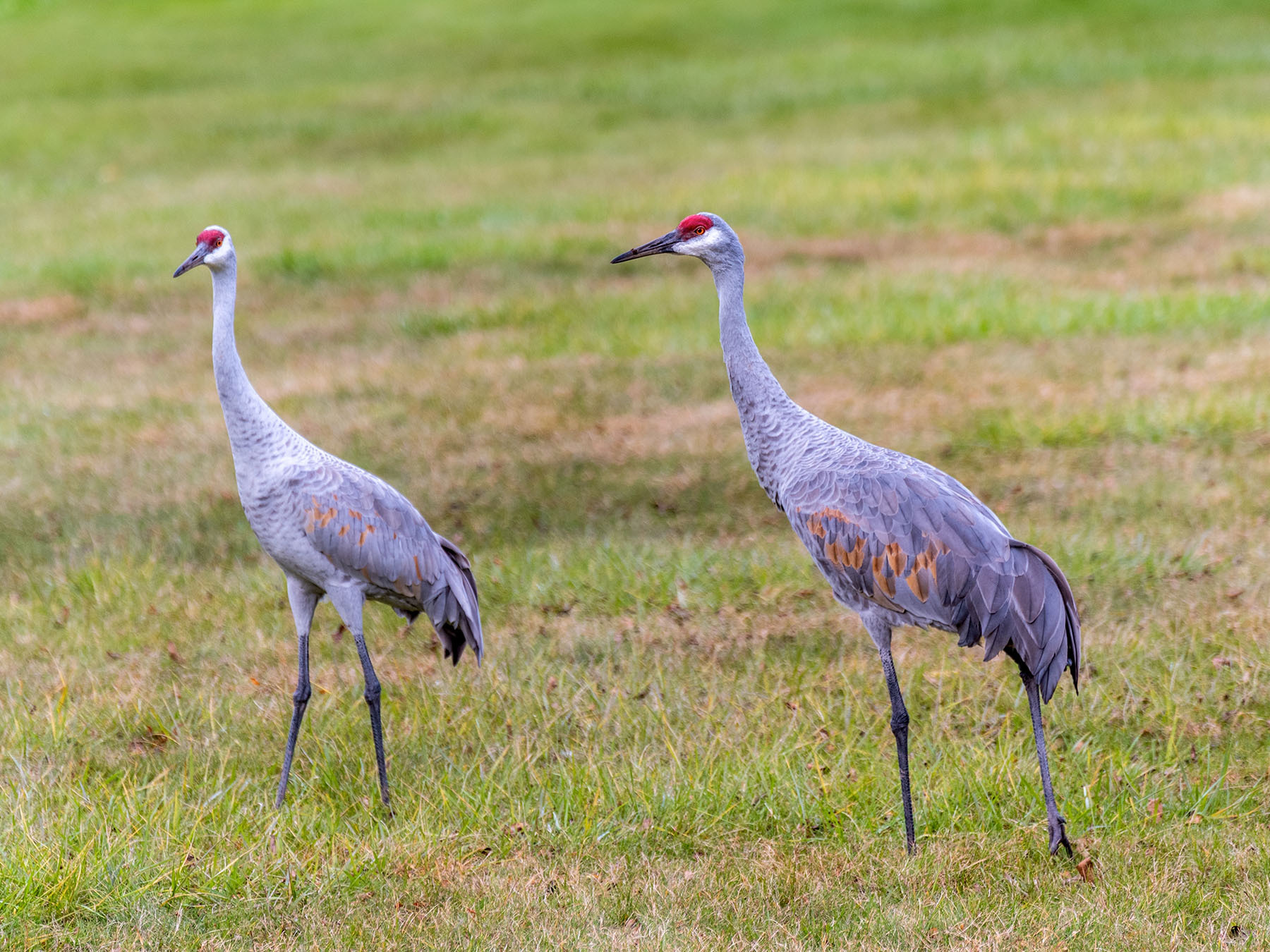
Sandhill Cranes are tall, upright birds with a generally grey plumage color. Their red crowns and foreheads are some of their most distinctive features and contrast well with the white lower half of their face.
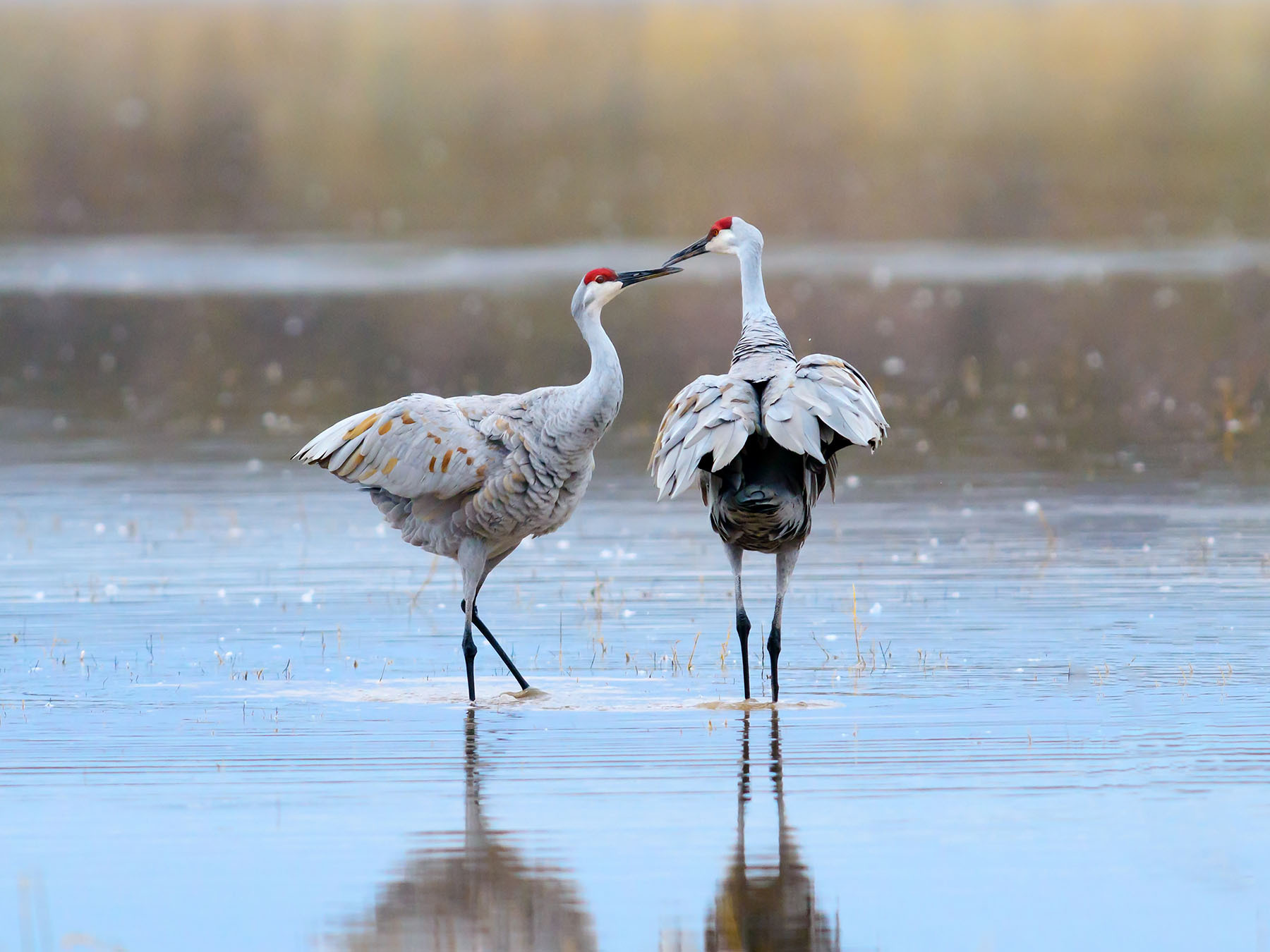
Sandhill Cranes have straight black bills, long black legs, and bright orange eyes. These birds have the unusual habit of covering their bills in mud while preening, which often stains their plumage to a reddish-brown shade.
Female Sandhill Cranes are a little smaller than males but otherwise impossible to distinguish.
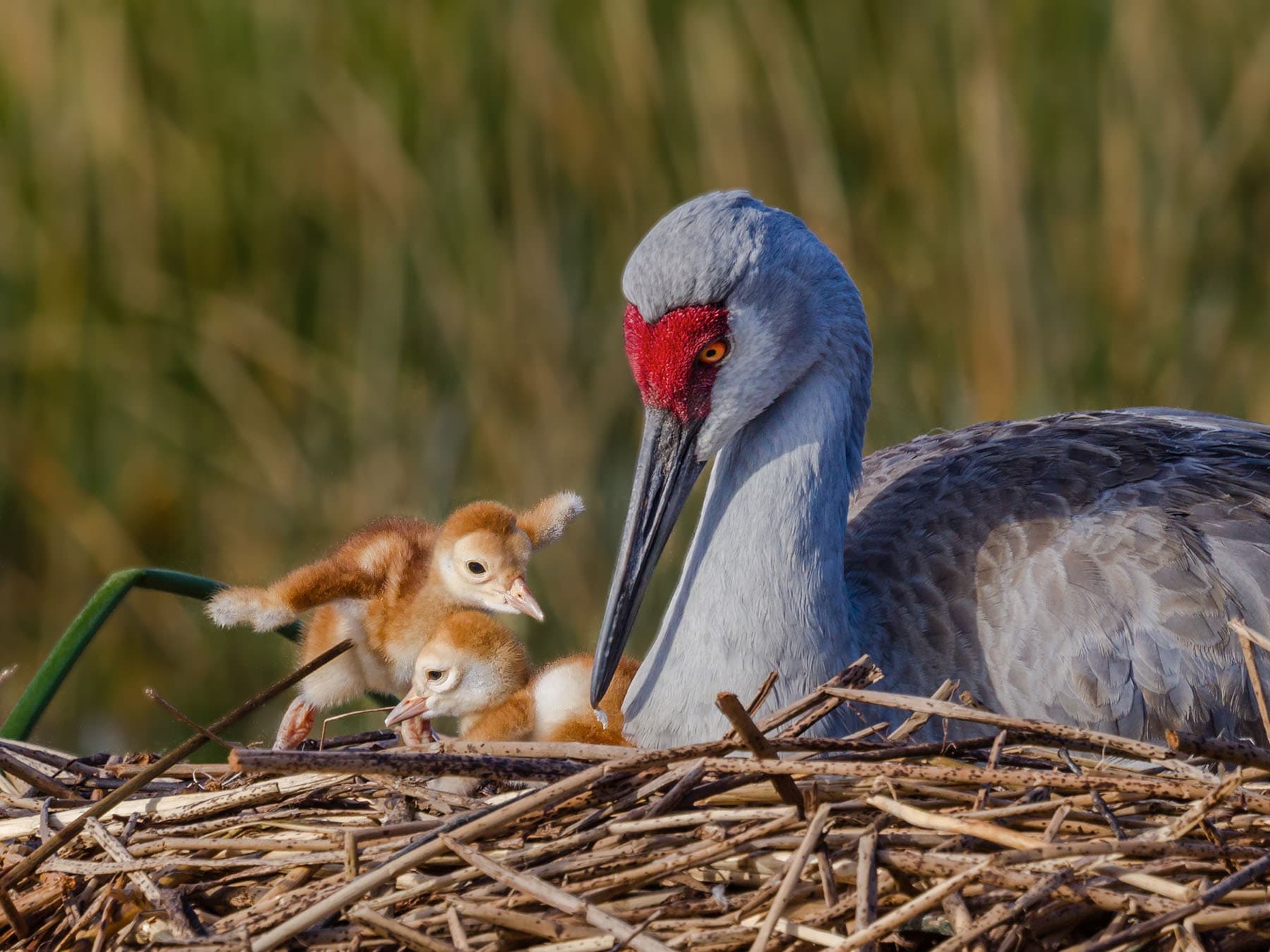
Sandhill Crane chicks start their lives with a covering of golden brown, fluffy down. As they mature, juveniles develop darker brown plumage and eventually the blue-gray color of the adults. Immature Sandhill Cranes do not develop the distinctive, bare red cap of their parents until they are two to three years old.
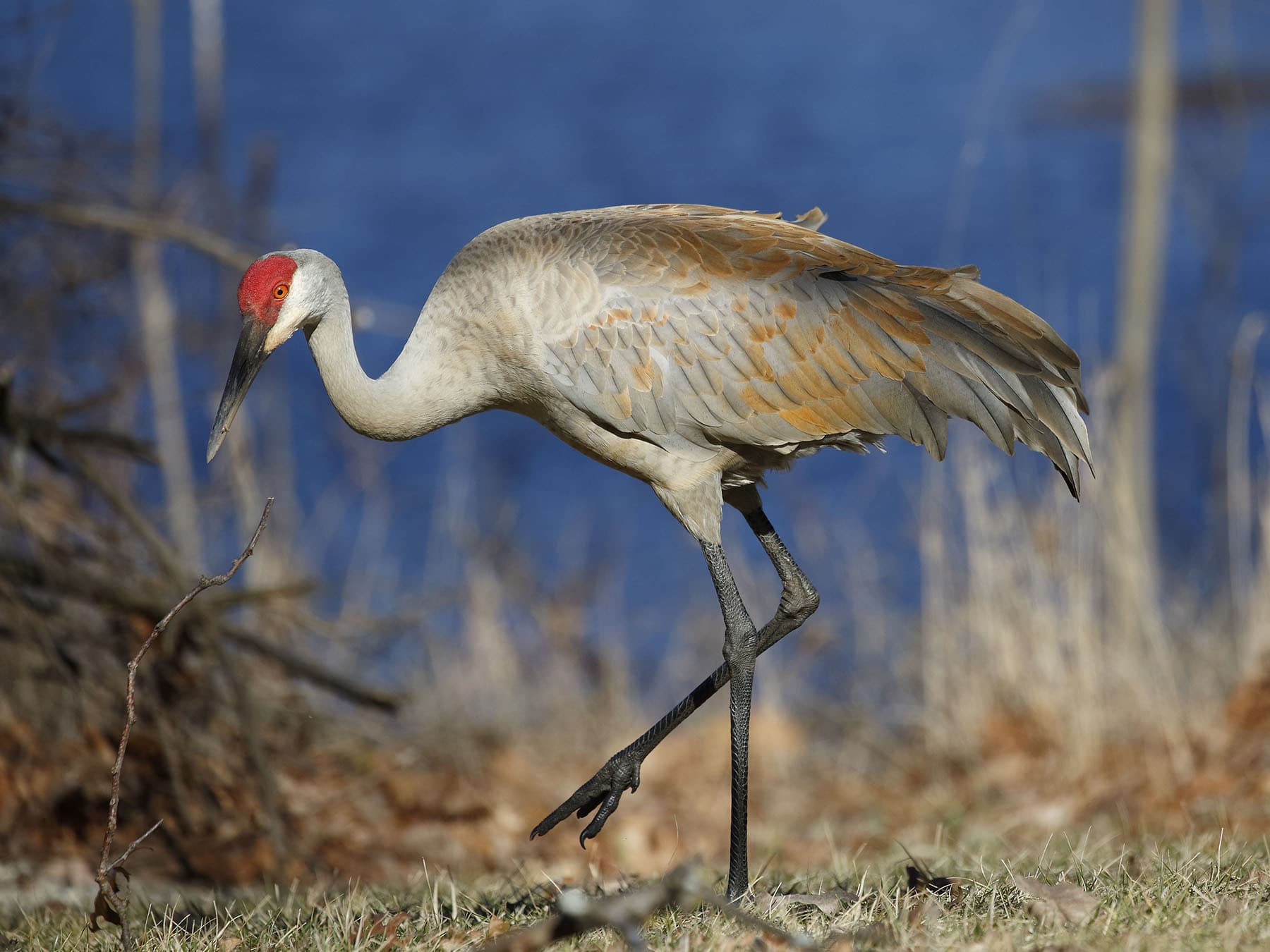
Sandhill Cranes are one of America’s tallest birds, although the various subspecies differ somewhat in size. The Greater Sandhill Crane (A. c. tabida) that breeds in the northern US and southwestern Canada is the largest.
Length
Sandhill Cranes have a body length of 2 ¾ to 4 feet (80 - 120 cm).
Weight
These birds have large, heavy bodies, and adults can weigh anything from 7 ½ to nearly 11 pounds (3.5 to 5 kg).
Wingspan
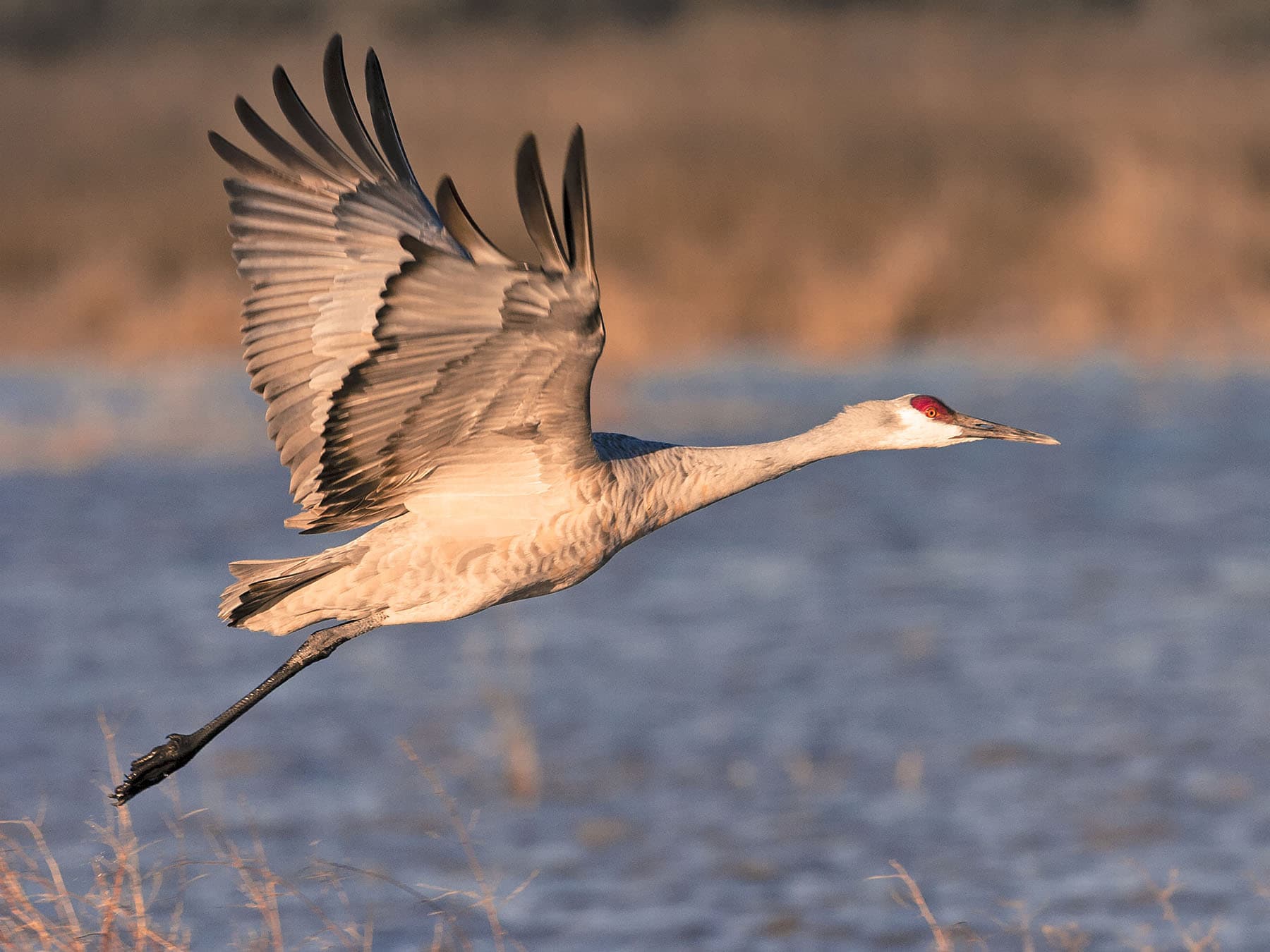
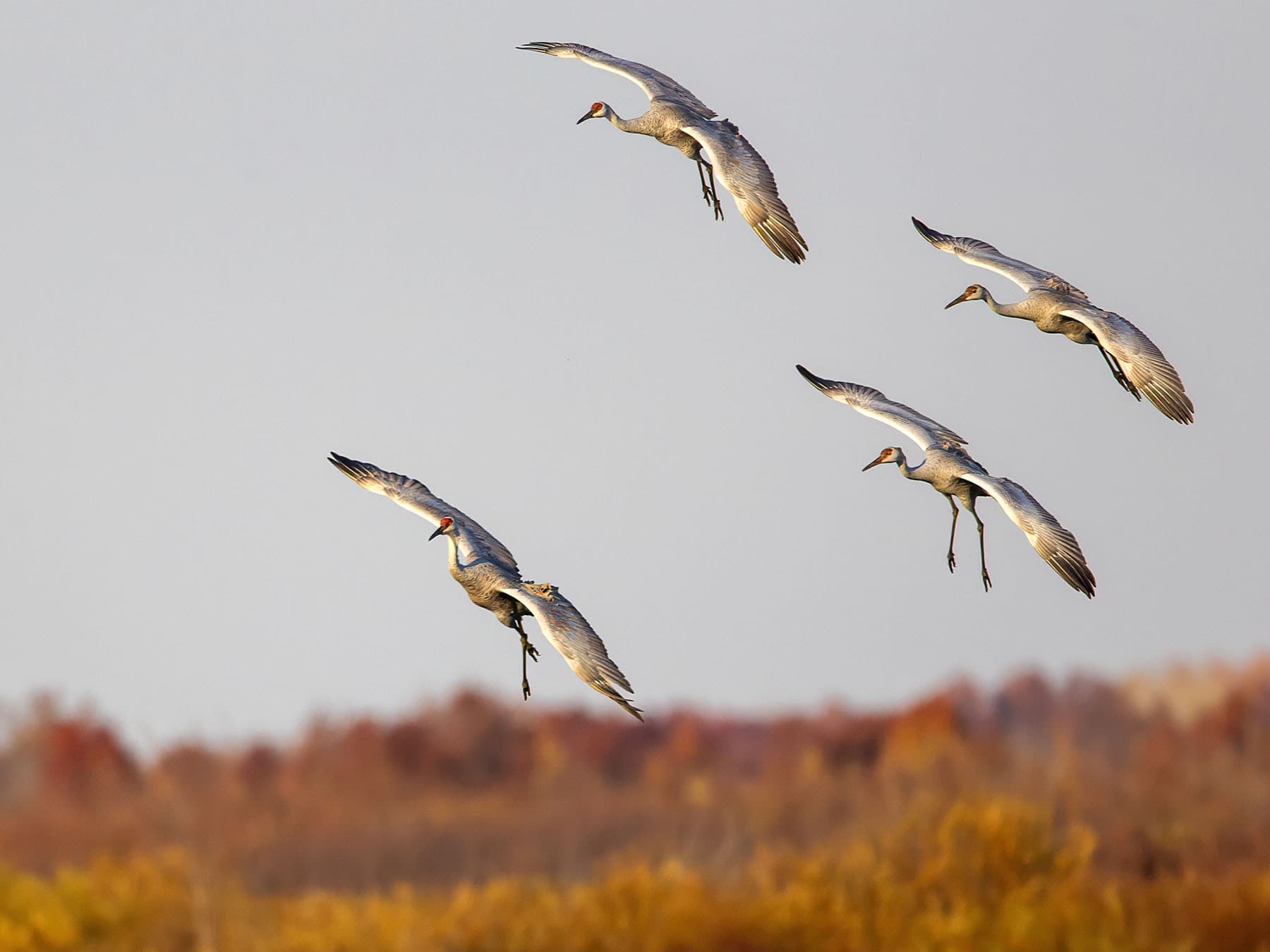
Sandhill Cranes have a wingspan of about 6 ½ feet (2 m). Their wings are broad, with large, prominent primary feathers at the tips.
For more information on the size of Sandhill Cranes, check out this guide.
Its size
Adults- Length
- 80–122 cm
- Wingspan
- 180–210 cm
- Weight
- 2500–6800 g
Its song and calls
The loud, distinctive call of the Sandhill Crane is a wonderful sound, audible from miles away in good weather. Listening is a great way to track them down in the open habitats where they live.
What sound does a Sandhill Crane make?
The typical Sandhill Crane call is a rattled, trumpet-like call that lasts a second or two and is repeated at varying intervals. The birds produce these calls most frequently in the early morning and late afternoon while on the ground or in flight.
- Call0:00 / 0:18
Recorded in Minnesota, United States · October 2012
When and where to see it
OctoberIn season
Most recorded in October
- 1. Wisconsin1.4%
- 2. New Mexico1.3%
- 3. Michigan1.1%
- 4. Saskatchewan0.91%
- 5. Wyoming0.66%
Each dot is a county, state or province: the bigger and darker, the larger the bird’s share of that place’s bird records that month. Grey dots: no regular records. The ringed point is the centre of the bird’s records this month; the arrow shows how it moved since last month, and the dashed loop its path through the year. “Arrivals” colours places where it becomes regular this month (orange) or is in its last regular month (grey). GBIF eBird Observation Dataset, 2019–2024. Map data: Natural Earth, US Census Bureau; place centres © OpenStreetMap contributors.
In your area
See when the Sandhill Crane is recorded in your county, state or province.
How often the Sandhill Crane turns up in the United States and Canada through the year, from birdwatchers' records.
United States
Resident · all year · most records in March
Canada
Summer visitor · all year · most records in April
Show as a table
| Month | United States | Canada |
|---|---|---|
| January | 0.20% (regular) | 0.048% (regular) |
| February | 0.22% (regular) | 0.049% (regular) |
| March | 0.32% (regular) | 0.16% (regular) |
| April | 0.22% (regular) | 0.27% (regular) |
| May | 0.19% (regular) | 0.18% (regular) |
| June | 0.16% (regular) | 0.15% (regular) |
| July | 0.16% (regular) | 0.13% (regular) |
| August | 0.19% (regular) | 0.17% (regular) |
| September | 0.17% (regular) | 0.22% (regular) |
| October | 0.20% (regular) | 0.16% (regular) |
| November | 0.24% (regular) | 0.12% (regular) |
| December | 0.21% (regular) | 0.066% (regular) |
Worldwide: recorded regularly in 8 countries
Countries where it was recorded in at least 3 of the 6 years 2019–2024. Linked countries have their own bird list.
Data: EOD – eBird Observation Dataset (Cornell Lab of Ornithology), accessed via GBIF.org, CC BY 4.0. Records from 2019–2024, aggregated and filtered by Birdfact. How these lists are made
Sandhill Cranes have a wide distribution, occurring in various open habitats across their range.
What is the habitat of a Sandhill Crane?
Sandhill Cranes inhabit open areas with low vegetation. They frequent shallow wetland areas and marshes but also forage in meadows, prairie, and agricultural fields.
What is the range of a Sandhill Crane?
Sandhill Cranes are mostly limited to North America and can be seen in Alaska, Canada, the United States, Mexico, and Cuba. However, some migrants leave the continent and cross the Bering Sea to breed in northeastern Russia.
In the United States, Sandhill Cranes are residents in northern Florida, southern Georgia, and Mississippi. They breed in parts of the Northwest, Midwest, and Northeast but fly south to overwinter in California, Arizona, Texas, New Mexico, Louisiana, Florida, and Georgia.
Where do Sandhill Cranes live?
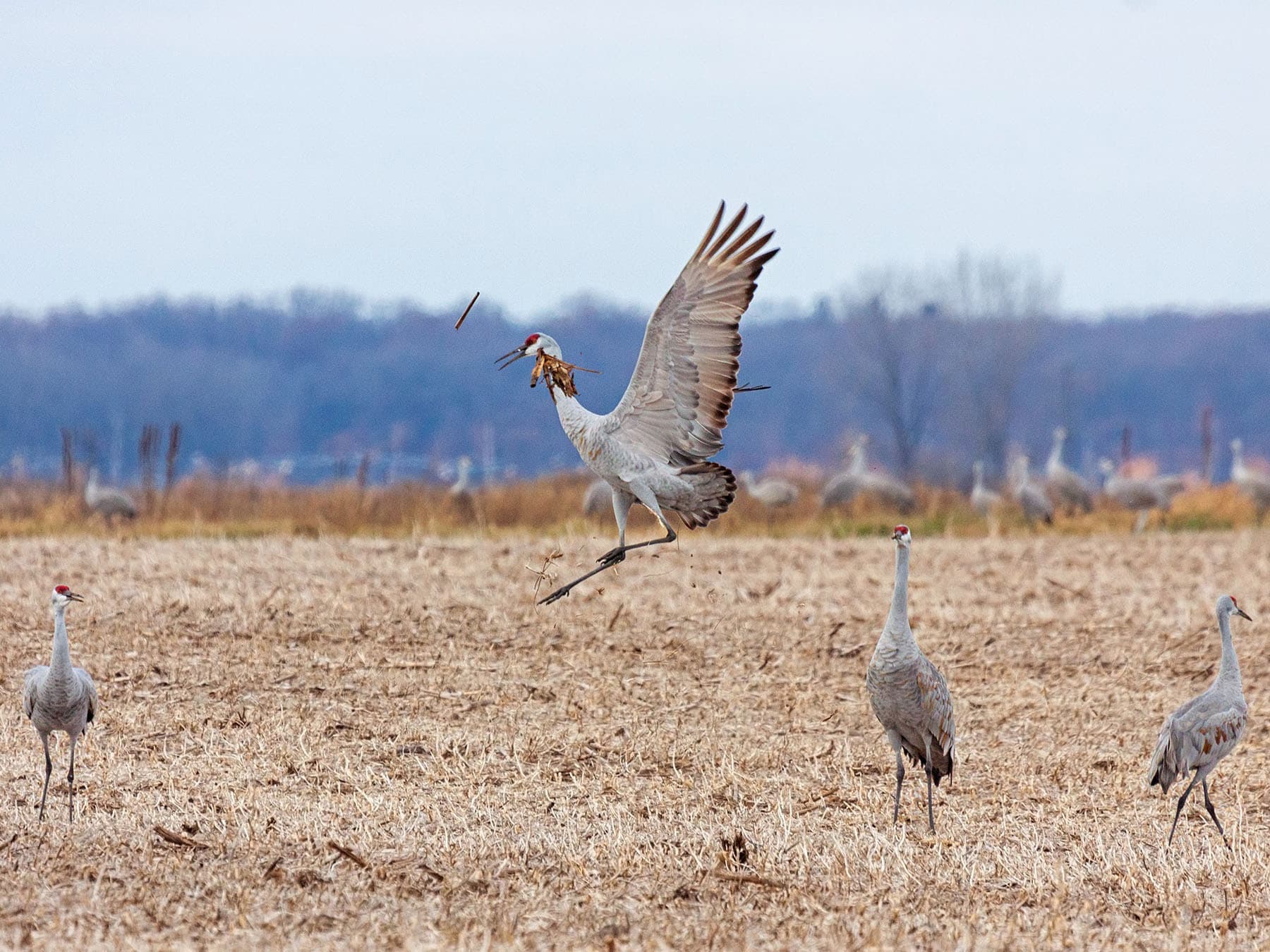
Sandhill Cranes spend most of their lives on the ground, usually in open marshy areas or crop fields. They do not perch or sleep in trees or bushes. Most populations migrate between different areas as the seasons change, traveling thousands of miles each year.
How rare are Sandhill Cranes?
The Sandhill Crane is the most common crane species on earth, and these majestic birds continue to increase their numbers.
According to the IUCN, the population of mature Sandhill Cranes stands at approximately 450,000 to 550,000 individuals, although the total population may number over 800,000.
Migration
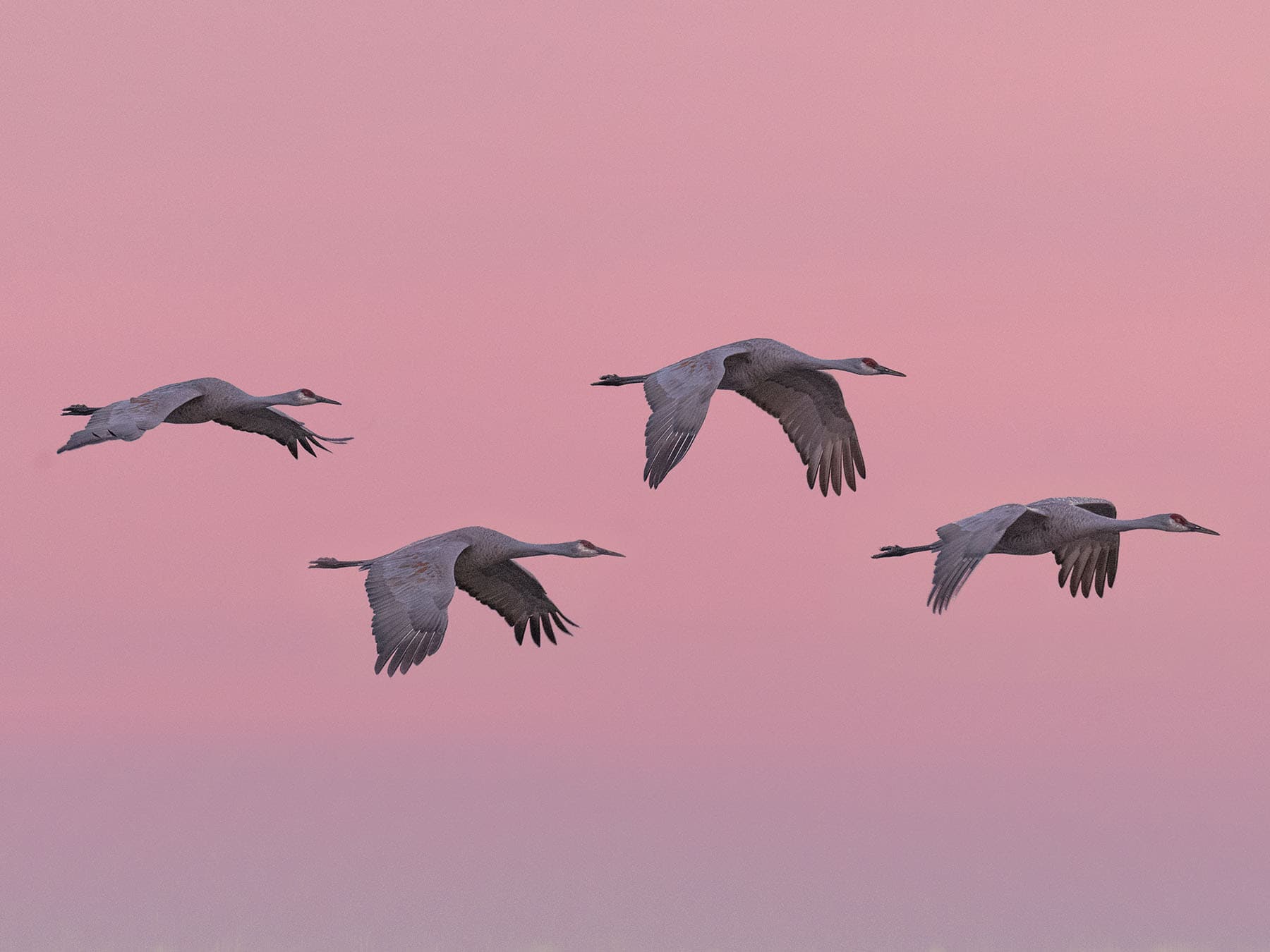
Half of the six Sandhill Crane subspecies are migratory, while the remainders live in relatively small resident populations. Read on to discover more about the Sandhill Crane migration.
Do Sandhill Cranes migrate?
Three Sandhill Crane subspecies migrate between summer breeding grounds in the north and overwintering grounds in the south. These are the Canadian, Lesser, and Greater Sandhill Cranes.
Migratory Sandhill Cranes head north in the spring to breed from the extreme northeast of Russia, through Alaska and Canada, and several northern states in the Lower 48.
In the fall, these birds return to their overwintering grounds in the contiguous United States and northern Mexico.
Tips for seeing it
- Look for Sandhill Cranes in open wetlands, prairies, and agricultural fields.
- Listen for their distinctive loud, rattling call, especially during migration.
- Observe their unique dancing behavior during courtship in spring.
- In the US, visit Nebraska's Platte River in March to witness massive gatherings during migration.
What it eats
Sandhill Cranes are omnivorous birds with varied diets. Continue reading to learn more about their foraging habits.
What do Sandhill Cranes eat?
Sandhill Cranes eat seeds, shoots, berries, invertebrates, and small animals like frogs, reptiles, and rodents. These birds forage on foot and collect their food from low vegetation, the ground, or just below the surface in mud or water.
What do baby Sandhill Cranes eat?
Baby Sandhill Cranes eat a variety of invertebrates and plant matter like seeds. Both parents will deliver food directly to their chicks' bill at first, but they begin to feed for themselves within two weeks. Sandhill Crane chicks leave their nest on their first day after hatching.
Nesting and breeding
Sandhill Cranes typically raise a single chick each year, and the young bird may remain in the company of its parents for up to ten months after hatching. Continue reading to learn more fascinating facts about Sandhill Crane nesting.
Where do Sandhill Cranes nest?
Most Sandhill Cranes nest in Canada, although some nest in Alaska and the Lower 48. Breeding residents also nest in the Southeast and Cuba.
Sandhill Cranes build their nests in marshy wetland areas, usually in water about eight to ten inches deep. Both partners work together to collect material and build a large mound-shaped nest above the waterline.
What do Sandhill Crane eggs look like?
Sandhill Cranes lay one to three (usually two) eggs. The eggs are olive to light brown in color with darker blotches. Their eggs are large, measuring nearly four inches in length and over two inches across (93 x 59 mm).
Do Sandhill Cranes mate for life?
Sandhill Cranes form long-lasting partnerships. Most find a partner and begin to breed by the age of eight, and pairs usually mate for life. However, some pairs separate after nesting failures, and cheating has been recorded.
Behaviour
Sandhill Cranes exhibit some beautiful and fascinating behaviors. Their courtship dances are particularly stirring and can be seen throughout the year, although they are performed most frequently at the start of the breeding season.
Are Sandhill Cranes aggressive?
Adult Sandhill Cranes are generally not aggressive, but they will defend themselves and their eggs and chicks when necessary. They will kick and peck to deter a potential threat, even leaping up to kick at attacking birds of prey.
Sandhill Crane chicks are aggressive toward their siblings, and sadly, this may explain why only a single chick survives in most broods. Although not considered dangerous, habituated cranes that have lost their fear of humans occasionally peck people when looking for food.
Lifespan and predators
Sandhill Cranes are relatively long-lived birds, but their terrestrial habits do put them in danger from various predatory animals. Continue reading to learn more about their predators and average lifespan.
How long do Sandhill Cranes live?
Sandhill Cranes can live for over thirty years. The oldest known specimen lived to 40 years old, although the average lifespan of adults is about seven.
The adult survival rate is relatively high, although predators account for many young birds, and usually, only a single chick can be adequately cared for.
What are the predators of Sandhill Cranes?
Sandhill Cranes have many predators, both as adults and chicks. Mammals like Coyotes, Raccoons, and Mink are their greatest threats, although large birds of prey like Golden Eagles and Great Horned Owls are occasional predators.
Are Sandhill Cranes protected?
Sandhill Cranes are protected in the United States by the Migratory Bird Treaty Act. However, licensed hunters may hunt them in many states if granted a permit.
Are Sandhill Cranes endangered?
Sandhill Cranes are not an endangered species. The species is listed as ‘Least Concern’ on a global level.
The resident Mississippi population is endangered, although this group has increased about four-fold in the last few decades. To the south, the resident Cuban population is considered critically endangered, with just a few hundred remaining individuals.
Conservation
While currently listed as Least Concern, Sandhill Cranes face threats from habitat loss and degradation. Conservation efforts focus on protecting key wetland habitats and migration stopover sites.
Some populations, particularly in the southern US, require careful management due to limited numbers.
More photos
3 photos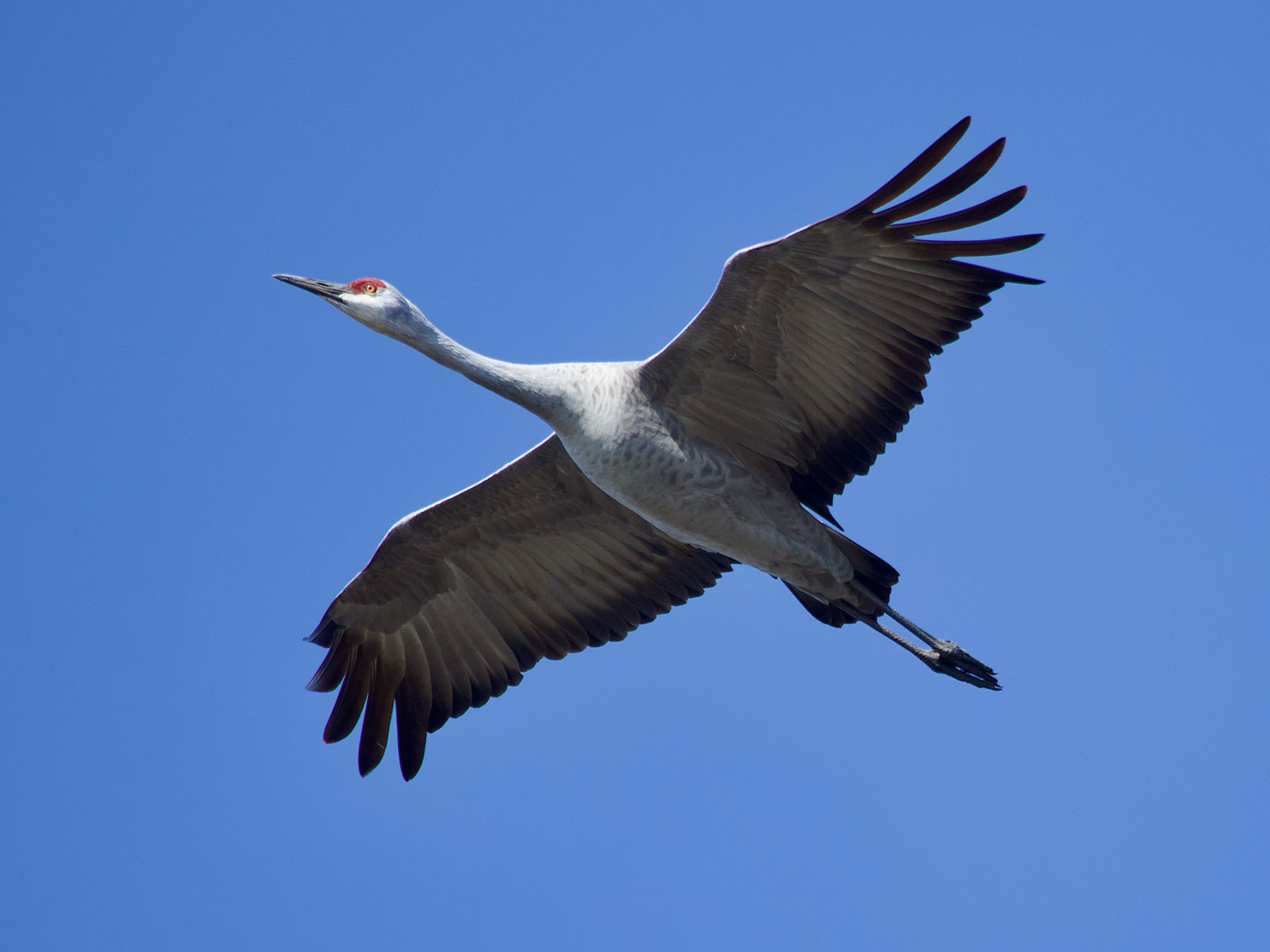
Sandhill Crane guides
4 guidesQuick facts
- Length
- 80–122 cm
- Wingspan
- 180–210 cm
- Weight
- 2500–6800 g
- Lifespan
- 7 years · oldest recorded 36.6 years
- Family
- Cranes
- Migration
- Long-distance Migrant
- Global status (IUCN)
- Least Concern
- World population
- 670,000 - 830,000 individuals
- Population trend
- Increasing
- Also called
- Canadian Crane
- Scientific name
- Antigone canadensis
Sources
4- 1BirdLife International. 2021. Grus canadensis. The IUCN Red List of Threatened Species 2021: e.T22692078A188597759. Source (opens in a new tab)
- 2Rosenberg et al. 2019; Partners in Flight 2020
- 3Wetlands International (2020)
- 4Longevity Records Of North American Birds. Version 2023.1 Source (opens in a new tab)

Checked by
Nathan Cope, founder and editor
Nathan founded Birdfact and leads its writers and contributors in the UK, the US and Canada. He has watched and studied birds for more than ten years, and checks every article and species guide before it’s published.