
Sabine's Gull
Xema sabini
By the Birdfact teamChecked by Nathan Cope
No gull on Earth travels further than Sabine's Gull — up to 39,000 km each year between its Arctic breeding grounds and the cold upwellings off Peru and South Africa. With its bold tricoloured wings, forked white tail, and tern-like flight, this small Arctic gull looks and behaves unlike any other member of its family.
On this page13 sections
How to recognise it
Sabine's Gull is immediately recognisable in flight by its tricoloured wing pattern — a feature unique among the world's gulls. Three bold geometric triangles divide each wing: a black wedge across the outer primaries, a pale grey panel across the coverts and back, and a bright white triangle along the trailing edge. This pattern is visible at all ages and distances, making the species essentially unmistakable once seen.
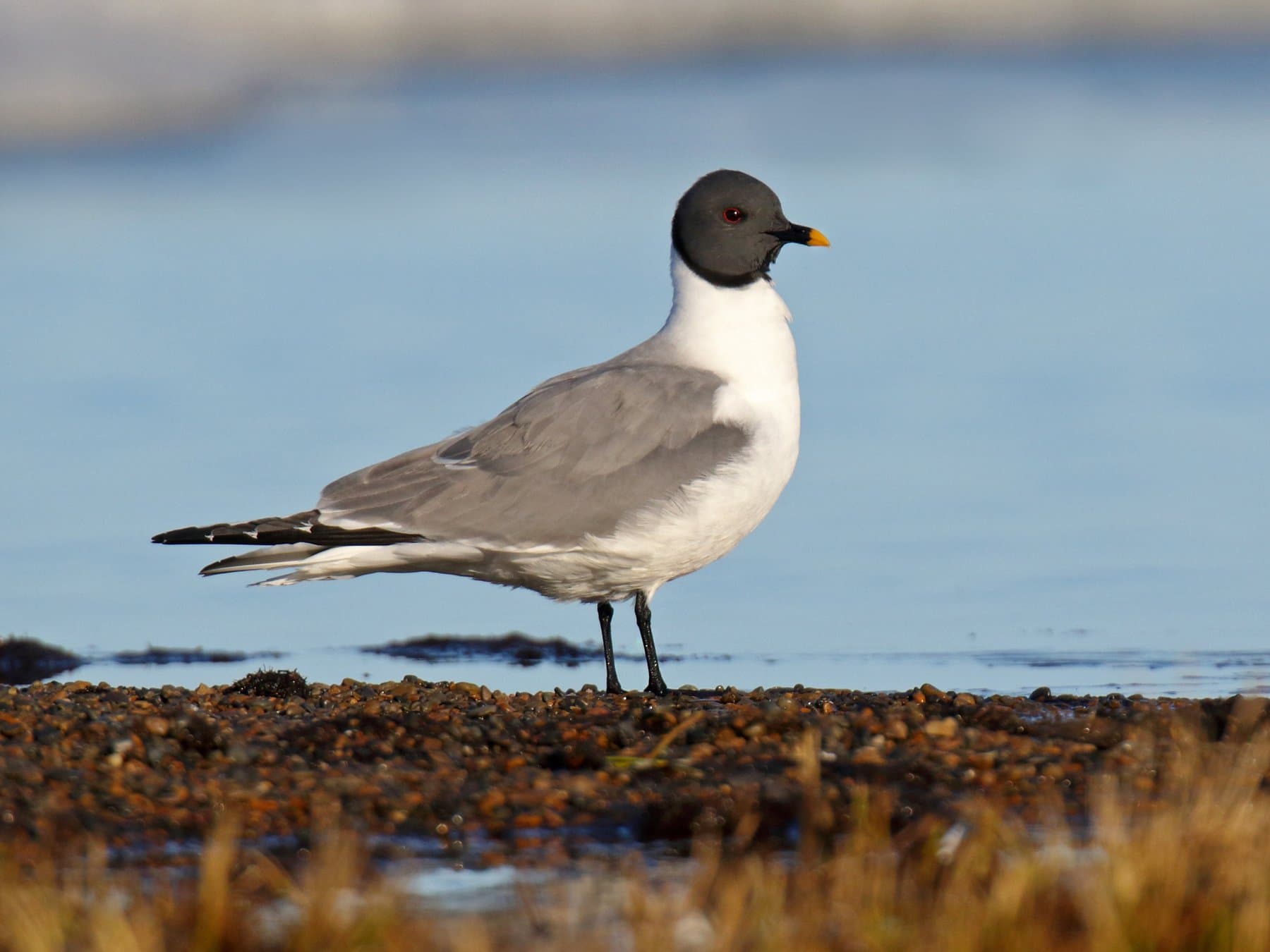
In breeding plumage, the adult carries a dark slate-grey hood bordered below by a narrow black collar. The bill is black with a vivid yellow tip — a combination shared only with the Swallow-tailed Gull of the Galápagos, though the two species are not closely related. A red orbital ring encircles the eye. The underparts are white, the back and wing coverts pale grey, and the tail is white and distinctly forked — again, a feature shared only with the Swallow-tailed Gull among gulls. Legs are black in breeding birds, sometimes with a purplish tinge.
In non-breeding plumage, the hood is largely lost, replaced by a white head with a dark smudge or partial collar on the nape. The legs become pinkish. The distinctive bill pattern and tricoloured wing pattern are retained year-round, so the bird remains identifiable in any season.
Juveniles share the same tricoloured wing structure, but the grey is replaced by brown, giving the back and wing coverts a scaly appearance. The tail carries a black terminal band, and the bill is all-black, lacking the yellow tip. Full adult plumage takes approximately two years to attain. Sabine's Gull is not sexually dimorphic — males and females are essentially identical in plumage at all seasons.
Not sure it’s a Sabine's Gull? Check your photo: Birdfact names the bird and shows the look-alike side by side.
Its size
Adults- Length
- 27–33 cm
- Wingspan
- 81–87 cm
- Weight
- 135–225 g
Its song and calls
Sabine's Gull is a relatively vocal species on the breeding grounds, but its calls bear little resemblance to the raucous, laughing cries of larger gulls. The primary call is a high-pitched, grating or rasping note — a harsh squeak that sounds more like a tern than a gull. Some observers describe it as a scratchy, squealing sound, quite unlike anything produced by Herring or Lesser Black-backed Gulls.
On the breeding grounds, males give a longer call during territorial and courtship displays, arching the neck and bowing while vocalising. Both sexes are vocal around the nest, particularly when defending against predators or intruders. The calls are given both singly and in series, with longer vocalisations apparently used in aggressive interactions between birds.
The tern-like quality of the calls is consistent with the species' overall ecology and behaviour — its foraging methods, flight style, courtship feeding, and distraction display all align more closely with terns than with typical gulls. Outside the breeding season, birds at sea are generally less vocal, though flight calls are given in feeding flocks.
The species is monotypic in its vocalisation patterns — there are no documented differences between the sexes in call structure, though males are more vocal during courtship. Juveniles and first-year birds produce similar calls to adults, though recordings suggest some variation in pitch and duration across age classes.
- Flight call0:00 / 0:15
Recorded in Normandie, France · November 2023
Heard one and not sure? Let the bird song identifier listen.
When and where to see it
OctoberLeaving
Most recorded in October
- 1. Pembrokeshire0.15%
- 2. Clareunder 0.1%
- 3. Donegalunder 0.1%
- 4. Kerryunder 0.1%
- 5. Kentunder 0.1%
Each dot is a county, state or province: the bigger and darker, the larger the bird’s share of that place’s bird records that month. Grey dots: no regular records. The ringed point is the centre of the bird’s records this month; the arrow shows how it moved since last month, and the dashed loop its path through the year. “Arrivals” colours places where it becomes regular this month (orange) or is in its last regular month (grey). GBIF eBird Observation Dataset, 2019–2024. Map data: Natural Earth, US Census Bureau; place centres © OpenStreetMap contributors.
In your area
See when the Sabine's Gull is recorded in your county, state or province.
How often the Sabine's Gull turns up in the UK, Ireland, the United States and Canada through the year, from birdwatchers' records.
United Kingdom
Passage migrant · regularly Jul–Nov · most records in September
Ireland
Passage migrant · regularly Jul–Oct · most records in August
United States
Summer visitor · regularly Apr–Oct · most records in September
Canada
Summer visitor · regularly May–Oct · most records in September
Show as a table
| Month | United Kingdom | Ireland | United States | Canada |
|---|---|---|---|---|
| January | 0.005% | – | – | <0.001% |
| February | 0.001% | – | <0.001% | – |
| March | – | – | <0.001% | <0.001% |
| April | <0.001% | – | 0.004% (regular) | <0.001% |
| May | <0.001% | – | 0.004% (regular) | 0.002% (regular) |
| June | – | – | 0.006% (regular) | 0.004% (regular) |
| July | 0.001% (regular) | 0.009% (regular) | 0.005% (regular) | 0.004% (regular) |
| August | 0.011% (regular) | 0.13% (regular) | 0.025% (regular) | 0.006% (regular) |
| September | 0.012% (regular) | 0.057% (regular) | 0.044% (regular) | 0.026% (regular) |
| October | 0.004% (regular) | 0.012% (regular) | 0.015% (regular) | 0.005% (regular) |
| November | 0.007% (regular) | 0.003% | 0.002% | <0.001% |
| December | – | – | <0.001% | <0.001% |
Recorded regularly in
Worldwide: recorded regularly in 24 countries
Countries where it was recorded in at least 3 of the 6 years 2019–2024. Linked countries have their own bird list.
Europe (12)
- Belgium
- France
- Germany
- Iceland
- Ireland
- Netherlands
- Norway
- Portugal
- Spain
- Svalbard & Jan Mayen
- Sweden
- United Kingdom
Africa (2)
- Senegal
- South Africa
North America (7)
South America (3)
- Chile
- Ecuador
- Peru
Data: EOD – eBird Observation Dataset (Cornell Lab of Ornithology), accessed via GBIF.org, CC BY 4.0. Records from 2019–2024, aggregated and filtered by Birdfact. How these lists are made
Tips for seeing it
The tricoloured wing pattern is the key to identifying Sabine's Gull at any age — no other gull shows the same bold black, grey, and white triangles. In flight, the pattern is unmistakable even at long range. The forked white tail is visible when the bird banks or glides, and the tern-like flight style — buoyant, flickering, with rapid wingbeats — immediately separates it from most gulls of similar size.
In the UK and Ireland, the best strategy is seawatching from a western headland in August and September, ideally after a period of strong south-westerly or westerly winds. Pendeen Watch in Cornwall, Strumble Head in Pembrokeshire, and Bridges of Ross in Co. Clare are the premier sites. Birds typically pass close inshore during or just after Atlantic low-pressure systems. Early morning is usually most productive. A telescope is essential for picking out distant birds, but Sabine's Gulls often come surprisingly close to headlands in good conditions.
On the US and Canadian West Coast, pelagic trips off California, Oregon, Washington, and British Columbia in May and again from August to October offer the best chances. Birds are most numerous over the continental shelf and slope. On the East Coast, scan offshore from coastal promontories in September and October after north-easterly gales.
Juveniles — brown-backed with the same tricoloured wing pattern and a black tail band — are the most commonly seen age class in autumn in the Northern Hemisphere. They can appear at inland reservoirs and lakes after autumn storms, particularly in October. The all-black bill (lacking the yellow tip of adults) and scaly brown back are the key features to look for. Confusion species include juvenile Kittiwake, which shares a similar size and wing pattern but lacks the forked tail and has a different wing structure.
What it eats
On the breeding grounds, Sabine's Gull is an opportunistic invertebrate hunter with a remarkably diverse toolkit. Beetles, springtails, craneflies, mosquitoes, midges, caddisflies, wasps, earthworms, molluscs, arachnids, and various insect larvae all feature in the summer diet. Small fish — including Arctic cod, threespine stickleback, and Pacific herring — are also taken, and birds occasionally raid the eggs or chicks of neighbouring species including waterfowl, Black Turnstones, and Lapland Longspurs.
What makes the species stand out is the variety of foraging methods it employs. Birds walk tidal flats and pick up prey like a plover, flip over debris like a turnstone, wade into shallow water and stamp their feet to flush invertebrates from the bottom, hawk flying insects in the air, or spin in circles in shallow pools like a phalarope to bring prey to the surface. Few birds of any family show such foraging versatility.
At sea during migration and on the wintering grounds, the diet shifts to marine prey: small fish, amphipods, mysids, euphausiids, copepods, jellyfish, polychaete worms, and shrimp. Birds forage by dipping to the water surface in flight, hovering and pattering on the water like a storm-petrel, or picking up items while swimming. They will scavenge offal from fishing vessels and gather in large flocks around upwelling zones where prey is concentrated near the surface. Arriving spring migrants sometimes feed along sea ice edges and in tidal rips before reaching the breeding grounds.
Nesting and breeding
Sabine's Gull arrives on the Arctic tundra in early June, sometimes before snow and ice have fully melted. Pairs form long-term monogamous bonds and typically return to the same territory with the same mate in successive years — a level of site and partner fidelity more typical of albatrosses than small gulls.
Nests are shallow depressions in vegetation or gravel, averaging around 13.7 cm across and 1.8 cm deep, and are seldom lined — occasionally a few strands of grass, algae, or feathers are added. Nest sites are typically at the edge of small tundra ponds, on islands within ponds, or on marshy ground near the coast. Colonies are small and loose, with 16–31 breeding pairs recorded annually at one well-studied Canadian High Arctic colony.
The clutch is typically 2–3 eggs (range 1–4), olive-green to olive-brown with darker greenish-brown irregular markings. Both sexes incubate for approximately 23–25 days. Chicks hatch covered in well-camouflaged down and may leave the nest cup within a day of hatching, though they typically remain on the nest platform for several days before parents lead them to freshwater or brackish ponds where fly and midge larvae are abundant.
Young birds are able to fly short distances before their flight feathers are fully grown — a developmental pattern more typical of terns than gulls. Both parents defend the nest vigorously, either by direct mobbing of intruders or by performing a distraction display, feigning injury to draw predators away. This injury-feigning behaviour is standard among plovers and sandpipers but is genuinely rare among gulls, reflecting Sabine's Gull's unusual position within the family.
Behaviour
In the air, Sabine's Gull is instantly separable from other gulls by both its wing pattern and its flight style. The tricoloured wings — black outer primaries, grey coverts, white trailing triangle — create a geometric pattern that flashes with every wingbeat, making the bird identifiable at considerable range. The forked white tail is visible when the bird banks or glides, adding to the tern-like silhouette.
The flight itself is buoyant and flickering, with rapid, shallow wingbeats that recall a Arctic Tern or a large storm-petrel rather than the heavier, more measured wingbeats of larger gulls. Birds bank and turn with ease, frequently hovering briefly over the water surface before dipping to pick up prey. In strong winds, they glide and shear low over the waves in a manner reminiscent of shearwaters.
Migration is often conducted in tight flocks, frequently at night. During southbound passage off western headlands in Britain and Ireland, birds typically fly low and direct, hugging the coastline or cutting across headlands in a purposeful manner quite different from the leisurely circling of larger gulls. The combination of small size, tern-like jizz, and tricoloured wings makes a passing Sabine's Gull one of the most distinctive and sought-after sights of the autumn seawatching season.
The wingspan of 81–87 cm is relatively broad for the bird's body size, giving it good lift in the strong winds of the open ocean. This wing shape, combined with the forked tail, allows precise manoeuvring at the water surface — essential for the delicate surface-dipping and hovering foraging techniques the species uses at sea.
Lifespan and predators
The oldest recorded Sabine's Gull was 8 years and 1 month old, based on banding records compiled by the Cornell Lab of Ornithology. This is a relatively modest maximum for a gull — the Herring Gull, for example, can exceed 30 years — though the remote and pelagic lifestyle of Sabine's Gull makes it difficult to track individuals over long periods, and the true maximum lifespan may be higher.
Typical lifespan in the wild is estimated at 5–10 years. Annual survival rates are not well documented, but the species faces mortality risks at multiple stages of its annual cycle: predation on the Arctic breeding grounds (from Arctic Foxes, Glaucous Gulls, and other predators), the hazards of two long ocean crossings each year, and the risks of marine pollution and food scarcity on the wintering grounds.
First-year birds face the highest mortality, as is typical for gulls. Juveniles must navigate their first southbound migration — often crossing the interior of continents or vast stretches of open ocean — without the experience of adults. Those that survive to breeding age (typically two years) have a much improved chance of reaching several years of age. The long-term pair bonds and site fidelity shown by breeding adults suggest that experienced birds can maintain successful breeding for multiple consecutive seasons.
Conservation
Sabine's Gull is listed as Least Concern on the IUCN Red List (assessed 2020), reflecting a large global range and a population estimated at 330,000–700,000 individuals. Partners in Flight puts the figure at around 340,000. The species scores 11 out of 20 on the Partners in Flight Continental Concern Score, indicating low overall conservation concern.
Population trends are not well known, largely because the species breeds in remote Arctic terrain and spends the non-breeding season far offshore. The global population is considered broadly stable. However, the Russian breeding population may be declining, and the species has been nominated for inclusion on Russia's Red Book. It is also listed as a Species of European Conservation Concern.
The remote Arctic breeding range and highly pelagic non-breeding habits provide some natural buffer against human disturbance, but several threats are recognised. Climate change is the most significant long-term concern: warming Arctic temperatures are reshaping tundra ecology, and shifts in ocean upwelling systems could reduce food availability on the wintering grounds. Oil spills and marine pollution pose risks during migration and on the wintering grounds, where birds concentrate in coastal upwelling zones. Bioaccumulation of pesticides and other marine pollutants is a concern for a species that feeds high in the marine food web. Overfishing of small fish and crustaceans along migration routes could reduce prey availability, and Arctic development — oil, gas, and mining — has the potential to disturb tundra breeding habitat.
The Greenland population was estimated at up to 2,000 pairs earlier this century. The Atlantic wintering population of approximately 10,000 birds is small enough that a significant oil spill in the Benguela Current could have a measurable impact on the global population.
Courtship & Display
Sabine's Gull's courtship behaviour is more typical of terns than gulls, and it sets the species apart from virtually every other member of the family. The male initiates courtship by giving a long call while arching his neck and bowing — a display that is broadly similar to the 'long call' displays of other gulls. But the key distinction comes in what happens next.
Rather than regurgitating food as most gulls do during courtship feeding, the male Sabine's Gull presents whole, intact prey items directly to the female — carrying fish in the bill and holding it upright as an offering. The female pecks at the partner's bill precisely where the yellow tip meets the black base. A receptive female then tosses her head several times, mirrored by the male, and often rubs her head and body against the male's breast as an invitation to mate. This direct prey-presentation behaviour is characteristic of terns and is genuinely unusual among gulls.
Pairs return to the same territory and the same mate in successive years, suggesting that pair bonds are maintained through the winter despite the two birds potentially wintering in different ocean basins — as geolocator studies have confirmed can happen. How pairs re-establish contact after months apart in different hemispheres remains an open question. Nest defence is equally atypical for a gull: both sexes perform injury-feigning distraction displays to lead predators away from eggs or chicks, a behaviour standard in shorebirds but rare in the Laridae.
Taxonomy And Discovery
Sabine's Gull was formally described to science on 25 July 1818, when Sir Edward Sabine — an Irish astronomer and geophysicist serving as scientific officer on Captain John Ross's Arctic expedition in search of the Northwest Passage — shot several specimens at Melville Bay on the west coast of Greenland. He sent the skins to his older brother Joseph Sabine in London, who formally described the new species and named it Xema sabini in his brother's honour. The genus name Xema was coined by William Elford Leach and has no clear etymology, though it has been suggested to derive from a Greek word for a type of seabird.
The species is the sole member of the genus Xema, reflecting its genuinely unusual combination of characters — the forked tail, yellow-tipped black bill, and tricoloured wing pattern are found in no other gull. For many years, its closest relative was assumed to be the Swallow-tailed Gull (Creagrus furcatus) of the Galápagos, which shares the forked tail and yellow-tipped bill. However, mitochondrial DNA studies overturned this assumption: Sabine's Gull's true sister taxon is the Ivory Gull (Pagophila eburnea) of the High Arctic. The two diverged from a common ancestor approximately 6 million years ago, with this clade splitting from the kittiwakes around 8 million years ago.
Four subspecies are recognised by some authorities: the nominate X. s. sabini (Canadian Arctic to Greenland), X. s. palaearctica (Svalbard to Taimyr Peninsula), X. s. tschuktschorum (Chukotsk Peninsula), and X. s. woznesenskii (Gulf of Anadyr to Alaska). Alaskan birds are slightly darker and perhaps larger than the nominate, though the differences are subtle and the validity of all four subspecies is not universally accepted.
Quick facts
- Length
- 27–33 cm
- Wingspan
- 81–87 cm
- Weight
- 135–225 g
- Lifespan
- 5–10 years · oldest recorded 8.1 years
- Family
- Gulls & Terns
- Migration
- Full migrant
- Global status (IUCN)
- Least Concern
- World population
- 330,000–700,000 individuals
- Population trend
- Broadly stable, though population trends are not well known due to the remote Arctic breeding range and highly pelagic non-breeding habits. The Russian population may be declining.
- Scientific name
- Xema sabini
Sources
10- 1Sabine's gull - Wikipedia Source (opens in a new tab)
- 2Sabine's Gull Xema sabini Species Factsheet. BirdLife International / IUCN Red List (2020). (2020) Source (opens in a new tab)
- 3Sabine's Gull - eBird. Cornell Lab of Ornithology. Source (opens in a new tab)
- 4Sabine's Gull. BTO BirdFacts. British Trust for Ornithology. Source (opens in a new tab)
- 5Sabine's Gull. Audubon Society Field Guide. Source (opens in a new tab)
- 6Sabine's Gull Life History. Cornell Lab of Ornithology / All About Birds. Source (opens in a new tab)
- 7Davis, S.E., Maftei, M. & Mallory, M.L. (2016). Migratory Connectivity at High Latitudes: Sabine's Gulls from a Colony in the Canadian High Arctic Migrate to Different Oceans. PLoS ONE 11(12): e0166043. (2016) Source (opens in a new tab)
- 8Sabine's Gull. Birdfinding.info. Source (opens in a new tab)
- 9Sabine's Gull influx hits western coasts. BirdGuides. Source (opens in a new tab)
- 10Sabine's Gull. Eastside Audubon Society / Corvid Crier. (2025) Source (opens in a new tab)

Checked by
Nathan Cope, founder and editor
Nathan founded Birdfact and leads its writers and contributors in the UK, the US and Canada. He has watched and studied birds for more than ten years, and checks every article and species guide before it’s published.