


Reeves's Pheasant
Reeves' Pheasant · Syrmaticus reevesii
By the Birdfact teamChecked by Nathan Cope
On this page21 sections
- How to recognise it
- Its size
- Its song and calls
- When and where to see it
- What it eats
- Nesting and breeding
- Behaviour
- Lifespan and predators
- Conservation
- What does a Reeves's Pheasant look like?
- How big is a Reeves's Pheasant?
- How much does a Reeves's Pheasant weigh?
- What is the scientific name of a Reeves's Pheasant?
- Are Reeves's Pheasants aggressive?
- Are Reeves's Pheasants rare or endangered?
- Do Reeves's Pheasants mate for life?
- Can Reeves's Pheasants fly?
- Similar birds
- Reeves's Pheasant guides
- Quick facts
- Sources
How to recognise it
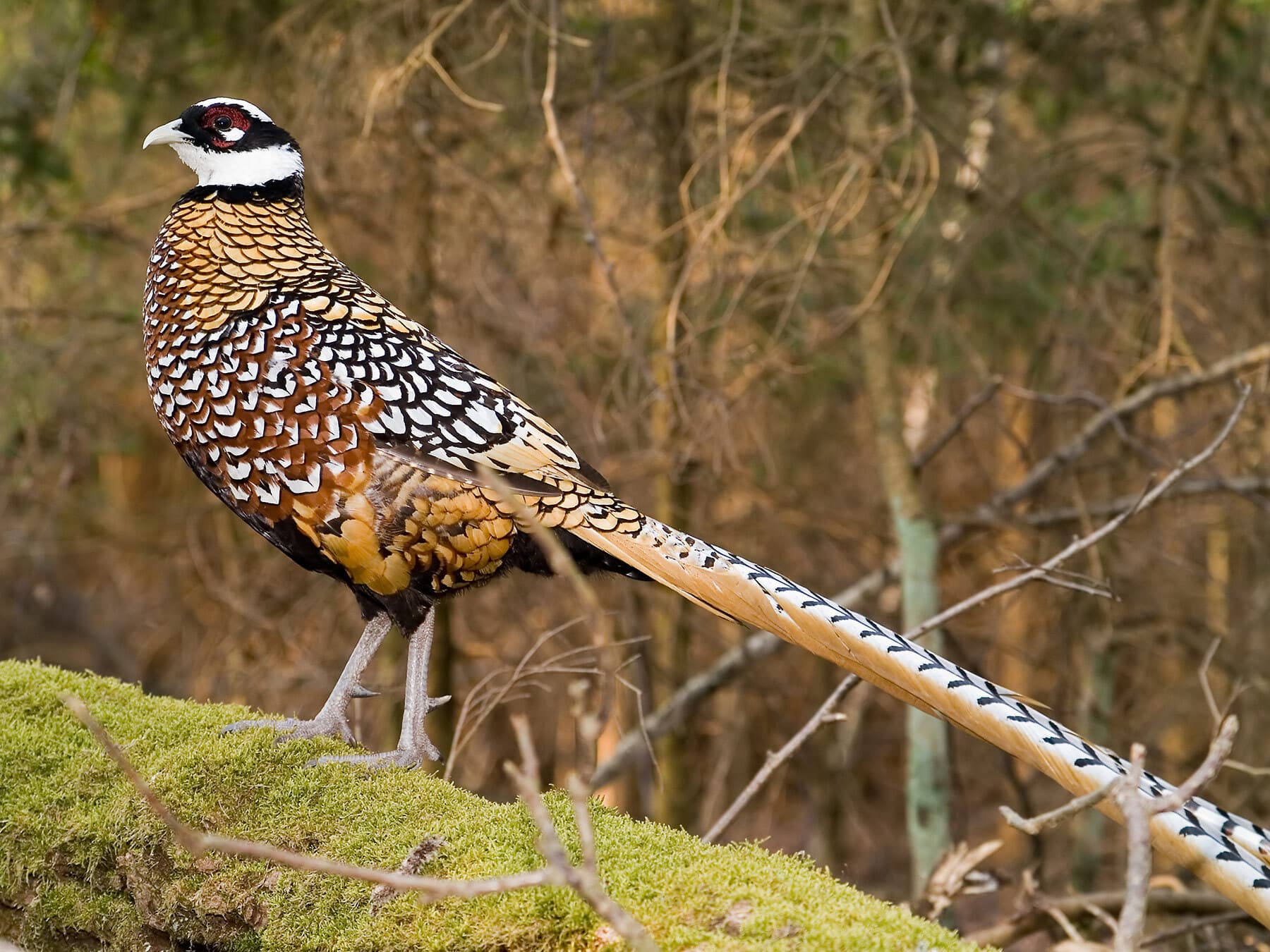
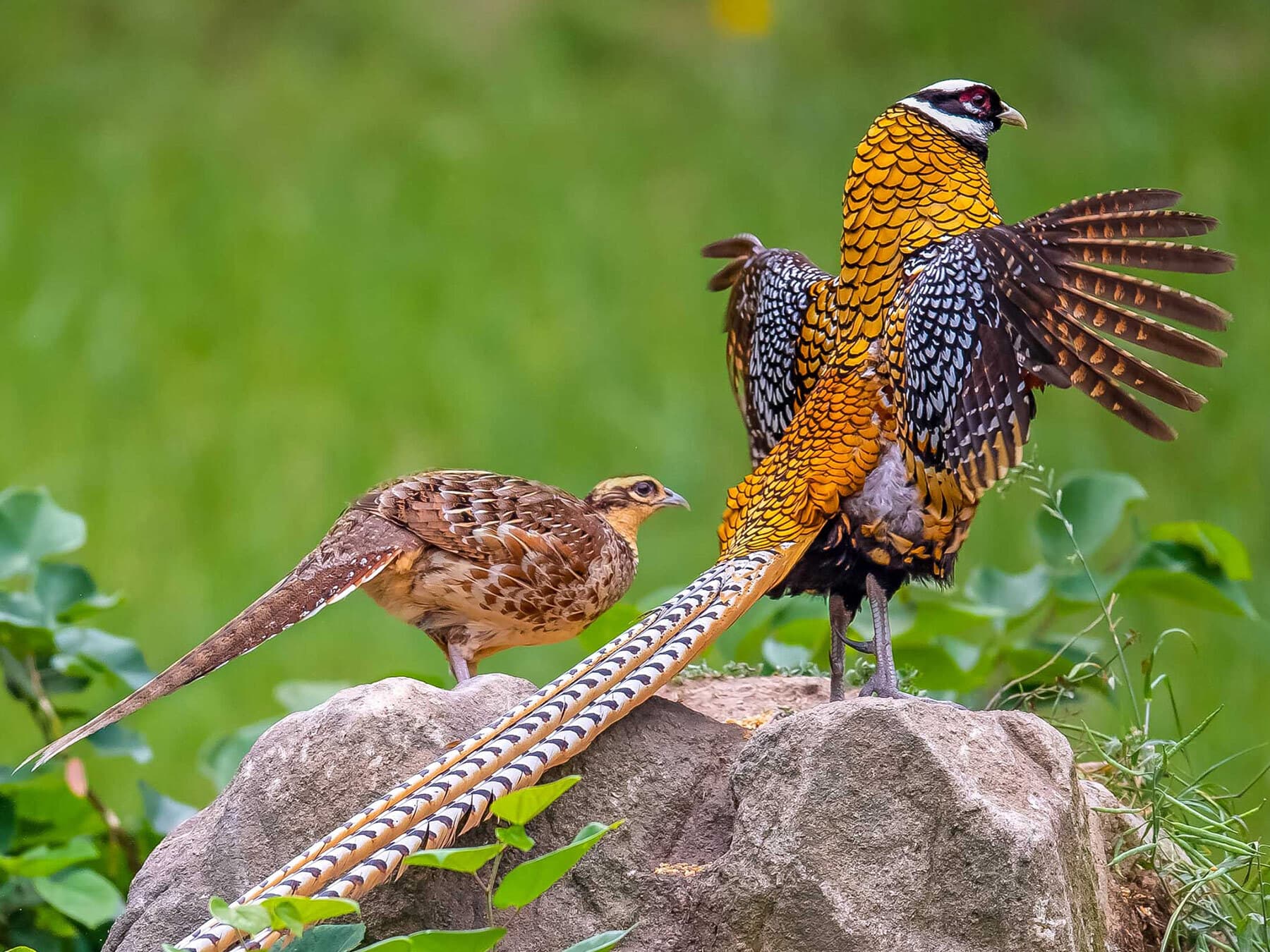
The Reeves's Pheasant is a striking bird, notable for its extremely long tail feathers in males, which can reach up to 1.8 meters, longer than any other pheasant. Males display a golden-brown body with distinct black-and-white markings, a white crown, and a black-and-white barred tail.
Females are smaller and less colourful, with mottled brown plumage and shorter tails. Both sexes have bare red facial skin, grey legs, and a greenish-grey hooked beak. Males also have short spurs on their feet, which females lack.
Juveniles are mostly the same as females but have lighter forenecks and whitish-streaking on their pale brown breasts. Young males are relatively quick to get the pattern on their tails.
Its size
Adults- Length
- 100–210 cm
- Wingspan
- 80–90 cm
- Weight
- 1000–1700 g
Its song and calls
The Reeves's Pheasant was named after the British naturalist John Reeves, who was responsible for introducing live specimens into Europe back in 1831.
As well as Reeves's Pheasant, he also has been commemorated for the Reeves's muntjac and four reptile species.
What does a Reeves's Pheasant sound like?
Reeves's Pheasants have musical calls that are unlike any other game bird. The call sounds a lot more like one a songbird would make.
During the breeding season, male birds wing-whirr and make high-pitched chirping calls. These can often be very loud and can be heard from some distance.
The alarm and contact calls are also both a short series of chirping, sputtering and squeaking sounds.
- Call0:00 / 0:32
Recorded in Hauts-de-France, France · January 2026
When and where to see it
The Reeves's Pheasant is not recorded regularly in the UK, Ireland, the United States or Canada.
United States: recorded in 3 of the 6 years; United Kingdom: recorded in 5 of the 6 years. Too few years to count as a regular visitor.
Worldwide: recorded regularly in 4 countries
Countries where it was recorded in at least 3 of the 6 years 2019–2024. Linked countries have their own bird list.
Data: EOD – eBird Observation Dataset (Cornell Lab of Ornithology), accessed via GBIF.org, CC BY 4.0. Records from 2019–2024, aggregated and filtered by Birdfact. How these lists are made
Nests are shallow bowls that are lined with a mixture of leaves, pined needles and herbs. They are built on the ground in grass or shrubs in the undergrowth in forests. Usually, the construction of the nest is solely taken on by the female.
What is the habitat of a Reeves's Pheasant?
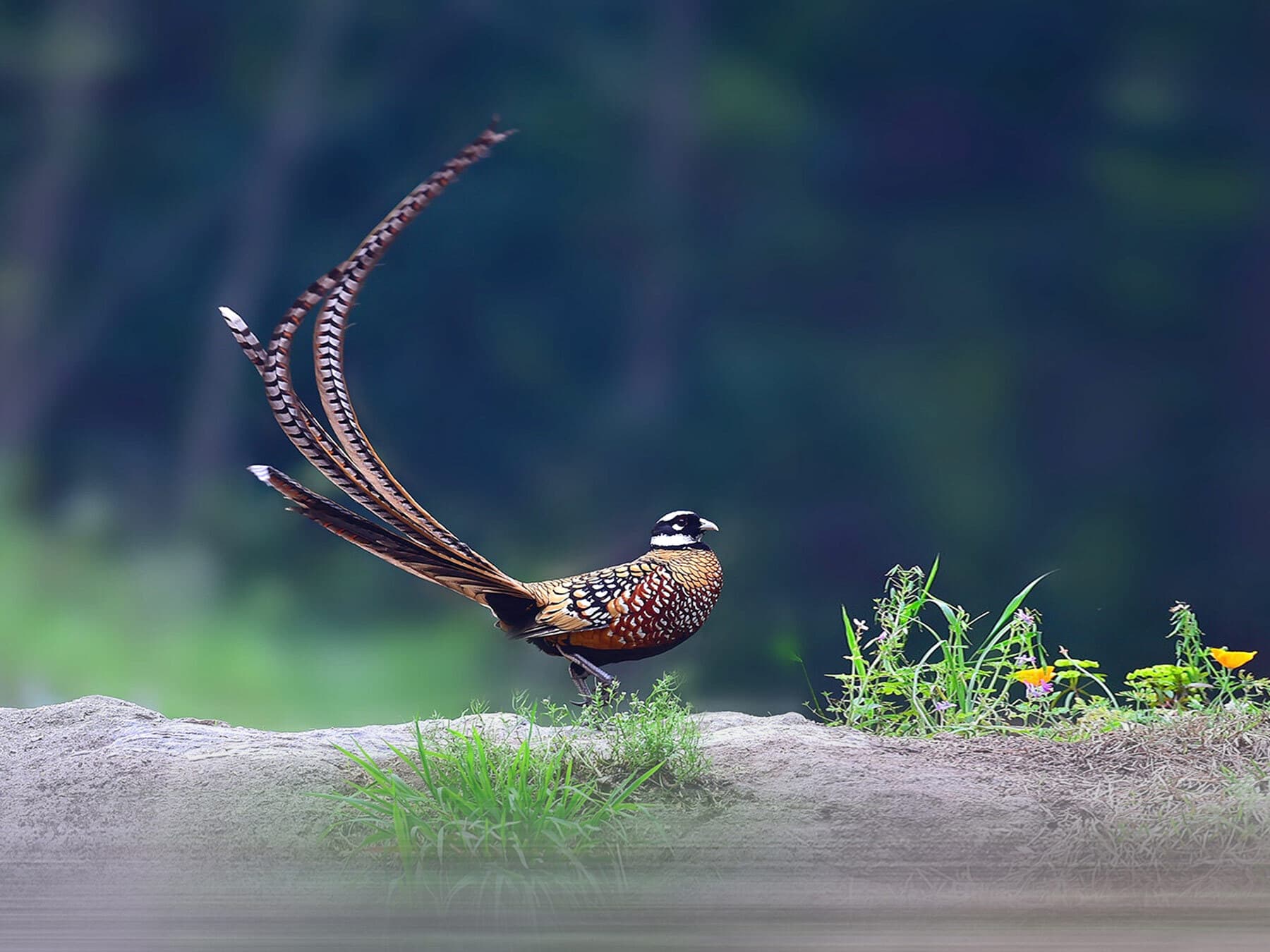
In China, Reeves's Pheasants can be found in evergreen woodlands, areas with plenty of grass and bushes and even the odd steep slope. This is usually between 200 and 2600m.
Introduced birds to Europe can be found in lowland forests. Males can sometimes be seen on farmland as well.
Reeves's Pheasants roost in trees during the night and sometimes throughout the day when resting.
Where do Reeves's Pheasants live?
The Reeves's Pheasant is native to evergreen forests of central and eastern parts of China.
They have been introduced into the United Kingdom, France and the Czech Republic, where small breeding populations have been established. They have also been introduced into the United States, but for sport and ornamental purposes - in other words, you're not likely to find one in the wild in the US.
In the other countries listed above, these pheasants are also released into the wild on a small scale for shooting alongside common pheasants.
Do Reeves's Pheasants migrate?
Reeves's Pheasants are mainly considered to be sedentary and therefore don't migrate.
Tips for seeing it
- Look for Reeves's Pheasants in the dense undergrowth of mixed forests
- Listen for their distinctive loud, harsh call, especially during breeding season
- Be patient and quiet, as these birds are easily startled
- Visit protected areas in central China for the best chances of spotting them
- Use binoculars to spot their long tails among the foliage
What it eats
The diet mainly consists of a mixture of seeds and fruit. They will also eat insects, snails, worms, buds and fresh shoots. This diet will also vary depending on their range.
Like other pheasants, they will forage on the ground with a mixture of scratching and digging to find food.
They will often feed in small groups of up to 10 or more closely related birds. In Europe, this is usually in unisexual groups and in China mix-sexed groups. This occurs more frequently during the winter and mainly with females and juveniles.
Nesting and breeding
A clutch of between 6 and 9 eggs is laid. Females will incubate the eggs and feed the chicks by themselves. Whilst the females are doing this, males will defend the territory.
What do Reeves's Pheasant eggs look like?
The eggs are usually a cream or olive colour.
Behaviour
Reeves's Pheasants are generally shy and elusive, preferring to run rather than fly when disturbed. They are often seen foraging on the ground in small groups, scratching the leaf litter for food.
During the breeding season, males become territorial and perform elaborate courtship displays, fanning their long tails to attract females.
Lifespan and predators
The average lifespan for a Reeves's Pheasant is around 9 years.
Conservation
Reeves's Pheasant is classified as Vulnerable due to habitat loss and fragmentation. Deforestation and conversion of land for agriculture pose significant threats.
Conservation efforts focus on habitat protection and captive breeding programs to support wild populations.
What does a Reeves's Pheasant look like?
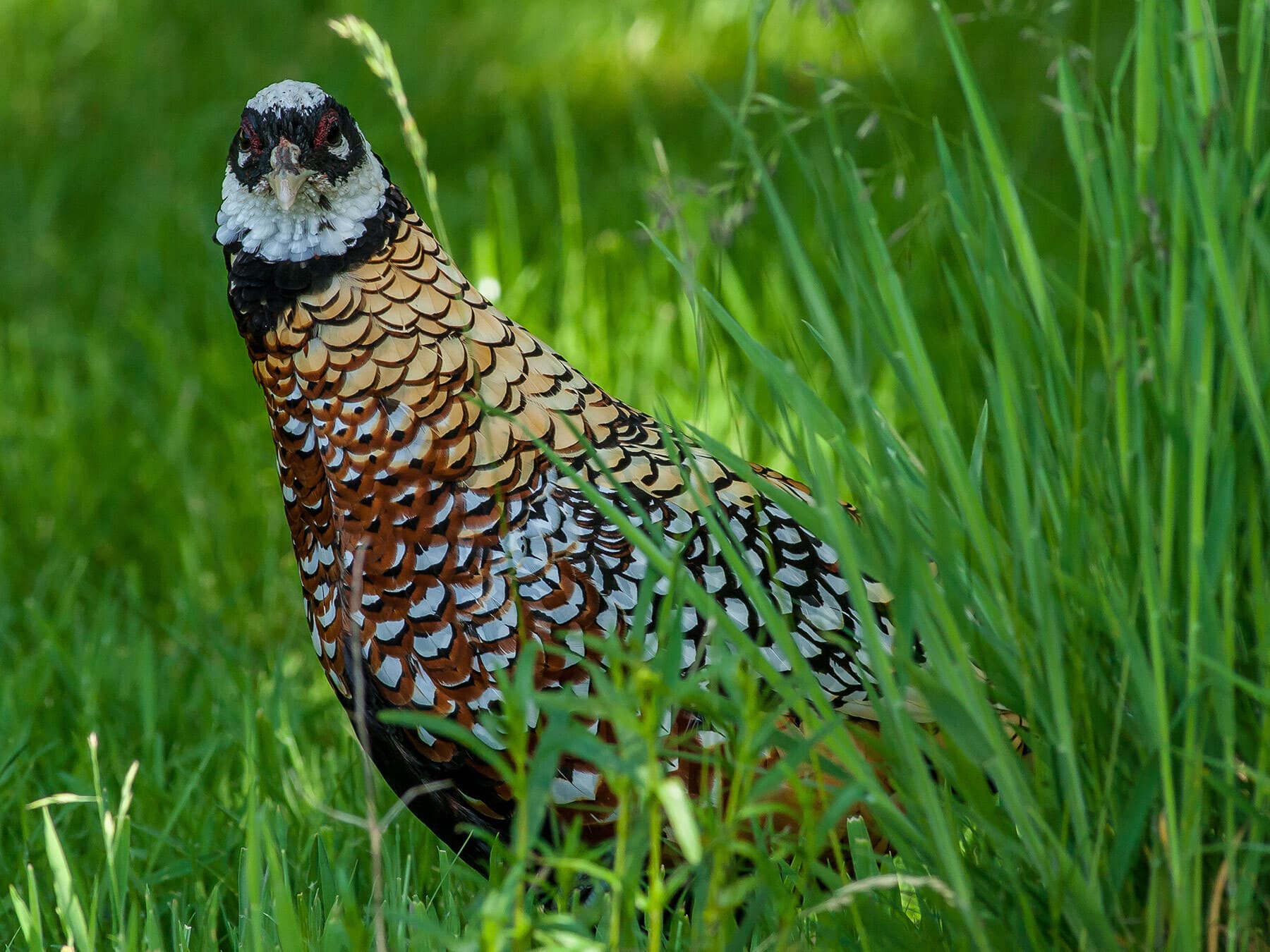
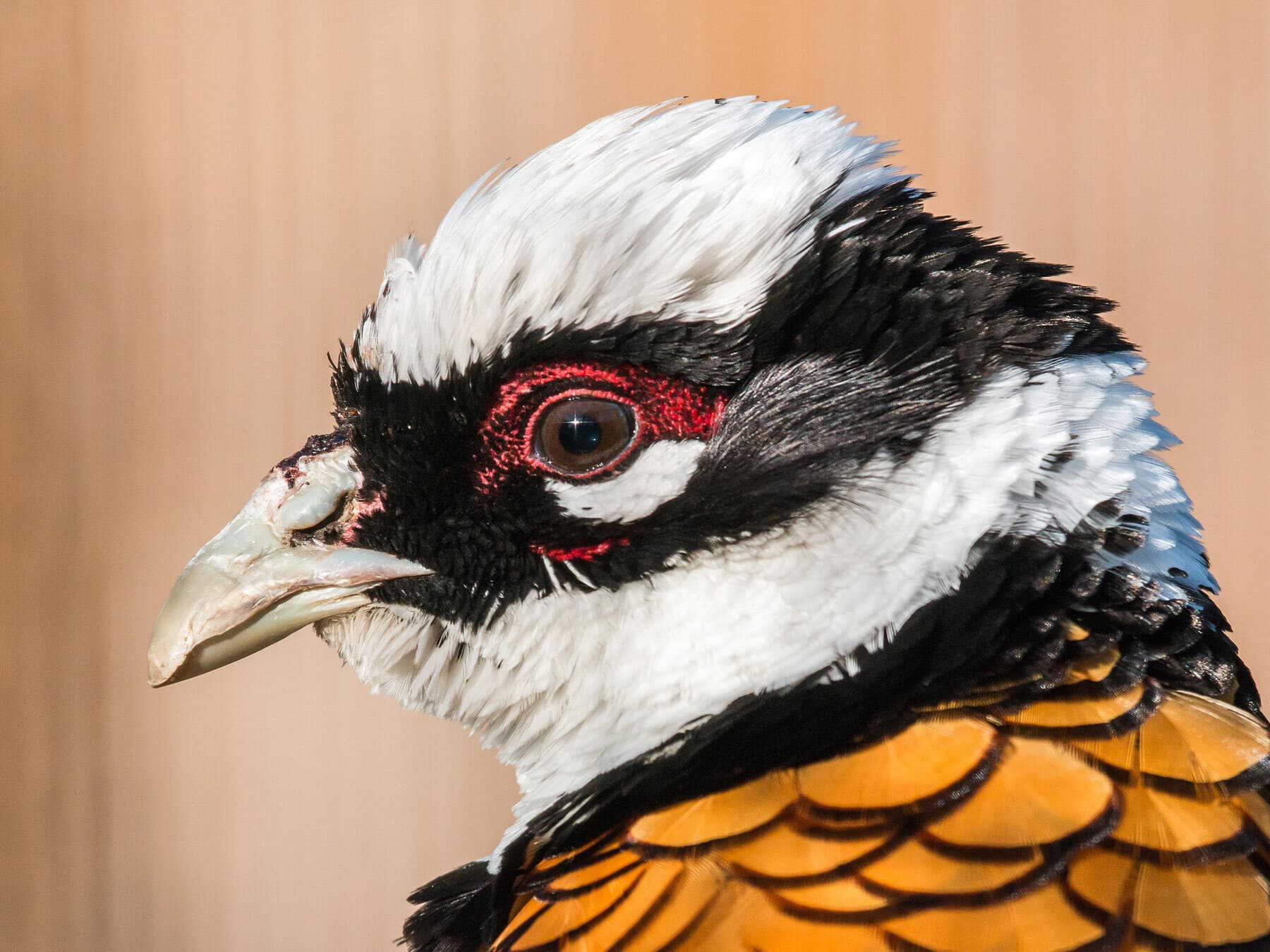
Male birds are highly distinctive with their white head and black masks which join together at the back of the neck. Most of the body is a vibrant golden-chestnut colour and the breast is either black or chestnut. The back has contrasting and bold black scaling, and the tails are buff-orange with a black and white patternation. The tail is the longest of any other pheasant.
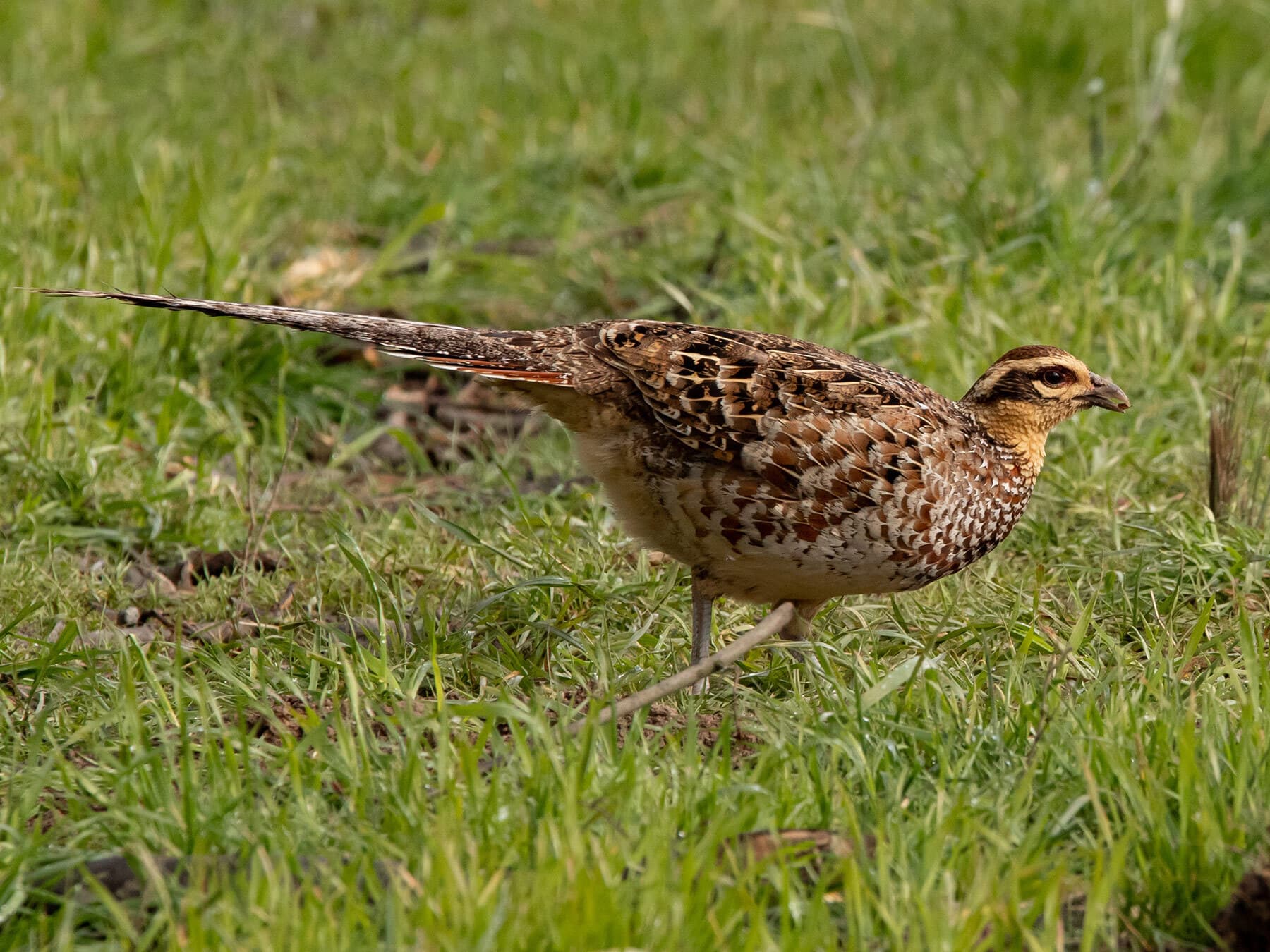
Females are much less striking overall but do have a distinctive black pattern on their heads. They have buff-brown faces with dark masks. Most of the body is a mixture of brown, chestnut and a buff colour with barring. The underparts are mostly lighter; however, this is variable. The tails of a female are considerably shorter than the males.
Both adults have grey legs and short, hooked greenish bills. The eyes are brown. Males also have short spurs on their feet, which females lack.
Juveniles are mostly the same as females but have lighter forenecks and whitish-streaking on their pale brown breasts. Young males are relatively quick to get the pattern on their tails.
Reeves's Pheasants are monotypic, but the plumage is highly variable between individuals.
How big is a Reeves's Pheasant?
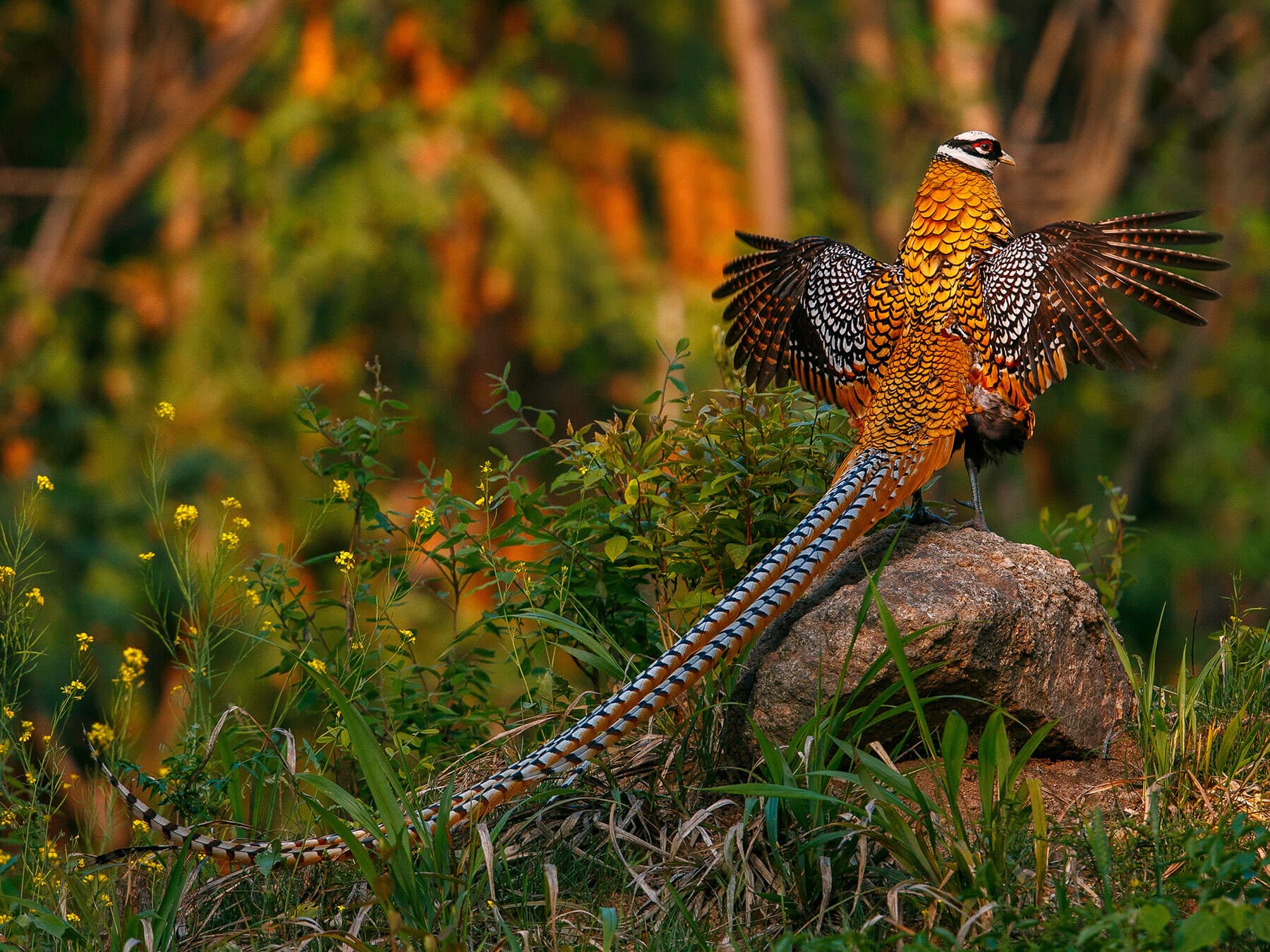
The Reeves's Pheasant is large bird. Male birds are considerably larger than females and are an average of 210cm (82 inches) in length. The tail is one of the standout features and has been reported in older birds to reach extraordinary lengths of over 200cm. The average tail length is anywhere from 100 to 160cm (39 to 63 inches).
The tail of the male bird grows on average 30cm (12 inches) each year. This makes the tail of the Reeves's Pheasant, the longest of all pheasants.
The average length of a female is 150cm (59 inches) with an average tail length of between 33 and 45cm (13 and 18 inches).
The wingspan is between 55 and 90cm (21 to 35 inches). The reason for the great difference in range is that males usually have a considerably larger wingspan compared to females.
How much does a Reeves's Pheasant weigh?
The average weight for male birds is around 1500g (approx 53 ounces) and females around 950g (34 ounces).
What is the scientific name of a Reeves's Pheasant?
The binomial name is Syrmaticus reevesii.
The first part (the genus) Syrmaticus is given to five species of long-tailed pheasants. Other than the Reeves's Pheasant, this includes:
- Copper pheasant (S. soemmerringii)
- Mikado pheasant (S. mikado)
- Elliot's pheasant (S. ellioti)
- Mrs. Hume's pheasant (S. humiae)
Are Reeves's Pheasants aggressive?
Reeves's Pheasants, unfortunately, do not have the best reputation. They can sometimes be aggressive towards humans, animals and other pheasants. This isn't the case with every bird, but they have more of a reputation than others.
Like other pheasants, the breeding season, in particular, is usually when males become more aggressive and is mostly towards other male pheasants. The aggression is triggered by hormones and pheromones and is used to protect their territory and partners.
Are Reeves's Pheasants rare or endangered?
Reeves's Pheasants are listed as Vulnerable and are therefore endangered. In China, it's estimated that there are anywhere between 2,500 and 10,000 mature individuals left. Unfortunately, this number is continuing to see a steady decline which is why they are endangered.
The decline is thought to be down to a mixture of habitat loss, poaching and poisoning.
Populations were introduced into parts of Europe back in the 1800s, but not all were established successfully. Both the Czech Republic and parts of central and north-western France have relatively well-established populations but are still slowly declining.
Due to the decline and small worldwide population, seeing a Reeves's Pheasant in the wild is quite a rare thing.
Do Reeves's Pheasants mate for life?
There is little known about the mating behaviour of Reeves's Pheasants, but it's speculated that males usually have more than one female partner, as they are frequently seen with two females, which makes them polygynous.
Can Reeves's Pheasants fly?
Yes, they are capable of flying and are, in fact, quite strong fliers. However, as the explosive flight utilises a lot of energy, they can only fly a couple of kilometres and generally prefer to run away.
Similar birds
Often mistaken for
Reeves's Pheasant guides
3 guidesQuick facts
- Length
- 100–210 cm
- Wingspan
- 80–90 cm
- Weight
- 1000–1700 g
- Lifespan
- 9 years · oldest recorded 9.2 years
- Family
- Pheasants & Grouse
- Migration
- Resident
- Global status (IUCN)
- Vulnerable
- World population
- 3,500 - 15,000 individuals
- Population trend
- Decreasing
- Also called
- Reeves' Pheasant
- Scientific name
- Syrmaticus reevesii
Sources
4- 1BirdLife International. 2018. Syrmaticus reevesii. The IUCN Red List of Threatened Species 2018: e.T22679346A131873938. Source (opens in a new tab)
- 2BirdLife International. 2018. Syrmaticus reevesii. The IUCN Red List of Threatened Species 2018: e.T22679346A131873938. Source (opens in a new tab)
- 3BirdLife International. 2018. Syrmaticus reevesii. The IUCN Red List of Threatened Species 2018: e.T22679346A131873938. Source (opens in a new tab)
- 4Caleb Finch, Longevity, Senescence, and the Genome (1990)

Checked by
Nathan Cope, founder and editor
Nathan founded Birdfact and leads its writers and contributors in the UK, the US and Canada. He has watched and studied birds for more than ten years, and checks every article and species guide before it’s published.