


Golden Pheasant
Chinese Pheasant · Chrysolophus pictus
By the Birdfact teamChecked by Nathan Cope
On this page16 sections
How to recognise it
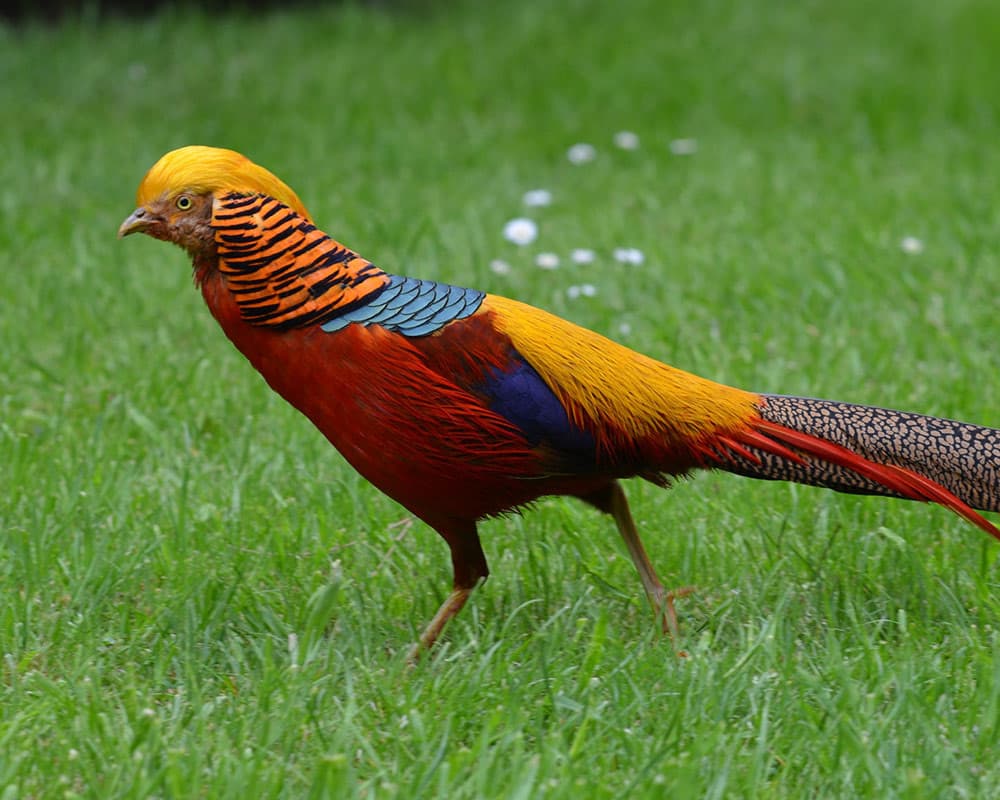
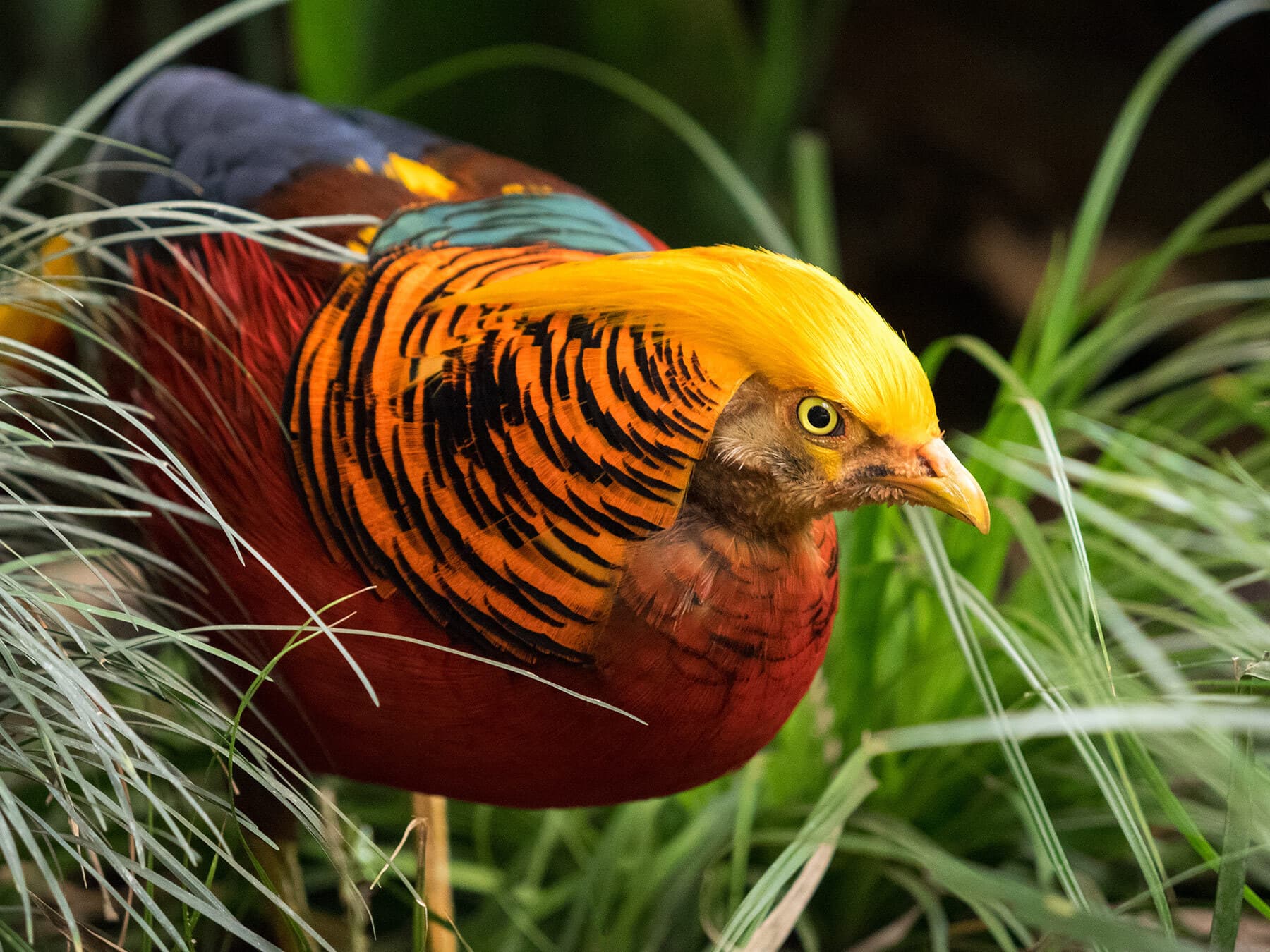
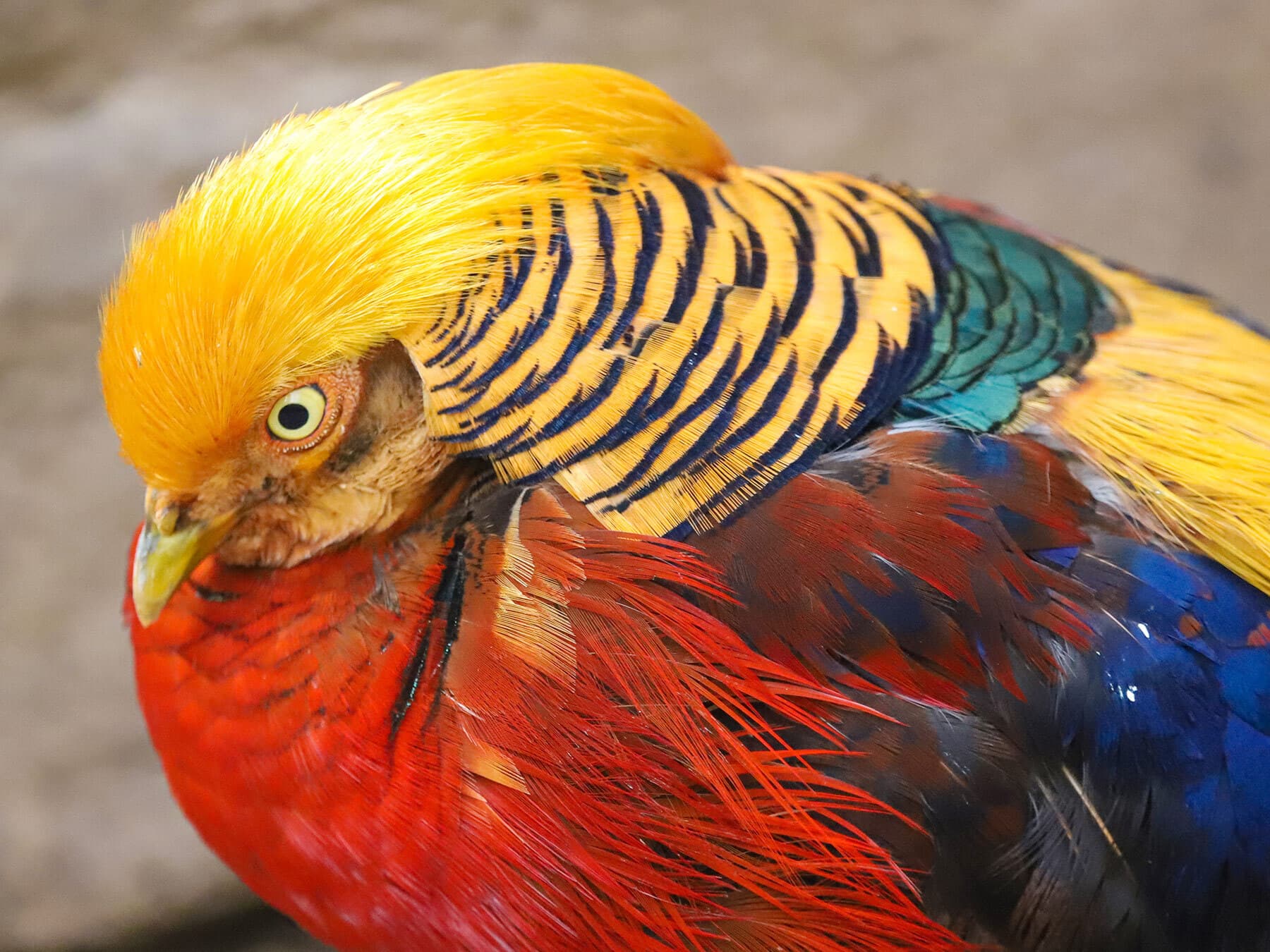
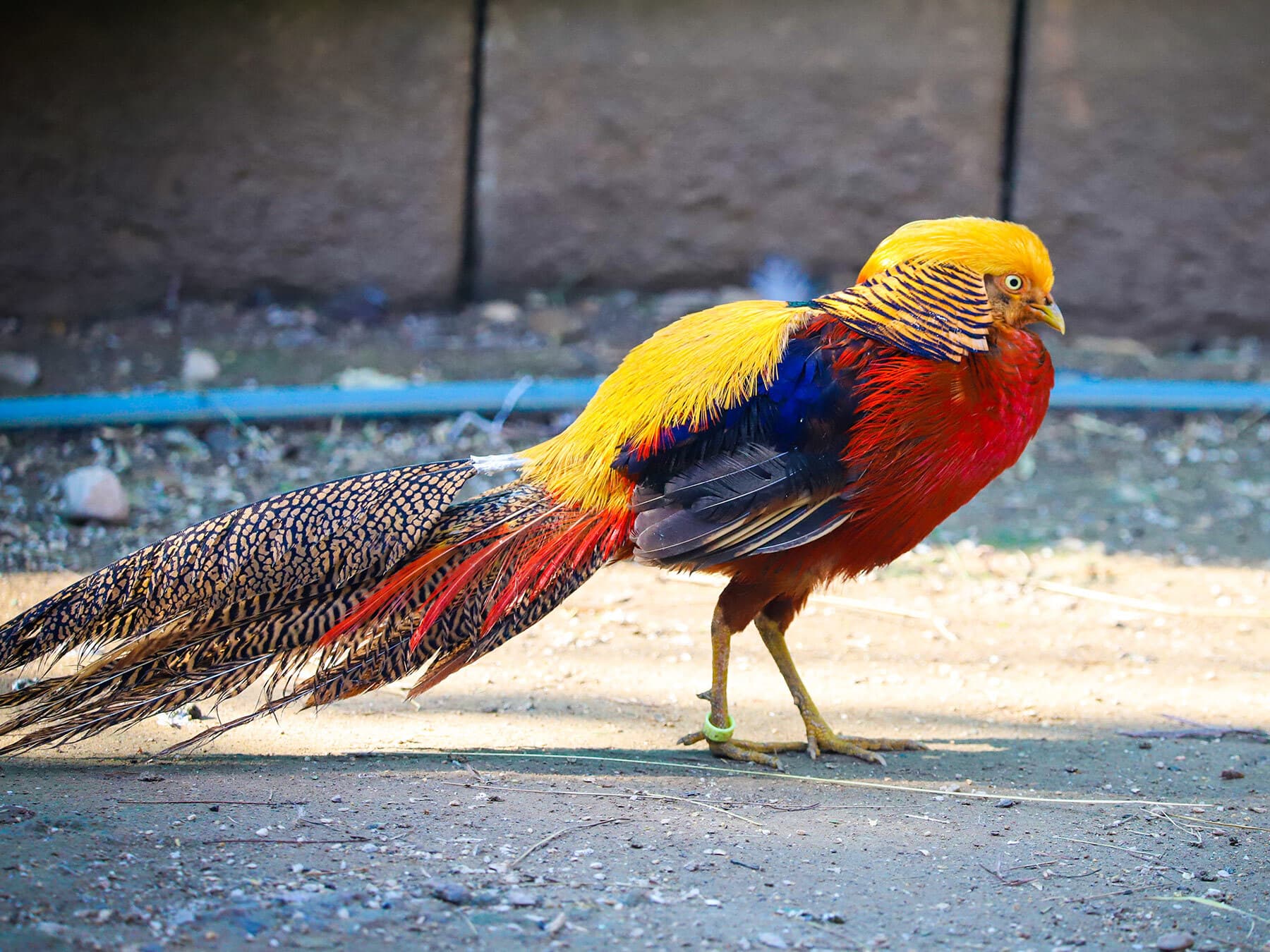
The Golden Pheasant is a strikingly colourful bird, particularly the male. Males display a golden-yellow crest, bright red body, and long, barred tail. Their wings showcase vibrant blue patches, while the back and rump are metallic green. The eyes are a very pale yellow to white.
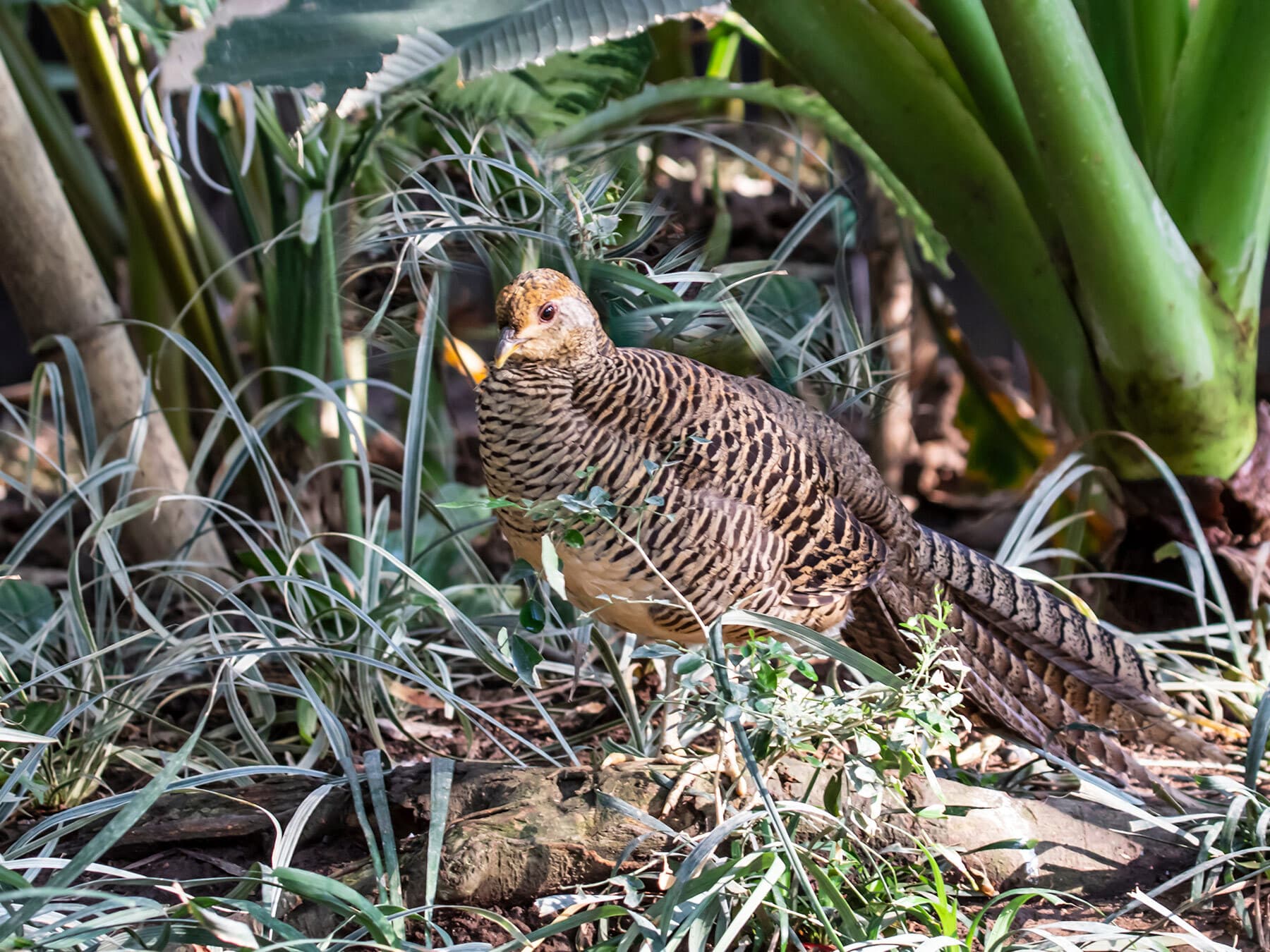
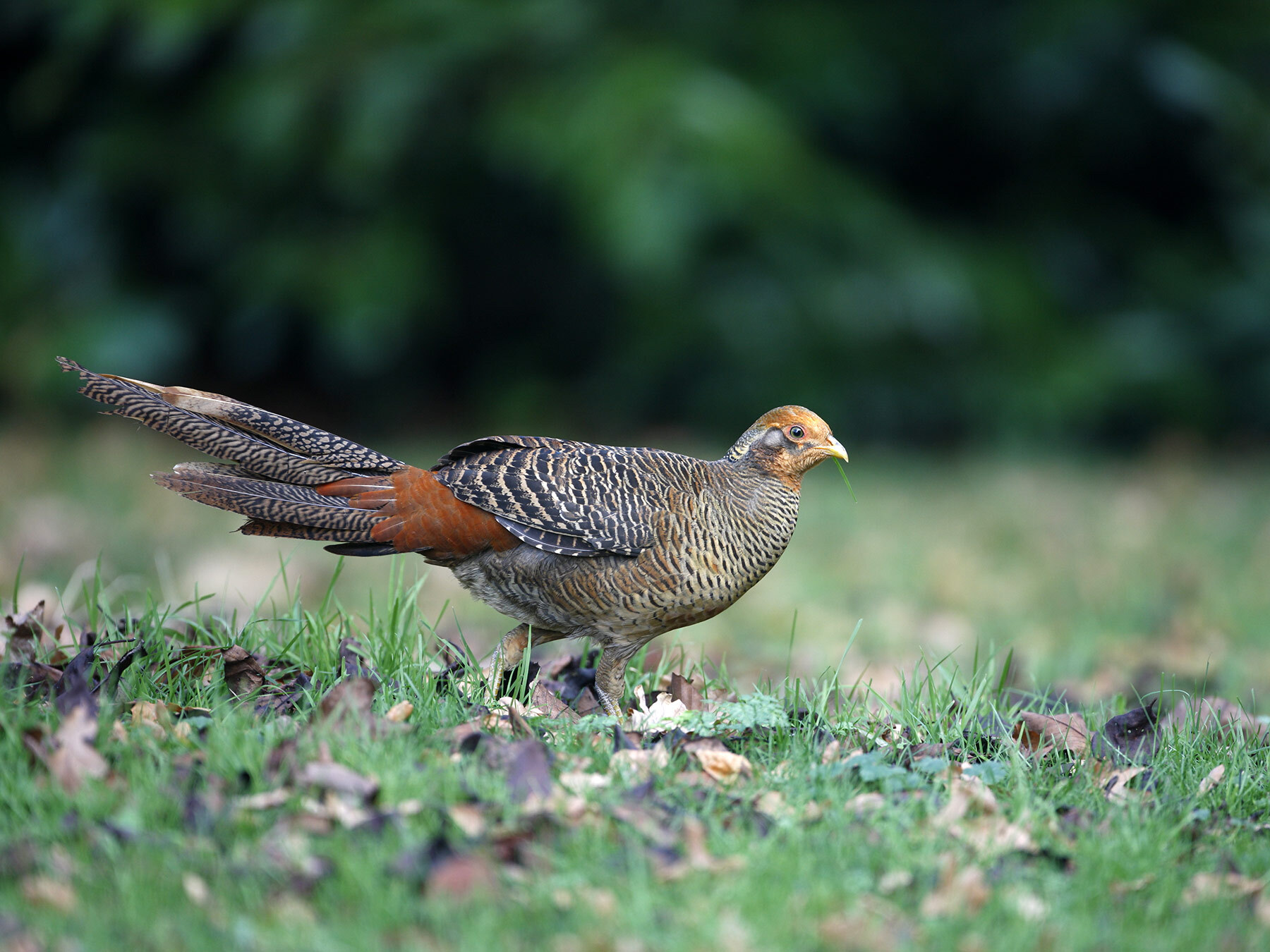
Females are much more subdued, with mottled brown plumage and black barring, which provides excellent camouflage. Juveniles resemble females but have shorter tails. Both adult females and juveniles have brown eyes compared to the male’s pale irides.
Its size
Adults- Length
- 90–105 cm
- Wingspan
- 65–75 cm
- Weight
- 500–1700 g
Its song and calls
Apart from a distinctive hissing sound; in typical pheasant fashion the golden pheasant issues a loud, high pitched shrieking call similar to ‘eh-sheek’.
When and where to see it
OctoberLeaving
Most recorded in October
- 1. Louisianaunder 0.1%
- 2. Washingtonunder 0.1%
- 3. Ontariounder 0.1%
Each dot is a county, state or province: the bigger and darker, the larger the bird’s share of that place’s bird records that month. Grey dots: no regular records. The ringed point is the centre of the bird’s records this month; the arrow shows how it moved since last month, and the dashed loop its path through the year. “Arrivals” colours places where it becomes regular this month (orange) or is in its last regular month (grey). GBIF eBird Observation Dataset, 2019–2024. Map data: Natural Earth, US Census Bureau; place centres © OpenStreetMap contributors.
In your area
See when the Golden Pheasant is recorded in your county, state or province.
The Golden Pheasant is not recorded regularly in the UK, Ireland, the United States or Canada.
United States: recorded in 6 of the 6 years; Canada: recorded in 5 of the 6 years; United Kingdom: recorded in 6 of the 6 years; Ireland: recorded in 1 of the 6 years. Too few years to count as a regular visitor.
Recorded regularly in
Worldwide: recorded regularly in 2 countries
Countries where it was recorded in at least 3 of the 6 years 2019–2024. Linked countries have their own bird list.
Asia (1)
Oceania (1)
Data: EOD – eBird Observation Dataset (Cornell Lab of Ornithology), accessed via GBIF.org, CC BY 4.0. Records from 2019–2024, aggregated and filtered by Birdfact. How these lists are made
Indigenous to the mountain and forest regions of south and west China this monotypic species has had mixed fortunes when introduced by man to other areas of the world. The most successful introduction thus far has been to England, where in the late nineteenth century they were imported and nowadays are located mainly within the pine forests of Suffolk and Norfolk in the east of England. It is estimated that the UK population is in the region of up to one hundred breeding pairs. Other areas of the world where they can be seen, albeit in much smaller numbers, are Australasia, Continental Europe and North and South America. Small feral populations favour coniferous forests and they are frequently found in aviaries and zoos.
Signs and Spotting tips
In the wild these hardy birds are easiest to spot during their feeding in the early morning. They are shy and tend to hide within dense forest areas. Their long tails and relatively short wings mean that they are not renowned for their flying capabilities and in fact, prefer to run away from trouble as opposed to taking to the wing. The adult male is unmistakable in his colourful plumage. Golden pheasants spend most of the day on the ground whilst at night they tend to roost high up in trees. Probably the best way to view these beautiful birds is visit them in a zoo or aviary where it is alleged, they adapt to captivity very well.
What it eats
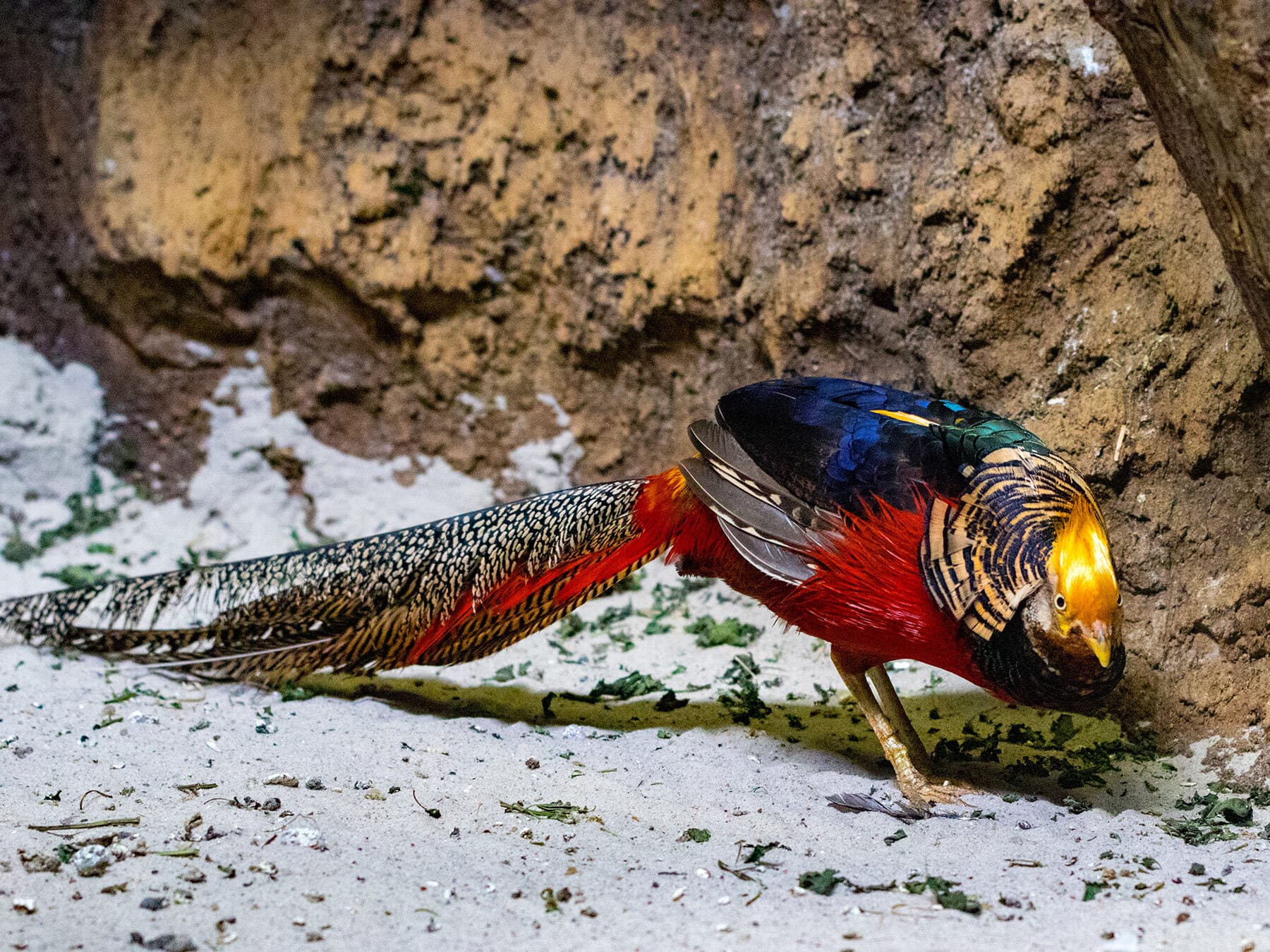
The golden pheasant is a ground forager, mainly dining on a diet of insects and spiders, foliage including leaves, plant shoots, buds and seeds and in its native China, bamboo shoots and leaves.
Nesting and breeding
Golden pheasants nest on the ground in small scrapes lined with foliage surrounded by the natural camouflage of ground vegetation. The breeding season is believed to take place from early April to June when one brood, consisting of between 5 -12 beige coloured eggs, is laid annually. The female alone incubates the eggs which hatch at around twenty three days. Fledging occurs some two weeks later.
How many eggs does a Golden Pheasant lay?
Golden Pheasants usually lay between 5 and 12 eggs.
Behaviour
Golden Pheasants are generally shy and elusive, preferring to run rather than fly when disturbed. They are most active during early morning and late afternoon, spending much of their time foraging on the forest floor. These birds are typically solitary or found in small groups outside the breeding season.
Lifespan and predators
Within its native China there is a very high predation rate amongst the young and whilst life expectancy in the wild is between five to six years, captive birds may live a lot longer.
Conservation
While the Golden Pheasant is listed as Least Concern globally, its native populations in China face habitat loss due to deforestation. In countries where it has been introduced, such as the UK, conservation efforts focus on managing populations to prevent competition with native species.
What does a Golden Pheasant look like?
Smaller than the Common Pheasant (Phasianus colchicus) the adult male golden pheasant has predominantly red underparts with a long golden crest tipped red and gold rump. The face is a light buff and the bill, pale yellow. The eyes are a very pale yellow to white. Extending from beneath the back of the crest across the mantle is an orange and indigo barred cape otherwise known as a ruff. The upper back area is a bottle green and the tail, which accounts for almost two thirds of the total length of the bird, is a golden brown with dark mottling. The wings are short and dark brown. The legs of both sexes are a pale yellow. The female adult is considerably smaller and whilst its tail is long for the size of the bird it is approximately half the length of the tail of the male. As with many gamebirds the female is rather drab and uninteresting compared with the male. Overall, she is predominantly a mid to golden brown which is closely and heavily barred in black. Unlike the male the female lacks any form of crest or cape. The underparts are less heavily barred and are more of a light buff colour particularly around the area of the lower belly. Juvenile birds are similar to female adults but with less barring. Both adult females and juveniles have brown eyes in contrast to the male’s pale irides.
Can Golden Pheasants fly?
Like all pheasants, the golden pheasant isn't able to fly for prolonged periods. Instead, they are capable of short and rapid bursts of flight. They spend most of their time on the ground.
Are Golden Pheasants endangered?
No, globally they are listed with a conservation status of Least Concern, which means there is a stable population.
More photos
2 photos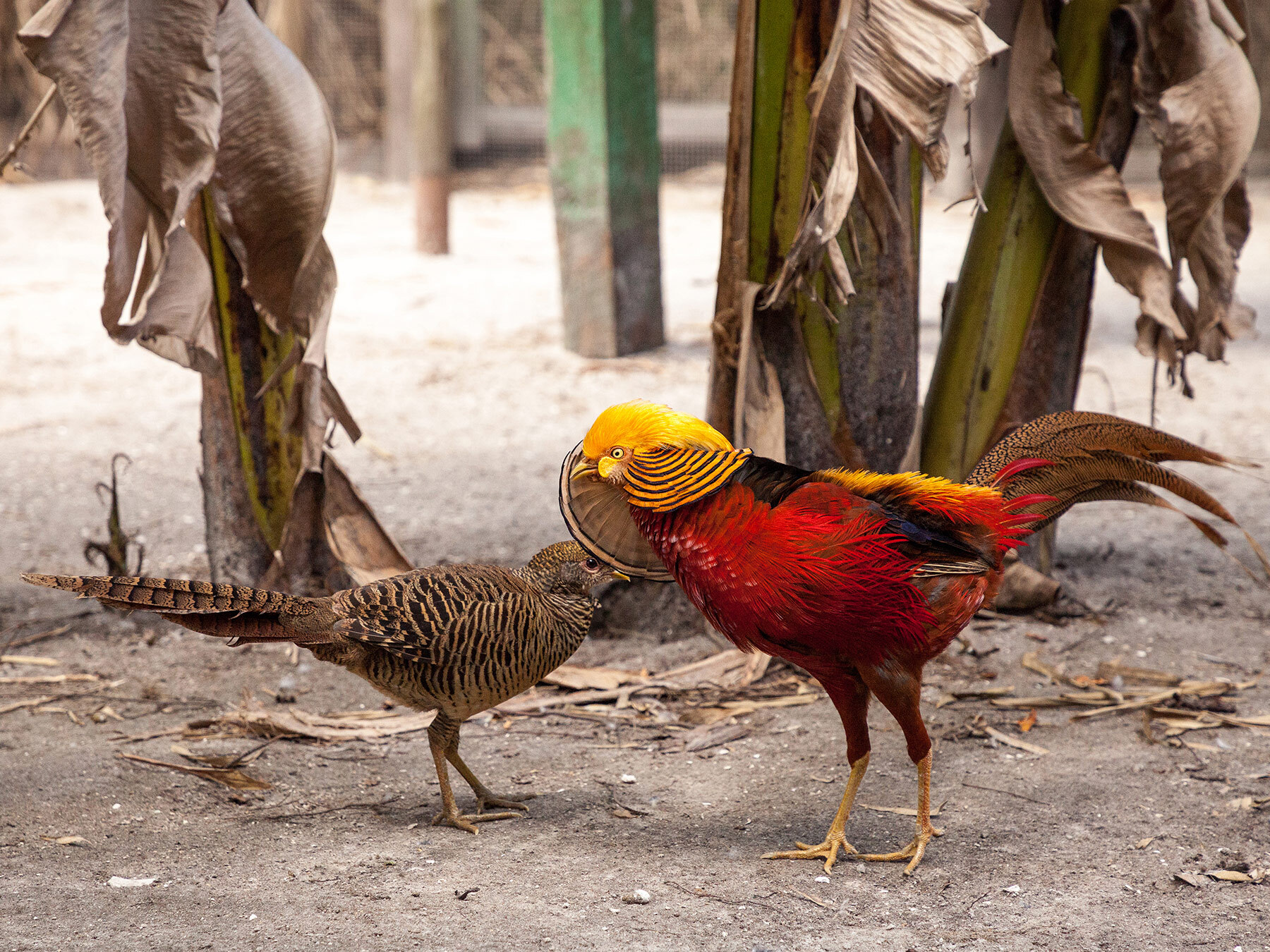
Golden Pheasant guides
4 guidesQuick facts
- Length
- 90–105 cm
- Wingspan
- 65–75 cm
- Weight
- 500–1700 g
- Lifespan
- 5–10 years
- Family
- Pheasants & Grouse
- Migration
- Resident
- Global status (IUCN)
- Least Concern
- World population
- 1,000 - 2,000 mature individuals (UK)
- Population trend
- Decreasing
- Also called
- Chinese Pheasant
- Scientific name
- Chrysolophus pictus
Sources
3- 1BirdLife International. 2018. Chrysolophus pictus. The IUCN Red List of Threatened Species 2018: e.T22679355A131874282. Source (opens in a new tab)
- 2del Hoyo et al. (1994)
- 3Madge and McGowan (2002)

Checked by
Nathan Cope, founder and editor
Nathan founded Birdfact and leads its writers and contributors in the UK, the US and Canada. He has watched and studied birds for more than ten years, and checks every article and species guide before it’s published.