


Lady Amherst's Pheasant
Lady Amherst Pheasant · Chrysolophus amherstiae
By the Birdfact teamChecked by Nathan Cope
On this page13 sections
How to recognise it
What do Lady Amherst Pheasants look like?
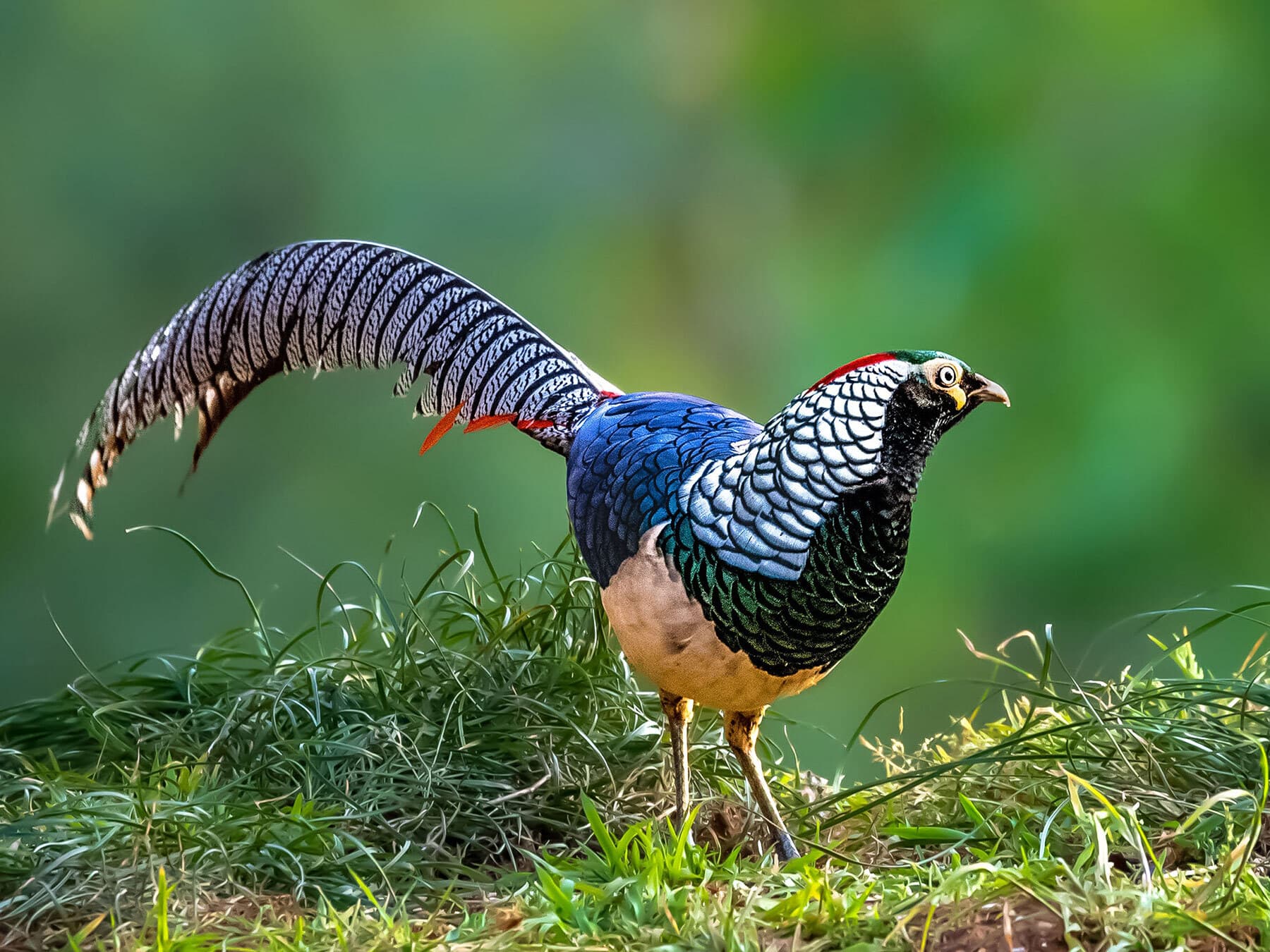
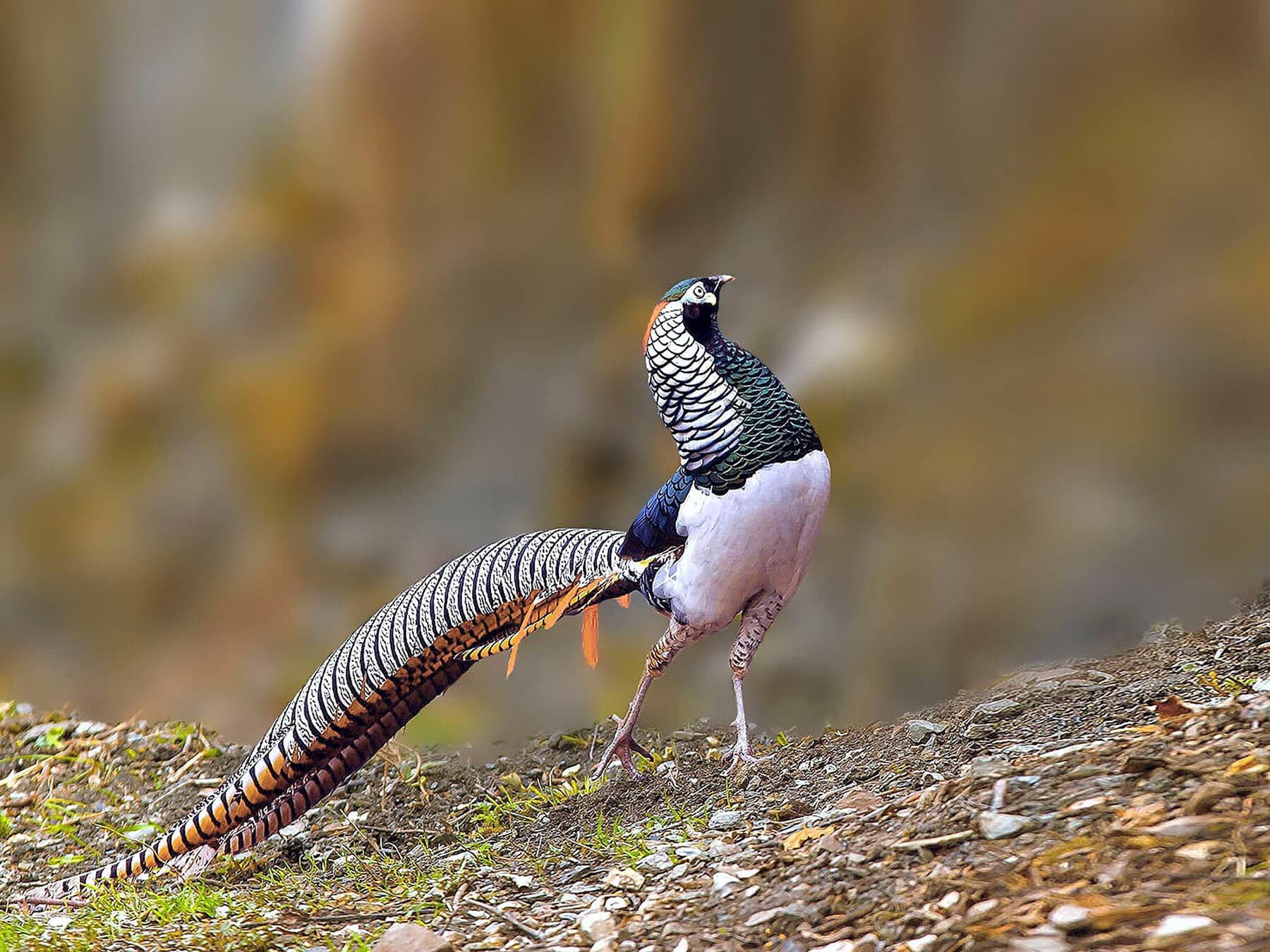
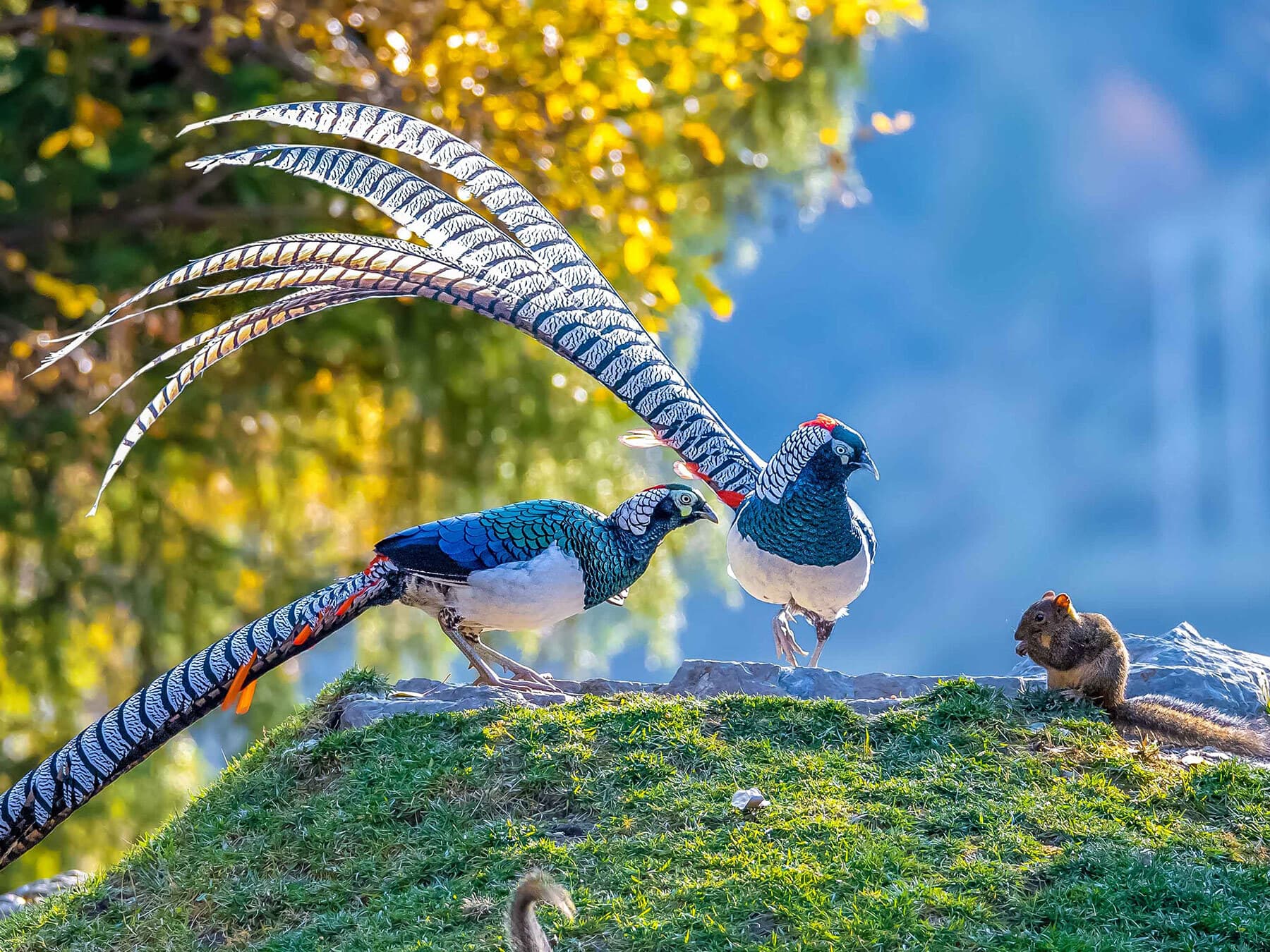
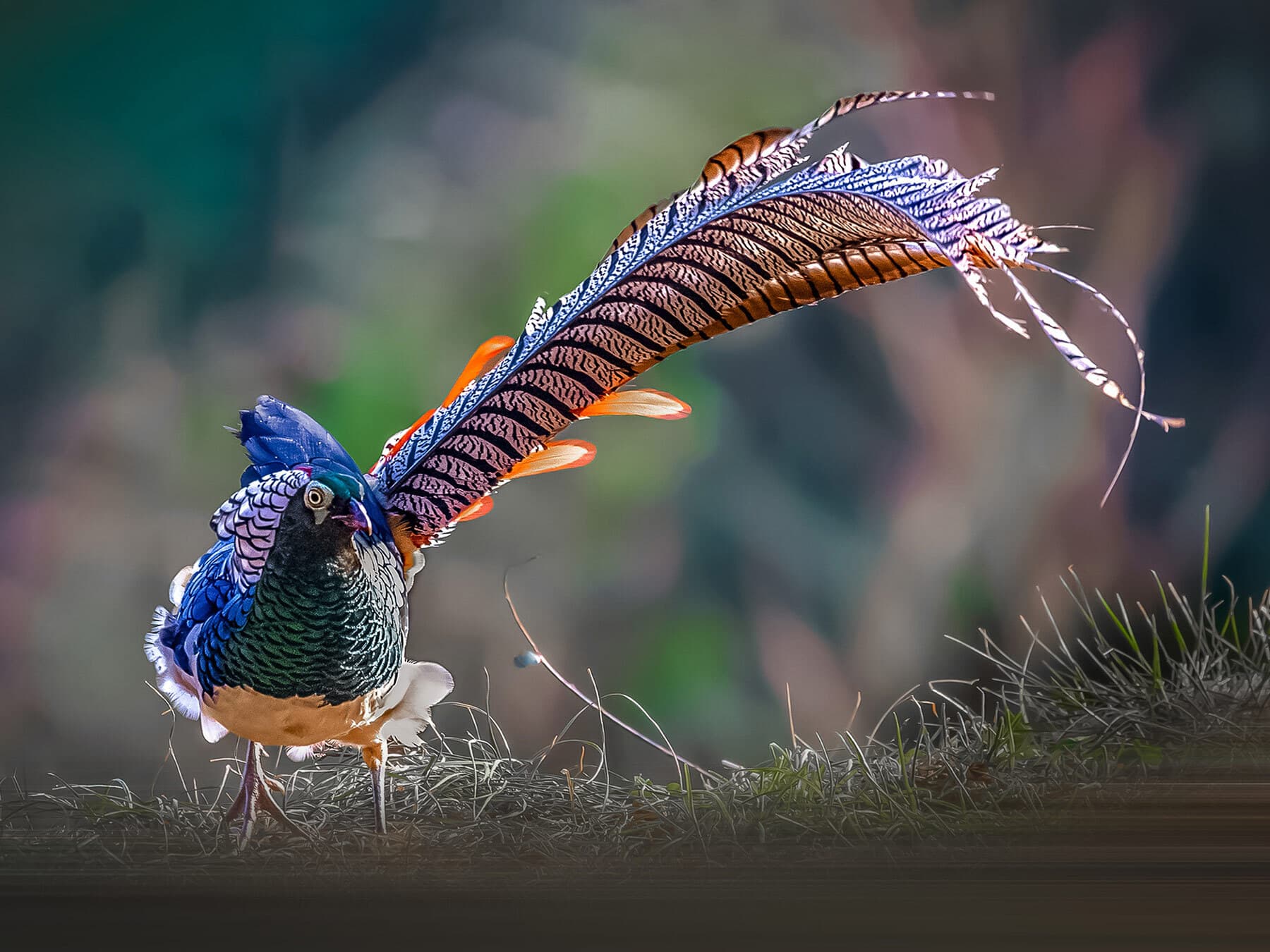
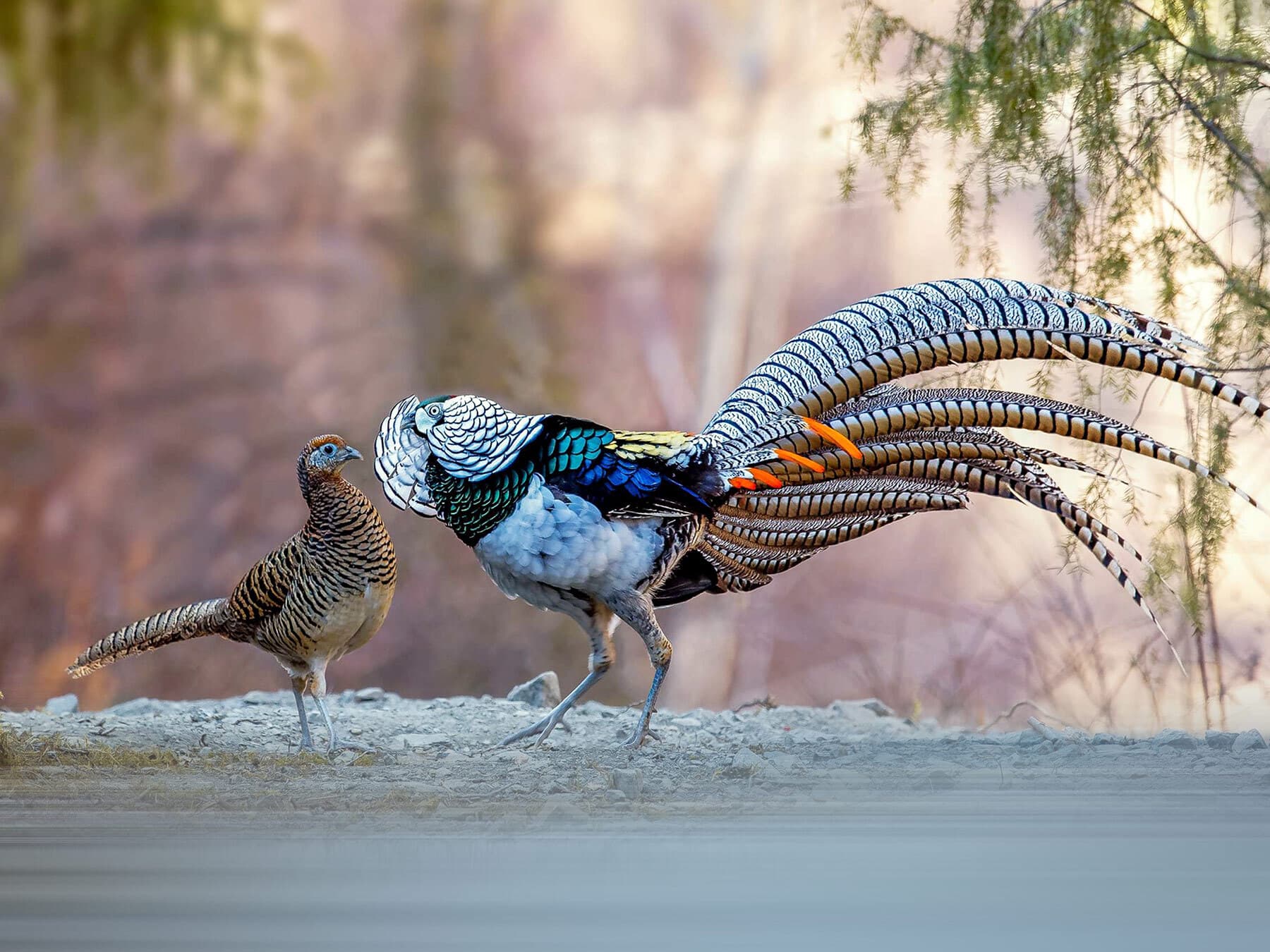
The male Lady Amherst's pheasant is one of the most unmistakable birds in the animal kingdom. The overall appearance is of a black and white ground bird with a long tail, but closer inspection reveals myriad colors and details.
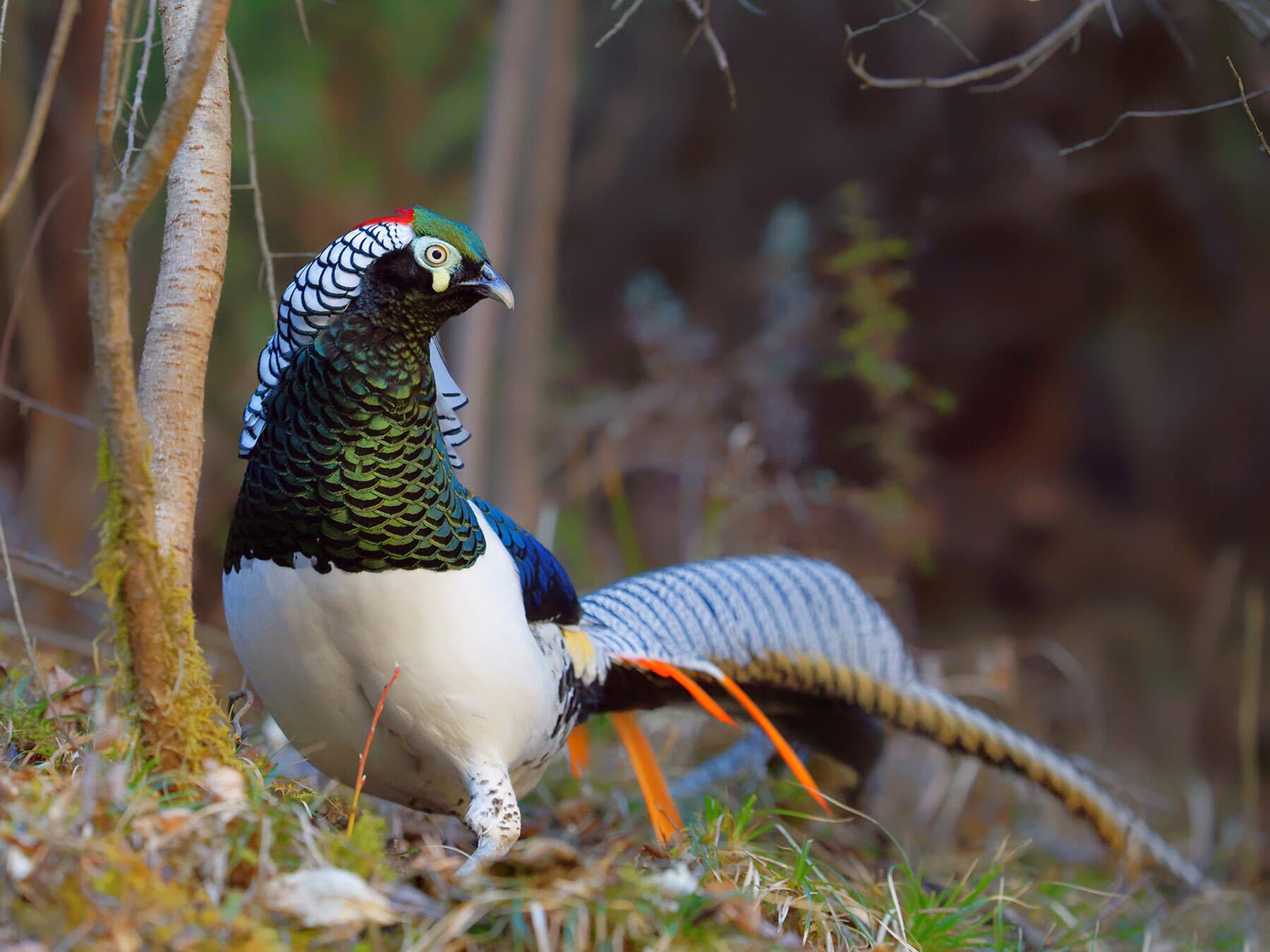
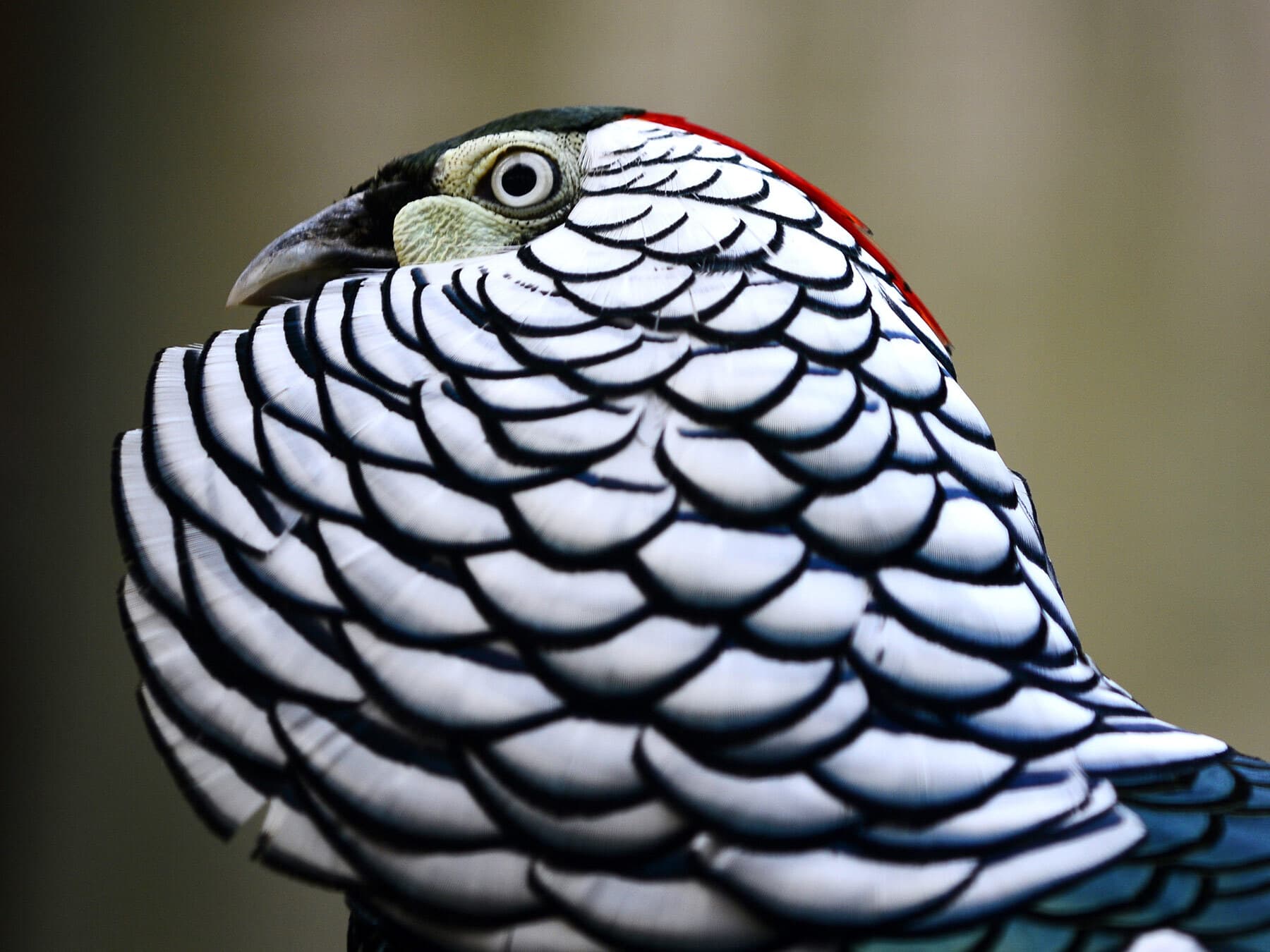
Their heads are adorned with a red crest and a green crown, while their napes are white, scalloped with black on the end of each feather. The dark throat area and back are highly reflective, showing up iridescent green and blue in good light.
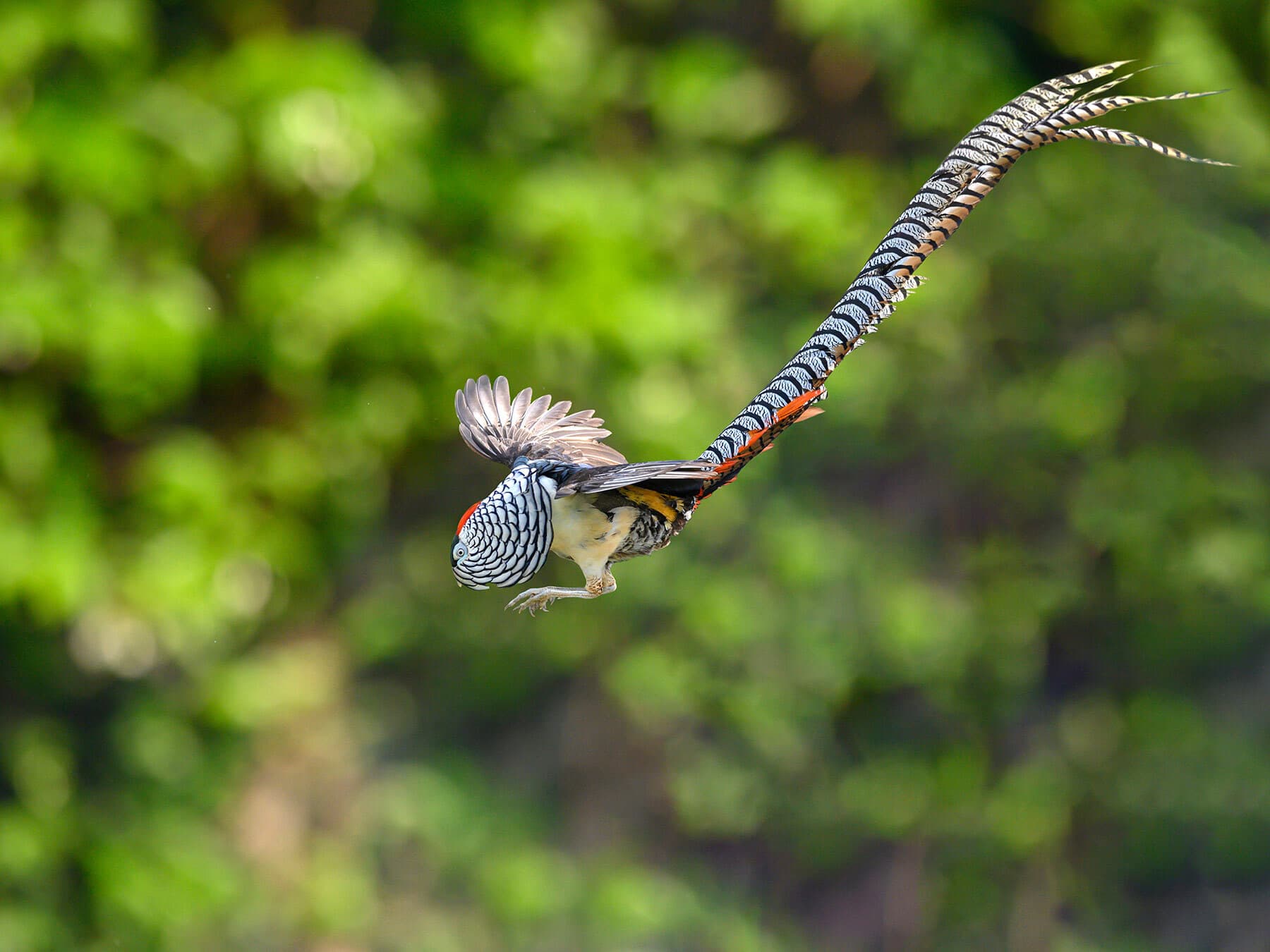
These dark feathers on their wings cover a large yellow patch on the lower back which is bordered by a smaller bright red patch on the rump. The long tail, one of the species’ most characteristic features, is crisscrossed in black and white and includes long orange feathers at its base.
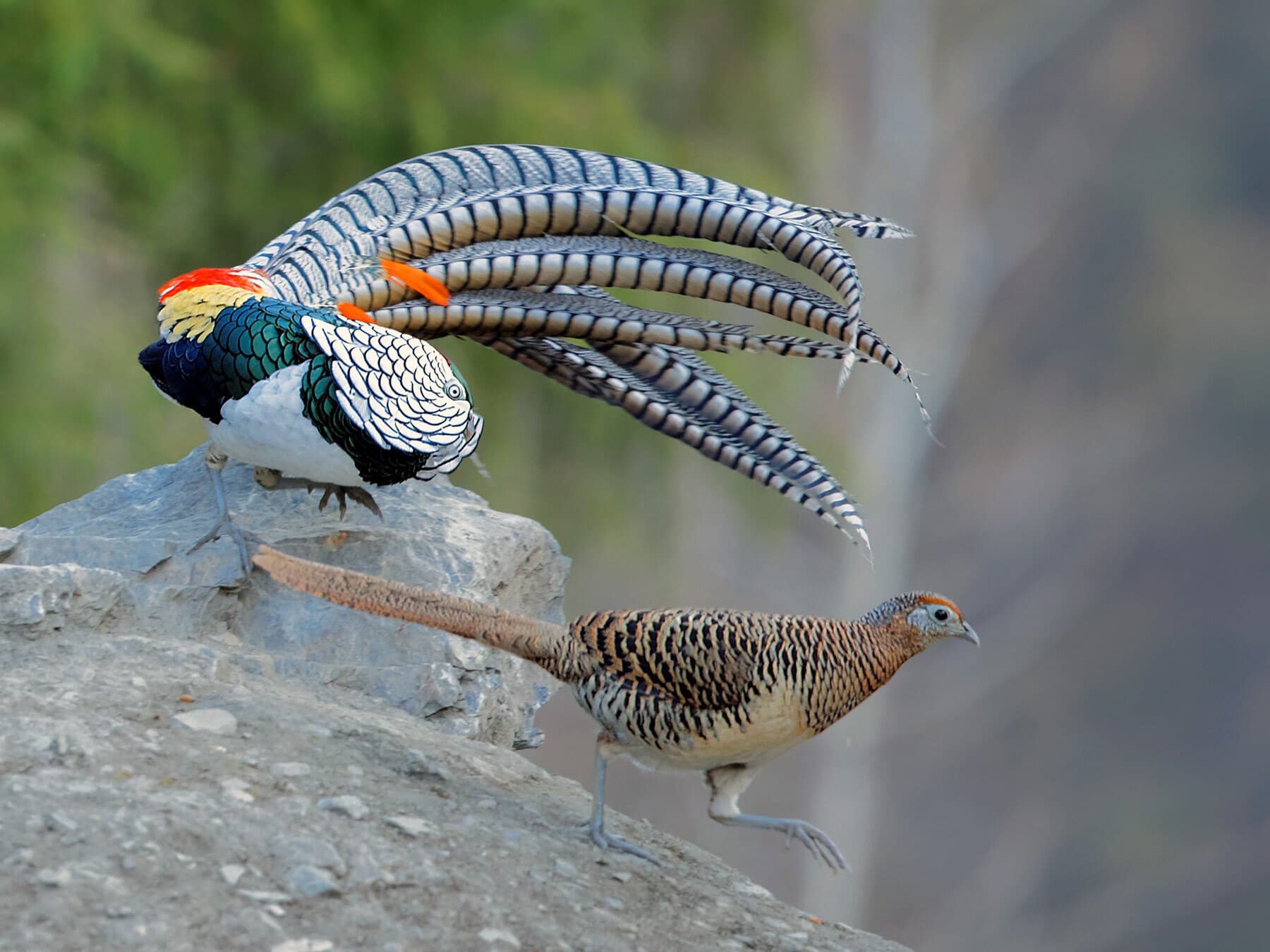
The female Lady Amherst's pheasant is not quite as colorful as her male counterpart but is still a very attractive bird. They have a shorter tail and are a rufous-brown color, strongly barred in black. Juveniles are similar to adult females but paler overall.
How big are Lady Amherst Pheasants?
Male Lady Amherst's pheasants are significantly longer than the females, largely due to their impressive tails. They measure 51-68 inches (130-173cm) long from bill to tail tip, of which 33-45 inches (83-115cm) are the tail. Females measure 26-27 inches (66-68cm) in length, of which about half is included in the tail.
Male Lady Amherst's pheasants weigh 24-30oz (675-850g). This is slightly heavier than the females which weigh 22-28oz (624-804g).
The wingspan for both sexes is usually between 27.5 and 33 inches (70-85cm) from wing tip to wing tip.
Its size
Adults- Length
- 100–120 cm
- Wingspan
- 65–70 cm
- Weight
- 600–800 g
Its song and calls
What sound does a Lady Amherst Pheasant make?
The male Lady Amherst's pheasant is the more vocal of the sexes. He frequently calls in the early mornings producing loud territorial calls that can be described as ‘hirk hik ik’, or ‘cheek er check’. Females also produce soft clucking sounds and drawn-out, high-pitched peeps.
When and where to see it
The Lady Amherst's Pheasant is not recorded regularly in the UK, Ireland, the United States or Canada.
United States: recorded in 2 of the 6 years; Canada: recorded in 3 of the 6 years; United Kingdom: recorded in 5 of the 6 years. Too few years to count as a regular visitor.
Worldwide: recorded regularly in 1 country
Countries where it was recorded in at least 3 of the 6 years 2019–2024. Linked countries have their own bird list.
Asia (1)
Data: EOD – eBird Observation Dataset (Cornell Lab of Ornithology), accessed via GBIF.org, CC BY 4.0. Records from 2019–2024, aggregated and filtered by Birdfact. How these lists are made
What is the habitat of a Lady Amherst Pheasant?
Lady Amherst's pheasants occur in fairly high altitude, wooded habitats, often with bamboo and thick scrub.
What is the range of a Lady Amherst Pheasant?
The Lady Amherst's pheasant is native to a fairly small region of Southeast Asia, encompassing parts of Tibet, China, and Myanmar. A feral population has existed in the United Kingdom since the 19th century but has dwindled in recent years.
Where do Lady Amherst Pheasants live?
Lady Amherst's pheasants are ground birds that spend most of their time foraging on the forest and woodland floor. They do ascend into the canopy of trees to roost, however. Lady Amherst's pheasants in China appear to prefer tall coniferous trees for roosting, with males roosting above females.
How rare are Lady Amherst Pheasants?
Lady Amherst's pheasants are not known to be particularly rare in their natural range, although the feral population in the United Kingdom will probably be lost soon. Anecdotal evidence suggests that the species is increasing in number in nature reserves in China’s Yunnan province.
Where to see Lady Amherst Pheasants in the US?
Lady Amherst's pheasants are not native to the United States and have not been successfully introduced to the country. They can be seen in many private collections and wildlife parks, however.
Where to see Lady Amherst Pheasants in the UK?
A feral population of Lady Amherst's pheasants has existed in the United Kingdom from 1869 until the present day. The birds have become increasingly rare, however, and there are few, if any, individuals left in the wild today.
Migration
Do Lady Amherst Pheasants migrate?
Lady Amherst's pheasants do not undertake long-distance migrations but do show seasonal movements. They are known to be altitudinal migrants, inhabiting the upper slopes in more favorable seasons but moving to lower altitudes for the winter. They have also been observed at lower altitudes during periods of poor weather.
Tips for seeing it
- Look for these birds in the dense undergrowth of mountain forests
- Listen for rustling in the leaf litter as they forage
- Be patient and quiet; they are shy and may take time to emerge
- Visit during early morning or late afternoon when they are most active
What it eats
What do Lady Amherst Pheasants eat?
The Lady Amherst's pheasant is an omnivorous species that feed on various insects and other invertebrates. They also feed on plant material, including young bamboo shoots, fern fronds, seeds, and roots.
What do baby Lady Amherst Pheasants eat?
Baby Lady Amherst's pheasants are precocial which means they forage and feed themselves. Their mother does lead them to good food sources, however, and they are known to eat various wild fruits.
Nesting and breeding
Where do Lady Amherst Pheasants nest?
Lady Amherst's pheasants are ground-nesting birds. They construct a shallow, leaf-lined nest under suitable cover like brush or low branches.
What do Lady Amherst Pheasant eggs look like?
Lady Amherst's pheasants lay 6 to 12 off-white to buff-colored eggs. Each egg measures 49.5mm long by 33.5mm across (approximately 2 x 1.3 inches).
How long does it take for Lady Amherst's pheasant eggs to hatch?
Lady Amherst's pheasants’ eggs usually take 24 days to hatch in their nest on the ground. Only the female incubates the eggs, putting her in great danger from hunters and predators.
Do Lady Amherst Pheasants mate for life?
Lady Amherst's pheasants are polygynous which means each successful male mates with more than one female during the breeding season.
Behaviour
Are Lady Amherst Pheasants aggressive?
Lady Amherst's pheasants can be quite aggressive towards each other and will resort to physical combat using their claws and beaks. They reportedly mix well with other species in captivity, although some males can become aggressive.
Lifespan and predators
How long do Lady Amherst Pheasants live?
The oldest Lady Amherst's pheasant on record lived to over 19 years of age, although the average wild bird probably lives between 6 and 10 years. Captive birds kept in good conditions will tend to live a little longer.
What are the predators of Lady Amherst Pheasants?
Lady Amherst's pheasants are probably hunted by a variety of mammalian, bird, and reptile predators in their native habitat. These birds are also hunted by humans for food, and birds like the red-billed blue-magpie (Urocissa erythroryncha) have been known to feed on their eggs. Foxes are thought to be a significant predator of feral birds in the UK.
Are Lady Amherst Pheasants protected?
Lady Amherst's pheasants are a Class II protected species in China. Globally they are classed as Least Concern.
Are Lady Amherst Pheasants endangered?
Lady Amherst's pheasants are not endangered. In fact, their status has improved from Near Threatened in the late 1980s, to Least Concern as of 2004 according to the International Union for Conservation of Nature (IUCN).
Conservation
While listed as Least Concern globally, Lady Amherst's Pheasants face localised threats from habitat loss and fragmentation due to deforestation and agricultural expansion.
Some conservation efforts focus on habitat protection and sustainable forest management in their native range.
Similar birds
Often mistaken for
Quick facts
- Length
- 100–120 cm
- Wingspan
- 65–70 cm
- Weight
- 600–800 g
- Lifespan
- 5–10 years
- Family
- Pheasants & Grouse
- Migration
- Resident
- Global status (IUCN)
- Least Concern
- World population
- Unknown
- Population trend
- Decreasing
- Also called
- Lady Amherst Pheasant
- Scientific name
- Chrysolophus amherstiae
Questions
3Why are they called Lady Amherst Pheasants?
Lady Amherst's pheasants were named after the wife of Governor-General of India, William Pitt Amherst. She, Sarah Amherst had these beautiful birds first brought to the United Kingdom in 1828.
What are female pheasants called?
Female pheasants are called hens and male pheasants are known as roosters.
What is a group of pheasants called?
There are many interesting collective nouns for a group of pheasants. These include a nye, a bouquet, and a nest of pheasants.
Sources
2- 1BirdLife International. 2018. Chrysolophus amherstiae. The IUCN Red List of Threatened Species 2018: e.T22679358A131905673. Source (opens in a new tab)
- 2del Hoyo et al. (1994)

Checked by
Nathan Cope, founder and editor
Nathan founded Birdfact and leads its writers and contributors in the UK, the US and Canada. He has watched and studied birds for more than ten years, and checks every article and species guide before it’s published.