


Red-headed Woodpecker
Tricolored Woodpecker · Melanerpes erythrocephalus
By the Birdfact teamChecked by Nathan Cope
On this page14 sections
How to recognise it
What do Red-headed Woodpeckers look like?
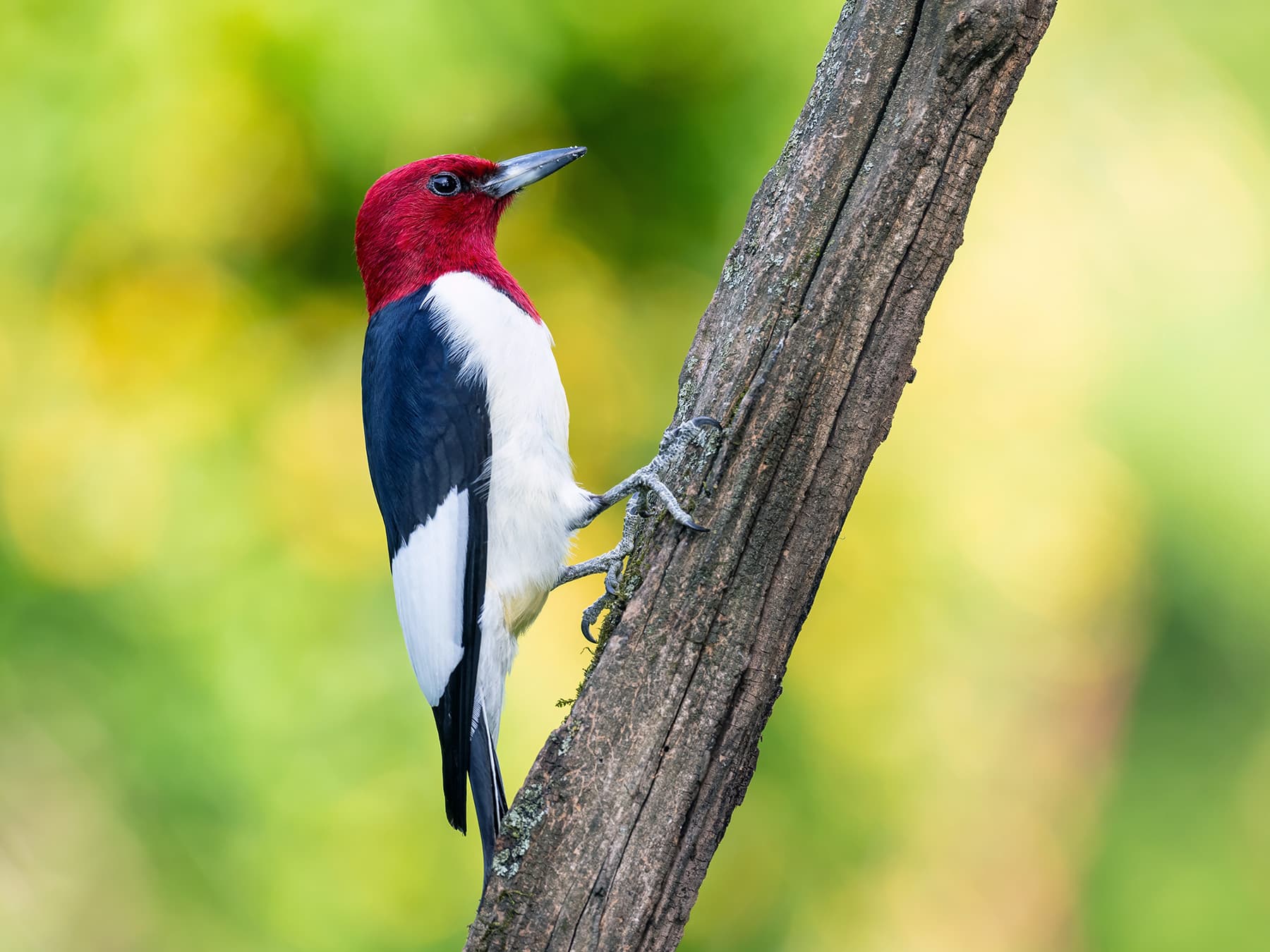
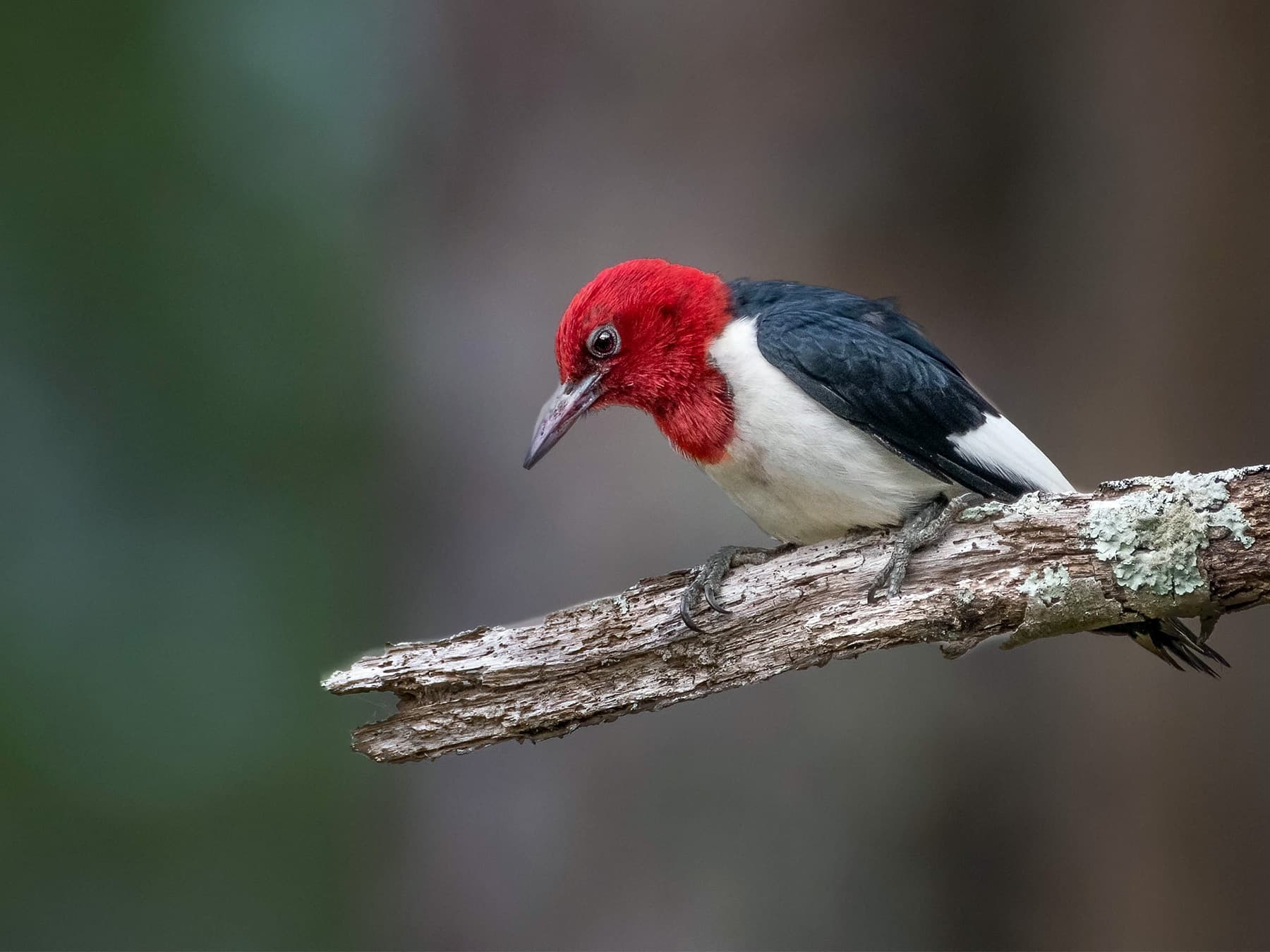
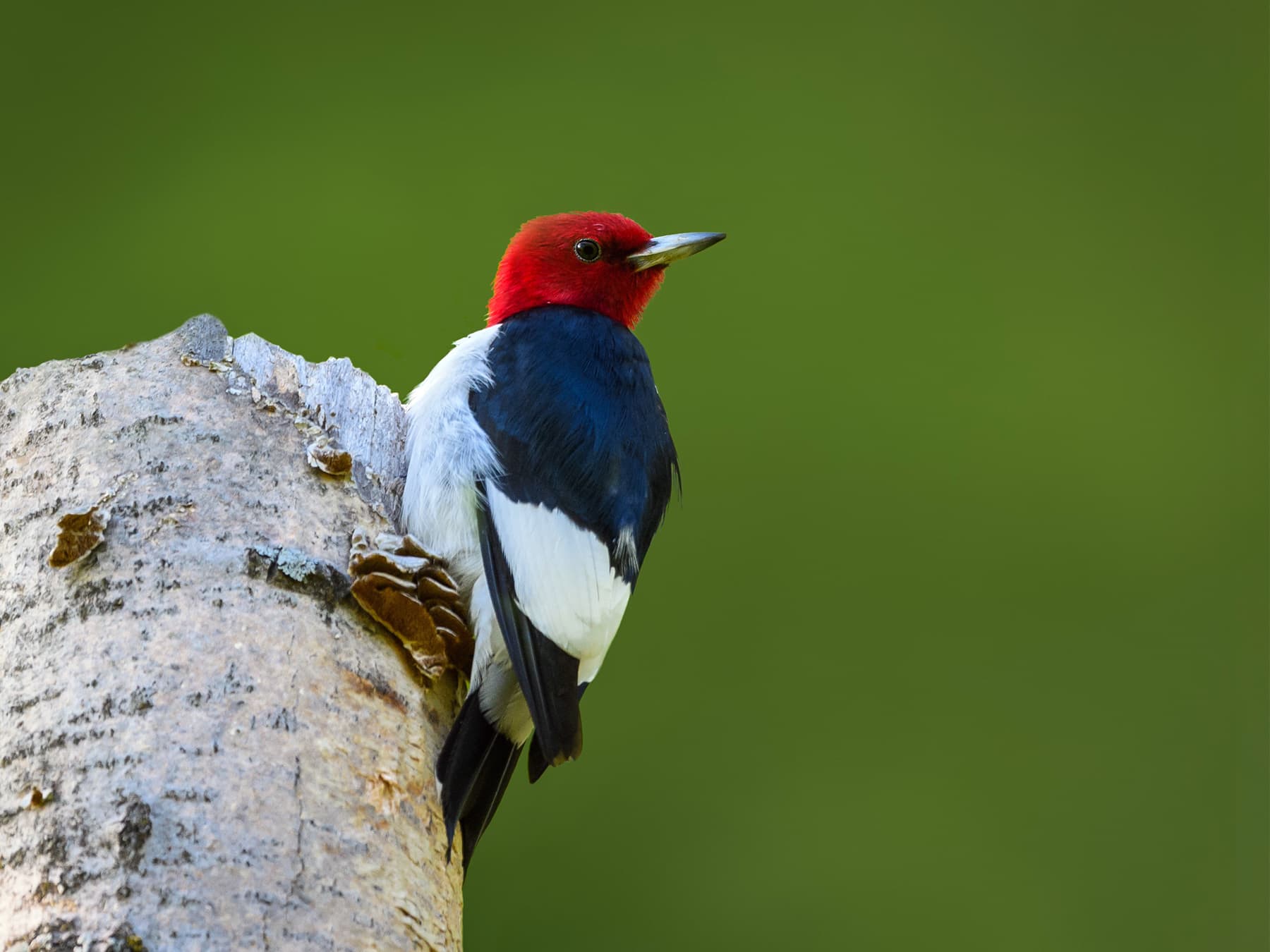
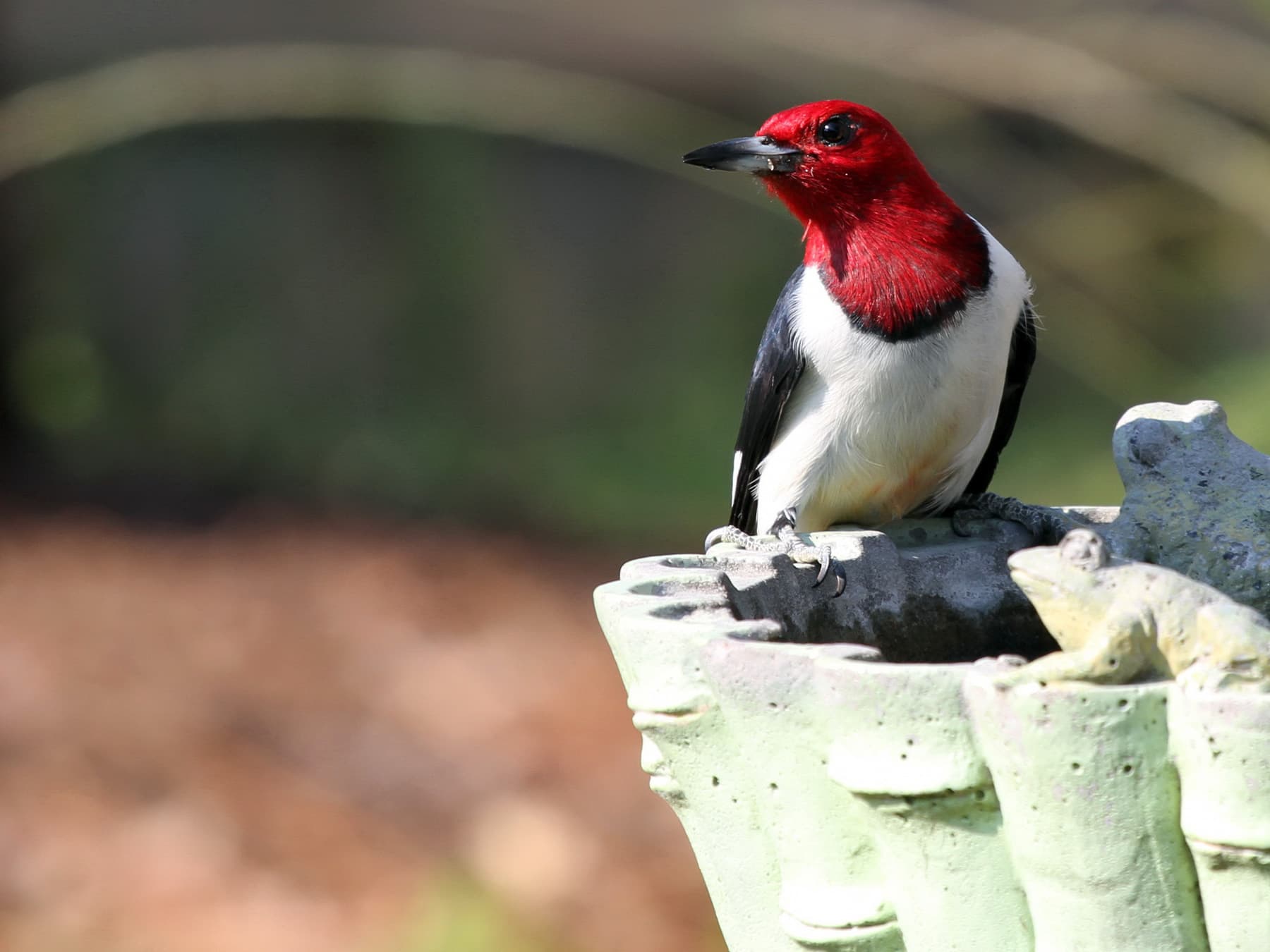
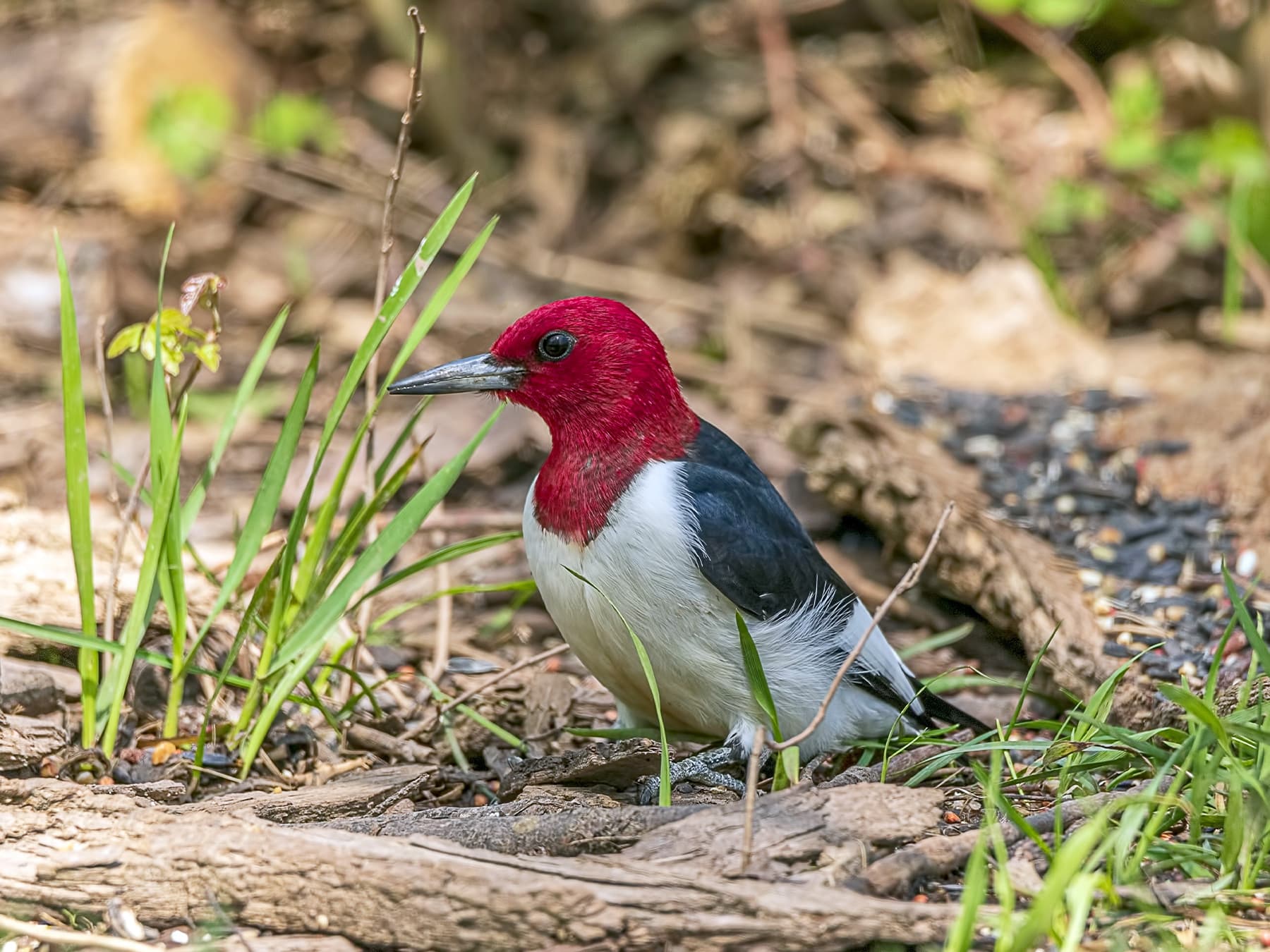
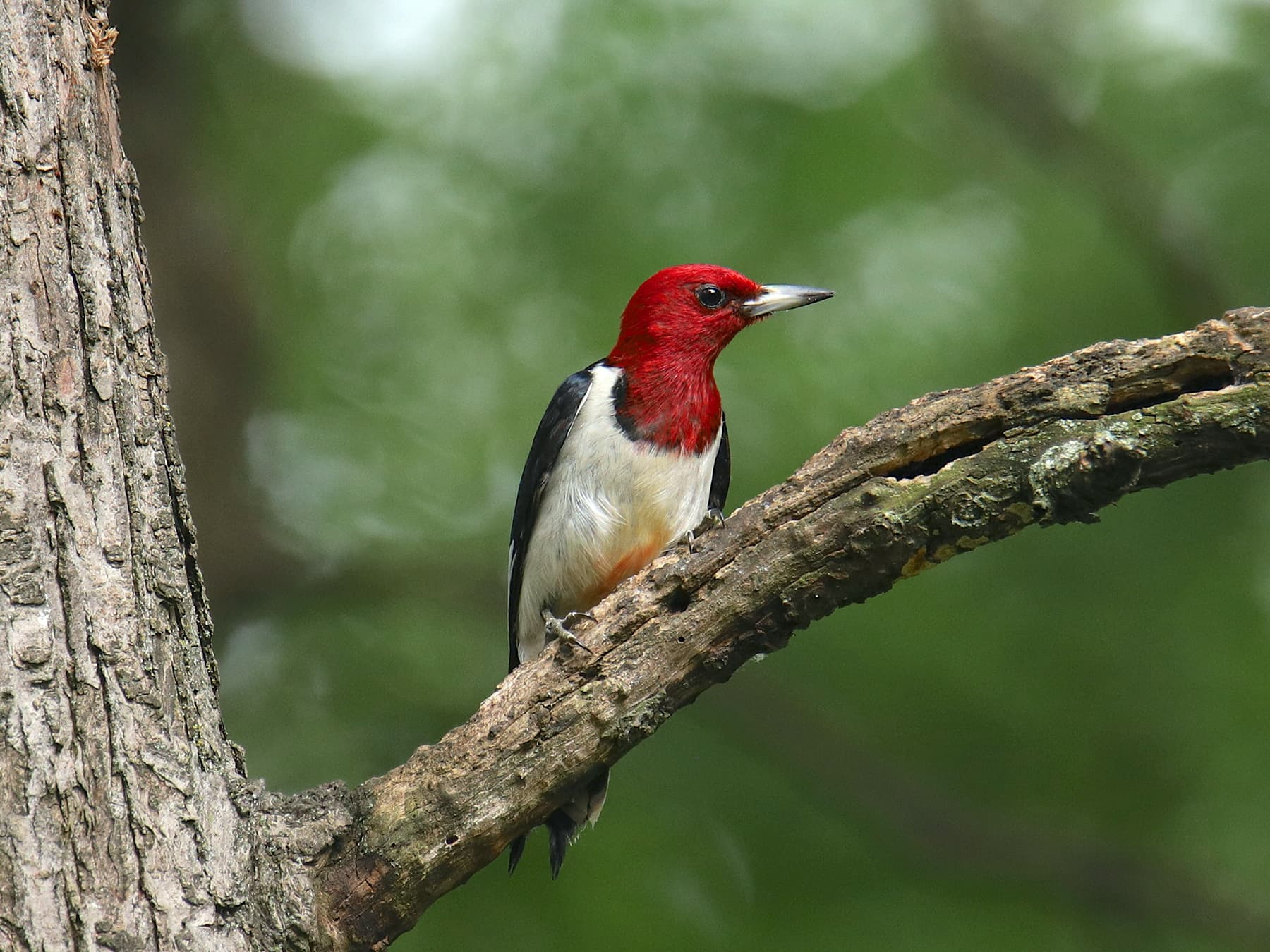
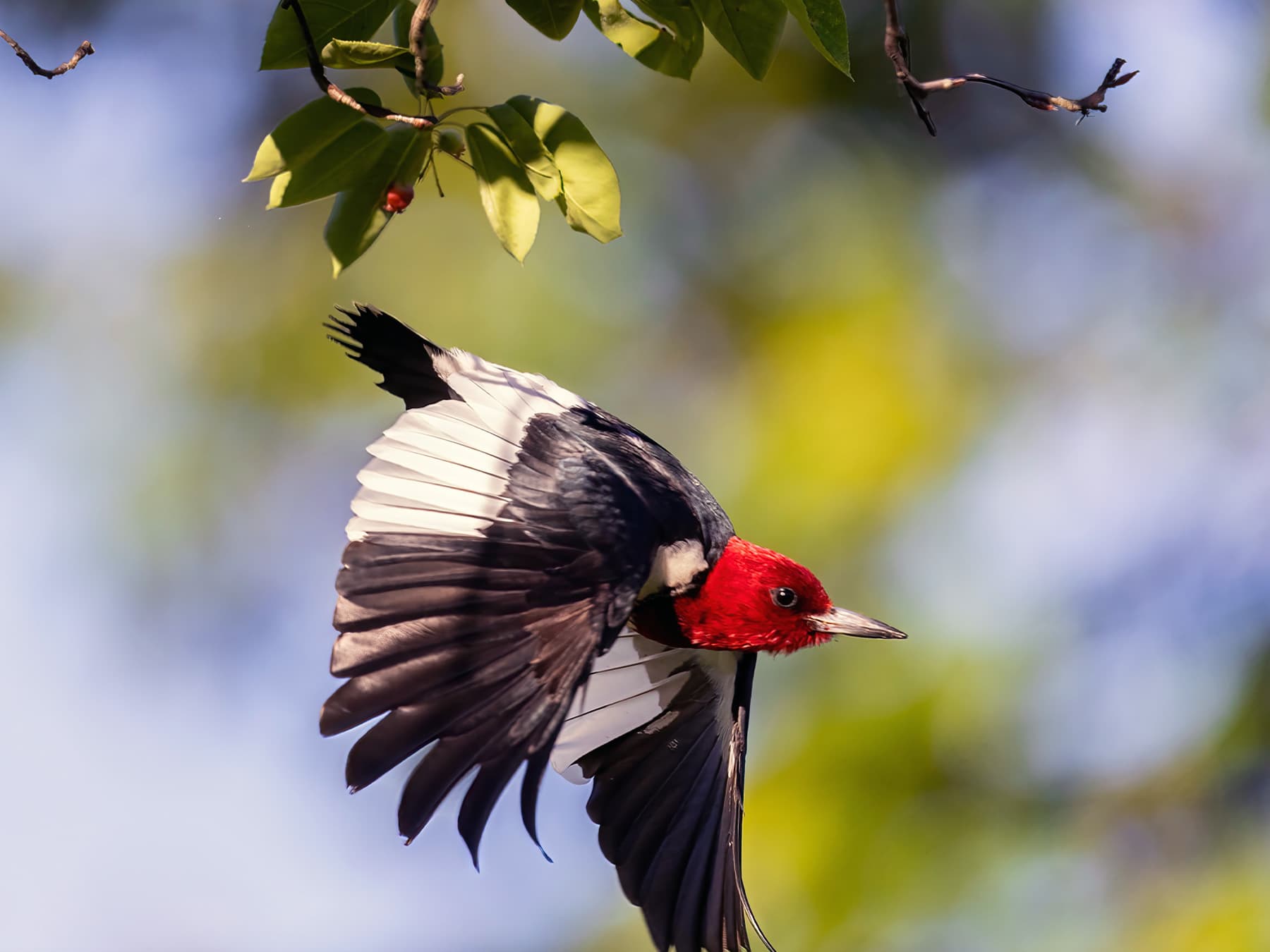
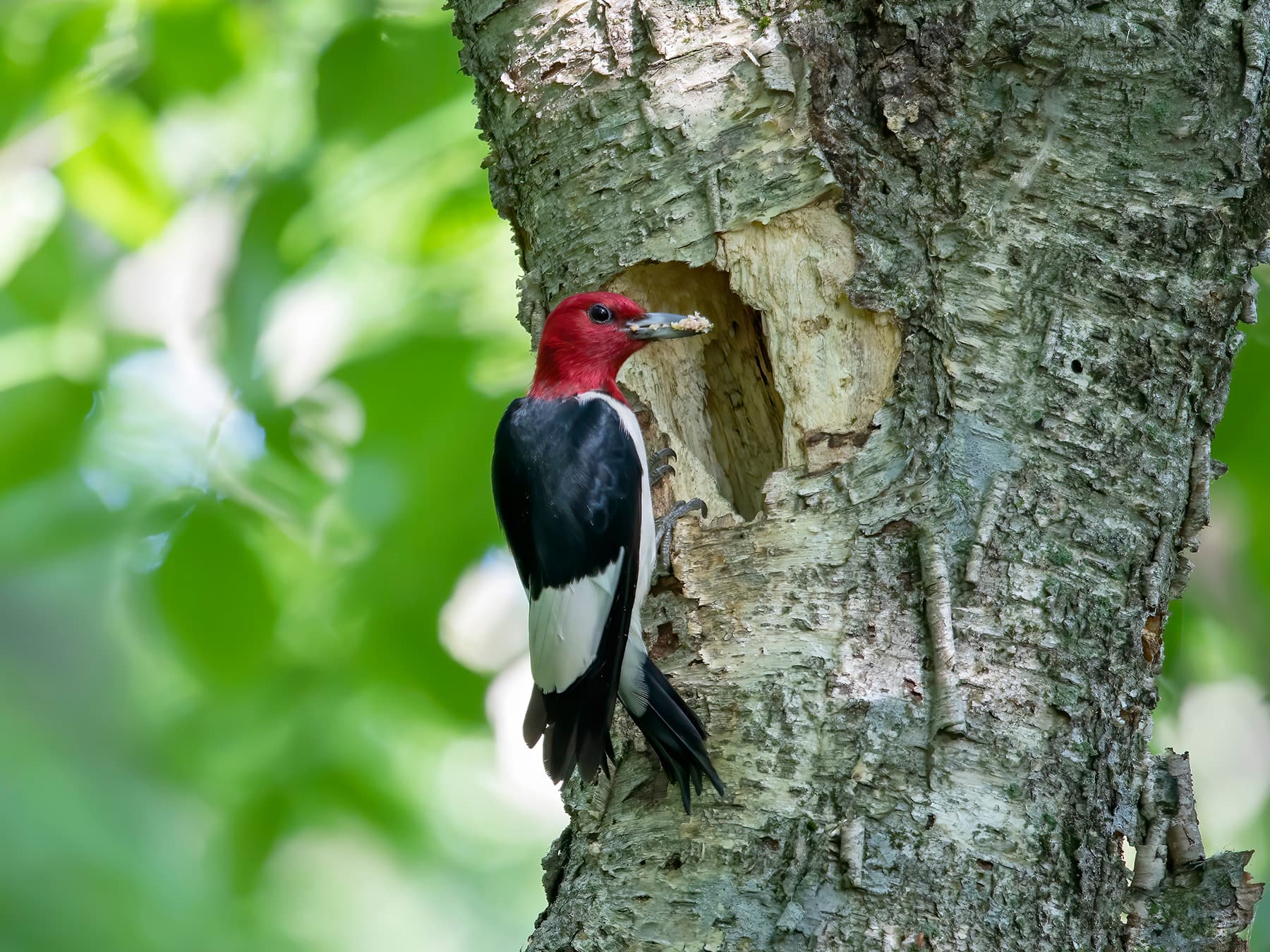
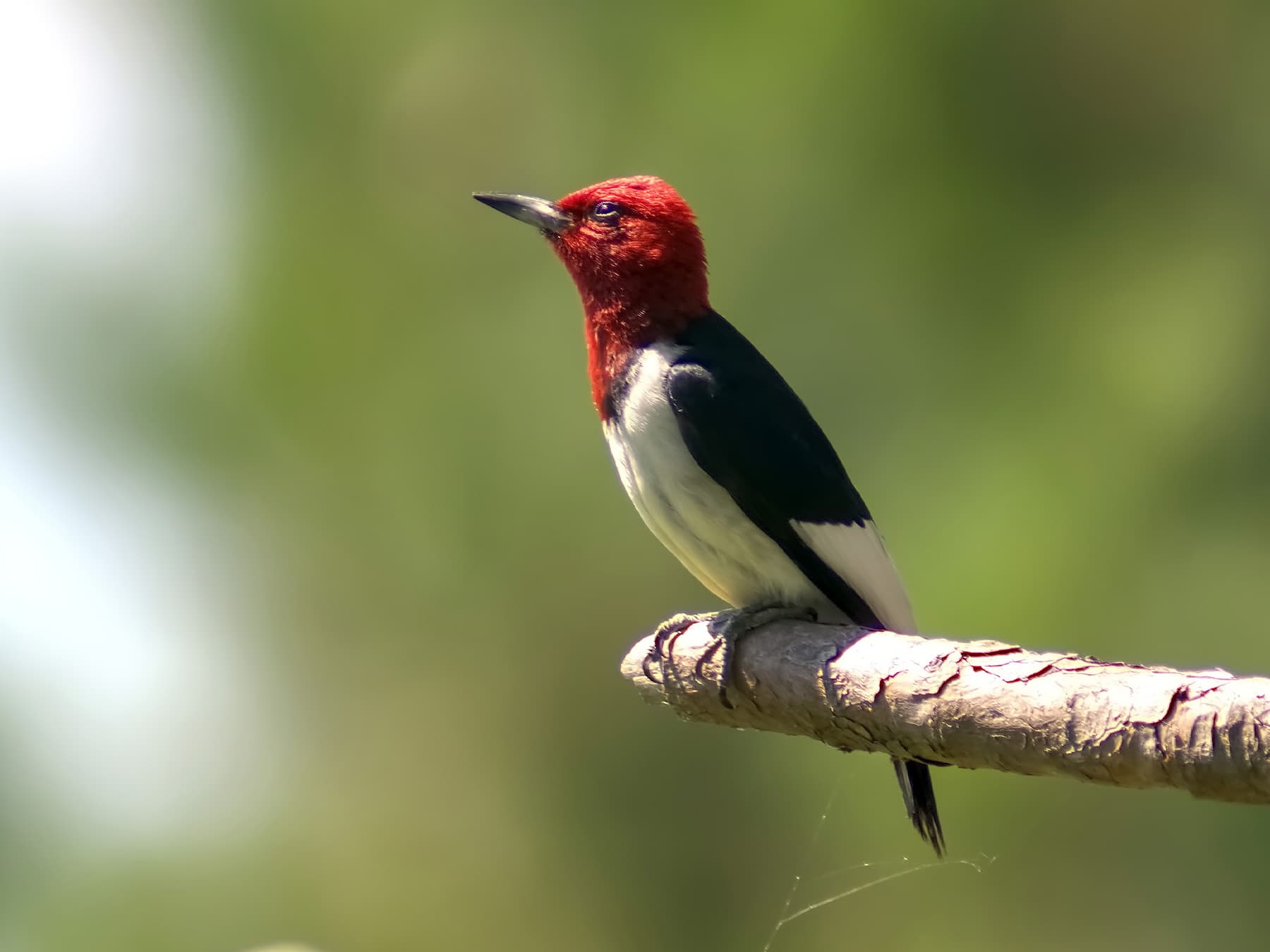
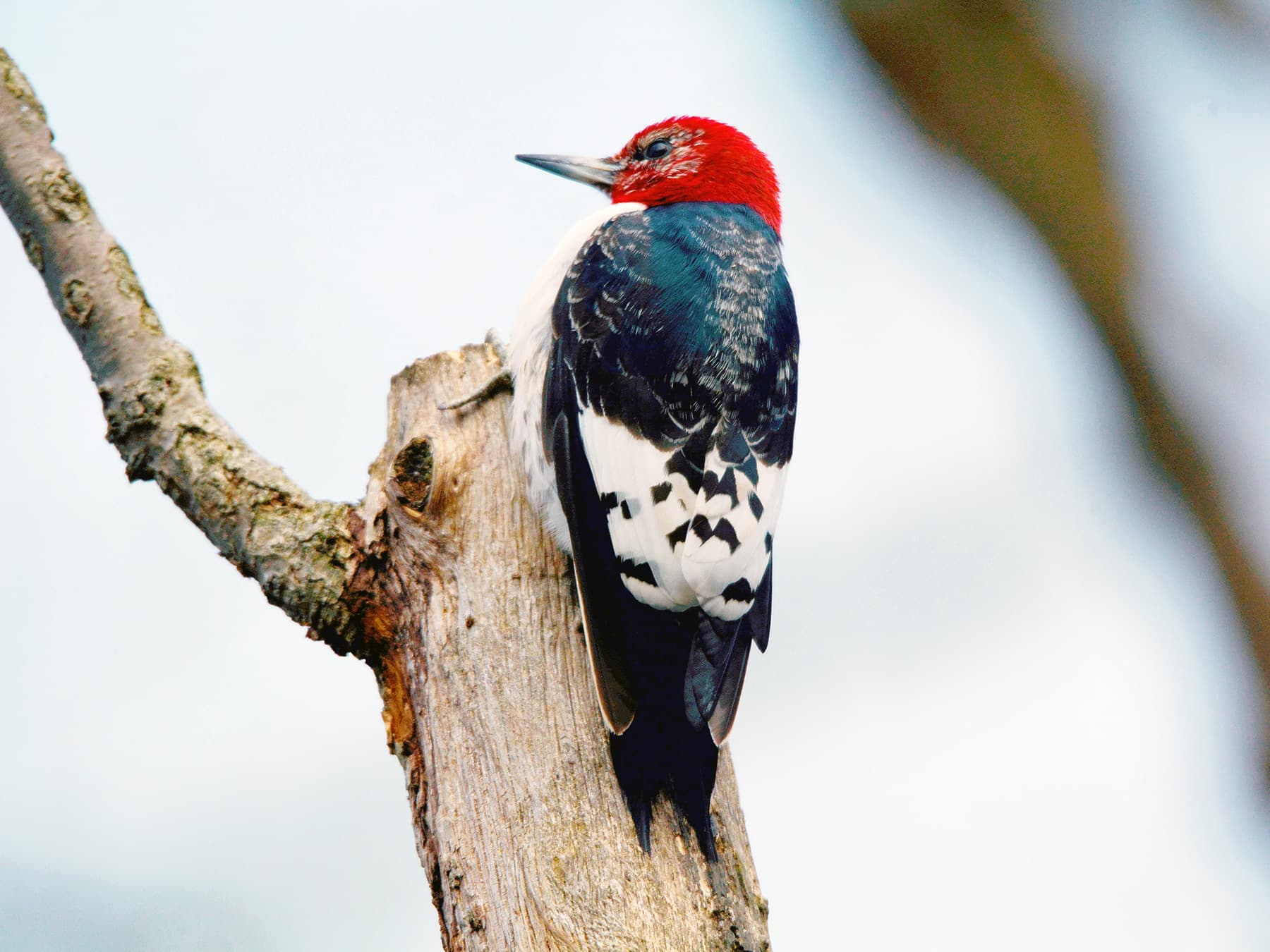
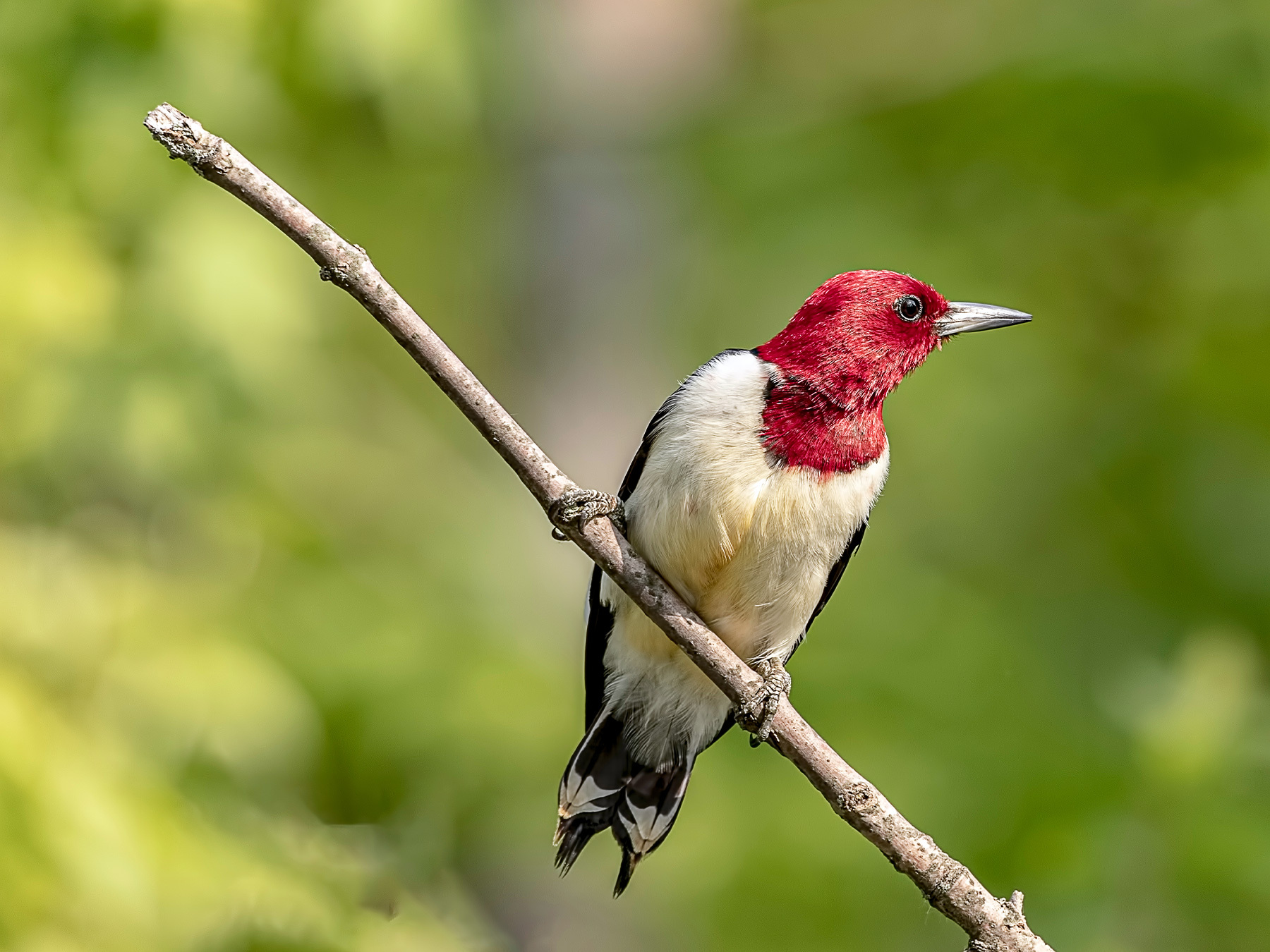
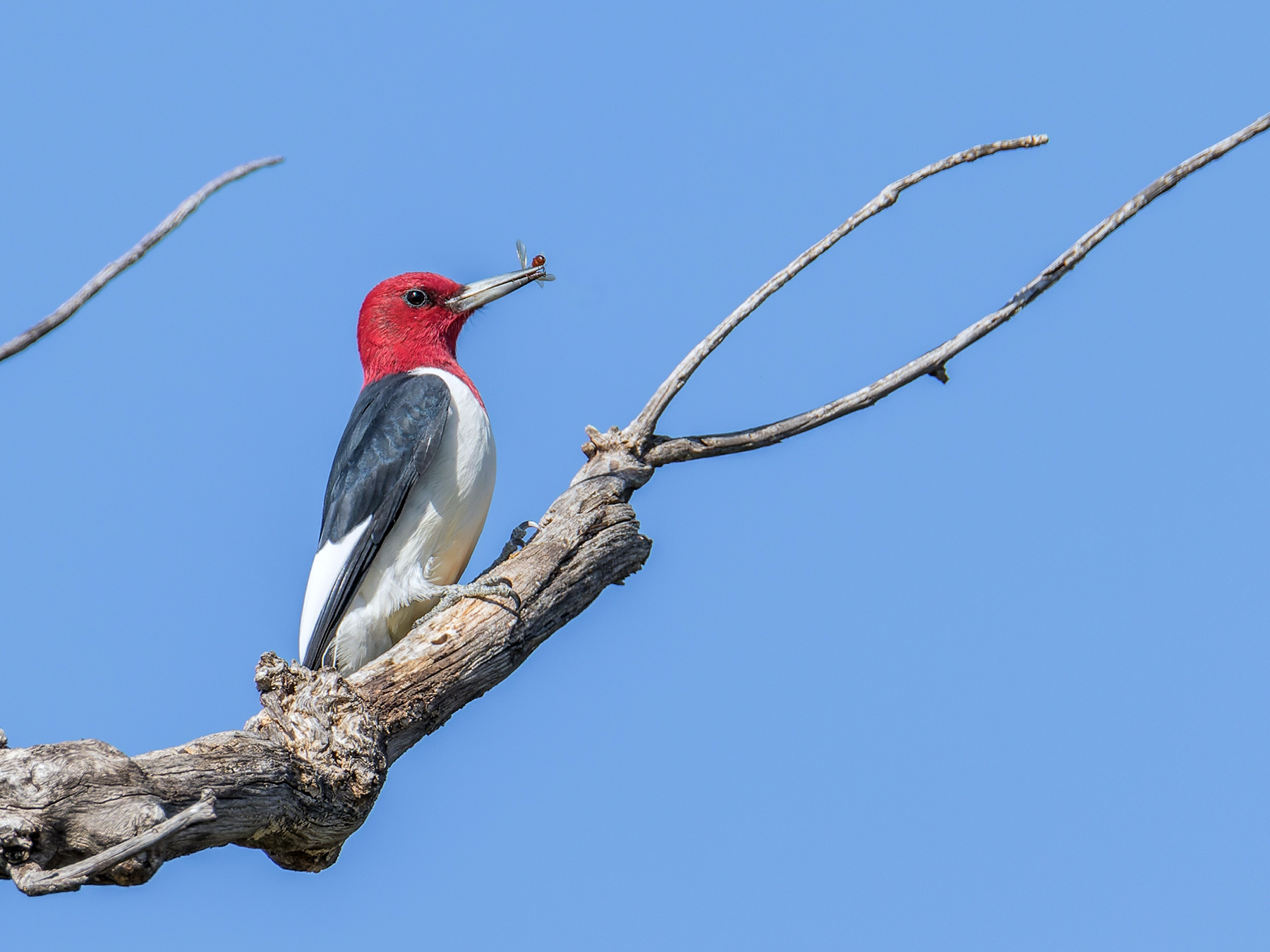
Male and female red-headed woodpeckers are identical in appearance. Both sexes have a crimson red head and neck that extends to the shoulders and is separated from the breast by a narrow black collar. Their back and tail are black, while their breast, belly, and rump are white. Their wings are black with a large white patch along the rear edge, which is also visible when folded.
Their bills are bluish-gray, and their eyes are a dark reddish brown. Legs and feet are greenish-gray.
Juvenile red-headed woodpeckers are similar to adults in markings, but coloring does not fully develop until during its first winter. Until then, they are mostly dusky brown and white, with a brownish head streaked with some red. The bill of a juvenile is duller gray than that of an adult.
Check out our guide to read more about Red-headed Woodpeckers' male versus female identification.
How big are Red-headed Woodpeckers?
Red-headed woodpeckers are relatively small woodpeckers, up to half the size of a pileated woodpecker. There is no difference in size between males and females.
- Length: 19 cm to 24 cm (7 in to 9 in)
- Wingspan: 30 cm to 37 cm (12 in to 15 in)
- Weight: 56 g to 91 g (2 oz to 3.2 oz)
Its size
Adults- Length
- 19–23 cm
- Wingspan
- 35–42 cm
- Weight
- 56–97 g
Its song and calls
What sound does a Red-headed Woodpecker make?
Drumming and tapping are arguably the most famous sounds associated with red-headed woodpeckers, and are heard particularly early on in the breeding season, but may continue to resonate through woodlands at times of conflict or communication between nesting pairs.
Vocal sounds include a ‘churr-churr’ as a flight call or contact call and a rattling alarm call. Chattering calls are heard between pairs as they change shifts when incubating or when returning to the nest to feed young.
- Call0:00 / 0:21
Recorded in South Dakota, United States · June 2015
- Drumming0:00 / 1:33
Recorded in South Dakota, United States · June 2015
When and where to see it
OctoberLeaving
Most recorded in October
- 1. Missouri0.73%
- 2. Oklahoma0.54%
- 3. Mississippi0.51%
- 4. Iowa0.51%
- 5. Indiana0.50%
Each dot is a county, state or province: the bigger and darker, the larger the bird’s share of that place’s bird records that month. Grey dots: no regular records. The ringed point is the centre of the bird’s records this month; the arrow shows how it moved since last month, and the dashed loop its path through the year. “Arrivals” colours places where it becomes regular this month (orange) or is in its last regular month (grey). GBIF eBird Observation Dataset, 2019–2024. Map data: Natural Earth, US Census Bureau; place centres © OpenStreetMap contributors.
In your area
See when the Red-headed Woodpecker is recorded in your county, state or province.
How often the Red-headed Woodpecker turns up in the United States and Canada through the year, from birdwatchers' records.
United States
Resident · all year · most records in May
Canada
Summer visitor · regularly Apr–Jan · most records in May
Show as a table
| Month | United States | Canada |
|---|---|---|
| January | 0.11% (regular) | 0.006% (regular) |
| February | 0.11% (regular) | 0.003% |
| March | 0.096% (regular) | 0.003% |
| April | 0.13% (regular) | 0.009% (regular) |
| May | 0.21% (regular) | 0.077% (regular) |
| June | 0.17% (regular) | 0.029% (regular) |
| July | 0.18% (regular) | 0.034% (regular) |
| August | 0.20% (regular) | 0.031% (regular) |
| September | 0.20% (regular) | 0.021% (regular) |
| October | 0.12% (regular) | 0.007% (regular) |
| November | 0.099% (regular) | 0.009% (regular) |
| December | 0.11% (regular) | 0.006% (regular) |
Worldwide: recorded regularly in 2 countries
Countries where it was recorded in at least 3 of the 6 years 2019–2024. Linked countries have their own bird list.
North America (2)
Data: EOD – eBird Observation Dataset (Cornell Lab of Ornithology), accessed via GBIF.org, CC BY 4.0. Records from 2019–2024, aggregated and filtered by Birdfact. How these lists are made
What is the habitat of a Red-headed Woodpecker?
Woodlands offer suitable nesting and foraging habitats for red-headed woodpeckers, although the species has adapted well to different landscapes, including parks, orchards, and forest groves. Mixed species woodlands and oak savannas are preferred, with dead and dying trees in which to build nest cavities, as well as open glades for catching insects.
In winter months, red-headed woodpeckers in urban locations may occasionally visit backyard feeders, particularly to feed on suet.
What is the range of a Red-headed Woodpecker?
Red-headed woodpeckers are native to North America, and breed from southern Canada through the eastern and central parts of the United States, extending into the southeastern US.
To the south, the species is found in northern Florida, through Alabama, and west through Louisiana into Texas. Red-headed woodpeckers reach as far west as Wyoming, Montana, and Colorado, but sightings become more scarce towards the Rocky Mountains.
Where do Red-headed Woodpeckers live?
The United States is home to most of the global population of red-headed woodpeckers, with smaller numbers breeding in southern regions of Canada. The species is not present outside of these two countries. Red-headed woodpeckers are especially abundant in the Midwest and Great Lakes regions, with populations concentrated in Michigan, Ohio, Minnesota, Illinois and Ohio.
How rare are Red-headed Woodpeckers?
Recent population estimates for the species stand at up to 1.6 million individuals in North America, making them far less common than downy and red-bellied woodpeckers. In the 19th century, red-headed woodpeckers were significantly more numerous and widespread, but population decline due to habitat loss has contributed to their decline.
Where can you see Red-headed Woodpeckers in the US?
The east and central regions of the US offer the best chances of red-headed woodpecker sightings, with concentrations in the southeastern coastal plain and in the Great Lakes region.
Semi-open landscapes with broken forest cover are ideal spots. Two sites that have regular reports of red-headed woodpeckers are Necedah National Wildlife Reserve in Wisconsin and Cedar Creek Reserve in Minnesota.
Where can you see Red-headed Woodpeckers in Canada?
Canada’s red-headed woodpeckers are summer breeding visitors and are concentrated in the southern regions, in particular southern Ontario and southern Manitoba. They are relatively widespread in these areas, but sightings are uncommon and none remain in the country during winter months.
Migration
Do Red-headed Woodpeckers migrate?
A partially migratory species, red-headed woodpeckers are mostly resident all year round in the eastern and southern parts of their range, but some movement occurs each year in populations that breed to the north and west.
Migration is usually determined by the availability of acorns and beechnuts during winter months, and in years where crops are plentiful, red-headed woodpeckers may remain in the same areas in which they raised their young.
Are Red-headed Woodpeckers native to the US?
Red-headed woodpeckers are a native US species, with a large resident range in the eastern United States, and breeding grounds found further towards the center of the country. The species is not found in the western regions of North America and is particularly concentrated in the northeast.
Tips for seeing it
- Look for their distinctive tri-color pattern in open woodlands or near forest edges.
- Listen for their sharp 'tchur' call or drumming on dead trees.
- Check utility poles and fence posts in rural areas, as they often use these for perching.
- In the US, visit oak savannas or pine barrens for better chances of spotting them.
What it eats
What do Red-headed Woodpeckers eat?
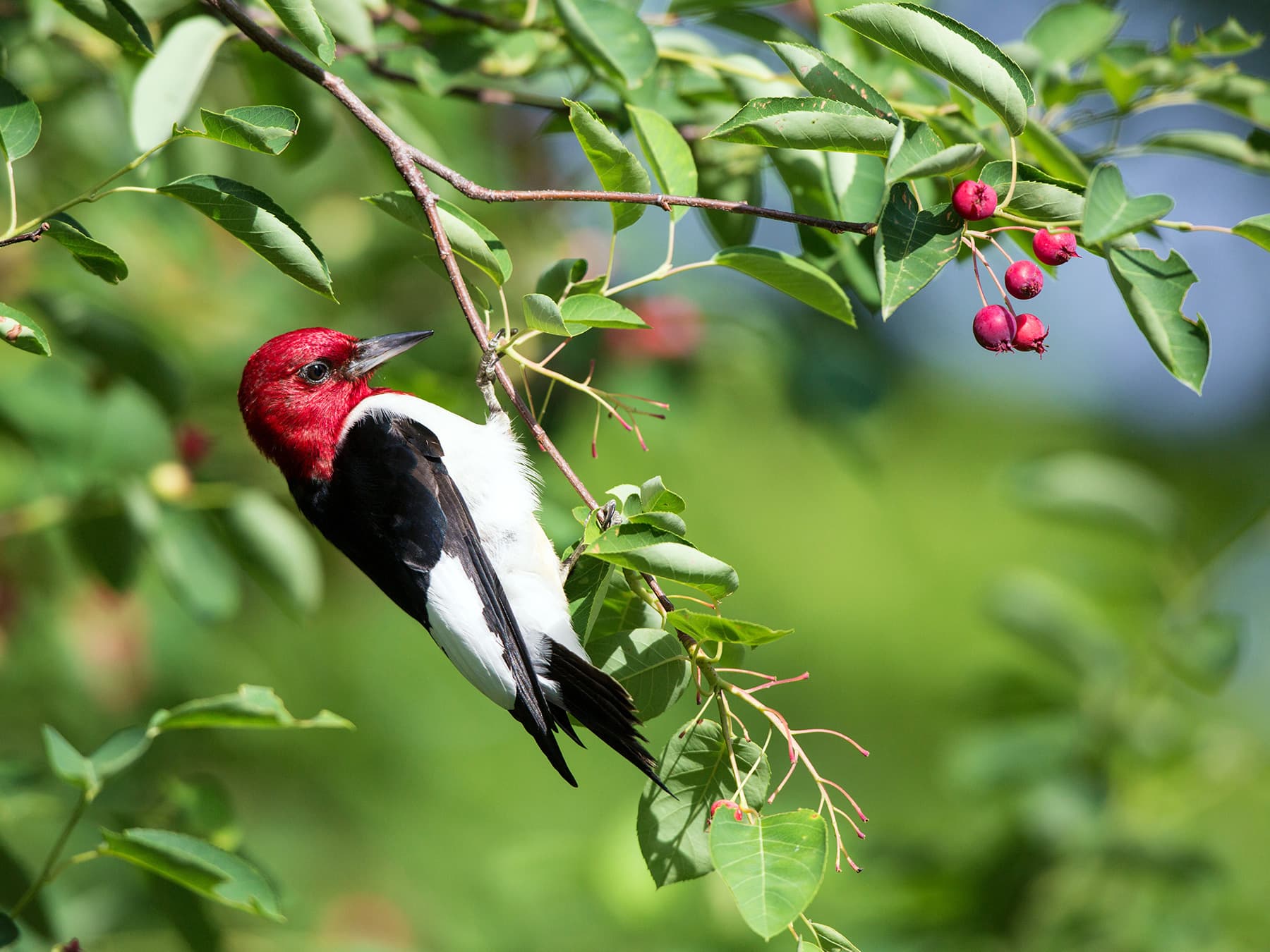
The red-headed woodpecker has a varied diet, including insects, seeds, berries, fruit, and nuts, as well as occasionally feeding on small rodents and the eggs of other woodland birds. Plant-based foods represent around two-thirds of their diet.
In winter acorns and beech nuts are particularly important, while in summer, cultivated and wild fruits, such as grapes, strawberries, mulberries and ivy.
Red-headed woodpeckers cache food for future meals, hiding it beneath the bark and in cracks and cavities in tree branches and trunks. They revisit these food stores in winter when local food resources may be running low. They also catch passing insects in flight or by foraging on the ground.
What do Red-headed Woodpecker chicks eat?
Young red-headed woodpeckers are fed in the nest by their parents, who bring insects, spiders, worms, fruit (especially mulberries and cherries), grasshoppers and larvae.
Nesting and breeding
Where do Red-headed Woodpeckers nest?
Red-headed woodpeckers are cavity nesters and excavate their own nesting hollows in the trunks of dead trees or rotting sections of living trees. The male selects the site, and the pair work together to drill out a suitable chamber, with a round entrance hole, usually between 7 m and 12 m (25 ft to 40 ft) above the ground.
Red-headed woodpeckers are more likely than many other woodpecker species to use a ready-made chamber excavated by another pair and may reuse a nest they have successfully raised young in a previous season.
When do Red-headed Woodpeckers nest?
Nest construction begins as early as February, although red-headed woodpeckers are one of the later woodpecker species to begin laying each year, with the earliest eggs laid from April onwards, and late May being the peak. Some pairs raise two broods successfully, in which cases, the latest fledglings are ready to leave the nest in August or September.
Incubation lasts 12 to 14 days, shared between the male and female, with the male taking responsibility for the overnight shift. Young red-headed woodpeckers are ready to fledge when they are 24 to 31 days old and are able to fend for themselves almost immediately after fledging.
What do Red-headed Woodpecker eggs look like?
Red-headed woodpeckers’ eggs are pure white in color and rounded in shape, measuring 25 mm by 19 mm (1 in by 0.7 in). A typical clutch contains between 4 and 7 eggs, although as many as 10 may be laid and successfully hatched.
Do Red-headed Woodpeckers mate for life?
During the breeding season, red-headed woodpeckers form monogamous pairings, remaining together until their young have fledged. Once the nesting season ends, pairs separate, and in the subsequent years, it’s likely they will select a new mate to breed with.
Behaviour
Are Red-headed Woodpeckers aggressive?
Red-headed woodpeckers display aggressive behavior around the nest site when intruders approach and when defending a mate or a territory. Confrontational behavior includes head bobbing and posturing with drooping wings and an erect tail to intimidate any threats.
Where do Red-headed Woodpeckers sleep at night?
Overnight solitary roosting takes place in the upper branches of tall trees or out of the breeding season, abandoned nest cavities may be used to shelter in particularly cold or wet weather.
Lifespan and predators
How long do Red-headed Woodpeckers live?
The average estimated lifespan for a red-headed woodpecker is around 9 years. The oldest individual recorded reached 9 years 11 months. First-time breeding is at 1 year old.
What are the predators of Red-headed Woodpeckers?
Red-headed woodpeckers’ nests are commonly predated by snakes, raccoons and squirrels. Sharp-shinned hawks, peregrine falcons, Eastern screech owls, and red foxes prey on adult birds.
Are Red-headed Woodpeckers protected?
Red-headed woodpeckers are safeguarded under the Migratory Bird Treaty Act, 1918 in the US and by Canada’s Migratory Birds Convention Act of 1994. Under this legislation, it is illegal to knowingly kill or injure a red-headed woodpecker or to trap or trade individuals, disturb their nests or take their eggs or young.
Are Red-headed Woodpeckers endangered?
Between 2004 and 2018 red-headed woodpeckers were classified as Vulnerable on the IUCN Red List of Endangered Species, due to a decline of 65 percent in population since the 1970s. However, habitat management has led to a recovery, and in 2018, they were reclassified as a species of least concern.
Conservation
Red-headed Woodpeckers face threats from habitat loss due to the removal of dead trees and the conversion of open woodlands. Competition with European Starlings for nesting cavities also impacts their populations.
Conservation efforts focus on preserving suitable habitats and maintaining standing dead trees in their range.
More photos
3 photos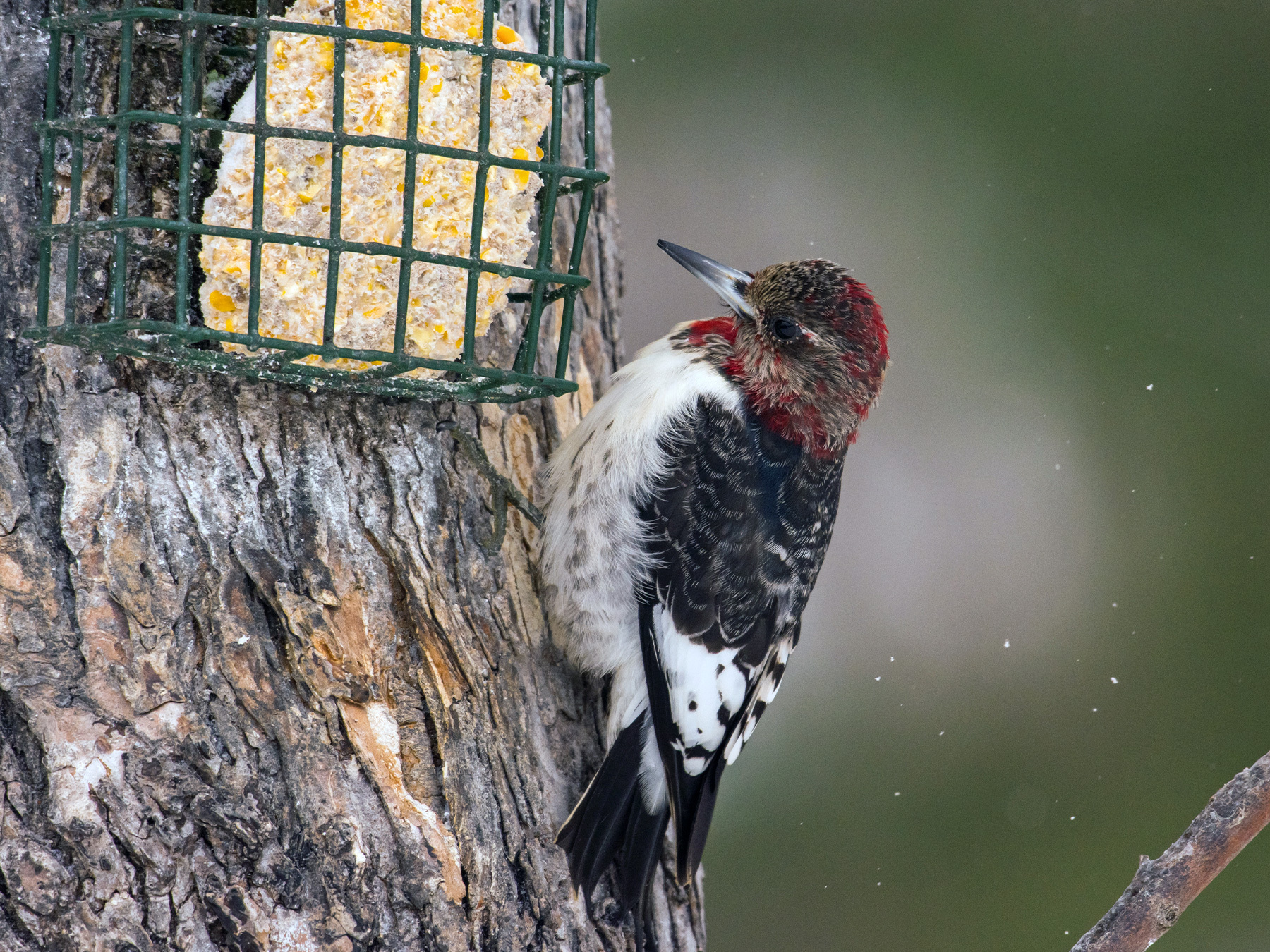
Red-headed Woodpecker guides
1 guidesQuick facts
- Length
- 19–23 cm
- Wingspan
- 35–42 cm
- Weight
- 56–97 g
- Lifespan
- 9 years · oldest recorded 10 years
- Family
- Woodpeckers
- Migration
- Partial migrant
- Global status (IUCN)
- Least Concern
- World population
- 1,800,000 mature individuals
- Population trend
- Decreasing
- Also called
- Tricolored Woodpecker
- Scientific name
- Melanerpes erythrocephalus
Questions
2Are Red-headed Woodpeckers protected in the US?
Red-headed woodpeckers are protected under the Federal Migratory Bird Treaty Act of 1918, which makes it an offense to kill, injure, trade, or trap an individual bird, or damage or destroy a nest, eggs, or young without a license.
What attracts Red-headed woodpeckers?
In winter months, red-headed woodpeckers have been known to visit backyard feeders where they are observed to be particularly fond of suet. Pecans, seeds, beechnuts, acorns, and soft fruits, including blackberries, cherries, and raspberries, may also work well at enticing red-headed visitors.
Sources
4- 1BirdLife International. 2018. Melanerpes erythrocephalus. The IUCN Red List of Threatened Species 2018: e.T22680810A131390783. Source (opens in a new tab)
- 2Christmas Bird Count data for 1966-2017
- 3Partners in Flight (2022) Source (opens in a new tab)
- 4John Terres, The Audubon Society Encyclopedia of North American Birds (1980)

Checked by
Nathan Cope, founder and editor
Nathan founded Birdfact and leads its writers and contributors in the UK, the US and Canada. He has watched and studied birds for more than ten years, and checks every article and species guide before it’s published.