Species Profile
Pacific Golden-Plover
Pluvialis fulva
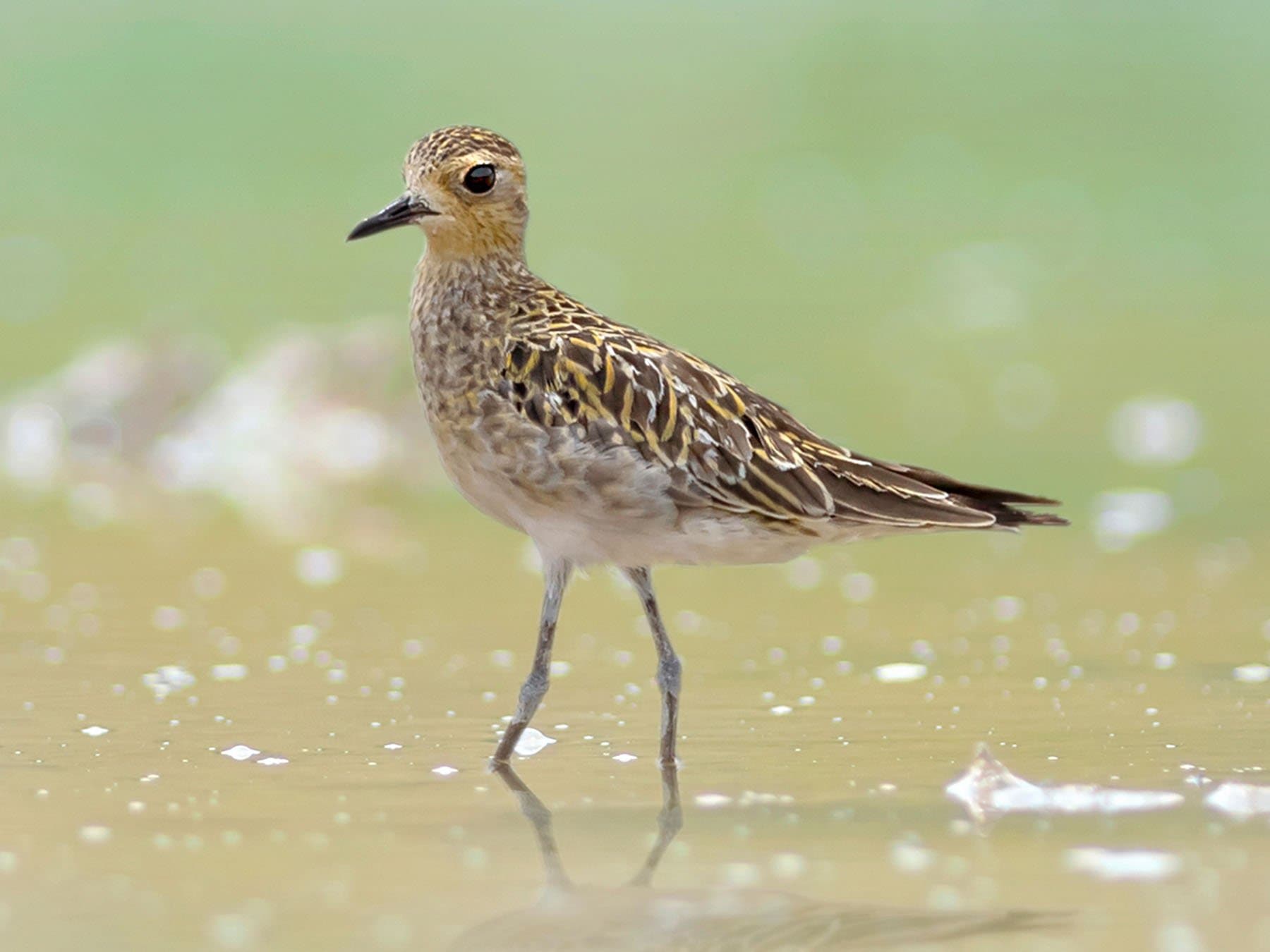
Pacific Golden-Plover standing in shallow water, showing mottled brown and gold plumage, dark eye, and slender bill.
Quick Facts
Conservation
LCLeast ConcernLifespan
5–6 years
Length
23–26 cm
Weight
100–200 g
Wingspan
58–67 cm
Migration
Long-distance Migrant
Every autumn, Pacific Golden-Plovers leave the Arctic tundra and fly non-stop across 4,800 km of open ocean to reach Hawaii — a journey of three to four days with no chance to land, rest, or feed. To fuel it, they double their body weight in fat before departure. Slender, upright, and spangled gold and black in breeding dress, this is a shorebird built for the extraordinary.
Also known as: Pacific Golden Plover
Think you've spotted a Pacific Golden-Plover?
Upload a photo and we'll confirm it instantly
Confirm with a PhotoAppearance
The Pacific Golden-Plover is a slender, upright shorebird with a rounded head, large dark eyes, a slim neck, and a short fine black bill. Adults measure 23–26 cm in length with a wingspan of 58–67 cm. The legs are long for a plover, ranging from grey to near-black — a useful structural clue when separating it from similar species.
In breeding plumage, the male is unmistakable. The upperparts — crown, nape, back, and wings — are densely spangled with gold, black, and white, creating a mosaic that catches the light on open tundra. The face, throat, breast, belly, and flanks are jet black, sharply bordered by a bold white stripe that arcs from the forehead around the auriculars and continues down the sides of the neck and flanks to the undertail coverts. The undertail coverts show black speckling along the white border — a key distinction from the American Golden-Plover.
Females in breeding plumage are similar but the black on the underparts is less extensive and more mottled with white. The white border stripe blends more gradually into the flanks. In non-breeding plumage, both sexes look quite different: the bold black-and-white pattern gives way to golden-brown upperparts with white and black spots, pale greyish-buff underparts, and a broad buff-apricot wash across the breast. A pale buff-white supercilium is visible. Juveniles resemble non-breeding adults but show a more pronounced yellow-gold wash to the head, neck, and breast, and the upperparts are crisply and neatly spangled — often appearing brighter and more golden than non-breeding adults.
Body weight varies dramatically with season. Fat-free birds weigh around 100–135 g, but prior to northward migration birds can reach 200 g as they accumulate the fat reserves needed for their transoceanic crossing. This near-doubling of body mass is visible in the field as a noticeably plumper silhouette.
Identification & Characteristics
Male Colors
- Primary
- Gold
- Secondary
- Black
- Beak
- Black
- Legs
- Dark Grey
Female Colors
- Primary
- Gold
- Secondary
- Brown
- Beak
- Black
- Legs
- Dark Grey
Male Markings
Bold white stripe arcing from forehead around auriculars and down flanks, bordering jet-black underparts; densely gold-spangled upperparts in breeding plumage
Tail: Short, dark tail; rump dark (no white rump); toes project slightly beyond tail tip in flight
Female Markings
Similar to male but black underparts less extensive and more mottled with white; white border stripe less sharply defined and blending more gradually into flanks
Tail: As male — short, dark tail with dark rump
Attributes
Understanding Attributes
Rated 0–100 based on research and observation. A score of 50 is average across all bird species. These attributes are relative and don't necessarily indicate superiority.
Habitat & Distribution
On the breeding grounds, Pacific Golden-Plovers nest on dry-to-moist open Arctic tundra among lichen-covered rocks, with vegetation of grasses, sedges, and dwarf shrubs. The breeding range spans Arctic and subarctic Siberia — from the Yamal Peninsula east to the Chukotskiy Peninsula — and the western Alaskan coast along the Bering and Chukchi Seas, mostly north of 60°N. In Alaska, where the species overlaps with the American Golden-Plover, Pacifics select lower-elevation, wetter tundra with denser vegetation, while Americans occupy higher, drier, rockier slopes.
The non-breeding range is one of the widest of any shorebird, spanning nearly half the Earth's circumference. It extends from the Hawaiian Islands and Pacific islands (including Micronesia, Polynesia, Fiji, and New Caledonia) south to Australia and New Zealand; west across Southeast Asia, the Indian subcontinent, southern China, Japan, and the Persian Gulf; and as far as northeastern Africa, including Kenya and the Horn of Africa. Small numbers winter in southern California and along the US West Coast.
In Australia, the species is a widespread non-breeding visitor along the coastline, arriving in September and departing mostly in April. It favours mudflats, estuaries, saltmarsh, beaches, and coastal grasslands. In New Zealand — where it is the fourth commonest Arctic migrant wader — an estimated 300–1,200 birds visit each summer, arriving September–November and departing late March to early April. Regular sites include Parengarenga, Manukau and Kaipara Harbours, the Firth of Thames, and Farewell Spit.
In Hawaii, the species (known locally as kōlea) is a common seasonal resident on all the Main Hawaiian Islands, arriving August–September and departing late April–May. Birds occupy an extraordinary range of habitats including lawns, parks, cemeteries, golf courses, rooftops, and airport grounds, ranging to at least 2,500 m elevation where suitable open habitat exists. In the UK, the Pacific Golden-Plover is a rare but near-annual vagrant, primarily recorded in late summer and early autumn (July–August). Most records come from Norfolk, Shetland, Orkney, and Cornwall, typically found within flocks of European Golden-Plovers.
Where to See This Bird
Explore regional guides for locations where this bird has been recorded.
Diet
Pacific Golden-Plovers are opportunistic omnivores, though insects form the backbone of the diet across most of the year. The foraging method is the classic plover run-stop-peck: a short sprint, a pause to scan, then a rapid strike to seize prey from the ground surface. Larger items are dismembered by pecking before being swallowed.
On Arctic breeding grounds, the diet centres on beetles, flies, mosquitoes, and crane fly larvae. Berries — crowberries and blueberries — become critically important in late summer, providing the carbohydrates needed to build fat reserves before the southward migration. Leaves and seeds supplement the diet when invertebrates are scarce.
On wintering grounds, the menu expands considerably. In Hawaii, primary prey includes cockroaches, moths, caterpillars, earwigs, earthworms, and millipedes. Across the wider wintering range, birds take grasshoppers, cutworms, wireworms, bees, wasps, ants, spiders, centipedes, slugs, snails, small crustaceans, marine worms, and brine shrimp. Coastal birds exploit mudflats and estuaries for bristleworms and small crabs.
Occasional items recorded include small reptiles such as geckos, skinks, and blind snakes, small fish, and bird eggs. In Hawaii, habituated birds living near human settlements have been observed eating discarded food including bread, rice, chicken, and fruit — behaviour that reflects both the species' intelligence and its adaptability to human-modified environments. Despite this flexibility, the species hunts entirely by sight and consistently selects open habitats where prey is visible against a short-vegetation background.
Behaviour
Pacific Golden-Plovers are strongly territorial on their wintering grounds — an unusual trait among migratory shorebirds. Most wintering birds defend a fixed patch of lawn, pasture, or mudflat against all rivals, returning to exactly the same territory year after year. In Hawaii, where this behaviour has been studied in detail, the site-fidelity rate is approximately 80%, meaning eight out of ten birds return to the same patch the following autumn.
Foraging follows the classic plover pattern: a short run of a few steps, an abrupt pause to scan, then a rapid peck to seize prey from the surface. The large eyes are central to this strategy — the species hunts entirely by sight, which explains why it favours open habitats with short vegetation where prey is visible and predators can be spotted early. In Hawaii, some birds have learned to excavate shallow holes in lawns to reach earthworms and millipedes buried just below the surface.
On the breeding grounds, males are conspicuously aggressive, chasing rival golden-plovers and most other shorebird species from territories that can span 25–125 acres (10–50 ha). One notable exception is the Dunlin, which is tolerated and often associates closely with golden-plovers — a relationship so well-observed that the Dunlin was historically called the 'plover's page' in 19th-century England. Outside the breeding season, non-territorial birds feed in loose groups, but dominant territory-holders feed alone.
Pre-migration behaviour is striking. In Hawaii, birds gather at traditional staging sites in late April, forming large flocks before departing en masse for Alaska. The same sites are used year after year, and the gatherings are predictable enough that local residents mark them on their calendars.
Calls & Sounds
The Pacific Golden-Plover's most frequently heard call is a clear, melodious two-syllable whistle, variously transcribed as 'tu-weet' (second syllable upslurred), 'tlu-ee', or 'quee-lee-lee'. eBird describes it as a quick 'pip' note followed by a rising 'plooEEP!' — the first note shorter and more clipped than the equivalent call of the Grey Plover. The overall quality is mellow but quick, with an upbeat, almost cheerful character.
Separating it by ear from the American Golden-Plover is important for birders in the UK and along the US West Coast. The American's call is slower and squeakier — a rising 'T-wee' or mournful 't-wee-loo' — while the Pacific's is quicker, more urgent, and more two-noted. The written descriptions are similar enough to mislead; the actual quality and delivery differ more than the transcriptions suggest, and hearing both species is strongly recommended before attempting identification by call alone.
On the breeding grounds, males sing during the butterfly display flight — a repeated, plaintive 'teee-chewee' whistle delivered while flying with exaggerated wingbeats over the territory. The song consists of slow, slurred whistles punctuated with pauses. Alarm calls near the nest are sharper and more urgent, used to deter foxes and avian predators. Birds in migrating flocks give contact calls that help maintain cohesion over open ocean.
The species' voice is embedded in the cultures of the peoples who share its range. In Alaska, the Yup'ik name 'tuuliik' and the Inupiaq name 'tullik' are both directly descriptive of the bird's call — a reminder that indigenous communities have been listening carefully to this bird for far longer than Western ornithology has been recording it.
Flight
In the air, the Pacific Golden-Plover is swift and direct, with long pointed wings that give it a streamlined silhouette quite different from the broader-winged European Golden-Plover. The wingbeats are steady and powerful — the same stroke that carries birds 4,800 km non-stop across the Pacific. During migration, birds fly at altitudes of approximately 900 m up to 4,900 m, where favourable tailwinds can be exploited.
Several flight features are diagnostically useful. The rump is dark, immediately ruling out the Grey Plover, which shows a conspicuous white rump in flight. The underwing and axillaries are grey-brown — a key feature separating it from the European Golden-Plover, which has white underwings. The toes project slightly beyond the tail tip, a subtle but consistent character that differs from the American Golden-Plover, whose longer primary projection means the wingtips extend well beyond the tail when perched.
On the breeding grounds, the male's butterfly display flight is immediately recognisable: slow, exaggerated wingbeats carry the bird in wide arcs over the territory while it sings continuously. This display is quite unlike the fast, direct flight used for commuting and migration. When flushed from coastal grasslands or mudflats, birds typically call as they rise and fly in a low, fast arc before landing some distance away — rarely allowing a close approach a second time.
Nesting & Breeding
Breeding takes place from late April or May to early August on Arctic tundra, constrained by the brief window of the northern summer. Males typically arrive on the breeding grounds first and immediately begin territorial advertisement, performing a spectacular 'butterfly display' — flying slowly over the territory with exaggerated, deep wingbeats while singing a repeated plaintive whistle. On landing, the wings are held upward in a V-shape. Ground displays include a scraping display (as if making a nest), raising wings overhead, and racing at the female with lowered head.
Pairs form within three to six days of arrival, with some individuals arriving already paired — possibly having been territorial neighbours on the wintering grounds. The male selects potential nest sites and scrapes them clear of lichen using feet and breast. Multiple scrapes may be made during courtship, but only the final chosen scrape is lined. The finished nest is a shallow depression averaging about 12 cm across and 3 cm deep, lined with lichen, moss, grass, leaves of willow and mountain avens, and sometimes twigs. Pacific Golden-Plover nests typically have thicker lining than those of American Golden-Plovers. Scrapes may be reused across multiple years.
The clutch is invariably four eggs, white to pale buff and heavily spotted with dark brown and black — camouflage so effective that nests are extremely difficult to locate on tundra. The four narrow ends fit together snugly in the centre of the nest, minimising the brooding area required. Both parents share incubation over approximately 25–26 days, with the male reportedly incubating by day and the female at night.
Chicks are precocial, covered in down at hatching and moving independently within hours. Birth mass is approximately 17 g. Both parents tend and protect the chicks, though they do not feed them — chicks find all their own food from the start. Females typically abandon the brood first, followed by males, leaving juveniles to migrate south entirely independently. Young are capable of flight approximately 26–28 days after hatching.
Lifespan
The typical lifespan of a Pacific Golden-Plover in the wild is around 5–6 years, though the maximum recorded age is strikingly higher: at least 21 years and 3 months, documented through banding operations in Hawaii. This longevity record is exceptional for a bird of this size and reflects both the species' physiological resilience and the practical advantages of studying a population with 80% annual site fidelity — birds that return to the same patch of lawn each year are far easier to recapture and re-measure than those that scatter across a continent.
Annual survival rates are shaped by the demands of long-distance migration. The transoceanic crossing is the single greatest mortality risk: birds that fail to accumulate sufficient fat reserves before departure, or that encounter severe weather over the Pacific, do not complete the journey. Juveniles making their first southward migration entirely by instinct face the highest mortality. Predation on the breeding grounds — from Arctic foxes and avian predators — is a significant pressure during the short nesting season.
Compared to the closely related European Golden-Plover, which has a similar typical lifespan of around 5 years but a lower maximum recorded age, the Pacific Golden-Plover's longevity record suggests that individuals that successfully navigate the first few years of life — and establish a reliable wintering territory — can achieve remarkable ages. Some individuals do not migrate at all, remaining on wintering grounds year-round; these non-migrants, typically first-year birds or those with insufficient fat reserves, may face different survival pressures than their migratory counterparts.
Conservation
The Pacific Golden-Plover is classified as Least Concern on the IUCN Red List (2019 assessment), with a global population estimated at 190,000–250,000 individuals; Partners in Flight estimates 220,000 breeding birds. Despite this relatively healthy total, the population trend is decreasing, and several threats are intensifying.
Climate change is the primary long-term concern. Increasing shrubby vegetation on Arctic tundra — a process known as shrubification — is gradually degrading the open tundra habitat the species requires for nesting. At the other end of the migration route, sea-level rise threatens the low-lying Pacific island wintering grounds with inundation. The species' dependence on a small number of key stopover and wintering sites makes it particularly vulnerable to habitat loss at any single location.
Hunting has been a significant historical pressure. In Hawaii, the kōlea was heavily hunted until protections were enacted in 1941. The species is still hunted for food in parts of eastern Asia. Habitat loss on wintering grounds — particularly residential and commercial development near Sydney, Australia, which has destroyed roosting and foraging sites — continues to reduce available habitat. Pesticide exposure on golf courses and agricultural land in Hawaii and elsewhere poses a risk that has not yet been fully quantified.
A more localised threat comes from aircraft strikes at airports where juvenile birds attempt to establish territories on open grass areas — incidents have been recorded at Lihue (Kauai) and Kahului (Maui). Conservation efforts focus on habitat protection, monitoring of key wintering populations (particularly in Hawaii, where site fidelity makes long-term tracking feasible), and ongoing geolocator research to map migration routes and identify critical stopover sites.
Population
Estimated: 190,000–250,000 individuals
Trend: Decreasing
Decreasing; primary drivers include climate-change-driven shrubification of Arctic tundra breeding habitat and sea-level rise threatening low-lying Pacific island wintering grounds.
Elevation
Sea level to 2,500 m (in Hawaii); breeds mainly north of 60°N on Arctic tundra
Additional Details
- Predators:
- Arctic foxes and avian predators (raptors, skuas) on breeding grounds. Raptors and feral cats on wintering grounds. Aircraft strikes at airports are a localised threat to juveniles.
- Clutch size:
- 4 eggs (invariably)
- Breeding age:
- 1–2 years
- Feeding times:
- Diurnal; active throughout daylight hours
- Major threats:
- Climate change (shrubification of tundra, sea-level rise); hunting in parts of eastern Asia; habitat loss on wintering grounds; pesticide exposure; aircraft strikes
- Parental care:
- Both parents incubate eggs and tend chicks; female typically abandons brood first; chicks are precocial and self-feeding from hatching
- Social habits:
- Territorial and solitary on wintering grounds; loosely gregarious on migration; monogamous pairs on breeding grounds
- Egg appearance:
- White to pale buff, heavily spotted and splotched with dark brown and black
- Feeding habits:
- Run-stop-peck foraging; hunts entirely by sight; occasionally excavates shallow holes for buried invertebrates
- Breeding season:
- Late April/May to early August
- Diet variations:
- Insects and berries on Arctic breeding grounds; wide variety of invertebrates, small reptiles, and occasionally human food scraps on wintering grounds
- Fledging period:
- 26–28 days after hatching
- Average lifespan:
- 5–6 years
- Call description:
- Clear two-syllable 'tu-weet' with second syllable upslurred; quicker and more cheerful than American Golden-Plover's call
- Nesting location:
- Shallow scrape on open Arctic tundra, often among lichen-covered rocks
- Number of broods:
- One
- Incubation period:
- 25–26 days
- Nest construction:
- Shallow depression lined with lichen, moss, grass, leaves of willow and mountain avens; thicker lining than American Golden-Plover nests
- Migration patterns:
- Non-stop transoceanic flights of ~4,800 km between Alaska and Hawaii; annual round trip estimated at 25,000–27,000 km; flies at 900–4,900 m altitude
- Conservation efforts:
- Habitat protection on key wintering sites; long-term banding and geolocator studies in Hawaii; protected under migratory bird treaties in the US and Australia
- Territorial behavior:
- Strongly territorial on wintering grounds; defends 10–50 ha territories on breeding grounds; 80% site fidelity rate on wintering grounds
Birdwatching Tips
Outside the Arctic breeding grounds, the best place in the world to see Pacific Golden-Plovers is Hawaii, where birds arrive from late August and remain until late April. They are genuinely easy to find on any well-mown lawn, park, golf course, or cemetery on the main islands — Oahu, Maui, and the Big Island all have reliable sites. Look for a solitary, upright plover standing alert on short grass, often returning to exactly the same patch day after day.
In Australia, the species is a regular non-breeding visitor to coastal mudflats, estuaries, and saltmarsh from September to April. In New Zealand, Farewell Spit, the Firth of Thames, and Manukau Harbour are among the most reliable sites, with birds present from October through March. Along the US West Coast, check coastal grasslands, sod farms, and mudflats from August to October, particularly in California.
In the UK, the species is a rare vagrant but is found almost annually, most often in July and August. The key strategy is to work through flocks of European Golden-Plovers on coastal fields and marshes, particularly in Norfolk, Shetland, and Orkney. Look for a bird that appears slightly smaller and slimmer than its companions, with longer legs, a more upright posture, and a slightly longer, finer bill.
The call is the single most useful identification tool. The Pacific's call is a quick, two-syllable 'tu-weet' with the second syllable upslurred — more cheerful and urgent than the American Golden-Plover's slower, squeakier 't-wee-loo', and quite different from the Grey Plover's mournful three-note whistle. In flight, note the dark rump (no white rump as in Grey Plover) and the grey-brown underwing and axillaries (not white as in European Golden-Plover). The toes project slightly beyond the tail tip — a subtle but consistent feature.
Did You Know?
- The Alaska–Hawaii migration leg covers approximately 4,800 km of open ocean in just three to four days — entirely non-stop, with no opportunity to land, rest, or feed. To fuel this crossing, birds accumulate enough fat to nearly double their body weight, from around 135 g to as much as 200 g, before departure.
- The oldest recorded Pacific Golden-Plover lived to at least 21 years and 3 months — an extraordinary age for a bird of its size, and far beyond the typical lifespan of 5–6 years. This individual was tracked through banding operations in Hawaii, where the species' site fidelity makes long-term monitoring unusually practical.
- In Hawaiian mythology, the kōlea is an incarnation of Koleamoku, a god of healing and a messenger to the ali'i (chiefs). Some folk belief holds that if a kōlea circles your home while calling, a death in the family is imminent. Some scholars suggest that Polynesian navigators may have followed the kōlea's migratory path to discover the Hawaiian Islands.
- Pacific Golden-Plovers tolerate Dunlins on their breeding territories despite aggressively evicting virtually every other shorebird species. This curious relationship was so well-known historically that the Dunlin was called the 'plover's page' in 19th-century England, and the Icelandic name for the Dunlin translates as 'plover-slave.'
- Geolocator studies tracking birds from Oahu confirmed that the transpacific flights follow direct north–south pathways with no intermediate stops — and that the same individual birds return to the same Hawaiian lawn or rooftop territory year after year, with an 80% site-fidelity rate.
Records & Accolades
Non-stop Ocean Crossing
~4,800 km
Flies non-stop from Alaska to Hawaii in 3–4 days with no opportunity to land, rest, or feed over open ocean.
Annual Round Trip
25,000–27,000 km
Total annual migration distance, one of the longest round trips of any shorebird relative to body size.
Longevity Record
21 years 3 months
The oldest recorded individual, tracked through banding operations in Hawaii — far exceeding the typical 5–6 year lifespan.
Site Fidelity
80%
Eight in ten birds return to exactly the same wintering territory in Hawaii year after year.
Community Photos
Be the first to share a photo of the Pacific Golden-Plover
Upload a PhotoIdentify Any Bird Instantly
- Upload a photo from your phone or camera
- Get an instant AI identification
- Ask follow-up questions about the bird
Monthly Birds in Your Area
- Personalised for your location
- Seasonal tips and garden advice
- Updated every month with new species