


Egyptian Goose
Nil Goose · Alopochen aegyptiaca
By the Birdfact teamChecked by Nathan Cope
On this page15 sections
How to recognise it
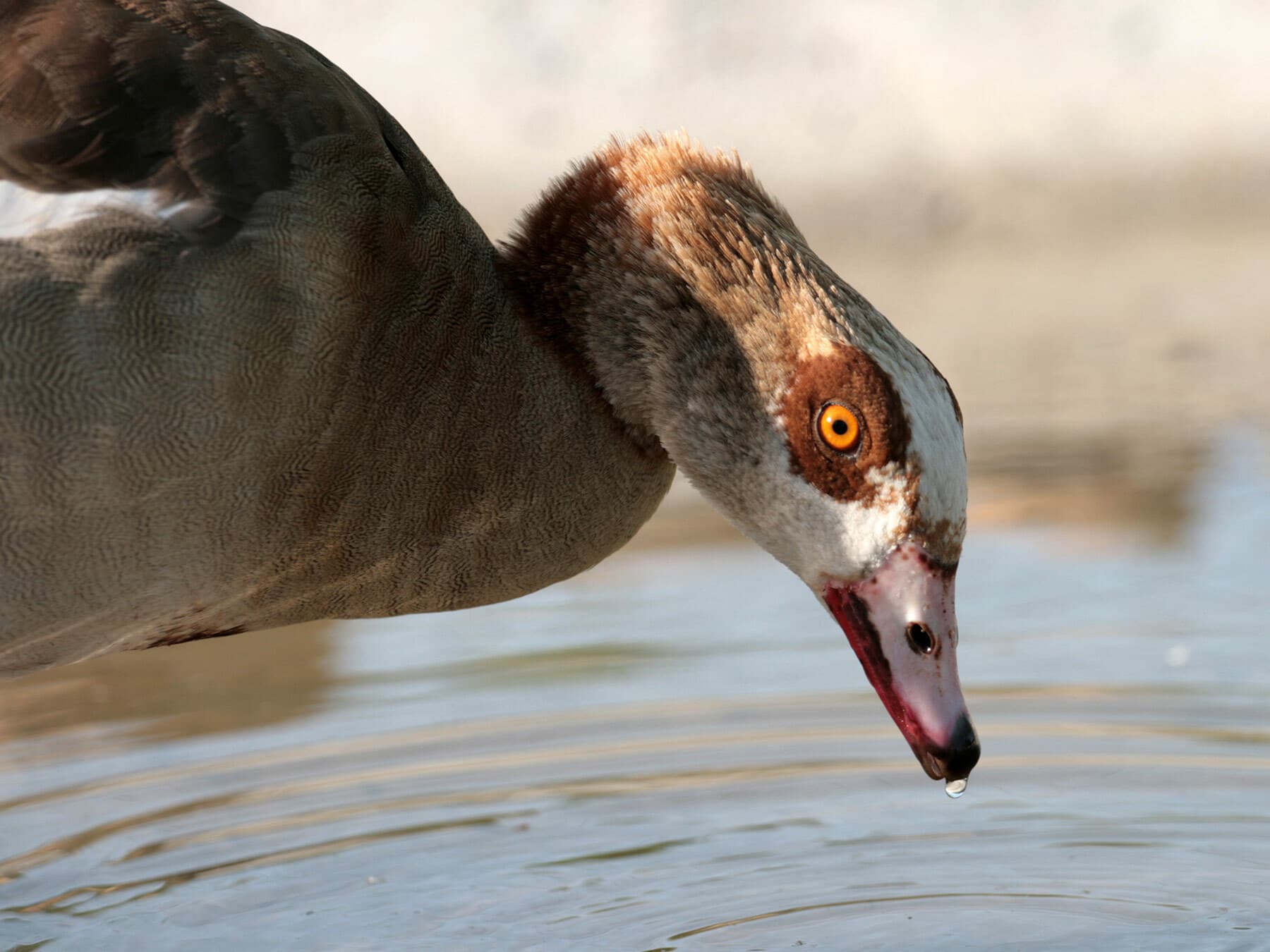
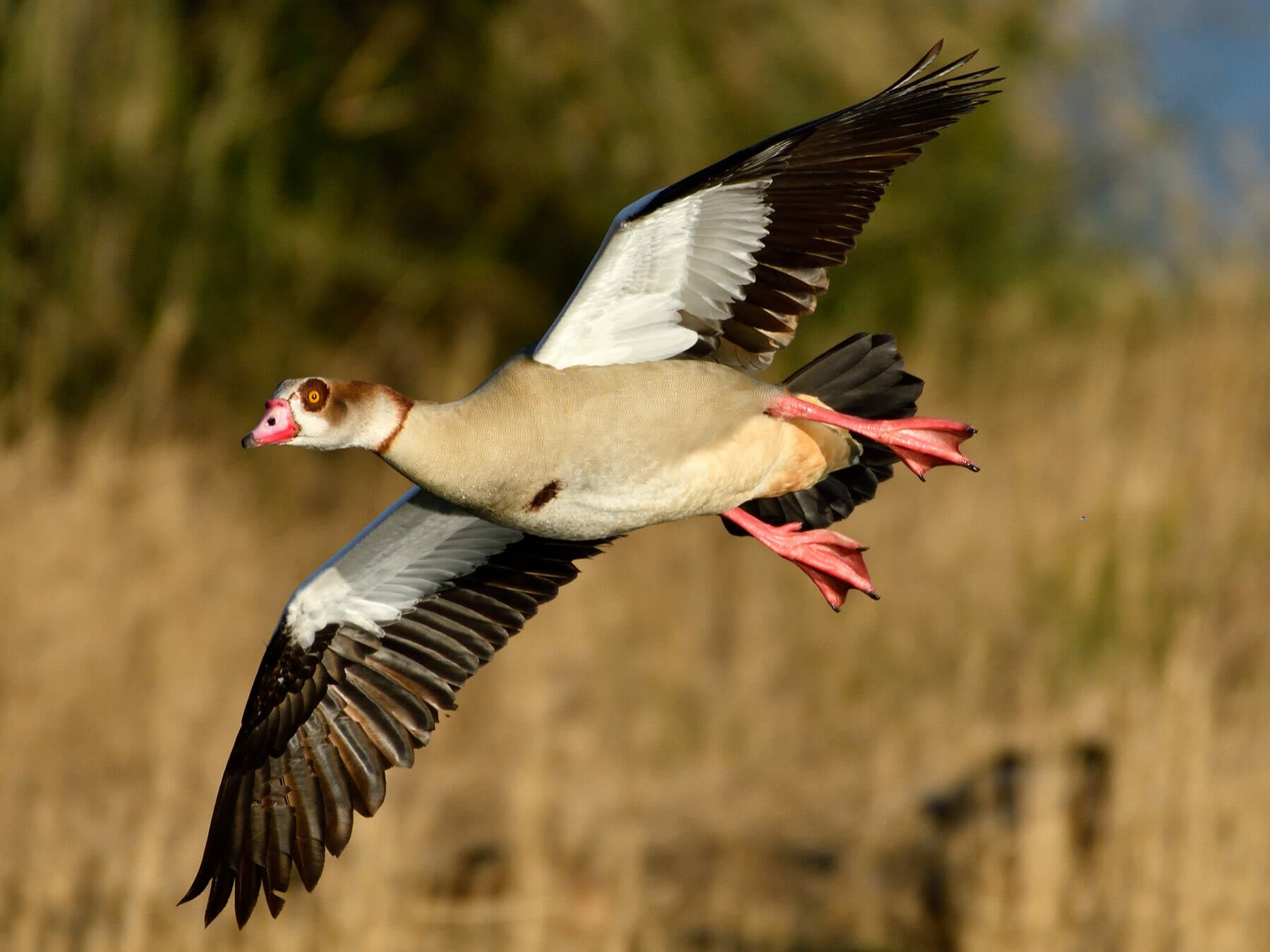
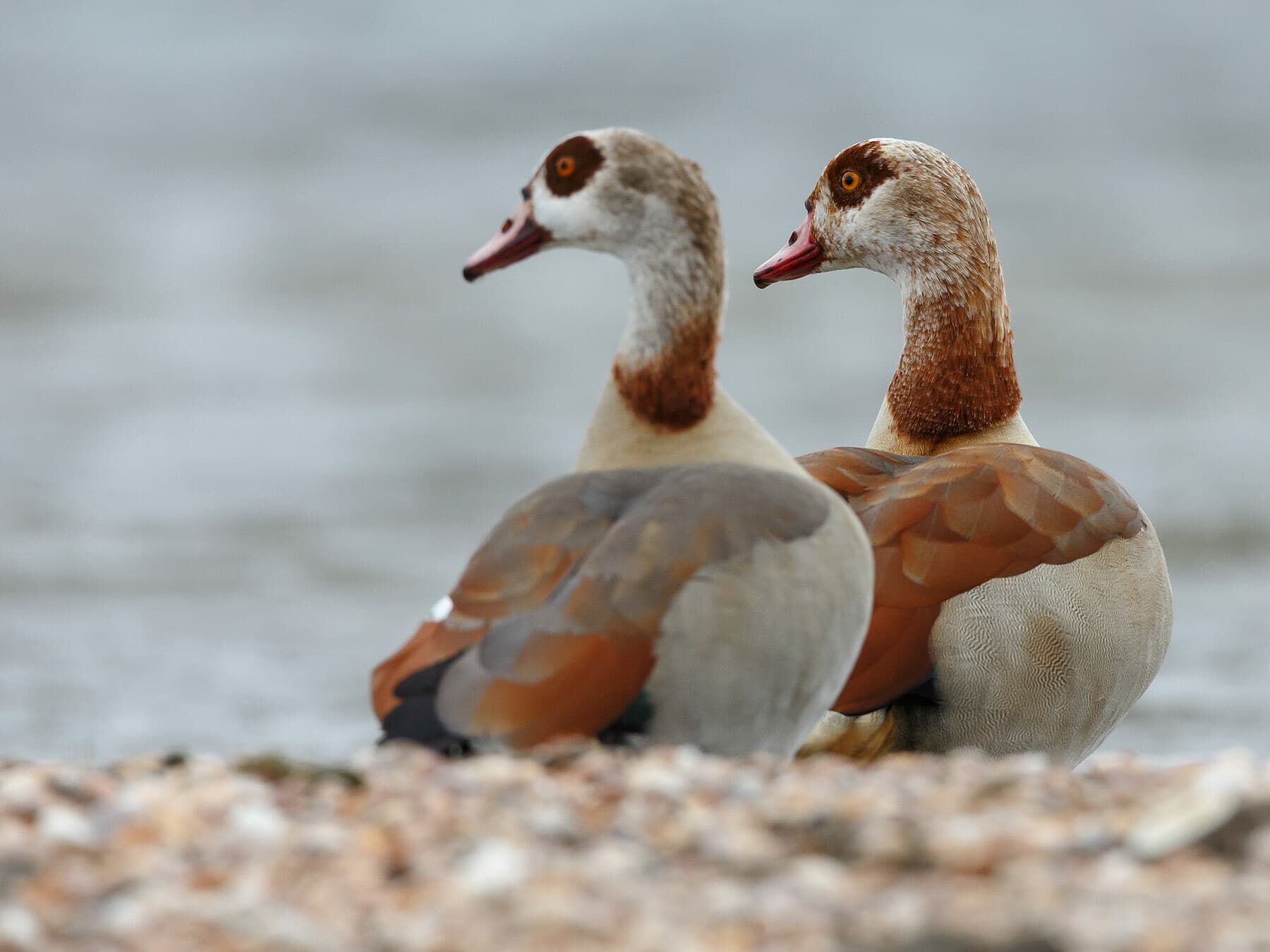
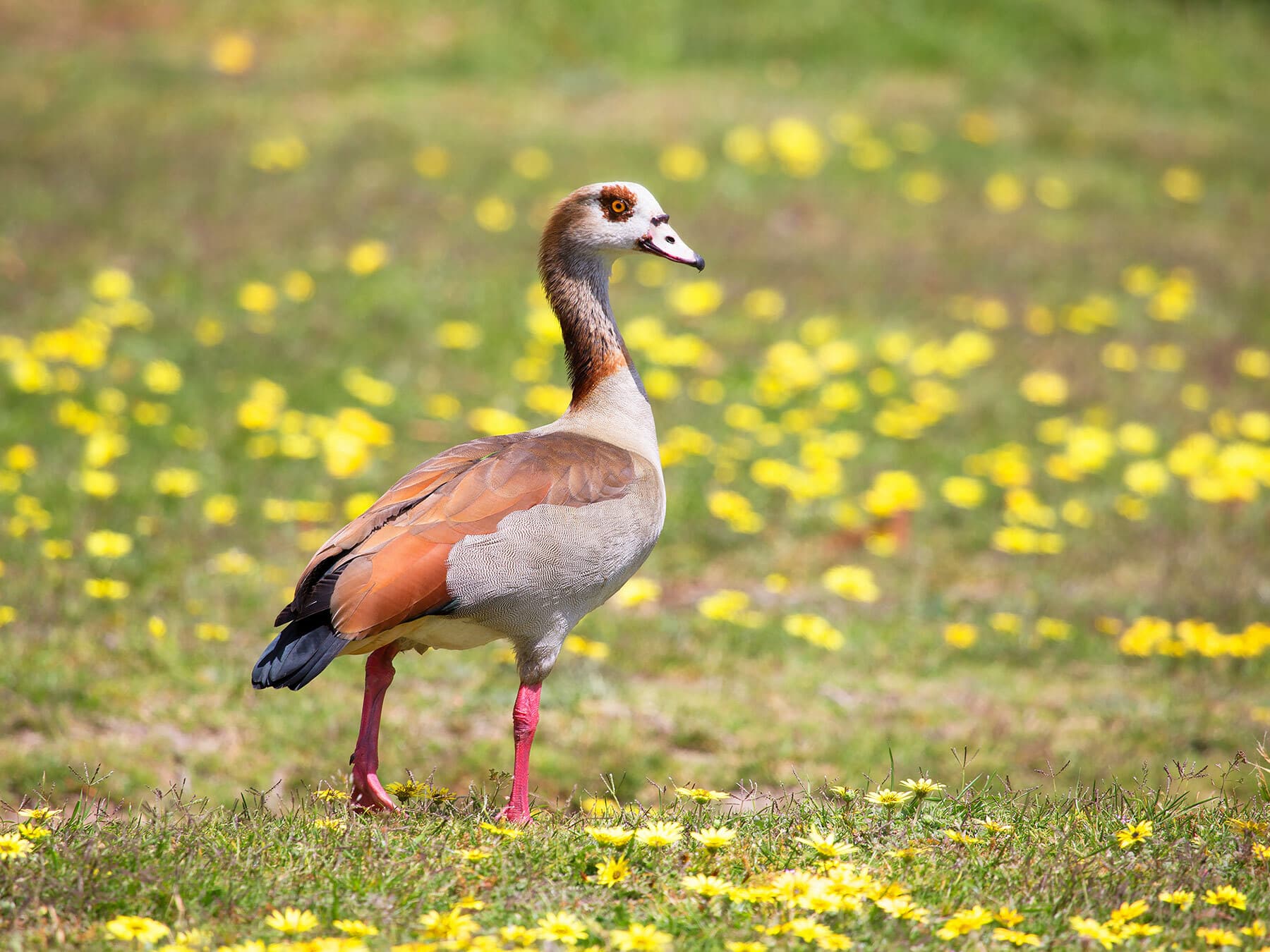
The Egyptian Goose is a striking bird with a distinctive appearance. Its predominantly grey-brown body contrasts with a darker brown eye patch and chestnut patch on the breast. The wings display a bold white patch, visible in flight and at rest.
Both sexes look similar, with males slightly larger. Juveniles resemble adults but have duller plumage and lack the distinctive breast patch. The bird's pink bill and legs provide a colourful contrast to its plumage.
Its size
Adults- Length
- 63–73 cm
- Wingspan
- 134–154 cm
- Weight
- 1500–2250 g
Its song and calls
Known as being fairly aggressive and quarrelsome the males can be noisy and raucous calling in what is often described as a low, grating snarl. Females are restricted to a typical gooselike honking or cackle and both birds commonly hiss loudly when alarmed or threatened.
- Flight call0:00 / 0:20
Recorded in Normandie, France · March 2024
When and where to see it
OctoberHere all year
Most recorded in October
- 1. London1.6%
- 2. Berkshire1.3%
- 3. Rutland1.2%
- 4. Nottinghamshire0.82%
- 5. Surrey0.68%
Each dot is a county, state or province: the bigger and darker, the larger the bird’s share of that place’s bird records that month. Grey dots: no regular records. The ringed point is the centre of the bird’s records this month; the arrow shows how it moved since last month, and the dashed loop its path through the year. “Arrivals” colours places where it becomes regular this month (orange) or is in its last regular month (grey). GBIF eBird Observation Dataset, 2019–2024. Map data: Natural Earth, US Census Bureau; place centres © OpenStreetMap contributors.
In your area
See when the Egyptian Goose is recorded in your county, state or province.
How often the Egyptian Goose turns up in the UK and the United States through the year, from birdwatchers' records.
United Kingdom
Resident · all year · most records in December
United States
Resident · all year · most records in January
Show as a table
| Month | United Kingdom | United States |
|---|---|---|
| January | 0.38% (regular) | 0.033% (regular) |
| February | 0.35% (regular) | 0.029% (regular) |
| March | 0.35% (regular) | 0.024% (regular) |
| April | 0.37% (regular) | 0.016% (regular) |
| May | 0.35% (regular) | 0.009% (regular) |
| June | 0.30% (regular) | 0.012% (regular) |
| July | 0.35% (regular) | 0.014% (regular) |
| August | 0.34% (regular) | 0.016% (regular) |
| September | 0.32% (regular) | 0.017% (regular) |
| October | 0.31% (regular) | 0.020% (regular) |
| November | 0.37% (regular) | 0.024% (regular) |
| December | 0.39% (regular) | 0.030% (regular) |
Recorded regularly in
Worldwide: recorded regularly in 57 countries
Countries where it was recorded in at least 3 of the 6 years 2019–2024. Linked countries have their own bird list.
Europe (21)
Africa (25)
North America (2)
Data: EOD – eBird Observation Dataset (Cornell Lab of Ornithology), accessed via GBIF.org, CC BY 4.0. Records from 2019–2024, aggregated and filtered by Birdfact. How these lists are made
A native species of sub-Saharan Africa and parts of Egypt south of the Nile Valley, the Egyptian goose has also been introduced into south western Europe, including the British Isles, the Arabian Peninsula and the USA. Many of these ‘foreign’ populations have expanded from original escapees but have now set up permanent residence in a number of North American states including Texas, Florida, Arkansas and southern California. They are generally non migratory.
Signs and Spotting tips
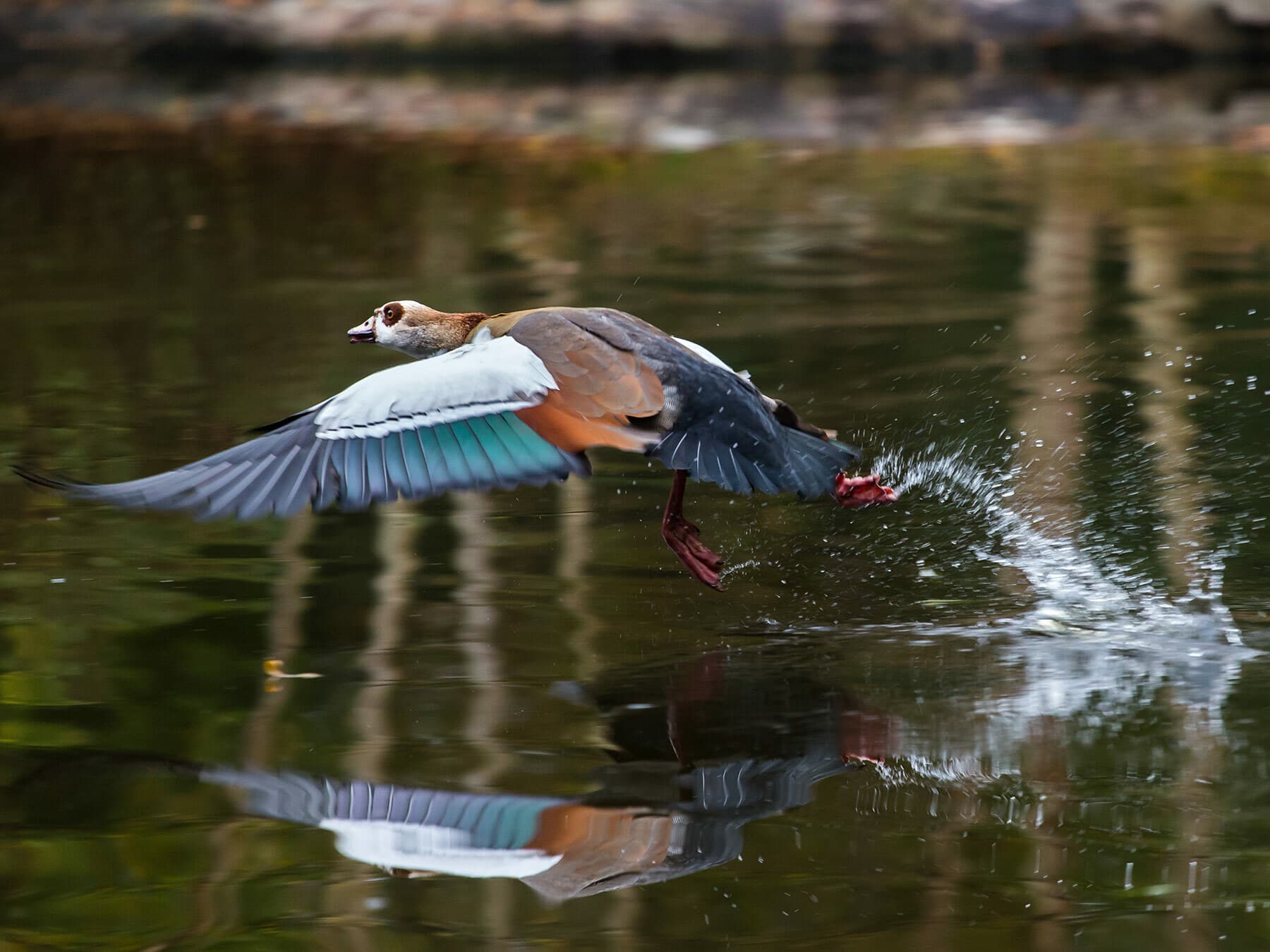
Preferring wetland areas these geese are often seen in pairs or small family groups and are immediately identifiable by the large brown eye patches and bold white wing areas. In the breeding season they may gather in large groups of around fifty birds. During the morning, evening and around midday adult birds can normally be seen grazing on grasses and seeds and although they are fully proficient swimmers they spend the majority of their time on land.
What it eats
Egyptian geese spend many hours simply grazing on grasses and seeds but will also take grain crops and aquatic plants including pond weed.
Nesting and breeding
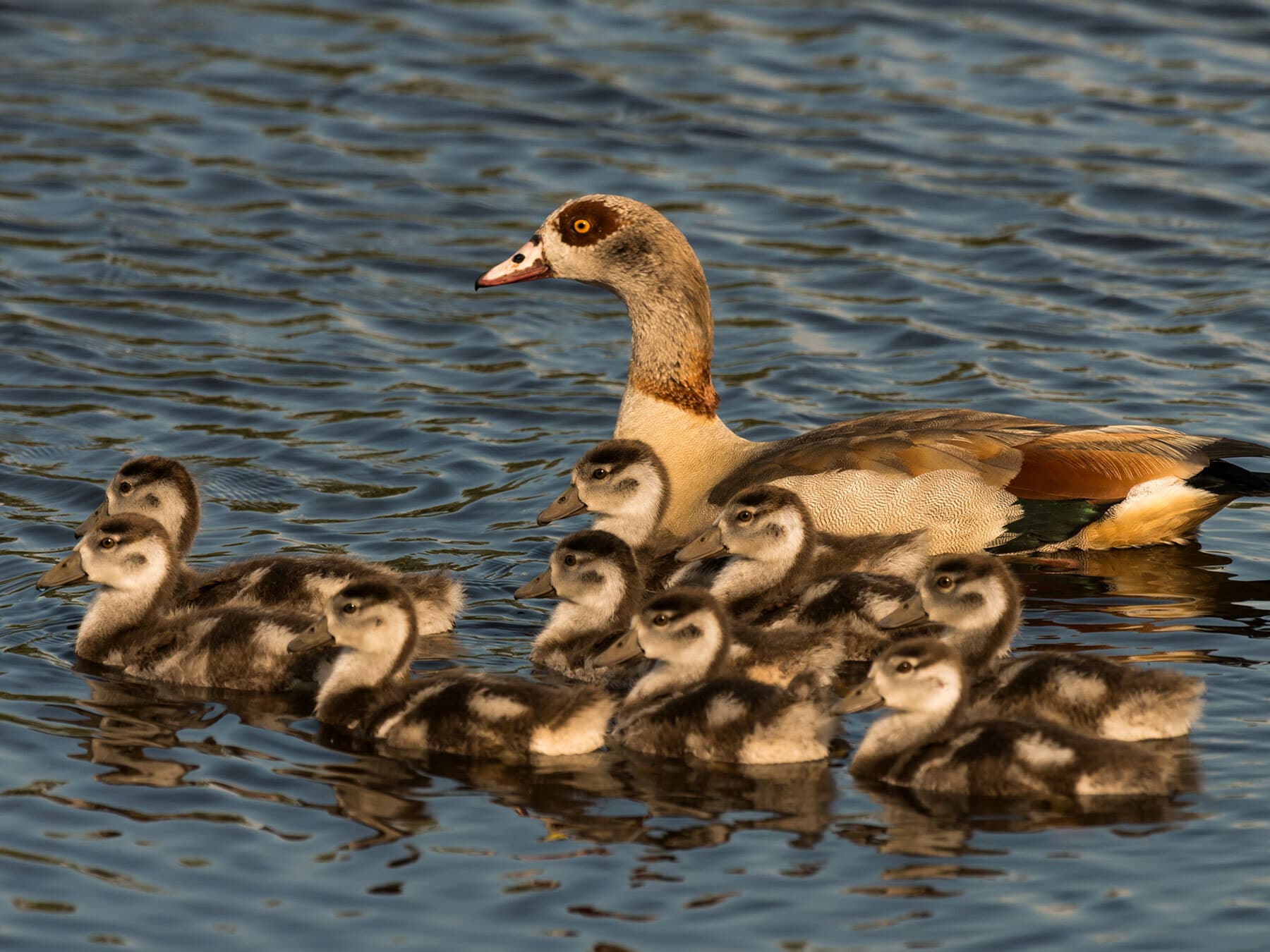
The breeding season varies upon location but within Africa will vary from year- round to periods towards the end of the dry season which again will vary from country to country and region to region. Elsewhere eggs are normally produced in late spring and will consist of one brood of between 5 – 12 creamy white eggs which are incubated by both parents for around thirty days. Fledging occurs from sixty to seventy five days from hatching. The nests are usually built using grasses, reeds and leaves, lined with down and located at ground level. Occasionally pairs will take over abandoned nests from other large bird species. Parents can be extremely brutal towards neighbouring nestlings of their own species when feeding, foraging or caring for their own young, even to go so far as to killing them.
Behaviour
Egyptian Geese are known for their aggressive territorial behaviour, often chasing away other waterfowl. They are primarily terrestrial, grazing on land more than swimming.
These birds are highly vocal, frequently communicating with loud honking calls, especially when alarmed or during courtship displays.
Lifespan and predators
The lifespan of Egyptian geese in the wild is between fifteen to twenty years.
Conservation
Despite being non-native in many areas, Egyptian Geese are not currently of conservation concern. In some regions, they are considered invasive due to their aggressive behaviour and competition with native species. Management efforts focus on controlling population growth in areas where they have been introduced.
What does an Egyptian Goose look like?
Whilst the adult male and female are similar in colour and patternation the male is generally larger with a fatter neck. The underparts are mainly pale tan or greyish white with a small brown patch at the centre of the lower breast. The back and upperparts are a mixture of brown, black, orange and white with a large white wing patch evident across the coverts on the upper and lower wing, contrasted with the very dark primary and secondary flight feathers. The head and top of the nape are a mid grey with the face and throat a paler grey. Half way down the neck there is often a dark brown band below which the grey colour morphs into a softer light buff, particularly on the underside. Around both eyes there is a large prominent chocolate brown patch. The top mandible of the bill is pink whilst the underside of the lower mandible is black. The eyes are a yellow or orange and the long legs and webbed feet are pink. Juveniles have a dark coloured upper wing area and lack both the brown eye patches and brown chest patch.
Similar birds
Often mistaken for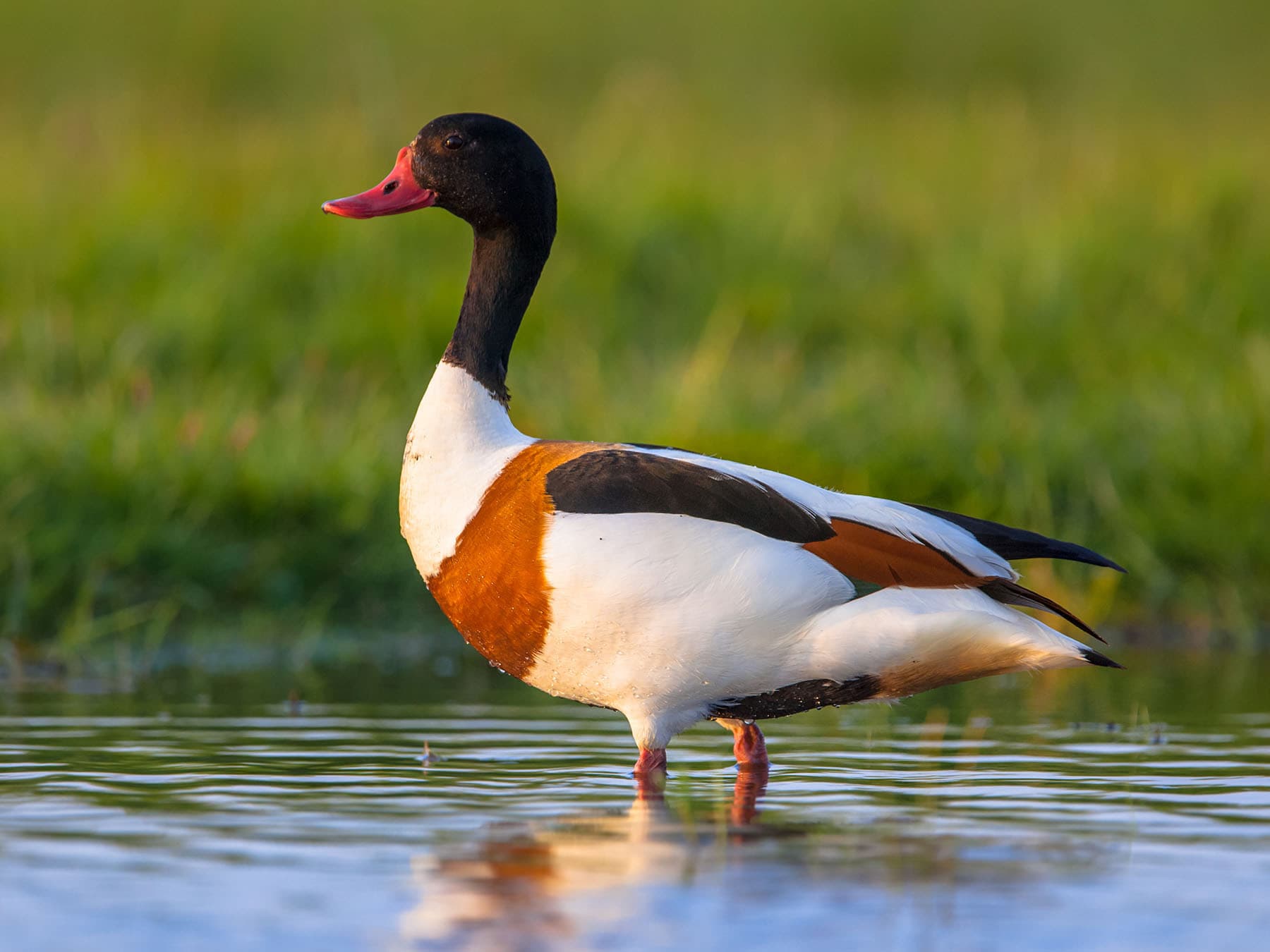
More photos
2 photos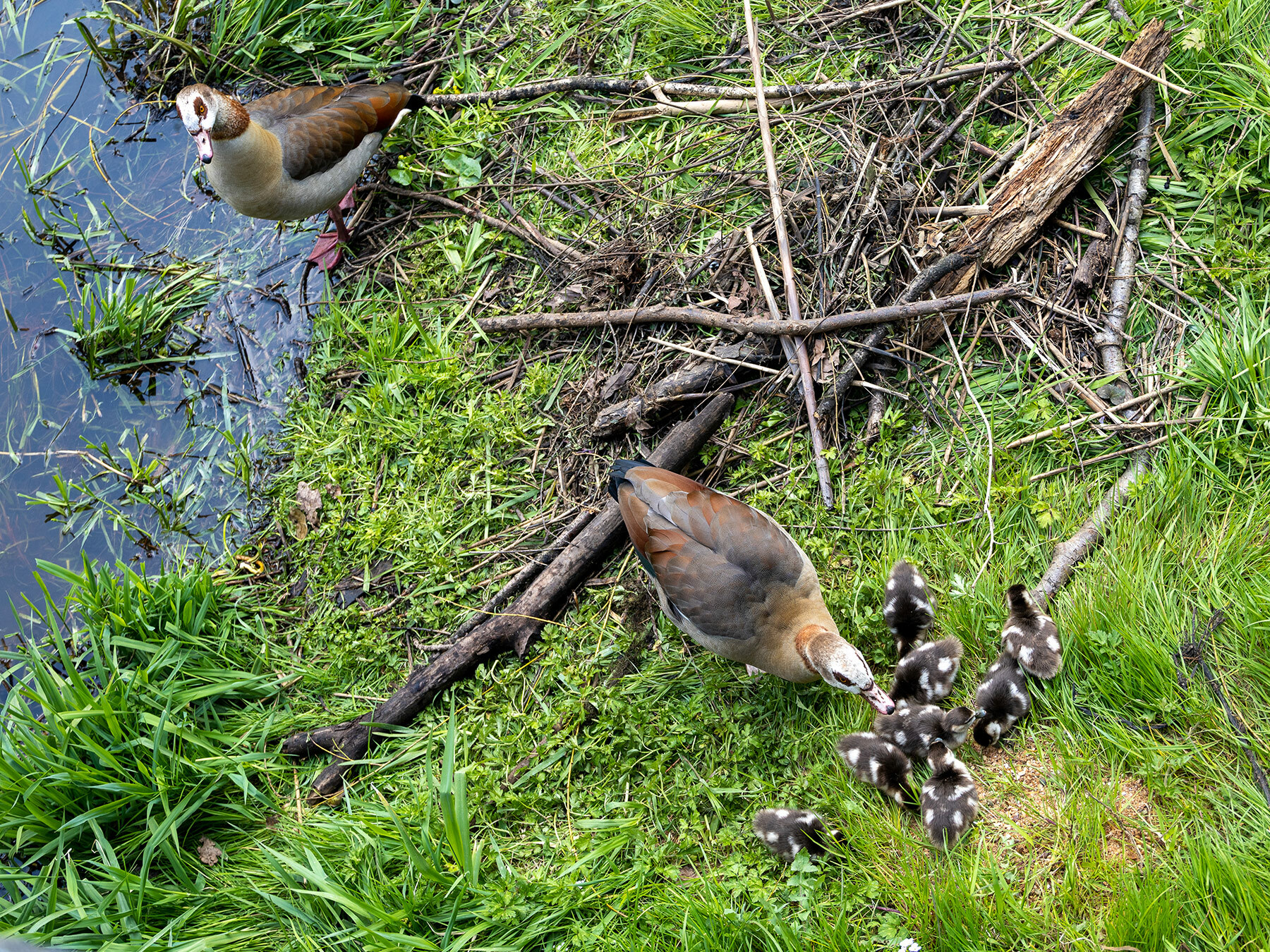

Egyptian Goose guides
4 guidesQuick facts
- Length
- 63–73 cm
- Wingspan
- 134–154 cm
- Weight
- 1500–2250 g
- Lifespan
- 15–20 years · oldest recorded 15 years
- Family
- Ducks, Geese & Swans
- Migration
- Resident
- Global status (IUCN)
- Least Concern
- World population
- 500,000 - 1,500,000 mature individuals
- Population trend
- Decreasing
- Also called
- Nil Goose
- Scientific name
- Alopochen aegyptiaca
Sources
3- 1BirdLife International. 2018. Alopochen aegyptiaca. The IUCN Red List of Threatened Species 2018: e.T22679993A131910647. Source (opens in a new tab)
- 2Wetlands International (2006)
- 3BTO longevity records: maximum age from a ringed bird, 15 years, 1 month, 4 days (set in 2017), BirdFacts: Egyptian Goose (2017) Source (opens in a new tab)

Checked by
Nathan Cope, founder and editor
Nathan founded Birdfact and leads its writers and contributors in the UK, the US and Canada. He has watched and studied birds for more than ten years, and checks every article and species guide before it’s published.