Species Profile
Cinnamon Teal
Spatula cyanoptera
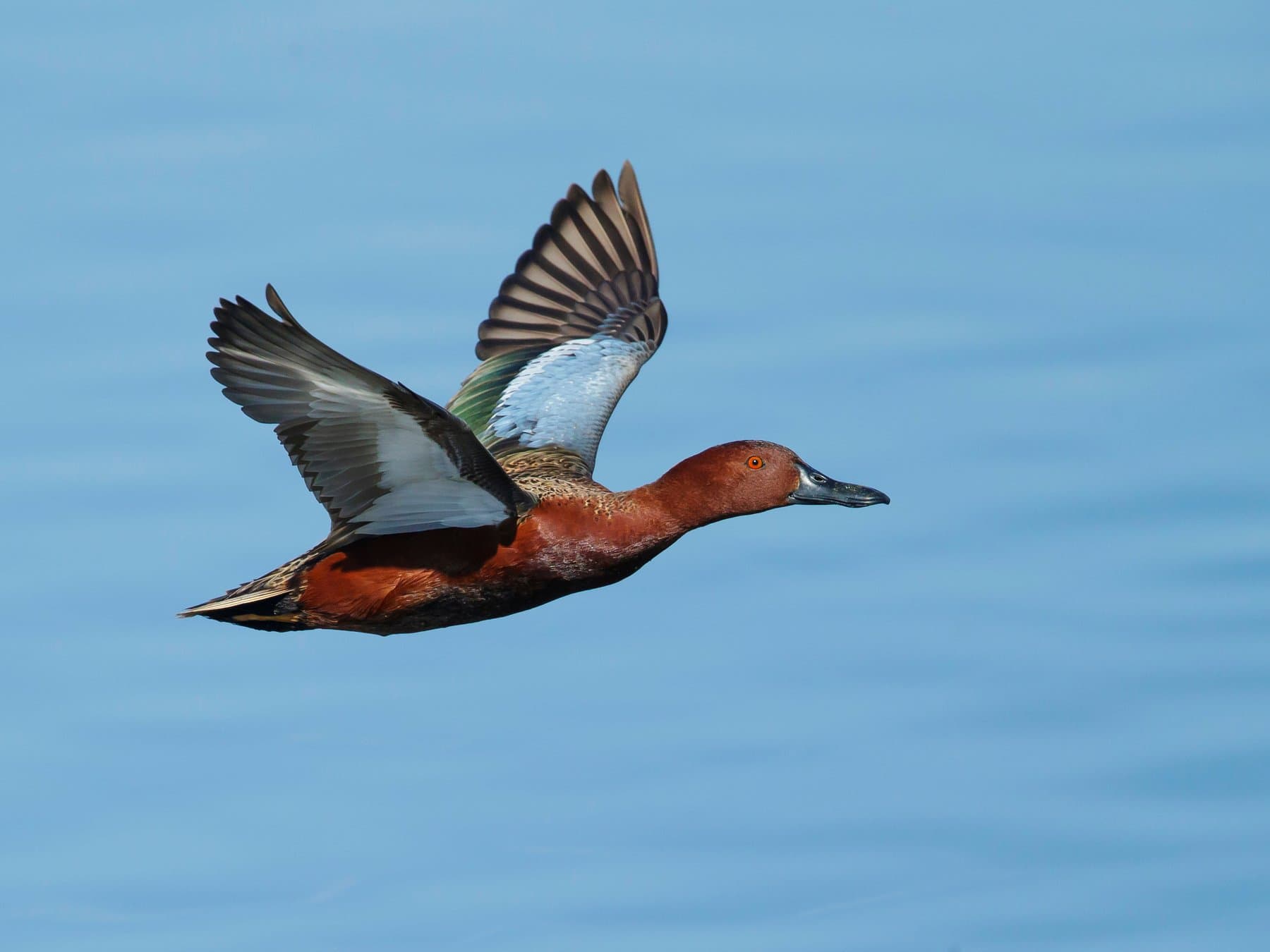
Cinnamon Teal in flight over blue water, showing reddish-brown plumage, bright orange eye, and blue wing patches.
Quick Facts
Conservation
LCLeast ConcernLifespan
5–10 years
Length
36–43 cm
Weight
335–520 g
Wingspan
54–57 cm
Migration
Partial migrant
A breeding male Cinnamon Teal is one of the most vividly coloured ducks in North America — his entire head, neck, and underparts a deep, burning cinnamon-red, offset by a scarlet iris that glows like a hot coal. Found across the wetlands of the American West and the high Andes of South America, this small dabbling duck is deceptively complex: five subspecies span two continents, and genetic studies reveal that North American birds are more distantly related to their South American counterparts than those South American birds are to the Blue-winged Teal.
Think you've spotted a Cinnamon Teal?
Upload a photo and we'll confirm it instantly
Confirm with a PhotoAppearance
The breeding male Cinnamon Teal is unmistakable. His head, neck, breast, flanks, and underparts are a rich cinnamon-red to rusty chestnut, while the back and rump are mottled brown and the undertail coverts are black. The bill is long, black, and slightly spatulate — noticeably longer than a Blue-winged Teal's but shorter than a Northern Shoveler's. Legs and feet are yellow-orange. The single most reliable bare-part feature is the male's scarlet-red iris, which distinguishes him from all female plumage and from every age of Blue-winged Teal.
Both sexes share a chalky powder-blue patch on the upper wing (the secondary coverts) — the most reliable field mark in flight. The speculum is iridescent green in males and duller in females. Males in flight also show bright white underwings, adding to their striking appearance.
In non-breeding (eclipse) plumage, worn from late summer through to January or later, the male becomes overall mottled brown and closely resembles the female. The red eye remains the best way to identify eclipse males. By midwinter, males begin moulting back into their rich reddish body plumage.
The adult female is mottled brown overall with a pale brown head and brown eyes. Her bill is grey-black and somewhat spatulate, and her legs and feet are pale yellow-orange. She is nearly identical to the female Blue-winged Teal — one of the most challenging identification problems in North American waterfowl. Key differences are subtle: the Cinnamon Teal female has a warmer, richer brown tone overall; a plainer face with a thinner, less distinct dark eye stripe that does not reach the nape; a reduced, pale yellowish-cream loral spot (compared to the conspicuous white loral spot of the Blue-winged Teal); and a longer, more spatulate bill with a faint orangey-pink tinge along the upper mandible rim. Juvenile males resemble adult females but develop the characteristic red eye during their eighth week.
Identification & Characteristics
Male Colors
- Primary
- Chestnut
- Secondary
- Black
- Beak
- Black
- Legs
- Orange
Female Colors
- Primary
- Brown
- Secondary
- Chestnut
- Beak
- Grey
- Legs
- Orange
Male Markings
Vivid cinnamon-red plumage on head, neck, and underparts; scarlet-red iris; chalky powder-blue upper wing patch (both sexes); iridescent green speculum; black undertail coverts
Tail: Short, mottled brown tail with black undertail coverts in breeding males
Female Markings
Mottled brown overall; chalky powder-blue upper wing patch; longer, more spatulate bill than Blue-winged Teal; reduced pale yellowish-cream loral spot; plainer face with thinner eye stripe not reaching nape
Tail: Short, mottled brown tail
Attributes
Understanding Attributes
Rated 0–100 based on research and observation. A score of 50 is average across all bird species. These attributes are relative and don't necessarily indicate superiority.
Habitat & Distribution
Cinnamon Teal are strongly associated with shallow freshwater wetlands. They favour small, shallow, alkaline or freshwater marshes, ponds, and lakes bordered by low herbaceous growth, with dense emergent vegetation such as bulrushes, cattails, sedges, and rushes. Specific marsh plants associated with nesting and foraging include Baltic rush, saltgrass, spikerush, tufted hairgrass, foxtail barley, alkali bulrush, and hardstem bulrush. They are most abundant on large, permanent marshes but also use streams, reservoirs, irrigation ditches, stock ponds, and temporary wetlands.
In North America, the breeding range is centred on the Great Basin and Intermountain West — from southern British Columbia and southern Alberta south through Washington, Oregon, California, Idaho, Nevada, Utah, Colorado, Montana, Wyoming, and western Texas to the Central Highlands of Mexico. The species is strictly a western bird in North America and rarely breeds in the midcontinent prairie-parkland region. It is an uncommon to locally common breeder in Utah, Idaho, Nevada, and Arizona. In the United States, birders in the West have the best chance of finding this species on shallow alkaline marshes from March through August; it is a rare visitor to the eastern states.
The majority of North American birds winter in Mexico, arriving by November, with smaller numbers wintering in California, Arizona, New Mexico, and southwestern Texas. Wintering birds use a wider variety of habitats, from reservoirs and wet agricultural fields to tidal estuaries and mangrove swamps. A GPS telemetry study tracking 61 fall migration routes (2017–2019) found that wet agriculture was the most used stopover habitat type (29.8% of locations), and over 72% of stopover locations were on private land.
In South America, four subspecies occupy distinct ranges. S. c. orinomus — the Andean Cinnamon Teal and the largest subspecies — occupies the Altiplano of Peru, northern Chile, and Bolivia at elevations of 3,500–4,600 m, making it one of the highest-altitude ducks in the Americas. S. c. cyanoptera is widespread at lower elevations along the coast of Peru, southern Brazil, Argentina, Chile, Uruguay, and the Falkland Islands. S. c. tropica is endemic to the Cauca and Magdalena Valleys of Colombia, while S. c. borreroi from the eastern Andes of Colombia has not been recorded since the 1950s and is likely extinct.
In the UK, the Cinnamon Teal has not been formally accepted as a genuine vagrant by national rarities committees and appears on Category E of the British List — birds considered likely to be escapes from captivity. Between 1990 and 2004, approximately 25–35 were reported in Britain, averaging around three per year. The most notable record was a drake at Loch Tuamister, Lewis, Outer Hebrides, from 13 May to 16 June 2004. Because the species is commonly kept in waterfowl collections, the origin of any UK record is difficult to establish.
Where to See This Bird
Explore regional guides for locations where this bird has been recorded.
Utah
Idaho
Nevada
Arizona
California
Montana
Colorado
New Mexico
Oregon
Wyoming
Alberta
Diet
Cinnamon Teal are omnivorous, with diet shifting seasonally between plant and animal matter. Seeds and shoots of aquatic and marsh plants dominate the diet overall, but invertebrates become critically important during the breeding season, when females and growing ducklings require high protein. In one study, migrants consumed mostly seeds and other plant material in autumn but a higher proportion of animal matter — mainly insects — in spring.
Recorded plant foods include seeds and shoots of alkali bulrush, hardstem bulrush, smartweed, wigeongrass, spikerush, horned pondweed, and millet, as well as seeds of sedges, grasses, and pondweeds. Animal prey includes snails, beetles, dragonflies, midges, water fleas, water boatmen, various flies, small crustaceans, and clams.
Foraging is primarily by dabbling — swimming forward with the head partly submerged, rapidly opening and closing the bill to strain food items from the water. They sometimes feed in the manner of Northern Shovelers, following each other in tight groups as they forage slowly across an area in near-unison, taking advantage of food stirred up by the paddling of the bird ahead. They occasionally feed on land near water, and at night may forage for acorns, grains, and seeds on land. Breeding females consume more food than males due to the energetic demands of egg production and incubation.
Behaviour
Cinnamon Teal are dabbling ducks — they feed at the surface or with head submerged rather than diving — and spend much of their time in shallow water, swimming slowly and straining food from the shallows with their spatulate bills. They are generally not strongly territorial outside the breeding season and gather in loose flocks on migration and at wintering sites, though they rarely form the enormous concentrations typical of some other dabbling ducks.
One of the most striking behavioural traits of the Cinnamon Teal is the male's unusual attentiveness during and after breeding. Unlike most male dabbling ducks, which abandon their mates shortly after incubation begins, male Cinnamon Teal remain with their mates through most of the incubation period, guarding the female and defending a small territory around the nest and his favourite resting spot. Males have even been observed accompanying the female and her brood after hatching — a behaviour so unusual in ducks that it is specifically noted in ornithological literature.
Courtship is energetic and competitive. Multiple males gather around a single female and perform a series of ritualised displays: preening the wing, back, and breast in specific sequences (Preen-behind-wing, Preen-dorsally, Belly-preen, Preen-back-behind-wing), moving the head through various positions, dipping and upending as though feeding, and performing synchronous "jump flights" together. The female signals interest by swimming in front of a chosen male and rejects suitors by head-pumping or opening the bill. Copulation occurs on the water surface, preceded by mutual head-bobbing.
Outside the breeding season, Cinnamon Teal are relatively unobtrusive. They tend to keep to dense emergent vegetation and are easily overlooked in mixed flocks of teal. Males undergo a separate moult migration in mid-July, moving from breeding grounds to gathering sites where they moult into eclipse plumage before heading south — earlier than most other dabbling duck species.
Calls & Sounds
The Cinnamon Teal is a quiet duck, and its vocalisations are poorly known compared to most other dabbling ducks. Both sexes are described as seldom vocal outside the breeding season, and calls are most frequent during courtship and when females are with broods.
Males produce a low, nasal, whistling call — sometimes described as a weak whistling "peep" or a nasal "squee-eeee." During conflict or courtship, males make a rattling, low-pitched "karr karr karr." Males also occasionally produce a low chattering sound during close-range interactions.
Females give a short, loud quack when alarmed or separated from their brood, similar to other female dabbling ducks. The female's call is sometimes described as a "gack-gack-ga-ga," similar to the call of the Northern Shoveler. Like many female dabbling ducks, females also give a decrescendo call — a relatively brief series of descending quacks. Receptive females give a quieter "rrrr" sound during courtship interactions.
The overall impression is of a duck that communicates sparingly. Observers in the field often note that a group of Cinnamon Teal can be watched for extended periods without hearing a single call — a contrast to the more vocal Mallard or Gadwall. This quietness, combined with a preference for dense emergent vegetation, means the species is often more common in an area than casual observation suggests.
Flight
In flight, the Cinnamon Teal is fast and direct, with rapid wingbeats typical of small dabbling ducks. The wings are relatively narrow and pointed, giving the bird a swift, agile profile. Flocks are small and loosely organised compared to the tight formations of some other ducks, and birds often fly low over marshes before dropping abruptly into cover.
The most distinctive flight feature is the chalky powder-blue patch on the upper wing (the secondary coverts), shared by both sexes and visible at considerable distance. This blue wing patch is structurally similar to that of the Blue-winged Teal and is the single most reliable field mark for identifying either sex in flight. In males, the iridescent green speculum contrasts sharply with the blue forewing, and the bright white underwings flash conspicuously as the bird banks and turns.
Cinnamon Teal take off from the water with the rapid, near-vertical spring typical of dabbling ducks, rather than the running take-off required by diving ducks. This allows them to flush quickly from dense marsh vegetation. On migration, they travel at night as well as by day, using a variety of wetland habitats as stopovers. Males undertake a separate moult migration in mid-July — moving to gathering sites to moult into eclipse plumage before the main southward movement begins in August or early September.
Nesting & Breeding
Cinnamon Teal are seasonally monogamous, generally selecting new mates each year. Pair bonds form during late winter and early spring, with courtship most intense when multiple males gather around a single female. Nesting dates vary with elevation and latitude but are generally March to May, peaking mid-May to mid-June in Washington state.
The female selects the nest site — usually beneath dead marsh grasses less than 60 cm tall, close to water and well concealed on all sides and from above. She approaches the nest through tunnels in the surrounding vegetation, keeping the entrance hidden. The nest is a shallow depression scraped by the female, averaging 18.5 cm across with an interior cavity about 12.7 cm across by 5 cm deep, lined with rushes, saltgrass, bulrushes, grasses, and down from her own breast. If water levels rise during incubation, she augments the nest with additional material.
Clutch size is 4–16 eggs, typically 8–12, creamy white to very pale buff, sub-elliptical, and measuring approximately 4.4–5 cm long by 3.33–3.5 cm wide. Incubation is by the female alone for 21–25 days (average 23 days). Unusually for a dabbling duck, the male remains with his mate through most of the incubation period, guarding her and defending a small territory that includes the nest and his favourite resting spot.
Ducklings hatch covered in yellow down with a grey-brown eyestripe and are precocial, leaving the nest within 24 hours of hatching to travel with the female to water. They can feed themselves from day one. The male has occasionally been observed accompanying the female and her brood — a rare occurrence in ducks. If danger threatens the young, the adult female may perform a "broken-wing" distraction display to lure predators away. Fledging occurs at approximately seven weeks, and sexual maturity is reached at around one year of age.
Lifespan
The typical lifespan of a Cinnamon Teal in the wild is 5–10 years, though survival rates vary considerably with habitat quality, predation pressure, and hunting. The maximum recorded longevity is 12.9 years (AnAge database), with another individual recorded at 10 years and 6 months in California in 2010 (Cornell Lab of Ornithology). These figures are broadly comparable to other small dabbling ducks of similar size.
Mortality causes include predation at all life stages — eggs and ducklings are taken by American mink, raccoons, skunks, foxes, corvids, and large gulls, while adults face pressure from raptors including Peregrine Falcons and Red-tailed Hawks. Hunting accounts for a relatively modest proportion of annual mortality compared to other dabbling ducks, because Cinnamon Teal migrate early — often before hunting seasons open in their range states. Approximately 33,913 were harvested per season in the US during 2019–2022.
First-year survival is typically lower than adult survival, as is the case in most waterfowl. Ducklings that survive to fledging at approximately seven weeks face the highest-risk period of their lives during their first autumn migration. Birds that reach adulthood and establish themselves on good-quality wetlands can achieve lifespans approaching a decade. The declining population trend suggests that recruitment is not fully compensating for adult mortality across the range, particularly in areas where wetland habitat has been lost or degraded.
Conservation
The Cinnamon Teal is listed as Least Concern on the IUCN Red List, but populations are declining. The global population is estimated at approximately 380,000 mature individuals (BirdLife International), with the North American breeding population estimated at 260,000–300,000 and a fall population of 500,000–600,000. Partners in Flight rates the species 13 out of 20 on the Continental Concern Score and includes it on the Yellow Watch List for declining populations. In Washington state, Breeding Bird Survey data show an annual decline of 3.3% between 1968 and 2012.
Wetland loss and degradation is the primary threat. The United States lost approximately 50% of its wetlands between the 1780s and the 1980s, with California losing more than 90% of its historic wetland area. Ongoing threats include conversion of wetlands to agriculture, intensive livestock grazing degrading upland nesting cover and wetland margins, urban and residential development, and conversion of shallow wetlands to deepwater reservoirs for recreational fishing — making them unsuitable for dabbling ducks. Water scarcity in the arid West, invasive vegetation (purple loosestrife, Phragmites), agricultural and industrial contamination, and climate change altering hydrology and snowpack all compound the pressure.
Hunting pressure is relatively low compared to other dabbling ducks because Cinnamon Teal migrate early, before most hunting seasons open. Approximately 33,913 were harvested per season in the US during 2019–2022, primarily in California, Utah, and Montana. The species is managed as a migratory game bird under the Pacific Flyway Council. Conservation actions include wetland protection, enhancement, and restoration in western states, and livestock fencing projects to protect wetland margins. The subspecies S. c. borreroi (Borrero's Cinnamon Teal) from the eastern Andes of Colombia has not been recorded since the 1950s and is likely extinct.
Population
Estimated: Approximately 380,000 mature individuals globally (BirdLife International); North American breeding population estimated at 260,000–300,000
Trend: Decreasing
Decreasing. North American Breeding Bird Survey data show population declines since 1968. In Washington state, annual declines of 3.3% were recorded between 1968 and 2012. Partners in Flight includes the species on the Yellow Watch List.
Elevation
Sea level to 4,600 m (Andean subspecies S. c. orinomus breeds at 3,500–4,600 m)
Additional Details
- Family:
- Anatidae (Ducks, Geese & Swans)
- Predators:
- American mink, raccoons, skunks, foxes, corvids, large gulls (eggs and ducklings); raptors including Peregrine Falcon and Red-tailed Hawk (adults)
- Subspecies:
- 5 recognised: S. c. septentrionalium (North America), S. c. cyanoptera (Argentina/southern South America), S. c. orinomus (Andean), S. c. tropica (Colombia), S. c. borreroi (likely extinct)
- Similar species:
- Blue-winged Teal (Spatula discors) — females nearly identical; Northern Shoveler (Spatula clypeata) — similar bill shape
Subspecies
Five subspecies of Cinnamon Teal are recognised, spanning two continents and a remarkable range of elevations and habitats. The North American subspecies, S. c. septentrionalium, breeds across the Great Basin and Intermountain West and winters primarily in Mexico. It is the subspecies most familiar to birders in the United States and Canada.
In South America, four subspecies occupy distinct ranges. S. c. orinomus — the Andean Cinnamon Teal — is the largest of the five and breeds on the Altiplano of Peru, northern Chile, and Bolivia at elevations of 3,500–4,600 m. At these altitudes, it occupies high-altitude wetlands where few other waterfowl breed, making it one of the highest-altitude ducks in the Americas. S. c. cyanoptera (the nominate subspecies, sometimes called the Argentine Cinnamon Teal) is widespread at lower elevations — below 1,000 m — along the coast of Peru, southern Brazil, Argentina, Chile, Uruguay, and the Falkland Islands.
S. c. tropica, the Tropical Cinnamon Teal, is the smallest subspecies and is endemic to the Cauca and Magdalena Valleys of Colombia. S. c. borreroi (Borrero's Cinnamon Teal) was found in the eastern Andes of Colombia and northern Ecuador but has not been recorded since the 1950s and is considered likely extinct — a sobering reminder of how quickly a subspecies can disappear when its specialised habitat is lost.
Genetic studies have produced a counterintuitive finding: North American Cinnamon Teal (S. c. septentrionalium) are more distantly related to the South American subspecies than the South American birds are to the Blue-winged Teal (Spatula discors). This makes the species technically paraphyletic — a result that has prompted ongoing discussion about whether the North American and South American populations should be treated as separate species.
Courtship & Display
Courtship in the Cinnamon Teal is a competitive, multi-male affair. Groups of males gather around a single female and perform a sequence of ritualised displays that are specific enough to have been given formal names in the ornithological literature. These include Preen-behind-wing (the male lifts one wing and appears to preen beneath it, flashing the blue wing patch), Preen-dorsally (preening the back feathers), Belly-preen, and Preen-back-behind-wing. Males also move their heads through various positions, dip and upend as though feeding, and perform synchronous "jump flights" — all males in the group launching briefly into the air together in a coordinated burst.
The female plays an active role in mate selection. She signals interest by swimming in front of a chosen male — a behaviour called inciting — and rejects unwanted suitors by head-pumping or opening the bill toward them. Once a pair bond forms, copulation occurs on the water surface, preceded by mutual head-bobbing by both birds.
Pair bonds form during late winter and early spring and are maintained through the breeding season, though the species is seasonally monogamous and generally selects new mates each year. The male's unusually attentive behaviour continues well beyond pair formation: he guards his mate during incubation, defends a small territory around the nest, and has been observed accompanying the female and her brood after hatching — a level of paternal investment that sets the Cinnamon Teal apart from most other dabbling ducks, in which the male's involvement ends at or before the start of incubation.
Birdwatching Tips
In the western United States, shallow alkaline marshes in Utah, Idaho, Nevada, and California offer the best opportunities from March through August. Look for the male's vivid cinnamon-red plumage and scarlet eye — both unmistakable in good light. The chalky powder-blue wing patch, shared by both sexes, is the most reliable in-flight field mark and is visible at considerable distance. In mixed flocks of teal, scan for the longer, more spatulate bill compared to the Blue-winged Teal.
Identifying females is one of the trickier challenges in North American waterfowl. The Cinnamon Teal female is nearly identical to the female Blue-winged Teal. Focus on bill shape (longer and more spatulate in Cinnamon Teal), face pattern (plainer, with a thinner eye stripe that does not reach the nape), and the loral spot (pale yellowish-cream in Cinnamon Teal, conspicuous white in Blue-winged Teal). The overall tone is warmer and richer brown in Cinnamon Teal. In good light, the iris of the female Cinnamon Teal tends toward a warmer hazel compared to the colder grey-brown of the Blue-winged Teal female.
Eclipse males from late summer through winter look like females but retain the red eye — always check the iris colour on any brown teal in the West. Spring migration (March–April) is the best time to see males in full breeding plumage before they move onto breeding marshes. In California, the Central Valley wetlands hold good numbers of wintering birds from November onwards. In Mexico, wintering birds use a wide variety of habitats including wet agricultural fields and tidal estuaries.
In the UK, any claimed Cinnamon Teal should be treated with caution — the species is commonly kept in waterfowl collections, and all records to date remain on Category E of the British List. That said, genuine vagrancy to the Western Palearctic is not impossible, and a bird in full male plumage is distinctive enough to warrant careful documentation.
Did You Know?
- Genetic studies reveal that North American Cinnamon Teal are more distantly related to South American Cinnamon Teal than those South American birds are to the Blue-winged Teal — making the species technically paraphyletic and one of the more counterintuitive results in waterfowl genetics.
- The Andean subspecies (S. c. orinomus) breeds at 3,500–4,600 metres in the central Andes, making it one of the highest-altitude ducks in the Americas — higher than virtually any other regularly breeding waterfowl on Earth.
- A bird ringed as a Blue-winged Teal at Abbotsbury Swannery, Dorset in 1979 was shot in France in 1981 and identified as an adult male Cinnamon Teal — vividly illustrating both the identification challenges between these two species and the escape/vagrancy ambiguity that surrounds Cinnamon Teal in Europe.
- Unlike virtually all other male dabbling ducks, which abandon their mates once incubation begins, male Cinnamon Teal remain with the female through most of the incubation period and have even been observed accompanying the female and her brood after hatching.
- A GPS telemetry study tracking 61 fall migration routes across western North America (2017–2019) found that over 72% of stopover locations were on private land, and wet agriculture was the single most used stopover habitat type at 29.8% of locations — a finding with significant implications for conservation planning on private farmland.
Records & Accolades
High-altitude Champion
3,500–4,600 m
The Andean subspecies (S. c. orinomus) breeds at 3,500–4,600 m on the Altiplano — among the highest elevations of any regularly breeding duck in the Americas.
Most Vivid Teal
Cinnamon-red plumage
The breeding male's full-body cinnamon-red colouration and scarlet iris make him one of the most distinctively coloured dabbling ducks in North America.
Longest Stopover Study
72% on private land
A 2017–2019 GPS telemetry study of 61 fall migration routes found that over 72% of stopover locations were on private land — a key finding for conservation planning.
Community Photos
Be the first to share a photo of the Cinnamon Teal
Upload a PhotoIdentify Any Bird Instantly
- Upload a photo from your phone or camera
- Get an instant AI identification
- Ask follow-up questions about the bird
Monthly Birds in Your Area
- Personalised for your location
- Seasonal tips and garden advice
- Updated every month with new species