Species Profile
Chukar
Alectoris chukar
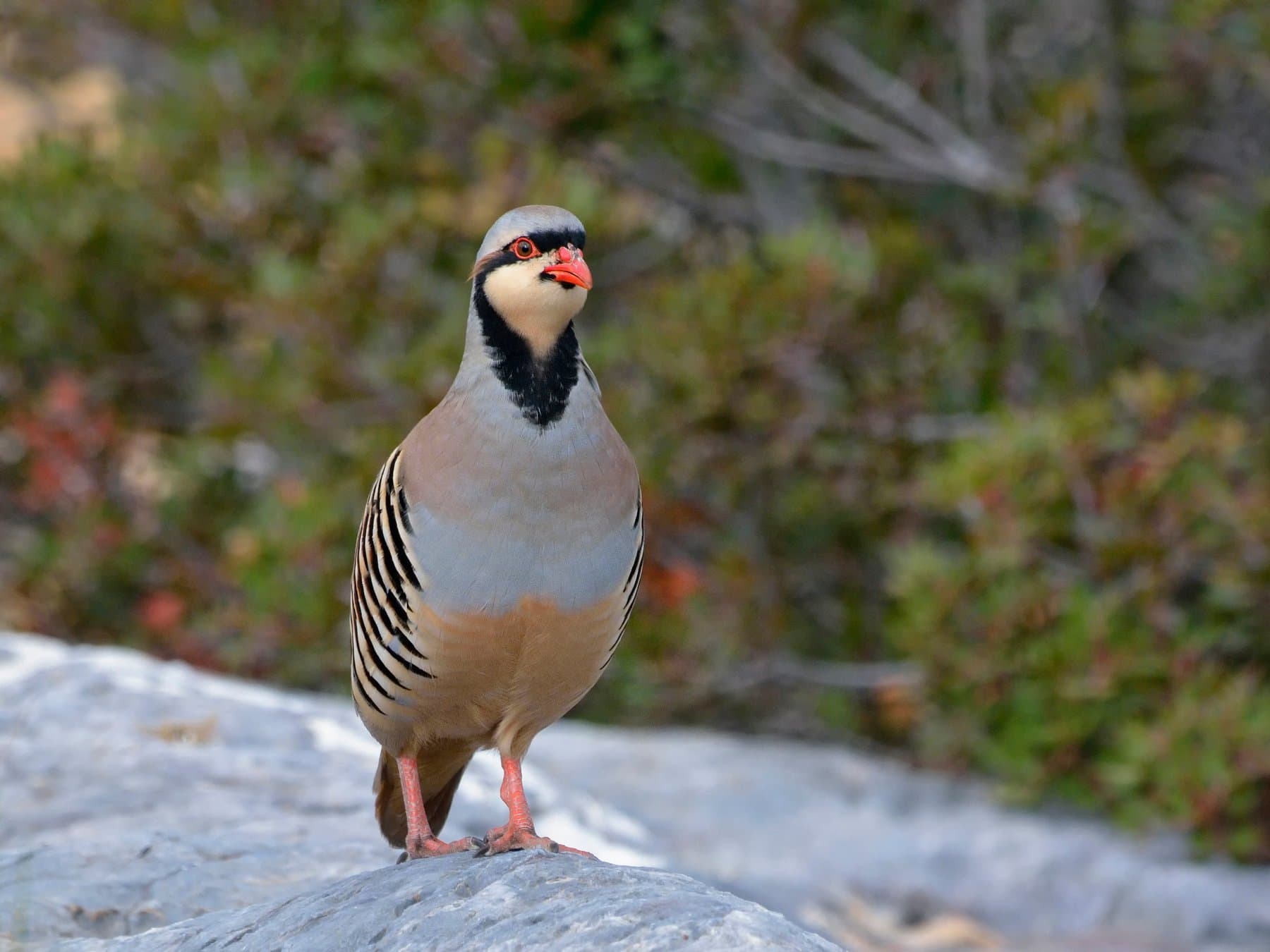
Chukar standing on a rock, with distinctive red bill, black eye stripe, black gorget, grey body, and striped flanks. Blurred green background.
Quick Facts
Conservation
LCLeast ConcernLifespan
3–5 years
Length
32–38 cm
Weight
450–800 g
Wingspan
47–52 cm
Migration
Non-migratory
Bold black necklace, flame-red bill, and flanks striped like a barcode — the Chukar is one of the most instantly recognisable gamebirds in the world. Native to the rocky hillsides of Central Asia and the Middle East, it has been transplanted to the American West, Hawaii, and beyond, where it now thrives in terrain so steep and unforgiving that hunters have nicknamed it the "devil bird."
Appearance
The Chukar is a compact, rotund gamebird — plump-bodied, short-legged, and small-headed — built for scrambling across rocky slopes rather than sustained flight. The upperparts are sandy brown to grey-brown, the breast is blue-grey, and the belly is warm buff. None of those colours, however, are what you notice first.
The defining feature is a bold black band that sweeps from the forehead, through the eye, and down the neck to form a sharply defined "necklace" enclosing a white or creamy-tan throat and cheeks. Below that, the flanks carry vertical bars of black, white, and chestnut — a pattern unique among North American gamebirds and unmistakable in the field. The bill, legs, feet, and bare eye-rings are all bright coral-red, giving the bird a vividly accessorised look.
The tail is short and square-tipped, with 14 feathers; the chestnut outer tail feathers flash conspicuously in flight. The wings are broad and rounded, and the third primary is the longest. Plumage varies geographically: birds in more arid lowland areas tend to be greyer and paler, while those at higher elevations are darker and more intensely barred.
Sexes are very similar in plumage — the Chukar is not strongly sexually dimorphic. Males are slightly larger and heavier (510–800 g versus 450–680 g in females) and typically carry a small tarsal spur on each leg; females may occasionally have a vestigial spur but it is primarily a male trait. Juvenile birds are considerably duller — mottled brown and grey overall, with only faint flank barring and none of the sharp head pattern of adults. They acquire full adult plumage gradually through their first year.
Identification & Characteristics
Colors
- Primary
- Grey
- Secondary
- Buff
- Beak
- Red
- Legs
- Red
Markings
Bold black band from forehead through eye forming a sharply defined necklace enclosing a white/creamy throat; strikingly barred flanks (black, white, and chestnut); coral-red bill, legs, and eye-rings
Tail: Short, square-tipped; 14 feathers; chestnut outer tail feathers conspicuous in flight
Attributes
Understanding Attributes
Rated 0–100 based on research and observation. A score of 50 is average across all bird species. These attributes are relative and don't necessarily indicate superiority.
Habitat & Distribution
The Chukar's native range forms a broad Palearctic belt from southeastern Europe through the Middle East and Central Asia to China. It breeds across Bulgaria, Greece, Turkey, Cyprus, Israel, Jordan, Lebanon, Syria, Iran, Iraq, Afghanistan, Tajikistan, Pakistan, India (particularly Ladakh, Jammu & Kashmir, Himachal Pradesh, and Uttarakhand), Nepal, and across Central Asia to Mongolia and northwestern China. It barely enters Africa on the Sinai Peninsula.
Elevation range in the native range is extraordinary: from around 400 m below sea level in the Dead Sea basin of Israel and Jordan, to approximately 4,000 m (13,100 ft) in the Himalayas and Central Asian ranges. In Pakistan, birds occur as low as 600 m (2,000 ft); in the eastern Himalayas, they are primarily a high-altitude species above 2,000 m.
In North America, self-sustaining introduced populations are established across ten western US states: California, Idaho, Nevada, Washington, Arizona, Colorado, Montana, Oregon, Utah, and Wyoming, as well as British Columbia, Canada. The core of the range is the Great Basin — centred on Nevada, western Utah, southwestern Idaho, northeastern California, and southeastern Oregon. In Colorado, established populations concentrate along the Colorado and Gunnison river drainages below 2,000 m (6,600 ft), particularly in Montrose, Delta, Mesa, and Garfield counties. Chukars have also successfully colonised all six main Hawaiian islands, with the strongest populations on the Big Island, Maui, and Molokai. Introduced populations also exist in New Zealand, Chile, Argentina, and Malta.
In the UK, the Chukar does not occur as a wild bird. Occasional records in counties such as Norfolk, Suffolk, Essex, and Hampshire are attributed to escaped captive birds or released hunting stock. The release of captive-bred Chukar × Red-legged Partridge hybrids has been banned in the UK due to the hybridisation threat to wild Red-legged Partridge populations.
Across its range, the Chukar is strongly associated with steep, dry, rocky terrain — open hillsides with sparse grass, scattered scrub, or cultivation. It is absent from areas of high humidity or heavy rainfall. In North America, birds occupy dry shrublands typically between 1,200 and 4,000 m (4,000–13,000 ft), favouring slopes dominated by big sagebrush (Artemisia spp.), saltbush, ephedra, bitterbrush, and rabbitbrush. They generally avoid dense pinyon-juniper climax forest, though scattered trees are acceptable. Access to water is critical in summer.
Diet
Chukars are predominantly herbivorous as adults, with a diet that shifts considerably through the seasons. Seeds form the bulk of the diet in summer and autumn. In North America, cheatgrass (Bromus tectorum) seeds are the single most important food source — a fact that has profound implications for the species' success as an introduced bird (see Introduced Populations). Other key seeds include Russian thistle (Salsola spp.), rough fiddleneck (Amsinckia retrorsa), cutleaf filaree (Erodium cicutarium), Indian ricegrass (Oryzopsis hymenoides), curly dock (Rumex crispus), wild onion (Allium spp.), and various mustards (Brassica spp.).
After autumn rains green up the hillsides, green grass blades and basal shoots become the dominant food, and in winter they provide the bulk of the diet. This seasonal shift to green vegetation is important: it reduces the birds' dependence on water sources, since fresh plant material provides sufficient moisture. In summer, when birds must drink daily, they concentrate near springs, seeps, and small streams, and foraging routes are structured around access to water.
Serviceberry (Amelanchier spp.) and hawthorn (Crataegus spp.) fruits are taken in summer, along with pinyon pine seeds, sunflower seeds, and tansy mustard. Insects — grasshoppers, caterpillars, and locusts — supplement the diet in spring and summer when available. Chicks rely heavily on insects for protein in their first weeks of life, before transitioning to the seed-and-leaf diet of adults. Foraging is entirely terrestrial: birds scratch at the ground with their strong feet, though they will occasionally climb into low shrubs for berries.
Behaviour
Chukars are gregarious outside the breeding season, moving in tight social groups called coveys that typically number 10–40 birds. Covey members forage together, roost together, and rely on collective vigilance to detect predators. At night, birds roost on the ground — often tucked under sagebrush, junipers, or rock overhangs — sometimes forming tight circles with tails pointing inward and heads facing outward, a configuration that conserves body heat and keeps every bird facing a potential threat.
When alarmed, a Chukar's first instinct is to run rather than fly. They are fast and agile on foot, using their strong legs to sprint uphill with impressive speed. When flushed, they burst into the air with a loud, whirring wingbeat and a piercing alarm call, then typically glide rapidly downhill — a behaviour that makes them notoriously difficult to hunt and has earned them the nickname "devil bird" among American upland hunters.
Foraging follows a predictable daily rhythm: birds are most active in the early morning and late afternoon, often moving toward water sources as part of their feeding circuit. During the breeding season, pairs separate from the covey; in autumn, family groups coalesce back into larger winter coveys. Males are pugnacious during the breeding season, calling persistently from prominent rocks and engaging in physical confrontations with rival males. Predators include golden eagles, hawks, owls, foxes, coyotes, and bobcats, though predation is not considered a population-limiting factor across the species' range.
Calls & Sounds
The Chukar is named for its call — one of the most direct pieces of onomatopoeia in bird nomenclature. The primary vocalisation is a rally call used to regroup scattered covey members and announce territory. It builds in a characteristic progression: a low-intensity series of chuck, chuck, chuck notes that gradually intensify to per-chuck, per-chuck, then escalate to the full chukar-chukar-chukar, which at maximum volume becomes a three-syllable chuckara-chuckara-chuckara. This call carries over long distances and echoes dramatically from rocky cliffs and canyon walls.
Males are most vocal during the breeding season from March to May, when territorial cocks call persistently from prominent rocks and ridgelines, especially in the early morning and evening. A second common call is a shrill whitoo! alarm call, given from the ground when disturbed or when flushed. Chukars also have distinct vocalisations for ground predators versus aerial predators — a distinction that allows covey members to respond appropriately to different threats. Duetting between individuals has been recorded.
Both sexes call, though males are considerably more vocal and pugnacious during the breeding season. The rally call is so reliable and distinctive that it has been used in population surveys: playback elicits a response from nearby birds, though the method is considered only moderately reliable for estimating numbers. The full vocal repertoire includes alarm, social contact, agonistic, and sexual vocalisations, each with distinct acoustic properties. The call's carrying power and the bird's tendency to call from elevated, exposed perches means that Chukars are almost always heard before they are seen.
Flight
The Chukar's flight style reflects its ground-dwelling lifestyle: powerful and fast over short distances, but not built for sustained aerial travel. When flushed, it launches with an explosive burst — a rapid, whirring wingbeat that generates immediate speed — accompanied by a loud alarm call that startles both predators and hunters. The wings are broad and rounded, well suited to rapid acceleration from a standing start on steep terrain.
Once airborne, the Chukar typically glides rather than continues flapping, using the slope of the hillside to its advantage. Its characteristic escape strategy is to fly upward briefly, then glide steeply downhill, covering ground quickly and landing well below the point of flushing. This downhill glide is the behaviour that makes Chukar hunting so physically demanding: the bird lands far below the hunter, who must then descend and climb again to relocate it.
In flight, the chestnut outer tail feathers are conspicuous against the grey-brown upperparts, and the barred flanks may be visible on a banking bird. The wingbeats are audible at close range — a heavy, whirring sound similar to other Phasianidae such as the Grey Partridge. Chukars rarely fly long distances voluntarily; most flights are under 200 m. The broad, rounded wing shape is typical of gamebirds that prioritise explosive short-distance escape over long-distance travel.
Nesting & Breeding
Pair formation begins from mid-February to April depending on latitude and elevation. Males perform elaborate courtship displays: tilting the head, turning sideways to show off the barred flanks, pecking at objects on the ground in a "tidbitting" display, and circling the female with one wing held low and sweeping the ground. Both sexes call during courtship, and males are monogamous, actively guarding their mate from rival males.
The nest is a shallow scrape in the ground, scratched by the female and lined with dry grasses, leaves, and breast feathers. Nests are well concealed under shrubs, overhanging rocks, or dense brush on rocky or steep slopes, and are notoriously difficult to find. In California, nesting birds are typically located within 3.2 km (2 miles) of a water source.
Clutch size ranges from 7 to 21 eggs, averaging around 10–15 under normal conditions. In drought years, clutch sizes are greatly reduced and breeding may not occur at all — weather during the breeding season is the single strongest driver of annual population fluctuations. Eggs are pale white to coffee-coloured, spotted with purplish, reddish, or yellowish-brown markings, and measure approximately 3.7–4.8 cm in length and 3.0–3.2 cm in width. Eggs are laid at a rate of one per day to one per two days.
Incubation lasts approximately 24 days and is carried out almost entirely by the female. The male typically leaves after egg-laying and rejoins bachelor groups, though a small percentage of males remain with the family. Renesting following clutch loss is normal, and double-brooding may occur. Chicks are precocial — covered in down, eyes open, and able to leave the nest and feed themselves within hours of hatching. Individual flight attempts begin at around 10–14 days; brood flights occur by 3 weeks; and by 4 weeks chick flight habits are similar to adults. Full adult size is reached by approximately 12 weeks. Hatching can occur from May through August depending on latitude and whether renesting has taken place.
Lifespan
In the wild, Chukars typically live 3–5 years, though survival rates vary considerably with habitat quality and weather. In demanding environments such as Colorado, Colorado Parks and Wildlife notes that few individuals survive beyond 2 years, with harsh winters and drought years causing significant mortality. The maximum recorded lifespan is 10.5 years, achieved in captivity. A longevity study found that 54% of males survived to 4 years of age, while only 20% of hens reached the same age — a notable disparity that likely reflects the higher energetic costs of egg production and incubation on females.
Annual survival in the wild is strongly influenced by weather during the breeding season. Severe winters reduce overwinter survival directly, while drought years suppress breeding success so dramatically that population recovery can take several seasons. Predation by golden eagles, hawks, owls, foxes, coyotes, and bobcats contributes to mortality but is not considered a population-limiting factor at a landscape scale.
Compared to other Phasianidae, the Chukar's lifespan is broadly similar to the Grey Partridge and Red-legged Partridge, both of which typically live 2–5 years in the wild. The Red Grouse has a similar typical lifespan of 2–3 years, with a maximum of around 7 years — somewhat shorter than the Chukar's captive record of 10.5 years.
Conservation
The Chukar is listed as Least Concern on the IUCN Red List (version 3.1). The global population is estimated at 5,000,000–34,999,999 mature individuals by BirdLife International, with Partners in Flight placing the global breeding population at approximately 7.8 million. The European breeding population alone is estimated at 488,000–1,680,000 pairs (975,000–3,370,000 mature individuals), and the Chinese population at 10,000–100,000 breeding pairs.
The global population trend is stable. The North American Breeding Bird Survey found the introduced population was stable from 1968 to 2019, and Partners in Flight rates the species just 5 out of 20 on the Continental Concern Score — indicating low conservation concern in North America.
The species is relatively unaffected by hunting or habitat loss at a global level. Population numbers are most strongly influenced by weather: severe winters and drought years can cause significant local declines, as clutch sizes shrink dramatically and breeding may cease entirely in extreme drought. Specific threats in parts of the native range include habitat loss and fragmentation from infrastructure development, agricultural expansion, and tourism in high-altitude areas; overhunting and illegal capture for commercial breeding; overgrazing, which degrades foraging habitat; and climate change, which threatens high-altitude habitats through altered precipitation and reduced water availability.
In Europe, the release of captive-bred Chukar × Red-legged Partridge hybrids poses a hybridisation threat to native partridge populations. The UK has banned this practice, as have several other European countries. In captivity, birds are susceptible to Mycoplasma infection and erysipelas outbreaks, which can affect commercial breeding operations.
Population
Estimated: 5,000,000–34,999,999 mature individuals (BirdLife International); c. 7.8 million estimated by Partners in Flight
Trend: Stable
Stable globally. North American Breeding Bird Survey found the introduced population stable from 1968 to 2019. Partners in Flight Continental Concern Score: 5/20 (low concern).
Elevation
Below sea level (Dead Sea basin, ~−400 m) to approximately 4,000 m (13,100 ft) in the Himalayas
Additional Details
- Family:
- Phasianidae (Pheasants & Grouse)
- Predators:
- Golden eagles, hawks, owls, foxes, jackals, wildcats, coyotes, and bobcats
- National bird:
- National bird of Pakistan (designated 1985); known locally as the Chakor
- Roost behaviour:
- Roosts on the ground under sagebrush, junipers, or rock outcrops; sometimes in tight circles with heads facing outward
- Subspecies note:
- 14 recognised subspecies; plumage varies geographically — arid lowland birds are greyer and paler, high-elevation birds are darker and more intensely barred
- Social structure:
- Gregarious outside breeding season; moves in coveys of 10–40 birds
Courtship & Display
Chukar courtship is an elaborate, multi-stage performance that begins as early as mid-February at lower elevations. The male's primary display involves approaching the female in a distinctive lateral posture: he tilts his head, turns sideways to present his barred flanks at maximum visual impact, and lowers one wing so that the primary feathers sweep the ground. This wing-dragging posture, combined with slow, deliberate circling of the female, is the core of the display sequence.
Interwoven with this is "tidbitting" — the male pecks repeatedly at objects on the ground, mimicking food-finding behaviour to attract the female's attention. This is a widespread display strategy among Phasianidae, seen also in domestic chickens and Common Pheasants, and it appears to signal male quality by demonstrating attentiveness and resource-finding ability. Both sexes call during courtship, and the male's territorial rally call — delivered from a prominent rock — serves simultaneously to advertise his presence to females and warn off rival males.
Males are monogamous and defend their mate actively. Rival males engage in face-to-face confrontations that can escalate to physical combat, with birds using their tarsal spurs as weapons. During drought years, when food resources are scarce, breeding activity may be restricted to only a few dominant individuals within a covey, with subordinate birds failing to pair at all. This flexible breeding strategy — scaling reproductive effort to resource availability — is one reason the species can recover quickly from poor years when conditions improve.
Cultural Significance
Few gamebirds carry as much cultural weight as the Chukar. In Pakistan, it was officially designated the national bird in 1985 — known there as the Chakor — in recognition of its deep historical and symbolic significance across the subcontinent. The choice was not arbitrary: the Chakor appears in Sanskrit texts as far back as the Markandeya Purana (c. 250–500 AD), where it is described as a bird so enamoured of the moon that it gazes at it ceaselessly and is believed to feed on moonbeams. This image of the Chakor as a symbol of intense, often unrequited love became one of the most enduring metaphors in South Asian literature.
The moon-gazing Chakor permeates Sufi poetry, Punjabi folk songs, Urdu ghazals, and Mughal miniature paintings. Poets from Rumi to Bulleh Shah used the Chakor's longing for the moon as a metaphor for the soul's yearning for the divine, or the lover's ache for the beloved. The image is so deeply embedded that "Chakor" is still used as a term of endearment in parts of Pakistan and northern India today.
In the American West, the Chukar has acquired a very different cultural identity. Its preference for near-vertical rocky terrain at high elevation, combined with its infuriating habit of gliding downhill when flushed, has made it the subject of a devoted — and frequently exasperated — hunting culture. British sportsmen in colonial India similarly noted that Chukars could fly considerable distances after being shot, making retrieval without dogs nearly impossible. The bird's reputation for making hunters work harder than any other upland quarry has, paradoxically, made it one of the most sought-after gamebirds in the western United States.
Introduced Populations
The Chukar's establishment across the American West is one of the more instructive stories in the history of wildlife introductions. The first birds were brought to the United States from Pakistan in 1893, but those early releases failed to establish. Between 1931 and 1970, wildlife managers tried again on a massive scale: over 795,000 Chukars were released across 41 US states, Hawaii, and parts of Canada. The results were strikingly uneven. Releases in the eastern United States, the Midwest, and the humid Pacific Northwest all failed. Only in the arid, rocky terrain of the Great Basin and Columbia Basin did self-sustaining populations take hold.
The key variable was cheatgrass (Bromus tectorum), an invasive Eurasian annual grass that had been spreading across the Great Basin since the late 19th century. By the mid-20th century, cheatgrass dominated millions of hectares of previously marginal shrubland — and its seeds are among the Chukar's most important food sources. The bird and the weed are both Eurasian in origin, and their ecological requirements aligned almost perfectly. The Chukar's success in the American West was, in large part, an unintended consequence of a separate biological invasion.
In Hawaii, the story took a different turn. Chukars were introduced to the islands in the 20th century and have successfully colonised all six main Hawaiian islands, with the strongest populations on the Big Island, Maui, and Molokai. Research has found that Hawaiian Chukars disperse and promote germination of seeds from native Hawaiian plants, potentially filling an ecological role vacated by extinct native birds. Whether this constitutes genuine ecological restoration or simply the substitution of one non-native dynamic for another remains a subject of scientific debate — but it represents one of the more nuanced outcomes of any gamebird introduction worldwide.
Birdwatching Tips
In the American West, the best strategy for finding Chukars is to look up — literally. Birds favour steep, rocky hillsides with sagebrush and sparse grass, often at elevations between 1,200 and 2,500 m. The Snake River canyon in Washington and Oregon, the Great Basin of Nevada and western Utah, and the river drainages of western Colorado (particularly Montrose and Delta counties) are among the most reliable locations. Early morning is the prime time: birds are most active in the first two hours after dawn, moving toward water sources and calling frequently.
The call is your best detection tool. The Chukar's loud, carrying chukar-chukar-chukar rally call echoes from rocky cliffs and can be heard from several hundred metres. Playback reliably elicits a response from nearby birds, making it useful for population surveys, though this method is considered only moderately reliable for counting individuals. Listen for the sharp whitoo! alarm call when birds are flushed.
In the field, the bold black necklace and barred flanks make identification straightforward. The only likely confusion species in North America is the Red-legged Partridge (Alectoris rufa), which is very similar but has a red-bordered white throat patch (rather than the Chukar's black-bordered creamy throat) and lacks the Chukar's clean grey breast. In the native range, the See-see Partridge (Ammoperdix griseogularis) shares similar rocky habitat but is much smaller and lacks the bold necklace.
In Hawaii, Chukars are most easily found on the upper slopes of Mauna Kea and Mauna Loa on the Big Island, and on the drier eastern slopes of Haleakalā on Maui. They are most vocal and visible in the early morning. In New Zealand, small introduced populations persist in the South Island's Mackenzie Basin and Central Otago — areas of dry, rocky tussock grassland that closely resemble the species' native habitat.
Did You Know?
- Chukar chicks helped crack one of ornithology's biggest puzzles: the evolution of bird flight. Before they can fly, young Chukars use Wing-Assisted Incline Running (WAIR) — flapping their partially developed wings to generate downforce and traction, allowing them to sprint up slopes as steep as 105° from the horizontal. Research at the University of Montana showed that chicks with trimmed wing feathers could not scale nearly as steep a slope, demonstrating that even partially developed wings have real aerodynamic function. This behaviour is now the leading evidence for the "ground-up" hypothesis of how powered flight evolved from running dinosaurs.
- The Chukar's successful colonisation of the American West was largely an accident of invasion biology. The spread of cheatgrass (Bromus tectorum) — an invasive Eurasian grass — across the Great Basin in the 20th century created millions of hectares of ideal Chukar habitat almost overnight. Between 1931 and 1970, over 795,000 Chukars were released across 41 US states, but only the western populations — where cheatgrass had taken hold — established self-sustaining wild populations.
- The Chukar is the national bird of Pakistan, where it is known as the Chakor. In Hindu mythology and Sufi poetry, the Chakor symbolises intense, unrequited love — depicted as gazing longingly at the moon, believed to feed on moonbeams. This imagery appears in Sanskrit texts as far back as the Markandeya Purana (c. 250–500 AD) and permeates folk songs and paintings across South Asia.
- In Hawaii, introduced Chukars have taken on an ecological role once filled by now-extinct native birds. Research has found that Chukars aid in the dispersal and germination of seeds from important native Hawaiian plants, potentially contributing to the restoration of degraded ecosystems across all six main Hawaiian islands.
- The maximum recorded lifespan for a Chukar is 10.5 years in captivity. In the wild, most birds live 3–5 years, and in challenging environments such as Colorado, few individuals survive beyond 2 years.
Records & Accolades
National Bird of Pakistan
Since 1985
Officially designated Pakistan's national bird in 1985, the Chukar (known locally as the Chakor) holds deep cultural and mythological significance across South Asia, appearing in Sanskrit texts dating back to c. 250–500 AD.
Steepest Climber
105° slopes
Chukar chicks can scale slopes steeper than vertical — up to 105° from the horizontal — using Wing-Assisted Incline Running (WAIR), a behaviour that inspired the leading scientific hypothesis for how bird flight evolved from ground-running dinosaurs.
Widest Elevation Range
~400 m below sea level to 4,000 m
The Chukar breeds across a greater elevation range than almost any other partridge — from the Dead Sea basin, around 400 m below sea level, to approximately 4,000 m in the Himalayas and Central Asian mountain ranges.
Community Photos
Be the first to share a photo of the Chukar
Upload a PhotoIdentify Any Bird Instantly
- Upload a photo from your phone or camera
- Get an instant AI identification
- Ask follow-up questions about the bird
Monthly Birds in Your Area
- Personalised for your location
- Seasonal tips and garden advice
- Updated every month with new species