


Red-legged Partridge
French Partridge · Alectoris rufa
By the Birdfact teamChecked by Nathan Cope
On this page14 sections
How to recognise it
What do Red-legged Partridges look like?
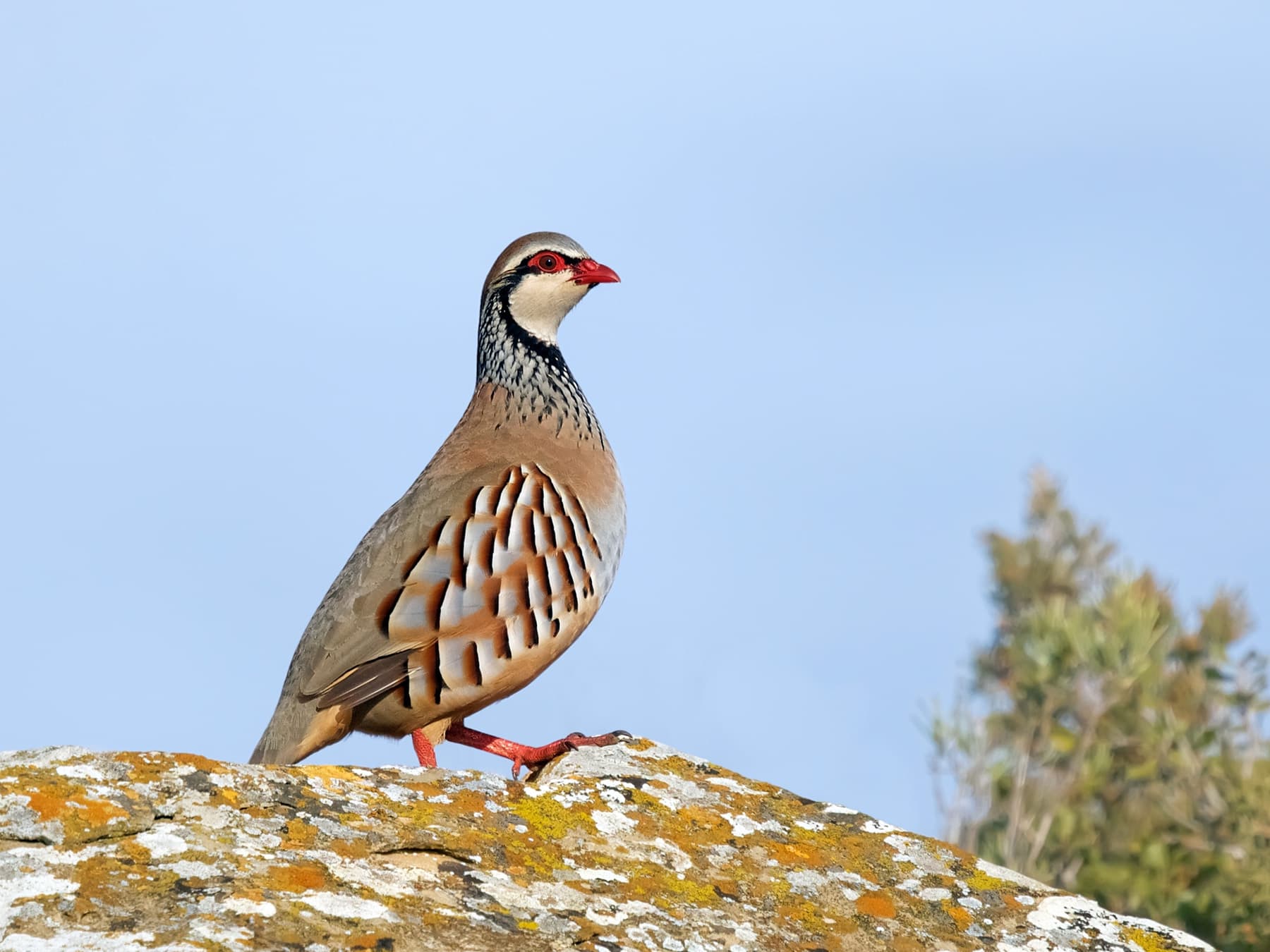
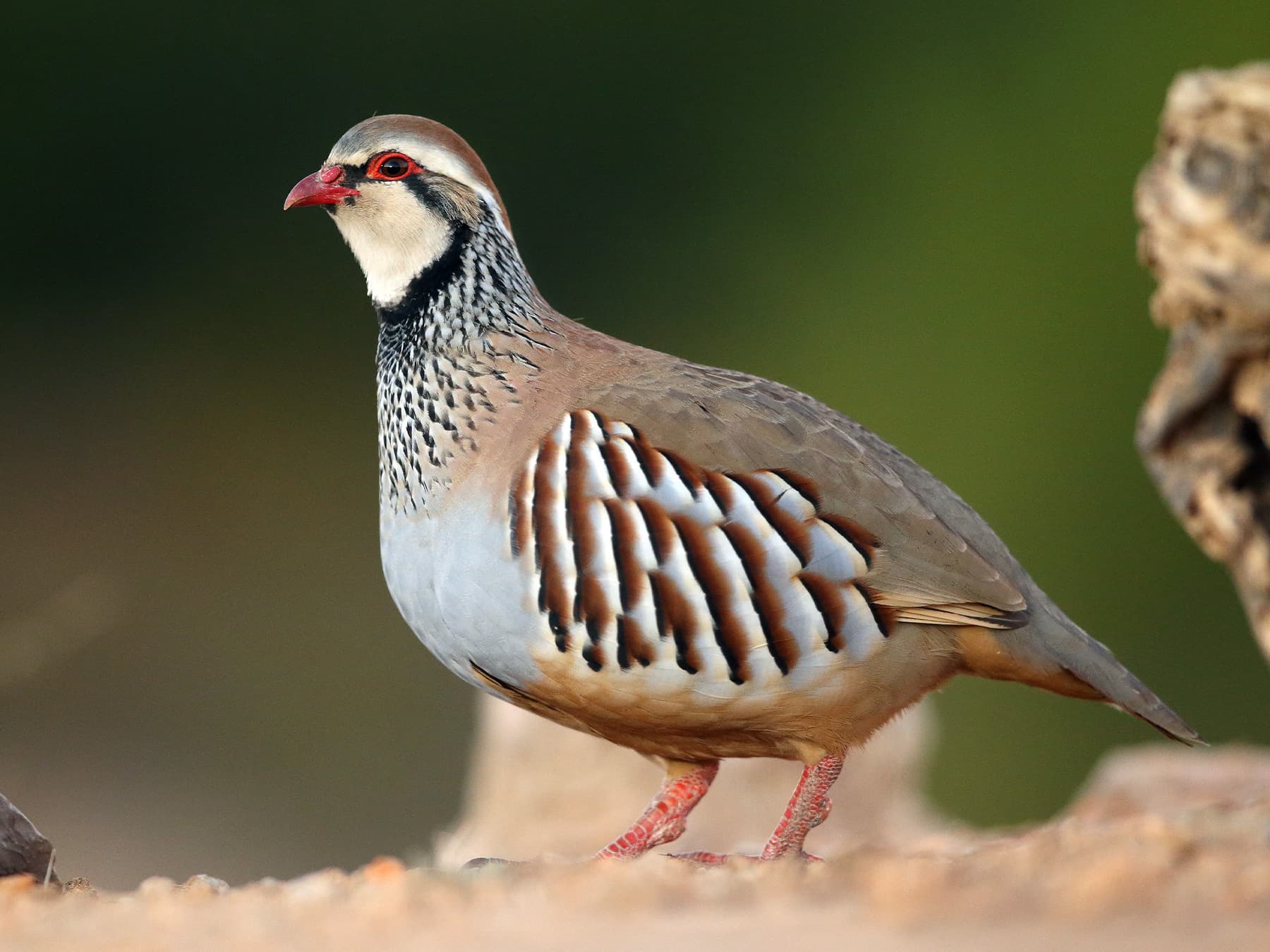
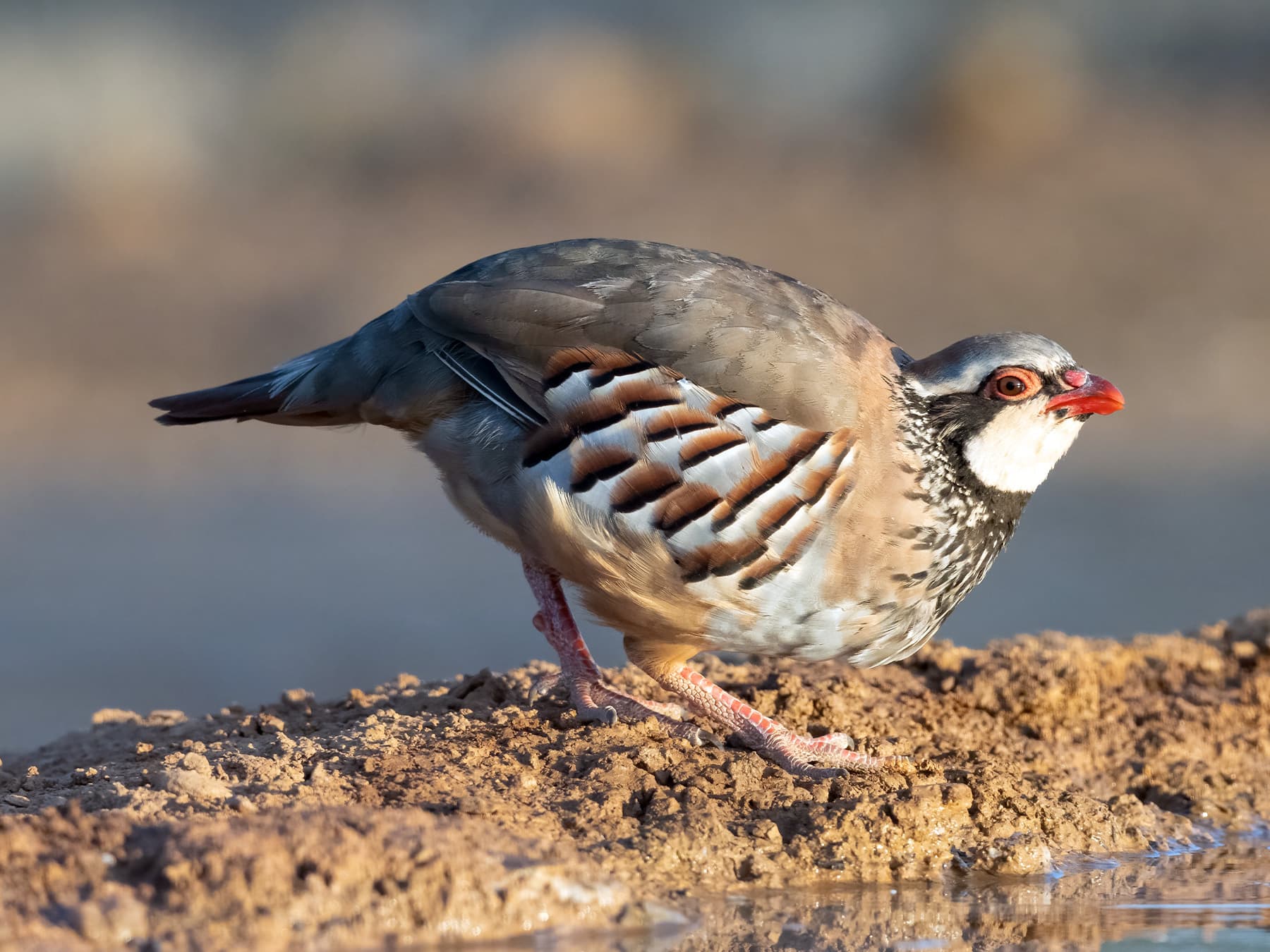
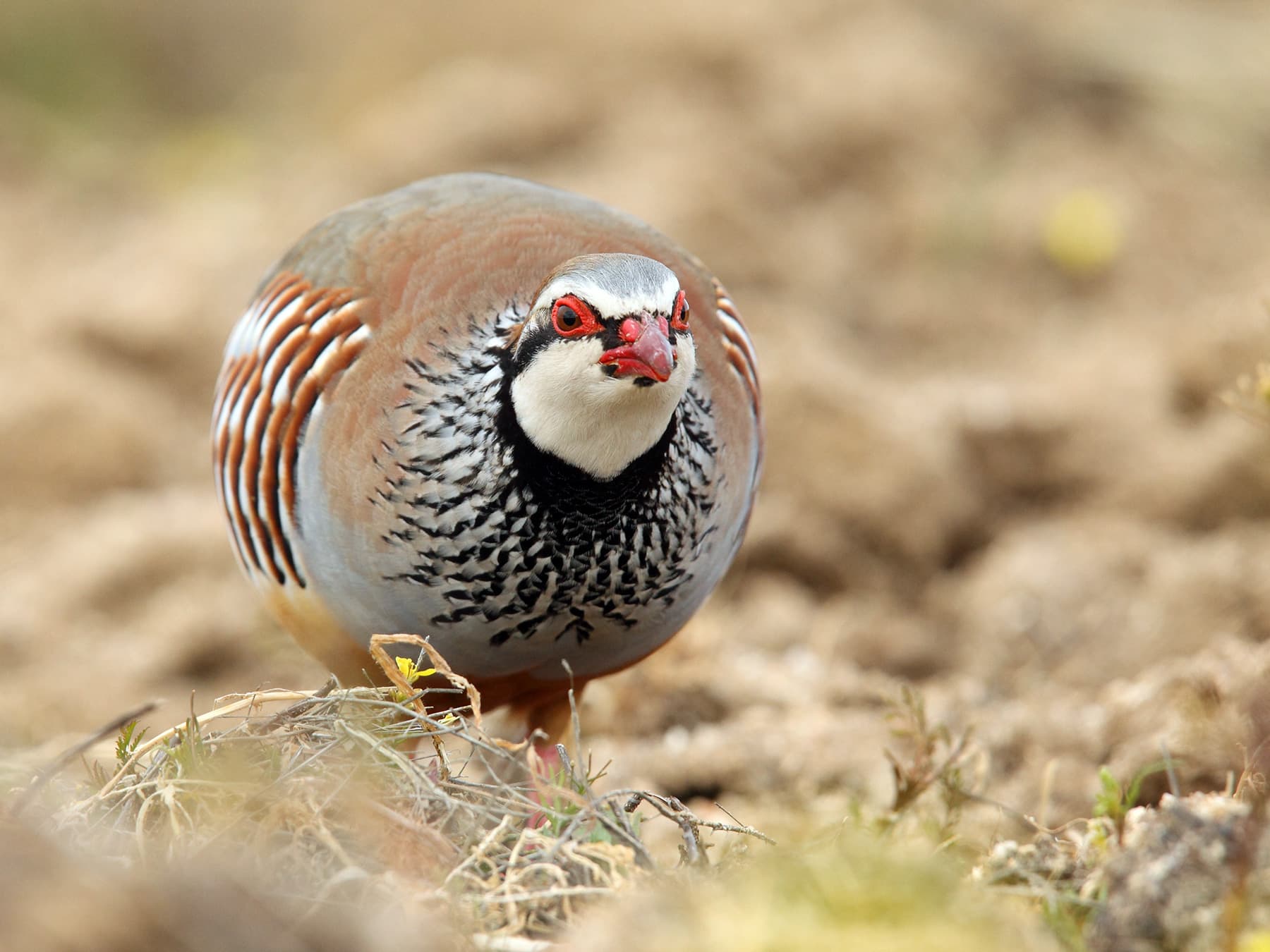
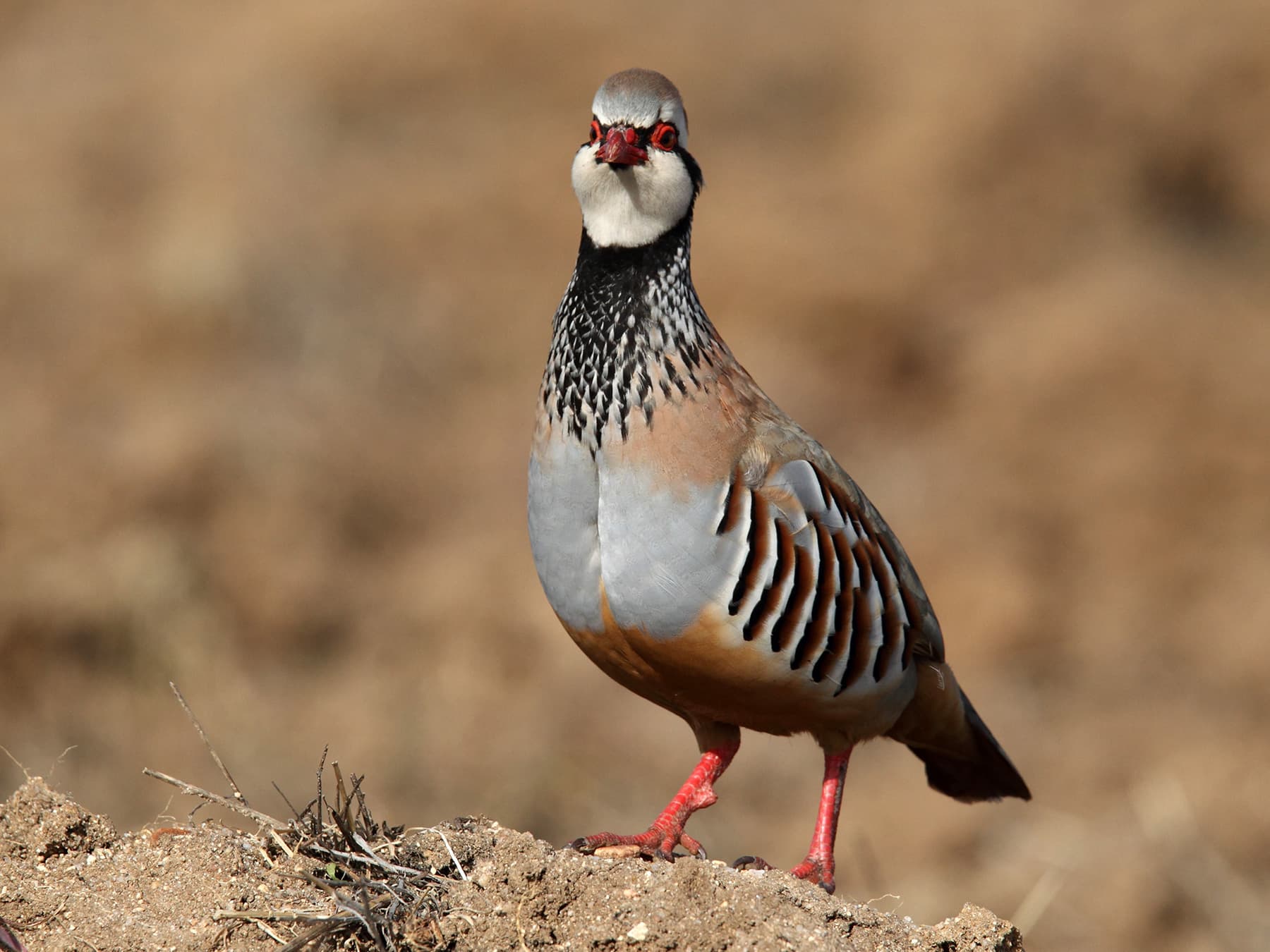
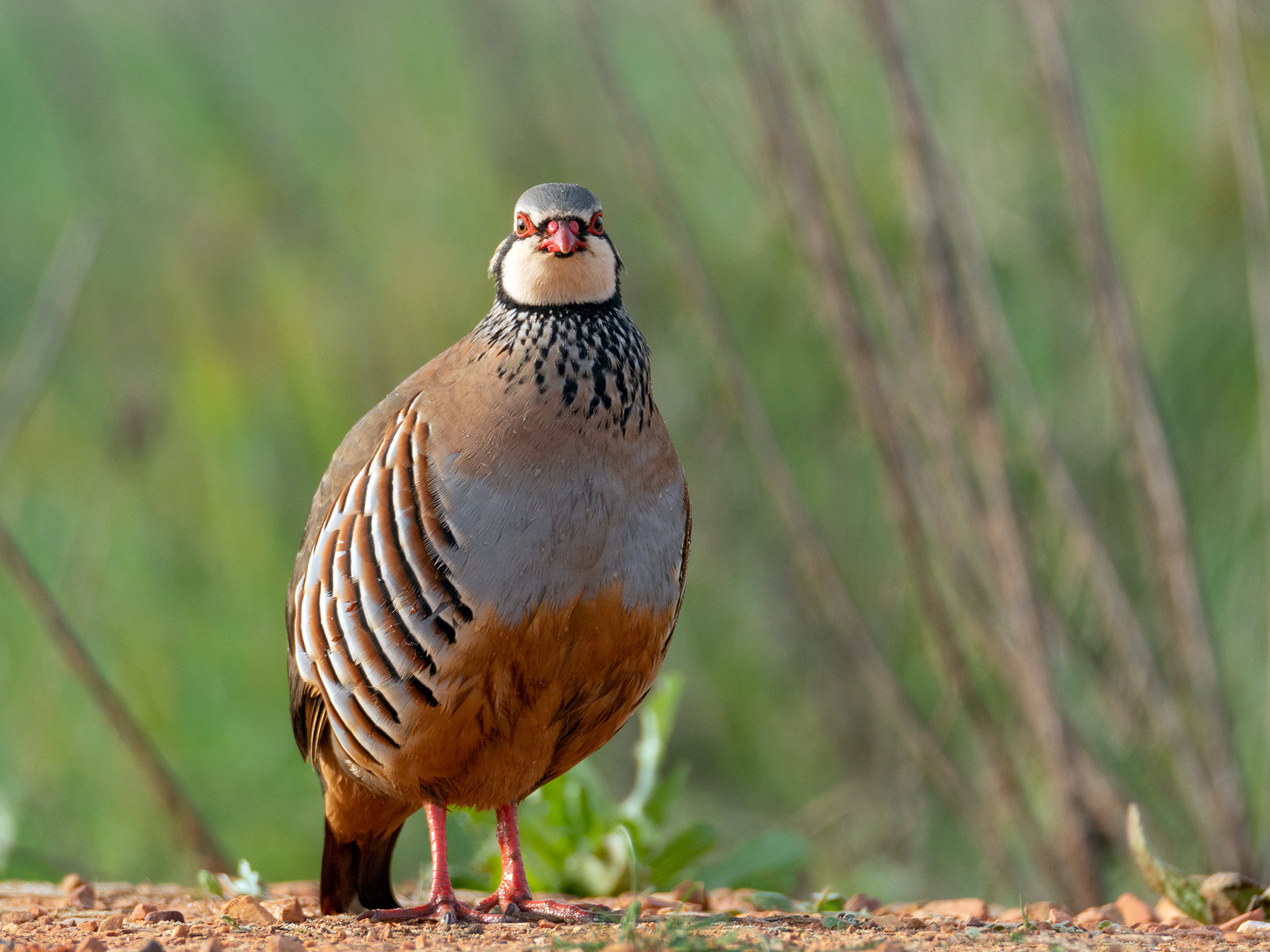
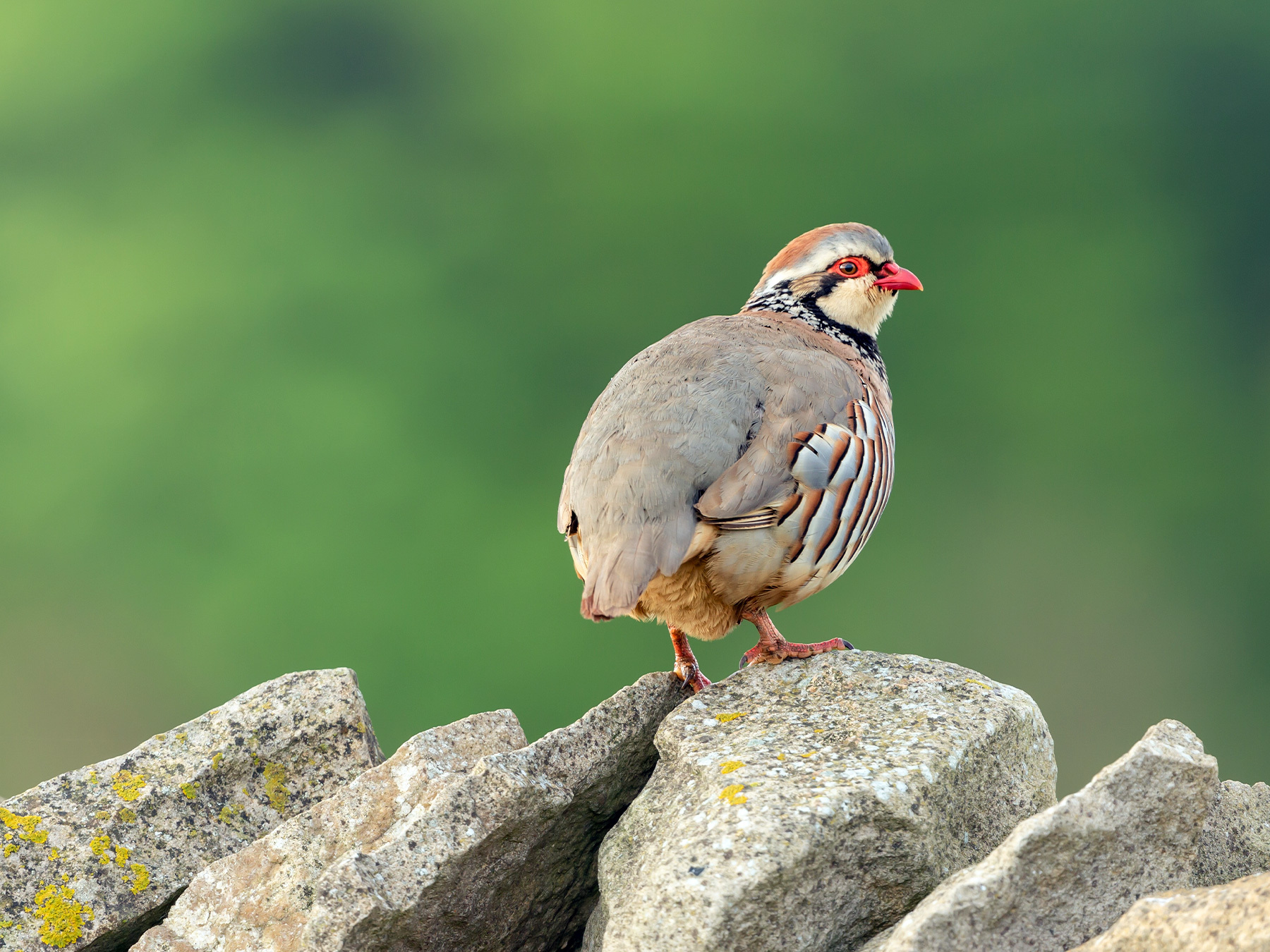
Red-legged Partridges are attractive gamebirds with bright red legs, bills, and rings around their eyes. They have a white eyebrow stripe and a white chin and throat, surrounded by a bold black ring that passes through each eye.
They are plain brown on the back, wings, and crown but have pale sides marked with long black and brown bars. A broad black and white ‘necklace’ covers the breast and sides of the neck. Their belly, vent, and undertail are warm cinnamon, and the breast is blue-grey.
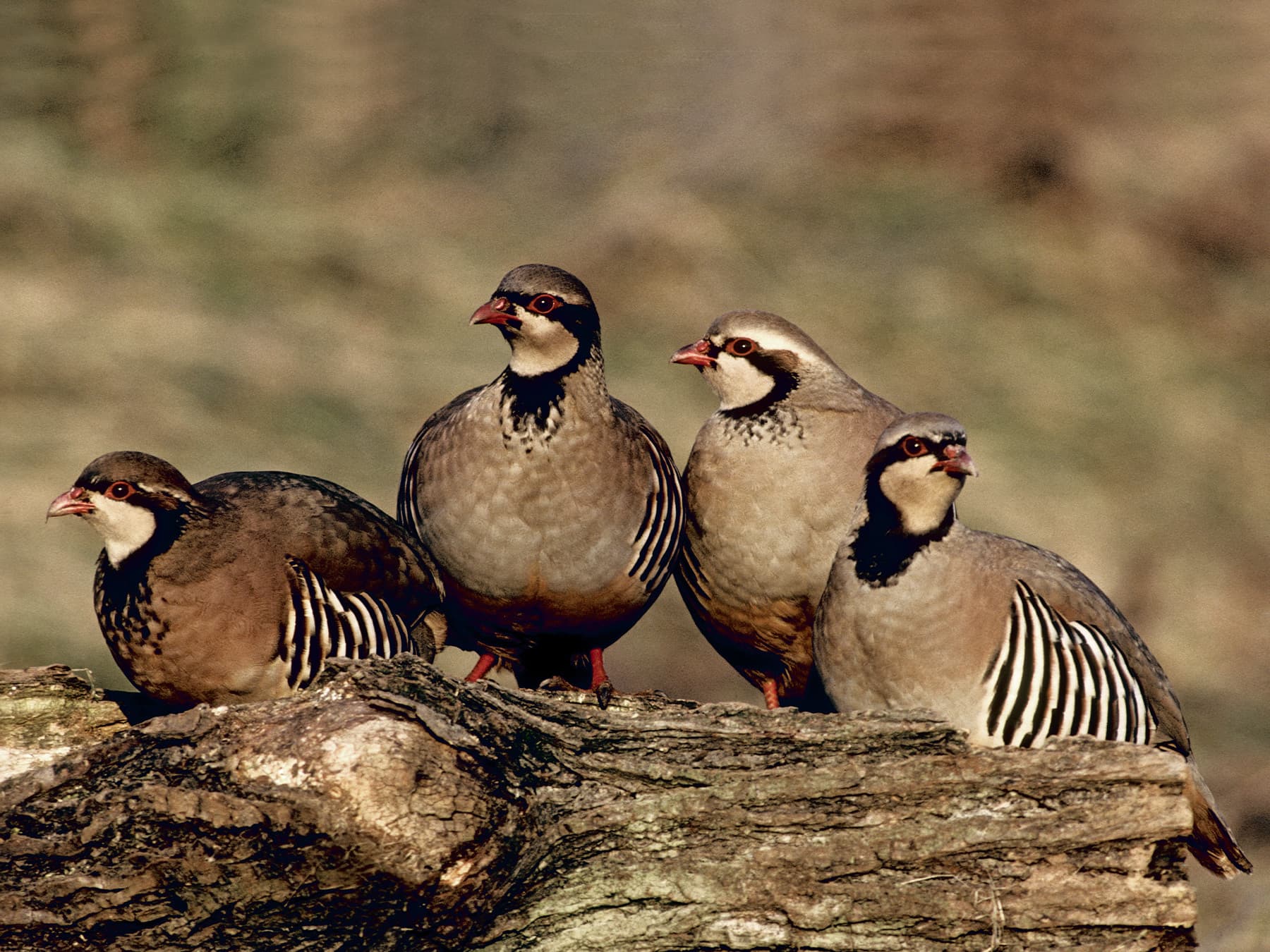
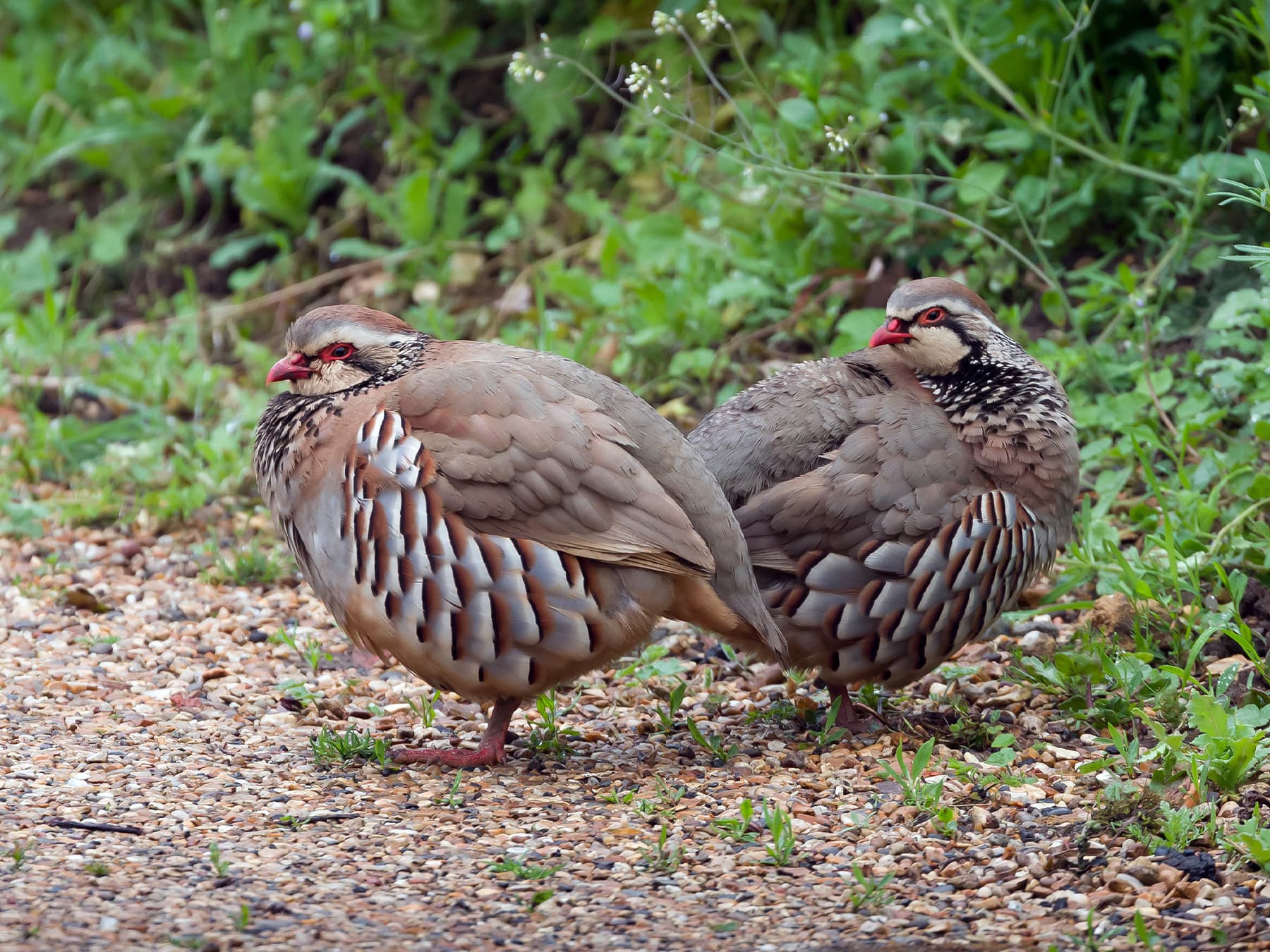
Females are very similar to males, although they are slightly smaller and lack leg spurs.
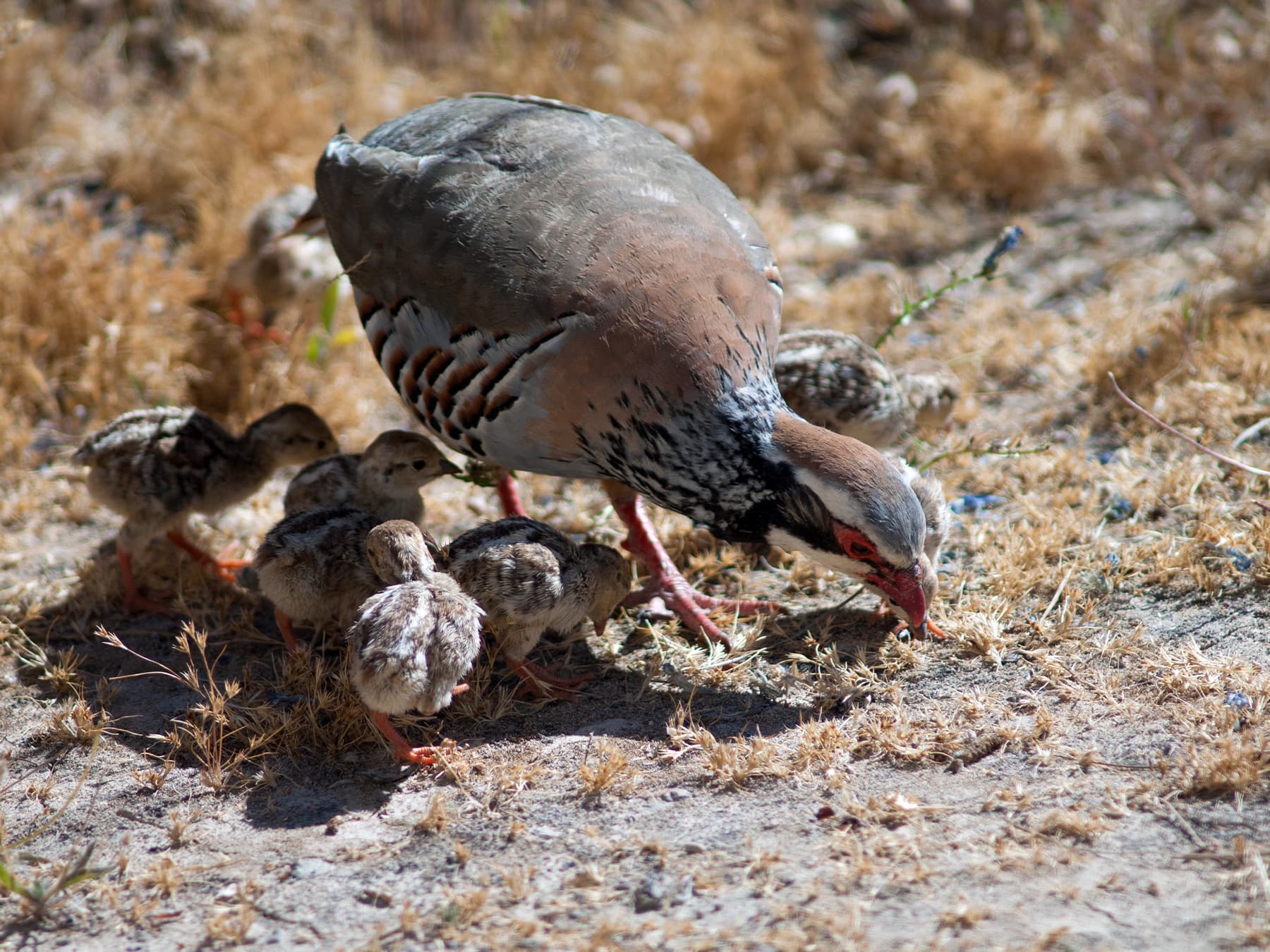
Juveniles attain adult-like plumage when they are about four months old. Before then, they are smaller and duller, with indistinct markings on the head and throat and pinkish-brown legs and bills.
This species could be confused with the indigenous Grey Partridge, although the combination of red legs and bill and contrasting black and white head and throat markings are distinctive.
How big are Red-legged Partridges?
These small, chunky gamebirds are larger than the Grey Partridge but smaller than the Pheasant.
Length
Red-legged Partridges measure 32 to 38 centimetres from tail to bill. They are stocky, short-necked birds with fairly short legs and tails.
Weight
Adults weigh 400 to 550 grams, and males tend to be the heavier sex.
Wingspan
These ground birds have short, broad wings and a 47 to 50-centimetre wingspan.
Its size
Adults- Length
- 32–34 cm
- Wingspan
- 47–50 cm
- Weight
- 400–550 g
Its song and calls
What sound does a Red-legged Partridge make?
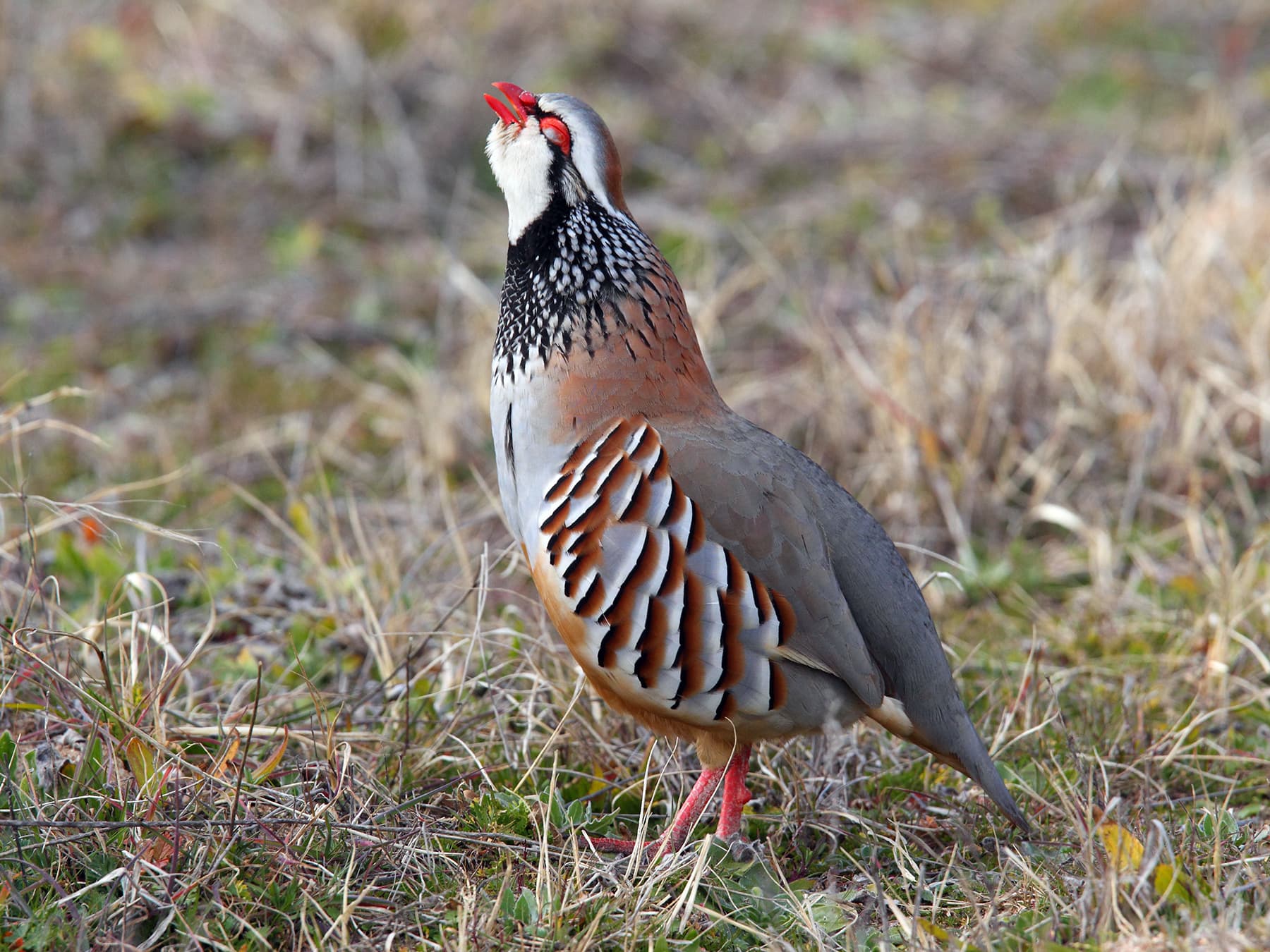
Red-legged Partridges produce harsh scratchy chuckling calls. Their territorial call starts off softly but builds to a loud series of rhythmic two or three-noted ‘chuk-chuk’ phrases. Flushed birds make a higher-pitched, shrieking alarm call.
- Song0:00 / 0:15
Recorded in Occitanie, France · May 2024
- Call0:00 / 0:06
Recorded in Occitanie, France · May 2026
When and where to see it
OctoberIn season
Most recorded in October
- 1. Midlothian0.63%
- 2. Wiltshire0.57%
- 3. Bedfordshire0.44%
- 4. Rutland0.36%
- 5. Angus0.34%
Each dot is a county, state or province: the bigger and darker, the larger the bird’s share of that place’s bird records that month. Grey dots: no regular records. The ringed point is the centre of the bird’s records this month; the arrow shows how it moved since last month, and the dashed loop its path through the year. “Arrivals” colours places where it becomes regular this month (orange) or is in its last regular month (grey). GBIF eBird Observation Dataset, 2019–2024. Map data: Natural Earth, US Census Bureau; place centres © OpenStreetMap contributors.
In your area
See when the Red-legged Partridge is recorded in your county, state or province.
How often the Red-legged Partridge turns up in the UK through the year, from birdwatchers' records.
United Kingdom
Resident · all year · most records in April
Show as a table
| Month | United Kingdom |
|---|---|
| January | 0.13% (regular) |
| February | 0.14% (regular) |
| March | 0.20% (regular) |
| April | 0.21% (regular) |
| May | 0.20% (regular) |
| June | 0.13% (regular) |
| July | 0.080% (regular) |
| August | 0.078% (regular) |
| September | 0.098% (regular) |
| October | 0.12% (regular) |
| November | 0.11% (regular) |
| December | 0.099% (regular) |
Recorded regularly in
Worldwide: recorded regularly in 7 countries
Countries where it was recorded in at least 3 of the 6 years 2019–2024. Linked countries have their own bird list.
Data: EOD – eBird Observation Dataset (Cornell Lab of Ornithology), accessed via GBIF.org, CC BY 4.0. Records from 2019–2024, aggregated and filtered by Birdfact. How these lists are made
What is the habitat of a Red-legged Partridge?
Red-legged Partridges live in various open, dry habitats ranging from farmland to stony mountain slopes. They are most common in lowland arable farmland in the United Kingdom.
What is the range of a Red-legged Partridge?
Red-legged Partridges are native to Europe, where they occur primarily in Portugal, Spain, France, and Italy. They are a widespread introduced species in the United Kingdom, naturalised in England, Wales, Scotland, and Northern Ireland.
Where do Red-legged Partridges live?
Red-legged Partridges live on the ground in open, dry countryside. They can fly, although they prefer to run from danger.
How rare are Red-legged Partridges?
About 72,500 pairs of Red-legged Partridges nest in the UK. However, their numbers vary greatly through the year since millions of captive birds are released annually for hunting. This number has increased over the last few decades, with about 10 million individuals released in 2016 alone.
Where can you see Red-legged Partridges in the UK?
Red-legged Partridges are widespread in low-lying, open country, particularly in the east of England. Look out for coveys in arable farmland, pasture, and unimproved grassland.
Migration
Do Red-legged Partridges migrate?
Red-legged Partridges do not migrate. They can be seen throughout the year, although populations from high-altitude areas may move downslope for the winter.
Tips for seeing it
- Look for Red-legged Partridges in open farmland, especially near field edges or hedgerows.
- Listen for their distinctive 'chuck-chuck' call, especially early morning or evening.
- Scan the ground carefully, as these birds blend well with their surroundings.
- In the UK, check areas with chalky or sandy soils where they are more common.
What it eats
What do Red-legged Partridges eat?
Red-legged Partridges are mainly vegetarian, although they do eat ants and other invertebrates in the summer. Grasses, roots, seeds, leaves, and fruits are important in their diet.
What do Red-legged Partridge chicks eat?
Chicks eat more arthropod invertebrates than adults, but they also eat grain, weed seeds, flowers, and leaves.
Nesting and breeding
Where do Red-legged Partridges nest?
Male Red-legged Partridges build a nest on the ground in a shaded spot. It is little more than a scrape, lined with plant material. These birds may build two nests in some years, with each parent incubating a separate clutch of eggs. This behaviour increases their chance of avoiding predators.
When do Red-legged Partridges nest?
Red-legged Partridges nest in spring. They lay their eggs in late April or May in the United Kingdom but may begin in January or February in southern Europe. The eggs hatch after 23 to 25 days, and the precocial hatchlings leave the nest soon after. The young are fully grown at about two months old but remain together as a family for their first winter.
What do Red-legged Partridge eggs look like?
Red-legged Partridges lay about 12 eggs per clutch on average, although up to 28 eggs have been recorded. They are whitish or yellowish with reddish spots, measuring roughly 40 millimetres long and 31 millimetres wide.
Do Red-legged Partridges mate for life?
Red-legged Partridges form long-term, stable pair bonds that may last for life. They are generally monogamous, although bigamy has been recorded.
Behaviour
Are Red-legged Partridges aggressive?
Red-legged Partridges are gregarious and often seen in coveys of two or more adults and their young, although they may form large groups of 70 or more individuals. Larger flocks occur outside the breeding season, although non-mated birds remain in groups throughout the year.
Lifespan and predators
How long do Red-legged Partridges live?
Red-legged Partridges are relatively short-lived birds, with a maximum recorded lifespan of seven years and seven months.
What are the predators of Red-legged Partridges?
Red Foxes, Wild Boar, lizards, and corvids like Magpies are major Red-legged Partridge nest predators. Humans, feral cats, and birds of prey like Peregrine Falcons and Bonelli’s Eagles hunt adults.
Are Red-legged Partridges protected?
Red Legged Partridges are protected by the UK’s Wildlife and Countryside Act and the EU Birds Directive.
Are Red-legged Partridges endangered?
Red-legged Partridges are listed as ‘Near Threatened’ on the IUCN Red List. This species has declined significantly in its native range due to habitat loss and overhunting.
Conservation
Listed as Near Threatened globally, Red-legged Partridges face localised pressures from habitat loss, intensive farming practices and overhunting.
In the UK, where they were introduced, conservation efforts focus on maintaining suitable habitats through wildlife-friendly farming methods and managing populations for sustainable game shooting.
Similar birds
Often mistaken for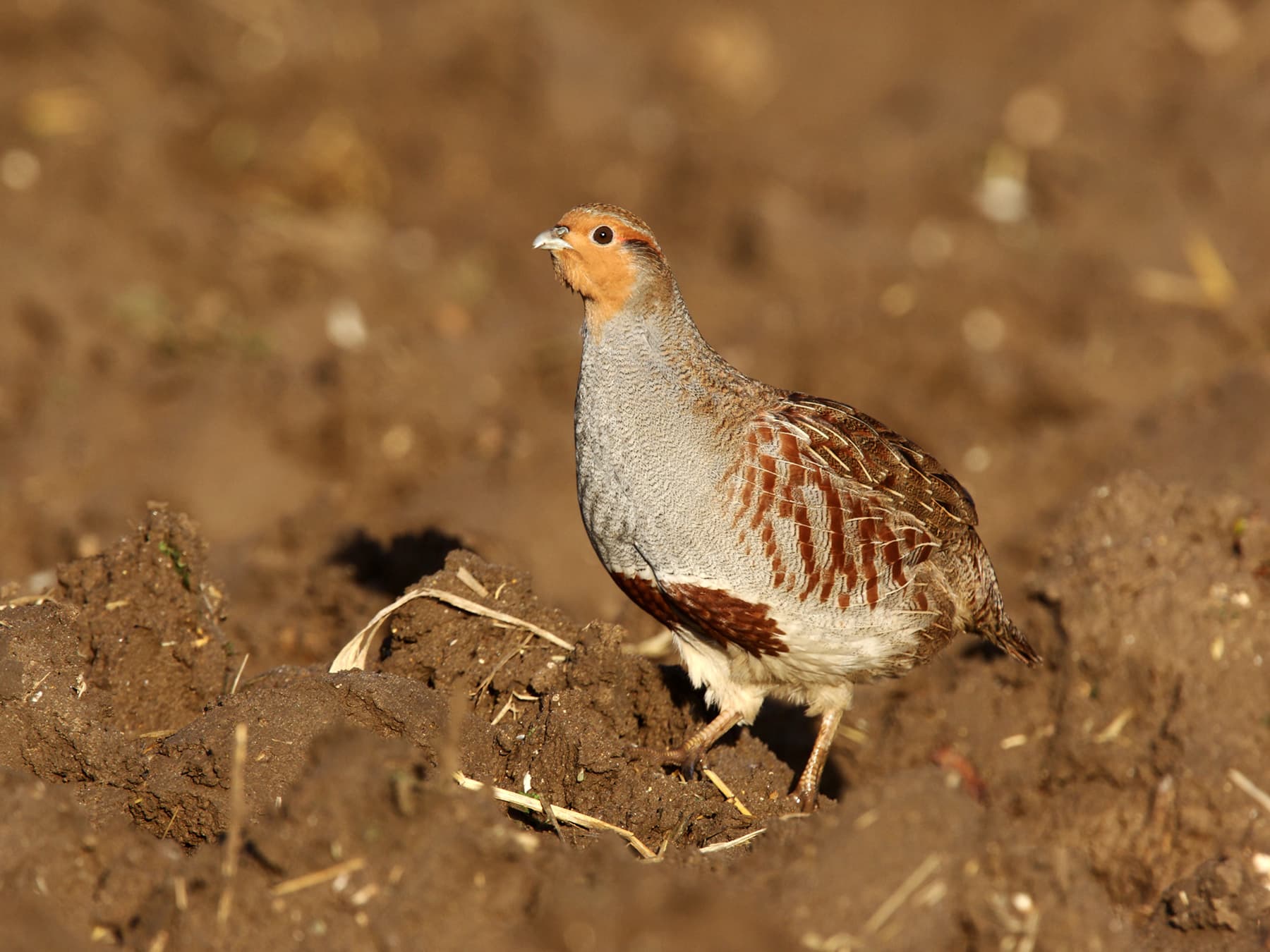
More photos
3 photos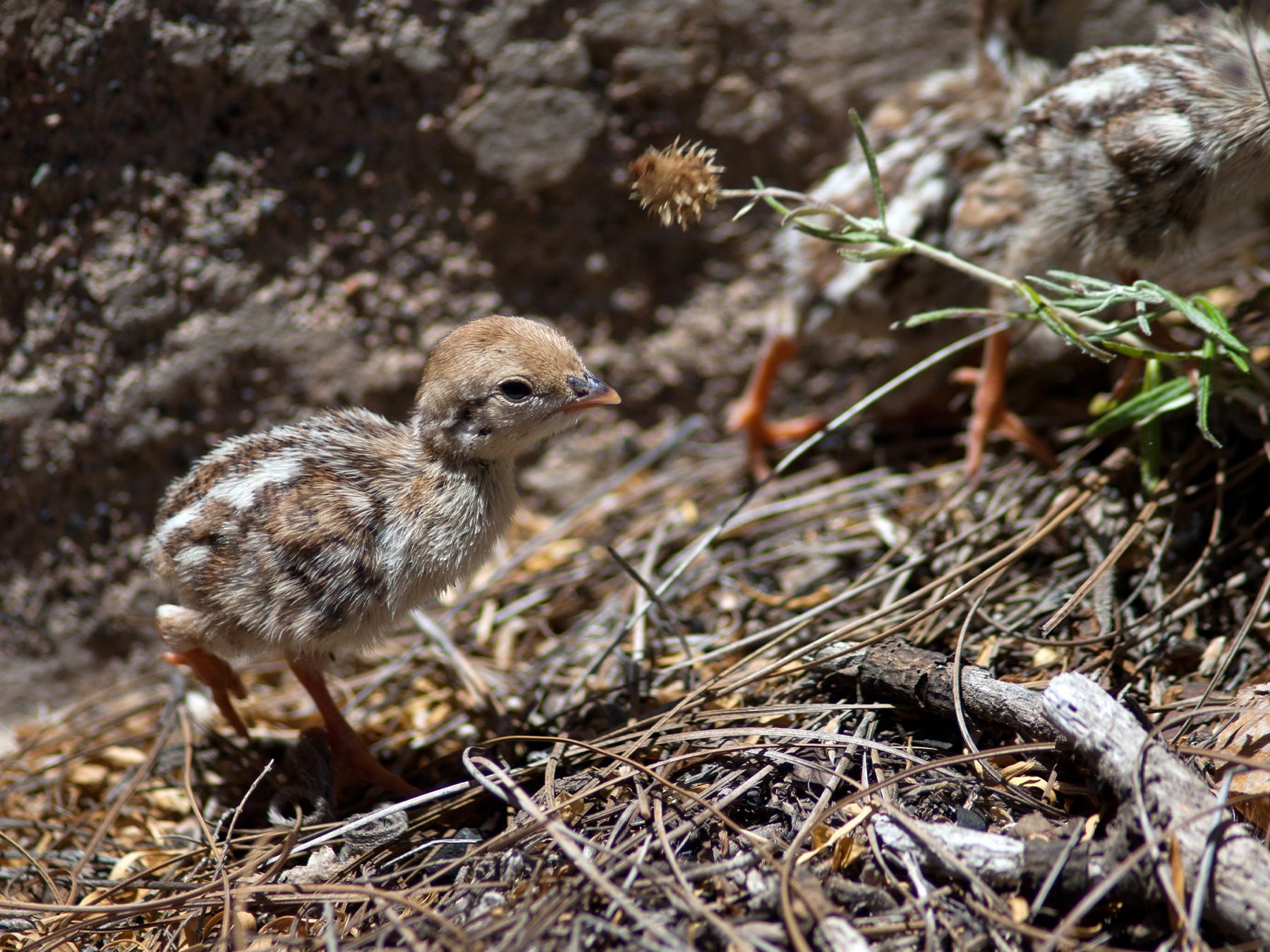
Quick facts
- Length
- 32–34 cm
- Wingspan
- 47–50 cm
- Weight
- 400–550 g
- Lifespan
- 3–5 years · oldest recorded 7.5 years
- Family
- Pheasants & Grouse
- Migration
- Resident
- Global status (IUCN)
- Near Threatened
- World population
- 9,950,000 - 13,700,000 mature individuals
- Population trend
- Decreasing
- Also called
- French Partridge
- Scientific name
- Alectoris rufa
Questions
1Do Red-legged Partridges visit gardens?
Red-legged Partridges occasionally visit gardens, although they are most at home in open farmland. Country gardens adjacent to open fields are most likely to attract these beautiful ground birds.
Sources
4- 1BirdLife International. 2021. Alectoris rufa (Europe assessment). The IUCN Red List of Threatened Species 2021: e.T22678711A166184840. Source (opens in a new tab)
- 2BirdLife International. 2021. Alectoris rufa (Europe assessment). The IUCN Red List of Threatened Species 2021: e.T22678711A166184840. Source (opens in a new tab)
- 3BirdLife International. 2021. Alectoris rufa (Europe assessment). The IUCN Red List of Threatened Species 2021: e.T22678711A166184840. Source (opens in a new tab)
- 4BTO longevity records: maximum age from a ringed bird, 7 years, 7 months, 2 days (set in 1975), BirdFacts: Red-legged Partridge (1975) Source (opens in a new tab)

Checked by
Nathan Cope, founder and editor
Nathan founded Birdfact and leads its writers and contributors in the UK, the US and Canada. He has watched and studied birds for more than ten years, and checks every article and species guide before it’s published.