Species Profile
Cape May Warbler
Setophaga tigrina
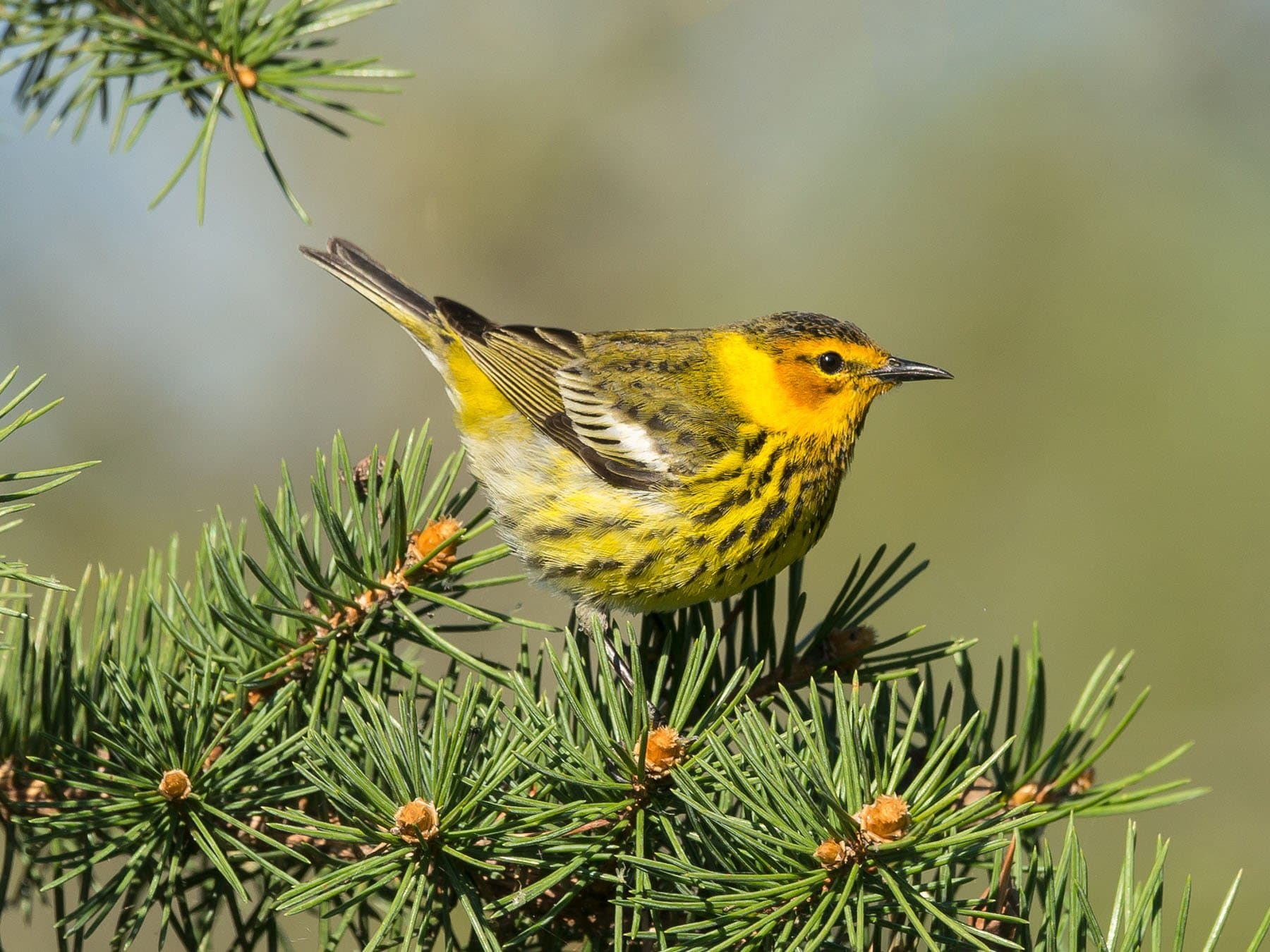
Cape May Warbler perched on a pine branch. Features yellow face, black streaking on chest, olive-green back, and black cap.
Quick Facts
Conservation
LCLeast ConcernLifespan
2–5 years
Length
12–14 cm
Weight
9–17.3 g
Wingspan
19–22 cm
Migration
Long-distance Migrant
A breeding male Cape May Warbler is one of North America's most vividly patterned songbirds — vivid yellow underparts laced with bold black streaks, a blazing chestnut cheek patch, and a crisp white wing patch that flashes in flight. What makes this small boreal warbler truly unusual is its curled, semitubular tongue: the only such structure in the entire warbler family, evolved to sip flower nectar and fruit juice on its Caribbean wintering grounds.
Think you've spotted a Cape May Warbler?
Upload a photo and we'll confirm it instantly
Confirm with a PhotoAppearance
The breeding male Cape May Warbler is among the most boldly marked of all North American warblers. The underparts are vivid yellow, heavily streaked with black in a dense pattern that inspired the species' scientific name, tigrina — the tiger-striped one. The face carries a rich chestnut-orange ear patch (auriculars) framed in bright yellow, with a black eyestripe cutting through it. The crown is dark brown to black, the nape and throat bright yellow, and the back is yellowish-olive to brown with dark streaking. A large white wing patch is conspicuous both at rest and in flight. The rump is bright yellow — a key field mark visible in all plumages and all ages. The bill is slender and distinctively decurved at the tip, unlike the straight bills of most warblers. The tail is short and notched, with white undertail coverts.
In non-breeding (autumn and winter) plumage, adult males retain the same basic pattern but are noticeably duller: the chestnut face patch shrinks, the crown lightens, and the wing patch is reduced. The legs are dark grey to blackish.
Adult females and immature males are washed-out versions of the breeding male. Spring females show pale yellow underparts with narrow grey streaking on the breast and sides, a yellowish-green rump (always present), two thin white wingbars, and a greyish cheek patch rather than chestnut. The crown is olive-grey and the back streaking is faint or absent. In non-breeding plumage, females are duller still. Immature females are the most challenging: they can be extremely drab and greyish overall, with only a hint of yellow on the rump, blurry underpart streaking, and thin white wingbars. Even the dullest birds usually show pale neck sides and greenish edges to the wing feathers. Males typically weigh 10.2–15.2 g; females are slightly lighter at 10.0–14.2 g.
Identification & Characteristics
Male Colors
- Primary
- Yellow
- Secondary
- Black
- Beak
- Black
- Legs
- Black
Female Colors
- Primary
- Olive
- Secondary
- Yellow
- Beak
- Black
- Legs
- Black
Male Markings
Bold chestnut-orange ear patch framed in bright yellow; vivid yellow underparts with heavy black streaking; large white wing patch; bright yellow rump patch (present in all plumages); slightly decurved bill
Tail: Short, notched tail with white undertail coverts
Female Markings
Greyish cheek patch (not chestnut); pale yellow underparts with narrow grey streaking; yellowish-green rump (always present); two thin white wingbars; olive-grey crown
Tail: Short, notched tail with white undertail coverts; similar to male but duller overall
Attributes
Understanding Attributes
Rated 0–100 based on research and observation. A score of 50 is average across all bird species. These attributes are relative and don't necessarily indicate superiority.
Habitat & Distribution
On the breeding grounds, Cape May Warblers are specialists of boreal coniferous forest, with a strong preference for mature spruce-fir stands approximately 25–75 years old, where trees typically exceed 10.7 m (35 ft) in height. Red, black, and white spruce are all used, as are balsam fir stands. Birds favour areas near forest edges or in more open woodland, and spend most of their time in the upper canopy — often at the very tops of the tallest trees. The breeding range spans most of southern Canada from the Maritime provinces west through Québec, Ontario, Manitoba, Saskatchewan, and Alberta into the southern Northwest Territories. In the United States, breeding populations occur in the Great Lakes region (including the Adirondack Mountains of New York) and northern New England.
The Cape May Warbler is a long-distance migrant, wintering almost exclusively in the Caribbean. The core wintering range covers the Bahamas, Greater Antilles (Cuba, Jamaica, Hispaniola, Puerto Rico), Lesser Antilles, Cayman Islands, Virgin Islands, and Bermuda, with small numbers in the Florida Keys. A few birds also winter in Central America as far south as Panama, and on the northernmost fringes of Colombia and Venezuela.
During migration, the species is relatively common in the eastern United States, particularly along the Atlantic Coast and around the Great Lakes. It is rare west of the Mississippi River, though vagrants have been recorded as far west as California, Nevada, Arizona, and New Mexico. For Canadian birdwatchers, the species breeds across the boreal forest belt and is a regular spring and autumn migrant through southern Ontario and the Maritime provinces. In the United States, the Atlantic Coast — especially Cape May, New Jersey itself — is a reliable autumn migration hotspot. For UK and Irish observers, the Cape May Warbler is a very rare vagrant; see the dedicated section below for details of recent records.
During migration, birds use almost any wooded habitat, scrub, or thicket, though they retain a preference for conifers, especially planted spruces. In winter, they occupy a wide variety of Caribbean habitats: shrubby gardens, coffee plantations, parks, dry forest, scrub, pine forest, broadleaf forest, mangroves, and second-growth vegetation, often in the crowns of palm trees.
Where to See This Bird
Explore regional guides for locations where this bird has been recorded.
Diet
Spruce budworm (Choristoneura fumiferana) is the cornerstone of the Cape May Warbler's breeding-season diet, potentially accounting for half or more of all food consumed during summer. This dependency is so strong that the species' entire population ecology — its breeding density, clutch size, and long-term abundance — tracks the boom-and-bust cycles of this boreal forest caterpillar. Other invertebrate prey on the breeding grounds includes parasitic wasps, flies, ants, bees, small moths, beetles, leafhoppers, scale insects, aphids, and spiders, all gleaned from spruce foliage or caught in mid-air.
In winter and during migration, the diet shifts substantially. Fruit and nectar together make up roughly a third of the non-breeding diet. Wintering birds feed on flower nectar from bottlebrush, agave, and a range of native and ornamental flowers; they pierce grapes and Cecropia fruit to drink the juice; and they exploit sap wells created by Yellow-bellied Sapsuckers. This nectar-feeding ability is underpinned by a unique anatomical feature: the Cape May Warbler possesses a curled, semitubular tongue found in no other member of the warbler family (Parulidae), functioning almost like a hummingbird's tongue to lap up liquid food.
At garden feeding stations in winter and during migration, Cape May Warblers will visit hummingbird feeders for sugar water, eat fresh fruit, fruit jelly, and mealworms. During migration, birds forage at all levels of the forest and are regularly seen at eye level in coffee plantations and ornamental plantings — a striking contrast to their canopy-hugging habits on the breeding grounds.
Behaviour
Cape May Warblers spend most of their time high in the forest canopy — often at the very tops of the tallest spruce trees — which makes them easy to hear but difficult to observe. On the breeding grounds, males are strongly territorial, defending roughly one acre against rival Cape Mays and other warbler species. Territory size expands when spruce budworm is scarce and contracts when caterpillars are abundant, a direct reflection of food availability.
Foraging behaviour is varied and energetic. On the breeding grounds, birds probe and pick insects from the tips of outer spruce branches, hang head-downward to glean prey from the undersides of needles, and regularly hawk insects in mid-air. In winter, the repertoire expands dramatically: birds sip nectar from flowers, pierce grapes to drink the juice, and visit sap wells drilled by Yellow-bellied Sapsuckers. Wintering Cape May Warblers are notably aggressive around food sources — they will actively defend flowering plants and hummingbird feeders against actual hummingbirds, a striking reversal of the usual size-based hierarchy.
Outside the breeding season, Cape May Warblers are generally solitary, though during migration they sometimes join loose mixed-species flocks moving through woodland. Nocturnal migrants calling high in spruce trees during autumn can be detected by their thin, high-pitched flight calls, often before the bird itself is visible. Both sexes undertake the full long-distance migration, with males typically arriving on the breeding grounds slightly ahead of females in mid-May.
Calls & Sounds
Male Cape May Warblers have two distinct song types, a detail that most field guides overlook. The primary song is a very high-pitched, thin series of four to eight repetitions of a single note — variously transcribed as seet seet seet seet, zi zi zi zi, or tseet tseet tseet tseet — delivered at an even pitch, cadence, and volume, at approximately three to four notes per second. It is strikingly similar to the song of the Golden-crowned Kinglet (though it lacks the jumbled ending) and is nearly identical to the primary song of the Bay-breasted Warbler, making the two species genuinely difficult to separate by ear alone.
The alternate (secondary) song consists of several two-syllable notes, is lower in pitch than the primary song, and is delivered at longer intervals. Individual males may switch between both song types. Males sing most frequently from late May to about mid-June, then less often as the breeding season progresses. Only males are known to sing.
The call note is a very thin, high-pitched tsip or sip — easy to overlook in a busy woodland. The flight call, used during nocturnal migration, is a high, soft, buzzy seet. Autumn migrants calling from high in spruce trees can be detected by this flight call long before the bird is visible, and experienced observers use it to count migrants moving overhead on still autumn nights. The extreme pitch of all vocalisations means that older birdwatchers with age-related high-frequency hearing loss may struggle to detect this species by ear.
Flight
In flight, the Cape May Warbler appears compact and slightly chunky for a warbler — the short tail and relatively broad-based wings give it a more rounded silhouette than the longer-tailed wood-warblers. The large white wing patch of the breeding male is conspicuous in flight, flashing against the dark wing as the bird moves between trees. The bright yellow rump patch is equally eye-catching from behind, visible in all plumages and a key identification feature when a bird flushes or moves away.
Like most warblers, the Cape May Warbler has a slightly undulating flight style over longer distances, alternating bursts of wingbeats with brief pauses. Over short distances within the canopy, flight is direct and fast. The species regularly hawks insects in mid-air on the breeding grounds, making short sallies from a perch to catch flying prey — a behaviour that requires quick acceleration and precise aerial manoeuvring.
As a long-distance nocturnal migrant, the Cape May Warbler is capable of sustained flight over considerable distances. The journey from Ontario to Jamaica covers approximately 3,540 km, much of it over open water in the Caribbean. Spring migrants funnel northward through Florida before fanning out across the eastern United States and Canada; autumn birds follow a more easterly route through the northeastern Atlantic coastal states. Vagrants recorded in the UK and western Europe have almost certainly been carried across the Atlantic by fast-moving storm systems, suggesting the species can survive extended over-water crossings — whether intentional or not.
Nesting & Breeding
Cape May Warblers breed from mid-to-late June, producing one brood per season — occasionally two when food is exceptionally abundant. Nest placement is extraordinary: the female builds almost exclusively at the very top of a spruce or balsam fir, typically 12–15 m (40–50 ft) above the ground, placing the nest close to the trunk just below the crown. This makes Cape May Warbler nests among the highest of any North American warbler, and among the hardest to find.
The nest itself is a bulky, oval-shaped cup constructed by the female from spruce twigs, grass, pine needles, cedar bark, and plant down, lined thickly with animal hair, rootlets, and feathers. The exterior is often clad in sphagnum moss. Nests average approximately 10.4 cm in diameter and 5.3 cm tall, with an interior cup around 5 cm across by 3.8 cm deep. The female's approach to the nest is deliberately secretive: she flies into the tree low and then creeps up the trunk, and departs by moving down the trunk rather than flying directly away — a behaviour that makes active nests almost impossible to locate from the ground.
Clutch size ranges from 4 to 9 eggs, with an average of 6 — the largest average clutch of any New World warbler. Clutches are consistently larger in years when spruce budworm is abundant, a direct evolutionary response to the predictable food bonanza. Eggs are creamy white with reddish-brown blotches, measuring approximately 1.5–1.84 cm long by 1.15–1.4 cm wide. Incubation is performed solely by the female and is estimated at 11–13 days based on closely related Setophaga species. Both parents feed the nestlings; fledging occurs approximately 9–12 days after hatching. Adults and young remain in the nesting area for several weeks before beginning their southward migration, sometimes joining mixed-species flocks.
Males are monogamous and guard females closely during nest construction, though they do not assist with building. Territory defence is vigorous, directed at rival Cape Mays and other warbler species alike.
Lifespan
Cape May Warblers typically live two to five years in the wild, with most individuals not surviving beyond their third or fourth year. Annual survival rates for small migratory songbirds are generally low — the hazards of two long-distance migrations per year, combined with predation, building collisions, and the challenges of finding food on both breeding and wintering grounds, keep mortality high.
The longevity record for the species was dramatically revised in 2022, when a female banded at the USGS Bird Banding Laboratory's fall migration station in 2013 was found dead in Friendsville, Pennsylvania. She was at least 9 years old — more than double the previous record of 4 years and 3 months, which had stood since 1978. Her cause of death was a building collision, one of the leading killers of nocturnal migrants in North America.
Compared with other Setophaga warblers of similar size, the Cape May Warbler's lifespan is broadly typical. The Prothonotary Warbler, for example, has a recorded maximum of just under 9 years. The principal mortality factors for Cape May Warblers are building and glass collisions during migration, predation by cats and raptors, and — on the breeding grounds — the indirect effects of insecticide spraying aimed at controlling spruce budworm, which can eliminate the food supply and cause breeding failure across large areas simultaneously.
Conservation
The Cape May Warbler is listed as Least Concern on the IUCN Red List (2021), with a global population estimated at approximately 7 million breeding adults by Partners in Flight. Despite this reassuring headline figure, the species is classified as a Common Bird in Steep Decline: North American Breeding Bird Survey data show an estimated 2.5% annual decline from 1966 to 2015, representing a cumulative loss of roughly 70% of the population over that period. Partners in Flight rates it 12 out of 20 on its Continental Concern Score.
The population trend is inseparable from the boom-and-bust cycle of the spruce budworm. Numbers surged during the 1967–1993 budworm outbreak — which affected an estimated 136 million acres of boreal forest — then crashed sharply through the 1990s as the outbreak subsided. A new outbreak began in Québec in 2006, and warbler numbers have been recovering since. This tight coupling means that the species' long-term fate is partly determined by forest management decisions made across the Canadian boreal zone.
The principal threats are: use of insecticides to control spruce budworm, which eliminates the primary food source and causes steep local population declines; logging of mature boreal forest, which removes the old-growth spruce stands needed for breeding; building and glass collisions, which kill an estimated up to 1 billion birds annually in the United States — nocturnal migrants like the Cape May Warbler are particularly vulnerable; and climate change, which is projected to shift and reduce boreal forest habitat over the coming decades. Feral and domestic cats also take some birds during migration, though the Cape May Warbler's preference for high canopy foraging reduces its exposure compared with ground-feeding species.
Population
Estimated: Approximately 7 million breeding adults
Trend: Declining
Declining overall — estimated 2.5% per year from 1966 to 2015, a cumulative decline of approximately 70% (North American Breeding Bird Survey). Trend closely tied to spruce budworm cycles; populations have been recovering since a new outbreak began in Québec in 2006.
Elevation
Breeding typically at low to moderate elevations in boreal forest; no strict elevation limits recorded. Wintering birds from sea level to mid-elevation in Caribbean highlands.
Additional Details
- Predators:
- On the breeding grounds, nests placed near the tops of tall spruce trees are relatively safe from most mammalian predators, though squirrels and corvids may occasionally take eggs or nestlings. During migration, Cape May Warblers are vulnerable to Merlins, Sharp-shinned Hawks, and Cooper's Hawks, which specialise in hunting small passerines. Feral and domestic cats take some birds during migration, though the species' preference for high canopy foraging reduces exposure compared with ground-feeding warblers. Building and glass collisions are a major source of mortality for nocturnal migrants.
- Similar species:
- The breeding male is distinctive and unlikely to be confused with any other species. Autumn females and immatures are most likely to be confused with the Bay-breasted Warbler and Blackpoll Warbler. The yellow rump patch — present in all Cape May Warbler plumages — is the key distinguishing feature; neither Bay-breasted nor Blackpoll shows this. The slightly decurved bill is also distinctive. The primary song closely resembles that of the Bay-breasted Warbler and the Golden-crowned Kinglet.
Courtship & Display
Courtship in the Cape May Warbler is rarely observed, partly because it takes place high in the boreal canopy and partly because the breeding season is short and concentrated. The most detailed early account comes from ornithologist James Bond, who in 1937 described watching a male fly above a female with rigid, outstretched wings — a display posture quite unlike normal flight — while she was engaged in nest construction. This stiff-winged display flight has since been noted by other observers and appears to be the primary visual courtship signal.
Males arrive on the breeding grounds slightly ahead of females in mid-May and immediately begin singing from prominent perches near the tops of spruce trees, establishing territories of approximately one acre. Once a female is present, the male guards her closely throughout nest construction — following her movements and singing persistently — though he takes no part in building the nest itself. This mate-guarding behaviour is consistent with the monogamous mating system typical of most Setophaga warblers.
Territory defence against rival males involves both song and direct chasing. Males will confront not only other Cape May Warblers but also other warbler species that attempt to establish territories in the same spruce stand. The intensity of territorial behaviour scales with food availability: when spruce budworm is abundant and territories are small, interactions between neighbouring males are frequent and vigorous.
Uk And European Records
The Cape May Warbler is a mega-rarity in Europe, classified as such by BirdGuides in the UK. As of late 2023, there have been at least three confirmed UK records. The first two were in Scotland, both documented prior to October 2013. The third — and most celebrated — was a female found on Bryher in the Isles of Scilly in November 2023, making it the first record for England. In the same autumn, a male was recorded in County Mayo in the Republic of Ireland.
Several of these 2023 arrivals were associated with Storm Babet, a powerful Atlantic storm that struck the British Isles in October 2023. Fast-moving Atlantic depressions can carry exhausted North American passerines across the ocean in as little as three to four days, depositing them on western coasts of Britain and Ireland. The Cape May Warbler's autumn migration route along the northeastern Atlantic seaboard of North America places it in exactly the right position to be caught up in such systems.
Norway recorded its first Cape May Warbler in September 2020, suggesting that transatlantic vagrancy — while still extremely rare — is not confined to the British Isles. For UK and Irish observers, any small warbler showing a yellowish rump, streaked underparts, and a slightly decurved bill in autumn should be examined carefully. The Isles of Scilly, the Outer Hebrides, and the west coast of Ireland are the most likely landfall points, particularly in October and November following westerly storm systems. The species' thin tsip call and buzzy seet flight call are worth learning for anyone seawatching or patch-watching in these locations during autumn.
Spruce Budworm Relationship
No other aspect of Cape May Warbler biology is as consequential as its relationship with the spruce budworm (Choristoneura fumiferana), a native moth whose caterpillars periodically defoliate vast areas of boreal spruce-fir forest across Canada. Budworm populations follow a roughly 30–40-year boom-and-bust cycle: numbers build slowly over decades, then explode into outbreaks that can affect tens of millions of acres simultaneously, before collapsing as the forest is stripped of foliage and the caterpillar population crashes.
The last major outbreak ran from approximately 1967 to 1993, affecting an estimated 136 million acres of boreal forest — an area larger than France. During this period, Cape May Warbler populations surged as birds exploited the superabundance of caterpillars. When the outbreak ended, warbler numbers crashed sharply through the 1990s. A new outbreak began in Québec in 2006, and Cape May Warbler populations have been recovering since — making the species a living barometer of boreal forest health.
The warbler's biology is shaped by this cycle at every level. The extraordinarily large clutch size — up to 9 eggs, averaging 6 — is thought to be a direct evolutionary response to the predictability of budworm outbreaks: when caterpillars are abundant, pairs can raise far more young than in normal years, rapidly rebuilding the population. The species' preference for mature spruce stands, its canopy-top foraging style, and even its migration route through the boreal zone all reflect this deep ecological dependency. Ironically, the same budworm outbreaks that benefit the warbler prompt forestry managers to apply insecticides — which eliminate the food supply and cause the very population declines the birds would otherwise avoid.
Birdwatching Tips
The Cape May Warbler's habit of foraging near the tops of tall conifers means that a good pair of binoculars and patience are essential. On the breeding grounds in the Canadian boreal forest and northern New England, listen for the male's very high-pitched, thin song — a series of four to eight identical notes on a single pitch, often described as seet seet seet seet — delivered from the crown of a spruce. The song is easy to miss if you're not tuned to very high frequencies, and it closely resembles that of the Bay-breasted Warbler.
For most North American birdwatchers, migration offers the best opportunities. In spring, the Atlantic Coast from Florida northward is the main corridor, with birds moving through in May. In autumn, the species concentrates along the northeastern Atlantic Coast; Cape May, New Jersey — the location where the first specimen was collected in 1811 — remains one of the most reliable spots in the world for this species in September and October. Around the Great Lakes, autumn migrants regularly appear in lakeside parks and woodland edges.
In the field, look for the bright yellow rump patch, which is present in all plumages and all ages — it is the single most reliable field mark for drab autumn birds. The slightly decurved bill is distinctive among warblers. Breeding males are unmistakable; autumn females and immatures are trickier, but the combination of yellowish rump, blurry streaking on pale yellow underparts, and thin white wingbars is diagnostic. In winter in the Caribbean, look for birds in flowering gardens, palm crowns, and coffee plantations — they will often visit hummingbird feeders.
In the UK and Ireland, the species is a mega-rarity; any warbler showing a yellow rump and streaked underparts in autumn should be scrutinised carefully, particularly after Atlantic storms.
Did You Know?
- The Cape May Warbler is the only warbler in the world with a curled, semitubular tongue — an adaptation that allows it to feed on flower nectar and fruit juices in winter, functioning almost like a hummingbird's tongue. It will even aggressively defend flowering plants and hummingbird feeders against actual hummingbirds.
- In 2022, a female banded at a USGS fall migration station in 2013 was found dead in Friendsville, Pennsylvania — at 9 years old, she shattered the previous longevity record of just 4 years and 3 months, set back in 1978.
- The species can lay up to 9 eggs per clutch, with an average of 6 — the largest average clutch of any New World warbler. Clutch size rises and falls directly with the abundance of spruce budworm caterpillars, an evolutionary bet-hedging strategy tied to a boom-and-bust food supply.
- The Cape May Warbler was named after Cape May, New Jersey, where the first specimen was collected by George Ord in 1811. After that single collection, the species was not recorded at Cape May again for over 100 years — it is now known as an uncommon but regular migrant there.
- The trip from Ontario to Jamaica covers approximately 3,540 km (2,200 miles). Vagrants occasionally overshoot and cross the Atlantic: in November 2023, a female was found on Bryher in the Isles of Scilly — the first record for England — associated with Storm Babet. A male appeared in County Mayo, Ireland, the same autumn.
Records & Accolades
Largest Clutch
Up to 9 eggs
The Cape May Warbler lays the largest average clutch of any New World warbler — up to 9 eggs, averaging 6 — a direct evolutionary response to the boom-and-bust cycles of the spruce budworm.
Unique Tongue
Only warbler with a semitubular tongue
The Cape May Warbler is the only member of the warbler family (Parulidae) to possess a curled, semitubular tongue, allowing it to feed on flower nectar and fruit juice like a hummingbird.
Longevity Record
9 years (confirmed 2022)
A female banded in 2013 and found dead in Pennsylvania in 2022 set a new longevity record of 9 years — more than double the previous record of 4 years and 3 months, which had stood since 1978.
Community Photos
Be the first to share a photo of the Cape May Warbler
Upload a PhotoIdentify Any Bird Instantly
- Upload a photo from your phone or camera
- Get an instant AI identification
- Ask follow-up questions about the bird
Monthly Birds in Your Area
- Personalised for your location
- Seasonal tips and garden advice
- Updated every month with new species