Species Profile
Bay-breasted Warbler
Setophaga castanea
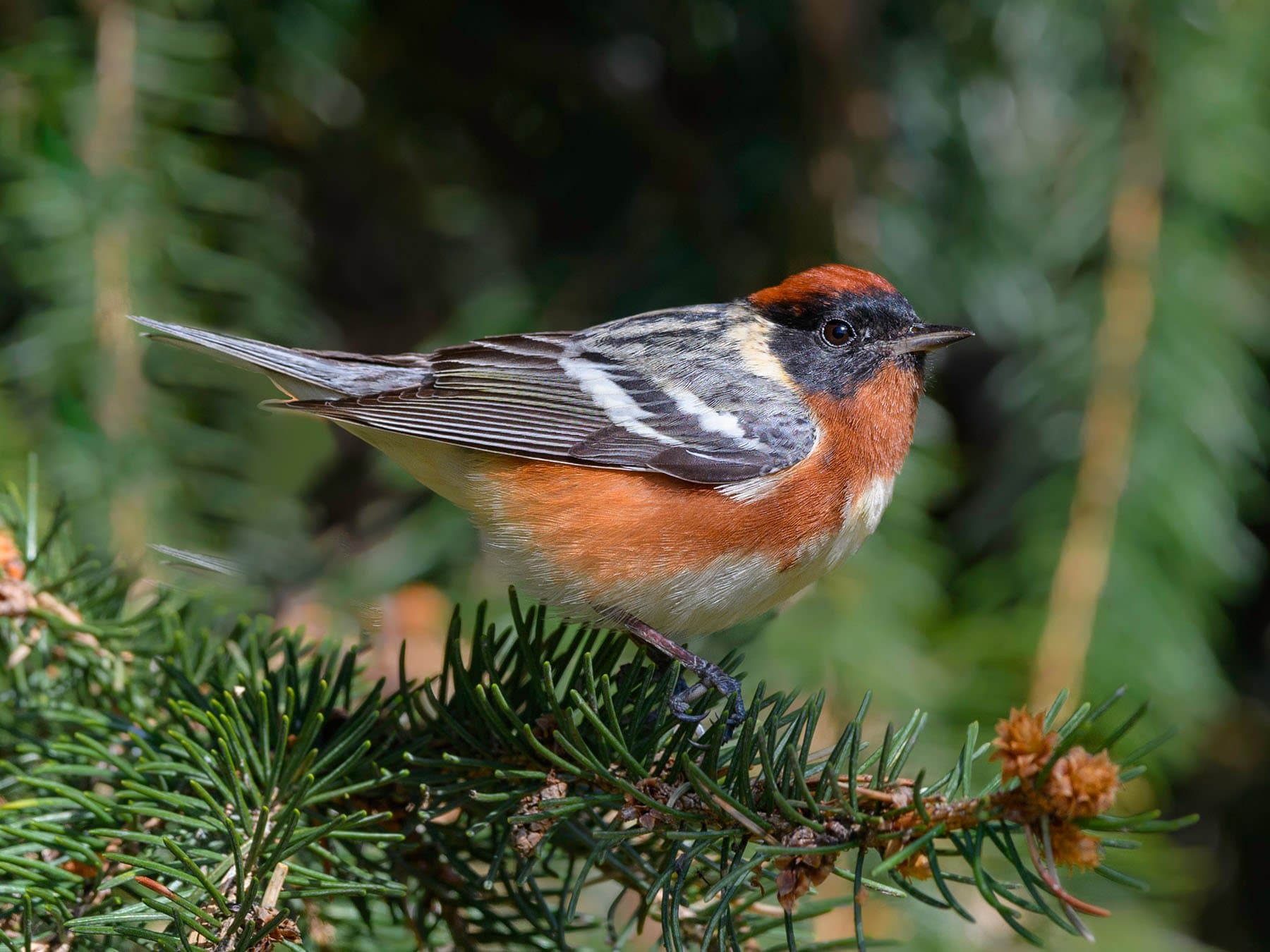
Bay-breasted Warbler perched on a conifer branch, showing its chestnut crown, black face, and chestnut breast and flanks.
Quick Facts
Conservation
LCLeast ConcernLifespan
2–5 years
Length
14 cm
Weight
10.7–15.1 g
Wingspan
20–23 cm
Migration
Long-distance Migrant
In spring, the Bay-breasted Warbler is one of North America's most striking songbirds — a rich chestnut crown, black mask, and creamy neck patch that make it unmistakable in the boreal forest canopy. By autumn, that same bird transforms into a drab olive-green puzzle that has confounded birders for generations. A long-distance Neotropical migrant, it travels thousands of miles between the spruce forests of Canada and the lowland jungles of Colombia and Venezuela.
Think you've spotted a Bay-breasted Warbler?
Upload a photo and we'll confirm it instantly
Confirm with a PhotoAppearance
The Bay-breasted Warbler is a medium-sized New World warbler, measuring around 14 cm (5.5 in) — roughly sparrow-sized, but towards the larger end of the Parulidae family. Its name is entirely apt in spring, when the breeding male is one of the most distinctive warblers on the continent.
The breeding male is unmistakable. The crown, throat, upper breast, and flanks are a deep, rich chestnut (bay) — warm and saturated, not the washed-out rufous of some relatives. The face is jet black, forming a bold mask that sweeps across the cheeks and lores. Against this darkness, a conspicuous creamy-buff patch on the nape and sides of the neck stands out sharply. The upperparts are grey with dark streaking on the back, and two bold white wing bars cut across the dark wings. The belly and undertail coverts are buffy-white. The bill is short, slender, and sharp-pointed — a precision tool for gleaning insects from foliage. The legs and feet are dark blackish — a detail that becomes critical for identification in autumn.
The breeding female shares the same overall pattern but is considerably paler and duller throughout. She lacks the bold black mask, showing instead a faint dusky wash on the face. The chestnut is reduced to a weak suffusion on the breast sides and fore-flanks. The creamy neck patch is less distinct, and the crown and mantle are streaked. Two white wing bars are present in all plumages.
Both sexes undergo a dramatic transformation in autumn. Non-breeding birds become predominantly olive-green above, with reduced or absent streaking on the underparts and little chestnut remaining on the flanks. In this dull plumage, the species closely resembles the Blackpoll Warbler (Setophaga striata) — one of the most notorious identification challenges in North American birding. The key distinction: Bay-breasted Warblers always retain dark (blackish) legs and feet, while Blackpolls typically show yellowish feet. The undertail coverts are buff rather than white, and the sides of the neck appear brighter greenish. Non-breeding females are the dullest of all, often showing virtually no chestnut whatsoever.
Identification & Characteristics
Male Colors
- Primary
- Chestnut
- Secondary
- Grey
- Beak
- Black
- Legs
- Dark Grey
Female Colors
- Primary
- Olive
- Secondary
- Buff
- Beak
- Black
- Legs
- Dark Grey
Male Markings
Rich chestnut (bay) crown, throat, breast and flanks; bold black face mask; conspicuous creamy-buff neck patch; two white wing bars; dark blackish legs and feet
Tail: Short, square-tipped tail with white spots on outer tail feathers; buffy-white undertail coverts
Female Markings
Paler and duller than male; weak chestnut suffusion on breast sides only; no black face mask; less distinct creamy neck patch; two white wing bars; dark legs shared with male
Tail: Short, square-tipped tail with white spots on outer tail feathers; buffy-white undertail coverts
Attributes
Understanding Attributes
Rated 0–100 based on research and observation. A score of 50 is average across all bird species. These attributes are relative and don't necessarily indicate superiority.
Habitat & Distribution
The Bay-breasted Warbler is a bird of the boreal north in summer and the tropical lowlands in winter, with a migration corridor that threads through the eastern half of North America.
On the breeding grounds, it strongly prefers mature, dense boreal spruce-fir forest, typically in stands near water — lakes, bogs, and streams. It is most frequently found in intermediate to mature spruce and balsam fir forests, particularly those infested with spruce budworm. It also uses pine, hemlock, and mixed stands with birch and maple, and may be found in bogs and swamps. During major budworm outbreaks, it will nest in a wider variety of forest types. The breeding range spans the boreal forests of eastern and central Canada — from the Maritime provinces (including Newfoundland and Nova Scotia) westward through Quebec, Ontario, Manitoba, Saskatchewan, Alberta, and into northeastern British Columbia and the southwestern Northwest Territories. An estimated 79–82% of the global population breeds within the North American Boreal Forest. Small numbers breed in the far northeast of the United States, including parts of northern New England (Maine, New Hampshire, Vermont) and the Upper Midwest (northern Minnesota and Michigan's Upper Peninsula), with an isolated population in the Adirondacks of New York.
During migration, the species is far less habitat-specific, using a wide variety of wooded habitats, forest edges, and shrubby areas. It passes through the eastern half of the United States in spring (late April–May) and autumn (August–October), and is an uncommon to fairly common migrant through the Great Lakes region, Ohio, Indiana, Kentucky, Illinois, New York, and the Mid-Atlantic states. Birders in these regions have the best chance of encountering the species during May, when males are in full breeding plumage.
The wintering range covers wet lowland primary and secondary forest from Costa Rica and Panama south through the Caribbean slope of Central America to northwestern South America — primarily Colombia and Venezuela, with some birds reaching Ecuador. Habitat preference shifts seasonally on the wintering grounds: during the rainy season, birds use a wider range of forest types; during the dry season, they shift toward younger forests where fruit is more abundant.
In Britain, the Bay-breasted Warbler is an extreme vagrant, with only two confirmed records as of 2023. The second — and first for Wales — occurred on Ramsey Island, Pembrokeshire, in September 2023 (see the UK Vagrant Records section below).
Where to See This Bird
Explore regional guides for locations where this bird has been recorded.
Diet
The Bay-breasted Warbler's diet shifts dramatically between seasons, from a highly specialised boreal insectivore in summer to a fruit-eating, nectar-sipping generalist in winter.
On the breeding grounds, the diet is dominated by insects and spiders gleaned methodically from vegetation — never caught on the wing. The spruce budworm (Choristoneura fumiferana), the larva and pupa of a native moth, is the single most important prey item. The species is considered a budworm specialist: one study found that a Bay-breasted Warbler population consumed over 13,000 budworms per hectare in just 41 days. Other prey includes larvae of beetles, flies, midges, moths, and butterflies, along with leafhoppers, grasshoppers, and dragonflies. Foraging is concentrated on the inner, mid-level portions of conifers — the same zone where budworm infestations are densest.
During migration, the diet shifts substantially toward fruit. Large quantities of berries are consumed, including Virginia creeper, dogwood, and mulberry. This high-energy food fuels the long overwater crossing of the Gulf of Mexico.
On the wintering grounds in Panama, Colombia, and Venezuela, the diet is highly seasonal. During the rainy season, when arthropods are plentiful, insects dominate. During the dry season, small tropical fruits — including gumbo-limbo — take over as the primary food source. Wintering birds also feed on nectar, potentially acting as pollinators of tropical forest plants. This is a role entirely absent from their summer ecology as boreal insectivores — a striking example of how completely a migratory bird's ecological function can change between seasons.
Behaviour
On the breeding grounds, Bay-breasted Warblers are methodical and deliberate — a contrast to the frenetic flitting of many warblers. They forage by hopping along branches in a radial direction around the tree, working systematically through the inner, mid-level portions of conifers on larger, lichen-covered limbs with sparse foliage. While feeding, they characteristically flick the tail in a down-up movement. They occasionally hover-glean to pluck prey from the underside of foliage, but rarely fly-catch.
Males arrive on the breeding grounds before females and quickly establish territories, singing persistently from outer branches. When a rival male approaches, the territory holder raises his crown feathers in warning and may snap his bill loudly at close quarters. Males are also sometimes aggressive toward Blackburnian Warblers, which nest higher in the same spruce trees but compete for the same budworm prey.
On the wintering grounds in Central and South America, the species becomes notably gregarious, joining mixed-species flocks of other Neotropical migrants and resident birds in the forest canopy. When food is plentiful, Bay-breasted Warblers are dominant over smaller warbler species, actively chasing them from food sources. When food is scarce, however, individuals may switch strategy and defend exclusive feeding territories.
The species migrates at night, taking advantage of favourable winds and clear skies. During nocturnal migration, thin flight calls can be heard overhead — a behaviour shared with many other warblers. First-year birds and adults follow subtly different routes in autumn, a rare example of age-segregated migration within the same species.
Calls & Sounds
The Bay-breasted Warbler's song is a series of 5–10 very high-pitched, thin, sibilant notes delivered on a single pitch without change in pitch or volume. It is variously rendered as teesi-teesi-teesi-teesi, seetzy-seetzy-seetzy-see, or sweeswee-sweeswee-sweeswee-swee — a rapid series of double notes, all on the same high frequency. The song is similar in quality to that of the Cape May Warbler and can be genuinely difficult to distinguish from it in the field. Its extremely high frequency also makes it one of the harder warbler songs for older birders to detect, as age-related high-frequency hearing loss can render it effectively inaudible at any distance.
Males sing from outer branches and also sing while foraging, making the song a useful locator even when the bird itself is hidden in dense foliage. Song frequency is highest early in the breeding season when males are establishing territories and attracting mates; it decreases noticeably after pair formation. Females rarely sing.
The call note is a soft, sharp chip — similar to many other warblers and not particularly distinctive. A thin, high-pitched seet or buzzy zip is given both in flight and while feeding. The flight call — a thin, high tsip — is frequently given during nocturnal migration and can be heard overhead on clear autumn nights at coastal watchpoints. Alarm calls include a sharp metallic chip and a rapid tititi when a predator is close to the nest.
The species migrates at night, and experienced birders use the flight call to detect passing birds during autumn migration — a technique known as nocturnal flight call monitoring that has revealed much about the timing and routes of warbler migration.
Flight
In flight, the Bay-breasted Warbler shows the compact, direct wing-beats typical of the Setophaga warblers — fast and slightly undulating over longer distances, more fluttery and hesitant when manoeuvring through dense foliage. The wings are relatively broad for a warbler, which aids sustained flight during the long transoceanic crossings of the Gulf of Mexico that form a key part of both spring and autumn migration.
The two bold white wing bars are visible in flight in all plumages and provide a useful in-flight identification feature. The tail is relatively short and square-tipped, with white spots on the outer tail feathers that flash briefly when the bird fans its tail. In breeding plumage, the rich chestnut flanks and black face are visible even in brief flight views, making spring identification straightforward. In autumn, the olive-green upperparts and buffy underparts are less distinctive, and the dark legs — visible when the bird lands — become the most reliable feature.
During migration, Bay-breasted Warblers travel at night, taking advantage of following winds and clear skies. They cross the Gulf of Mexico in a single overwater flight — a journey of roughly 1,000 km — and are capable of sustained nocturnal flight over many hours. Migrants occasionally arrive exhausted at coastal watchpoints after crossing open water, dropping into the first available cover. The species is not known for spectacular aerial displays, but the sheer distance covered on migration — thousands of kilometres between the Canadian boreal forest and the lowland forests of South America — speaks to considerable endurance in the air.
Nesting & Breeding
The Bay-breasted Warbler is seasonally monogamous and raises only one brood per year — a constraint imposed by the brief boreal summer. Males arrive on the breeding grounds before females, sometimes not until early June, and immediately begin singing from outer branches to establish territories.
Nests are most often placed on a horizontal branch of a dense spruce, balsam fir, hemlock, or birch, typically in the lower third of the tree. Nest height ranges from approximately 1.2 to 12 m (4–40 ft) above the ground, with an average of around 5 m (16 ft). This is notably lower than the nests of Blackpoll Warblers (average ~6.4 m) and much lower than those of Cape May and Blackburnian Warblers, which often nest at 12–24 m.
The female builds the nest, with some assistance from the male. It is a large, open cup — either loosely built or compact — constructed from coniferous bark and twigs, dried grass, lichen, and spider silk, and lined with rootlets, hair (including rabbit hair), moss, pine needles, and grasses. Nests average about 10.8 cm across and 5.7 cm tall, with an interior cup approximately 5.5 cm wide and 3.3 cm deep.
Clutch size is typically 4–7 eggs (average 5), off-white or creamy with bold dark brown or black spots concentrated at the larger end. Clutch size tends to be larger in years of spruce budworm outbreaks, when food is superabundant. Incubation lasts 12–13 days, carried out primarily by the female, who is fed on the nest by the male during this period. If disturbed, the female may feign injury — flapping her wings and spreading her tail — to draw a predator away from the nest.
Young are altricial at hatching, covered with sparse brown down. Both parents feed the nestlings, which leave the nest 10–12 days after hatching and continue to be fed by adults for several days thereafter. Independent young often join mixed-species flocks, frequently alongside Blackpoll Warblers. The species is only rarely parasitised by Brown-headed Cowbirds (Molothrus ater), and only in the limited area where both species' ranges overlap.
Lifespan
The Bay-breasted Warbler is a relatively short-lived songbird, as is typical for small migratory passerines. The typical lifespan in the wild is estimated at 2–5 years, with the maximum recorded longevity standing at 4 years and 11 months — a figure from banding records compiled by the USGS Bird Banding Laboratory. This is broadly comparable to other Setophaga warblers of similar size and migratory distance.
Survival rates are shaped by the hazards of long-distance migration. Crossing the Gulf of Mexico twice a year exposes birds to exhaustion, storms, and disorientation. Collision mortality with communications towers, wind turbines, and illuminated buildings during nocturnal migration is a significant and well-documented cause of death across North American warblers. Predation by hawks — particularly Sharp-shinned Hawks and Merlins, which time their own migration to coincide with warbler movements — also takes a toll.
On the breeding grounds, nest predation by snakes, red squirrels, and corvids reduces annual productivity. The species' tight dependence on spruce budworm outbreaks means that in years between outbreaks, food availability on the breeding grounds is lower, potentially reducing adult body condition and survival. First-year birds face the highest mortality, as they must complete their first transoceanic migration without the experience of previous journeys. Those that survive to their second year have a substantially better chance of reaching the upper end of the typical lifespan range.
Conservation
The Bay-breasted Warbler is listed as Least Concern on the IUCN Red List (2018), with a global population estimated at approximately 9.9 million mature individuals by BirdLife International. However, the long-term trajectory is concerning. Partners in Flight estimates a 9% decline in the combined US and Canadian population between 1970 and 2014, while the American Bird Conservancy reports an overall population drop of approximately 74% since 1966 — one of the steeper declines among North American warblers. The North American Breeding Bird Survey recorded a decline of roughly 3.85% per year in the Boreal Hardwood Transition Region. BirdLife International's most recent (2024) assessment lists the trend as increasing, reflecting the species' inherent boom-bust population dynamics tied to spruce budworm cycles, which makes long-term trend assessment genuinely difficult.
The primary threats are interconnected. Pesticide spraying programmes targeting spruce budworm outbreaks directly reduce the species' most important food source and may cause direct mortality — a troubling paradox, since the very pest that drives population booms is also the one being chemically suppressed. Reduction of mature boreal forest through short-rotation forestry and fragmentation reduces available breeding habitat. On the wintering grounds, tropical deforestation in Central and South America shrinks the lowland forest the species depends on from November through April.
Climate change adds further pressure. Models indicate that the zone of favourable breeding conditions is shifting northward, and it is uncertain whether the birds, the spruce forests, and the budworm can all shift in synchrony. More frequent severe Atlantic storms may also displace migrants. Collision mortality with communications towers, wind turbines, and other tall structures during nocturnal migration is an additional source of mortality.
The species is on the Partners in Flight Watch List and is designated a Species in Greatest Conservation Need by the Minnesota DNR. On the wintering grounds, Bay-breasted Warbler habitat is protected by ProAves at Colombia's El Dorado Reserve, supported by the American Bird Conservancy.
Population
Estimated: Approximately 9.9 million mature individuals
Trend: Decreasing
Decreasing overall; estimated 74% decline since 1966 (American Bird Conservancy). Population fluctuates dramatically with spruce budworm outbreak cycles, complicating long-term trend assessment. BirdLife International's 2024 assessment lists the trend as increasing, reflecting the most recent cycle.
Elevation
Breeding: low to mid elevations in boreal zone. Wintering: lowland forest, typically below 1,000 m.
Additional Details
- Family:
- Parulidae (New World Warblers)
- Predators:
- Sharp-shinned Hawks and Merlins during migration; nest predators include snakes, red squirrels, and corvids on the breeding grounds.
- Similar species:
- Blackpoll Warbler (Setophaga striata) in non-breeding plumage — distinguished by dark legs (Bay-breasted) vs yellowish feet (Blackpoll), buff undertail coverts (Bay-breasted) vs white (Blackpoll), and any hint of chestnut on flanks.
Uk Vagrant Records
The Bay-breasted Warbler is one of the rarest North American vagrants to reach Britain. As of 2023, only two confirmed records exist for the UK. The first record was accepted by the British Birds Rarities Committee some years prior; the second — and first for Wales — arrived in dramatic circumstances in September 2023.
On 21 September 2023, RSPB wardens Alys Perry and Nia Stacey found an immature or female Bay-breasted Warbler on Ramsey Island, Pembrokeshire — a small island off the far southwest tip of Wales, accessible only by boat. The bird remained for six days, until 26 September, attracting hundreds of birdwatchers who made the crossing to see it. The record was part of an extraordinary influx of North American passerines blown across the Atlantic by the remnants of Hurricane Lee, which had tracked northeast across the ocean in mid-September. Experts described the event as "the largest arrival of North American passerines ever recorded in the British Isles," with species including Canada Warbler, Magnolia Warbler, and American Redstart also turning up at coastal sites across Britain and Ireland simultaneously.
For UK birders, a Bay-breasted Warbler would represent a major tick — a bird that requires exceptional weather conditions to reach these shores. The most likely scenario for a future record would be a first-year bird in autumn (September–October), found at a coastal watchpoint in southwest England, Wales, or Ireland, or on an offshore island such as the Scilly Isles, after a period of sustained westerly winds following a transatlantic storm system. In non-breeding plumage, the bird would appear as a drab olive-green warbler with dark legs and buff undertail coverts — easily overlooked without careful scrutiny.
Spruce Budworm Relationship
No other aspect of Bay-breasted Warbler biology is as consequential — or as paradoxical — as its relationship with the spruce budworm (Choristoneura fumiferana). This native moth, whose larvae defoliate and kill millions of hectares of spruce and fir forest across the boreal zone, is the warbler's primary food source and the engine of its population dynamics.
During major budworm outbreaks, which occur on roughly 30–40 year cycles across the boreal forest, Bay-breasted Warbler populations explode. Breeding densities of 120–230 pairs per km² have been recorded in Ontario during outbreak years — among the highest warbler densities ever documented anywhere. Clutch sizes increase, productivity rises, and the species temporarily becomes one of the most abundant birds in the boreal forest. One study quantified the consumption at over 13,000 budworms per hectare in 41 days, making the warbler a genuine natural control on the pest.
Between outbreaks, populations crash. The species retreats to lower densities in mature spruce-fir stands, where budworm larvae are present at background levels. This boom-bust cycle makes long-term population trend assessment genuinely difficult: a survey conducted during an outbreak year will record very different numbers from one conducted in the trough between outbreaks.
The paradox lies in pest management. Provincial and federal forestry agencies have historically sprayed insecticides over millions of hectares of boreal forest to suppress budworm outbreaks and protect the timber industry. These programmes directly reduce the warbler's food supply and may cause direct mortality through pesticide ingestion. The American Bird Conservancy has identified pesticide spraying as a major driver of the species' long-term decline — meaning that the very effort to protect the forest may be undermining one of the forest's most effective natural pest controllers.
Macarthur Study Significance
In 1958, a young ecologist named Robert MacArthur published a paper in Ecology that would become one of the most-cited works in the history of the discipline. Titled "Population ecology of some warblers of northeastern coniferous forests," it used five species of Setophaga warbler — including the Bay-breasted Warbler — to demonstrate how ecologically similar species can coexist without competitive exclusion by partitioning their habitat into distinct niches.
MacArthur showed that each of the five species — Bay-breasted, Cape May, Blackburnian, Yellow-rumped, and Black-throated Green Warblers — occupied a different vertical and horizontal zone within the same spruce trees. Bay-breasted Warblers specialised in the middle strata of the tree, foraging on larger inner branches at mid-height, where budworm density was high but competition from the crown-foraging Blackburnian and Cape May Warblers was reduced. This spatial partitioning allowed all five species to exploit the same food source — spruce budworm — without directly competing.
The paper helped establish the concept of the ecological niche as a measurable, testable entity, and contributed to the development of niche theory as a cornerstone of modern ecology. It is regularly cited in undergraduate ecology textbooks and remains a touchstone for studies of species coexistence. A 2018 revisit of MacArthur's original study sites by Cornell Lab researchers found that the cast of characters had shifted — Bay-breasted Warbler numbers had declined significantly, while Yellow-rumped Warblers had increased — reflecting the broader population changes that have occurred in the boreal forest over six decades.
Birdwatching Tips
Spring is by far the best time to find a Bay-breasted Warbler, and the Great Lakes region in May is the place to be. During peak migration (typically the second and third weeks of May), males in full breeding plumage — chestnut crown, black mask, creamy neck patch — move through in numbers, often pausing in lakeside woodlands and parks. Hotspots include Point Pelee National Park in Ontario, Magee Marsh in Ohio, and Presque Isle State Park in Pennsylvania. In these locations, the species can be surprisingly approachable as it forages at mid-canopy level.
On the breeding grounds in the Canadian boreal forest, listen for the song — a series of very high-pitched, thin, sibilant notes on a single pitch, often rendered as teesi-teesi-teesi-teesi. The song carries poorly at distance due to its extremely high frequency, which can be challenging for birders with age-related high-frequency hearing loss. Binoculars pointed at the middle strata of dense spruce and fir trees are more reliable than ears alone.
Autumn identification is the real challenge. From August onwards, Bay-breasted Warblers moult into drab olive-green plumage that closely resembles the Blackpoll Warbler. The single most reliable field mark is leg colour: Bay-breasted always has dark blackish legs and feet, while Blackpoll often shows yellowish feet (the soles are bluish-grey in Bay-breasted, yellow in Blackpoll). Also check the undertail coverts — buff in Bay-breasted, white in Blackpoll — and look for any hint of chestnut on the flanks. In autumn, adults migrate predominantly west of the Appalachians, while first-year birds are more frequent along the eastern coast.
In the UK, the Bay-breasted Warbler is an extreme rarity. Any sighting would be exceptional, most likely in September or October at a coastal watchpoint in the southwest or on an offshore island, following a period of strong westerly winds from the Atlantic.
Did You Know?
- One study found that a Bay-breasted Warbler population consumed over 13,000 spruce budworms per hectare in just 41 days — and during major budworm outbreaks, breeding densities can reach 120–230 pairs per km², as recorded in Ontario in 1946, making it one of the densest warbler breeding aggregations ever documented.
- The Bay-breasted Warbler was a key subject in Robert MacArthur's landmark 1958 study on warbler niche partitioning — one of the most-cited papers in the history of ecology. MacArthur showed that five warbler species coexist in the same spruce trees by specialising in different vertical zones, with Bay-breasted occupying the middle strata to avoid competition with Blackburnian and Cape May Warblers above and Yellow-rumped Warblers below.
- Adults and first-year birds follow different migratory routes in autumn: adults migrate predominantly west of the Appalachian Mountains, while first-year birds are more frequent east of the mountains and along the coast — a rare example of age-segregated migration routes within the same species.
- On its tropical wintering grounds, this boreal insectivore feeds on nectar and potentially acts as a pollinator of tropical forest plants — a role entirely absent from its summer ecology.
- The second UK record of Bay-breasted Warbler — and the first for Wales — was found on Ramsey Island, Pembrokeshire, in September 2023, blown across the Atlantic by Hurricane Lee as part of what experts described as the largest arrival of North American passerines ever recorded in the British Isles.
Records & Accolades
Budworm Specialist
13,000+ budworms/ha in 41 days
One of North America's most voracious consumers of spruce budworm, capable of consuming over 13,000 larvae per hectare in just six weeks during breeding season.
Ecological Icon
MacArthur 1958
A key subject in Robert MacArthur's landmark 1958 study on niche partitioning — one of the most-cited papers in the history of ecology.
Storm Vagrant
2nd UK record, 1st for Wales (2023)
The second UK record was blown across the Atlantic by Hurricane Lee in September 2023, part of the largest arrival of North American passerines ever recorded in the British Isles.
Community Photos
Be the first to share a photo of the Bay-breasted Warbler
Upload a PhotoIdentify Any Bird Instantly
- Upload a photo from your phone or camera
- Get an instant AI identification
- Ask follow-up questions about the bird
Monthly Birds in Your Area
- Personalised for your location
- Seasonal tips and garden advice
- Updated every month with new species