


Blackpoll Warbler
Blackpoll · Setophaga striata
By the Birdfact teamChecked by Nathan Cope
On this page11 sections
How to recognise it
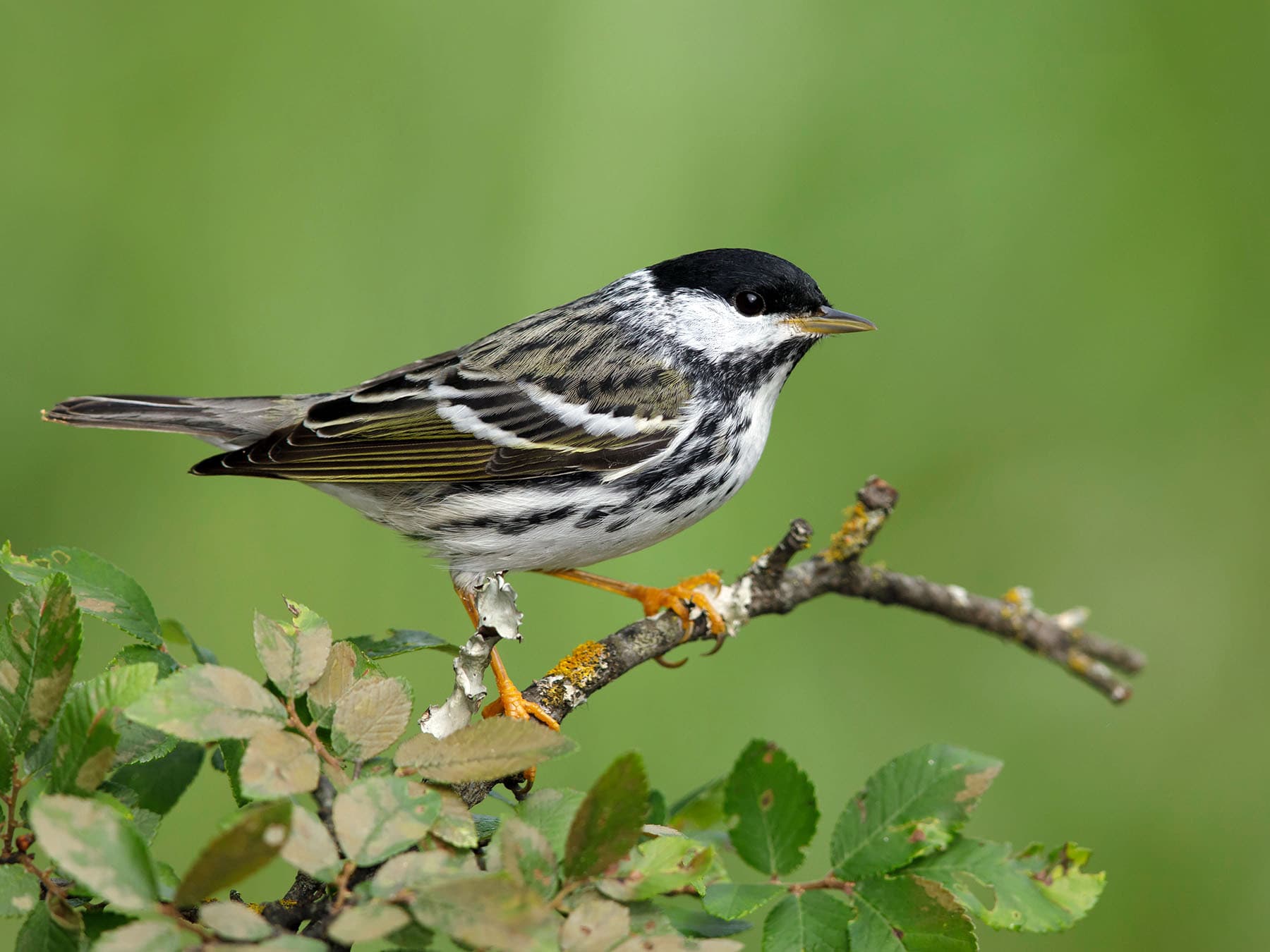
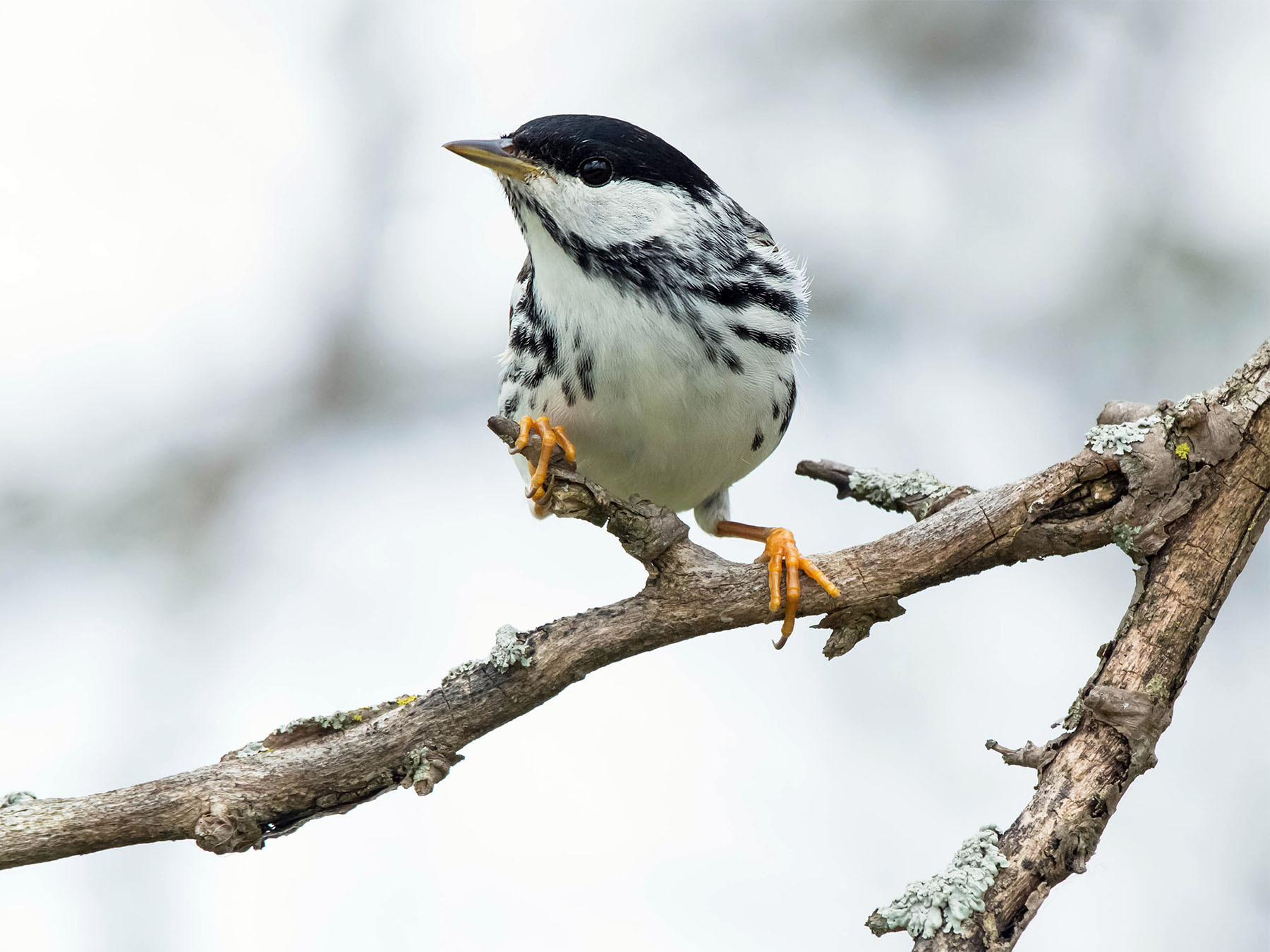
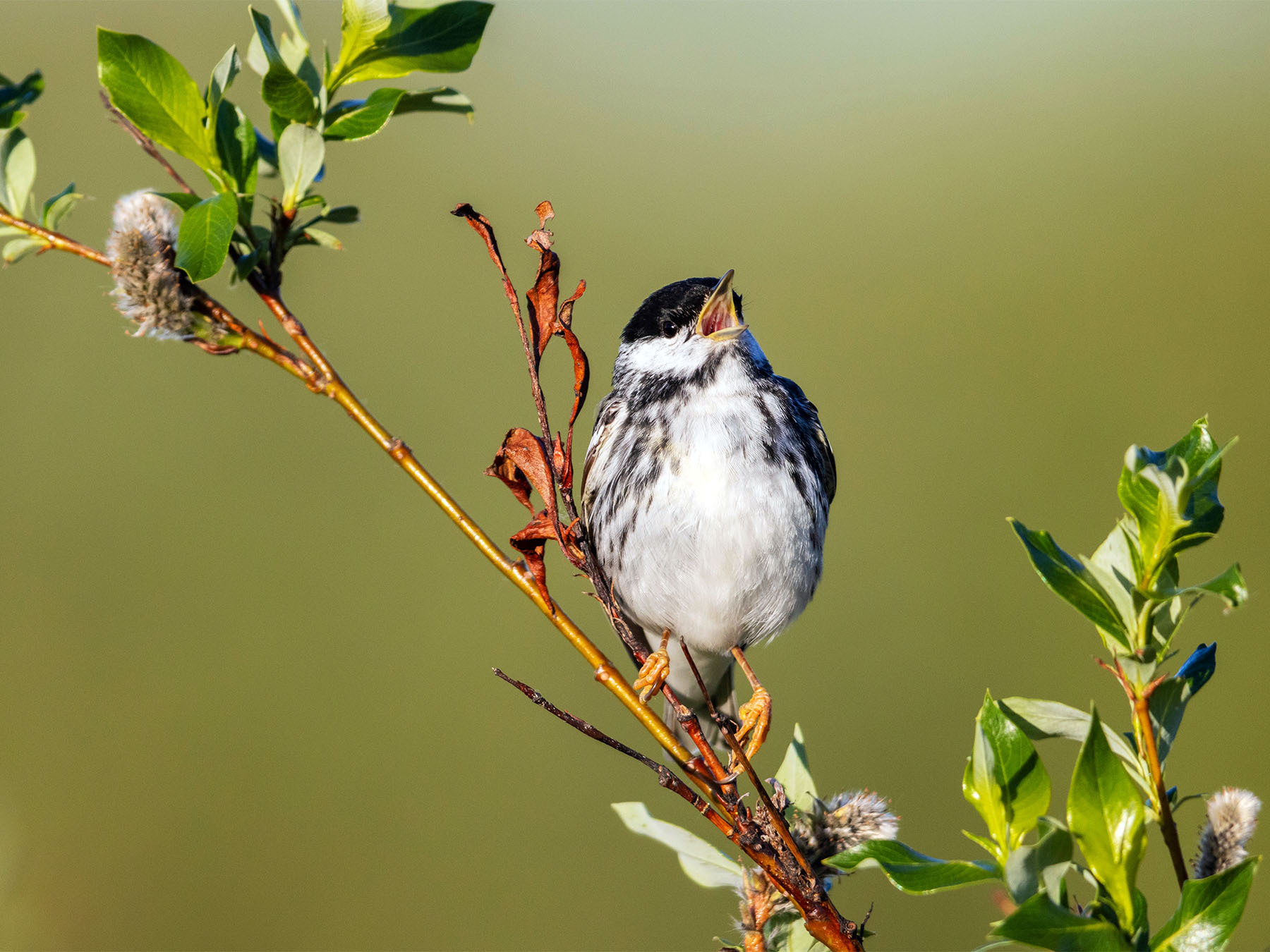
The Blackpoll Warbler is one of the larger warblers in its family. Breeding males are striking with their black and white coloring - they have a distinctive black cap on top, white cheeks with a black stripe, and gray backs streaked with black.
Their white underparts show bold black streaks along the sides. Two white wing bars stand out against their dark wings, and their tail has prominent white spots.
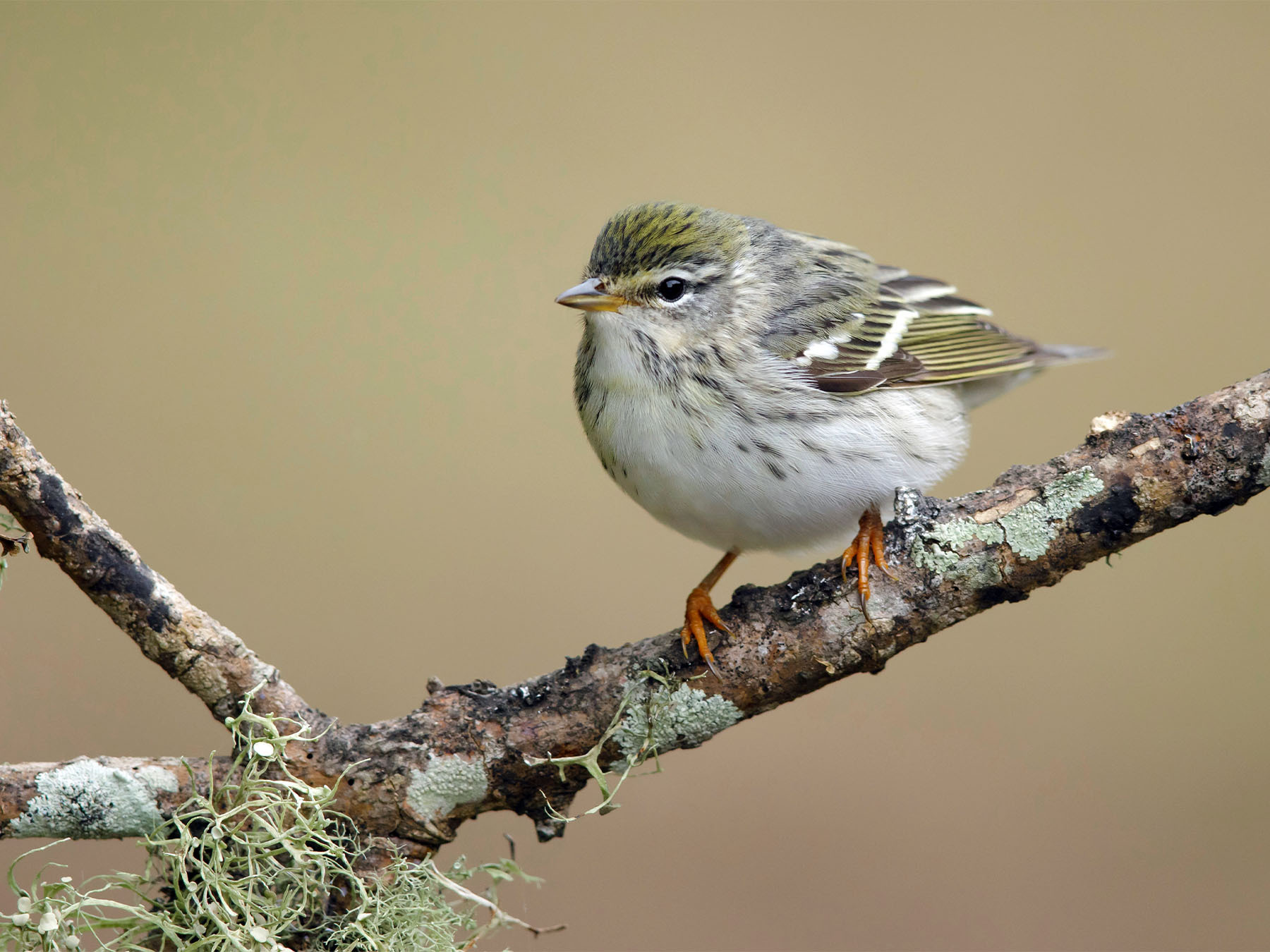
Females and non-breeding birds are more subtly colored, typically olive-gray to olive-green above, with dark streaks. They show pale stripes above their eyes and variable streaking on their underparts, which can range from whitish to having a slight yellow tinge.
Both sexes have dull orange to yellow legs and feet.
Its size
Adults- Length
- 13–15 cm
- Wingspan
- 20–23 cm
- Weight
- 12–13 g
Its song and calls
The Blackpoll Warbler's song is a simple series of high-pitched, thin notes on one pitch, often described as sounding like a tiny sewing machine. It's typically rendered as "tsi tsi tsi tsi tsi tsi tsi". Their call is a sharp, high "chip" or "tsip", often given during migration.
- Song0:00 / 0:33
Recorded in Minnesota, United States · May 2025
- Call0:00 / 0:40
Recorded in Miranda, Venezuela · October 2025
Rosa Elena Albornoz @rosaelena_naturaleza · xeno-canto XC1047424 · CC0 1.0
When and where to see it
OctoberLeaving
Most recorded in October
- 1. Rhode Island0.67%
- 2. Massachusetts0.57%
- 3. Nova Scotia0.48%
- 4. New Jersey0.43%
- 5. New Brunswick0.41%
Each dot is a county, state or province: the bigger and darker, the larger the bird’s share of that place’s bird records that month. Grey dots: no regular records. The ringed point is the centre of the bird’s records this month; the arrow shows how it moved since last month, and the dashed loop its path through the year. “Arrivals” colours places where it becomes regular this month (orange) or is in its last regular month (grey). GBIF eBird Observation Dataset, 2019–2024. Map data: Natural Earth, US Census Bureau; place centres © OpenStreetMap contributors.
In your area
See when the Blackpoll Warbler is recorded in your county, state or province.
How often the Blackpoll Warbler turns up in the United States and Canada through the year, from birdwatchers' records.
United States
Passage migrant · regularly Apr–Oct · most records in May
Canada
Summer visitor · regularly May–Oct · most records in September
Show as a table
| Month | United States | Canada |
|---|---|---|
| January | <0.001% | – |
| February | <0.001% | – |
| March | <0.001% | – |
| April | 0.035% (regular) | <0.001% |
| May | 0.24% (regular) | 0.17% (regular) |
| June | 0.027% (regular) | 0.12% (regular) |
| July | 0.007% | 0.061% (regular) |
| August | 0.012% (regular) | 0.094% (regular) |
| September | 0.18% (regular) | 0.31% (regular) |
| October | 0.12% (regular) | 0.071% (regular) |
| November | 0.005% | <0.001% |
| December | <0.001% | <0.001% |
Worldwide: recorded regularly in 37 countries
Countries where it was recorded in at least 3 of the 6 years 2019–2024. Linked countries have their own bird list.
North America (29)
- Anguilla
- Antigua & Barbuda
- Aruba
- Bahamas
- Barbados
- Belize
- Bermuda
- Canada
- Caribbean Netherlands
- Cayman Islands
- Costa Rica
- Cuba
- Curaçao
- Dominican Republic
- Grenada
- Guadeloupe
- Honduras
- Jamaica
- Martinique
- Mexico
- Panama
- Puerto Rico
- St Lucia
- St Pierre & Miquelon
- St Vincent & the Grenadines
- Trinidad & Tobago
- Turks & Caicos Islands
- United States
- US Virgin Islands
Data: EOD – eBird Observation Dataset (Cornell Lab of Ornithology), accessed via GBIF.org, CC BY 4.0. Records from 2019–2024, aggregated and filtered by Birdfact. How these lists are made
Tips for seeing it
- Look for Blackpolls in spruce forests during the breeding season
- Listen for their high-pitched, insect-like song
- During fall migration, watch for them in mixed flocks in deciduous trees
- In the eastern United States, look for them in coastal areas during migration
What it eats
Blackpoll Warblers primarily feed on insects and spiders. During the breeding season, they consume large quantities of spruce budworms, playing a crucial role in forest pest control.
In migration and winter, they supplement their diet with small fruits and seeds, which are especially important for fueling their long-distance flights.
Nesting and breeding
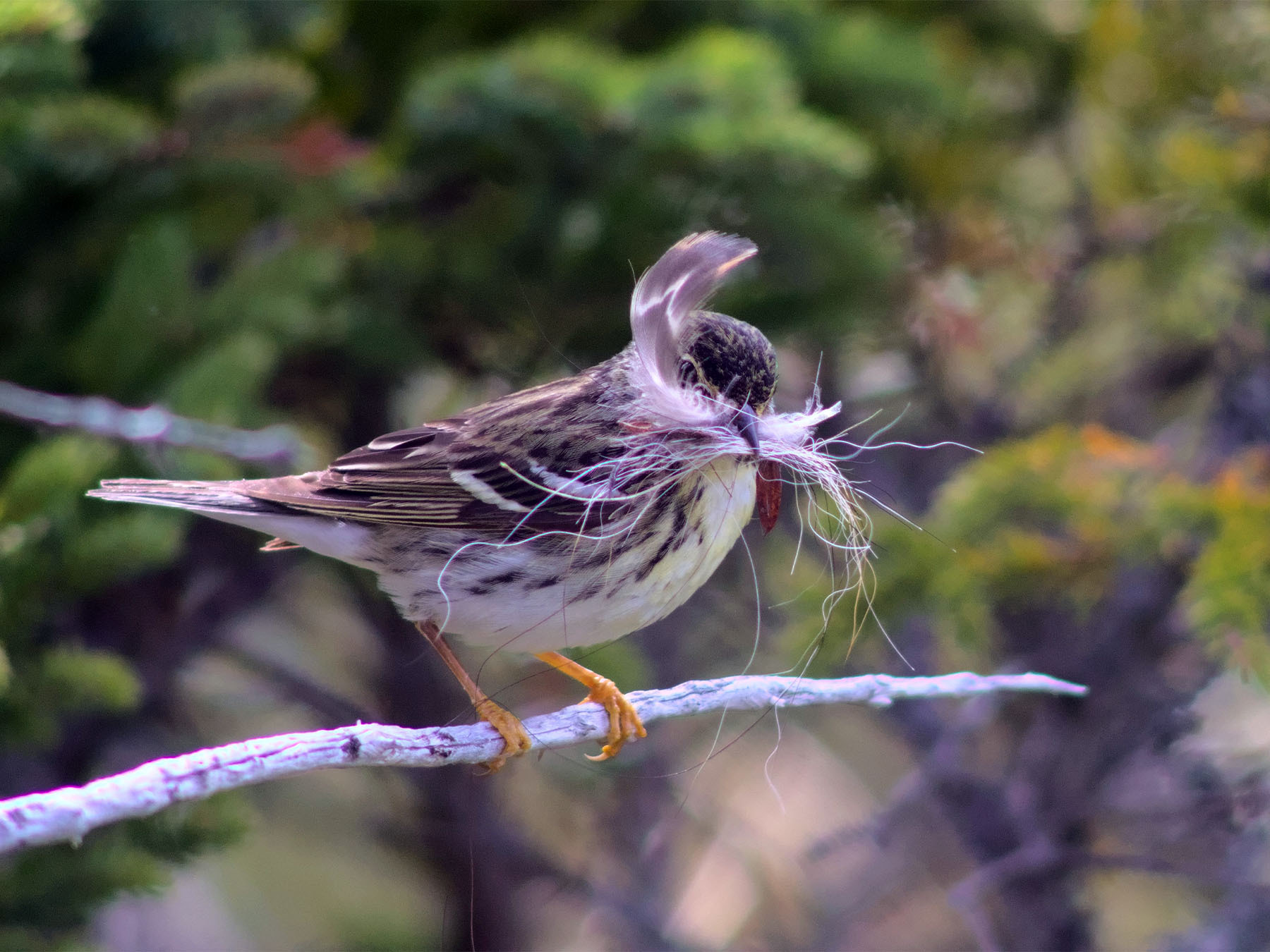
Breeding occurs from late May to July. Males establish territories and attract females with their high-pitched songs. Females build cup-shaped nests, typically placed on horizontal branches of conifers, close to the trunk.
The nest is constructed with twigs, bark strips, and grasses, lined with feathers and fine plant materials. Females lay 3-5 eggs, which are white or creamy with brown speckles.
Incubation lasts about 12 days, primarily by the female. Both parents feed the nestlings, which fledge after 9-10 days. Fledglings remain dependent on their parents for several more weeks.
Behaviour
Blackpoll Warblers are known for their impressive long-distance migration, flying non-stop over the Atlantic Ocean for up to 88 hours, flying at speeds of around 27 mph (43 km/h).
During the breeding season, they forage actively in the upper canopy of coniferous forests, gleaning insects from leaves and branches with quick, agile movements.
Conservation
The Blackpoll Warbler is listed as Near Threatened. While their remote breeding grounds are largely protected, they face several challenges. Climate change poses a significant threat to their mountain breeding habitats, with models suggesting that even small temperature increases could dramatically reduce available habitat.
During migration, they can suffer significant casualties from collisions with towers, wind turbines, and other tall structures. However, their ability to use various habitats means that tropical deforestation in their wintering grounds may be less critical than originally thought.
More photos
5 photos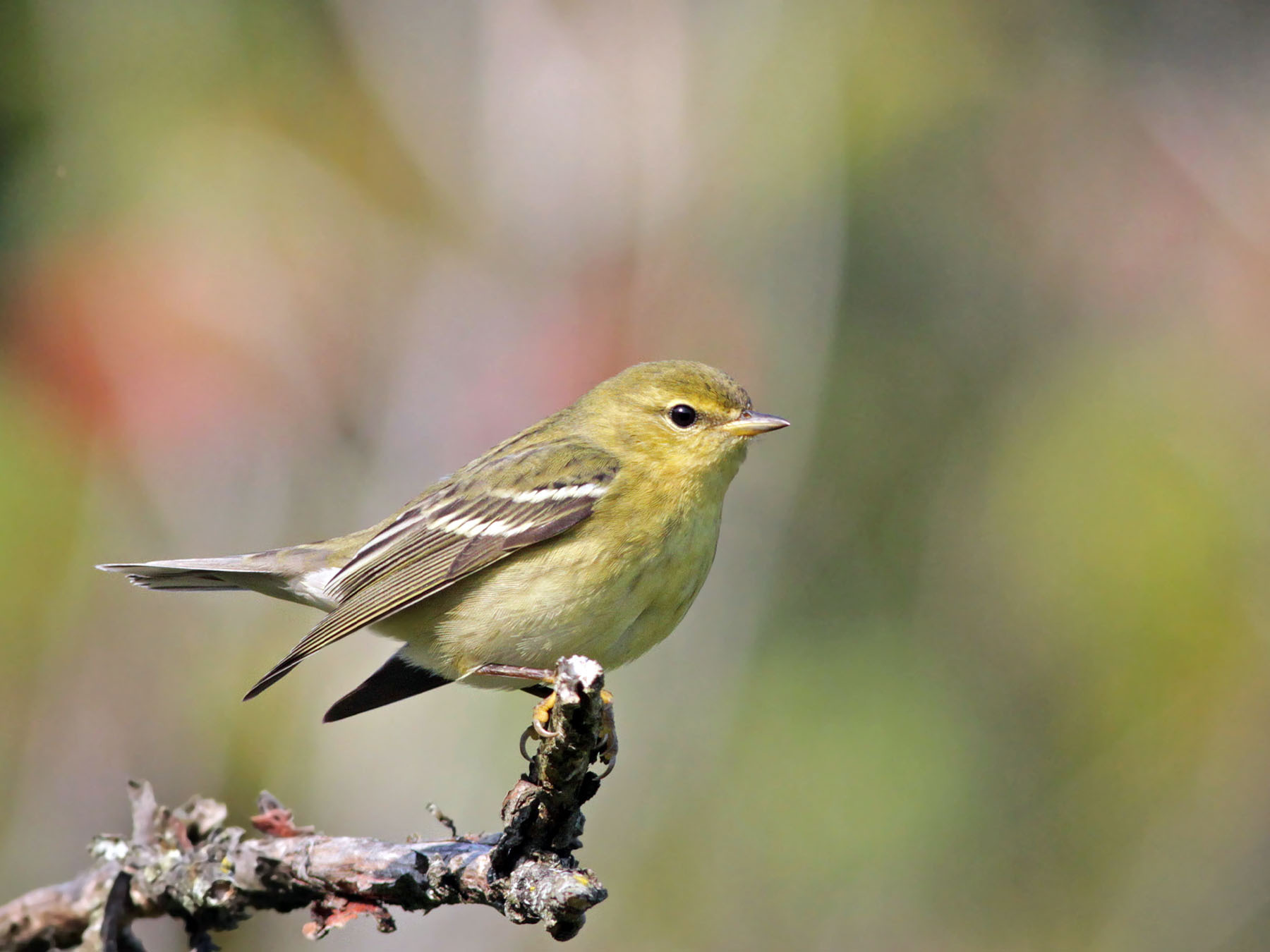
Quick facts
- Length
- 13–15 cm
- Wingspan
- 20–23 cm
- Weight
- 12–13 g
- Lifespan
- 3–6 years · oldest recorded 8.1 years
- Family
- New World Warblers
- Migration
- Long-distance Migrant
- Global status (IUCN)
- Near Threatened
- World population
- 60,000,000 mature individuals
- Population trend
- Decreasing
- Also called
- Blackpoll
- Scientific name
- Setophaga striata
Sources
4- 1BirdLife International. 2018. Setophaga striata. The IUCN Red List of Threatened Species 2018: e.T22721737A131459482. Source (opens in a new tab)
- 2Partners in Flight Landbird Conservation Plan; Rosenberg et al. (2016)
- 3Partners in Flight (2020) Source (opens in a new tab)
- 4Historical Longevity Records of North American Birds Source (opens in a new tab)

Checked by
Nathan Cope, founder and editor
Nathan founded Birdfact and leads its writers and contributors in the UK, the US and Canada. He has watched and studied birds for more than ten years, and checks every article and species guide before it’s published.