Species Profile
American Avocet
Recurvirostra americana
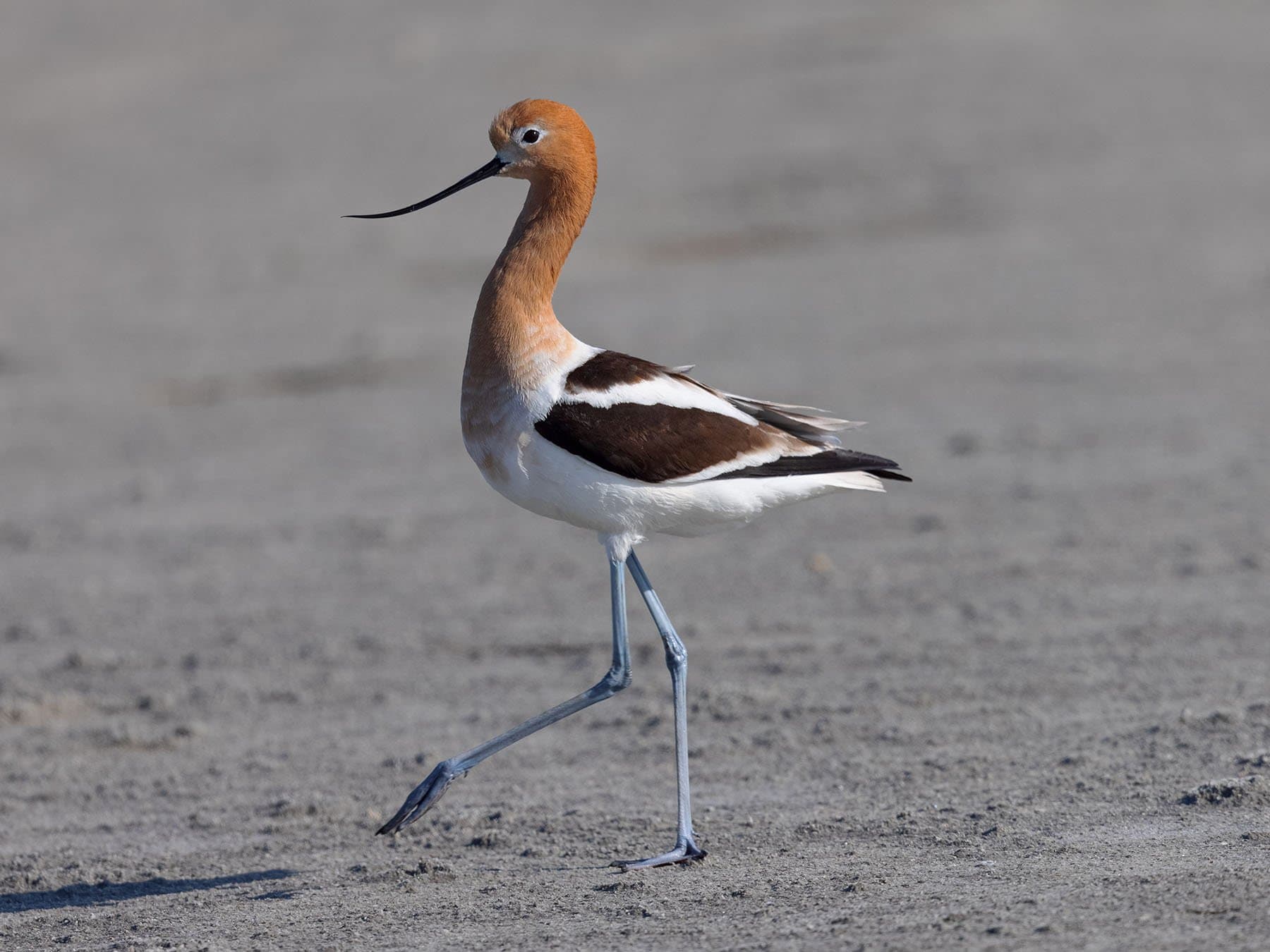
American Avocet walking on sandy ground, showing its distinctive upturned bill, orange head and neck, and white and brown plumage.
Quick Facts
Conservation
LCLeast ConcernLifespan
9–15 years
Length
43–51 cm
Weight
275–420 g
Wingspan
68–79 cm
Migration
Partial migrant
Long pastel-blue legs, a bold black-and-white body, and a head blazing cinnamon-orange in the breeding season — the American Avocet is one of the most visually arresting shorebirds in North America. Its most distinctive feature is a long, slender bill that curves upward at the tip, swept rhythmically through shallow water in a behaviour called scything. Up to 250,000 of them stage at the Great Salt Lake during migration, one of the largest shorebird concentrations on the continent.
Think you've spotted a American Avocet?
Upload a photo and we'll confirm it instantly
Confirm with a PhotoAppearance
The American Avocet is the tallest and longest-legged member of its family — a large, elegant shorebird with a slender oval body, long neck, and small rounded head set atop striking pastel blue-grey legs. Those legs earned it the colloquial nickname "blue shanks", and they are long enough to allow the bird to wade confidently through water that would swamp most other shorebirds. The bill is the defining feature: long, thin, and black, curving upward toward the tip in a shape unique among North American shorebirds.
In breeding plumage, worn roughly from January or February through to July or August, the head and neck are a rich brassy cinnamon-orange that extends slightly onto the upper breast. The back and wings are boldly patterned in black and white, with two white stripes forming a prominent V on the back. The underparts are clean white. After the breeding season, those orange feathers are replaced by pale grey-white, giving the bird a more subdued but still elegant winter appearance. This seasonal transformation makes the American Avocet the only avocet species in the world with distinct breeding and non-breeding plumages — the other three avocet species look the same year-round.
Males and females are nearly identical in plumage, but can be reliably told apart by bill shape — a key field mark. The female's bill is shorter and more sharply upturned, while the male's is longer and straighter. Head shape also differs subtly: females have a more rounded, bulging forehead and steeper rear crown; males show a lower, flatter forehead and a longer, flatter rear crown. Even immature birds show these same sex-based bill differences. Juveniles otherwise resemble non-breeding adults but have a pale pinkish-orange wash on the head and neck, a mottled back, and a straighter bill than adults.
Identification & Characteristics
Male Colors
- Primary
- White
- Secondary
- Black
- Beak
- Black
- Legs
- Blue-grey
Female Colors
- Primary
- White
- Secondary
- Orange
- Beak
- Black
- Legs
- Blue-grey
Male Markings
Long upturned black bill; bold black-and-white back and wing pattern with two white V-stripes; cinnamon-orange head and neck in breeding plumage; pale grey-white head in non-breeding plumage.
Tail: Short, white tail, largely obscured by folded wings at rest; long blue-grey legs trail well beyond the tail in flight.
Female Markings
Identical to male in plumage; distinguished by shorter, more strongly upturned bill and more rounded, bulging forehead with steeper rear crown.
Tail: As male — short white tail with long blue-grey legs trailing in flight.
Attributes
Understanding Attributes
Rated 0–100 based on research and observation. A score of 50 is average across all bird species. These attributes are relative and don't necessarily indicate superiority.
Habitat & Distribution
American Avocets are strongly associated with open, shallow wetlands — wide, flat landscapes where they can detect approaching predators at a distance. They prefer water generally less than 20 cm (8 inches) deep, with fine sediments and high invertebrate productivity. Highly alkaline and saline lakes and ponds are particularly favoured, providing the brine shrimp and alkali flies that form the core of the diet.
The breeding range covers the interior west and Great Plains of the United States and southern Canada, including Alberta, Saskatchewan, Montana, Idaho, Washington, Utah, the Dakotas, Nebraska, Colorado, Kansas, and parts of New Mexico, Oklahoma, and Texas. Breeding habitat includes freshwater to hypersaline wetlands, prairie ponds, shallow alkaline lakes, marshes, and the bare ground of islands and dikes. The species readily uses artificial habitats — impoundments with artificial islands, sewage ponds, and agricultural evaporation ponds have all expanded available breeding sites.
Wintering birds are mainly coastal. Along the Pacific, they winter in California and Mexico; along the Gulf of Mexico in Florida, Texas, and Mexico; and along the Atlantic in the Carolinas, Georgia, and Florida. Some populations in central California and several Mexican states are resident year-round. The species was historically found across much of the eastern United States but was extirpated from the East Coast by the early 20th century through overhunting and wetland drainage. In recent decades, numbers wintering and migrating through the eastern US have increased markedly, and flocks of non-breeders now remain through summer on the Atlantic Coast — a partial recovery of that lost eastern presence.
For US birders, the species is most accessible in the Great Basin and Great Plains states during the breeding season, and along both coasts in winter. In Canada, breeding birds can be found in the prairie wetlands of Alberta and Saskatchewan from April onwards.
Where to See This Bird
Explore regional guides for locations where this bird has been recorded.
Montana
Idaho
Kansas
Nevada
California
North Dakota
Colorado
Delaware
Utah
Wyoming
Alberta
Saskatchewan
Diet
The American Avocet is primarily carnivorous, feeding on small aquatic invertebrates with a diet that shifts noticeably by season. In winter, brine shrimp dominate. During the breeding season, brine flies and their larvae become the main food source — so abundant at productive alkaline lakes that they can blacken the surface of exposed mud. Year-round prey includes water boatmen, midges, fairy shrimp, water fleas, amphipods, and other aquatic insects and crustaceans. Small fish and seeds from aquatic plants are also taken occasionally.
Foraging methods are varied and often time-dependent. Scything — the signature behaviour — involves walking forward with the slightly open bill barely submerged, sweeping the head rhythmically from side to side to catch prey by touch. The bill tip is packed with sensory receptors, making it effective even in turbid water. Females, with their more strongly curved bills, are particularly adept at scything; males, with their longer, straighter bills, are better suited to probing the water column. This means the two sexes are not simply dimorphic in appearance — they are functionally specialised for different foraging strategies.
Pecking — lunging to grab visible prey at the surface or on the wetland bottom — is primarily a visual method used more during daylight hours. Plunging, in which the bird submerges its entire head and neck to grab prey in the water column, is more common at night. In deeper water, avocets upend like dabbling ducks to reach food below the surface, and they occasionally hawk flying insects from the air. Foraging method also varies with flock size and season, giving the species considerable flexibility in how it exploits its environment.
Behaviour
American Avocets are highly social birds, gathering in large flocks outside the breeding season and often roosting alongside Black-necked Stilts. They are crepuscular — most active at dawn and dusk — and rest in tightly packed groups during the middle of the day. Foraging flocks sometimes number in the hundreds, with birds walking forward in loose unison and sweeping their bills side to side in coordinated waves.
On the breeding grounds, the social dynamic shifts sharply. Pairs become fiercely territorial, and the species is notably aggressive toward potential nest predators. When a threat approaches, avocets launch into repeated dive-bombing runs, calling loudly throughout. One of the most documented anti-predator behaviours involves vocal modulation during these dives: the bird gradually raises the pitch of its calls as it swoops, simulating the Doppler effect — the same acoustic phenomenon that makes an approaching siren sound higher-pitched. The result is that the avocet sounds as though it is approaching far faster than it actually is, heightening the intimidation effect on the intruder. This graded vocal system was documented in detail by Sordahl (1986) and remains one of the more extraordinary examples of acoustic deception in birds.
When eggs or chicks are in immediate danger, avocets also perform a broken-wing display, dragging themselves along the ground to lure predators away from the nest. Parent birds dip their belly feathers in water before returning to incubate on hot days, effectively acting as a living evaporative cooler to prevent eggs from overheating on bare, shadeless ground.
Calls & Sounds
The American Avocet is a vocal species, particularly noisy around active nests. The most frequently heard call is a loud, repeated "wheep" or "wheet" — shrill and melodic, rising in inflection, also rendered as "pleet" or "kleap". This contact and alarm call is used in a wide variety of contexts and carries well across open water. In heightened alarm situations, the same call is delivered with a faster, accelerating rhythm rather than an even cadence.
When eggs or chicks are in immediate danger, the bird switches to a distressed screech — the broken-wing call — that is strikingly different in character from the other calls: alarming rather than melodic, and clearly communicating urgency. Birds are most vocal on breeding grounds when defending nests and young, and a colony under threat can produce a raucous, sustained chorus.
The most scientifically documented vocal behaviour is the Doppler-effect dive. When an avocet swoops at a predator, it gradually raises the pitch of its calls as it descends, simulating the acoustic compression that makes an approaching object sound higher-pitched. The effect makes the bird sound as though it is moving much faster than it actually is — a form of acoustic bluffing that heightens the intimidation effect on the intruder. This graded vocal system, documented by Sordahl (1986), is one of the more sophisticated examples of vocal deception recorded in any bird species.
No significant differences in call type between the sexes have been described, though both sexes call actively during nest defence. The species also communicates extensively through visual displays — dancing, bowing, crouching, and the elaborate circling display — making it one of the more expressive shorebirds in terms of combined vocal and visual signalling.
Flight
In flight, the American Avocet is immediately recognisable by its bold black-and-white wing pattern — a large black patch dominates the back and inner wing, contrasting sharply with white on the outer wing and body. The long blue-grey legs trail well beyond the tail, and the long neck is extended forward, giving the bird a distinctive elongated silhouette. The overall impression is of a large, graceful shorebird with a clean, purposeful flight style.
Wingbeats are steady and relatively shallow for a bird of this size, producing a smooth, direct flight path. The species is capable of sustained flight over long distances during migration, travelling in flocks of 50–300 birds. Spring migration flocks typically move together to breeding grounds, arriving in Washington State by early April and in Montana and the northern Great Plains from late April to late May. Autumn departure from breeding grounds begins in late summer, with return flights in Montana generally occurring September to early October.
The wingspan of 68–79 cm gives the bird good lift relative to its body weight of 275–420 g, supporting the long migratory flights between breeding grounds in the interior west and wintering areas on the Pacific, Gulf, and Atlantic coasts. Some birds migrate well to the east of the main western flyways, accounting for the increasing numbers now recorded wintering along the Atlantic seaboard. In flight over water, avocets sometimes land briefly to feed before continuing — their ability to swim as well as wade extending their foraging options during stopovers.
Nesting & Breeding
Breeding season runs from April through June, with most pairing taking place before or during spring migration and birds arriving on breeding grounds in early April. Some individuals show natal philopatry — returning to breed near where they hatched. Pairs are monogamous within a single season.
Courtship displays are elaborate and can be initiated by either sex. They involve crouching and bowing postures both in and out of water, dancing with outspread wings, and swaying from side to side. The male preens himself with water, gradually escalating to frenzied splashing just before mating. After copulation, the pair crosses bills and intertwines their long necks, then runs forward together — sometimes with the male draping a wing over the female. A group display called "circling" involves two pairs (or a pair and a third individual) facing each other, stretching their bills toward one another while calling and rotating in a circle. Nesting is colonial, in loose groups sometimes mixed with Black-necked Stilts.
Both sexes select the nest site together — the male leads the female around making scrapes until they agree on a spot. The nest is a shallow scrape in bare ground, sometimes lined with grass, feathers, pebbles, or shells; some nests are completely unlined. If rising water threatens to flood the nest, additional lining is added and the structure can be built up into a mound more than 30 cm tall. Clutch size is 3–5 eggs, with 4 most common. Eggs are olive-buff to greenish-brown, blotched with dark brown and black spots, and pointed at one end — a shape that prevents them rolling away on bare ground. Eggs are laid at intervals of 1–2 days.
Incubation lasts 23–25 days, with both parents taking turns during the day; the female incubates alone at night. Chicks are precocial — downy, open-eyed, and able to walk, swim, and even dive underwater within 24 hours of hatching. Both parents tend the young, though chicks find all their own food from the start. First flight occurs at 4–5 weeks. One brood per year.
The species also practices brood parasitism in both directions. Females sometimes lay eggs in the nests of other avocets or even Mew Gulls. But avocet nests are also parasitised by Common Terns and Black-necked Stilts — and in at least one documented case, avocets successfully reared Black-necked Stilt hatchlings as their own chicks.
Lifespan
The typical lifespan of an American Avocet in the wild is 9–15 years, with the maximum recorded age for a wild bird standing at 15 years based on banding data. In captivity, the species can live considerably longer — individuals in zoos have been recorded living more than 20 years, reflecting the absence of predation, disease pressure, and the physical demands of migration.
Survival rates in the wild are shaped by several factors. Precocial chicks are mobile from their first day but remain vulnerable to predation by foxes, corvids, gulls, and raptors during the first weeks of life. Adults face predation from birds of prey and mammalian predators at nest sites. Selenium contamination and methylmercury pollution in some western wetlands have been documented causing chick deaths and reproductive failure, reducing effective recruitment into the population. The physical demands of long-distance migration — including the need to stage at productive but increasingly threatened saline lakes — also impose mortality costs.
Compared to its closest relative in Europe, the Pied Avocet (Recurvirostra avosetta), the American Avocet has a broadly similar lifespan, though the Pied Avocet holds a remarkable longevity record of nearly 28 years in the wild based on European ringing data. Both species are long-lived relative to their body size, a pattern typical of shorebirds that invest heavily in parental care and have relatively low annual reproductive output.
Conservation
The American Avocet is listed as Least Concern on the IUCN Red List, with a global population estimated at approximately 450,000–460,000 individuals by Partners in Flight and BirdLife International. The North American Breeding Bird Survey found populations broadly stable between 1966 and 2015, and numbers wintering along the Atlantic Coast have increased substantially in recent decades. The species rates 11 out of 20 on the Partners in Flight Continental Concern Score and is not on the Watch List.
The picture was not always so stable. Overhunting in the 19th and early 20th centuries, combined with large-scale wetland drainage, extirpated the species from much of its eastern range and caused significant population declines across the west. The American Avocet is now protected under the US Migratory Bird Treaty Act, and the creation of sewage ponds, agricultural evaporation ponds, rice fields, and salt ponds has provided additional breeding and foraging habitat that has helped support recovery.
Selenium contamination remains a serious ongoing threat. When irrigation water leaches selenium from agricultural soils into wetlands, concentrations can reach toxic levels. The most notorious case occurred at Kesterson Reservoir in California's San Joaquin Valley in the 1980s, where selenium poisoning caused widespread embryo deformities, congenital disorders, and reproductive failure in waterbirds including avocets. Similar contamination affects wetlands across the western US today.
Climate change poses an increasingly urgent threat to the saline lakes that are critical staging and foraging sites. Lake Abert in Oregon — which can host up to 40,000 avocets in a single day during migration — went completely dry in 2014 for the first time since the 1930s Dust Bowl, due to a combination of drought, climate change, and upstream water diversions. The Great Salt Lake in Utah, where up to 250,000 avocets stage during migration, has been shrinking steadily. Audubon scientists project that the breeding range in Montana will shift north into Alberta and Saskatchewan as the climate warms. The Saline Lakes Act, enacted by Congress, has dedicated USGS funding to monitor these critical western wetlands.
Population
Estimated: 450,000–460,000 mature individuals
Trend: Stable
Broadly stable. The North American Breeding Bird Survey found stable populations between 1966 and 2015. Numbers wintering and migrating through the eastern US have increased substantially in recent decades. However, saline lake staging sites in the west are under increasing pressure from drought, climate change, and water diversions.
Elevation
Primarily lowland; breeds and stages at alkaline lakes and prairie wetlands at various elevations across the Great Basin and Great Plains.
Additional Details
- Family:
- Recurvirostridae (Stilts & Avocets)
- Predators:
- Foxes, corvids (crows, ravens), gulls, and birds of prey including harriers and falcons. Eggs and chicks are particularly vulnerable to mammalian predators and corvids.
- Similar species:
- Black-necked Stilt (smaller, lacks upturned bill and orange head); Pied Avocet (Eurasian species, black-and-white head, no orange).
Courtship & Display
Few North American shorebirds have a courtship sequence as elaborate as the American Avocet's. Pairing typically begins before or during spring migration, and displays intensify once birds reach the breeding grounds in April. Either sex can initiate courtship, and the full sequence involves a progression of increasingly intense behaviours.
Early displays involve crouching and bowing postures both in and out of water, with birds swaying from side to side and spreading their wings. As intensity builds, the male begins preening himself with water — dipping and flicking — gradually escalating to frenzied splashing just before mating. After copulation, the pair performs a distinctive post-mating display: they cross bills and intertwine their long necks, then run forward together, sometimes with the male draping a wing over the female's back. This physical intertwining of necks is one of the most visually striking pair-bonding behaviours of any shorebird.
A group display called "circling" adds a social dimension to courtship. Two pairs — or a pair and a third individual — face each other, stretch their bills toward one another while calling, and rotate slowly in a circle. The function of this display is not fully understood but is thought to reinforce pair bonds and establish social relationships within the colony. Nesting is colonial, with pairs often nesting in loose groups alongside Black-necked Stilts, and the circling display may help mediate interactions between neighbouring pairs. Both sexes participate in nest-site selection, with the male leading the female around making trial scrapes until a site is agreed upon — a collaborative process that itself reinforces the pair bond before egg-laying begins.
Anti Predator Behaviour
American Avocets are among the most aggressive nest defenders of any North American shorebird. When a predator — whether a fox, crow, gull, or human — approaches the nest, the response is immediate and coordinated. Adults launch into repeated dive-bombing runs, sweeping low over the intruder while calling loudly. Neighbouring pairs and even non-breeding birds often join in, creating a sustained aerial assault that can drive off much larger animals.
The acoustic component of these dives is particularly sophisticated. As an avocet swoops toward a predator, it gradually raises the pitch of its calls, simulating the Doppler effect — the acoustic compression that makes an approaching sound source seem higher-pitched. The result is that the bird sounds as though it is moving faster than it actually is, amplifying the perceived threat. This graded vocal system, documented by Sordahl (1986), is one of the most precisely described examples of acoustic deception in any bird species.
When eggs or chicks face immediate danger, avocets also perform a broken-wing or distraction display, dragging themselves along the ground with one wing held out as if injured. This lures ground predators away from the nest before the adult suddenly "recovers" and flies off. The broken-wing call — a distressed screech quite unlike the normal wheep contact call — accompanies this display and adds to its convincing quality. Parent birds have also been observed building up nest mounds during flooding events, raising eggs above rising water rather than abandoning the clutch. Taken together, these behaviours represent a layered and flexible anti-predator toolkit that reflects the exposed nature of ground-nesting on bare, open flats.
Birdwatching Tips
The American Avocet is not a difficult bird to find if you are in the right habitat at the right time of year. In the US, the most reliable approach is to visit shallow alkaline or saline lakes and wetland impoundments in the Great Basin and Great Plains states between April and August. Utah's Bear River Migratory Bird Refuge, Farmington Bay, and the margins of the Great Salt Lake are outstanding sites, with large numbers present from spring through autumn. In California, the South San Francisco Bay salt ponds and the Salton Sea host birds year-round.
During migration — particularly August through October — staging flocks can be enormous. If you are near the Great Salt Lake or Lake Abert in Oregon in late summer, scan carefully: flocks of hundreds or even thousands of avocets are possible. On the Atlantic and Gulf Coasts, look for wintering birds on tidal mudflats, salt ponds, and coastal impoundments from October through March, particularly in Florida, the Carolinas, and coastal Texas.
Identification is straightforward once you have the jizz: no other North American shorebird combines the upturned black bill, blue-grey legs, and bold black-and-white wing pattern. In breeding plumage, the cinnamon-orange head and neck are unmistakable. In winter, the head turns pale grey-white, but the bill shape and leg colour remain diagnostic. In flight, look for the striking black-and-white wing pattern and the long legs trailing well beyond the tail.
To distinguish males from females in the field, focus on bill shape: the female's bill curves more sharply upward, while the male's is longer and straighter. This is easiest to judge when both sexes are present together. Watch for the scything foraging behaviour — birds walking forward and sweeping their bills side to side — which is one of the most distinctive feeding actions of any shorebird.
Did You Know?
- When diving at a predator near the nest, the American Avocet gradually raises the pitch of its calls to mimic the Doppler effect — making itself sound as though it is approaching far faster than it actually is. This acoustic bluff was documented scientifically by Sordahl in 1986 and remains one of the most sophisticated examples of vocal deception recorded in any bird.
- The American Avocet is the only one of the world's four avocet species to have distinct breeding and non-breeding plumages. The other three species — the Pied Avocet, Red-necked Avocet, and Andean Avocet — look the same year-round.
- Up to 250,000 American Avocets have been recorded staging at the Great Salt Lake in Utah during migration, and up to 40,000 have been counted in a single day at Lake Abert in Oregon — one of the largest concentrations of any shorebird species in North America.
- American Avocet chicks can walk, swim, and dive underwater to escape predators within 24 hours of hatching. On hot days, parent birds dip their belly feathers in water before returning to the nest, acting as a living evaporative cooler to prevent the eggs from overheating on bare, shadeless ground.
- The species practices brood parasitism in both directions: females sometimes lay eggs in the nests of other avocets or Mew Gulls, while avocet nests are also parasitised by Common Terns and Black-necked Stilts. In at least one documented case, avocets successfully reared Black-necked Stilt hatchlings as their own chicks.
Records & Accolades
Largest in Family
Tallest avocet species
The American Avocet is the tallest and longest-legged member of the Recurvirostridae family, standing taller than all other avocet and stilt species.
Acoustic Trickster
Doppler-effect vocal bluff
The only bird species with a scientifically documented behaviour of modulating call pitch during predator dives to simulate the Doppler effect, making itself sound faster than it is.
Staging Spectacle
Up to 250,000 at Great Salt Lake
One of the largest single-species shorebird concentrations in North America, with up to 250,000 American Avocets staging at the Great Salt Lake, Utah, during migration.
Unique Seasonal Change
Only avocet with seasonal plumage
The only one of the world's four avocet species to undergo a dramatic seasonal plumage change, swapping cinnamon-orange for pale grey-white each autumn.
Community Photos
Be the first to share a photo of the American Avocet
Upload a PhotoIdentify Any Bird Instantly
- Upload a photo from your phone or camera
- Get an instant AI identification
- Ask follow-up questions about the bird
Monthly Birds in Your Area
- Personalised for your location
- Seasonal tips and garden advice
- Updated every month with new species