


Eurasian Woodcock
Woodcock · Scolopax rusticola
By the Birdfact teamChecked by Nathan Cope
On this page14 sections
How to recognise it
What do Woodcocks look like?
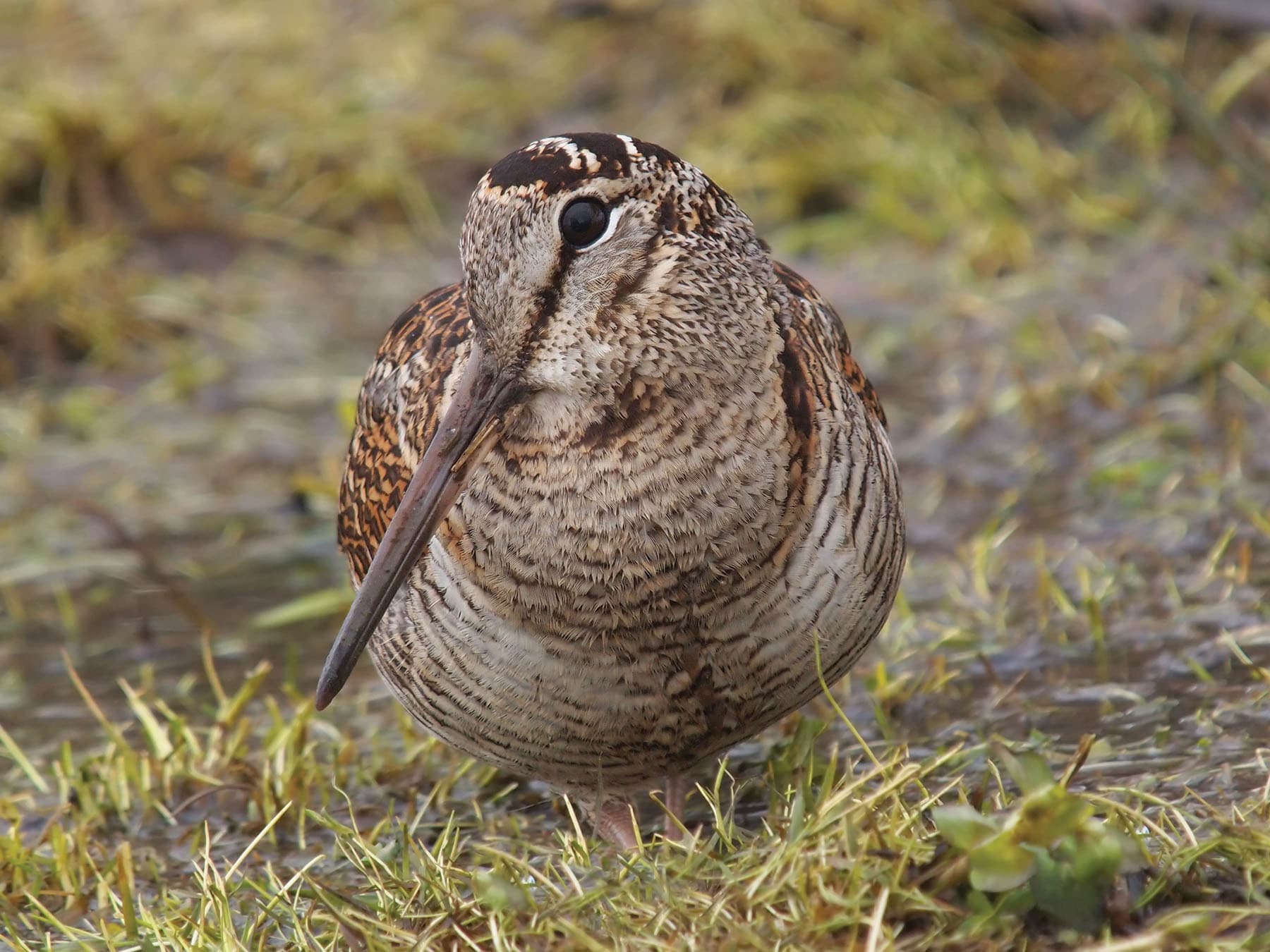
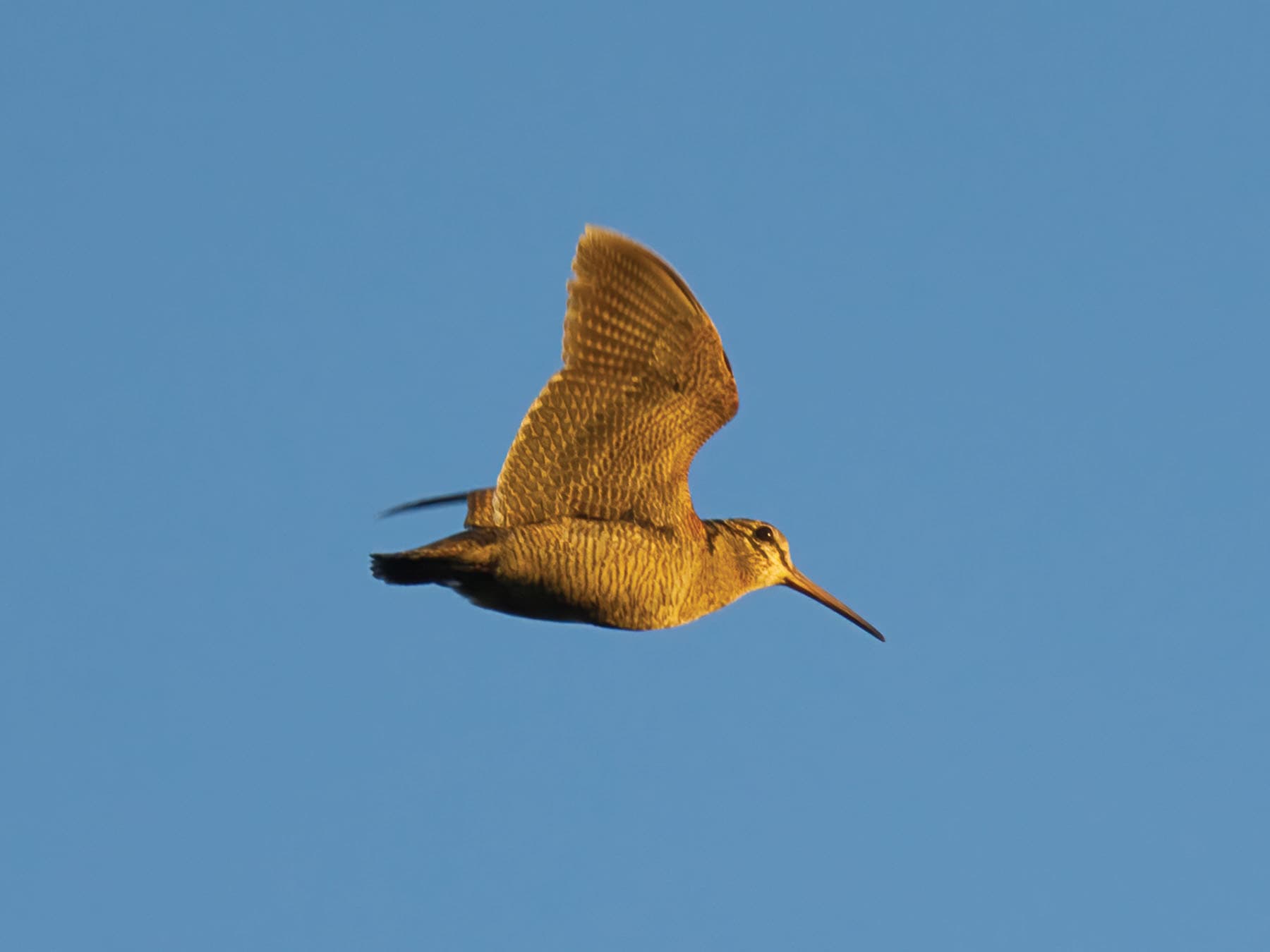
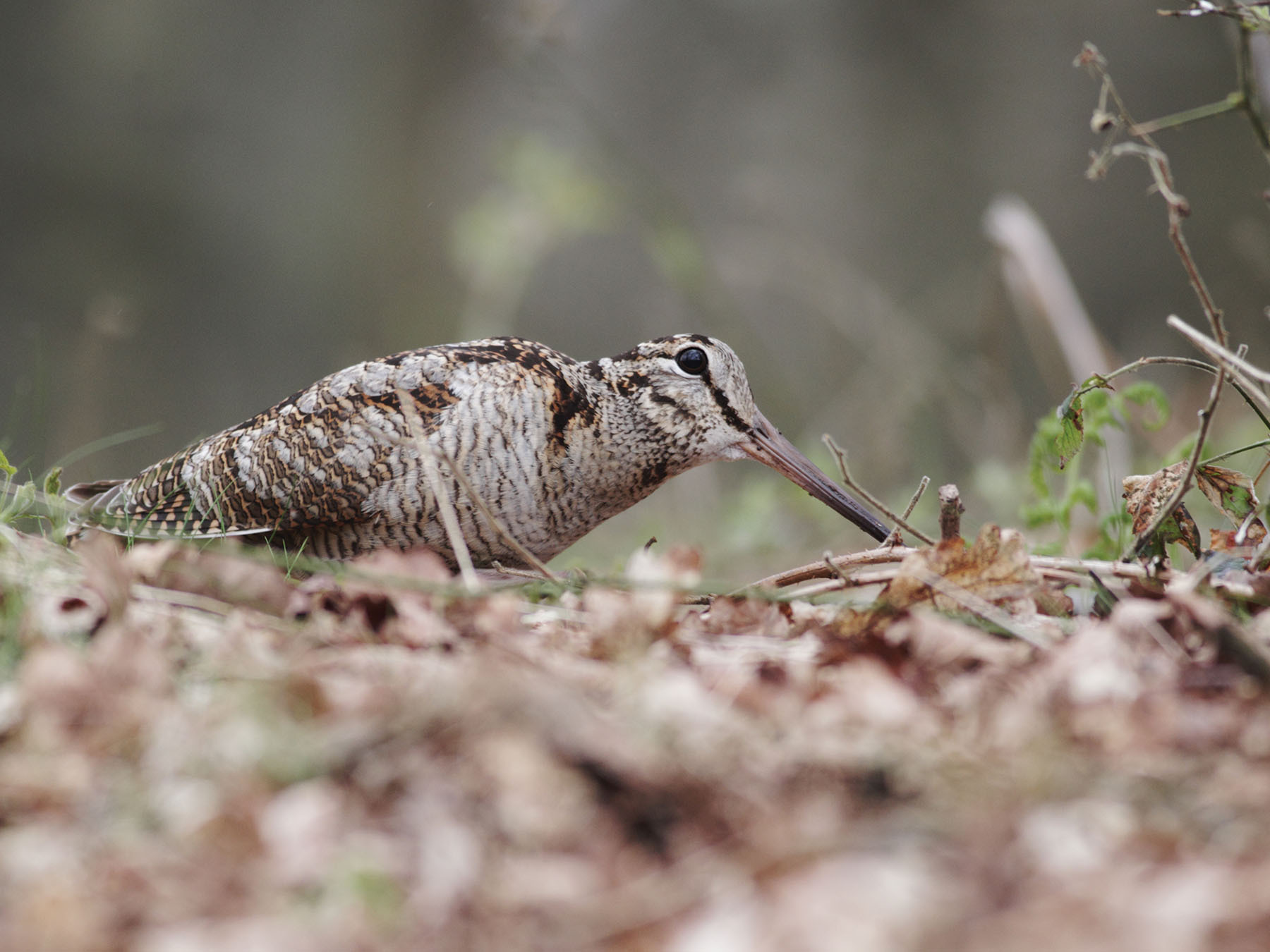
Eurasian woodcocks are stocky wading birds in the sandpiper family, with a long straight tapered bill and relatively short legs.
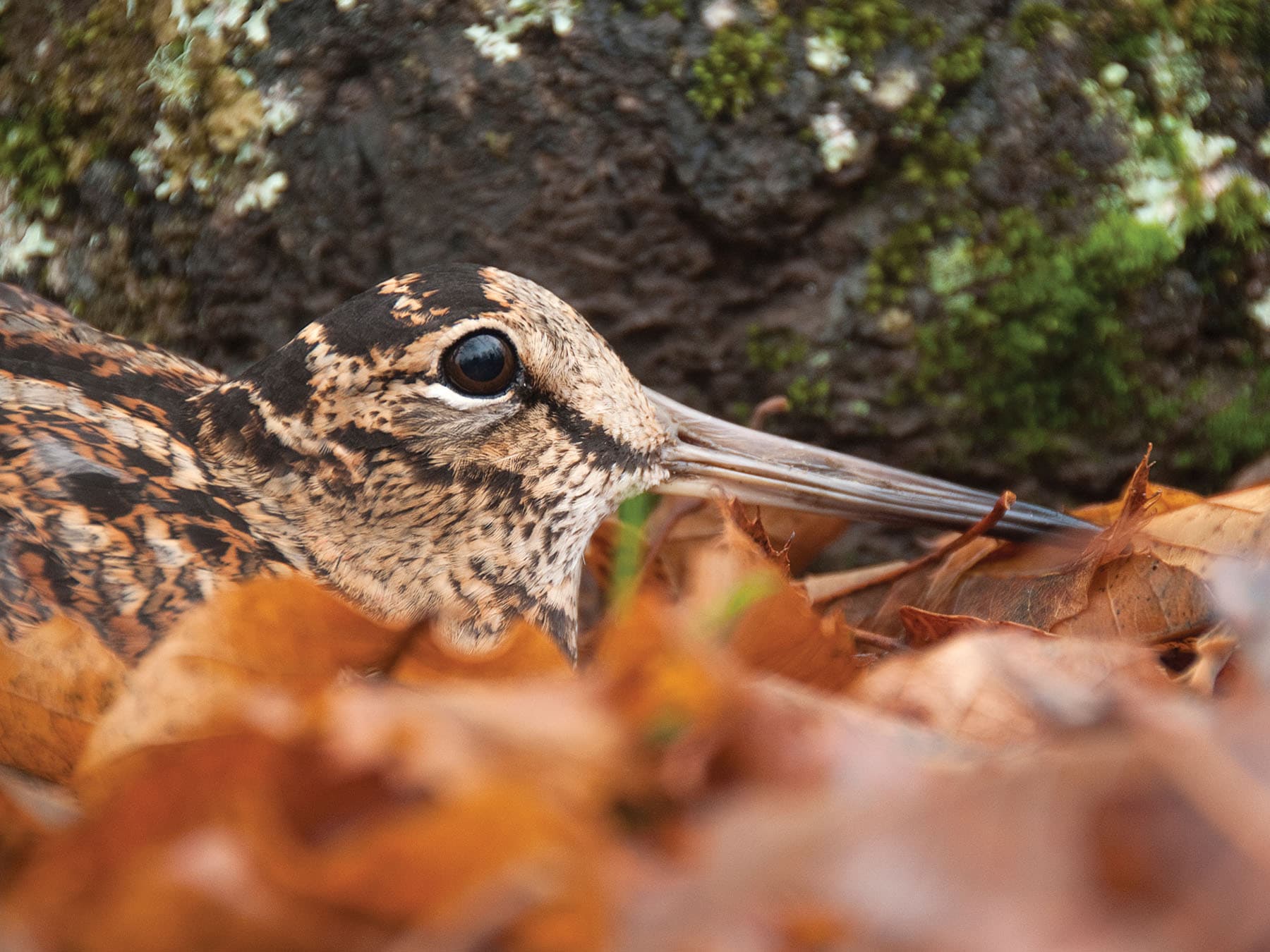
Their large brown eyes are set far back on the sides of the head, which gives them an improved peripheral vision so they are able to sense the presence of nearby predators.
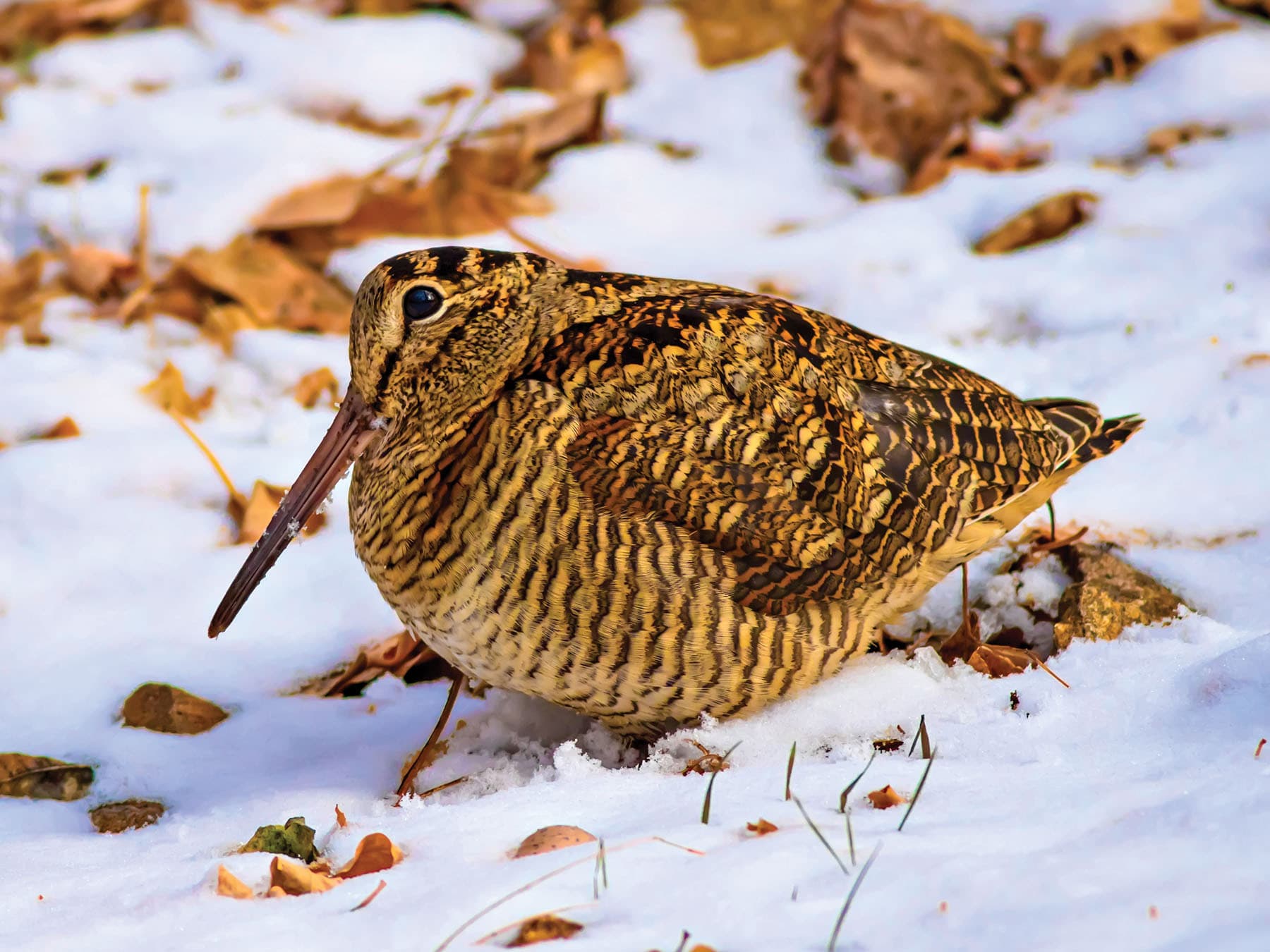
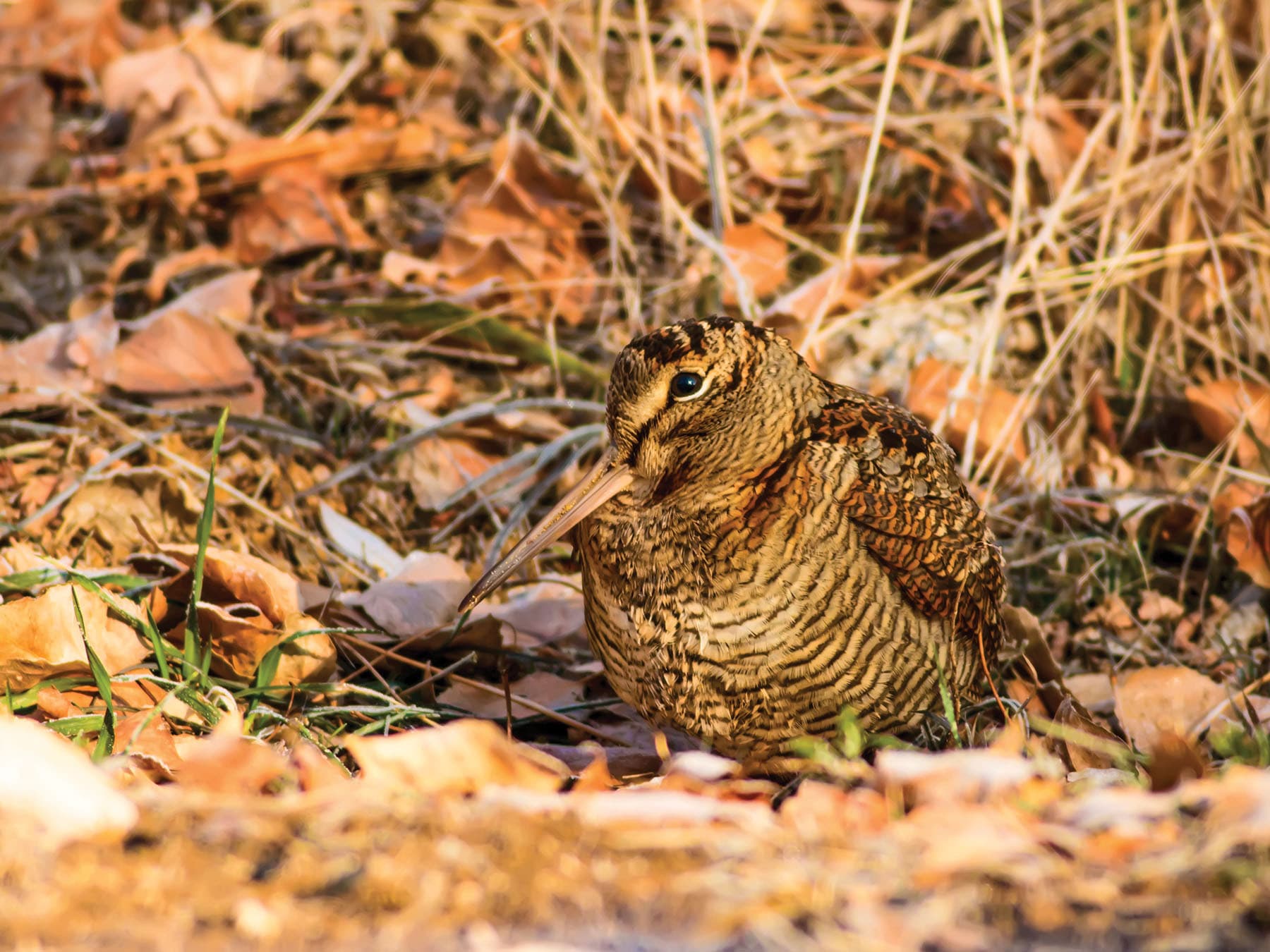
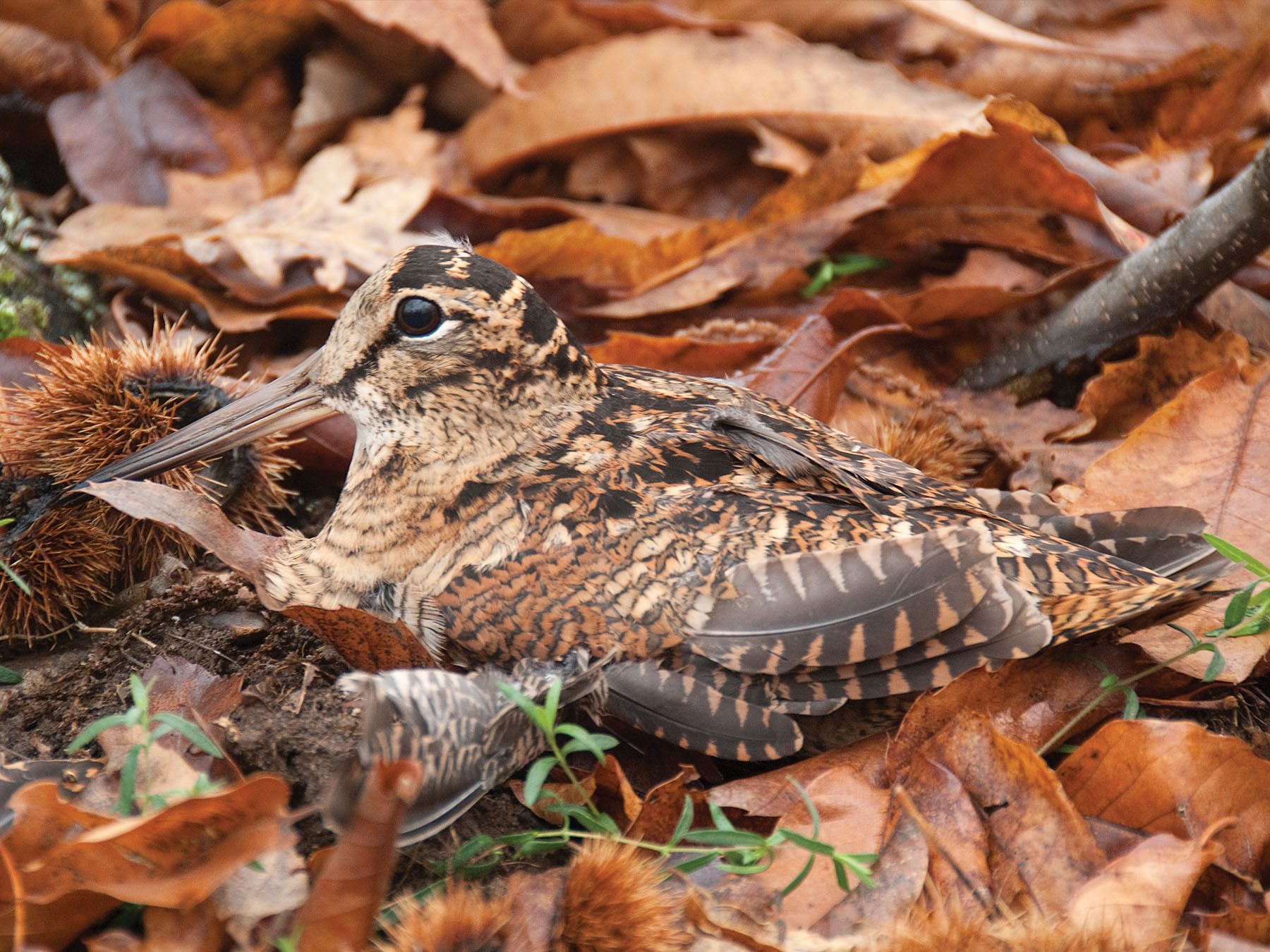
Their plumage is highly mottled, allowing them to blend into their woodland surroundings. Their upperparts are reddish brown with darker brown markings across their rounded wings.
Underparts are buff and streaked with darker barrings. Their crown features black bars, and a cheek stripe runs from their bill to the back of their head crossing the eye.
Female and male woodcocks are alike in markings and size, although in females the tail is slightly shorter and the bill marginally longer.
Juvenile woodcocks look very similar to adults, although their foreheads are more speckled.
How big are Woodcocks?
Woodcocks are roughly the same size as woodpigeons, and are bulky, rounded birds, shorter in stature than many other wading birds due to their short legs. Females and males are the same size.
- Length: 33 cm to 35cm (13 in to 14 in)
- Wingspan: 55 cm to 65 cm (22 in to 26 in)
- Weight: 240 g to 420 g (8.5 oz to 14.8 oz)
Its size
Adults- Length
- 33–38 cm
- Wingspan
- 55–65 cm
- Weight
- 225–400 g
Its song and calls
What sound does a Woodcock make?
During the breeding season, male woodcocks engage in an elaborate and noisy courtship ritual known as roding. They fly over their territories at first light and again at dusk, making a series of grunts and squeaks, attempting to attract a mate and competing with other nearby males.
A common call of a woodcock sounds almost like a frog croaking, accompanied by higher pitched squeak.
Woodcocks are also known for their owl-like flight, with whirring wingbeats that echo through their woodland habitats at night.
- Song0:00 / 0:13
Recorded in Dalarna County, Sweden · May 2023
- Call0:00 / 0:03
Recorded in Dalarna County, Sweden · May 2023
When and where to see it
OctoberArriving
Most recorded in October
- 1. Orkney Islands0.38%
- 2. East Riding of Yorkshire0.20%
- 3. Shetland Islands0.15%
- 4. Antrim0.13%
- 5. Northumberland0.12%
Each dot is a county, state or province: the bigger and darker, the larger the bird’s share of that place’s bird records that month. Grey dots: no regular records. The ringed point is the centre of the bird’s records this month; the arrow shows how it moved since last month, and the dashed loop its path through the year. “Arrivals” colours places where it becomes regular this month (orange) or is in its last regular month (grey). GBIF eBird Observation Dataset, 2019–2024. Map data: Natural Earth, US Census Bureau; place centres © OpenStreetMap contributors.
In your area
See when the Eurasian Woodcock is recorded in your county, state or province.
How often the Eurasian Woodcock turns up in the UK and Ireland through the year, from birdwatchers' records.
United Kingdom
Winter visitor · regularly Oct–Jul · most records in November
Ireland
Winter visitor · regularly Nov–Jul · most records in January
Show as a table
| Month | United Kingdom | Ireland |
|---|---|---|
| January | 0.082% (regular) | 0.067% (regular) |
| February | 0.079% (regular) | 0.033% (regular) |
| March | 0.041% (regular) | 0.021% (regular) |
| April | 0.010% (regular) | 0.007% (regular) |
| May | 0.023% (regular) | 0.011% (regular) |
| June | 0.035% (regular) | 0.010% (regular) |
| July | 0.010% (regular) | 0.005% (regular) |
| August | 0.003% | <0.001% |
| September | 0.002% | 0.002% |
| October | 0.036% (regular) | 0.003% |
| November | 0.093% (regular) | 0.029% (regular) |
| December | 0.084% (regular) | 0.046% (regular) |
Recorded regularly in
Worldwide: recorded regularly in 58 countries
Countries where it was recorded in at least 3 of the 6 years 2019–2024. Linked countries have their own bird list.
Europe (36)
Data: EOD – eBird Observation Dataset (Cornell Lab of Ornithology), accessed via GBIF.org, CC BY 4.0. Records from 2019–2024, aggregated and filtered by Birdfact. How these lists are made
What is the habitat of a Woodcock?
Woodcocks breed in damp woodland environments, where dense undergrowth covers much of the woodland floor.
Their main prey is earthworms, and they seek foraging sites with soils that are easy to penetrate, for example along streams, in orchards, hedgerows and marshes. Young conifer plantations are also a prime habitat for woodcocks.
What is the range of a Woodcock?
Eurasian woodcocks’ breeding range extends from the Canary Islands and Azores in the west, across northern and central Europe and Asia as far as Japan in the west. Woodcocks that breed in France and the UK are typically resident in these countries all year round.
Woodcocks are migratory across much of their eastern and northern range and their winter range of woodcocks stretches from Portugal and the UK in the west, across parts of Spain, France, Belgium and the Netherlands in northern Europe.
To the south, Italy, Greece, coastal regions of Turkey, isolated parts of the North African coast all welcome visiting woodcocks in winter months, and the species’ non-breeding range extends into Asia, with parts of India, south-eastern China and South East Asia.
Where do Woodcocks live?
Population statistics estimate that as many as 10 million woodcock pairs live in Russia, the country with the highest number of woodcocks.
Other countries with high woodcock populations include Belarus, with up to 240,000 pairs, Finland, with up to 200,000 pairs, and Sweden, where up to 100,000 woodcocks live.
How rare are Woodcocks?
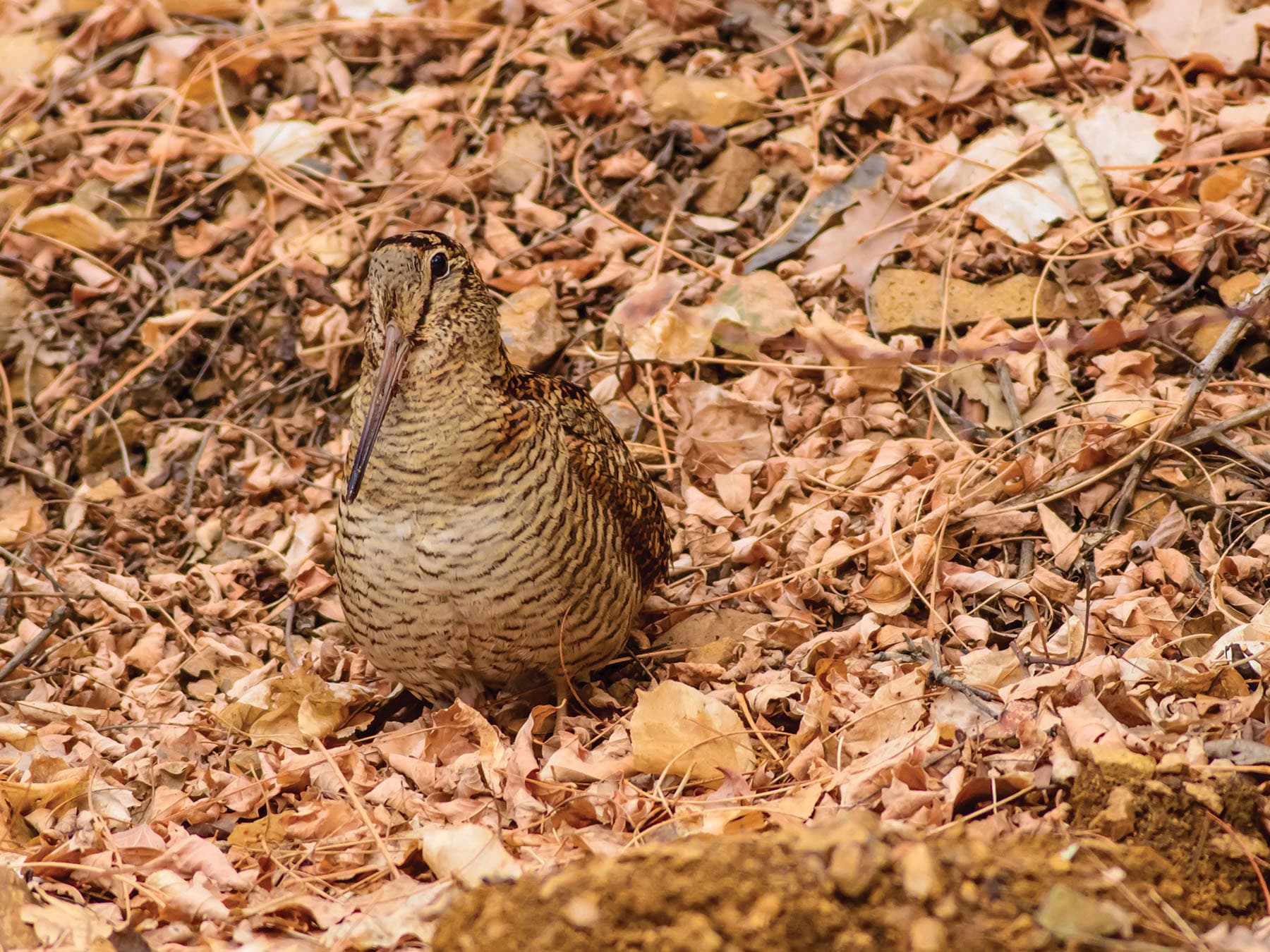
In the UK, there are around 55,000 breeding pairs of woodcocks, fairly widespread throughout the country. However, the species has a reputation as being rather elusive birds that prefer to stay hidden out of view, and with their nocturnal feeding habits, they are not usually active in daylight hours.
In winter, the population of woodcocks increases to around 1.4 million birds, offering a greater likelihood of spotting one while the numbers are temporarily inflated by visiting woodcocks.
Where can you see Woodcocks in the UK?
Woodcocks breed throughout England, Wales and Scotland, but are most common and widespread in northern regions, in lowland regions of Scotland.
However, important populations are also present in southern England, including heath-covered woodlands in Hampshire, Dorset, Kent, Sussex and Surrey. No breeding occurs in Devon and Cornwall, although woodcocks arrive in these regions each winter.
Migration
Do Woodcocks migrate?
While the UK’s woodcock population is largely sedentary, in winter many birds may shift temporarily to lower altitude landscapes further south.
Are Woodcocks native to the UK?
Most of the woodcocks in the UK are resident here throughout the year, but in winter the native population is joined by overwintering migrants from Russia and Finland.
Tips for seeing it
- Look for Woodcocks at dawn or dusk in damp woodland clearings
- Listen for the distinctive 'roding' call during the breeding season
- Watch for their unique bobbing walk as they forage on the forest floor
- In the UK, participate in organised 'woodcock watches' during spring evenings
What it eats
What do Woodcocks eat?
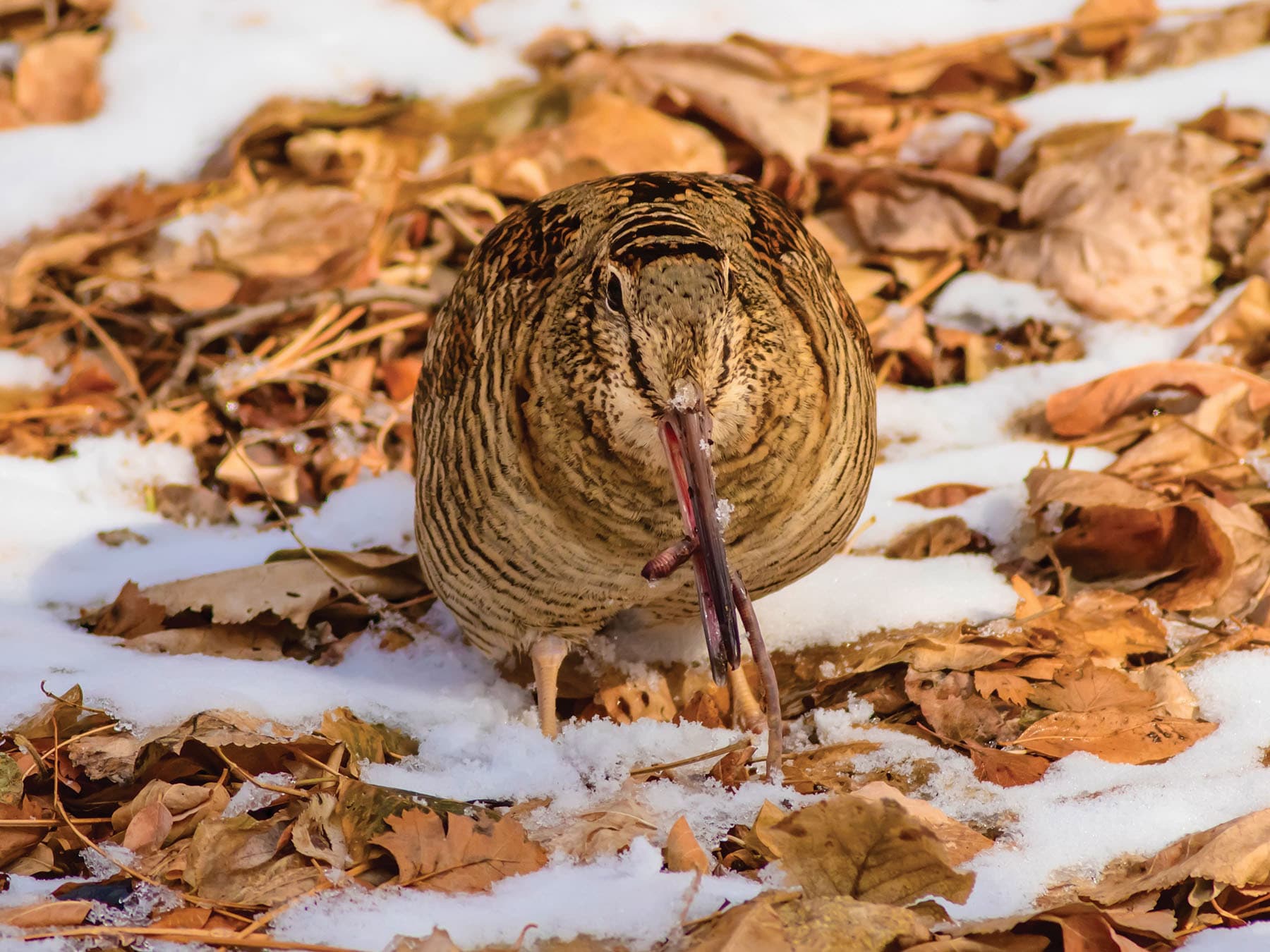
Woodcocks eat invertebrates, and their main sources of food include earthworms and spiders, as well as beetles, caterpillars, fly larvae and small snails. In spring, some plant matter is eaten, especially seeds, fruit, peas, grains, roots and grasses.
Woodcocks drum the earth with their feet to attract worms to the surface, and then probe the soil with their long bills.
What do baby Woodcocks eat?
Woodcock chicks self feed from a very early stage, and eat mainly spiders and earthworms.
Nesting and breeding
Where do Woodcocks nest?
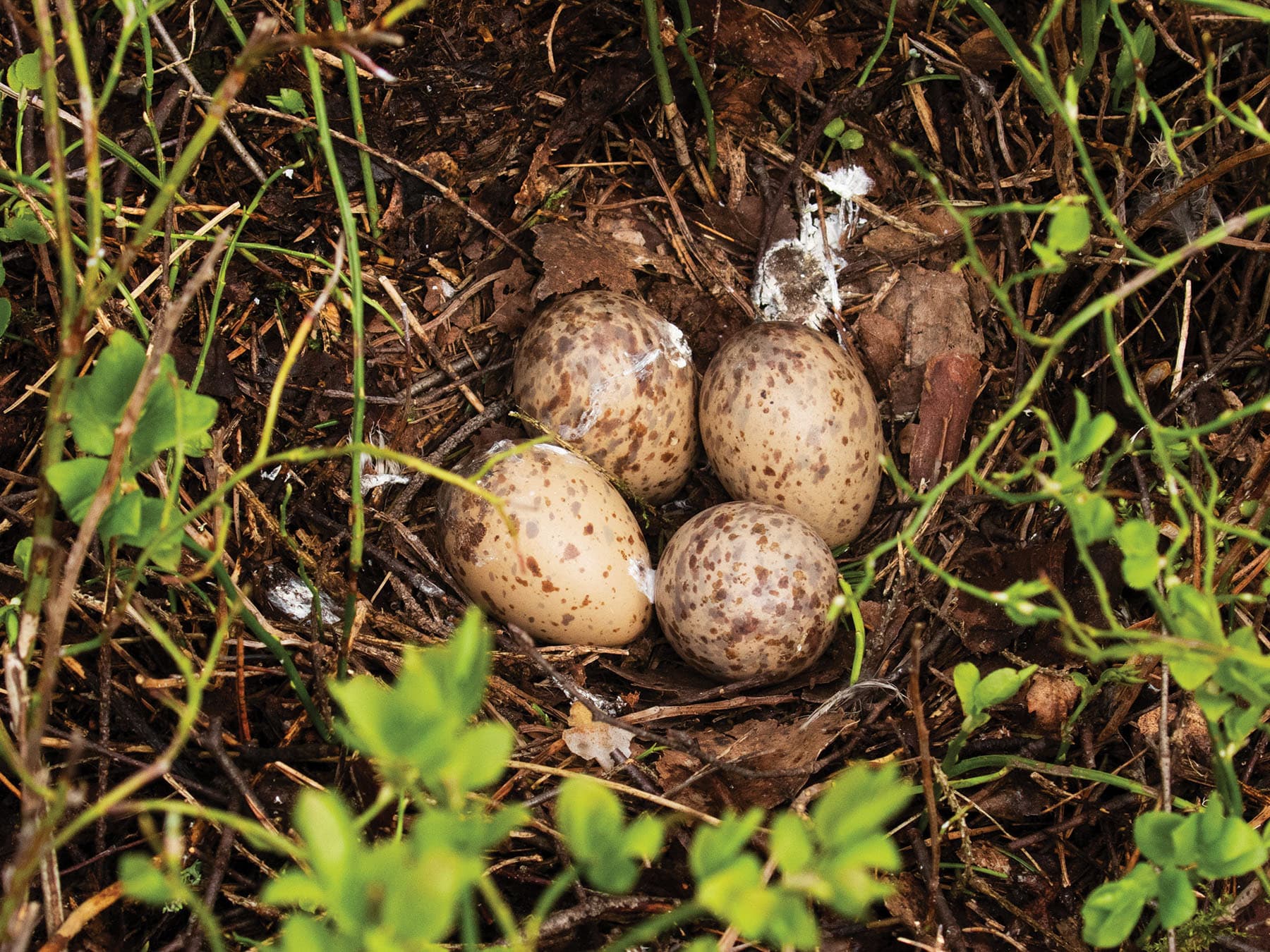
Woodcocks use ground-level nests, forming a shallow scrape up to 5 cm (2 in) deep hidden by vegetation and roughly lined with grass, dry leaves and feathers.
What do Woodcock eggs look like?
A typical woodcock clutch contains between 2 and 5 eggs, which are pale buff-pinkish-brown in colour and heavily marked with red-brown spots. Eggs measure 44.2 mm by 33.5 mm, and are incubated for around 22 days by the female alone.
Do Woodcocks mate for life?
Woodcock pairs only stay together for the briefest period, around three to four days, and do not raise their young together.
Behaviour
Are Woodcocks aggressive?
Woodcocks are solitary birds and tend to be territorial during the breeding season, using a dramatic, loud flight display to see off any rival males.
Where do Woodcocks sleep at night?
Woodcocks roost during the day, and are active at night, foraging in pastures and meadows for earthworms and other invertebrate prey. During the day, they roost in woodland clearances that offer a good all-round view of any approaching ground predators.
Lifespan and predators
How long do Woodcocks live?
The average lifespan of a woodcock is 1.8 years. However, individuals are known to occasionally reach 7 years, as seen in recovered ringed birds.
What are the predators of Woodcocks?
Like other ground-nesting bird species, woodcocks are vulnerable to predation by foxes, stoats, sparrowhawks and tawny owls, while their eggs and young are commonly attacked by jays, carrion crows, squirrels, mice, hedgehogs and birds of prey.
Are Woodcocks protected?
Woodcocks are game birds, and can legally be hunted during the open season which runs from October 1 (September 1 in Scotland) until January 31. Outside of this period, it is an offence under the Wildlife and Countryside Act, 1981, to knowingly kill, injure or capture a woodcock.
Are Woodcocks endangered?
Although across their entire range, woodcocks are numerous and considered a species of least concern, their numbers are declining in the UK and they are classed with Red status in the British Birds of Conservation Concern list.
Loss of habitat, particularly grasslands used by wintering birds and the number of coniferous plantations reaching maturity, is feared to be a factor in falling numbers.
Conservation
While listed as Least Concern globally, Eurasian Woodcock populations are declining in some areas due to habitat loss and hunting pressure.
Conservation efforts focus on protecting breeding and wintering habitats, particularly in Western Europe, where the species faces the most significant threats.
Similar birds
Often mistaken for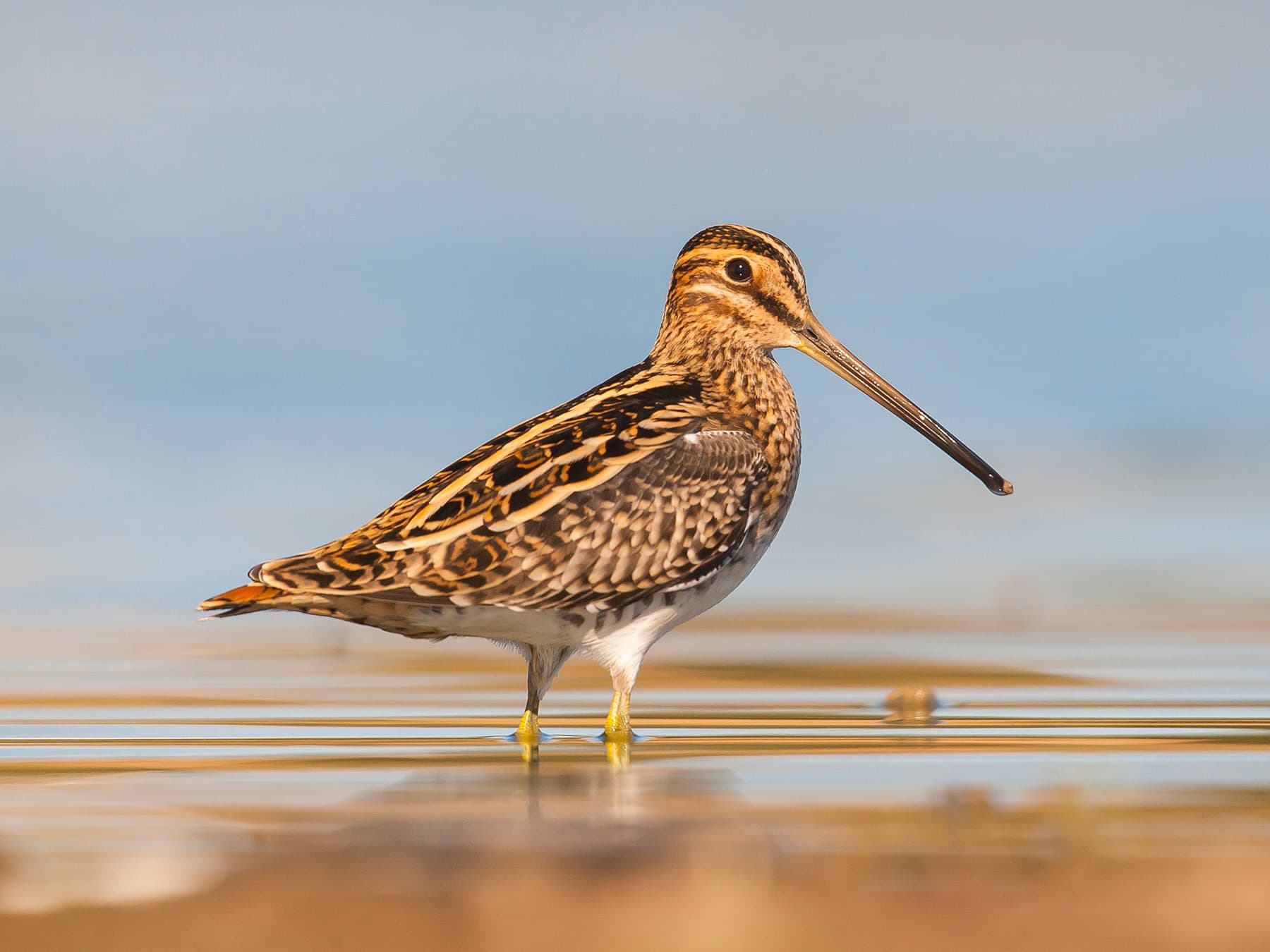
More photos
3 photos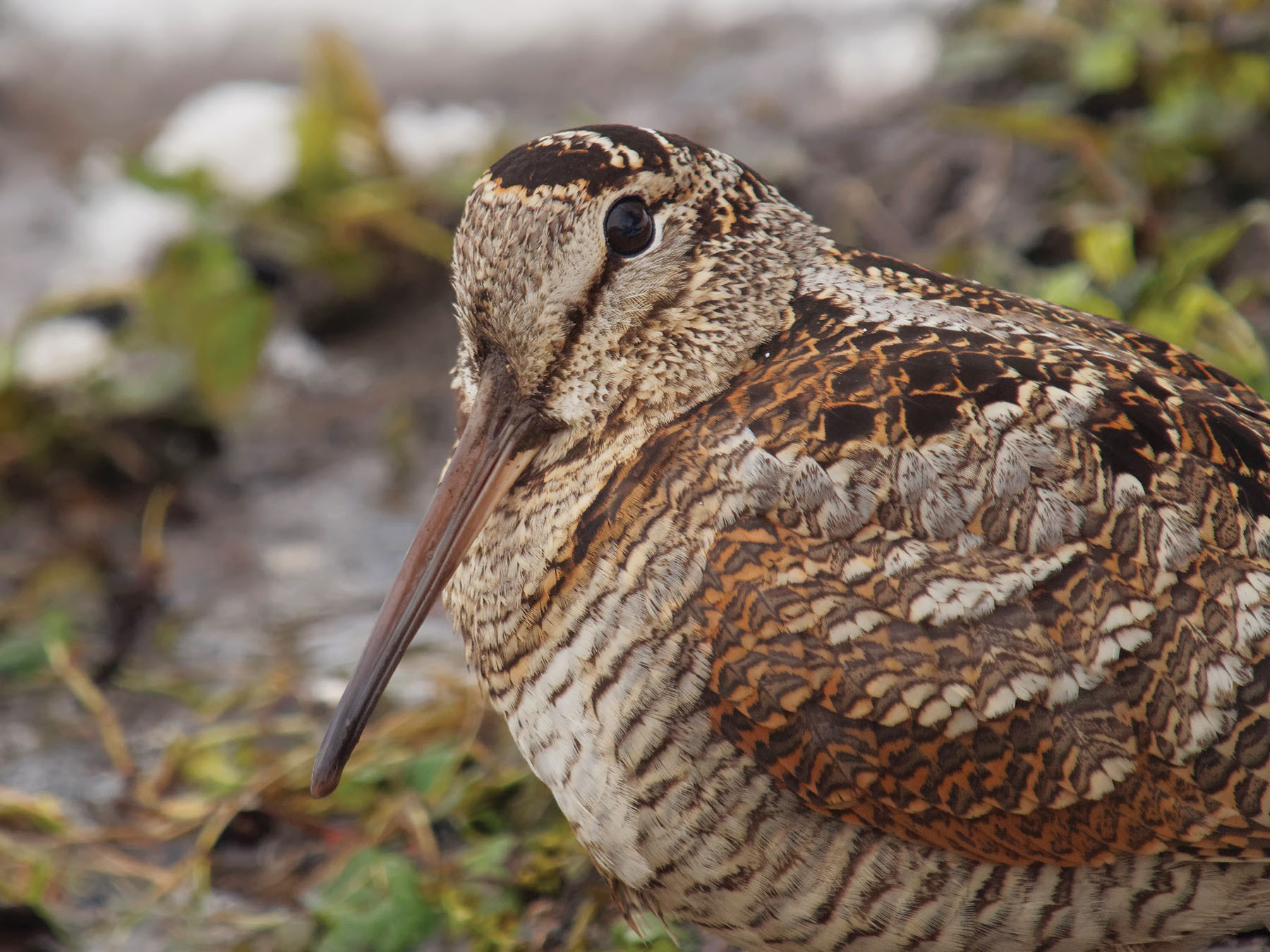
Quick facts
- Length
- 33–38 cm
- Wingspan
- 55–65 cm
- Weight
- 225–400 g
- Lifespan
- 1–2 years · oldest recorded 15.5 years
- Family
- Sandpipers & Snipes
- Migration
- Partial migrant
- Global status (IUCN)
- Least Concern
- World population
- 10,000,000 - 26,000,000 individuals
- Population trend
- Stable
- Also called
- Woodcock
- Scientific name
- Scolopax rusticola
Questions
3Are Snipe and Woodcock the same?
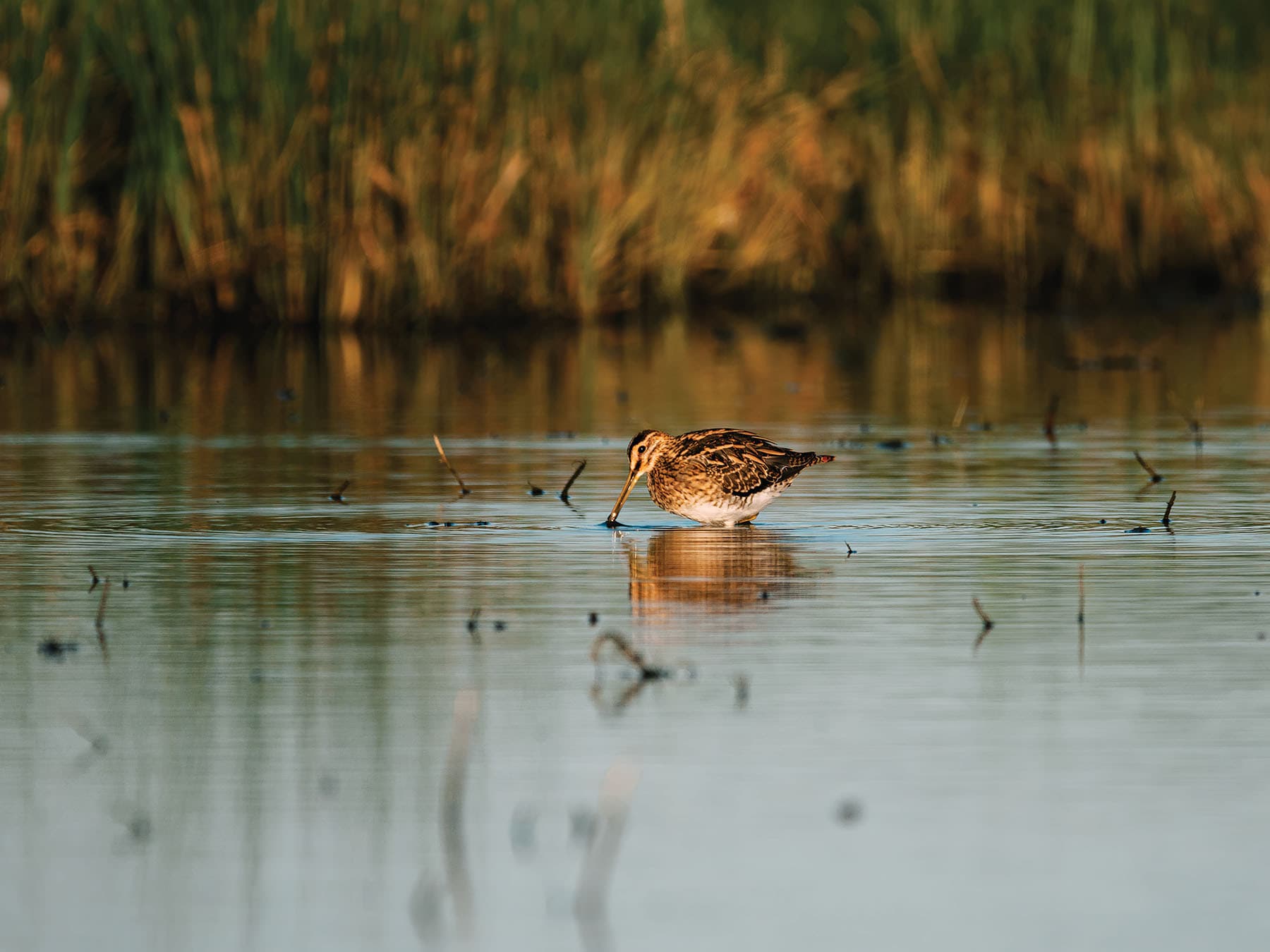
Woodcocks are similar in appearance to snipes but the two species are found in different habitats, with woodcocks preferring woodlands and snipes mainly living and foraging in grasslands and moorlands.
It’s not impossible to distinguish between the two visually, as snipes are slightly smaller and slimmer birds, and have striped faces, while woodcocks are stockier and have a striped crown.
How many Woodcock are shot in the UK?
An estimated 160,000 woodcock are shot by recreational hunters as game birds each year. Shooting is only permitted during the open season, which runs from October 1 (September 1 in Scotland) until January 31.
Can you eat Woodcock?
Classed as a game bird, woodcock is indeed edible. Due to the reclusive nature of the species, they are a notoriously hard species to track down, so woodcock is considered a relatively rare find in a butcher’s shop.
Sources
4- 1BirdLife International. 2019. Scolopax rusticola (amended version of 2016 assessment). The IUCN Red List of Threatened Species 2019: e.T22693052A155471018. Source (opens in a new tab)
- 2BirdLife International. 2019. Scolopax rusticola (amended version of 2016 assessment). The IUCN Red List of Threatened Species 2019: e.T22693052A155471018. Source (opens in a new tab)
- 3Wetlands International (2015)
- 4Fransson et al., EURING list of longevity records for European birds (2010) Source (opens in a new tab)

Checked by
Nathan Cope, founder and editor
Nathan founded Birdfact and leads its writers and contributors in the UK, the US and Canada. He has watched and studied birds for more than ten years, and checks every article and species guide before it’s published.