


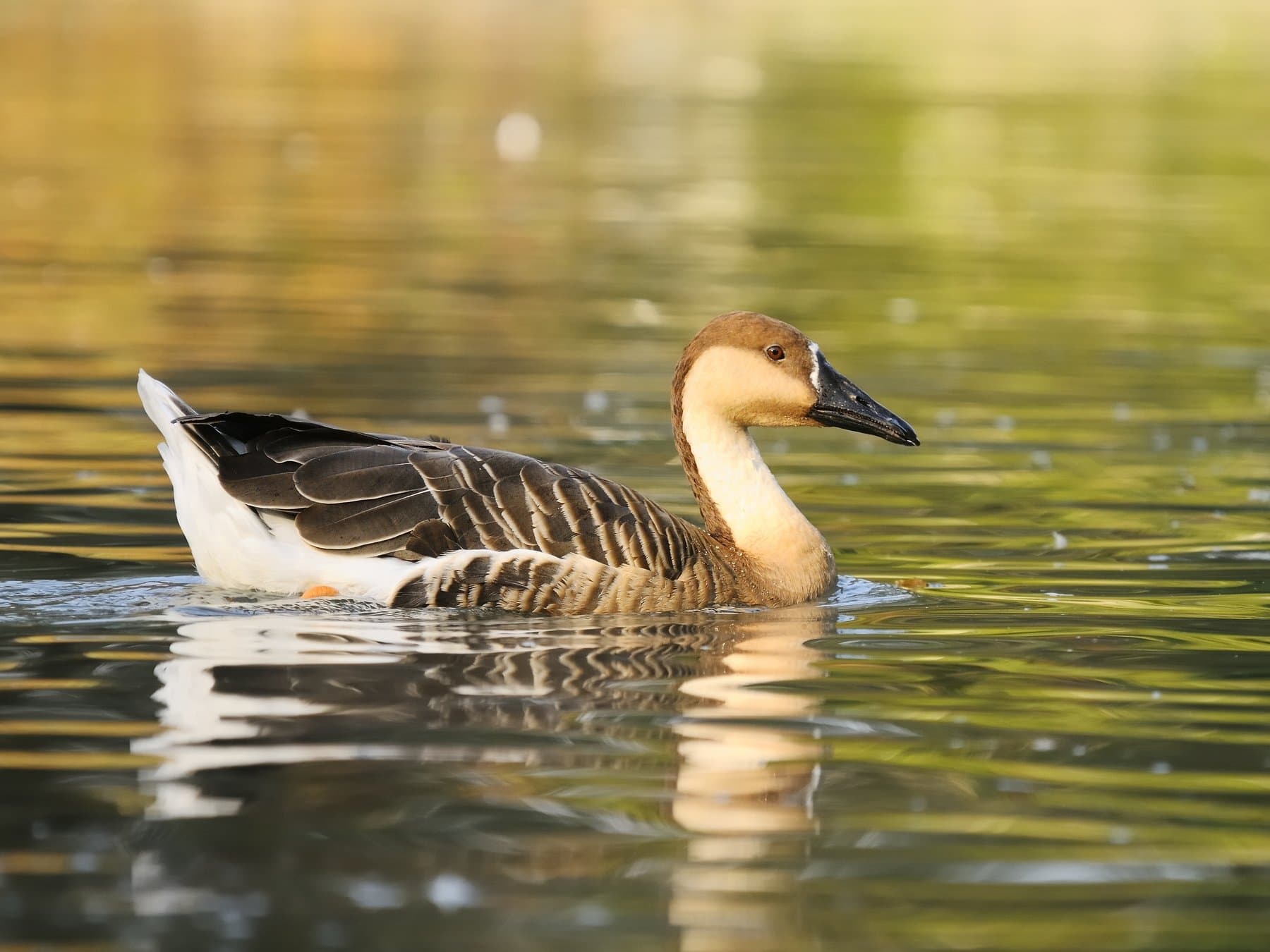
Swan Goose
Anser cygnoides
By the Birdfact teamChecked by Nathan Cope
The longest goose in the genus Anser, the Swan Goose earns its name from a neck so elongated it gives the bird an almost swan-like silhouette — a profile made all the more striking by its jet-black bill, rich maroon cap, and vivid orange feet. Wild birds breed across the steppes of Mongolia and northeastern China, yet the species faces a precarious future: roughly 95% of the entire global population now winters at just three closely situated wetlands in central China.
On this page13 sections
How to recognise it
At 81–94 cm in length and weighing 2.8–3.5 kg, the Swan Goose is the longest species in the genus Anser and the second-heaviest, surpassed only by the Greylag Goose. Its wingspan stretches 160–185 cm. The overall impression is of a large, long-necked goose with a distinctly swan-like bearing — an effect amplified by the proportionally long, heavy bill and stretched neck posture.
The upperparts are greyish-brown, with thin pale fringes to the larger feathers. The hindneck and cap — extending just below the eye — are a rich maroon-brown, sharply contrasting with the pale buff lower head and foreneck. A thin white stripe encircles the base of the bill, a feature that becomes more vivid in breeding condition. The underparts are pale buff, with darker streaking on the belly and flanks. The upper- and undertail coverts are white, and the tail feathers are white-tipped.
One of the Swan Goose's most distinctive features is its bill: entirely black, with no orange or pink banding — unique among Anser geese. The legs and feet are bright orange, and the irides are maroon. In flight, the wings appear uniformly dark, with blackish remiges and no conspicuous wing pattern.
Males are noticeably larger than females, with proportionally longer bills (8.7–9.8 cm vs 7.5–8.5 cm) and longer necks. Wing measurements run 45–46 cm in males and 37.5–44 cm in females. The largest females barely match the smallest males in body size. Plumage colouration is essentially identical between the sexes. Juveniles are duller overall, lacking the white bill-base stripe and the dark streaking on the underparts. The species undergoes a complete moult in late summer — typically August to September — during which it becomes temporarily flightless for several weeks.
Not sure it’s a Swan Goose? Check your photo: Birdfact names the bird and shows the look-alike side by side.
Its size
Adults- Length
- 81–94 cm
- Wingspan
- 160–185 cm
- Weight
- 2800–3500 g
Its song and calls
The Swan Goose is among the most vocal of all geese — a trait so pronounced that it carries through into its domesticated descendants, which are widely regarded as the noisiest of all domestic goose breeds. The primary call is a loud, drawn-out, ascending honk rendered as "aang" — a carrying sound audible at considerable distance across open wetland. The warning call is a sharper, more barking "hong," typically given two or three times in rapid succession when a threat is detected.
Birds communicate constantly within flocks, responding to each other's calls with head-bobbing and slightly higher-pitched honks. This vocal responsiveness helps maintain flock cohesion during migration and at crowded wintering sites. Mated pairs engage in loud vocal duets — a bonding behaviour in which both birds call simultaneously, often accompanied by mutual preening and neck-stretching displays. The duet appears to reinforce the pair bond and may also serve to advertise territory to neighbouring pairs.
Xeno-canto hosts 62 foreground recordings of the species, reflecting its vocal activity across the full range from Mongolian breeding grounds to Chinese wintering sites. Calls are most frequent at dawn and dusk, coinciding with peak foraging activity. Juveniles produce softer, higher-pitched versions of the adult call, gradually deepening as they mature. There is no evidence of significant vocal differences between the sexes, though males may call more frequently during territorial encounters on the breeding grounds.
Heard one and not sure? Let the bird song identifier listen.
When and where to see it
OctoberLeaving
Most recorded in October
- 1. Warwickshireunder 0.1%
- 2. Gloucestershireunder 0.1%
- 3. Lancashireunder 0.1%
- 4. Cumbriaunder 0.1%
- 5. West Yorkshireunder 0.1%
Each dot is a county, state or province: the bigger and darker, the larger the bird’s share of that place’s bird records that month. Grey dots: no regular records. The ringed point is the centre of the bird’s records this month; the arrow shows how it moved since last month, and the dashed loop its path through the year. “Arrivals” colours places where it becomes regular this month (orange) or is in its last regular month (grey). GBIF eBird Observation Dataset, 2019–2024. Map data: Natural Earth, US Census Bureau; place centres © OpenStreetMap contributors.
In your area
See when the Swan Goose is recorded in your county, state or province.
How often the Swan Goose turns up in the UK, Ireland and the United States through the year, from birdwatchers' records.
United Kingdom
Resident · all year · most records in September
Ireland
Scarce · most records in June
United States
Winter visitor · all year · most records in January
Show as a table
| Month | United Kingdom | Ireland | United States |
|---|---|---|---|
| January | <0.001% (regular) | <0.001% | 0.006% (regular) |
| February | 0.001% (regular) | – | 0.004% (regular) |
| March | <0.001% (regular) | – | 0.003% (regular) |
| April | <0.001% (regular) | – | 0.002% (regular) |
| May | <0.001% (regular) | <0.001% | 0.001% (regular) |
| June | <0.001% (regular) | 0.002% | 0.001% (regular) |
| July | 0.001% (regular) | <0.001% | 0.002% (regular) |
| August | 0.001% (regular) | – | 0.002% (regular) |
| September | 0.001% (regular) | – | 0.002% (regular) |
| October | <0.001% (regular) | – | 0.003% (regular) |
| November | 0.001% (regular) | – | 0.004% (regular) |
| December | <0.001% (regular) | 0.002% | 0.004% (regular) |
Recorded regularly in
Worldwide: recorded regularly in 28 countries
Countries where it was recorded in at least 3 of the 6 years 2019–2024. Linked countries have their own bird list.
Europe (15)
North America (3)
South America (1)
Oceania (1)
Data: EOD – eBird Observation Dataset (Cornell Lab of Ornithology), accessed via GBIF.org, CC BY 4.0. Records from 2019–2024, aggregated and filtered by Birdfact. How these lists are made
Tips for seeing it
In the wild, the Swan Goose is a challenging bird to see — its range is concentrated in remote parts of Mongolia, northeastern China, and the Russian Far East during the breeding season, and on a handful of Chinese floodplain lakes in winter. The most accessible wild viewing is at Poyang Lake and Shengjin Lake in China during November to February, where tens of thousands of birds gather on the shallow, seasonally flooded wetlands. Early morning visits yield the best views, as birds are most active at dawn.
Identification is straightforward once you know what to look for. The all-black bill is the clinching feature — no other Anser goose has a bill entirely devoid of orange or pink. Combined with the rich maroon-brown hindneck and cap, the pale buff foreneck, and the long swan-like neck, the Swan Goose is unmistakable at close range. In flight, the uniformly dark wings with no pale panel or speculum distinguish it from most other geese.
In the UK and across much of Europe and North America, the birds most observers encounter are feral Chinese geese — the domesticated form of the Swan Goose. These are commonly found on urban park lakes, farm ponds, and managed wetlands. They share the same all-black bill and maroon cap as wild birds, though domestic individuals are often heavier, paler, and may show a pronounced knob at the base of the bill. Feral birds in the UK can be seen year-round; check local park lakes and nature reserves, particularly in England. In the US, Florida's urban parks and retention ponds host established feral populations.
When distinguishing wild-type Swan Geese from similar species, note the contrast between the dark hindneck and pale foreneck — a pattern absent in the Greylag Goose and Tundra Bean Goose, both of which have orange or pink-and-black bills.
What it eats
The Swan Goose is strictly herbivorous across all seasons, but its foraging strategies shift dramatically between breeding and wintering grounds. On the breeding steppes of Mongolia and northeastern China, birds graze on terrestrial grasses (Poaceae), sedges (Cyperaceae), roots, and seeds near wetlands — a straightforward grazing strategy typical of geese.
Winter feeding on the Yangtze River floodplain is considerably more specialised. Research at Shengjin Lake has documented two distinct foraging modes depending on habitat conditions. On exposed mudflats, birds graze on Canary grass (Phalaris arundinacea). In shallow lake areas, they excavate pits in the lake substrate to extract the buried rhizomes and tubers of aquatic plants — principally Vallisneria spiralis and Vallisneria natans. This pit-digging behaviour is energetically demanding, and birds have been shown to optimise their effort by targeting tubers buried at intermediate sediment depths of 11–20 cm, where tuber size and abundance are greatest relative to excavation costs.
At stopover sites in South Korea, Swan Geese also feed on grain left in paddy fields after harvest, as well as roots of legumes and sedges — a flexible opportunism that helps sustain them during the long migration. Feeding intensity increases markedly in mid-winter, as birds accumulate fat reserves for the spring migration and breeding season. The crepuscular feeding pattern — most active at dawn and dusk — likely reduces competition with diurnal species and minimises exposure to disturbance.
Nesting and breeding
Swan Geese return to their breeding grounds from wintering areas around April, with nesting activity beginning in May. Pairs breed as single couples or in loose groups near marshes, river deltas, and lake margins. Nest sites are on the ground — typically on a small knoll or elevated spot to keep the nest dry — and are constructed from grasses and other plant material, lined with down. The female selects the site and builds the nest; the male stands guard nearby, actively chasing away intruders.
The clutch typically consists of 5–6 eggs, occasionally up to 8. Incubation lasts approximately 28 days and is carried out by the female alone, while the male maintains a close vigil. Goslings hatch in a precocial state — they can walk and begin feeding themselves within hours of hatching. Both parents cooperate to protect the brood: the female leads goslings to foraging areas and teaches escape behaviour, while the male remains vigilant against aerial and terrestrial threats.
Juveniles reach fledging stage at around 8 weeks and are capable of independent living by approximately 12 weeks, though they often remain with their parents through the first migration. Sexual maturity is reached at 2–3 years of age. One clutch is produced per season; there is no evidence of replacement clutches if the first is lost late in incubation. Courtship involves ritualised displays including head-bobbing, neck-stretching, and mutual preening. Pair bonds are monogamous for the mating season, and the species' strong site fidelity suggests that established pairs may reunite at the same breeding location in subsequent years.
Behaviour
In the air, the Swan Goose presents a distinctive silhouette: the long neck is held fully extended, and the large body tapers to a relatively short tail, giving the bird a front-heavy, elongated profile that recalls a small swan more than a typical goose. The wings are broad and rounded, producing a steady, powerful wingbeat with a measured cadence — less hurried than smaller geese, but capable of sustained speed over long distances.
The wings appear uniformly dark in flight — the blackish remiges and dark underwing coverts create a plain, unpatterned wing surface with no pale panel, speculum, or contrasting bar. This is a useful identification feature: where the Tundra Bean Goose and Greylag Goose show pale forewing panels, the Swan Goose's wings are dark throughout. The white upper- and undertail coverts flash briefly as the bird takes off or banks.
Migration flights cover 2,500–3,000 km between breeding and wintering grounds. GPS telemetry has shown that spring migration is approximately twice as fast as autumn migration, with birds making fewer and shorter stopovers as they race to reach breeding grounds by mid-April. Flocks typically fly in loose V-formations or diagonal lines, which reduce aerodynamic drag and allow birds to monitor each other's position. During the late-summer moult, adults become temporarily flightless for several weeks — a vulnerable period when they rely on dense wetland vegetation for cover.
Lifespan and predators
Wild Swan Geese typically live for 10–20 years, with a maximum recorded lifespan of around 40 years in captivity. As with most large geese, survival rates improve markedly after the first year: juvenile mortality is high, with many birds lost to predation, hunting, and the physiological demands of the first long-distance migration. Birds that survive to adulthood benefit from accumulated experience — knowledge of safe staging sites, productive foraging areas, and effective predator avoidance.
Sexual maturity is reached at 2–3 years of age, meaning that even in favourable conditions, a cohort of juveniles takes several years to contribute to breeding productivity. This slow maturation makes the species particularly sensitive to elevated adult mortality — losses from hunting or habitat-driven starvation cannot be quickly offset by increased recruitment. Research has identified low juvenile survival rates as one of the key drivers of the species' ongoing population decline.
For comparison, the closely related Tundra Bean Goose has a similar typical lifespan of around 7–20 years in the wild. The Swan Goose's longevity record of 40 years comes from captive individuals, where the absence of predation, hunting, and migration stress allows birds to reach their biological maximum. In the wild, most individuals are unlikely to approach this figure.
Conservation
The Swan Goose is currently listed as Endangered on the IUCN Red List — a status it was most recently uplisted to in 2023 following continued population declines. The global population is estimated at 36,000–43,500 mature individuals, with a total wintering count of approximately 54,400 birds. The population trend is declining.
The species faces a cluster of serious and interacting threats. Habitat loss and degradation — driven by conversion of wetlands for agriculture, aquaculture, and urban development — affects both breeding and wintering grounds. The Three Gorges Dam has altered the hydrology of Poyang Lake, modifying water levels and reducing the productivity of submerged aquatic vegetation that wintering birds depend on. Proposals for a Poyang Dam risk compounding this disruption further. Unsustainable hunting, particularly in Russia where goose hunting is poorly regulated, and historical egg collecting on the Sanjiang Plain in China have also taken a toll. Steppe fires on breeding grounds destroy nesting habitat.
Perhaps the most acute vulnerability is the extreme concentration of the wintering population: approximately 95% of all Swan Geese now winter at just three closely situated wetlands in Anhui and Jiangxi provinces. A single disease outbreak, pollution event, or severe weather episode at these sites could be catastrophic. Critically, most staging areas used during migration fall outside nationally protected areas — a major conservation gap identified by GPS telemetry research.
Conservation measures include legal protection in Russia, Mongolia, South Korea, and some Chinese provinces; listing on CMS Appendix II; ongoing satellite telemetry research to map critical staging areas; and captive populations maintained at institutions including Saint Louis Zoo. The species has had a turbulent listing history: uplisted from Near Threatened to Vulnerable in 1992, to Endangered in 2000, downlisted to Vulnerable in 2008 following revised population estimates, and uplisted again to Endangered in 2023.
Courtship & Display
Courtship in the Swan Goose is an elaborate affair involving ritualised posturing, vocalisation, and physical competition. Males begin displaying in late winter, as flocks on the wintering grounds start to break into pairs ahead of the spring migration. Display behaviours include repeated head-bobbing, neck-stretching, wing-spreading, and mutual preening between prospective partners. Both sexes participate actively — unlike in some waterfowl where display is predominantly male-driven.
Vocal duetting is central to pair formation and bond maintenance. Mated pairs call simultaneously in a coordinated sequence, with the male's deeper "aang" interlocking with the female's slightly higher-pitched response. This duet is performed repeatedly during courtship and continues throughout the breeding season, serving both to reinforce the pair bond and to signal occupancy of a territory to neighbouring birds.
Males occasionally engage in direct physical competition for access to females, involving chest-bumping, neck-wrestling, and wing-striking. These contests are typically brief and resolved without serious injury, with the larger male usually prevailing. Once a pair bond is established, the male becomes intensely protective of his mate, chasing away rival males and other potential threats. The strong site fidelity shown by Swan Geese — returning to the same breeding wetlands year after year — means that established pairs are likely to encounter each other in successive seasons, potentially reinforcing long-term bonds.
Domestication And Cultural Significance
The Swan Goose holds a unique position in the history of animal domestication. Archaeological evidence from Tianluoshan, a 7,000-year-old rice cultivation village in the lower Yangtze River valley, points to goose domestication in China as early as the fifth millennium BC — potentially making the Chinese goose the oldest domesticated poultry species in history, predating the domestic chicken. Multiple lines of evidence from the site, including bone morphology, isotope analysis, and spatial distribution of remains, support the interpretation that geese were being kept and managed by early rice farmers.
The domestic Chinese goose (Anser cygnoides domesticus) is now one of the most widespread domestic waterfowl breeds in the world. Genetic studies have confirmed that 25 of 26 recognised Chinese domestic goose breeds derive from the Swan Goose rather than the Greylag Goose — the ancestor of European domestic breeds. Chinese geese are distinguished by the prominent knob at the base of the bill, a feature absent in wild birds, which has been selectively amplified over millennia of breeding.
Charles Darwin examined Chinese geese closely in his work on variation under domestication, noting that despite their markedly different appearance from Greylag-descended breeds, the two could hybridise and their offspring could sometimes breed inter se. He used this as evidence that domestic varieties, however divergent in appearance, retain their fundamental species identity. Today, feral Chinese geese are established across Europe, North America, and Australia — a global diaspora of a species that, in its wild form, is Endangered and confined to a shrinking corner of East Asia.
Quick facts
- Length
- 81–94 cm
- Wingspan
- 160–185 cm
- Weight
- 2800–3500 g
- Lifespan
- 10–20 years · oldest recorded 40 years
- Family
- Ducks, Geese & Swans
- Migration
- Long-distance Migrant
- Global status (IUCN)
- Endangered
- World population
- 36,000–43,500 mature individuals (2023 estimate); total wintering population approximately 54,400 birds
- Population trend
- Declining. The global population has fallen significantly in recent decades, driven by wetland habitat loss, hunting pressure, and extreme concentration of wintering birds at a handful of sites. The species was uplisted to Endangered on the IUCN Red List in 2023.
- Scientific name
- Anser cygnoides
Sources
13- 1Swan goose - Wikipedia Source (opens in a new tab)
- 2Swan Goose Species Factsheet | BirdLife DataZone Source (opens in a new tab)
- 3Swan Goose - eBird Source (opens in a new tab)
- 4Anser cygnoides (swan goose) | Animal Diversity Web Source (opens in a new tab)
- 5Home Range and Habitat Use of the Swan Goose during Wintering in the Seocheon Tidal Flat, South Korea - PMC Source (opens in a new tab)
- 6Seasonal and regional differences in migration patterns and conservation status of Swan Geese in the East Asian Flyway | Avian Research (2021) Source (opens in a new tab)
- 7Migration strategies of Swan Geese Anser cygnoides from northeast Mongolia - USGS Source (opens in a new tab)
- 8Wintering Swan Geese maximize energy intake through substrate foraging depth when feeding on buried Vallisneria natans tubers | Avian Research (2019) Source (opens in a new tab)
- 9Multiple lines of evidence of early goose domestication in a 7,000-y-old rice cultivation village in the lower Yangtze River, China - PNAS/PMC Source (opens in a new tab)
- 10Swan Goose (Anser cygnoides) :: xeno-canto Source (opens in a new tab)
- 11Swan Goose | Saint Louis Zoo Source (opens in a new tab)
- 12Brit-ish Birds - Swan Goose Source (opens in a new tab)
- 13Swan Goose | Florida Breeding Bird Atlas Source (opens in a new tab)

Checked by
Nathan Cope, founder and editor
Nathan founded Birdfact and leads its writers and contributors in the UK, the US and Canada. He has watched and studied birds for more than ten years, and checks every article and species guide before it’s published.