Species Profile
Scissor-tailed Flycatcher
Tyrannus forficatus
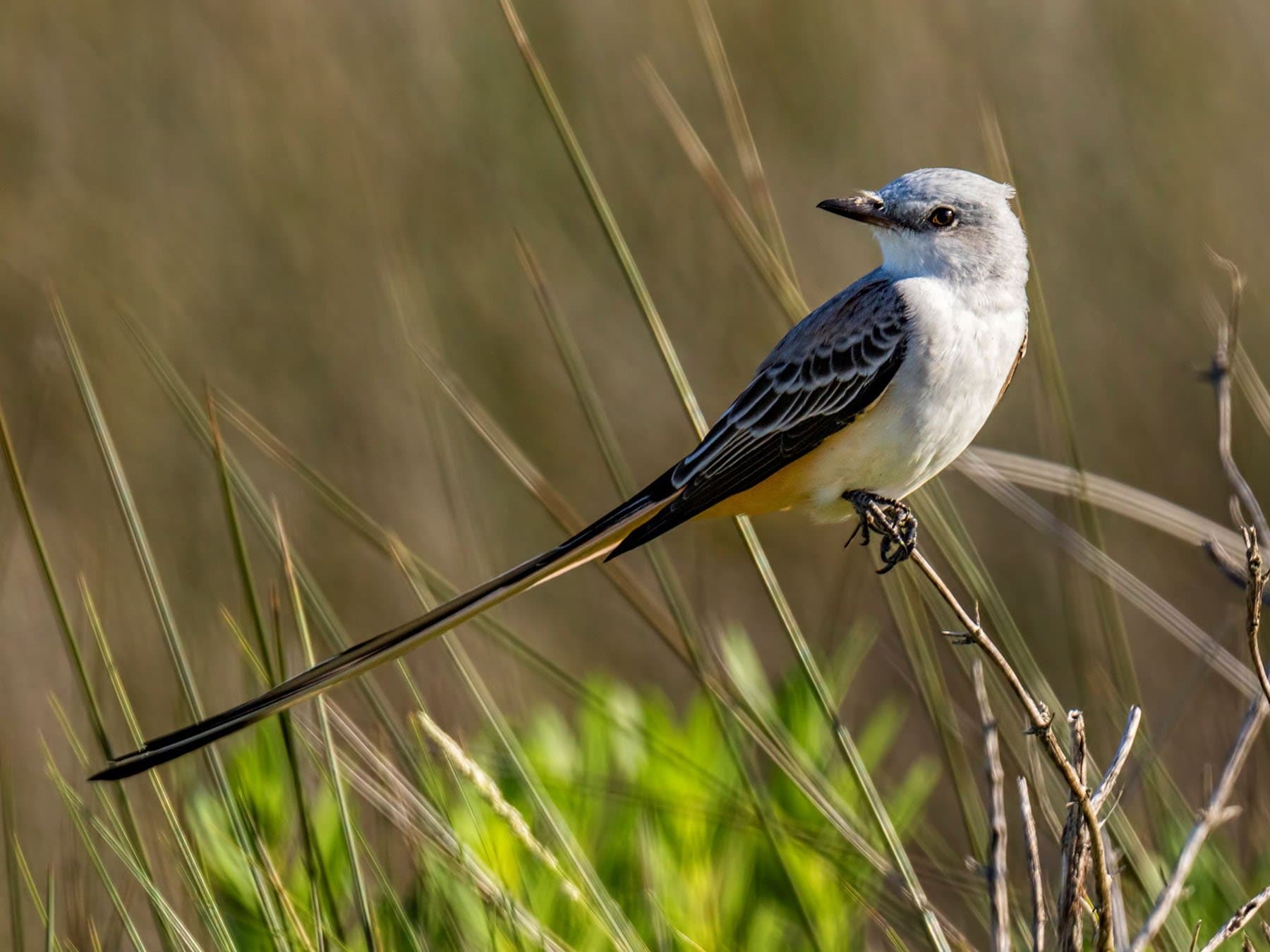
Scissor-tailed Flycatcher perched on a thin branch, showing its long forked tail, grey head, white body, and orange flanks against a grassy background.
Quick Facts
Conservation
LCLeast ConcernLifespan
3–7 years
Length
28–38 cm
Weight
32–54 g
Wingspan
38–43 cm
Migration
Long-distance Migrant
Few North American birds stop traffic quite like the Scissor-tailed Flycatcher. The adult male carries a tail up to 23 cm long — often longer than the rest of his body — which he opens and closes like a pair of scissors during flight, flashing salmon-pink flanks and a hidden blaze of scarlet on the underwing. Oklahoma named him state bird in 1951, and it's easy to see why.
Think you've spotted a Scissor-tailed Flycatcher?
Upload a photo and we'll confirm it instantly
Confirm with a PhotoAppearance
Pearl-grey on the head, nape, and back, with a clean white face and breast — the Scissor-tailed Flycatcher's base palette is almost understated until the salmon-pink kicks in. The flanks, belly, and undertail coverts are washed in vivid salmon-pink, and the underwing coverts and axillaries flash a brilliant scarlet-red that is largely concealed when the bird is perched. A small scarlet crown patch sits hidden beneath the grey crown feathers, revealed only when the bird is excited or alarmed.
The wings are sooty black to dark grey with frosty white edging on the feathers. The bill is stout and black; legs and feet are also black. The tail is black on the upperside and white on the underside, with the long outer rectrices creating the characteristic deeply forked shape. In adult males, the tail alone can reach 20–23 cm — and the bird's total length, including tail, can reach 38 cm (15 in).
Females share the same plumage pattern but are noticeably smaller, with tails typically 15–18 cm long — roughly 30% shorter than the male's, and with a shallower fork. Research by Regosin and Pruett-Jones (2001) measured the tail-length dimorphism ratio at 1.48 (male to female) — the most exaggerated tail asymmetry of any North American passerine. The female's salmon-pink colouring is present but slightly duller and less extensive than in males.
Juvenile birds of both sexes resemble adults but have much shorter, only slightly forked tails, and show yellowish-pink rather than salmon-pink on the flanks and belly. Their overall plumage is duller and browner. First-year birds undergo a partial preformative moult in autumn and winter that produces more adult-like plumage, though some juvenile flight feathers are typically retained through the first winter.
Identification & Characteristics
Male Colors
- Primary
- Grey
- Secondary
- Pink
- Beak
- Black
- Legs
- Black
Female Colors
- Primary
- Grey
- Secondary
- Pink
- Beak
- Black
- Legs
- Black
Male Markings
Extraordinarily long, deeply forked black-and-white tail (up to 23 cm in males); salmon-pink flanks and belly; scarlet-red underwing coverts visible in flight; hidden scarlet crown patch; pearl-grey upperparts; white face and breast
Tail: Deeply forked, black on upperside and white on underside; outer rectrices greatly elongated (20–23 cm in adult males); opened and closed like scissors during flight
Female Markings
Same plumage pattern as male but smaller overall; tail 15–18 cm (roughly 30% shorter than male's) with shallower fork; salmon-pink colouring present but slightly duller and less extensive
Tail: Forked, black on upperside and white on underside; outer rectrices elongated but significantly shorter than male's (15–18 cm); fork shallower than male
Attributes
Understanding Attributes
Rated 0–100 based on research and observation. A score of 50 is average across all bird species. These attributes are relative and don't necessarily indicate superiority.
Habitat & Distribution
Open country with scattered trees is the Scissor-tailed Flycatcher's defining requirement. During the breeding season, the species occupies native grasslands, savannas, mesquite prairies, pastures, croplands, and roadsides — any landscape that combines open foraging space with isolated trees or shrubs for nesting and elevated perches for hunting. Ideal breeding habitat has roughly 1–5% tree cover and 5–30% shrub cover. Dense woodland is avoided entirely.
The core breeding range covers Texas and Oklahoma (where it is the state bird), with significant populations in Kansas, Arkansas, western Louisiana, and southwestern Missouri. The range extends west to southeastern Colorado and far eastern New Mexico, and north to southern Nebraska. In recent decades the species has expanded eastward: in Missouri it has pushed north beyond the Missouri River; in Arkansas the range has shifted toward the Mississippi; in Louisiana it has moved east from the Red River area; and it has nested successfully in western Tennessee several times since 1983.
US birders outside the core range have a reasonable chance of encountering the species during migration, when individuals wander widely. Vagrant records exist from virtually every US state, as well as southern Canada (including British Columbia and New Brunswick), Hudson Bay, and the West Indies. The species is not recorded in the UK, Ireland, or Australia.
The species winters primarily in southern Mexico and Central America — Guatemala (a common winter visitor below 1,500 m), Belize, El Salvador, Honduras, Nicaragua, and Costa Rica, rarely reaching Panama. A small number winter in southern Florida and the Florida Keys. On the wintering grounds, birds occupy similar open habitats: humid savannas, pastures, agricultural lands, scrublands, and the margins of tropical deciduous forests, generally remaining below 1,500 m elevation.
Where and when to see it
The Scissor-tailed Flycatcher is not recorded regularly in the UK or Ireland.
Worldwide: recorded regularly in 12 countries
Countries where it was recorded in at least 3 of the 6 years 2019–2024. Linked countries have their own bird list.
North America (12)
- Belize
- Canada
- Cayman Islands
- Costa Rica
- Cuba
- El Salvador
- Guatemala
- Honduras
- Mexico
- Nicaragua
- Panama
- United States
Data: EOD – eBird Observation Dataset (Cornell Lab of Ornithology), accessed via GBIF.org, CC BY 4.0. Records from 2019–2024, aggregated and filtered by Birdfact. How these lists are made
Diet
Grasshoppers dominate the Scissor-tailed Flycatcher's diet during the breeding season, comprising more than 50% of prey items at peak times — a higher proportion than any other Oklahoma flycatcher. Beetles, crickets, robber-flies, dragonflies, bees, wasps, true bugs, caterpillars, moths, and spiders round out the menu. Spiders are taken more frequently than many accounts suggest, particularly when feeding nestlings.
The foraging method is classic perch-and-sally: the bird watches from an elevated, exposed perch, then launches out to snatch prey in mid-air (hawking) or picks it from vegetation or the ground. Agility in the air is exceptional — they can make abrupt mid-air turns and hover briefly to pluck prey from a leaf or stem. Small prey items are often swallowed during the return flight to the perch; larger items are beaten against the perch before eating.
Like other flycatchers, they cannot digest hard insect parts — wings, legs, and exoskeleton — and periodically regurgitate these as small pellets. Foraging activity peaks in mid-morning and late afternoon rather than early morning, as insects are most active in the warmer parts of the day.
On the wintering grounds in Mexico and Central America, and during migration, the diet is supplemented with berries and small fruits taken from fruiting trees such as mulberry and hackberry, either while perched or hovering. This fruit-eating on the wintering grounds also makes the Scissor-tailed Flycatcher a minor seed disperser in the tropical habitats it occupies from October through March.
Behaviour
Scissor-tailed Flycatchers are conspicuous, active birds that spend much of their time on exposed perches — fence posts, utility wires, and bare tree branches — scanning the ground and air below for prey. They are not shy. A perched bird will hold its ground as you approach, often tilting its head and flicking that extraordinary tail before launching into a swift, agile sally.
Territorial behaviour is pronounced during the breeding season. Males defend territories vigorously against other flycatchers and will mob much larger birds — hawks, crows, and even Great Horned Owls — with persistent dive-bombing attacks. This aggression extends to the Western Kingbird, their closest relative, with which they share overlapping range in parts of the south-central US. Pairs give excited, pipping, sputtering calls during territorial encounters.
Outside the breeding season, the species becomes markedly more social. From late August through September, birds gather in large communal pre-migratory roosts, often in mature trees along streams or in towns. These roosts can hold 100–1,000 birds (occasionally more) and are frequently reused for many years — some known roost sites have been occupied for over 20 consecutive years. Numbers peak in September before declining as migration begins in October.
Foraging activity peaks in mid-morning and late afternoon rather than early morning, tracking the activity patterns of their insect prey. On the wintering grounds in Central America, birds gather in large flocks but typically disperse to forage alone or in pairs during the day.
Calls & Sounds
The Scissor-tailed Flycatcher's most common call is a low, flat "pik" or "kik," also rendered as "pik-prrr." A frequently heard contact and alarm call is a harsh, repeated "kee-kee-kee-kee" or "cah-kee…cah-kee…CAH-KEY," rising in intensity as the bird becomes more agitated. The Missouri Department of Conservation describes the voice as a "kek or kit or a repeated cac-wee or ca-leek in a series of jumbled, sputtering notes." The song proper is a low-pitched "pidik pek pik pik pidEEK" — a series of sputtering, chattering notes similar in character to those of the Eastern Kingbird.
During territorial interactions, pairs exchange "kik" calls and quiet gravelly notes. Males are most vocal during the breeding season, particularly during courtship displays and territorial defence. The species also produces wing sounds audible during certain flight displays.
The dawn song is the most extraordinary vocal performance in the species' repertoire, and almost never described in popular accounts. Performed in flight before sunrise during the breeding season, the male flips upside down during the most rapid series of notes and simultaneously produces an audible whirring noise with modified primary feathers — a combined acoustic and visual display that has no equivalent among North American flycatchers. Females are generally quieter than males but give similar call types, particularly when alarmed near the nest.
Flight
In the air, the Scissor-tailed Flycatcher is among the most agile birds in North America. The long outer tail feathers open and close continuously during flight — the scissoring action that gives the species its name — and function as a dynamic rudder, enabling abrupt directional changes that would be impossible for a bird with a conventional tail. This aerodynamic advantage is most visible during insect pursuits, when the bird can reverse direction almost instantaneously to intercept prey that has changed course.
Typical foraging flight is a swift, direct sally from a perch, often covering 5–15 m before the bird snaps up an insect and curves back to its starting point. The wingbeats are rapid and slightly undulating. In sustained flight between perches or during migration, the bird adopts a more buoyant, slightly undulating style, with the tail streaming behind and the salmon-pink flanks visible from considerable distance.
The courtship sky dance is the most dramatic flight performance: the male climbs to approximately 30 m, then plunges in a series of erratic V-shaped dives, opening and closing the tail streamers dramatically and uttering a rolling, cackling call. He may perform backwards somersaults in mid-air. The display has been described as an aerial ballet and can be witnessed along roadsides throughout spring and early summer across Oklahoma and Texas.
In flight, the underwing coverts and axillaries flash brilliant scarlet-red — a colour almost entirely hidden when the bird is perched. This flash of colour, combined with the scissoring tail, makes the Scissor-tailed Flycatcher one of the most visually distinctive birds in North American airspace.
Nesting & Breeding
Males arrive on the breeding grounds before females in early spring — typically early April in Oklahoma — to establish territories. The nest is a ragged open cup, 11–15 cm in diameter, placed on a horizontal limb or in a vertical fork, usually 2–9 m above ground in an isolated tree or tall shrub. Hackberry, mesquite, elm, oak, and orchard trees are commonly used. Nests are also built on utility poles, windmill towers, bridge supports, and streetlamps.
The female builds the nest alone, sometimes escorted by the male, completing it anywhere from a few days to several weeks. The outer frame is constructed from coarse plant stems, oak catkins, cudweed, wool, and Spanish moss. In urban Texas, one study found that artificial human materials — string, cloth, paper, carpet fuzz, and cigarette filters — accounted for 30% of total nest weight, making this one of the most urban-adapted nest builders among North American flycatchers. The inner cup is lined with tightly woven dried roots, thistledown, and cotton fibres.
Clutch size is 3–6 eggs (typically 4–5), white or creamy with dark red, reddish-brown, or purple blotches concentrated at the larger end. One egg is laid per day; incubation does not begin until the last egg is laid and is performed solely by the female over 13–23 days (typically 14–17 days). Chicks hatch altricial — naked except for sparse white down — and both parents feed the nestlings. Young fledge 14–17 days after hatching.
After the first brood fledges, the female typically builds a second nest and lays a new clutch while the male tends the fledglings from the first brood. Up to two broods per season are raised. Nests are only rarely parasitised by Brown-headed Cowbirds, and Scissor-tailed Flycatchers are capable of recognising and removing cowbird eggs from their nests. Severe thunderstorms and tornadoes can destroy large numbers of nests, significantly reducing local reproductive output in some years.
Lifespan
Wild Scissor-tailed Flycatchers typically live 3–7 years, with the oldest individual on record reaching 10.9 years according to US Geological Survey Bird Banding Laboratory data. This maximum is broadly comparable to other medium-sized Tyrannidae flycatchers, though the species' long-distance migration and exposure to severe weather on the breeding grounds introduce significant annual mortality risks.
Nest failure from thunderstorms and tornadoes can be substantial in some years across the Great Plains breeding range, and first-year birds face the highest mortality rates as they navigate their first southward migration to Mexico and Central America — a round trip of approximately 4,000 km. Predation by hawks and falcons is the primary cause of adult mortality; nest predation by snakes and corvids accounts for a significant proportion of reproductive failure.
Pesticide exposure on both the breeding and wintering grounds is a growing concern, as it reduces insect prey availability and may directly affect adult survival and nestling development. Despite a documented population decline of approximately 31% between 1966 and 2014, the species' relatively high reproductive rate — up to two broods per season with clutches of 3–6 eggs — provides some buffer against annual losses. Birds that survive their first year and establish a territory have a reasonable chance of reaching 5 or more years of age.
Conservation
The Scissor-tailed Flycatcher is listed as Least Concern on the IUCN Red List (2021), with a global population estimated at approximately 9.1–9.5 million mature individuals (Partners in Flight 2019; BirdLife International). Despite this, the long-term trend is downward: North American Breeding Bird Survey data show a decline of approximately 31% between 1966 and 2014. The species rates 11 out of 20 on the Partners in Flight Continental Concern Score.
The primary drivers of decline are habitat loss and fragmentation — conversion of open grasslands to intensive agriculture or residential development — and pesticide use, which reduces insect prey availability and may harm adults and nestlings directly. Brush clearance removes nest sites and perch structures. Climate change is projected to affect both range and habitat suitability over the coming decades.
The picture is not uniformly bleak. In some areas the species appears to be expanding its range in response to forest clearing on both breeding and wintering grounds, and the planting of shelterbelt trees has provided additional nesting sites in parts of the Great Plains. The species is fully protected under the US Migratory Bird Treaty Act (1918) and the Canadian Migratory Birds Convention Act (1994).
No targeted conservation programmes currently exist for this species. Researchers recommend retaining strips or patches of brush when clearing land, and maintaining isolated trees and shrubs within open grasslands to preserve both nesting habitat and the elevated perch sites the species depends on for foraging.
Population
Estimated: 9.1–9.5 million mature individuals
Trend: Decreasing
Declining — approximately 31% decrease between 1966 and 2014 (North American Breeding Bird Survey). Partners in Flight Continental Concern Score: 11/20.
Elevation
Breeding: lowlands to ~1,500 m; wintering: typically below 1,500 m, occasionally to 2,300 m
Additional Details
- Family:
- Tyrannidae (Tyrant Flycatchers)
- Predators:
- Adult birds are taken by hawks and falcons, particularly American Kestrels, Cooper's Hawks, and Merlins during migration. Nests are predated by snakes, corvids, and climbing mammals such as raccoons. The species actively mobs potential nest predators, including Great Horned Owls and American Crows, with persistent dive-bombing attacks.
Courtship & Display
The male Scissor-tailed Flycatcher's courtship display is among the most elaborate aerial performances of any North American passerine. Shortly after arriving on the breeding grounds in early April, males begin their "sky dance": climbing to approximately 30 m (100 ft) in the air, then plunging in a series of erratic, V-shaped dives while opening and closing the long tail streamers and uttering a rolling, cackling call. Backwards somersaults mid-dive have been documented. The entire sequence can be repeated multiple times in succession and is most frequently performed in the early morning hours along roadsides and over open grassland.
The tail is central to mate choice. Research by Regosin and Pruett-Jones (2001), conducted at Fort Sill, Oklahoma in 1991–1992, demonstrated that females actively choose males with longer tails as mates. The tail-length dimorphism ratio of 1.48 is the highest recorded for any North American passerine, and experimental tail manipulation studies in related kingbird species have confirmed that longer tails confer a direct mating advantage. The Scissor-tailed Flycatcher's tail is therefore both a sexual signal and a functional aerodynamic tool — a dual role that is unusual among sexually selected ornaments in birds.
Pairs are socially monogamous within a season but do not always reunite in subsequent years. Both male and female search for a nest site together, testing potential spots by pressing themselves against branches. Once the female begins building, the male's role shifts to territory defence and provisioning — he may occasionally sit over the eggs to shade them from the sun when the female is absent, but incubation is performed solely by the female.
Cultural Significance
No bird is more closely identified with Oklahoma than the Scissor-tailed Flycatcher. It was designated state bird on 26 May 1951 by House Joint Resolution No. 21, defeating the bobwhite quail — which had won a public popularity contest back in 1932 — largely on the grounds that no other US state had claimed it. The bird is depicted in flight on the reverse of the Oklahoma Commemorative Quarter (issued 2008) and appears on the state's licence plate. FC Tulsa, the professional soccer club, features the Scissor-tailed Flycatcher on its crest.
In Texas, the species has historically been called the "Texas bird of paradise" — a nickname that captures the combination of improbable elegance and everyday accessibility that makes it so beloved. Unlike many showpiece birds, the Scissor-tailed Flycatcher is genuinely common along roadsides and fence lines across the south-central US, meaning most Texans and Oklahomans have a personal encounter story.
The species also appears in the popular board game Wingspan, which has introduced millions of players worldwide to North American bird diversity. Its card in the game reflects the bird's real-world attributes: a long tail, insectivorous diet, and grassland habitat. For many players, the Scissor-tailed Flycatcher is the first time they encounter this species by name — and the game's artwork captures the salmon-pink and pearl-grey palette with reasonable accuracy.
Birdwatching Tips
In the US, the Scissor-tailed Flycatcher is one of the most reliably findable showpiece birds in the south-central states. Oklahoma and Texas offer the best opportunities from April through September. Drive any rural road through open grassland or farmland with scattered trees and scan fence posts, utility wires, and bare branches — a perched male is unmistakable, the long tail streamers hanging below the wire like a pair of dropped ribbons.
Early morning and late afternoon are the most productive times to watch, as foraging activity peaks during these windows when insect prey is most active. Watch for the characteristic perch-and-sally foraging style: the bird launches from its post, makes a swift aerial manoeuvre, and returns — often to the same perch. In flight, the salmon-pink flanks and the scissoring tail action are diagnostic.
During late August and September, look for pre-migratory roosts in mature trees along streams or in town parks across Oklahoma and Texas. These gatherings can number in the hundreds and offer exceptional views of multiple birds in one location. Some roost sites are used year after year — local birding groups often know the traditional spots.
The species is most easily confused with the Fork-tailed Flycatcher (Tyrannus savana), a rare vagrant from South America that occasionally appears in the US. The Fork-tailed has a black cap and lacks the salmon-pink colouring. During migration, vagrant Scissor-tails can appear almost anywhere in North America — keep an eye on open country and fence lines well outside the core range, particularly in September and October.
Did You Know?
- The male's tail is not just a sexual ornament — it functions as a precision aerodynamic tool. Research by Regosin and Pruett-Jones (2001) confirmed that females actively choose males with longer tails as mates, and the tail-length dimorphism ratio of 1.48 (male to female) is the most exaggerated of any North American passerine. Yet the same tail enables the sharp mid-air twists needed to catch agile flying insects, making it one of the few sexually selected structures in birds that also directly improves foraging performance.
- During the dawn song, the male flips completely upside down in mid-air at the peak of his vocal display, simultaneously producing an audible whirring noise with modified primary feathers — a behaviour almost entirely absent from popular field guides and competitor species accounts.
- In eastern Arkansas and western Tennessee, the Scissor-tailed Flycatcher and the Western Kingbird have created a hybrid breeding zone after both species independently expanded their ranges eastward over the past 50 years. This is one of the few documented cases of two closely related North American flycatchers forming a stable hybrid zone through concurrent range expansion rather than secondary contact after geographic isolation.
- Some pre-migratory roost sites in Oklahoma and Texas have been used continuously for over 20 years, with flocks peaking at 100–1,000 birds in September before the main southward movement begins in October.
- The Scissor-tailed Flycatcher became Oklahoma's state bird on 26 May 1951 (House Joint Resolution No. 21), defeating the bobwhite quail — which had won a 1932 public contest — partly because no other US state had claimed it. The bird is depicted in flight on the reverse of the Oklahoma Commemorative Quarter and features on the crest of professional soccer club FC Tulsa.
Records & Accolades
State Bird of Oklahoma
Since 1951
Designated Oklahoma's official state bird on 26 May 1951 by House Joint Resolution No. 21, depicted on the Oklahoma Commemorative Quarter and the state licence plate.
Longest Tail Dimorphism
Ratio 1.48 (male:female)
The most exaggerated tail-length sexual dimorphism of any North American passerine, with males carrying tails up to 23 cm — often longer than the rest of the body.
Grasshopper Specialist
>50% of diet
Grasshoppers comprise more than 50% of the diet during the breeding season — a higher proportion than any other Oklahoma flycatcher.
Community Photos
Be the first to share a photo of the Scissor-tailed Flycatcher
Upload a PhotoIdentify Any Bird Instantly
- Upload a photo from your phone or camera
- Get an instant AI identification
- Ask follow-up questions about the bird
Monthly Birds in Your Area
- Personalised for your location
- Seasonal tips and garden advice
- Updated every month with new species