Species Profile
Ross's Goose
Anser rossii
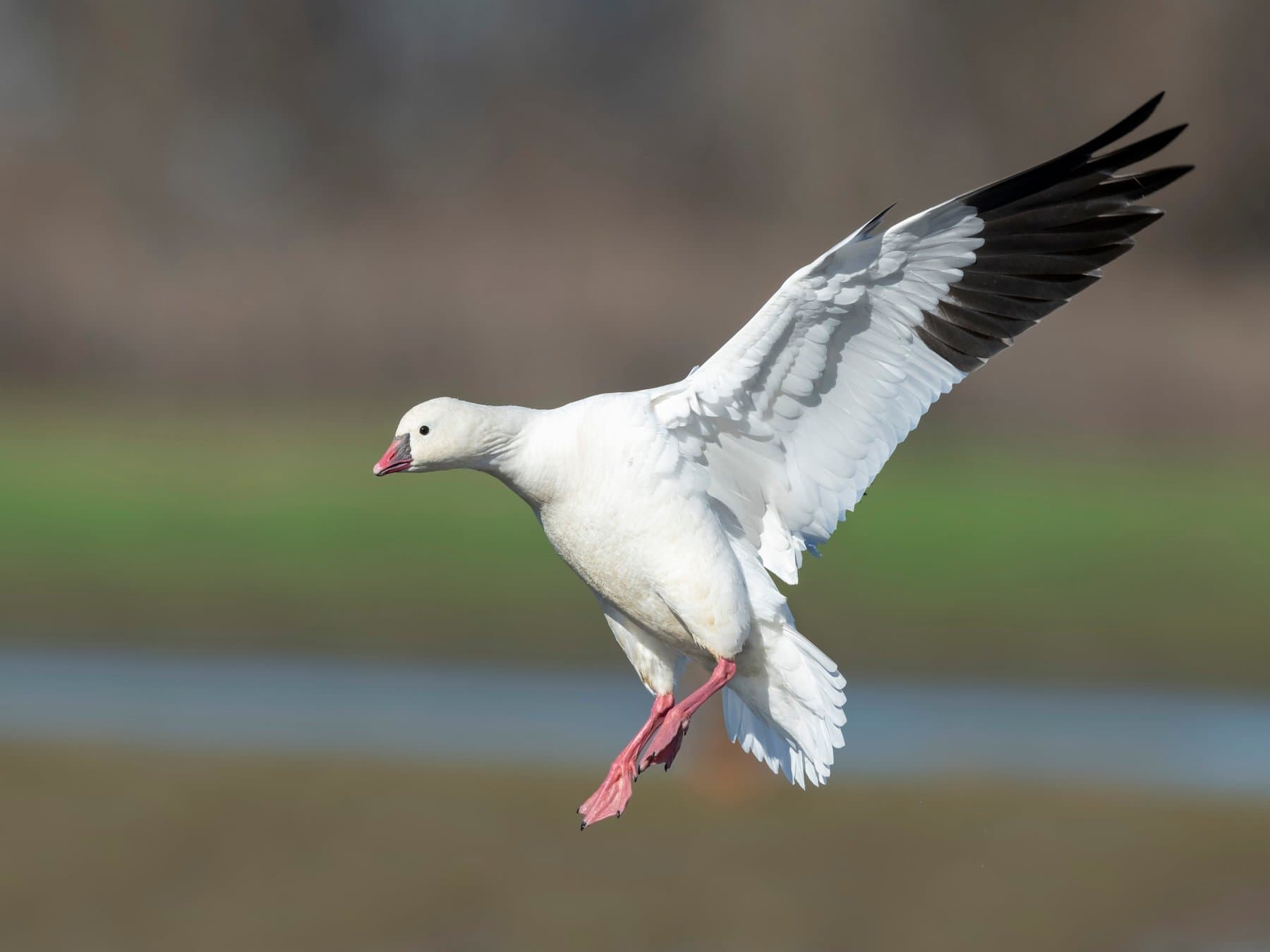
Ross's Goose in flight, descending with wings spread, showing white plumage, black wingtips, and a pink bill and legs against a blurred natural background.
Quick Facts
Conservation
LCLeast ConcernLifespan
6–15 years
Length
57.3–64 cm
Weight
1066–1567 g
Wingspan
113–116 cm
Migration
Full migrant
Snow-white with jet-black wingtips and a stubby rose-pink bill, the Ross's Goose is the smallest of North America's three white geese — and one of ornithology's great comeback stories. From a world population of just 2,000–3,000 birds in the early 1950s, it has rebounded to an estimated 2.35 million, growing at roughly 11.7% per year for four decades. Its breeding grounds in the Canadian Arctic were not even discovered by Western science until 1938.
Think you've spotted a Ross's Goose?
Upload a photo and we'll confirm it instantly
Confirm with a PhotoAppearance
The Ross's Goose is almost entirely snow-white, with sharply contrasting black wingtips (primaries) and grey primary coverts. At rest or in flight, the overall impression is of a compact, rounded bird — noticeably smaller and stubbier than the closely related Snow Goose, with a proportionally shorter neck that gives it a stocky, almost toy-like silhouette.
The bill is the single most important identification feature. Short, triangular, and stubby, it is coloured rose-pink to rose-red and lacks the prominent black "grinning patch" — the dark lips along the bill edges — that is characteristic of the Snow Goose. On adults, the base of the upper bill often shows a blue-grey warty or carunculated area that becomes more pronounced with age. The border where the bill meets the face is straighter than in Snow Geese, where it curves forward. The eye sits more centrally in the face, contributing to the bird's gentle, rounded expression.
Legs and feet are deep pink to rose-red in adults, transitioning from olive-grey in goslings as they mature. In flight, the bird appears all-white with black wingtips, and the stubby bill is visible even at distance — a useful cue when scanning mixed flocks.
A very rare blue morph exists, occurring in fewer than 0.01% of adults. Blue morph birds have a white head but a brownish-black neck, back, and flanks, with grey wing coverts, black primaries, a light grey belly, and white vent and rump. Most reported blue morph individuals should be scrutinised carefully for signs of hybridisation with Snow Goose — hybrid characters such as a black grin patch or curved bill base are common. Males average approximately 6% larger than females, but the sexes are otherwise identical in plumage at all seasons.
Identification & Characteristics
Colors
- Primary
- White
- Secondary
- Black
- Beak
- Pink
- Legs
- Pink
Markings
Snow-white plumage with sharply contrasting black wingtips; short, stubby rose-pink bill lacking the black grin patch of the Snow Goose; blue-grey warty caruncles at bill base in adults; rounded head and short neck giving a compact, stocky silhouette
Tail: White tail, continuous with the overall white body plumage; no distinctive markings
Attributes
Understanding Attributes
Rated 0–100 based on research and observation. A score of 50 is average across all bird species. These attributes are relative and don't necessarily indicate superiority.
Habitat & Distribution
Ross's Goose is a strictly North American species with a breeding range centred on the central Canadian Arctic. Approximately 95% of the global population historically nested in and around the Queen Maud Gulf Migratory Bird Sanctuary in Nunavut, at elevations of 300–600 m. Additional colonies occur along the western and southern coasts of Hudson Bay (including the McConnell River area in Manitoba), on Southampton Island, north of Foxe Peninsula, and on Baffin Island. Since the 1950s, the breeding range has expanded eastward, bringing the species into increasing contact with Lesser Snow Geese.
On the breeding grounds, the habitat is low Arctic tundra: flat plains with rock outcrops and drumlins, wet meadows, and marshy tundra dominated by moss, lichens, sedges, dwarf birch, and willow. Nesting colonies are typically on islands within lakes, rivers, or deltas, or on tundra lake shores at the edge of low thickets.
The main wintering grounds are California's Central Valley, historically the stronghold of the species. In recent decades, the wintering range has shifted and expanded eastward, with significant numbers now wintering in New Mexico, Texas, Arkansas, Louisiana, and the north-central highlands of Mexico. Smaller populations winter along the North Carolina coast. During migration, the main corridor runs through Montana, Idaho, Nevada, and Oregon, with Freezeout Lake in Montana serving as one of the most important staging sites in North America.
In the United Kingdom, Ross's Goose is a rare vagrant — formally accepted to the British List (Category A) only in November 2021. The first accepted British record was an adult at Plex Moss, Lancashire, from 5 December 1970 to 17 January 1971, which returned in consecutive winters until January 1974. Most UK records come from England, particularly Lancashire, where birds have been found among Pink-footed Goose flocks. Records have also been accepted in the Netherlands, Norway, and Denmark. The species is kept in captivity and escapes do occur, so each record requires careful assessment of origin.
Diet
Ross's Geese are almost exclusively herbivorous, with diet shifting substantially between seasons. On the breeding grounds, as the tundra begins to thaw, they eat mainly roots of grasses and sedges, grubbing in the softening ground before new growth is available. As the season progresses, they switch to fresh shoots of cottongrass, birch, and sedge. Because their short bill is less effective at deep digging than the Snow Goose's, they typically only excavate roots after heavy rain has softened the ground.
During spring migration, birds feed heavily on barley, wheat, field peas, and wheatgrass in agricultural fields, fuelling up for the long flight north. Native prairie plants and wet meadow vegetation also feature during this northward push. At Freezeout Lake Wildlife Management Area in Montana — where 20,000–40,000 birds stage each spring and autumn — grain fields and shallow wetlands provide critical refuelling habitat for roughly 20% of the world population.
In winter, the diet broadens to include cottongrass, chickweed, sedges, yellow sweet clover, common bulrush, spikerush, saltgrass, millet, barley, rice, corn, and other domestic grains. Roots and tubers are taken when accessible. Foraging typically occurs in large mixed flocks with Snow Geese, with birds moving between agricultural fields and wetland roost sites throughout the day. Goslings occasionally take insects, particularly during the brief Arctic summer when invertebrates are abundant.
The species' preference for surface grazing rather than deep rooting means it has adapted readily to harvested grain fields — a behavioural flexibility that has helped support the population's dramatic expansion over recent decades.
Behaviour
Ross's Geese are highly gregarious birds, rarely seen alone outside the breeding season. They travel, roost, and forage in flocks that frequently number in the thousands, and these flocks are almost always mixed with Lesser Snow Geese — a habit that makes picking out individual Ross's Geese a genuine identification challenge. The two species share migration routes, staging areas, breeding colonies, and wintering grounds, and hybridisation between them is increasing as the Ross's Goose range expands eastward.
On the ground, Ross's Geese walk slowly while grazing, picking short shoots and seeds from the surface. They rarely dig deeply for roots and tubers — their short bill is less suited to this than the Snow Goose's longer bill, and they typically only root in soft ground after heavy rain. As a result, their white faces tend to stay cleaner than those of Snow Geese, which often develop yellowish iron staining from deep foraging in marshes.
The species communicates not only vocally but also through posture. Birds can vibrate their raised neck feathers — a non-vocal signal used in territorial and social interactions. After a territorial dispute, pairs perform a "triumph ceremony": both birds stretch their necks, raise their bills, and give a low moaning call together, reinforcing the pair bond.
Daily routines follow a predictable pattern: birds leave overnight roost sites on open water at dawn to fly to foraging fields, feed through the morning, rest and preen during the middle of the day, then return to feed again in the afternoon before flying back to roost at dusk. Large feeding flocks produce a continuous, high-pitched cacophony audible from considerable distance.
Calls & Sounds
Ross's Geese are vocal birds, and their calls are consistently higher-pitched than those of the Lesser Snow Goose — a useful distinction when scanning mixed flocks by ear. Both sexes call similarly. The most frequently heard flight call is a rapid, high-pitched "keek-keek keek," delivered in quick succession. At rest and while feeding, birds produce a range of softer cackling and grunting notes, and large feeding flocks generate a continuous high-pitched babble that carries across open farmland.
The full vocal repertoire is broader than the familiar honking suggests. Birds produce honks, squawks, moans, grunts, hisses, and clucks depending on context. During courtship, the male gives high-pitched yelping calls while approaching the female with neck feathers pushed out and head dipping. After territorial disputes, pairs perform the "triumph ceremony" — both birds stretch their necks, raise their bills skyward, and give a low, moaning call together, reinforcing the pair bond through shared vocalisation.
When threatened, birds may hiss with bill open and tail depressed — a posture and sound familiar from many goose species. Geese do not produce songs in the traditional sense; all vocalisations are functional calls used for alarm, coordination, courtship, and social bonding. Interestingly, Ross's Geese also communicate non-vocally by vibrating their raised neck feathers — a subtle postural signal used in territorial and social interactions that is easily overlooked by observers focused on sound alone.
The species is most vocal during migration and on the breeding grounds, where the noise of a large colony — thousands of birds calling simultaneously — can be heard from several kilometres away.
Flight
In flight, the Ross's Goose appears as a compact, all-white bird with sharply defined black wingtips — a pattern shared with the Snow Goose, but on a noticeably smaller and stubbier frame. The short neck is one of the most useful in-flight identification features: even at distance, the bird looks abbreviated compared to the longer-necked Snow Goose, with the head appearing to sit almost directly on the body.
Wingbeats are rapid and relatively shallow for a goose of this size, giving the bird a slightly hurried, flickering quality in flight. The wingspan of 113–116 cm is modest for a goose, and the overall silhouette is more compact than any other white goose species in North America. The stubby, triangular bill is visible even at range, particularly when birds are flying toward or away from the observer.
Ross's Geese typically migrate in large flocks, often mixed with Snow Geese, and adopt the classic V-formation or loose diagonal lines that allow following birds to benefit from the upwash of those ahead. Flocks can number in the tens of thousands at major staging sites. The species is a capable long-distance migrant, travelling between Arctic Canadian breeding grounds and wintering areas in the southern United States and Mexico — a round trip of several thousand kilometres completed twice each year.
When flushed from a field, flocks rise steeply and noisily, filling the air with high-pitched calls before reforming and moving to a new location. Individual birds within a flock are highly responsive to the movements of their neighbours, producing the fluid, rolling wave patterns characteristic of large goose flocks in flight.
Nesting & Breeding
Ross's Geese nest in dense colonies on the Arctic tundra, typically alongside Lesser Snow Geese. Colony densities can exceed 2,000 pairs per square mile, with recorded nest densities of 3–64 nests per 1,000 m². Nest sites are usually on islands or shores of tundra lakes, often at the edge of low thickets, on moss, short grass, or gravel. The same site is frequently reused in successive seasons.
The female builds the nest from plant material immediately surrounding the site — birch, willow, moss, grass, and Labrador tea — and lines it with down feathers from her brood patch, beginning around the time the first egg is laid. Nests average 47 cm across, with an interior cup 16 cm across and 7.6 cm deep, making them larger and better insulated than the nests of the closely related Lesser Snow Goose.
Clutch size is typically 4 eggs (range 2–6, rarely 1–8), dull white and becoming nest-stained during incubation. Eggs average 6.5–8.0 cm long and 4.4–5.1 cm wide, weighing approximately 94 g. The female incubates alone for 19–25 days (typically 21–23 days), while the male stands guard and defends the territory, occasionally covering the eggs during the female's brief foraging breaks.
Goslings hatch covered in down with eyes open and leave the nest within 24 hours. They can swim and feed themselves almost immediately. Both parents attend and protect the young. Fledging occurs at 40–45 days. After nesting, adults move to lowland areas to moult their flight feathers, becoming temporarily flightless before migration begins. Nest success is closely tied to snowmelt timing — later snowmelt leads to fewer nesting attempts and smaller clutch sizes. First breeding typically occurs at age 2–3 years.
Lifespan
Ross's Geese typically live between 6 and 15 years in the wild, with the maximum recorded lifespan standing at 22 years and 6 months — a female banded in Saskatchewan in 1972 and recovered in California in 1993. This figure almost certainly underestimates the true potential lifespan: five of the six oldest recorded individuals were taken by hunters rather than found dead naturally, meaning birds that avoided hunting pressure may have lived longer still.
Survival rates are influenced by several factors. Predation on the breeding grounds — primarily by Arctic foxes, large gulls, and raptors targeting eggs and goslings — is the main source of mortality for young birds. Adults face fewer natural predators, and hunting is now the primary cause of mortality for birds that survive to adulthood. An average of 63,825 birds were harvested per season in the US during 2019–2022, with California, Texas, and Arkansas accounting for the largest harvests.
Compared to larger geese, the Ross's Goose has a relatively short typical lifespan, reflecting its smaller body size — larger-bodied geese such as the Canada Goose regularly exceed 20 years in the wild. However, the species' rapid population growth (11.7% per year between 1975 and 2014) suggests that overall survival rates are high and that annual productivity consistently exceeds mortality across the population. Climate change poses an emerging threat to survival rates, particularly through its effects on Arctic snowmelt timing, which directly influences nest success and gosling survival in the critical early weeks of life.
Conservation
Ross's Goose is listed as Least Concern by the IUCN (2016), and its population trajectory is one of the most dramatic recoveries in North American ornithology. The primary historical threat was market hunting: extensive shooting and trapping drove the entire world population to just 2,000–3,000 birds in the early 1950s, with as few as 25,000 birds recorded in California in 1963. Hunting was made illegal in the US in 1931 under the Migratory Bird Treaty Act, and the population responded spectacularly.
By 1988, 188,000 breeding birds were recorded. By 2006, the population had reached 1.3 million. The most recent estimate stands at approximately 2.35 million birds, with Partners in Flight estimating the global breeding population at 1.7 million. Growth has averaged 11.7% per year between 1975 and 2014 — an overall increase of approximately 8,900% in roughly 40 years. The species scores just 10 out of 20 on the Partners in Flight Continental Concern Score, indicating low conservation concern. Restricted hunting was reintroduced as populations recovered, with an average of 63,825 birds harvested per season in the US during 2019–2022.
Paradoxically, the population explosion has itself become an ecological problem. Growing colonies of Ross's and Snow Geese are overgrazing vast areas of Arctic tundra, stripping vegetation nearly to bare ground — damage now visible from space. Wildlife agencies are actively exploring population management measures to protect the broader tundra ecosystem. Other current threats include loss of migration stopover and wintering wetland habitats, climate change altering Arctic snowmelt timing and vegetation green-up, low genetic diversity from the historic population bottleneck, and potential harm from pesticides and water pollution in agricultural wintering areas.
Population
Estimated: Approximately 2.35 million birds (Partners in Flight estimates global breeding population at 1.7 million)
Trend: Increasing
Increasing at approximately 11.7% per year between 1975 and 2014; population has grown by an estimated 8,900% over the past 40 years from a historic low of 2,000–3,000 birds in the early 1950s
Elevation
300–600 m on breeding grounds; sea level to mid-elevation on wintering and migration grounds
Additional Details
- Family:
- Anatidae (Ducks, Geese & Swans)
- Predators:
- Arctic foxes, large gulls (particularly Herring and Glaucous Gulls), Snowy Owls, Peregrine Falcons, and other raptors targeting eggs and goslings on the breeding grounds; adults face few natural predators, with hunting the primary cause of adult mortality
Taxonomy And Naming
The Ross's Goose has one of the more convoluted naming histories of any North American bird. The species was first described in Western literature by explorer Samuel Hearne in 1770, who encountered it during his overland journey to the Arctic Ocean and called it the "horned wavey" — a reference to the warty caruncles at the base of the bill ("horned") and the Cree word for goose ("wavey" or "wavy"). Despite this early description, the bird was not formally named by science until 1861, when American ornithologist John Cassin described it as Chen rossii, naming it in honour of Bernard Rogan Ross, a Hudson's Bay Company trader and naturalist who collected specimens from the Northwest Territories.
Most remarkably, the species' Arctic breeding grounds were not discovered by Western science until 1938 — making it one of the last North American bird species to have its nesting colonies located, nearly 170 years after Hearne's first written description. The discovery was made by Dewey Soper, a Canadian naturalist, at the Queen Maud Gulf in what is now Nunavut.
The species has been placed in two genera over its taxonomic history. It was long classified as Chen rossii (in the genus Chen, alongside the Snow Goose and Emperor Goose), but is now placed in Anser by most authorities, including the International Ornithological Congress, reflecting molecular evidence that the white geese are not a distinct lineage from the grey geese. The common name honours Bernard Ross, though the possessive apostrophe placement (Ross's rather than Ross') follows standard ornithological convention for eponymous species names.
Courtship & Display
Ross's Geese form long-term monogamous pair bonds, likely maintained for life as in other goose species. Pairs probably form in late winter or during spring migration, with courtship behaviour observed from February onward. The male initiates courtship by walking toward the female with short, deliberate steps, neck feathers pushed out to increase apparent size. He then pulls back, dips his head repeatedly, and gives a series of high-pitched, yelping calls — a display that is more energetic and insistent than the subtle head movements of larger goose species.
Copulation apparently occurs mostly during migration rather than on the breeding grounds. Males occasionally attempt to mate with additional females, but these attempts typically fail due to the female's active resistance and the intervention of her mate.
One of the most distinctive social behaviours is the "triumph ceremony" performed after territorial disputes. Once a rival has been driven off, both members of the pair stretch their necks forward and upward, raise their bills skyward, and give a low, moaning call in unison — a coordinated display that reinforces the pair bond and signals joint ownership of the territory to neighbouring birds. This ceremony is common to many goose species but is particularly well-documented in Ross's Goose due to the species' colonial nesting habits, where territorial interactions are frequent.
Non-vocal communication also plays a role in social interactions: birds vibrate their raised neck feathers as a postural signal during territorial encounters, conveying threat or submission without vocalisation. On the breeding grounds, the male stands guard near the incubating female, defending the nest against neighbouring pairs and potential predators, and the pair's bond is reinforced through repeated triumph ceremonies throughout the breeding season.
Birdwatching Tips
The key to finding Ross's Geese is to search through flocks of Snow Geese — the two species are almost always found together. In North America, the best opportunities are at major wintering and staging sites: California's Central Valley (particularly Sacramento National Wildlife Refuge) from October through February, Bosque del Apache in New Mexico, and the rice fields of Texas and Louisiana. Spring migration through Montana offers exceptional views: Freezeout Lake Wildlife Management Area hosts 20,000–40,000 birds in March and April, roughly 20% of the world population, making it one of the most reliable sites on the continent.
In the field, focus on bill shape and size. The Ross's Goose bill is noticeably shorter and stubbier than the Snow Goose's, with a straighter base and no black grin patch along the edges. The head appears rounder and smaller, and the neck shorter, giving the bird a more compact, rounded profile. At close range, look for the blue-grey warty caruncles at the bill base in adults. The face tends to be cleaner white than many Snow Geese, which often show yellowish iron staining from deep foraging.
In the UK, Ross's Goose is a rare but genuine vagrant — added to the British List only in 2021. Birds have most often been found in Lancashire among Pink-footed Goose flocks in winter. Any white goose in a UK flock deserves careful scrutiny: check bill shape, size relative to surrounding birds, and look for the absence of a grin patch. Be aware that captive escapes do occur, so provenance assessment is important for any potential record.
Beware of hybrids between Ross's Goose and Snow Goose, which are increasingly common. Hybrids typically show intermediate bill size, a partial grin patch, and a slightly curved bill base — features that fall between the two parent species.
Did You Know?
- The Ross's Goose was one of the last North American bird species to have its breeding grounds discovered by Western science — its Arctic nesting colonies were not located until 1938, despite the species having been described by explorer Samuel Hearne as the "horned wavey" as far back as 1770 and formally named by science in 1861.
- The oldest known Ross's Goose was a female that lived to at least 22 years and 6 months. Banded in Saskatchewan in 1972, she was shot by a hunter in California in 1993. Notably, five of the six oldest recorded individuals were taken by hunters rather than found dead naturally — suggesting the true maximum lifespan in the wild may be considerably longer.
- The blue morph of the Ross's Goose was not discovered until the late 1970s — more than a century after the species was formally described. It remains extraordinarily rare, occurring in fewer than 0.01% of adults. Most reported blue morph birds turn out on close inspection to be hybrids with Snow Goose, identifiable by a black grin patch or curved bill base.
- Ross's Goose colonies have grown so large that their overgrazing is stripping Arctic tundra nearly to bare ground across vast areas — patches of denuded vegetation now visible from space. The species' own conservation success has become an ecological management challenge.
- Ross's Goose was formally added to the British List only in November 2021, when the British Ornithologists' Union accepted a 50-year-old record from Plex Moss, Lancashire (December 1970 – January 1971). The species had been held in Category D for decades due to concerns about captive escapes, but the population's 8,900% growth since the 1950s made genuine trans-Atlantic vagrancy increasingly plausible.
Records & Accolades
Smallest White Goose
57–64 cm
The Ross's Goose is the smallest of the three white geese that breed in North America, noticeably more compact than the Snow Goose and Emperor Goose.
Greatest Conservation Recovery
~8,900% increase
From just 2,000–3,000 birds in the early 1950s to an estimated 2.35 million today — one of the most dramatic population recoveries in North American ornithology.
Last Breeding Grounds Discovered
1938
The Ross's Goose breeding colonies were not located by Western science until 1938 — making it one of the last North American bird species to have its nesting grounds found, nearly 170 years after its first written description.
Community Photos
Be the first to share a photo of the Ross's Goose
Upload a PhotoIdentify Any Bird Instantly
- Upload a photo from your phone or camera
- Get an instant AI identification
- Ask follow-up questions about the bird
Monthly Birds in Your Area
- Personalised for your location
- Seasonal tips and garden advice
- Updated every month with new species