


Roseate Tern
Rosy Tern · Sterna dougallii
By the Birdfact teamChecked by Nathan Cope
On this page14 sections
How to recognise it
What do Roseate Terns look like?
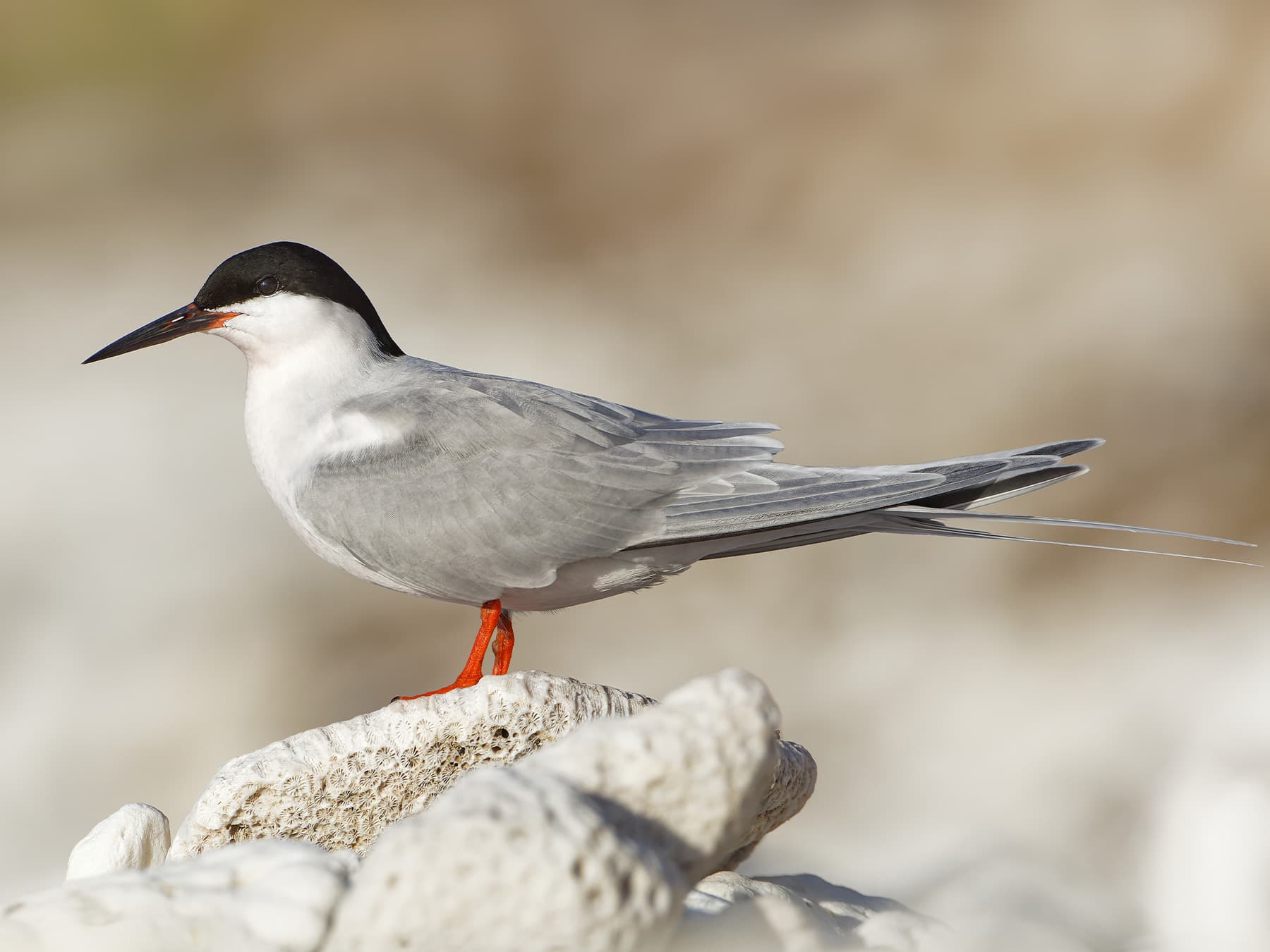
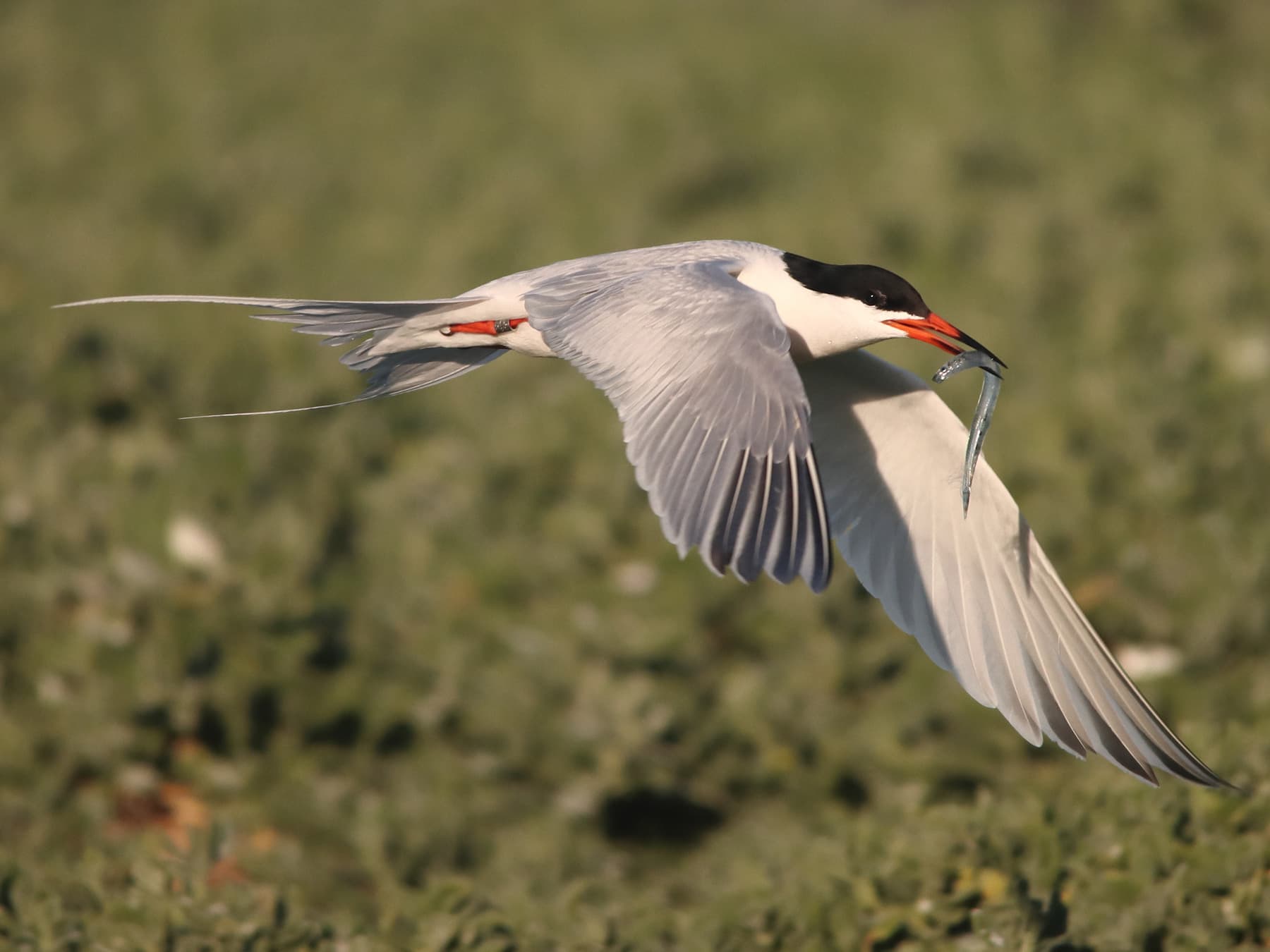
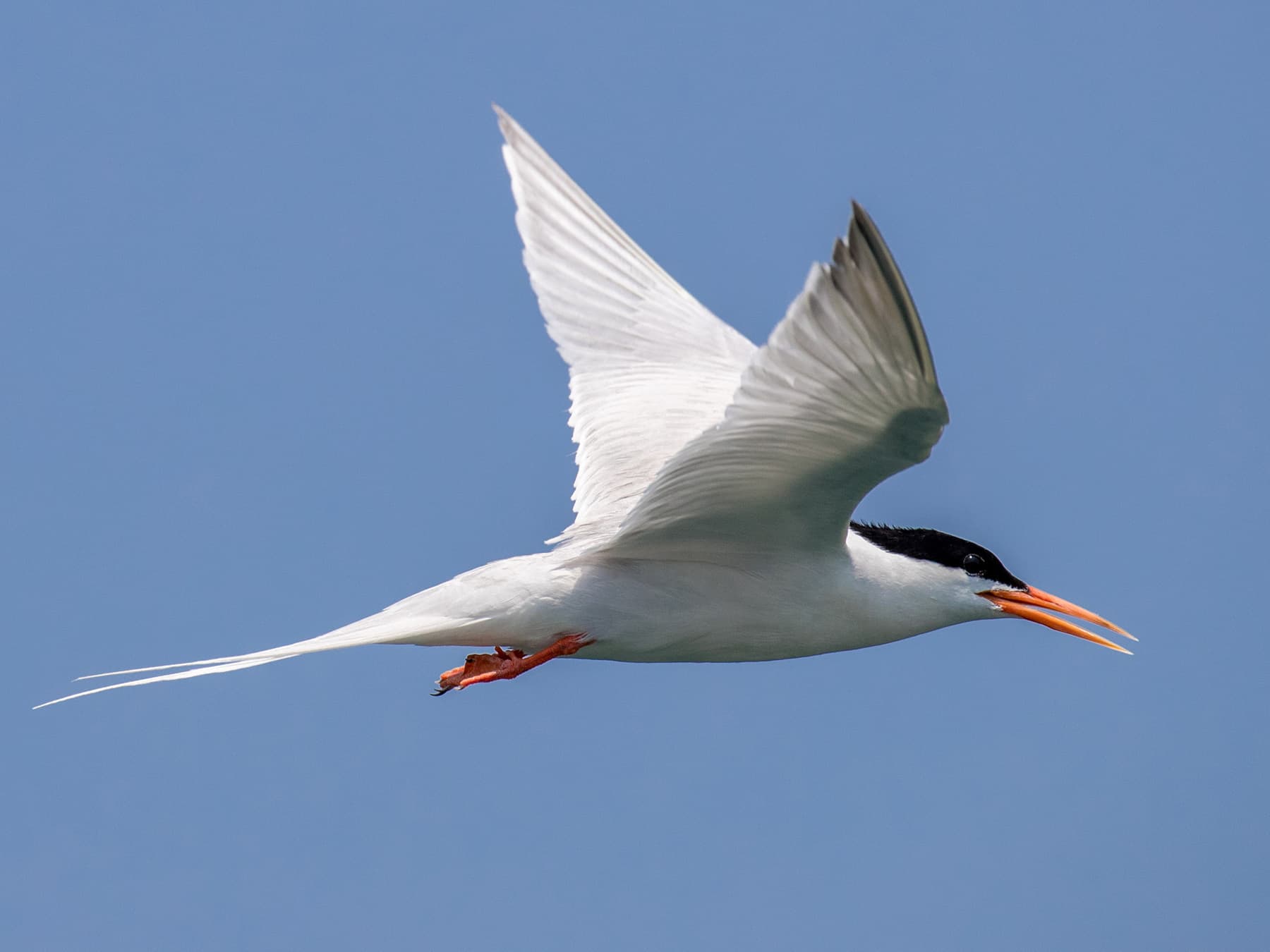
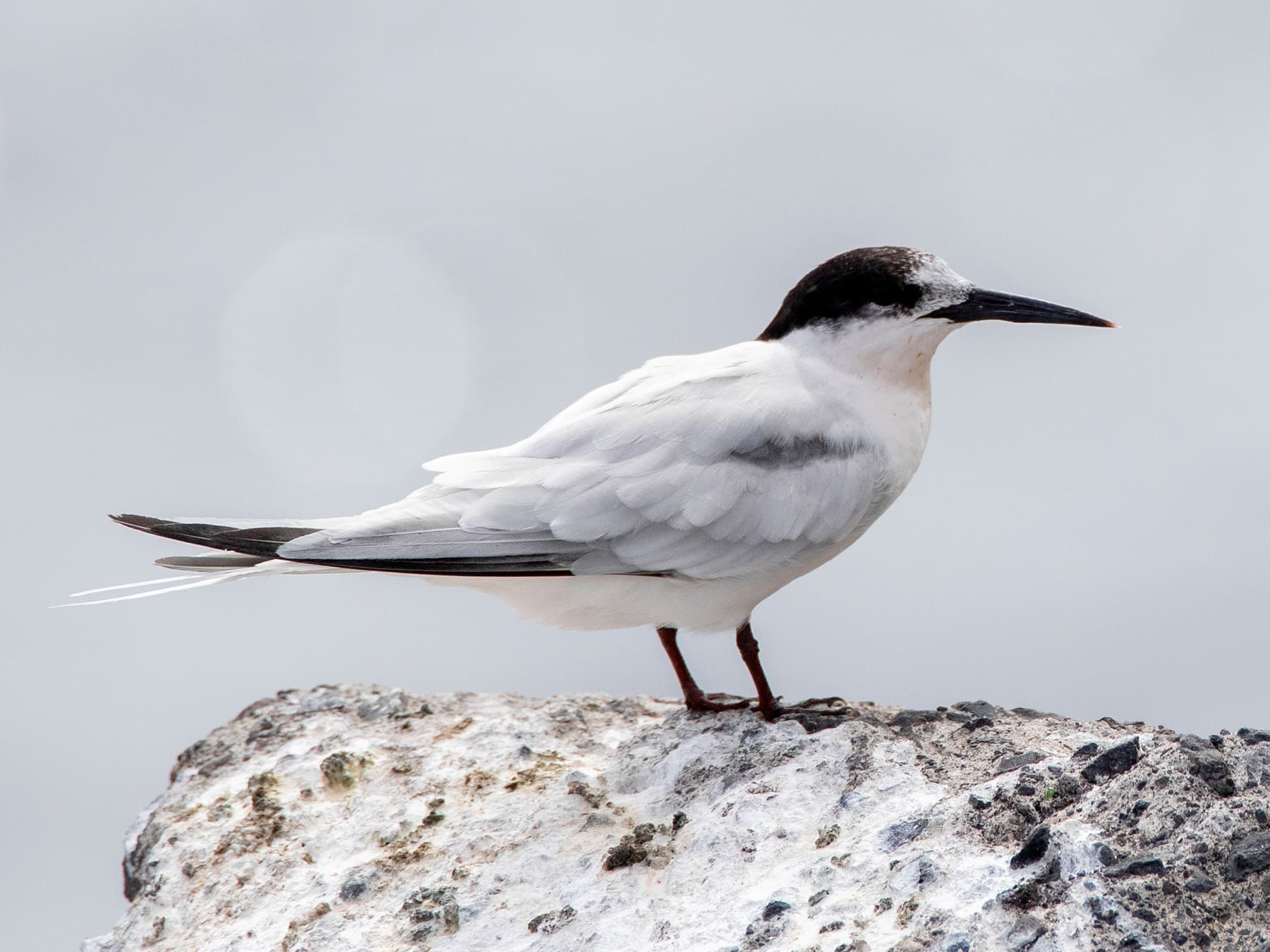
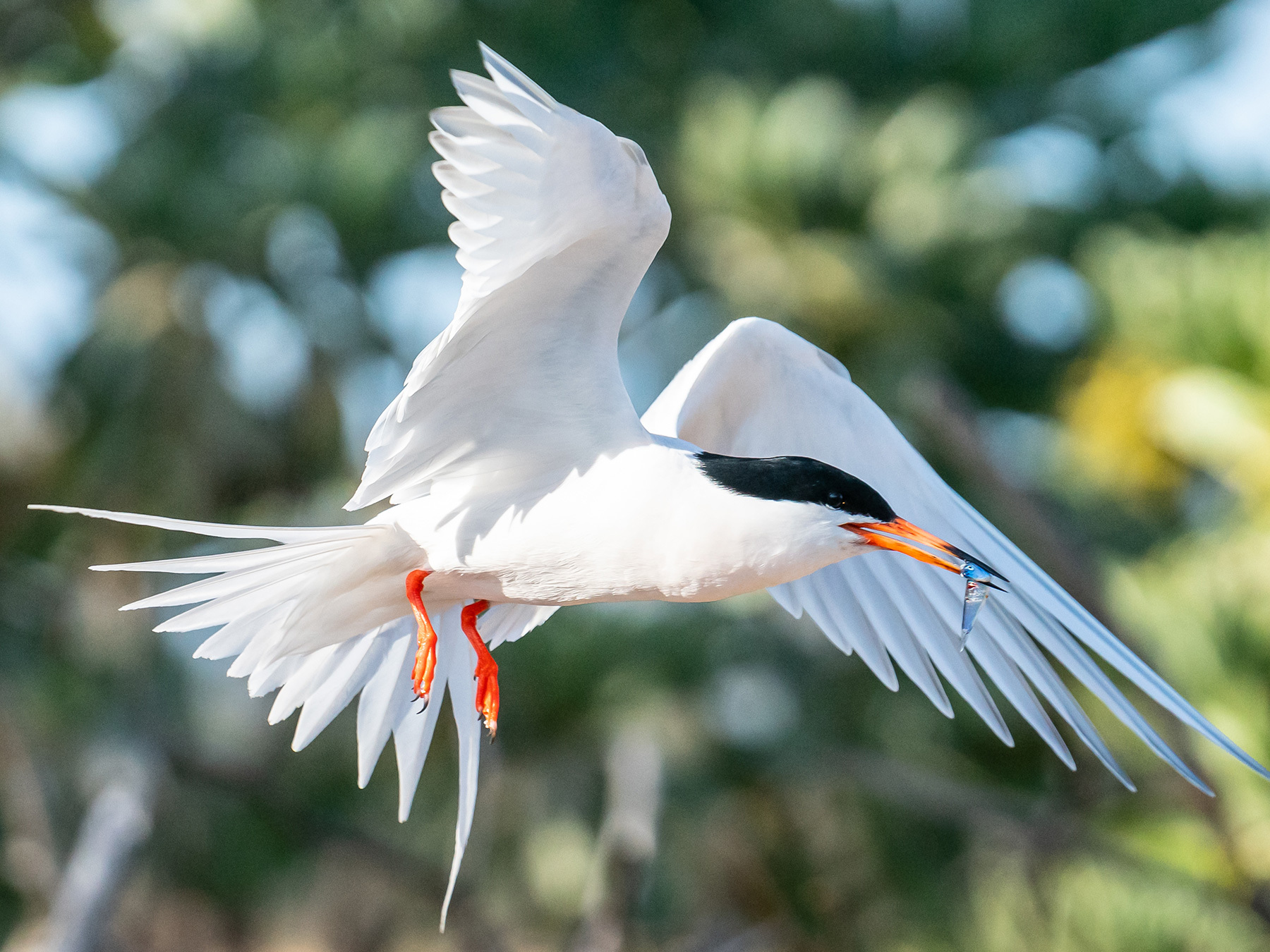
Adult roseate terns have different plumages according to the time of year but are mostly white with a bold black cap that extends down the nape of their neck. Their wings are pale grey, with the outermost primary wing feathers black, giving the wings a dark-tipped appearance.
Their breast is creamy white, but tinges of rosy pink are usually visible, particularly early in the breeding season. Their forked tails feature a pair of distinctive long white plumes.
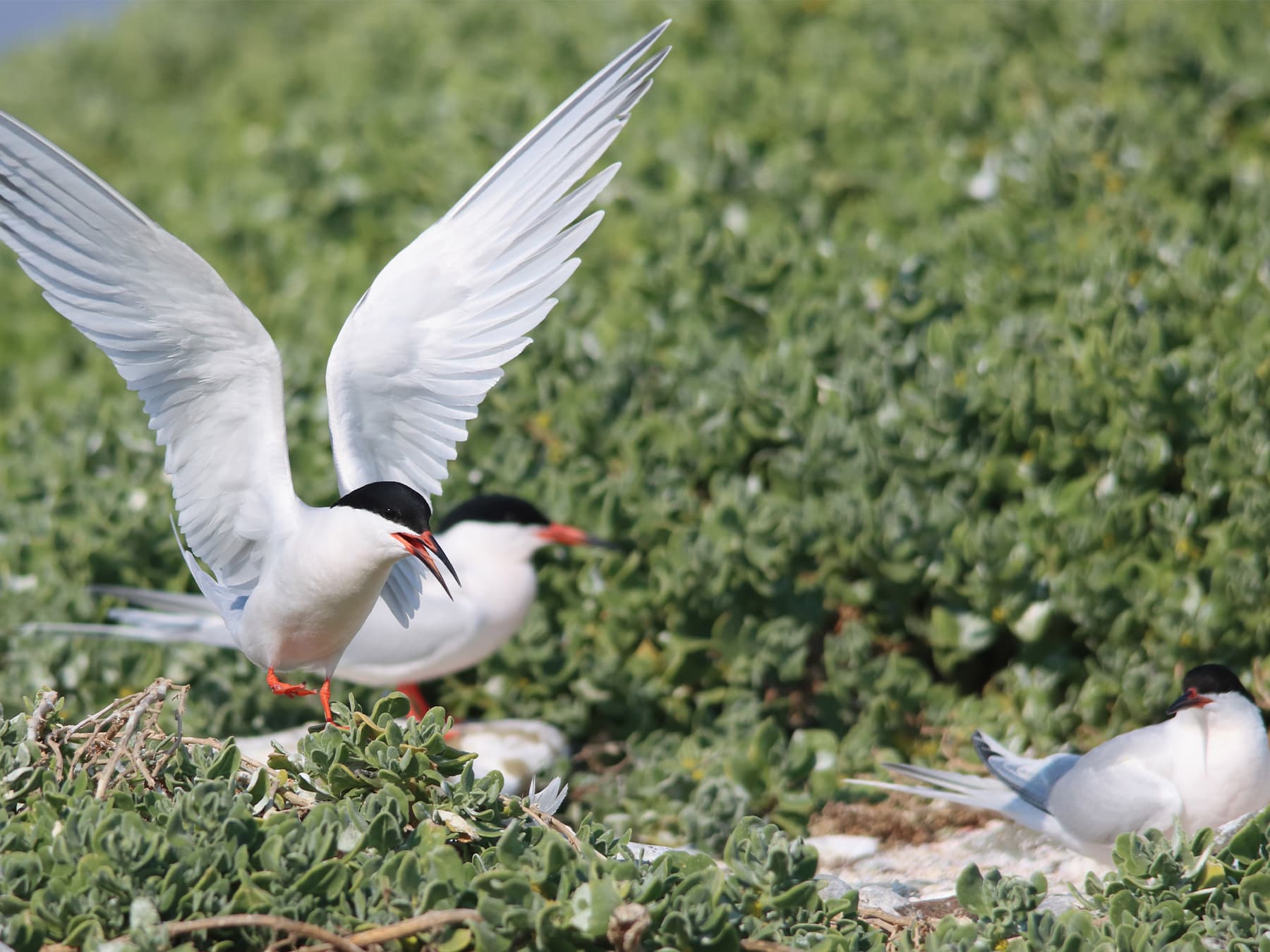
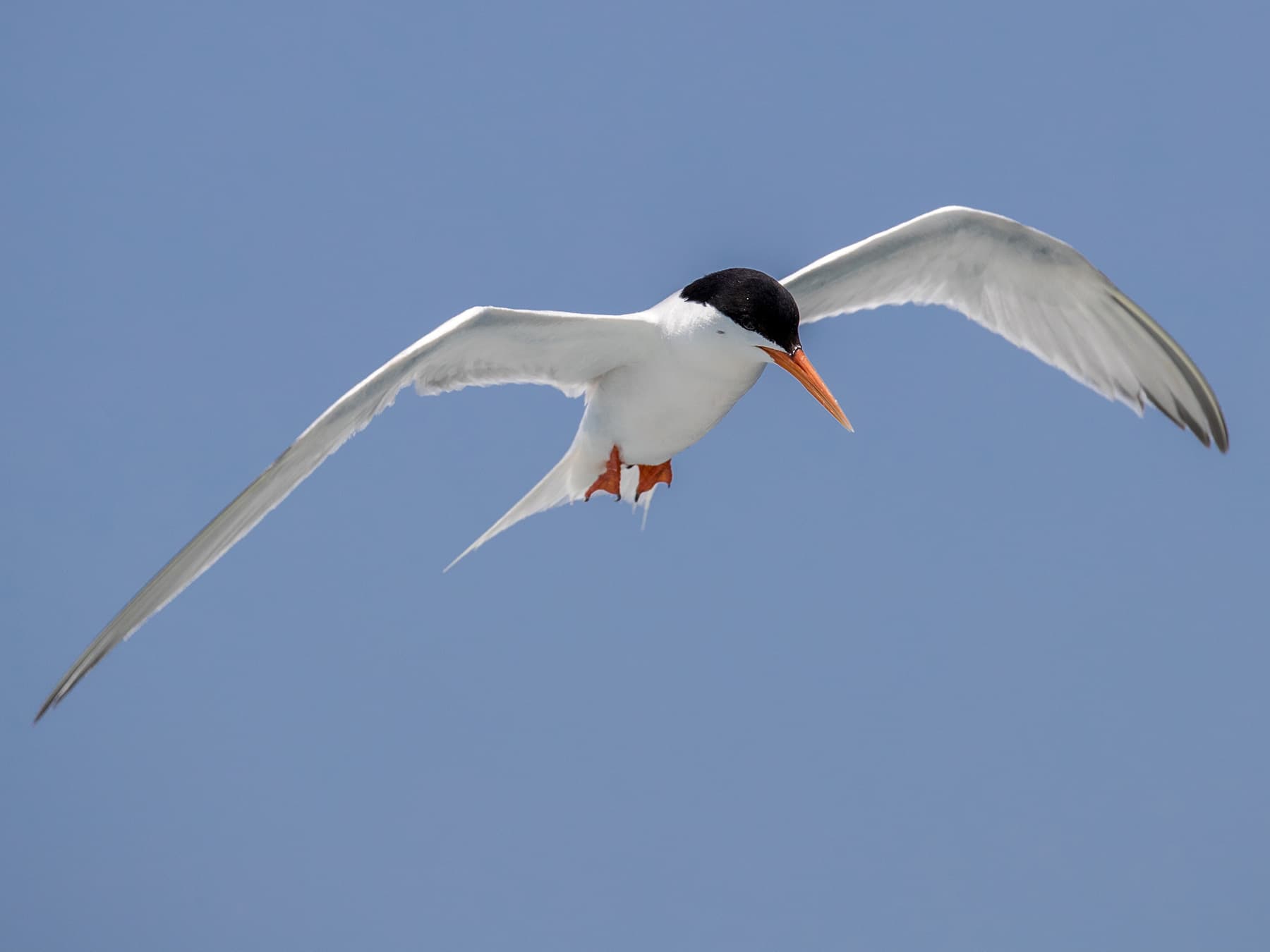
In breeding plumage, roseate terns have bright red-orange legs and feet, and a red bill that is tipped with black. Eyes are black all year round.
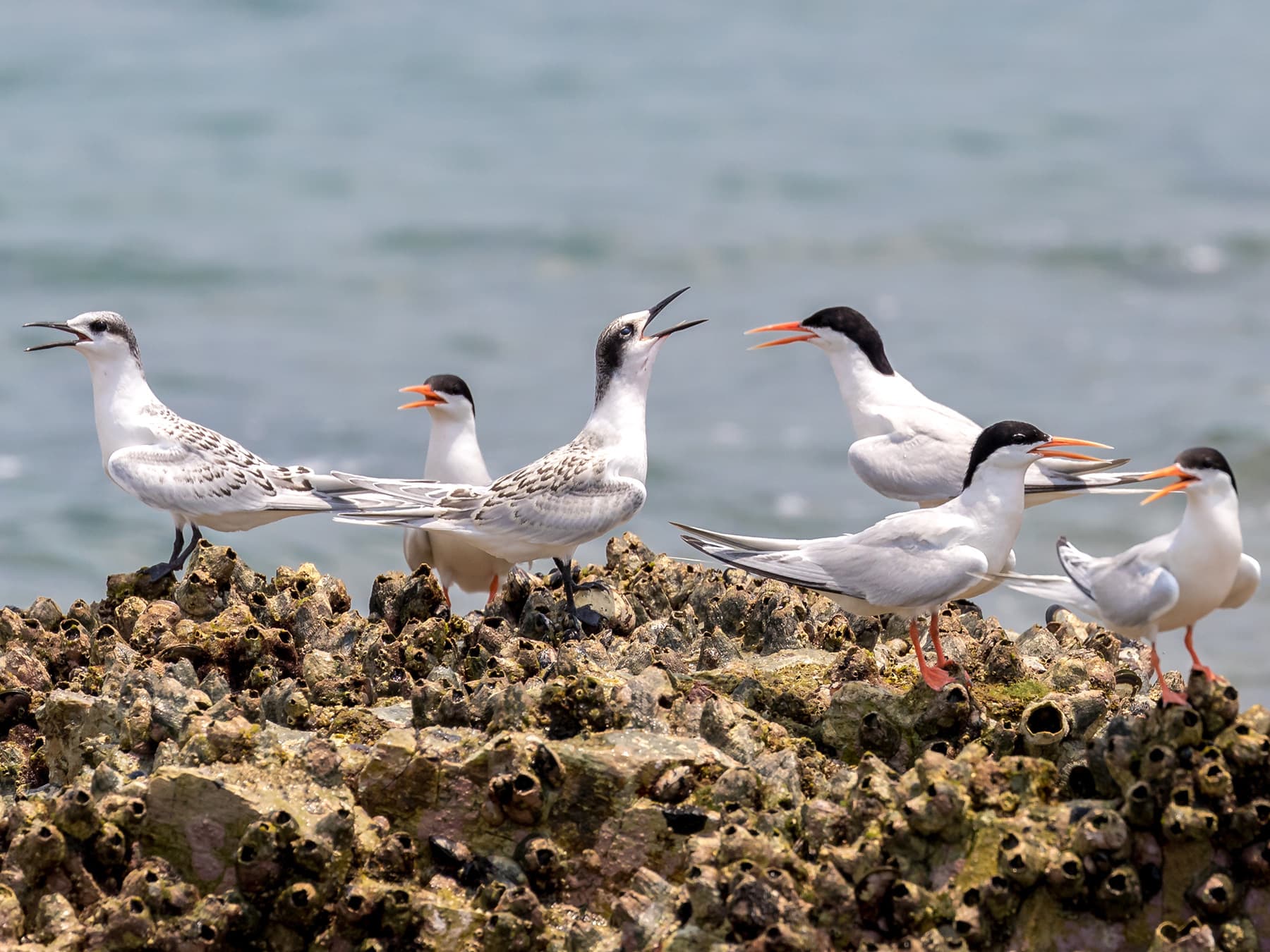
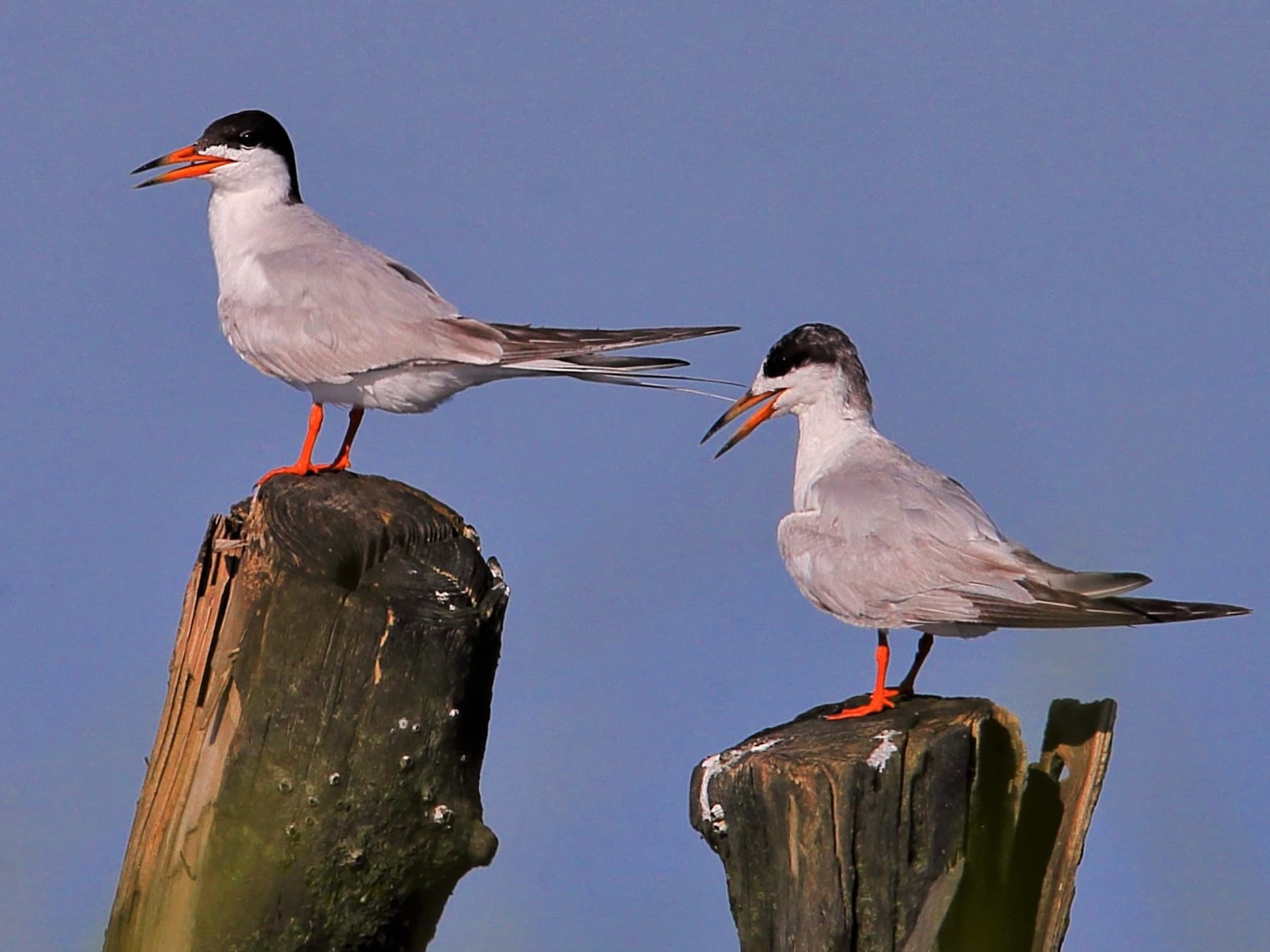
Once breeding is complete, the black cap of adult roseate terns extends into mask-like facial markings that cover the entire top half of the head. The bill darkens to a deep black, and legs and feet become a duller shade and their wings become a uniform pale gray. Their tail plumes are noticeably shorter in nonbreeding plumage.
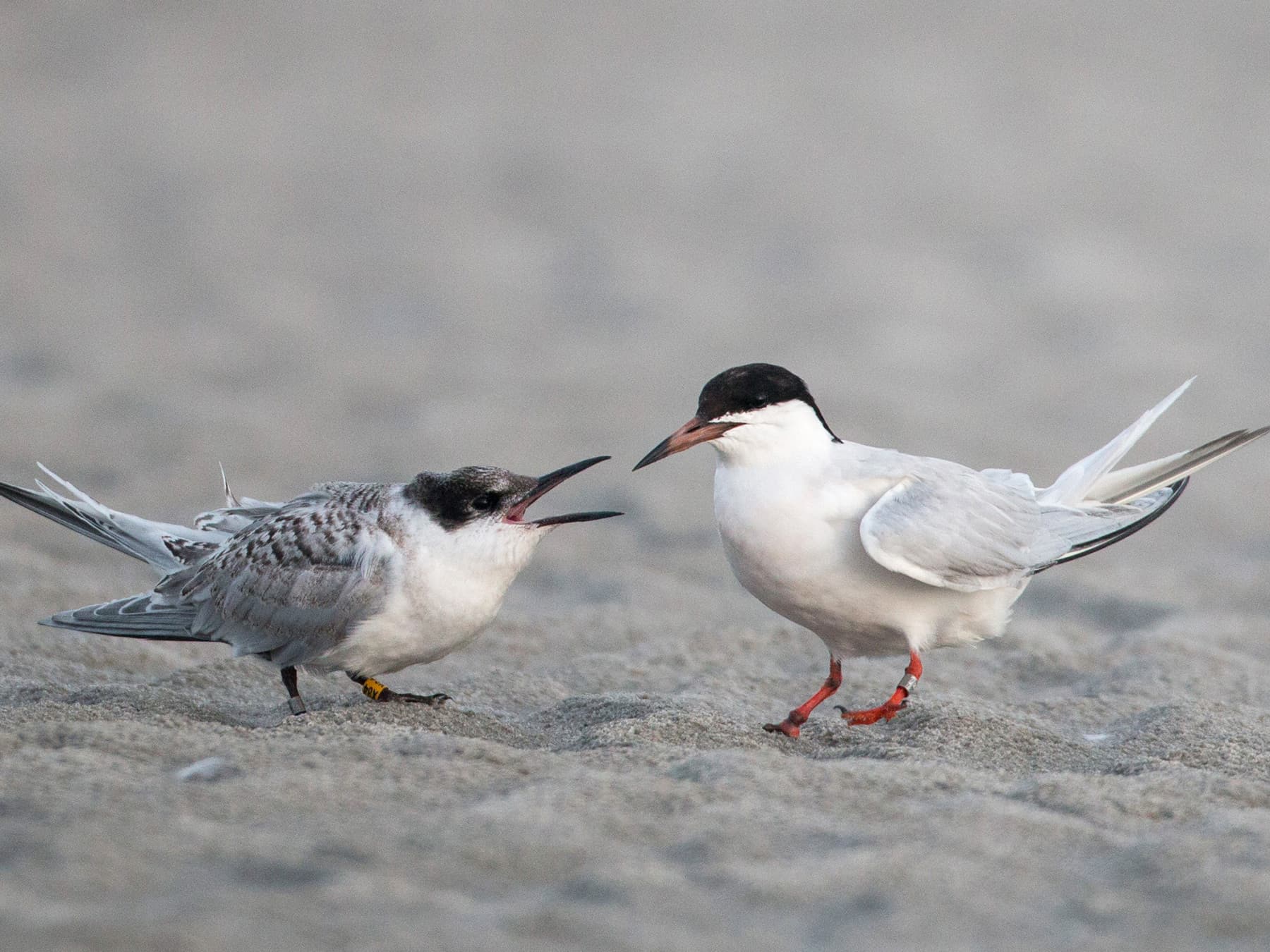
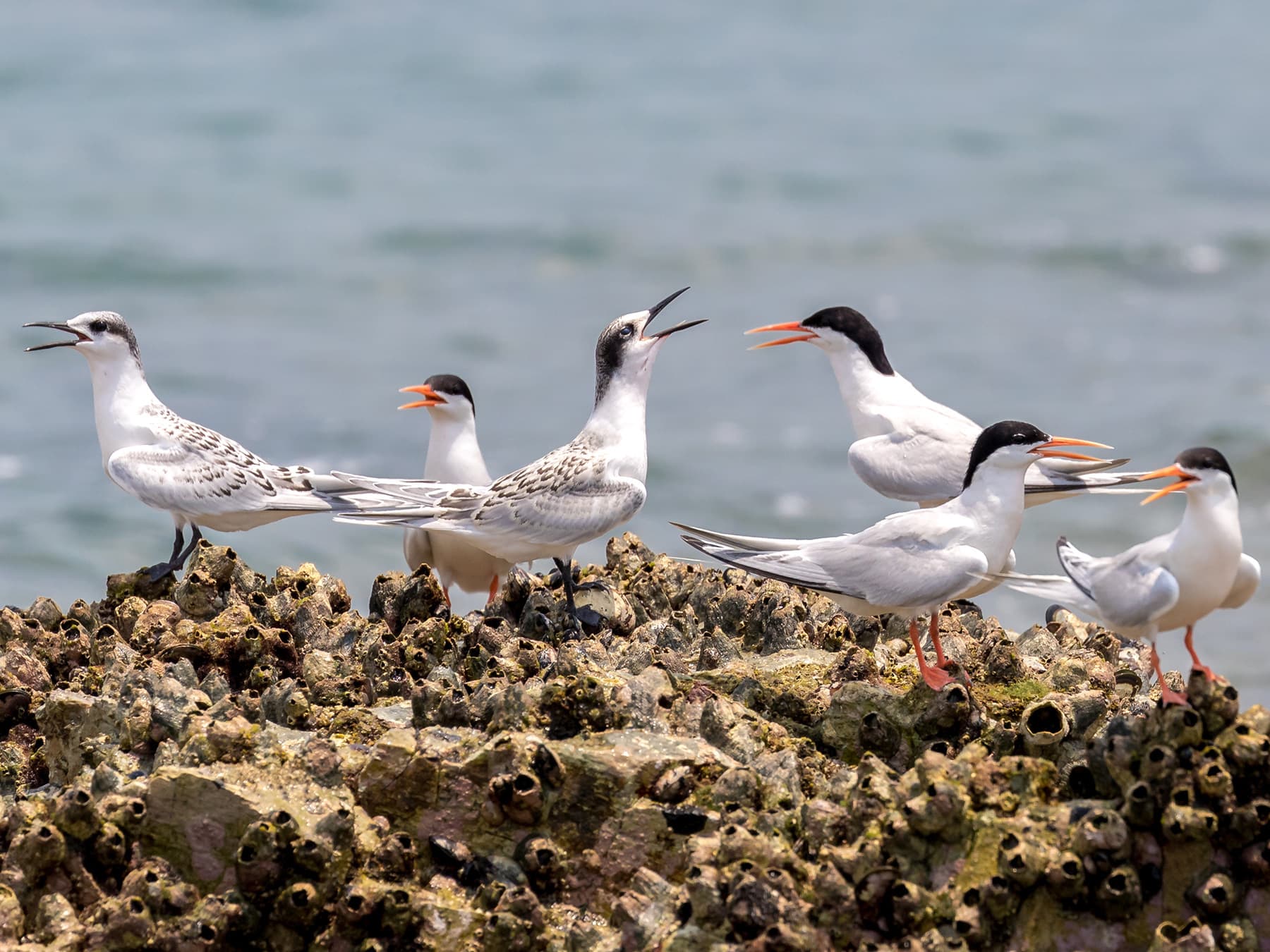
Juvenile roseate terns have white underparts, and their backs and wings are heavily mottled with brown and white markings. Their bill and legs are dark, and they have a grayish-black cap.
How big are Roseate Terns?
Roseate terns are similar in size to the Arctic tern and common tern, but smaller than the Sandwich tern.
Males and females are the same size, except for a brief period during the breeding season when females are temporarily slightly heavier. Their tail streamers can measure up to 22 cm (8.7 in).
- Length: 33 cm to 36 cm (13 in to 14 in)
- Wingspan: 67 cm to 76 cm (26 in to 30 in)
- Weight: 95 g to 130 g (3.4 oz to 4.6 oz)
Its size
Adults- Length
- 33–41 cm
- Wingspan
- 72–80 cm
- Weight
- 95–130 g
Its song and calls
What sound does a Roseate Tern make?
Roseate terns have a distinctive call that sounds unlike any other tern species – two-note ‘tchi-vik’ and ‘chu-wit’ calls that echo the call made by a spotted redshank.
- Call0:00 / 1:42
Recorded in Nova Scotia, Canada · June 2023
When and where to see it
OctoberMostly absent
Most recorded in October
- 1. Norfolkunder 0.1%
- 2. Pembrokeshireunder 0.1%
- 3. Tyne and Wearunder 0.1%
- 4. Northumberlandunder 0.1%
Each dot is a county, state or province: the bigger and darker, the larger the bird’s share of that place’s bird records that month. Grey dots: no regular records. The ringed point is the centre of the bird’s records this month; the arrow shows how it moved since last month, and the dashed loop its path through the year. “Arrivals” colours places where it becomes regular this month (orange) or is in its last regular month (grey). GBIF eBird Observation Dataset, 2019–2024. Map data: Natural Earth, US Census Bureau; place centres © OpenStreetMap contributors.
In your area
See when the Roseate Tern is recorded in your county, state or province.
How often the Roseate Tern turns up in the UK, Ireland, the United States and Canada through the year, from birdwatchers' records.
United Kingdom
Summer visitor · regularly May–Oct · most records in July
Ireland
Summer visitor · regularly Apr–Sep · most records in July
United States
Summer visitor · regularly May–Sep · most records in July
Canada
Summer visitor · regularly May–Aug · most records in July
Show as a table
| Month | United Kingdom | Ireland | United States | Canada |
|---|---|---|---|---|
| January | – | – | – | – |
| February | – | – | <0.001% | – |
| March | – | – | <0.001% | – |
| April | <0.001% | 0.016% (regular) | <0.001% | – |
| May | 0.005% (regular) | 0.044% (regular) | 0.004% (regular) | <0.001% (regular) |
| June | 0.018% (regular) | 0.066% (regular) | 0.012% (regular) | 0.003% (regular) |
| July | 0.027% (regular) | 0.15% (regular) | 0.016% (regular) | 0.004% (regular) |
| August | 0.017% (regular) | 0.12% (regular) | 0.015% (regular) | <0.001% (regular) |
| September | 0.005% (regular) | 0.045% (regular) | 0.003% (regular) | <0.001% |
| October | 0.001% (regular) | – | <0.001% | – |
| November | – | – | <0.001% | – |
| December | – | – | <0.001% | – |
Recorded regularly in
Worldwide: recorded regularly in 58 countries
Countries where it was recorded in at least 3 of the 6 years 2019–2024. Linked countries have their own bird list.
Europe (7)
Africa (8)
- Ghana
- Kenya
- Madagascar
- Mozambique
- Senegal
- Seychelles
- South Africa
- Tanzania
Asia (12)
North America (27)
- Anguilla
- Antigua & Barbuda
- Aruba
- Bahamas
- Barbados
- Belize
- Bermuda
- British Virgin Islands
- Canada
- Caribbean Netherlands
- Curaçao
- Dominica
- Dominican Republic
- Grenada
- Guadeloupe
- Honduras
- Martinique
- Mexico
- Puerto Rico
- Sint Maarten
- St Lucia
- St Martin
- St Vincent & the Grenadines
- Trinidad & Tobago
- Turks & Caicos Islands
- United States
- US Virgin Islands
South America (2)
- Brazil
- Venezuela
Oceania (2)
- Australia
- New Caledonia
Data: EOD – eBird Observation Dataset (Cornell Lab of Ornithology), accessed via GBIF.org, CC BY 4.0. Records from 2019–2024, aggregated and filtered by Birdfact. How these lists are made
What is the range of a Roseate Tern?
In North America, two distinct populations exist: one in Nova Scotia and along the Atlantic coast to New York, and the second in the Caribbean. Within these ranges, breeding is limited to a handful of sites with vast communal colonies.
In the Caribbean, roseate terns breed on islands from the Florida Keys, Cuba, the Bahamas, Puerto Rico, the Virgin Islands and Trinidad and Tobago. Breeding extends further south, as far as Venezuela, but is no longer common in the western Caribbean islands.
In Europe, breeding populations of roseate terns can be found at isolated locations along the coasts of the British Isles, Ireland and France, as well as in the Canaries and the Azores in the Atlantic.
The Caribbean and North American populations spend winters along the northern and eastern coasts of South America. European roseate terns migrate to West Africa once they have finished breeding.
Additional populations of roseate terns can be found in Asia and Australia, breeding from east Africa across the Indian Ocean as far east as the coast of Japan. Further subspecies are present in Australia and in the Pacific islands of New Caledonia, Loyalty Island and Vanuatu.
Where do Roseate Terns live?
The largest colonies of roseate terns in North America are found at three sites: Great Gull Island in New York, and Ram Island and Bird Island a short way along the coast in Massachusetts. A further 6,000 to 7,000 pairs form the Caribbean population.
In Europe, around 1,500 pairs breed in the UK, Ireland and France, and an additional 1,200 pairs are found in the Azores.
How rare are Roseate Terns?
Roseate terns have experienced a significant decline in numbers across their North American and European ranges, and conservation efforts are in place to attempt to reverse the downward trends. Populations are concentrated at a handful of large breeding colonies, and in these spots, you’d be forgiven for thinking they were not at all rare or declining. But outside of these hotspots, it’s a far more unusual occurrence to spot one, let alone see a lone breeding pair.
Migration passage increases the chances of a sighting, but observations are limited to coastal regions and spotting a roseate tern inland would be an exceptionally rare event.
The global population of roseate terns was estimated at around 200,000 to 220,000 in 2017.
Where can you see Roseate Terns in North America?
In North America, three large breeding colonies exist: Great Gull Island in New York, with more than 9,500 pairs, and Ram Island and Bird Island, both in Massachusetts, which host 2,500 and 3,000 pairs respectively.
Where can you see Roseate Terns in the UK?
Breeding in the UK is limited and highly localized, limited to a few isolated sites with only around 100 pairs a year. In summer, the best opportunities to spot roseate terns are found on the Northumberland coast, on Anglesey and the Firth of Forth. During migration in spring and autumn, passage birds might be spotted along the south and east coasts, with Dungeness, Kent regularly reporting sightings.
One of the nearest key breeding sites for roseate terns is at Rockabill Island, in County Dublin, which is the species’ largest European colony and accounts for more than 75 percent of the continent’s population.
Migration
Do Roseate Terns migrate?
Roseate terns are a migratory species, and undertake lengthy journeys between wintering and breeding grounds each year. Less is known about their winter destinations than the territories where they arrive to breed, but general patterns of migration are assumed from North America to the Caribbean and South America, and Northwestern Europe to West Africa.
Are Roseate Terns native to North America?
Roseate terns live and breed in North America, but move between breeding and wintering grounds on the continent each year. One North American subspecies breeds in the northeastern US into Canada (Nova Scotia), while the other is found in the southeastern US and the Caribbean. In winter, both of these subspecies head south, to the coastal locations among the Caribbean islands and along South America’s northeastern coast.
Are Roseate Terns native to the UK?
A limited number of roseate terns breed in the UK, and many more can be seen during migration passage, but once September arrives, these temporary visitors have all departed for warmer territories, thought to be mainly located in western Africa, from Senegal to Nigeria.
Tips for seeing it
- Look for Roseate Terns in coastal areas, especially near sandy or rocky islands.
- Observe their distinctive forked tail and listen for their characteristic 'kir-rick' call.
- Visit known breeding colonies in the summer months for the best chance of sightings.
- In the UK, try birdwatching at Coquet Island in Northumberland or North Solent in Hampshire.
What it eats
What do Roseate Terns eat?
Roseate terns are fish eaters, catching their prey by plunging into marine waters. Crustaceans, squid and insects are also occasionally eaten, but are only of minor importance. Sand lance, blueback herring, striped anchovies, Atlantic herring and bay anchovy are among the most popular species.
Roseate terns may be observed to mob other seabirds in order to steal their prey, with puffins and brown pelicans frequently being targeted in this way.
What do Roseate Tern chicks eat?
Roseate tern chicks are initially fed regurgitated fish by their parents, before small fish species are introduced, particularly sand lance, but also anchovies, hake and herring.
Nesting and breeding
Where do Roseate Terns nest?
Roseate terns nest colonially, constructing individual nests at ground level, with a simple scrape in the ground beneath dense vegetation or in a hollow in the ground. Coral reefs, bare sand, rock and soil are all common choices for nest sites, and some loose nesting material may be added during incubation, including flattened grasses and smaller pebbles. Artificial nest boxes are increasingly used, with an encouraging rate of success.
When do Roseate Terns nest?
For North American roseate tern populations, nesting usually begins in May, with the first eggs hatching in June. For European populations, the timings are similar, and in all locations it’s usual for just one brood to be raised in a single season.
What do Roseate Tern eggs look like?
Roseate terns’ eggs are a light buff color, heavily mottled with dark brown scrawls. They measure 43 mm by 30 mm (1.7 in by 1.2 in) and are subelliptical in shape, tapering to a conical point. Clutches contain 1 to 5 eggs, with 1 or 2 being the most usual. Eggs are incubated by both parents for around 27 days.
Do Roseate Terns mate for life?
Long-term pairs do form between some roseate terns, and monogamous breeding is usual. However, while many pairs remain bonded for two seasons or longer, it is unusual – although not unheard of – for pairs to raise young together for up to 12 consecutive years.
Behaviour
Are Roseate Terns aggressive?
Roseate terns are a relatively social species that breeds colonially and readily nests alongside common terns. Defensive behavior is observed immediately around the nest site, but roseate terns have a reputation for startling easily and are quick to desert a nest or abandon young if they feel slightly threatened.
Feisty behavior is frequently seen with roseate terns pursuing larger birds and harassing them in order to steal their prey.
Where do Roseate Terns sleep?
Roseate terns sleep standing up, on the ground, with their eyes closed and heads tucked back into their upper wings. Roosting takes place overnight from dusk until before first light, and large roosting flocks of up to 7000 birds form on flat sandy beaches, salt pans or mudflats.
Lifespan and predators
How long do Roseate Terns live?
The average lifespan for a roseate tern is around 8 years, although older individuals are frequently recorded – one example is a ringed bird that reached 23 years and 10 months. Breeding usually occurs for the first time at two years.
What are the predators of Roseate Terns?
Black rats, King’s skink, foxes, badgers, American mink and otters are among the chief land predators of roseate terns and their eggs and young. Avian predators include white-bellied sea-eagles, silver gulls, turnstones and peregrines.
Are Roseate Terns protected?
In the United States, roseate terns are protected by the US Migratory Bird Treaty Act of 1918. They are also protected as a Threatened species by the Federal Endangered Species Act of 1973, which serves to safeguard roseate terns and their habitats.
In the UK, roseate terns are classified as a Schedule I species under the Wildlife and Countryside Act, 1981, which offers additional protection to their nest sites and eggs against being disturbed or destroyed. Roseate terns themselves are also safeguarded against being knowingly killed, injured or taken into captivity.
Are Roseate Terns endangered?
In 1987 roseate terns were first listed as a threatened species in the Caribbean by the US Fish and Wildlife Service and as an endangered species in the Northeast. Roseate terns are listed as endangered in Canada under the Species at Risk Act (Environment Canada 2010) and have been classified as a Red category species on the British Birds of Conservation Concern list.
Why are Roseate Terns endangered?
The initial decline of roseate terns was linked to the species being hunted for their feathers in the 19th century. Habitat loss, predation, and collisions with manmade structures, particularly at offshore windfarms are all factors in the serious decline in roseate tern numbers witnessed in the late 20th century.
What is being done to protect Roseate Terns?
Predator management at known breeding sites is helping to improve the success of nesting roseate terns. Managed breeding colonies have also been set up, with artificial nest boxes and floating rafts, which are readily used by roseate tern pairs and are contributing to a rise in populations.
Conservation
Despite being listed as Least Concern globally, Roseate Tern populations face regional challenges. Habitat loss, predation, and climate change impact breeding success.
Conservation efforts focus on protecting nesting sites, managing predators, and creating artificial nesting habitats to support population recovery.
Similar birds
Often mistaken for
More photos
2 photos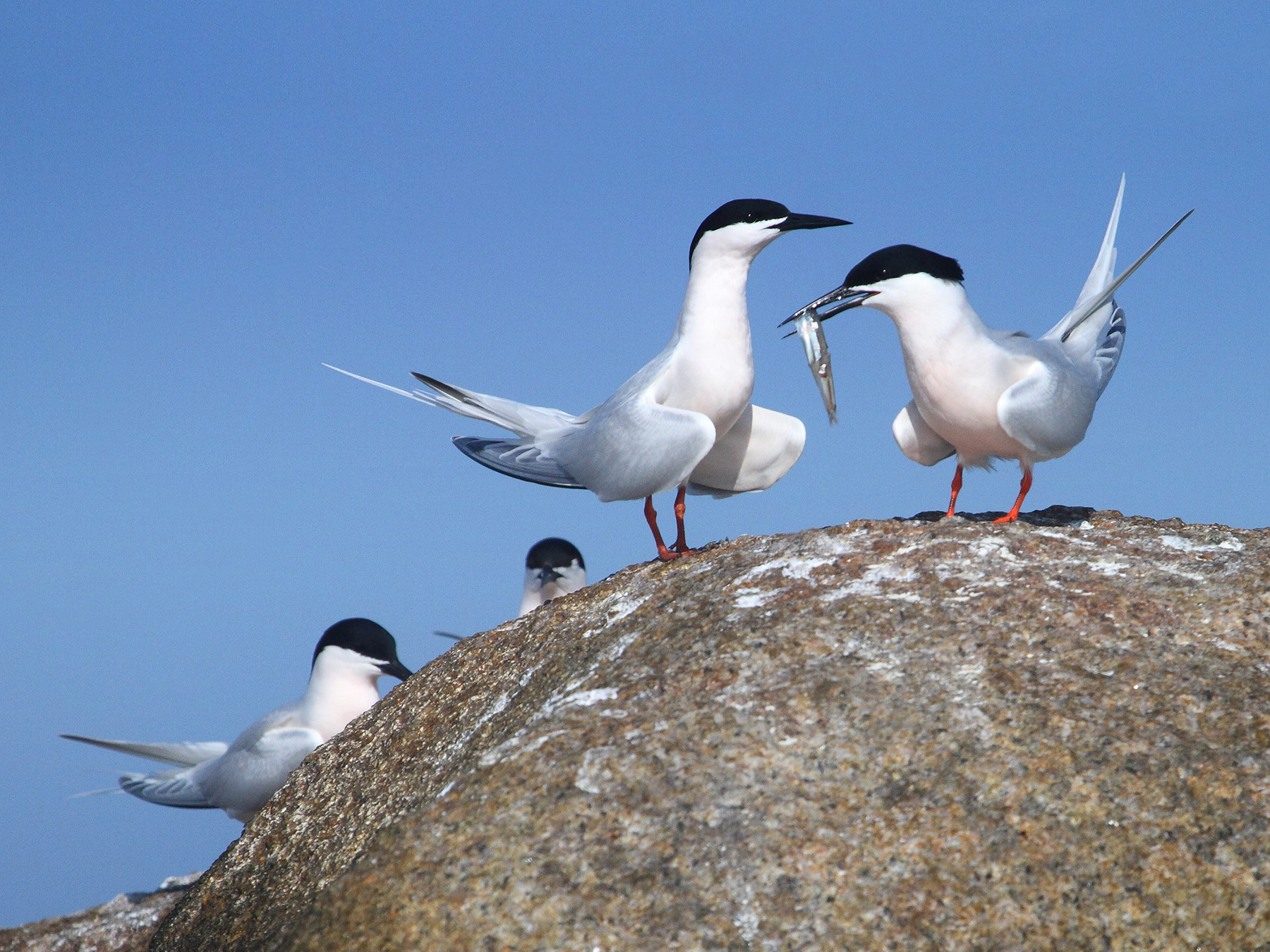
Roseate Tern guides
3 guidesQuick facts
- Length
- 33–41 cm
- Wingspan
- 72–80 cm
- Weight
- 95–130 g
- Lifespan
- 8 years · oldest recorded 25.7 years
- Family
- Gulls & Terns
- Migration
- Long-distance Migrant
- Global status (IUCN)
- Least Concern
- World population
- 200,000 - 220,000 individuals
- Population trend
- Unknown
- Also called
- Rosy Tern
- Scientific name
- Sterna dougallii
Sources
3- 1BirdLife International. 2018. Sterna dougallii. The IUCN Red List of Threatened Species 2018: e.T22694601A132260491. Source (opens in a new tab)
- 2Wetlands International (2015)
- 3Longevity Records Of North American Birds. Version 2023.1 Source (opens in a new tab)

Checked by
Nathan Cope, founder and editor
Nathan founded Birdfact and leads its writers and contributors in the UK, the US and Canada. He has watched and studied birds for more than ten years, and checks every article and species guide before it’s published.