


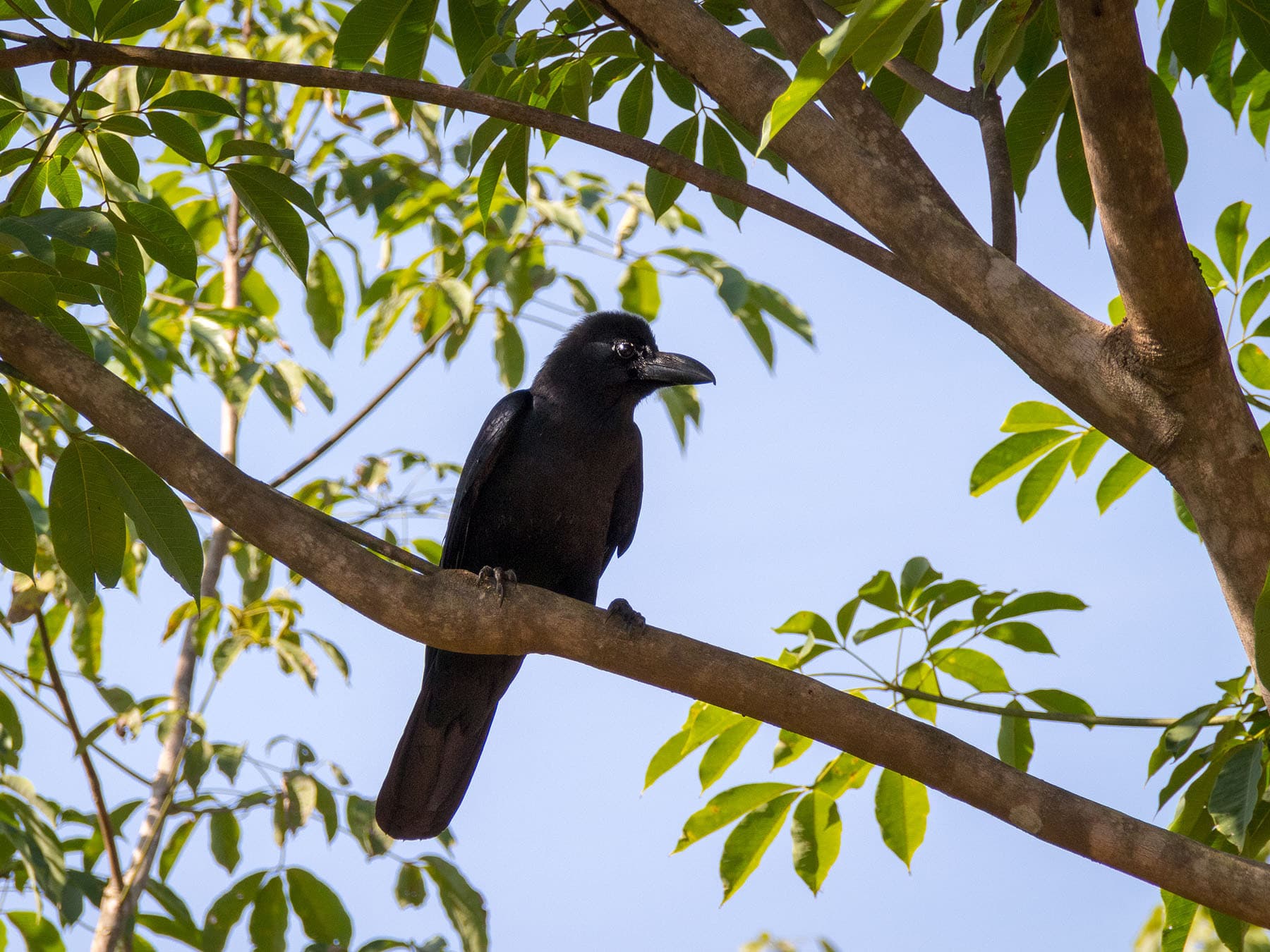
New Caledonian Crow
Kanaky Crow · Corvus moneduloides
By the Birdfact teamChecked by Nathan Cope
On this page11 sections
How to recognise it
The New Caledonian Crow is a medium-sized corvid with predominantly black plumage. Its feathers have a glossy sheen, with subtle brown undertones visible in bright light. The bird has a robust, slightly curved black beak and strong black legs.
Both males and females share similar appearances, with no significant sexual dimorphism. Juveniles may appear slightly duller than adults, with less glossy feathers and a pinkish base to their beak that darkens with age.
Its size
Adults- Length
- 40–45 cm
- Wingspan
- 75–85 cm
- Weight
- 280–330 g
Its song and calls
The New Caledonian Crow's vocalisations include a variety of harsh, raspy calls. Their most common sound is a distinctive 'waa-waa' or 'kaaa-kaaa'.
They also produce softer, more melodious notes during social interactions and a series of rapid, staccato calls when alarmed or excited.
When and where to see it
The New Caledonian Crow is not recorded regularly in the UK, Ireland, the United States or Canada.
Worldwide: recorded regularly in 1 country
Countries where it was recorded in at least 3 of the 6 years 2019–2024. Linked countries have their own bird list.
Oceania (1)
- New Caledonia
Data: EOD – eBird Observation Dataset (Cornell Lab of Ornithology), accessed via GBIF.org, CC BY 4.0. Records from 2019–2024, aggregated and filtered by Birdfact. How these lists are made
Tips for seeing it
- Look for them in forested areas, especially near Pandanus trees
- Listen for their distinctive, raspy 'waa-waa' calls
- Observe tree branches and crevices for signs of tool use
- Be patient, as they can be shy around humans
- Visit protected areas in New Caledonia for the best chances of spotting them
What it eats
New Caledonian Crows are omnivorous, with a diet consisting of insects, larvae, small vertebrates, and fruit. They are particularly skilled at extracting grubs from dead wood using self-made tools.
These crows have been observed creating hooks from twigs to fish out insects from tree crevices, showcasing their innovative foraging techniques.
Nesting and breeding
New Caledonian Crows typically form monogamous pairs and breed between September and December. They engage in mutual preening and food sharing as part of their courtship rituals.
Nests are usually built high in trees, constructed with sticks and lined with softer materials like leaves and moss. The female lays 2-3 pale blue-green eggs with brown speckles.
Both parents participate in incubation, which lasts about 18-20 days. Nestlings fledge after approximately 35 days but may remain with their parents for several months, learning crucial tool-making and foraging skills.
Behaviour
New Caledonian Crows are renowned for their exceptional tool-making and tool-using abilities, crafting and modifying sticks to extract insects from tree crevices.
They exhibit complex problem-solving skills, often working in pairs or small family groups. These crows also engage in aerial acrobatics, performing barrel rolls and loops during flight.
Conservation
While currently listed as Least Concern, the New Caledonian Crow faces threats from habitat loss due to mining and forest degradation.
Conservation efforts focus on protecting their native forest habitats and raising awareness about their unique cognitive abilities and cultural significance to the island.
Similar birds
Often mistaken for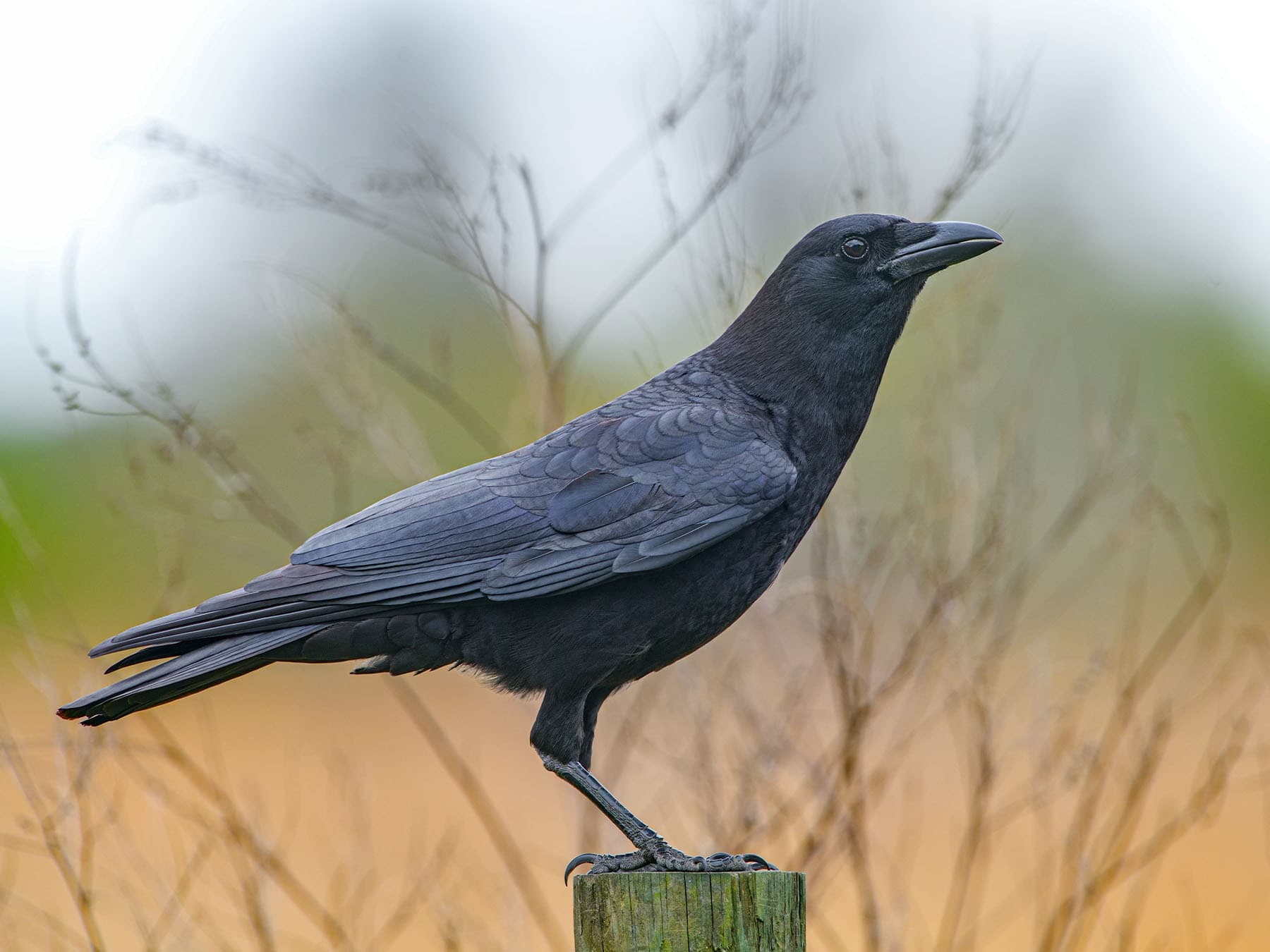
Quick facts
- Length
- 40–45 cm
- Wingspan
- 75–85 cm
- Weight
- 280–330 g
- Lifespan
- 5–10 years · oldest recorded 15 years
- Family
- Crows & Jays
- Migration
- Resident
- Global status (IUCN)
- Least Concern
- World population
- Not quantified, but believed to be common in its range
- Population trend
- No reliable population trend information available, although thought to be stable
- Also called
- Kanaky Crow
- Scientific name
- Corvus moneduloides
Sources
3- 1BirdLife International. 2018. Corvus moneduloides. The IUCN Red List of Threatened Species 2018: e.T22705944A131945232. Source (opens in a new tab)
- 2Ekstrom et al. (2000)
- 3Madge and Burn (1993)

Checked by
Nathan Cope, founder and editor
Nathan founded Birdfact and leads its writers and contributors in the UK, the US and Canada. He has watched and studied birds for more than ten years, and checks every article and species guide before it’s published.