


Little Ringed Plover
Little Ringed Dotterel · Thinornis dubius
By the Birdfact teamChecked by Nathan Cope
On this page13 sections
How to recognise it
What do Little Ringed Plovers look like?
The appearance of little ringed plovers varies throughout the year, with distinct plumages for breeding and non-breeding seasons, as well as subtle differences between males and females.
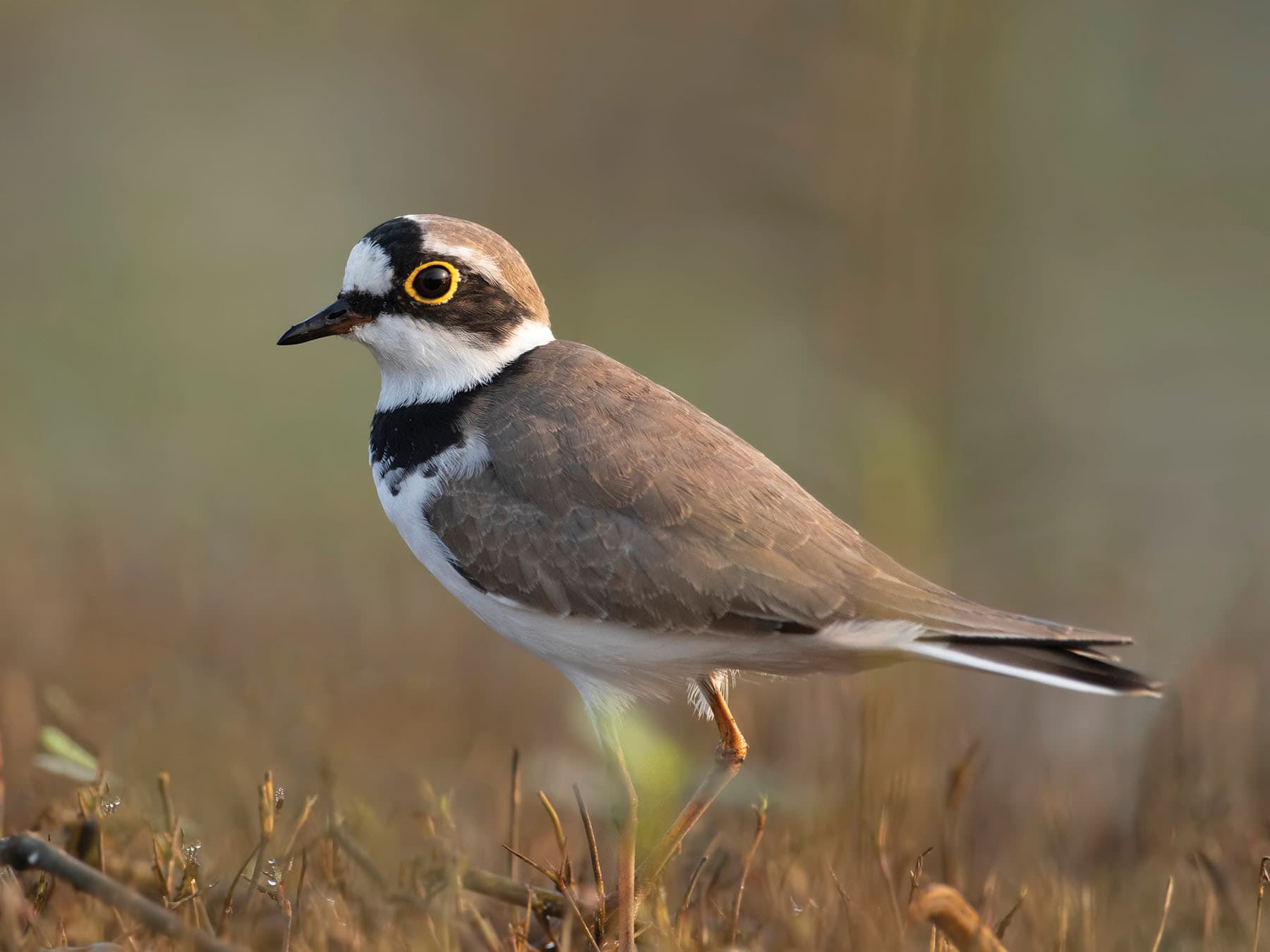
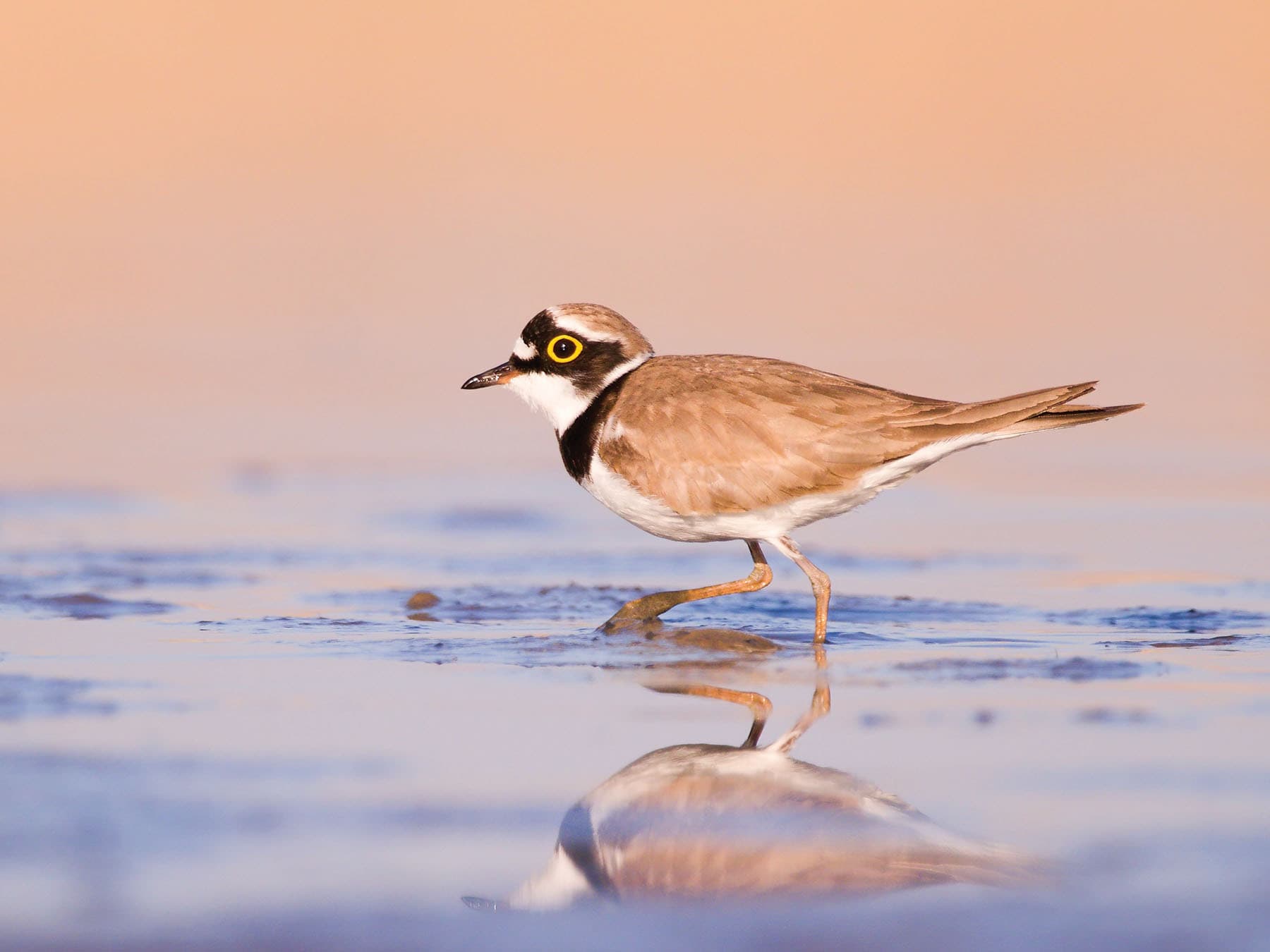
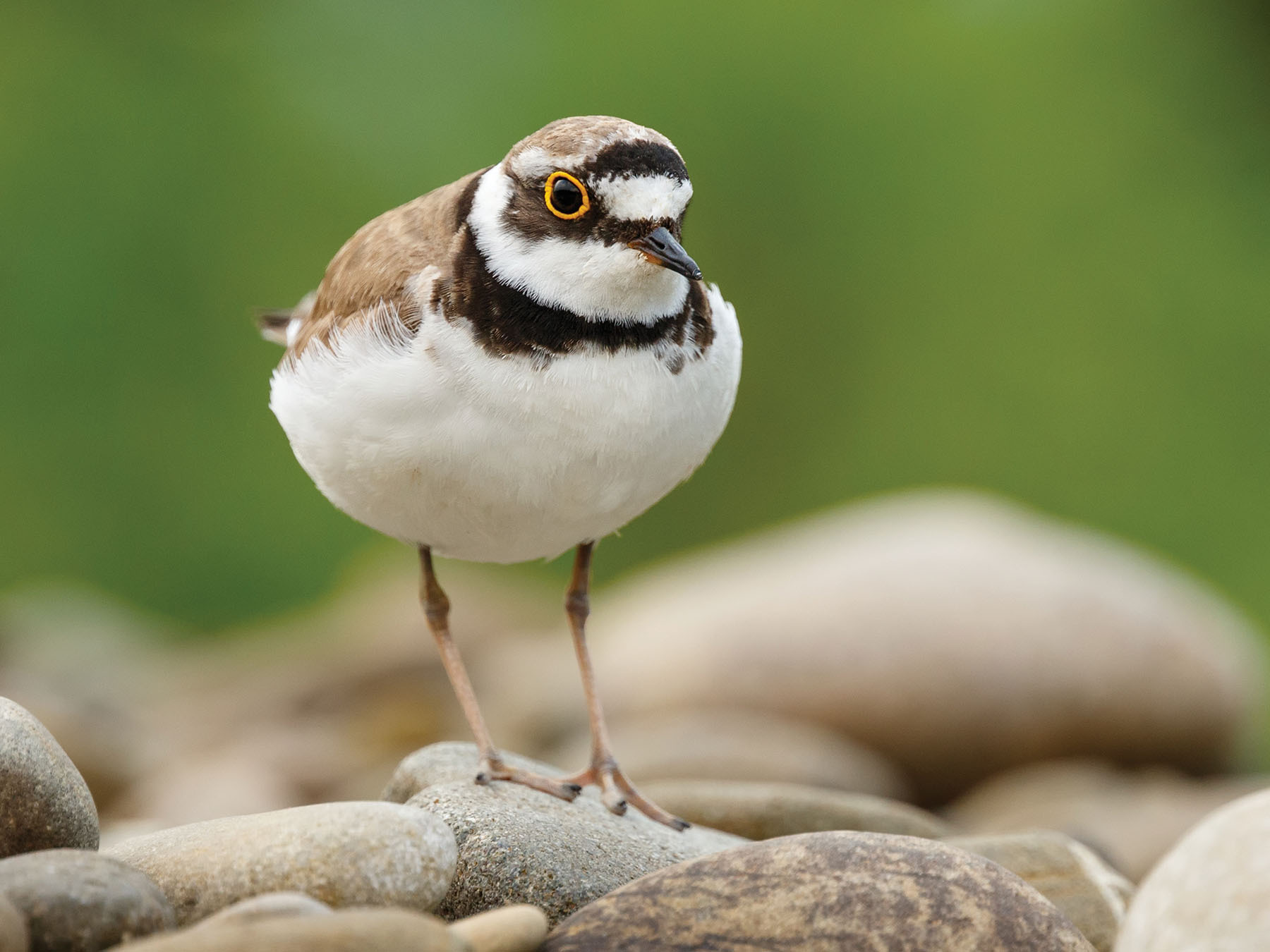
Breeding males have brown upper parts and white underparts, and a black collar, which widens into a black band across the breast. Their chin and throat are white, extending to form a ring around the neck, above the black collar.
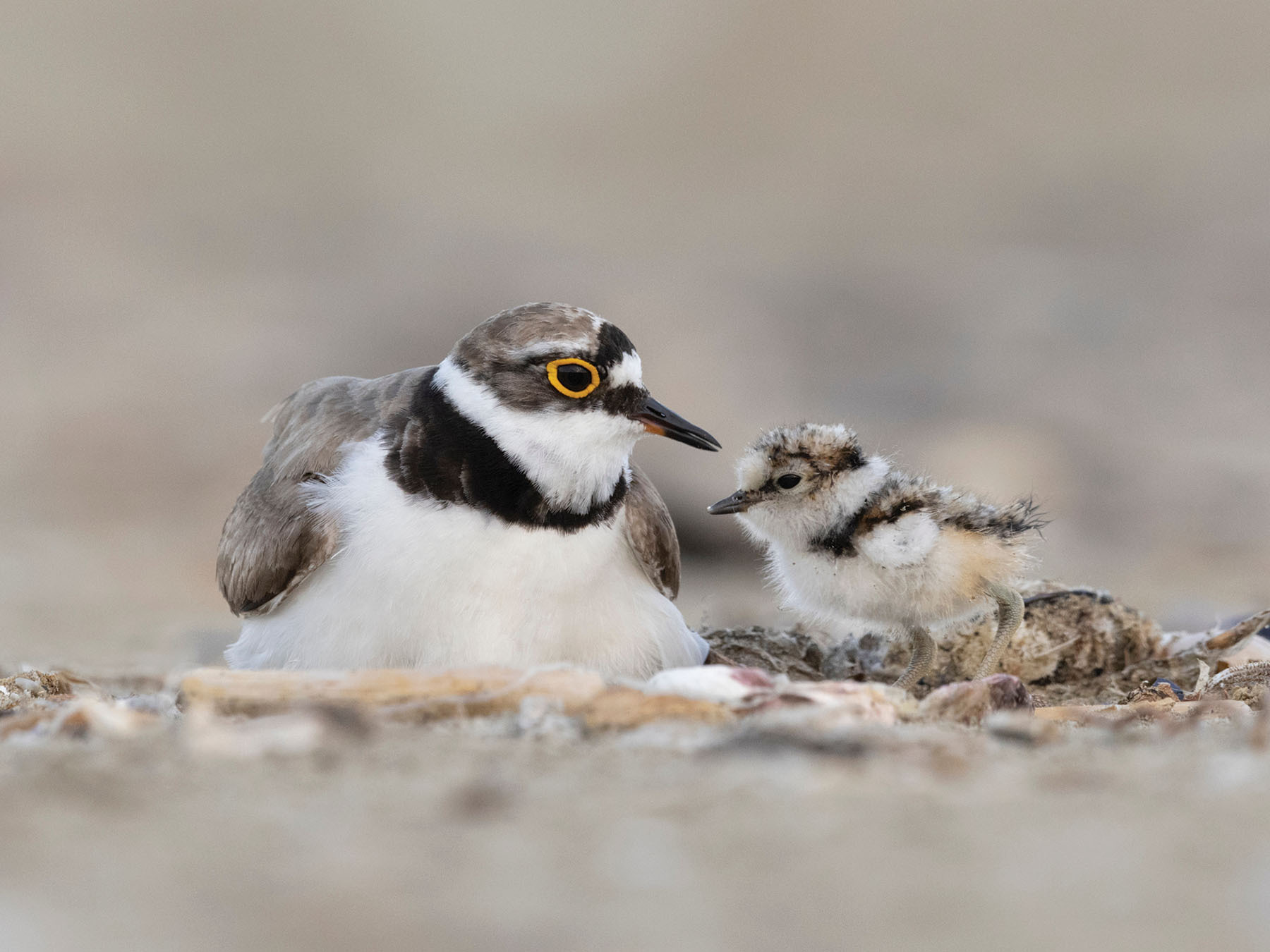
The crown is brown, with a bold black eye mask and forehead, punctuated by a white patch directly above the bill. They have bold wide yellow eyerings around their black eyes, and their feet and legs are pinkish-grey.
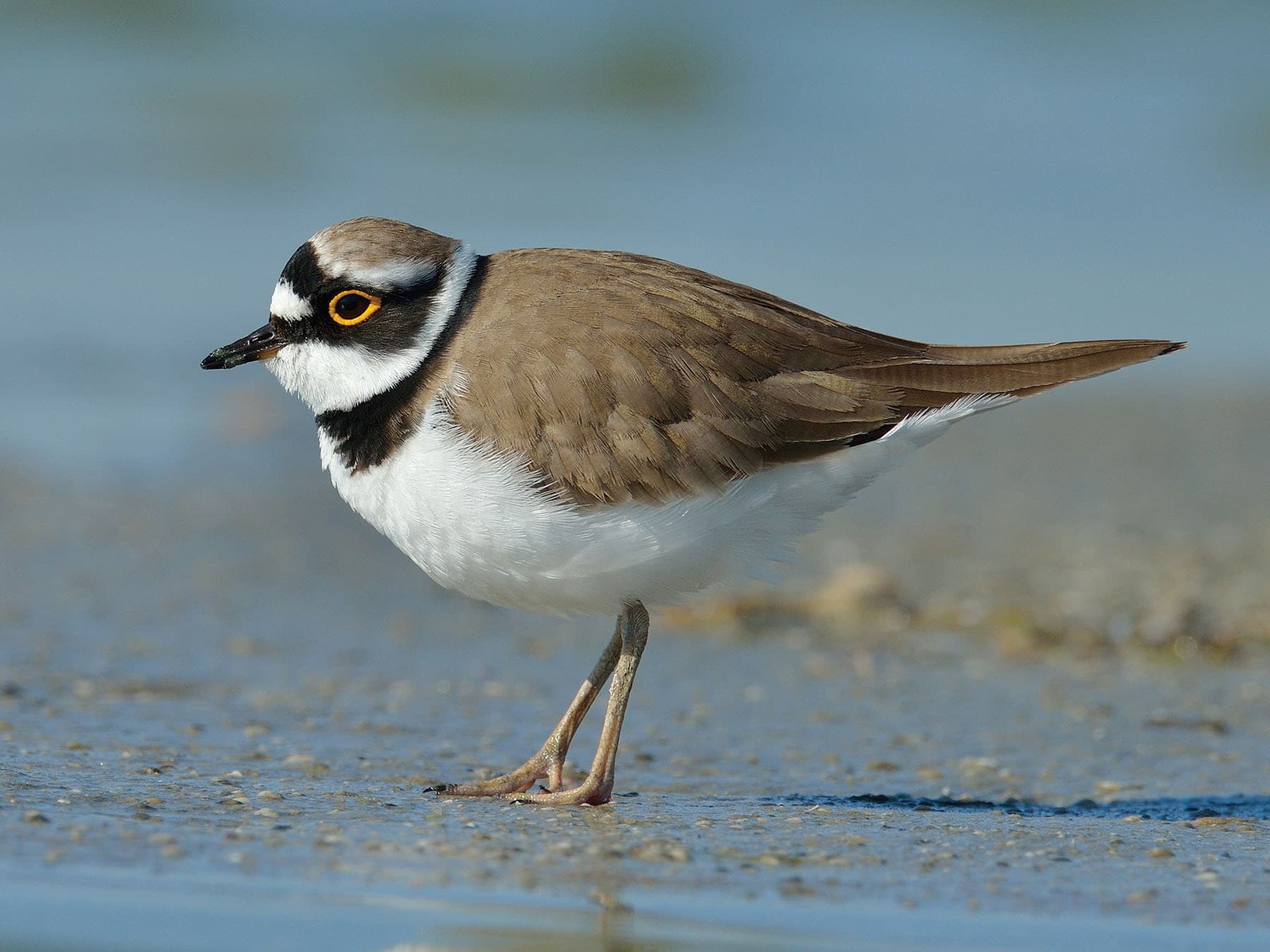
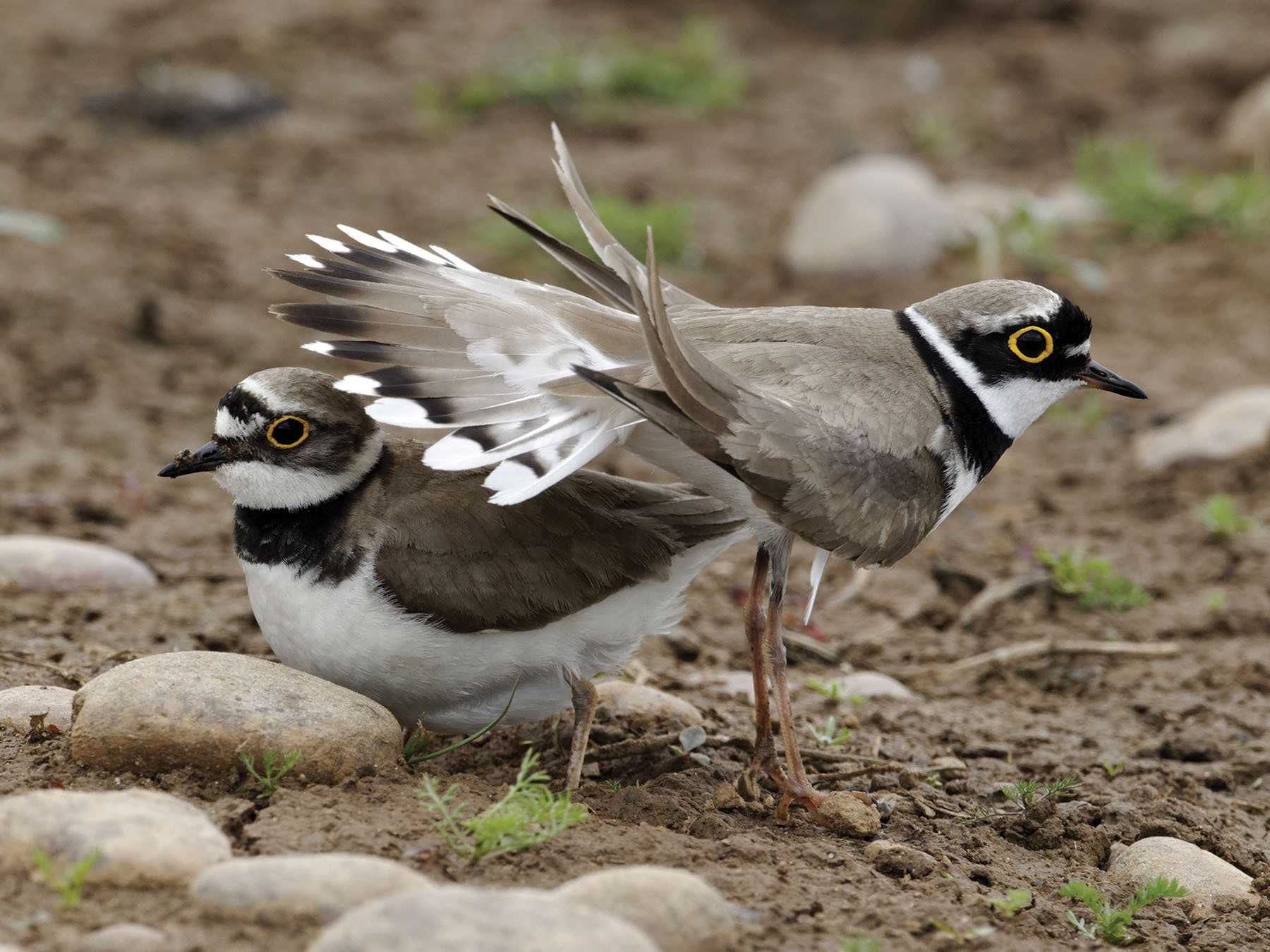
Breeding female little ringed plovers are similar in markings to males, but have a slightly narrower eyering than males, and their breast band is less bold, with a brownish tinge.
Non-breeding adult little ringed plovers moult into a brownish plumage, which is particularly visible in the breast band. The forehead and eye stripe are a lighter buff-grey shade.
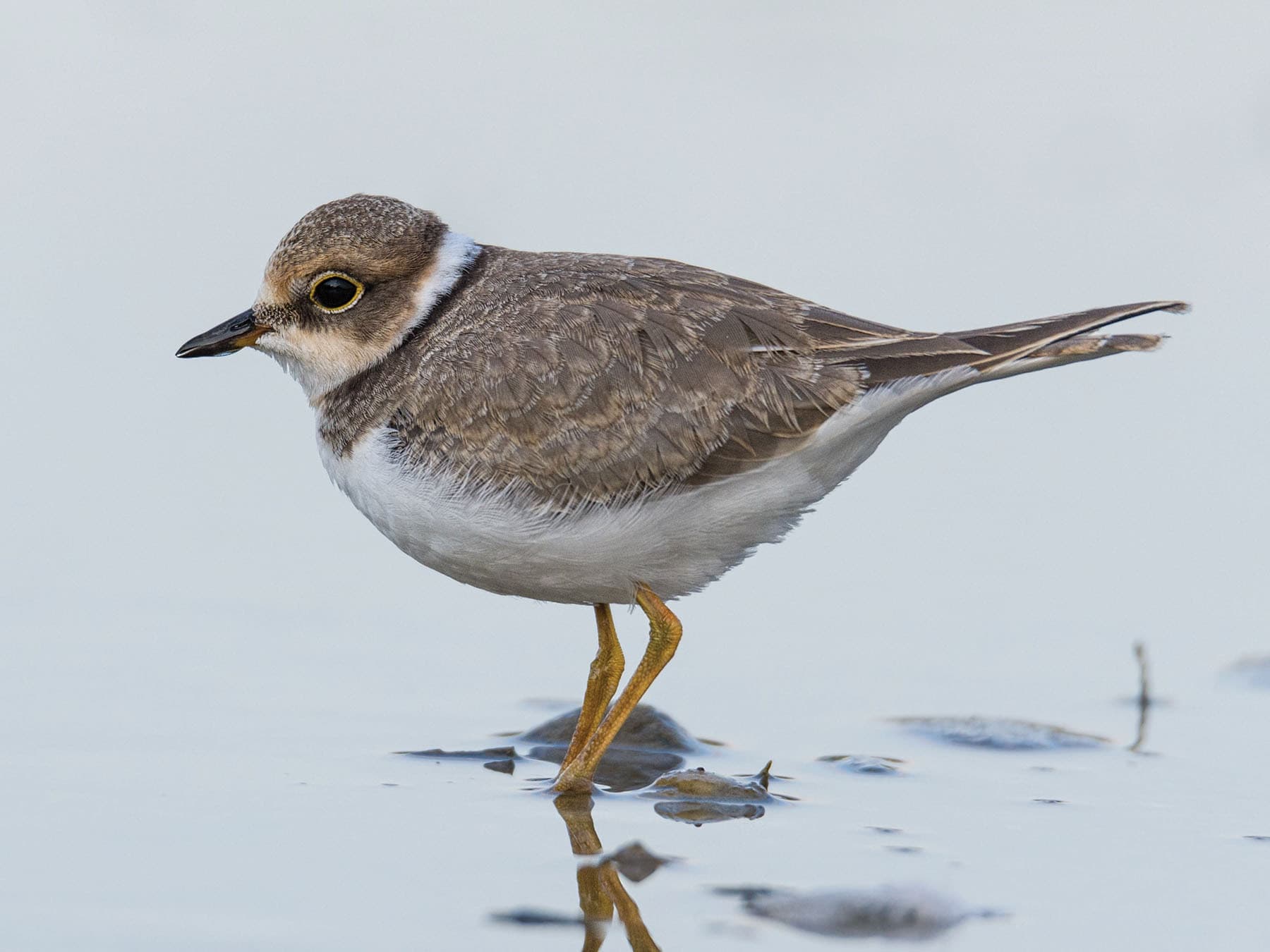
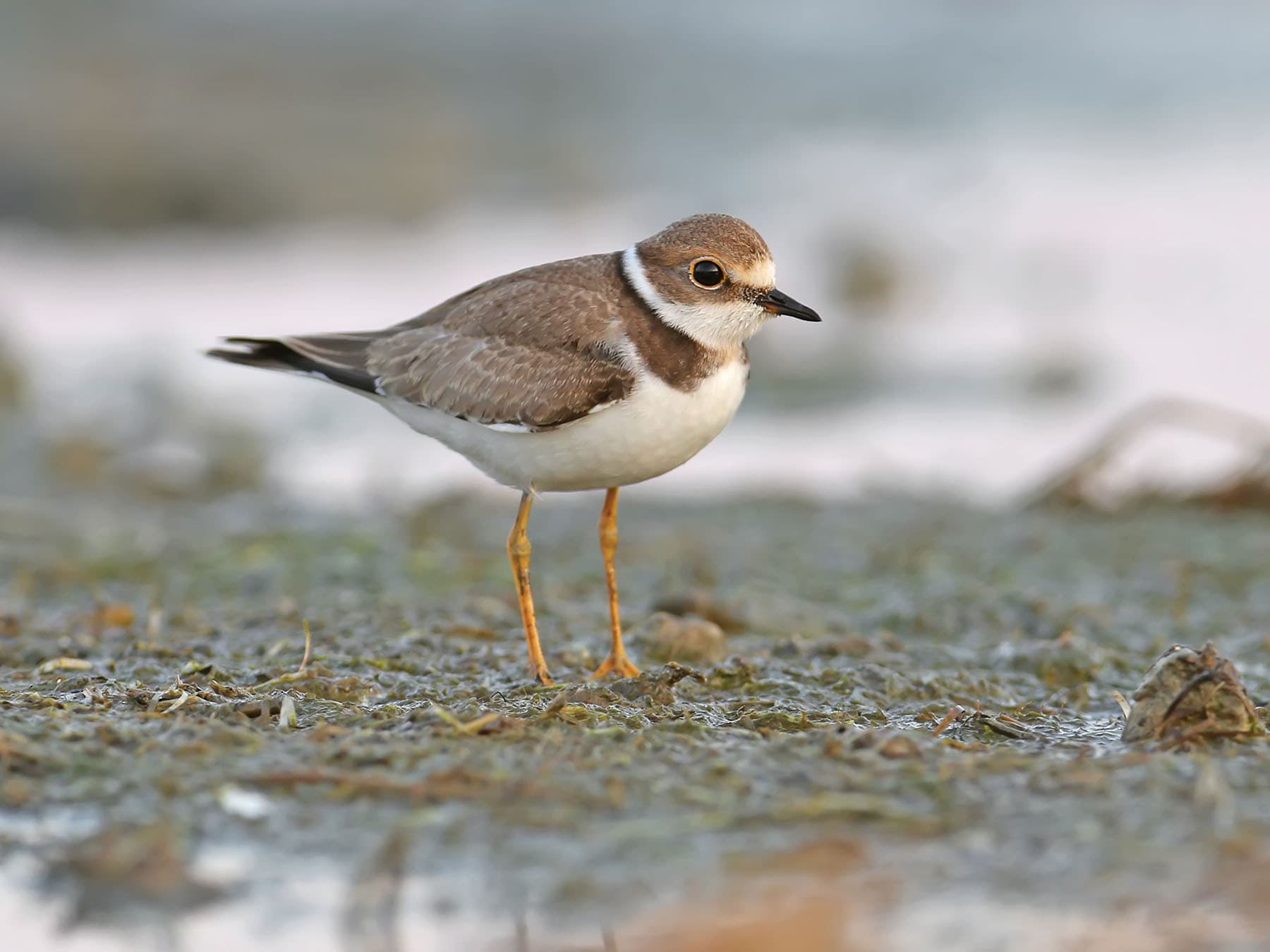
Juvenile little ringed plovers have a much duller plumage and head markings than the adults, and appear brownish overall, with a much fainter yellow eye ring. The barred breast is not fully developed and appears as two patches.
Their upperparts are pale brown, with buff-edged feathers, while underparts are white, and their legs and feet are a greyish-yellow.
How big are Little Ringed Plovers?
As their name suggests, little ringed plovers are by no means large or imposing birds and are smaller in body size than house sparrows. Males and females are the same size, falling within the measurement ranges below:
- Length: 14 cm to 15 cm (5.5 in to 5.9 in)
- Wingspan: 42 cm to 48 cm (16.5 in to 18.9 in)
- Weight: 32 g to 48 g (1.1 in to 1.8 in)
Its size
Adults- Length
- 14–17 cm
- Wingspan
- 42–48 cm
- Weight
- 32–48 g
Its song and calls
What sound does a Little Ringed Plover make?
The flight call of little ringed plovers is a burred ‘preeuw’ piping sound, while courtship calls during display flights, a series of rasping whistles can be heard. The distress call when approaching threats are sensed, is ‘pip-pip-pip’.
- Song and calls0:00 / 0:12
Recorded in South Holland, Netherlands · May 2023
- Call0:00 / 0:18
Recorded in Grand Est, France · April 2025
When and where to see it
OctoberMostly absent
Most recorded in October
- 1. East Lothianunder 0.1%
- 2. Staffordshireunder 0.1%
- 3. Lincolnshireunder 0.1%
- 4. Nottinghamshireunder 0.1%
- 5. Hampshireunder 0.1%
Each dot is a county, state or province: the bigger and darker, the larger the bird’s share of that place’s bird records that month. Grey dots: no regular records. The ringed point is the centre of the bird’s records this month; the arrow shows how it moved since last month, and the dashed loop its path through the year. “Arrivals” colours places where it becomes regular this month (orange) or is in its last regular month (grey). GBIF eBird Observation Dataset, 2019–2024. Map data: Natural Earth, US Census Bureau; place centres © OpenStreetMap contributors.
In your area
See when the Little Ringed Plover is recorded in your county, state or province.
How often the Little Ringed Plover turns up in the UK and Ireland through the year, from birdwatchers' records.
United Kingdom
Summer visitor · regularly Mar–Sep · most records in July
Ireland
Summer visitor · regularly Apr–Sep · most records in July
Show as a table
| Month | United Kingdom | Ireland |
|---|---|---|
| January | – | – |
| February | <0.001% | – |
| March | 0.086% (regular) | 0.002% |
| April | 0.27% (regular) | 0.003% (regular) |
| May | 0.27% (regular) | 0.011% (regular) |
| June | 0.22% (regular) | 0.018% (regular) |
| July | 0.29% (regular) | 0.022% (regular) |
| August | 0.17% (regular) | 0.021% (regular) |
| September | 0.056% (regular) | 0.008% (regular) |
| October | 0.002% | – |
| November | – | – |
| December | – | – |
Recorded regularly in
Worldwide: recorded regularly in 104 countries
Countries where it was recorded in at least 3 of the 6 years 2019–2024. Linked countries have their own bird list.
Europe (41)
- Åland Islands
- Albania
- Austria
- Belarus
- Belgium
- Bosnia & Herzegovina
- Bulgaria
- Croatia
- Czechia
- Denmark
- Estonia
- Finland
- France
- Germany
- Greece
- Hungary
- Ireland
- Italy
- Jersey
- Kosovo
- Latvia
- Lithuania
- Luxembourg
- Malta
- Moldova
- Montenegro
- Netherlands
- North Macedonia
- Norway
- Poland
- Portugal
- Romania
- Russia
- Serbia
- Slovakia
- Slovenia
- Spain
- Sweden
- Switzerland
- Ukraine
- United Kingdom
Africa (16)
Asia (45)
- Armenia
- Azerbaijan
- Bahrain
- Bangladesh
- Bhutan
- Brunei
- Cambodia
- China
- Cyprus
- Georgia
- Hong Kong SAR China
- India
- Indonesia
- Iran
- Iraq
- Israel
- Japan
- Jordan
- Kazakhstan
- Kuwait
- Kyrgyzstan
- Laos
- Lebanon
- Macao SAR China
- Malaysia
- Mongolia
- Myanmar (Burma)
- Nepal
- Oman
- Pakistan
- Palestinian Territories
- Philippines
- Qatar
- Saudi Arabia
- Singapore
- South Korea
- Sri Lanka
- Taiwan
- Tajikistan
- Thailand
- Turkey
- United Arab Emirates
- Uzbekistan
- Vietnam
- Yemen
Oceania (2)
- Australia
- Palau
Data: EOD – eBird Observation Dataset (Cornell Lab of Ornithology), accessed via GBIF.org, CC BY 4.0. Records from 2019–2024, aggregated and filtered by Birdfact. How these lists are made
What is the habitat of a Little Ringed Plover?
Gravel pits, artificial reservoirs, shingle banks and the edges of flooded meadows provide little ringed plovers with suitable nesting and foraging sites.
Open coastal regions are less likely to attract little ringed plovers, as they prefer flat inland wetland landscapes, and also avoid regions with dense vegetation, preferring instead a sparsely vegetated environment.
What is the range of a Little Ringed Plover?
Little ringed plovers breed across northern and central Europe and into central and east Asia, from the UK, across southern Norway, Sweden, Finland and Russia in the north as far as China, Japan and the Korean peninsula in the east.
Breeding occurs as far south as southern Portugal, Spain and parts of North Africa, southern Italy and Turkey, across central Asia, the Indian subcontinent and into South East Asia.
The winter range extends from Senegal in West Africa, throughout the sub-Saharan region to the coast of East Africa, as far south as northern Tanzania.
Year-round populations are present in India and parts of South East Asia, with further wintering grounds for north-east Asian populations found across Malaysia and Indonesia.
Where do Little Ringed Plovers live?
European population estimates for little ringed plovers are rather vague, with numbers between 100,000 and 1 million pairs quoted. Countries with the highest populations include Russia, Belarus and Ukraine.

How rare are Little Ringed Plovers?
Until the 1930s, little ringed plovers were rare visitors to the UK, but since 1938 have been regular breeders at a number of sites around the country.
Attracted by the many reservoirs and gravel pits that have been built and filled during the last century, little ringed plovers are a fairly common sight in their preferred habitats of shingle shores, sewage works and manmade reservoirs.
Where can you see Little Ringed Plovers in the UK?
Breeding grounds of little ringed plovers are most prevalent in southern, central and northern England. Some breeding also occurs in Wales, as well as lowlands in central and eastern Scotland.

Migration
Do Little Ringed Plovers migrate?
European populations of little ringed plovers are entirely migratory, breeding in northern and central Europe, and flying south after they have raised their young to spend winters in the African tropics.
Into Central Asia, little ringed plovers that breed in Siberia and Russia migrate to South East Asia and India.
Are Little Ringed Plovers native to the UK?
Little ringed plovers are summer visitors to the UK, arriving in March to breed, and leaving from July onwards. By September, the last straggling little ringed plovers have left to spend winters in sub-Saharan Africa. Breeding in the UK was first recorded in 1938.

Tips for seeing it
- Look for them on sandy or gravelly shores of rivers, lakes, and coastal areas
- Listen for their distinctive high-pitched 'pee-oo' call
- Observe their quick, darting movements when foraging
- Use binoculars to spot the yellow eye-ring during breeding season
- In the UK, watch for them at inland gravel pits and reservoirs from March to September
What it eats
What do Little Ringed Plovers eat?
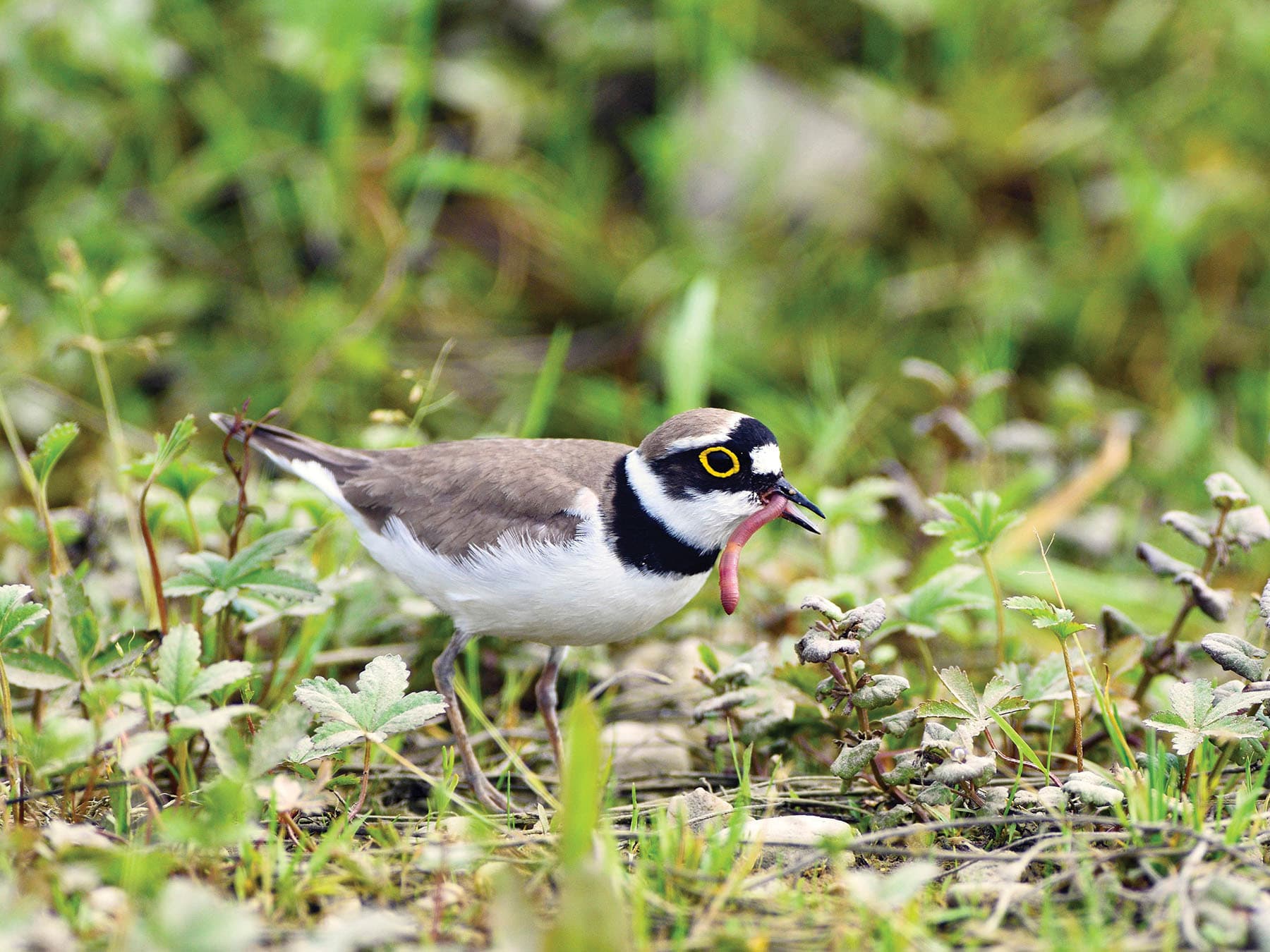
The diet of little ringed plovers is mainly insect-based, with beetles, flies, ants and crickets among the chief foods. Other invertebrates, including spiders and larvae are eaten, as well as shrimps, snails and tadpoles.
What do Little Ringed Plover chicks eat?
Juvenile little ringed plovers feed on insects and invertebrates and quickly learn the art of catching their own prey on shores, catching ants, flies and earthworms.
Nesting and breeding
Where do Little Ringed Plovers nest?
Little ringed plover nests are rather basic structures, formed as a basic shallow scrape in the ground and either unlined or with some simple grasses or gravel added to the inside.
Ground-level nests are preferred, with nests built on flat rooftops on rare occasions. More common are sites on small islands or among low vegetation close to water, on the shores of gravel pits, reservoirs and sandy riverbanks.
What do Little Ringed Plover eggs look like?
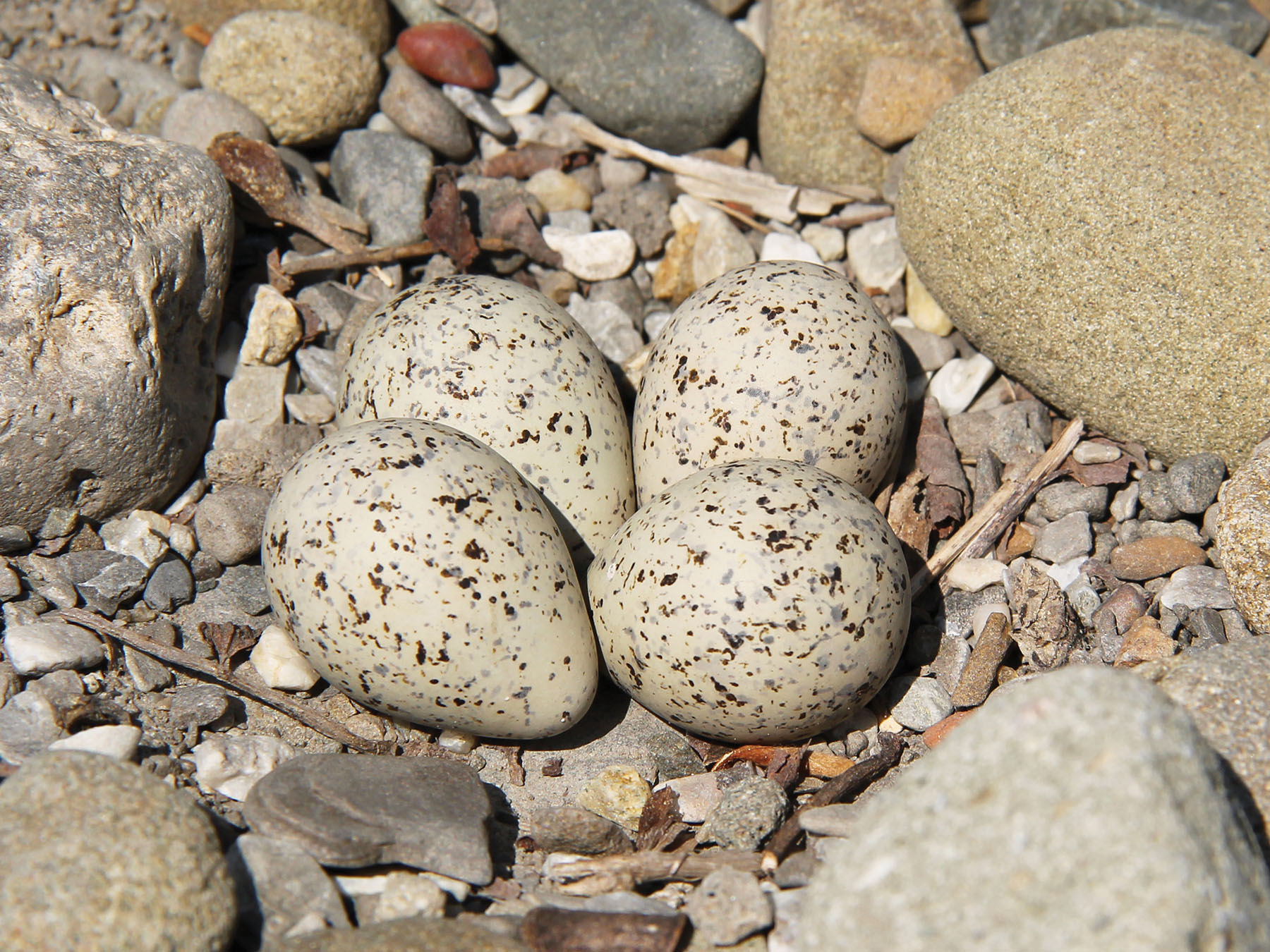
A typical little ringed plover clutch consists of between three and five eggs, which are either buff, pale brown, grey-blue or stone coloured, with darker brown or black mottled markings.
Eggs measure 29.8 mm by 22.1 mm (1.2 in by 0.9 in) and are incubated by both males and females in turn for between 22 and 28 days.
Do Little Ringed Plovers mate for life?
Pair bonds formed between little ringed plovers do frequently last beyond one single breeding season. Occasionally a third ‘helper’ bird is present during breeding, but it is unclear what the dynamics of this extra bird is.
Behaviour
Are Little Ringed Plovers aggressive?
Little ringed plovers are observed to be a highly territorial and aggressive species, challenging any threats to their nest site by displaying their bold black and white markings.
They feed away from their nest sites, and frequently choose to breed in close proximity to other aggressive species, so they can enjoy the benefits of being exposed to fewer predators.
Lifespan and predators
How long do Little Ringed Plovers live?
On average, the expected lifespan of a little ringed plover is 4 years, with first-time breeding at 2 years. The oldest known individual was recorded in 2016 at 17 years and 10 months.
What are the predators of Little Ringed Plovers?
Mink, rats and hedgehogs are among the chief predators of young little ringed plovers, taking them and any unhatched eggs from nests. Seabirds, including skuas and gulls may attempt to target little ringed plovers and their nest sites.
Are Little Ringed Plovers protected?
Little ringed plovers are classed as Schedule 1 birds under the Wildlife and Countryside Act, 1981, which gives them additional protection against their young, eggs, and nest site being damaged or disturbed, as well as making it illegal to kill, injure or capture an adult little ringed plover.
Are Little Ringed Plovers endangered?
Little ringed plovers have Green status on the British Birds of Conservation Concern list, and across their global range are classed as a species of least concern.
Conservation
While the Little Ringed Plover is currently listed as Least Concern, it faces threats from habitat loss due to wetland drainage and shoreline development. Conservation efforts focus on protecting breeding sites and maintaining suitable wetland habitats across their range.
More photos
5 photos
Quick facts
- Length
- 14–17 cm
- Wingspan
- 42–48 cm
- Weight
- 32–48 g
- Lifespan
- 5–10 years · oldest recorded 17.8 years
- Family
- Plovers & Lapwings
- Migration
- Long-distance Migrant
- Global status (IUCN)
- Least Concern
- World population
- 280,000 - 530,000 individuals
- Population trend
- Decreasing
- Also called
- Little Ringed Dotterel
- Scientific name
- Thinornis dubius
Questions
1Do Little Ringed Plovers flock?
Little ringed plovers may form small flocks during migration, with between 10 and 12 birds gathering ahead of their journey to the African tropics. They are a typically solitary species and do not integrate with other wading bird species, preferring to stick to their own company.
Sources
4- 1BirdLife International. 2019. Charadrius dubius (amended version of 2016 assessment). The IUCN Red List of Threatened Species 2019: e.T22693770A155486463. Source (opens in a new tab)
- 2Wetlands International (2015)
- 3Wetlands International (2006)
- 4BTO longevity records: maximum age from a ringed bird, 17 years, 10 months, 19 days (set in 2016), BirdFacts: Little Ringed Plover (2016) Source (opens in a new tab)

Checked by
Nathan Cope, founder and editor
Nathan founded Birdfact and leads its writers and contributors in the UK, the US and Canada. He has watched and studied birds for more than ten years, and checks every article and species guide before it’s published.