


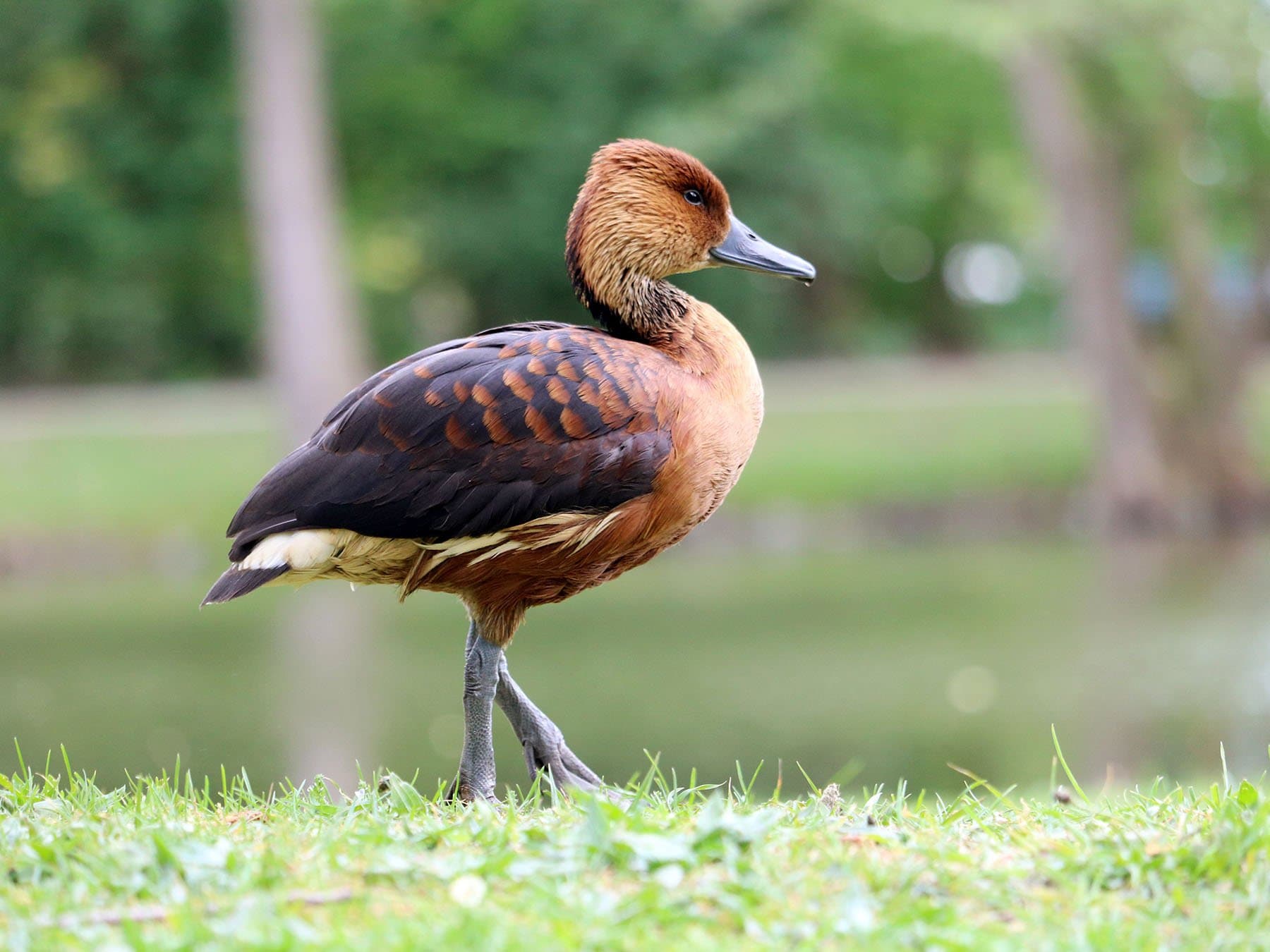
Fulvous Whistling-Duck
Dendrocygna bicolor
By the Birdfact teamChecked by Nathan Cope
Tawny, long-legged, and unmistakably upright, the Fulvous Whistling-Duck is a waterfowl that behaves more like a goose than a duck — bonding for life, sharing incubation duties equally, and calling loudly through the night with a clear, whistling kee-wee-ooo. One of the most widely distributed waterfowl on Earth, it breeds across four continents yet remains underappreciated, partly because males and females look so alike that scientists can only reliably tell them apart by the sound of their voices.
On this page13 sections
How to recognise it
Rich reddish-buff plumage gives the Fulvous Whistling-Duck its name: fulvous is Latin for tawny yellow-brown, and it describes the warm cinnamon colouring that covers the head, neck, breast, flanks, and underparts almost entirely. The mantle and back are darker brown, with buff-tipped feathers that create a neat scalloped effect across the upperparts. Flight feathers and tail are dark brown to blackish, and a dark stripe runs from the crown down the back of the neck to the base of the mantle — a useful feature to look for when the bird is swimming or standing.
The flanks carry distinctive whitish streaks, and the bill and legs are a uniform grey-blue. In flight, the wings appear brown above and black below, with no white wing patches — but a bold white crescent on the rump flashes against the black tail and is the single most reliable identification feature at any distance. The neck is long, the legs are long, and the bird carries itself with a distinctly upright, almost goose-like posture both on land and in the water.
The sexes are essentially identical in plumage — the species is monomorphic — though females average marginally lighter (712–1,000 g versus 748–1,050 g for males) and tend to be very slightly duller overall. Juveniles resemble adults but show paler underparts and a generally washed-out appearance, particularly on the flanks. There is no seasonal plumage change. After breeding, birds undergo a complete wing moult that renders them temporarily flightless for several weeks; during this vulnerable period they retreat into dense wetland vegetation. Body feathers may be replaced throughout the year, but each feather is replaced only once annually. In captivity, colour morphs including pale "champagne" and "silver" variants have been documented, though the natural tawny colouring is genetically dominant.
Not sure it’s a Fulvous Whistling-Duck? Check your photo: Birdfact names the bird and shows the look-alike side by side.
Its size
Adults- Length
- 45–53 cm
- Wingspan
- 85–93 cm
- Weight
- 712–1050 g
Its song and calls
The Fulvous Whistling-Duck is one of the noisier waterfowl species, and its calls are a defining feature of the wetlands it inhabits. The primary call is a clear, two-syllable whistle — variously transcribed as kee-wee-ooo, ka-wheee, or kit-tee — with the accent falling on the second syllable. It is given freely on the ground and in flight, and is frequently heard at night as flocks move between roost and feeding sites. Quarrelling birds produce a harsh, repeated kee. When flushed or taking to the wing, birds often squeal loudly — a habit that earned the species the regional names "Mexican Squealer" and "Whistling Teal" across parts of its North American range. The British Waterfowl Association describes the call as a shrill double-noted whistle. In flight, the wingbeats themselves produce a dull, audible sound.
Despite the sexes being visually identical, males and females produce structurally different calls. Males sound wheezier; females produce a more nasal, slightly lower, and squeakier call. This difference is subtle to the human ear but consistent enough to be scientifically useful. A 2009 acoustic study on 59 captive birds achieved 100% accuracy in sex determination using call analysis alone, validated against molecular (DNA) methods — making the Fulvous Whistling-Duck one of the very few monomorphic bird species where sex can be reliably assigned by vocalisation. The species is most vocal during flight and at night, and a wetland that falls quiet at dusk may erupt with whistling calls as flocks arrive to feed after dark.
Heard one and not sure? Let the bird song identifier listen.
When and where to see it
OctoberLeaving
Most recorded in October
- 1. Louisianaunder 0.1%
- 2. Texasunder 0.1%
- 3. Floridaunder 0.1%
- 4. Mississippiunder 0.1%
- 5. Arkansasunder 0.1%
Each dot is a county, state or province: the bigger and darker, the larger the bird’s share of that place’s bird records that month. Grey dots: no regular records. The ringed point is the centre of the bird’s records this month; the arrow shows how it moved since last month, and the dashed loop its path through the year. “Arrivals” colours places where it becomes regular this month (orange) or is in its last regular month (grey). GBIF eBird Observation Dataset, 2019–2024. Map data: Natural Earth, US Census Bureau; place centres © OpenStreetMap contributors.
In your area
See when the Fulvous Whistling-Duck is recorded in your county, state or province.
How often the Fulvous Whistling-Duck turns up in the United States through the year, from birdwatchers' records.
United States
Resident · all year · most records in April
Show as a table
| Month | United States |
|---|---|
| January | 0.008% (regular) |
| February | 0.007% (regular) |
| March | 0.007% (regular) |
| April | 0.015% (regular) |
| May | 0.004% (regular) |
| June | 0.004% (regular) |
| July | 0.006% (regular) |
| August | 0.006% (regular) |
| September | 0.003% (regular) |
| October | 0.003% (regular) |
| November | 0.007% (regular) |
| December | 0.008% (regular) |
Worldwide: recorded regularly in 45 countries
Countries where it was recorded in at least 3 of the 6 years 2019–2024. Linked countries have their own bird list.
Europe (1)
- Belgium
Africa (17)
Asia (6)
- Bangladesh
- India
- Israel
- Myanmar (Burma)
- Nepal
- United Arab Emirates
North America (12)
- Barbados
- Belize
- Costa Rica
- Cuba
- Dominican Republic
- El Salvador
- Guatemala
- Honduras
- Mexico
- Nicaragua
- Panama
- United States
Data: EOD – eBird Observation Dataset (Cornell Lab of Ornithology), accessed via GBIF.org, CC BY 4.0. Records from 2019–2024, aggregated and filtered by Birdfact. How these lists are made
Tips for seeing it
In the United States, the most reliable places to find Fulvous Whistling-Ducks are the rice-growing areas of coastal Texas and Louisiana between March and October, and the freshwater marshes of south and central Florida year-round. The Anahuac and Brazoria National Wildlife Refuges in Texas are particularly productive, as are the marshes around Lake Okeechobee in Florida. Look for flocks wading in flooded fields or resting on muddy margins — the upright, long-necked posture is immediately distinctive and rules out most other ducks at a glance.
In flight, the combination of slow wingbeats, dangling feet, and the bright white rump crescent contrasting with the black tail is diagnostic. No other North American duck shows this exact combination. The whistling kee-wee-ooo call carries well and is often the first indication of birds overhead, especially at dusk and after dark when flocks move between roost and feeding sites.
The species can be confused with the Black-bellied Whistling-Duck, which shares the same long-legged, upright build and overlaps in range across Texas and Florida. The Black-bellied is easily separated by its bright pink-red bill, bold white wing stripe visible in flight, and black belly. The Fulvous shows no white in the wing and has a grey-blue bill. In the UK, any record should be treated with caution: the species is widely kept in wildfowl collections, and most British birds are likely escapes. A genuinely wild vagrant would be expected in autumn or winter, potentially alongside other long-distance waterfowl arrivals.
What it eats
Plant material makes up more than 95% of the Fulvous Whistling-Duck's diet. Seeds are the primary food: rice, paspalum, wild millet, sedge, smartweed, knotgrass, switchgrasses, jungle-rice, bahiagrass, darnel ryegrass, reed canary grass, watershield, cape blue waterlily, blue mudplantain, knotweed, and sea ragwood have all been recorded. Green algae and wheat are also taken. In rice-growing areas of the southern United States, the species is rarely found far from flooded rice fields, which provide both optimal foraging depth and an abundant seed supply. Whether birds feed primarily on the rice itself or on weed seeds growing among the crop is debated — some studies suggest the latter, which would make the species less of a pest than rice farmers sometimes assume.
The remaining fraction of the diet — less than 5% in adults — consists of invertebrates: earthworms, midges, water beetles, dragonfly larvae, snails, and small molluscs. Invertebrates may form a larger share of the duckling diet during the first weeks of life, when protein demand is highest.
Foraging takes place by day and night. Birds swim or wade in shallow water and dabble, tip up, or dive to reach submerged food. Unusually for a duck, the Fulvous Whistling-Duck is also a significant filter-feeder, straining fine mud through well-developed lamellae — comb-like structures lining the bill — to extract seeds and small invertebrates. This technique is more reminiscent of the Northern Shoveler than of most dabbling ducks. Birds also graze on emergent vegetation and glean insects from plant surfaces, making the species a versatile and opportunistic forager across a wide range of wetland conditions.
Nesting and breeding
Nest site selection begins in March in North America, with both male and female flying over and landing in several candidate spots before committing. Nests are placed on the ground next to water, in dense marsh vegetation just above the waterline, on floating vegetation, or occasionally in tree holes. The nest itself is a woven platform of grass, sedges, cattails, and rice straw — sometimes with a partial canopy of the same materials pulled over the top. Unusually for a waterfowl, no down is added to line the cup. Nests average about 36 cm across, with an interior bowl approximately 25 cm wide and 7–12 cm deep.
The typical clutch is 10–14 eggs (range 6–16), white to buffy white, bluntly oval, averaging 5.3 × 4.1 cm. Both sexes share incubation, which normally lasts 24–26 days. Eggs may be left unattended for hours on warm days until close to hatching. The breeding season in Texas runs from early May to late October; in Louisiana, peak breeding is April to late August.
Brood parasitism — known as dump nesting — is common and can dramatically alter clutch dynamics. Females routinely lay eggs in each other's nests or in the nests of other duck species, and such dump nests can accumulate 60 or more eggs. When a clutch is enlarged this way, the incubation period can stretch from the normal 24–26 days to as long as 44 days. Redheads (Aythya americana) are also known to parasitise Fulvous Whistling-Duck nests. Downy grey ducklings leave the nest within a day of hatching and can swim and dive immediately. Both parents tend the young, though the ducklings find their own food. Young fledge at approximately 55–63 days, and each pair typically raises one clutch per season.
Behaviour
In the air, the Fulvous Whistling-Duck is immediately recognisable by its silhouette alone. The neck is stretched straight out, the long legs trail visibly beyond the tail, and the wingbeats are slow and deliberate — producing a somewhat hunchbacked, almost prehistoric profile that is quite unlike the compact, fast-beating shape of most dabbling ducks. The wings are broad and rounded, brown above and blackish below, with no white wing patches on either surface.
The single most striking flight feature is the bold white rump crescent, which flashes sharply against the black tail as the bird banks or lands. This marking is visible at considerable distance and is the most reliable single identification feature in flight. The underwing is uniformly dark, which further separates the species from the Black-bellied Whistling-Duck, which shows a broad white stripe across the upperwing.
Flocks typically fly in loose, irregular formations rather than the tight chevrons of geese, and they call frequently in flight — the whistling kee-wee-ooo carrying well above the sound of the wingbeats. When a flock takes off from water or marsh, the collective squealing of disturbed birds is audible from some distance. Birds are capable of sustained flight over long distances: Gulf Coast populations migrate to wintering grounds in eastern Mexico, and wandering flocks have reached Hawaii, southern Canada, and the Dakotas — demonstrating that the species' slow, deliberate wingbeat style conceals considerable endurance.
Lifespan and predators
In the wild, Fulvous Whistling-Ducks typically live between 5 and 10 years, though survival rates vary considerably with habitat quality, hunting pressure, and predation. The oldest confirmed wild individual was a male banded in Florida in 1993 and shot by a hunter in Cuba in 2004 — a minimum age of 11 years and 2 months, which stands as the documented longevity record for the species in the wild. Anecdotal reports from captive collections suggest the species may reach 20 years under managed conditions, though this figure is not formally verified.
Mortality causes in the wild include hunting (the annual US harvest is estimated below 5,000 birds), predation, and the effects of agricultural pesticides — particularly organochlorine compounds, which caused significant population crashes in Texas and Louisiana during the 1960s. The post-breeding moult, during which birds become temporarily flightless for several weeks, represents a period of heightened vulnerability to ground predators. Ducklings face additional risks in the first weeks of life before they can fly.
Compared with other Anatidae, the Fulvous Whistling-Duck's lifespan is broadly similar to that of medium-sized dabbling ducks such as the Mallard, which typically lives 5–10 years in the wild with a maximum recorded age of around 29 years in captivity. The lifelong pair bond and biparental care system of the Fulvous Whistling-Duck — more reminiscent of geese than ducks — may contribute to higher annual survival rates for paired adults compared with species where males disperse after mating.
Conservation
The Fulvous Whistling-Duck is classified as Least Concern by the IUCN, supported by a global population estimated at 1.3–1.5 million individuals by BirdLife International. Regional breakdowns suggest roughly 1 million birds in the Americas, around 1.1 million in Africa, and fewer than 20,000 in Asia. Despite the Least Concern rating, the overall global trend is declining, driven primarily by habitat loss and historical pesticide contamination.
The most dramatic documented population crash occurred in the 1960s, when organochlorine pesticides applied to rice fields in Texas and Louisiana caused sharp declines in Gulf Coast populations. Those populations have largely recovered following restrictions on the most harmful chemicals, and the North American Breeding Bird Survey recorded a survey-wide trend of +2.2% per year between 1966 and 2019. Florida's population has expanded particularly strongly, with a 220% increase in breeding records between the two Florida Breeding Bird Atlases. A Southern California population, by contrast, declined and eventually vanished for reasons that remain unclear.
Ongoing threats include drainage and development of floodplain wetlands, continued agricultural pesticide use, hunting (annual US harvest is estimated below 5,000 birds, mainly in Florida, Texas, and Louisiana), and climate change. The species is also shot for food across parts of its African and Asian range. Partners in Flight rates it 9 out of 20 on the Continental Concern Score, indicating low conservation concern in North America. The species' large global range, multi-continental distribution, and demonstrated ability to colonise new habitats provide a degree of resilience that most wetland specialists lack.
Similar Species
The Black-bellied Whistling-Duck (Dendrocygna autumnalis) is the species most likely to be confused with the Fulvous in North America, sharing the same upright posture, long legs, and overlapping range across Texas and Florida. Separation is straightforward: the Black-bellied has a vivid pink-red bill, a bold white stripe across the upperwing visible in flight, and a contrasting black belly. The Fulvous shows a grey-blue bill, no white in the wing, and uniform tawny underparts. The calls also differ — the Black-bellied produces a higher, more rapid whistling chatter.
In Africa and Asia, the Lesser Whistling-Duck (Dendrocygna javanica) overlaps with the Fulvous across parts of the Indian subcontinent. The Lesser is noticeably smaller, has a chestnut rump (not white), and shows a warmer, more uniformly rufous tone without the distinctive flank streaking of the Fulvous. The Wandering Whistling-Duck (Dendrocygna arcuata) of Australasia and Southeast Asia is similar in build but shows a darker cap, more strongly streaked flanks, and a chestnut rump patch rather than white.
In the UK, where the Fulvous Whistling-Duck is a rare vagrant and likely escape, the upright posture and tawny colouring are distinctive enough that confusion with native species is unlikely. The combination of grey-blue bill, long grey-blue legs, white rump crescent, and whistling call should clinch identification even for observers unfamiliar with the species.
Courtship & Display
Courtship in the Fulvous Whistling-Duck is relatively brief compared with the elaborate displays of many duck species, reflecting the fact that pairs bond for life and do not need to re-establish a partnership each season. When pairs do display, they face each other and repeatedly dip the bill — a simple but direct exchange that reinforces the bond. After mating, the pair performs a side-by-side display involving synchronised head-nodding, foot-paddling, breast-raising, and wing-extension, a sequence that closely parallels the triumph ceremonies seen in geese and swans rather than the head-pumping and wing-flapping typical of dabbling ducks.
Aerial pursuit also plays a role: multiple males may chase a single female through the air in large circling flights, with the female eventually settling with her chosen partner. Nest site selection is a joint activity — both male and female fly over and land in several candidate spots before committing to a location, a behaviour that further underlines the equal partnership that characterises this species' breeding system.
The lifelong pair bond means that established pairs invest relatively little time in courtship each season, instead channelling energy directly into nesting and incubation. Both sexes develop brood patches and share incubation shifts, and the male remains with the brood after hatching — a level of paternal investment that is rare among ducks and more closely parallels the behaviour of geese such as the Canada Goose.
Quick facts
- Length
- 45–53 cm
- Wingspan
- 85–93 cm
- Weight
- 712–1050 g
- Lifespan
- 5–10 years · oldest recorded 11.2 years
- Family
- Ducks, Geese & Swans
- Migration
- Partial migrant
- Global status (IUCN)
- Least Concern
- World population
- 1,300,000–1,500,000
- Population trend
- Declining globally, though North American populations have shown stability or slight increase since 1966. The North American Breeding Bird Survey recorded +2.2% per year (1966–2019). Florida's breeding population increased by 220% between the two Florida Breeding Bird Atlases. Asian populations number fewer than 20,000 and face ongoing habitat pressures.
- Scientific name
- Dendrocygna bicolor
Sources
14- 1Fulvous whistling duck - Wikipedia Source (opens in a new tab)
- 2Fulvous Whistling-Duck | Audubon Field Guide Source (opens in a new tab)
- 3Fulvous Whistling-Duck - eBird Source (opens in a new tab)
- 4Fulvous Whistling-duck Dendrocygna bicolor Species Factsheet | BirdLife DataZone Source (opens in a new tab)
- 5Fulvous Whistling-Duck Life History, All About Birds, Cornell Lab of Ornithology Source (opens in a new tab)
- 6Fulvous Whistling-Duck Overview, All About Birds, Cornell Lab of Ornithology Source (opens in a new tab)
- 7Fulvous Whistling-Duck | Ducks Unlimited Source (opens in a new tab)
- 8Fulvous Whistling Duck (Dendrocygna bicolor) :: xeno-canto Source (opens in a new tab)
- 9Fulvous whistling duck (Dendrocygna bicolor) longevity, ageing, and life history - AnAge Source (opens in a new tab)
- 10Fulvous Whistling-Duck | Florida Breeding Bird Atlas Source (opens in a new tab)
- 11FULVOUS WHISTLING-DUCK | The Texas Breeding Bird Atlas Source (opens in a new tab)
- 12Fulvous Whistling-Duck | Bird Gallery | Houston Audubon Source (opens in a new tab)
- 13Fulvous Whistling Duck - British Waterfowl Association Source (opens in a new tab)
- 14Fulvous Whistling-Ducks | FWC Source (opens in a new tab)

Checked by
Nathan Cope, founder and editor
Nathan founded Birdfact and leads its writers and contributors in the UK, the US and Canada. He has watched and studied birds for more than ten years, and checks every article and species guide before it’s published.