
European Green Woodpecker
Green Woodpecker, Yaffle, Eurasian Green Woodpecker · Picus viridis
By the Birdfact teamChecked by Nathan Cope
On this page14 sections
How to recognise it
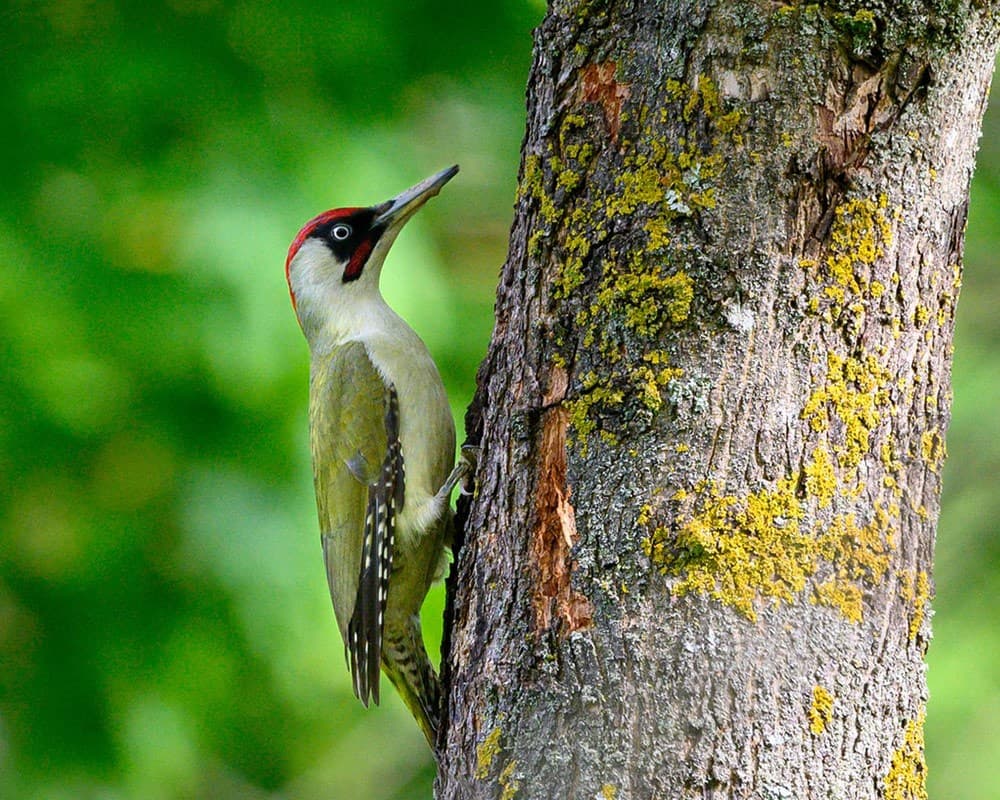
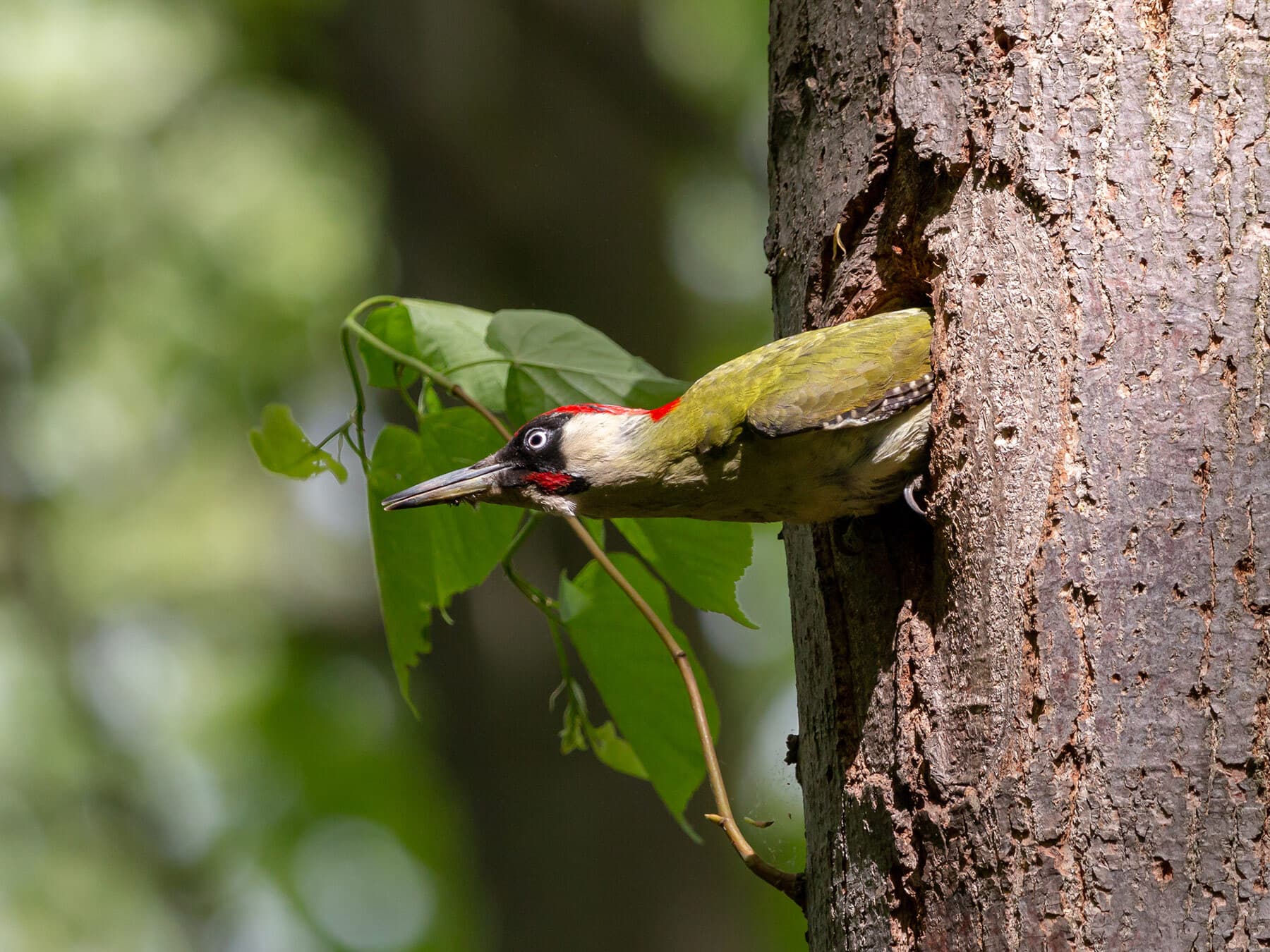
The European Green Woodpecker is a striking bird with predominantly green plumage on its back and wings, contrasting with a pale yellow rump. Its underparts are pale green to yellowish, with a distinctive red crown and nape.
Both sexes have red caps, but the malar area (moustache) is black, with a red centre in the male and a solid black in the female.
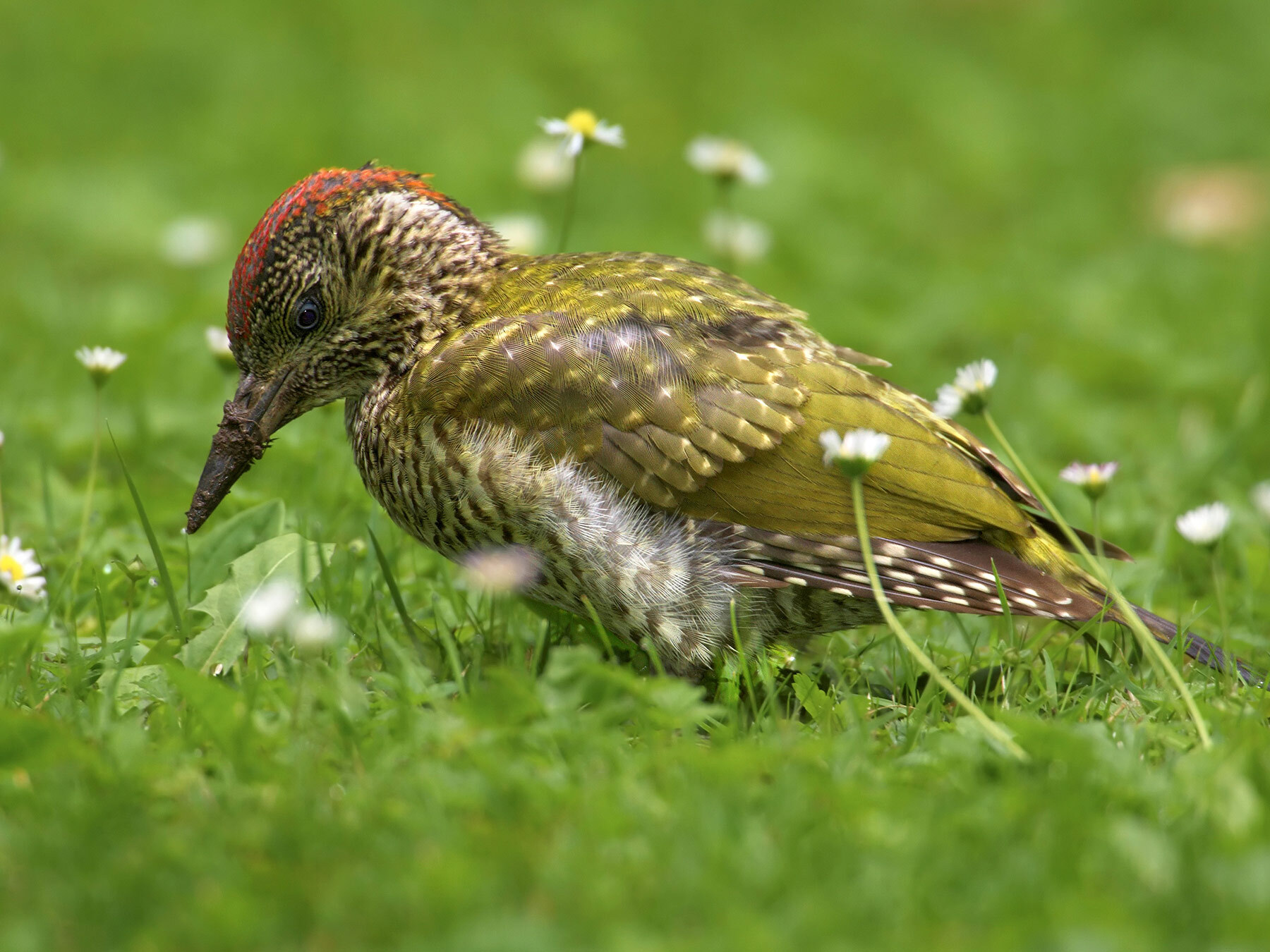
Juveniles are similar to adults but have barred underparts and less vibrant colouration overall.
Its size
Adults- Length
- 30–36 cm
- Wingspan
- 40–42 cm
- Weight
- 180–220 g
Its song and calls
Unlike most species of woodpecker the European green rarely drums (the tap tap tapping noise often heard with other species) and is confined to loud vocalisations similar to a ‘kleu – kleu – kleu – kleu’ or a single ‘kyik’ when alarmed.
- Song0:00 / 0:56
Recorded in Surrey, England
Aubrey John Williams / The British Library Board · Wikimedia Commons · CC BY-SA 4.0
- Call0:00 / 1:05
Recorded in Normandie, France · July 2024
When and where to see it
OctoberIn season
Most recorded in October
- 1. Neath Port Talbot2.1%
- 2. Bedfordshire1.9%
- 3. Cambridgeshire1.2%
- 4. Berkshire1.1%
- 5. Surrey1.1%
Each dot is a county, state or province: the bigger and darker, the larger the bird’s share of that place’s bird records that month. Grey dots: no regular records. The ringed point is the centre of the bird’s records this month; the arrow shows how it moved since last month, and the dashed loop its path through the year. “Arrivals” colours places where it becomes regular this month (orange) or is in its last regular month (grey). GBIF eBird Observation Dataset, 2019–2024. Map data: Natural Earth, US Census Bureau; place centres © OpenStreetMap contributors.
In your area
See when the European Green Woodpecker is recorded in your county, state or province.
How often the European Green Woodpecker turns up in the UK through the year, from birdwatchers' records.
United Kingdom
Resident · all year · most records in August
Show as a table
| Month | United Kingdom |
|---|---|
| January | 0.40% (regular) |
| February | 0.46% (regular) |
| March | 0.60% (regular) |
| April | 0.56% (regular) |
| May | 0.37% (regular) |
| June | 0.34% (regular) |
| July | 0.56% (regular) |
| August | 0.66% (regular) |
| September | 0.49% (regular) |
| October | 0.43% (regular) |
| November | 0.40% (regular) |
| December | 0.38% (regular) |
Recorded regularly in
Worldwide: recorded regularly in 39 countries
Countries where it was recorded in at least 3 of the 6 years 2019–2024. Linked countries have their own bird list.
Europe (34)
- Albania
- Austria
- Belarus
- Belgium
- Bosnia & Herzegovina
- Bulgaria
- Croatia
- Czechia
- Denmark
- France
- Germany
- Greece
- Hungary
- Italy
- Kosovo
- Latvia
- Liechtenstein
- Lithuania
- Luxembourg
- Moldova
- Montenegro
- Netherlands
- North Macedonia
- Norway
- Poland
- Romania
- Russia
- Serbia
- Slovakia
- Slovenia
- Sweden
- Switzerland
- Ukraine
- United Kingdom
Asia (5)
- Armenia
- Azerbaijan
- Georgia
- Iran
- Turkey
Data: EOD – eBird Observation Dataset (Cornell Lab of Ornithology), accessed via GBIF.org, CC BY 4.0. Records from 2019–2024, aggregated and filtered by Birdfact. How these lists are made
Picus viridis viridis is a widespread resident across southern Scandinavia eastwards into western Russia and the Balkans. It is common in parts of Scotland and throughout England, Wales and France.
Picus viridis karelini is similar in plumage but with less yellow and more grey colouration and is generally smaller in size than the nominate. It has a range from Italy through the southern Balkans into Georgia, Armenia and Azerbaijan then southeast into northwestern Iran and southwestern Turkmenistan.
Picus viridis innominatus is monotypic and is similar to the nominate with occasional subtle colour differences. It occupies a range along the Zagros Mountains which lie between northeastern Iraq and southwestern Iran.
Preferred habitats are broadleaved and mixed woodlands, farmland and other open areas such as heath with natural bushes and small coppices.
Signs and Spotting tips
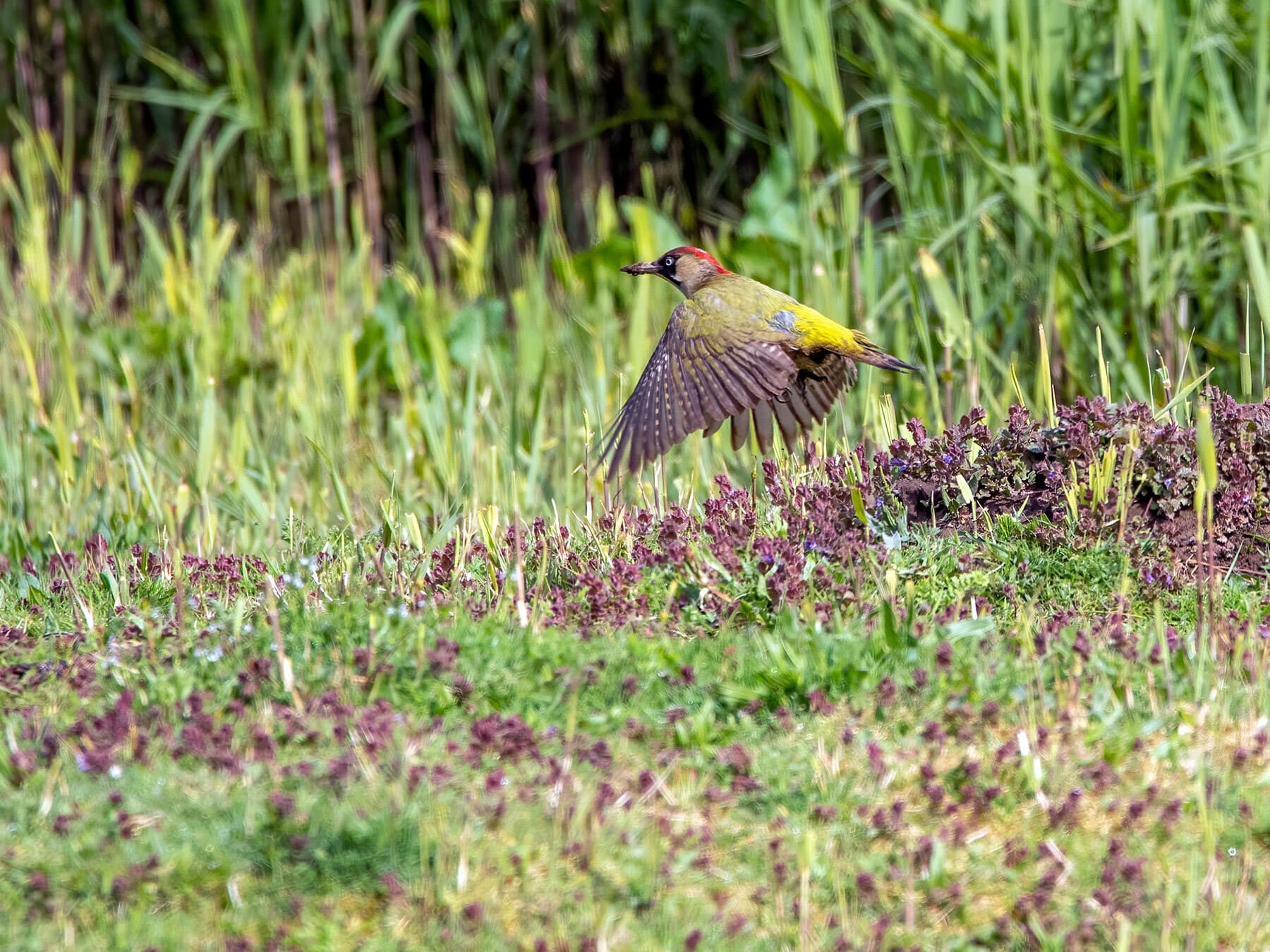
Whilst easily recognisable with its green plumage and bright red crown in Britain, elsewhere in Europe it can be mistaken for the similar sized and coloured, Grey-headed woodpecker although the latter has a far thinner black moustache and lacks the vivid red crown, having instead a small red patch on the forehead. As its name implies it also has a mid grey head and its underparts are also tinged grey. The green woodpecker can often be seen feeding on grassy areas and cultivated lawns as it forages for ants. It is a solitary and shy bird albeit that its call can be extremely loud and shrill.
What it eats
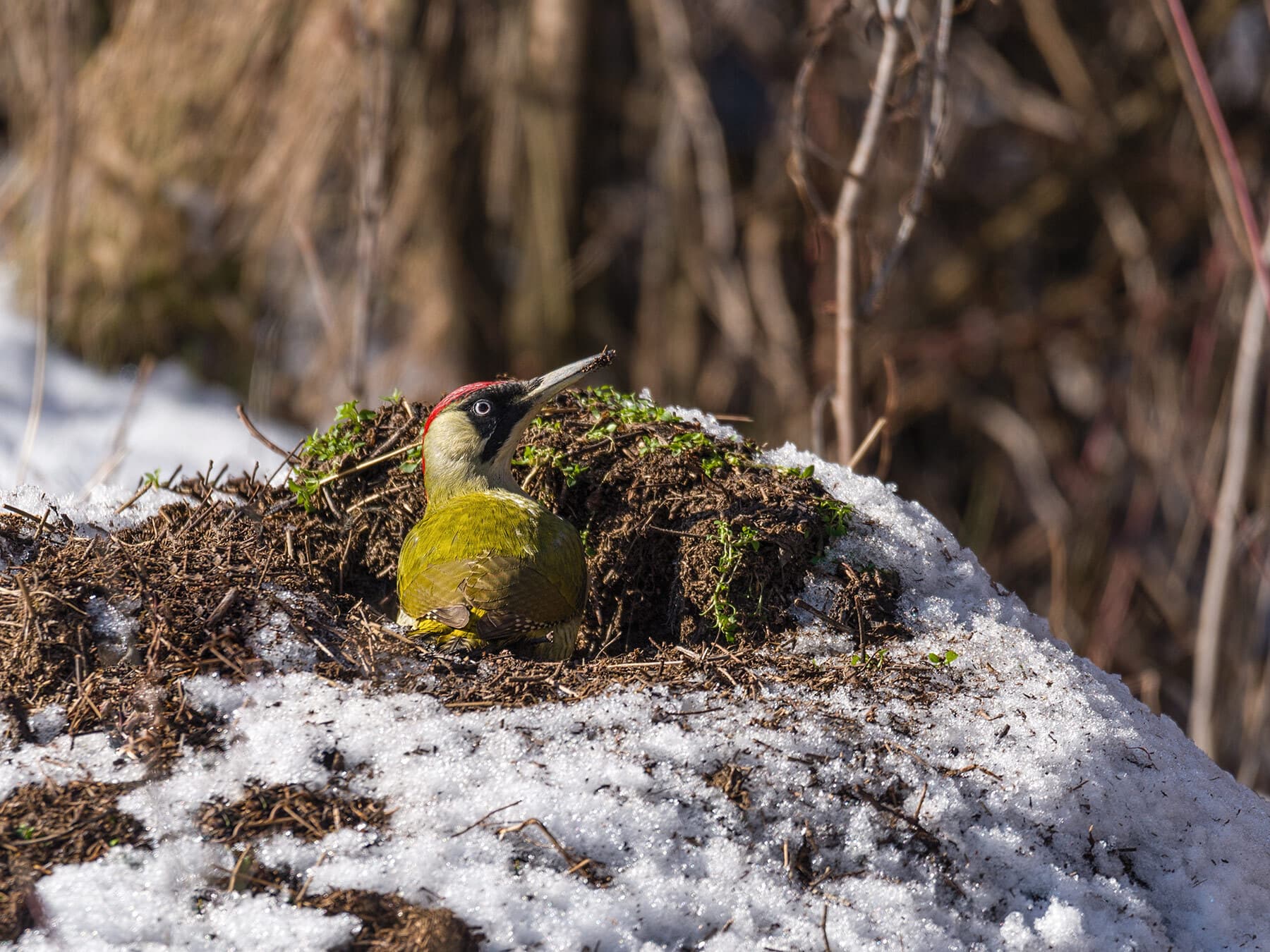
A diet of ants, ant eggs and larvae are the staple for this shy, resident breeder. Unlike most members of the Picidae family European green woodpeckers frequently forage and feed off the ground where they probe ants’ nests with their long sticky tongues.
Nesting and breeding
A nesting hole, usually in a deciduous tree, is burrowed, predominantly by the male and can take up to a month to complete. One clutch of 4 – 6 white eggs, is laid annually between May to July and incubated for up to twenty days by both parents. Upon hatching the young emerge naked and helpless and are dependent on their parents for food and welfare (altricial). Fledging occurs an average of twenty two days after hatching. It is unusual for the green woodpecker to revisit the nest and use it subsequently although many species of bird will take up residence during the following breeding seasons to their own advantage.
Behaviour
European Green Woodpeckers are often seen foraging on the ground, using their long, sticky tongues to probe for ants, their primary food source. They have a distinctive undulating flight pattern and are known for their loud, laughing call. These birds are generally solitary but may form loose pairs during breeding season.
Lifespan and predators
Life expectancy for the European green woodpecker is between five to ten years although ringed birds have been recorded as reaching fifteen years of age.
Conservation
While the European Green Woodpecker is currently listed as Least Concern, it faces localised threats from habitat loss and fragmentation.
Conservation efforts focus on preserving mature woodlands and promoting wildlife-friendly gardening practices to maintain suitable habitats and food sources.
What does a European Green Woodpecker look like?
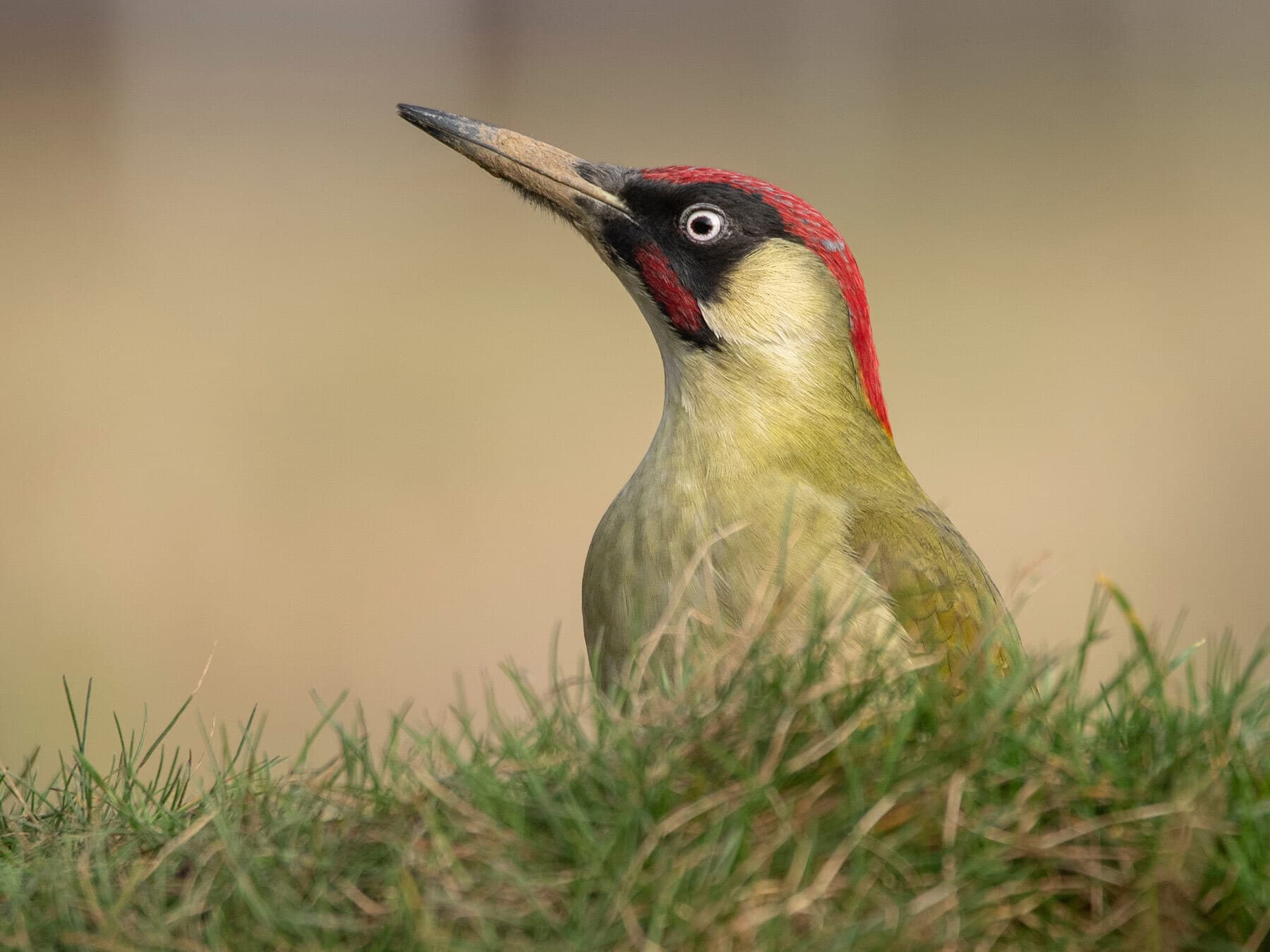
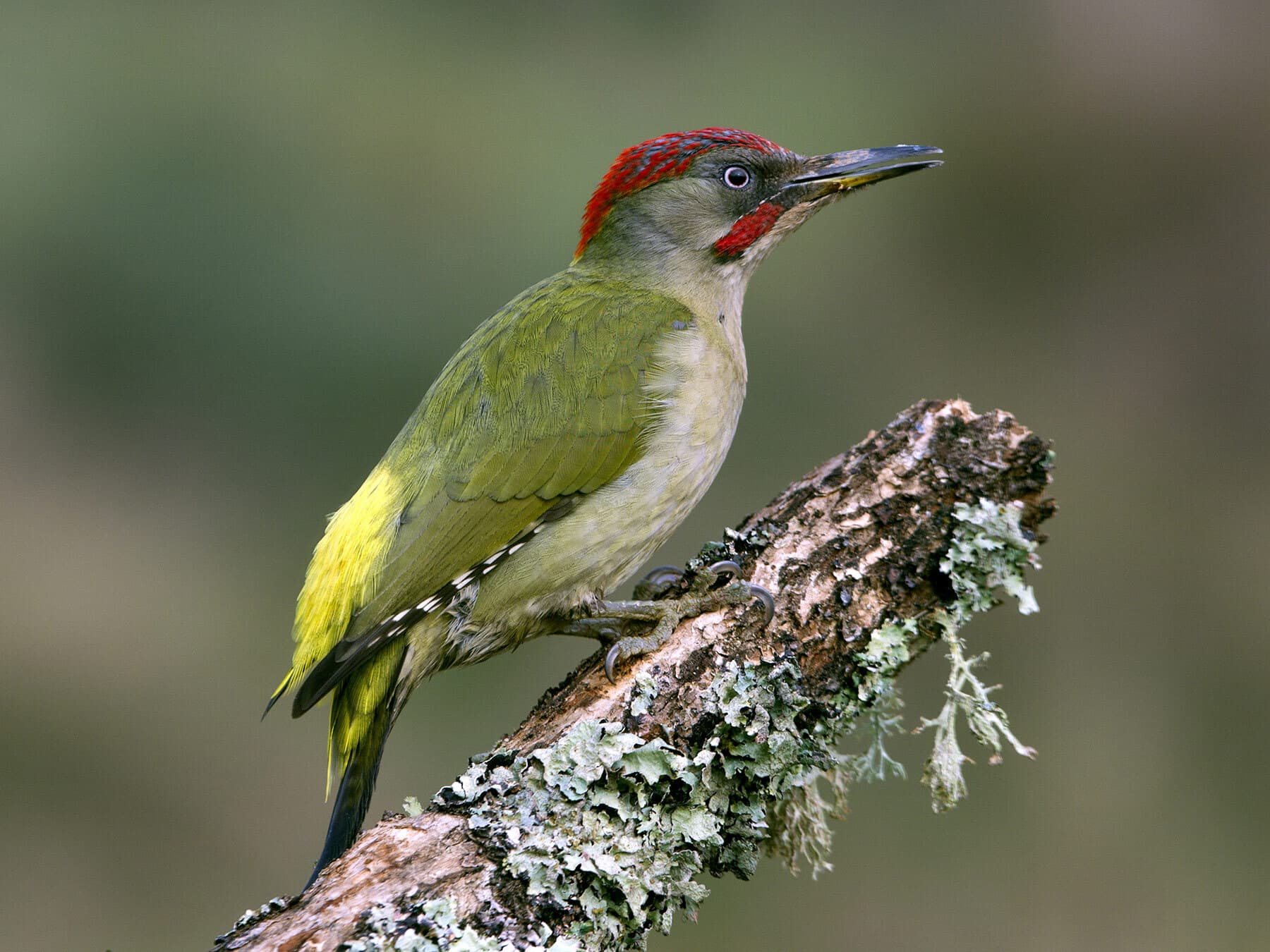
This is the largest woodpecker found within the United Kingdom and the second largest in Europe after the Black Woodpecker. Adult birds have predominantly green upperparts with white underparts, tinged with pale yellow. The rump is a yellow green and cheeks are a whitish hue similar to the bird’s underparts. Both sexes have a vivid red cap extending down towards the nape with a black patch surrounding the white eye. The malar area (moustache) is black with a red centre in the male and solid black in the female. The upperwing secondary flight feathers are green with the primary feathers and tail feathers being a dark grey with white barring. The tail itself is relatively short and is also used as an aid when the bird is upright clinging to a tree trunk. Underwing flight feathers are a pale grey with extensive white barring. The grey blue bill is long and chunky and the tongue up to 10 centimetres in length! The legs are a grey brown with two forward pointing toes and two angled backwards. Juvenile birds have white spotted, dull green upperparts, with a pale greyish white face and underparts streaked and spotted black. The forehead, crown and nape are red with grey streaks.
More photos
2 photos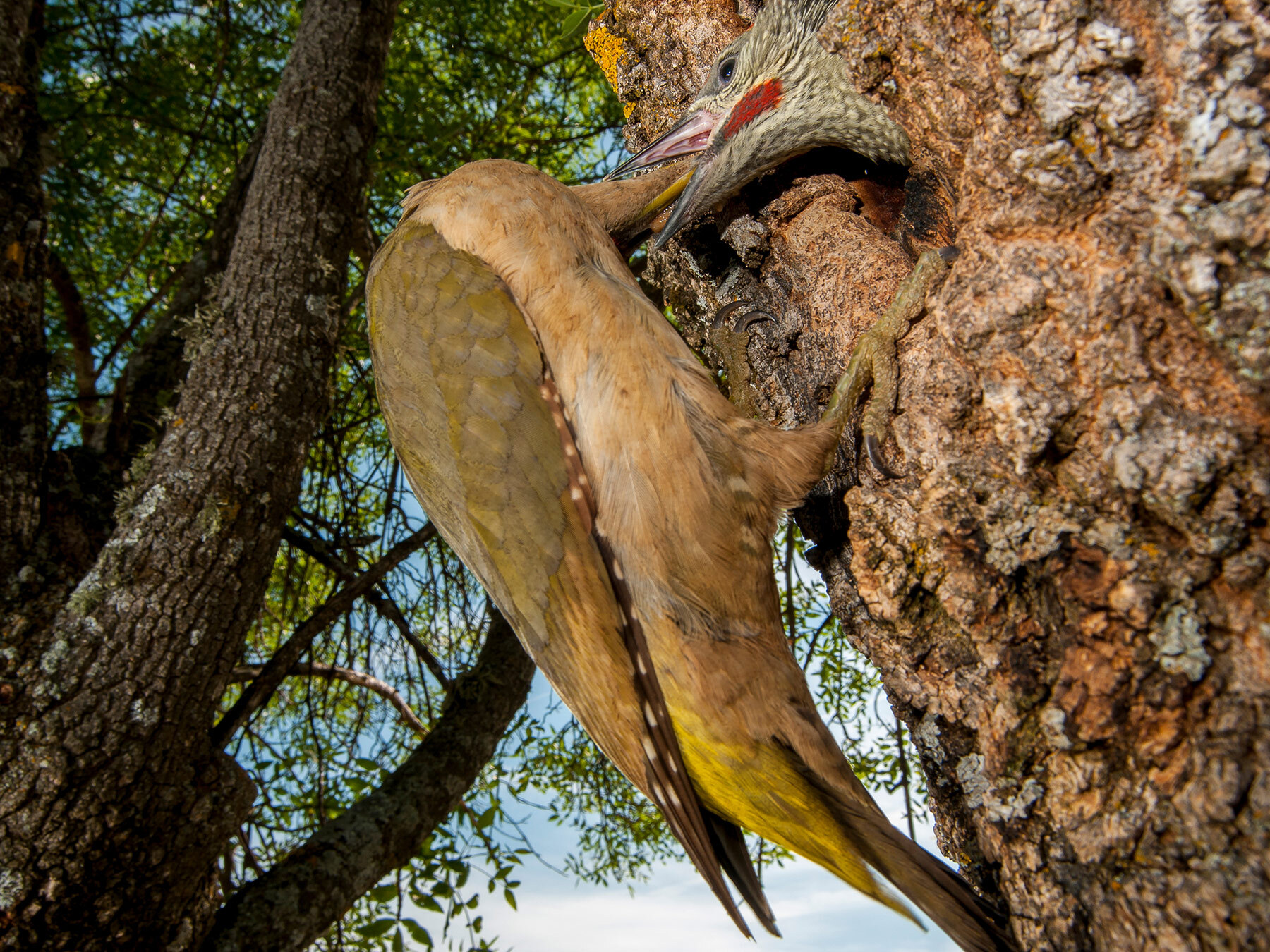
European Green Woodpecker guides
1 guidesQuick facts
- Length
- 30–36 cm
- Wingspan
- 40–42 cm
- Weight
- 180–220 g
- Lifespan
- 5–7 years · oldest recorded 15 years
- Family
- Woodpeckers
- Migration
- Resident
- Global status (IUCN)
- Least Concern
- World population
- 1,200,000 - 2,300,000 mature individuals
- Population trend
- Increasing
- Also called
- Green Woodpecker, Yaffle, Eurasian Green Woodpecker
- Scientific name
- Picus viridis
Sources
4- 1BirdLife International. 2016. Picus viridis. The IUCN Red List of Threatened Species 2016: e.T22725022A87292744. Source (opens in a new tab)
- 2EBCC (2015)
- 3BirdLife International. 2016. Picus viridis. The IUCN Red List of Threatened Species 2016: e.T22725022A87292744. Source (opens in a new tab)
- 4BTO longevity records: maximum age from a ringed bird, 15 years, 8 days (set in 1985), BirdFacts: Green Woodpecker (1985) Source (opens in a new tab)

Checked by
Nathan Cope, founder and editor
Nathan founded Birdfact and leads its writers and contributors in the UK, the US and Canada. He has watched and studied birds for more than ten years, and checks every article and species guide before it’s published.