


Red Crossbill
Common Crossbill · Loxia curvirostra
By the Birdfact teamChecked by Nathan Cope
On this page15 sections
How to recognise it
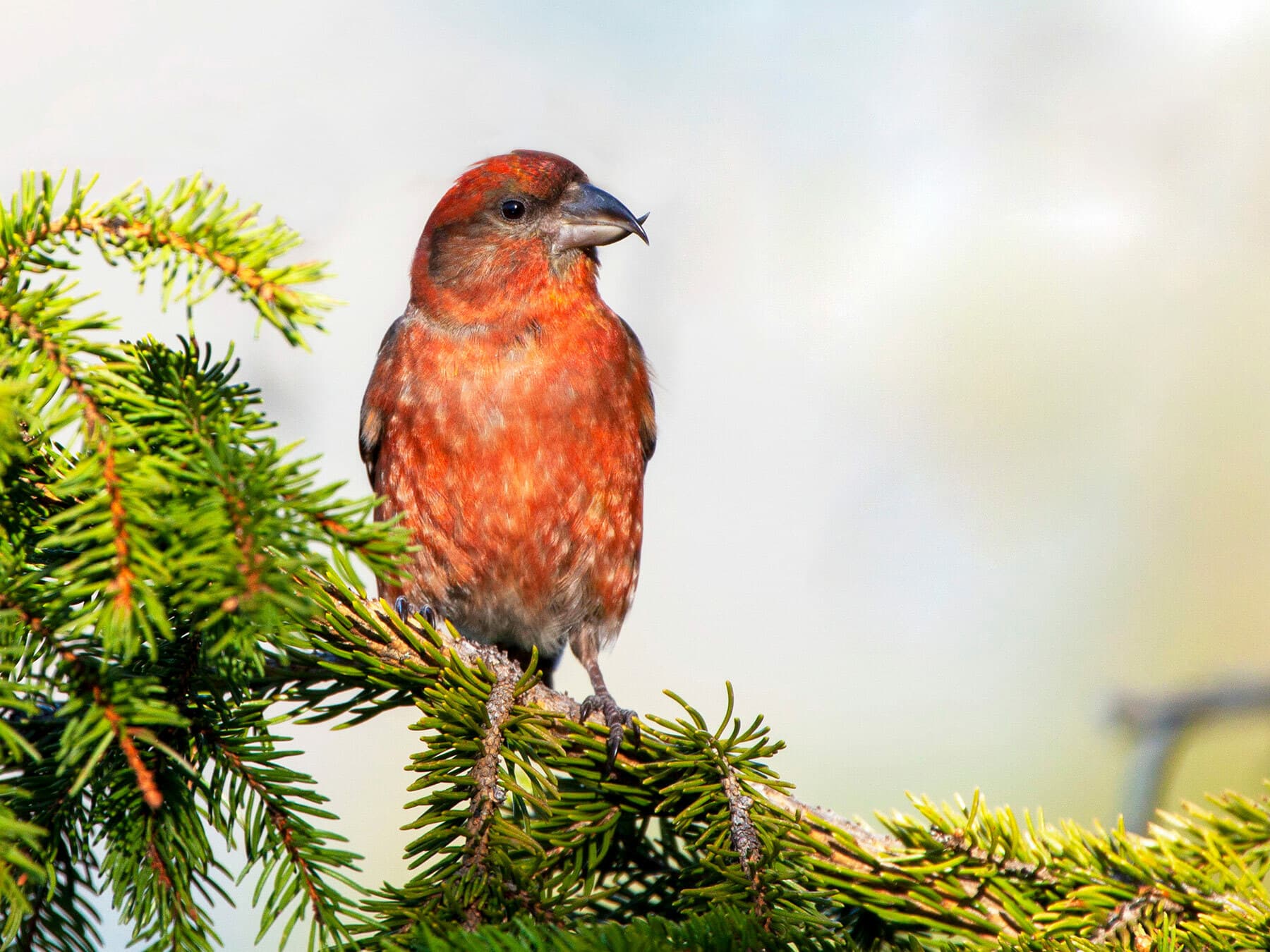
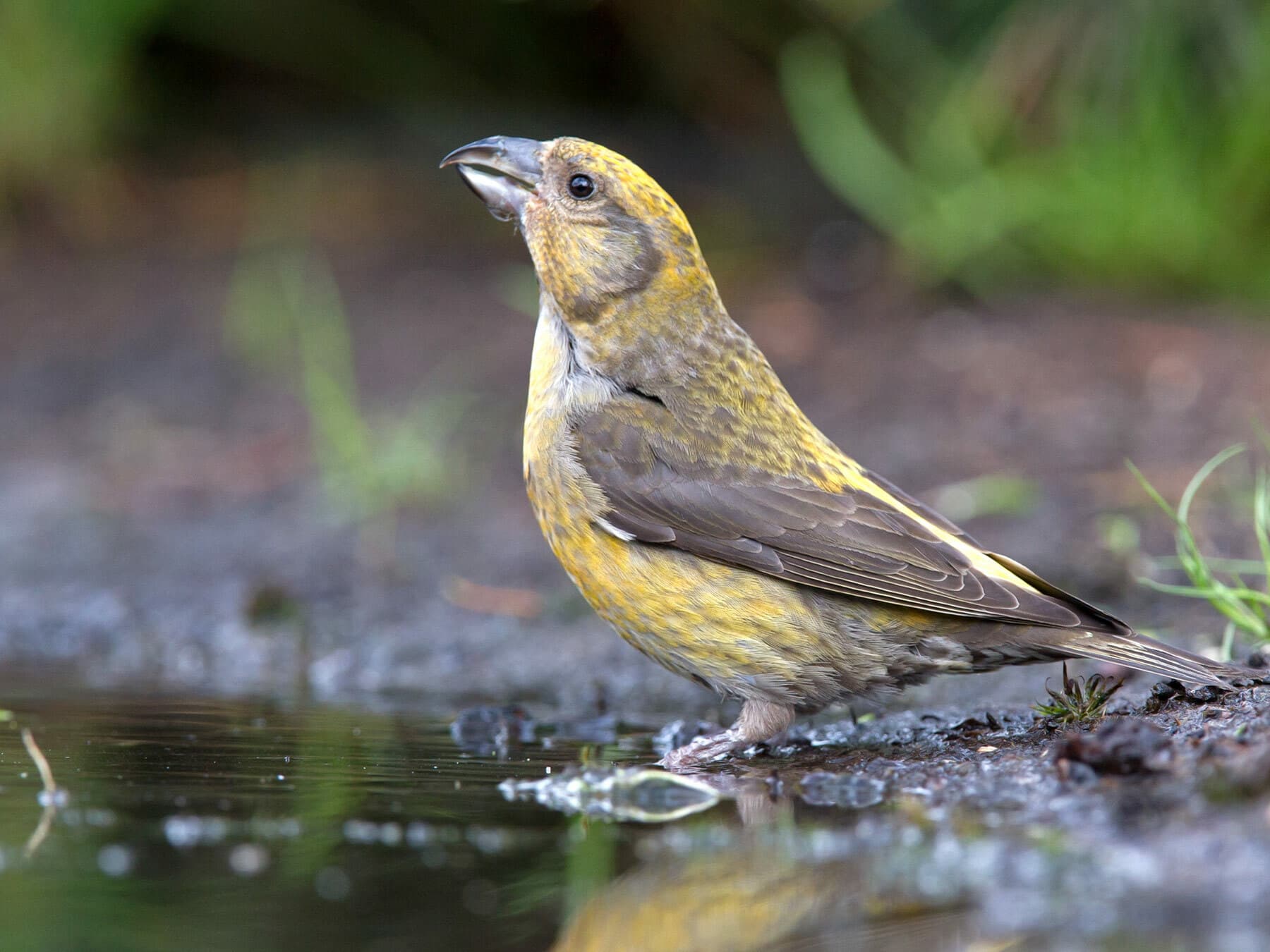
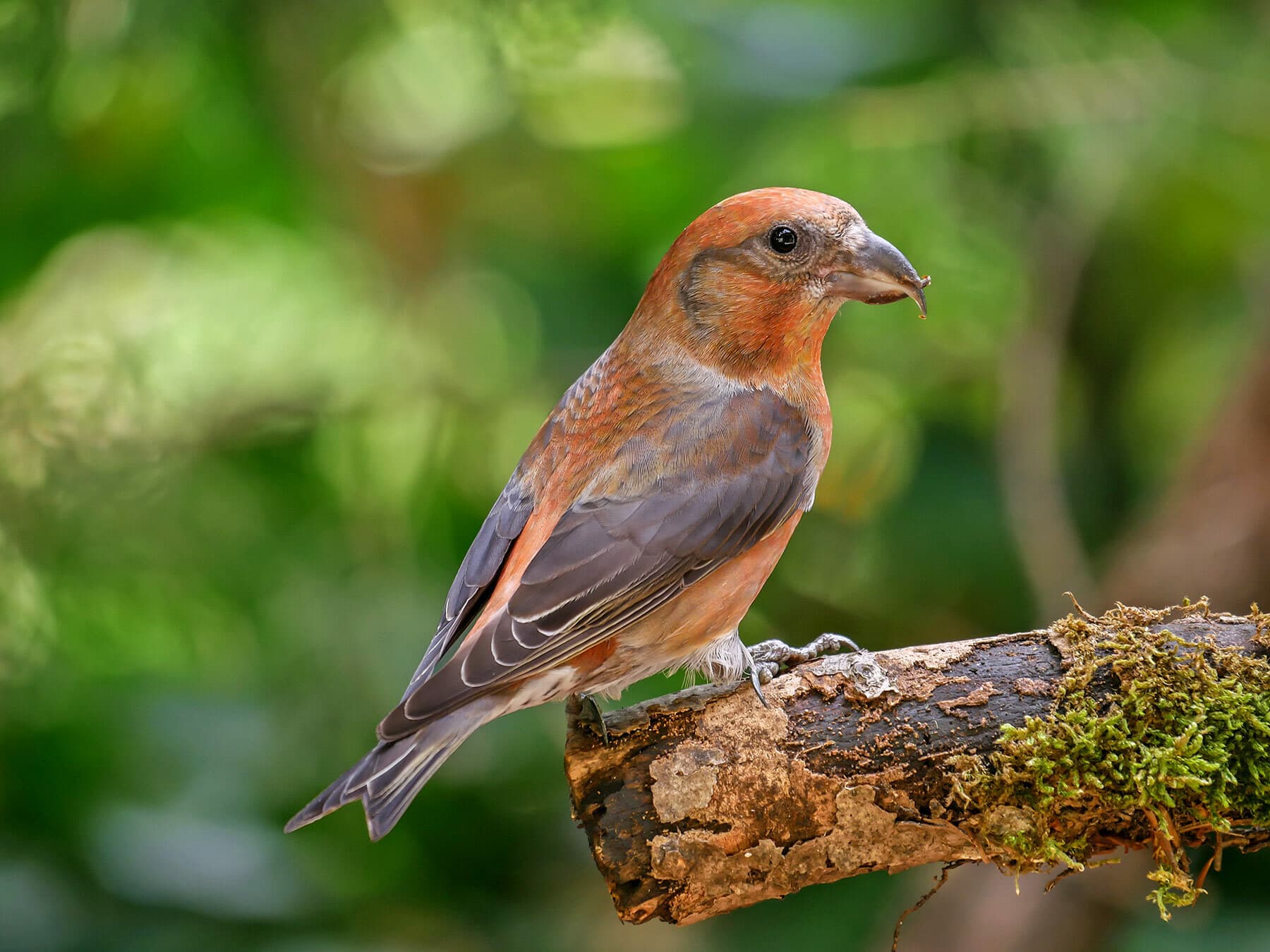
The Red Crossbill is a small finch with a distinctive crossed bill. Adult males are primarily brick-red with darker wings and tails, while females are olive-green with yellowish rumps.
Both sexes have strong, crossed mandibles adapted for extracting seeds from conifer cones.
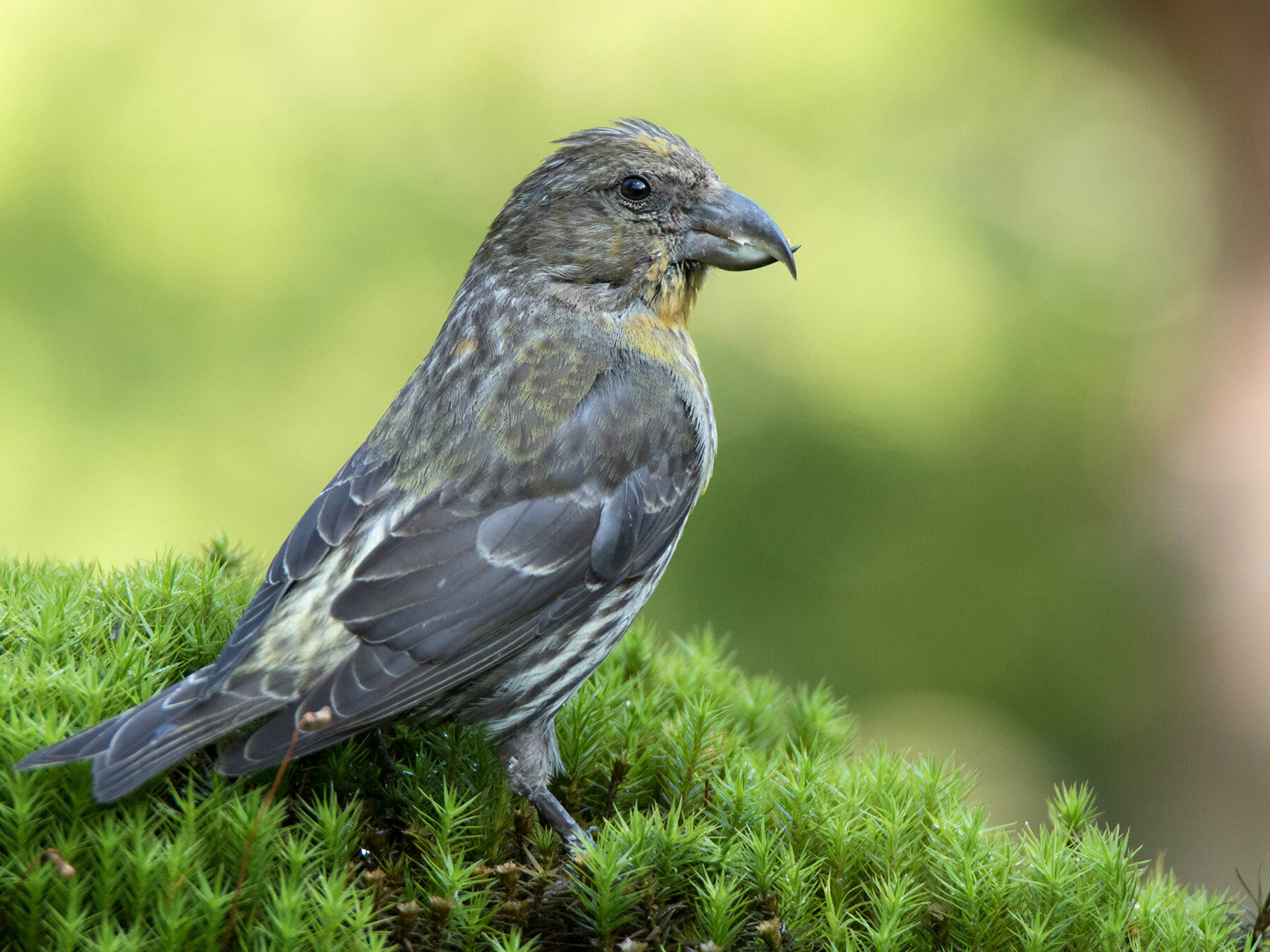
Juveniles resemble females but are more heavily streaked. The intensity of red in males can vary, and some populations show slight differences in bill size and shape based on their preferred conifer species.
Its size
Adults- Length
- 15–17 cm
- Wingspan
- 25–28 cm
- Weight
- 30–53 g
Its song and calls
The crossbill call is a loud staccato medium tone ‘jip – jip – jip’ interspersed with slightly higher pitched notes. Its song is a mixture of softer trills and warbles.
- Song0:00 / 0:12
Recorded in Uppsala län, Sweden · July 2021
- Call0:00 / 0:17
Recorded in Aberdeenshire, Scotland · April 2018
When and where to see it
OctoberArriving
Most recorded in October
- 1. Carlow0.68%
- 2. Midlothian0.57%
- 3. Rhondda, Cynon, Taff0.54%
- 4. Scottish Borders0.47%
- 5. Flintshire0.38%
Each dot is a county, state or province: the bigger and darker, the larger the bird’s share of that place’s bird records that month. Grey dots: no regular records. The ringed point is the centre of the bird’s records this month; the arrow shows how it moved since last month, and the dashed loop its path through the year. “Arrivals” colours places where it becomes regular this month (orange) or is in its last regular month (grey). GBIF eBird Observation Dataset, 2019–2024. Map data: Natural Earth, US Census Bureau; place centres © OpenStreetMap contributors.
In your area
See when the Red Crossbill is recorded in your county, state or province.
How often the Red Crossbill turns up in the UK, Ireland, the United States and Canada through the year, from birdwatchers' records.
United Kingdom
Resident · all year · most records in February
Ireland
Resident · all year · most records in June
United States
Resident · all year · most records in July
Canada
Resident · all year · most records in February
Show as a table
| Month | United Kingdom | Ireland | United States | Canada |
|---|---|---|---|---|
| January | 0.039% (regular) | 0.038% (regular) | 0.035% (regular) | 0.16% (regular) |
| February | 0.054% (regular) | 0.036% (regular) | 0.036% (regular) | 0.20% (regular) |
| March | 0.047% (regular) | 0.025% (regular) | 0.034% (regular) | 0.16% (regular) |
| April | 0.032% (regular) | 0.046% (regular) | 0.025% (regular) | 0.078% (regular) |
| May | 0.031% (regular) | 0.049% (regular) | 0.029% (regular) | 0.052% (regular) |
| June | 0.043% (regular) | 0.053% (regular) | 0.069% (regular) | 0.086% (regular) |
| July | 0.046% (regular) | 0.031% (regular) | 0.10% (regular) | 0.16% (regular) |
| August | 0.031% (regular) | 0.039% (regular) | 0.099% (regular) | 0.18% (regular) |
| September | 0.027% (regular) | 0.023% (regular) | 0.055% (regular) | 0.11% (regular) |
| October | 0.049% (regular) | 0.033% (regular) | 0.041% (regular) | 0.093% (regular) |
| November | 0.045% (regular) | 0.019% (regular) | 0.050% (regular) | 0.12% (regular) |
| December | 0.033% (regular) | 0.031% (regular) | 0.043% (regular) | 0.16% (regular) |
Recorded regularly in
Worldwide: recorded regularly in 65 countries
Countries where it was recorded in at least 3 of the 6 years 2019–2024. Linked countries have their own bird list.
Europe (40)
- Åland Islands
- Andorra
- Austria
- Belarus
- Belgium
- Bosnia & Herzegovina
- Bulgaria
- Croatia
- Czechia
- Denmark
- Estonia
- Finland
- France
- Germany
- Greece
- Hungary
- Iceland
- Ireland
- Isle of Man
- Italy
- Latvia
- Liechtenstein
- Lithuania
- Luxembourg
- Moldova
- Montenegro
- Netherlands
- Norway
- Poland
- Portugal
- Romania
- Russia
- Serbia
- Slovakia
- Slovenia
- Spain
- Sweden
- Switzerland
- Ukraine
- United Kingdom
Asia (14)
North America (8)
Data: EOD – eBird Observation Dataset (Cornell Lab of Ornithology), accessed via GBIF.org, CC BY 4.0. Records from 2019–2024, aggregated and filtered by Birdfact. How these lists are made
Crossbills are resident breeders mainly confined to conifer woodland areas in the northern and southern regions of the UK. The production of conifer seeds in specific regions can be unpredictable and may differ from year to year which affects the localised crossbill population forcing them to move to more abundant feeding grounds and as such they adopt a more nomadic lifestyle than other members of the finch family.
Signs and Spotting tips
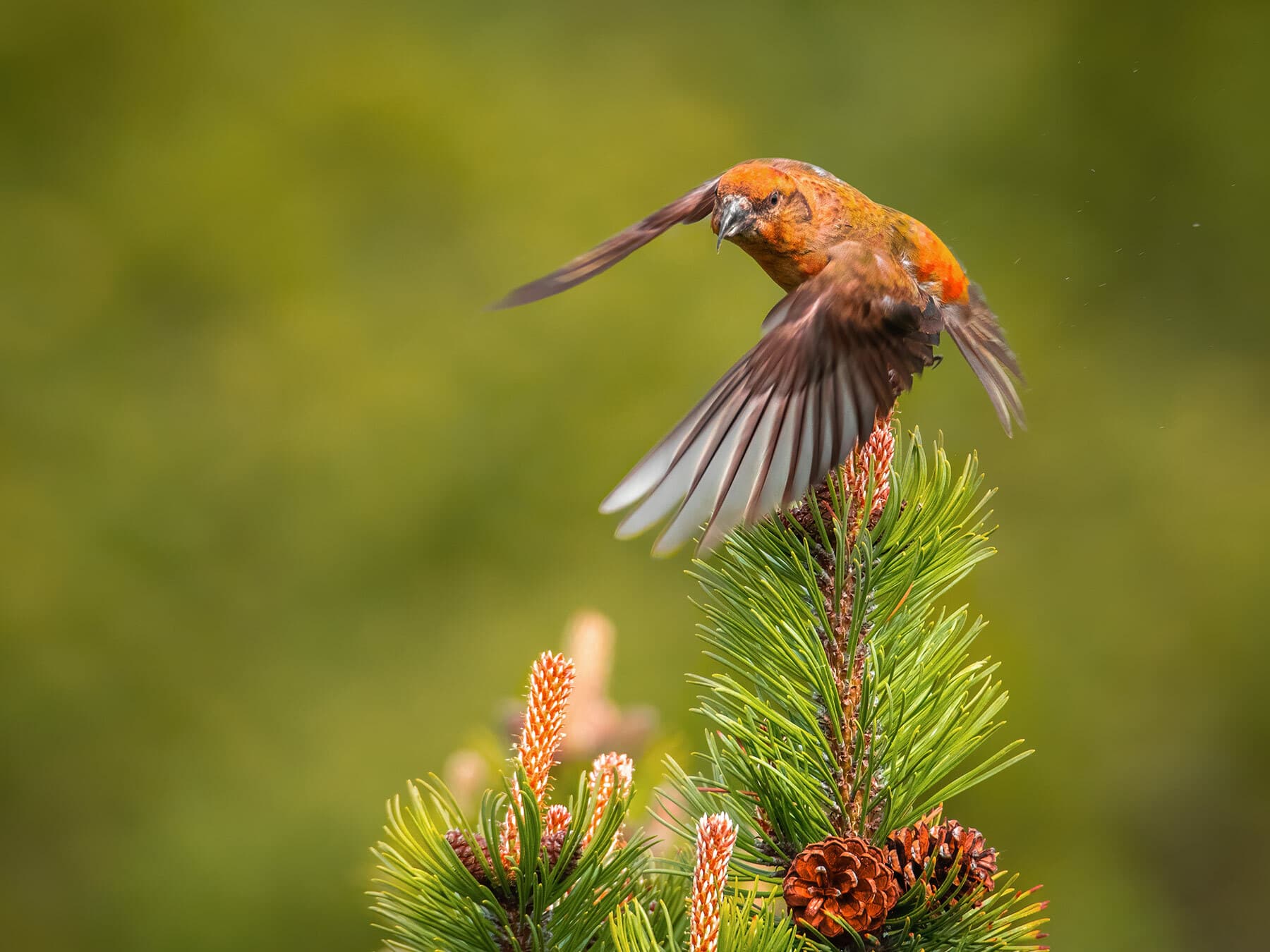
Crossbills are the only bird species with easily identifiable crossed tips at the end of their bill which is an obvious marker when seeking them out. They are however difficult to see as they spend much of their life high in conifer trees or flying over the treetops. A social bird they often gather and feed in small flocks. When feeding they flit from pine cone to pine cone prising the cone scales apart with their mandibles thus enabling them to remove the seeds using their tongues. As cone seeds are dry the crossbill drinks frequently and can often be seen quenching its thirst in nearby ponds and lakes.
What it eats
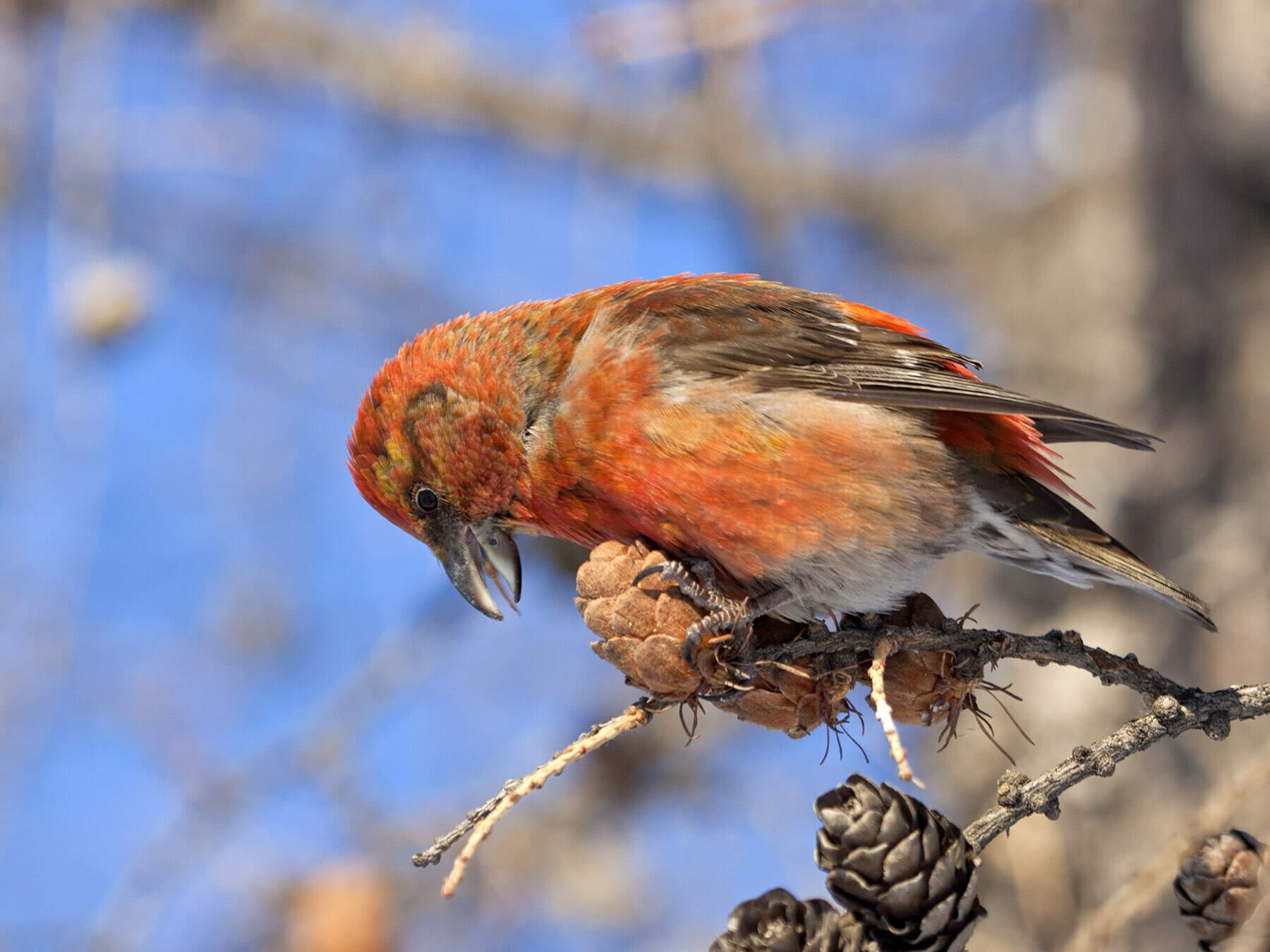
Occasionally feeding on insects and berries, its main diet comprises of dry conifer seeds which it prises from pine cones using its specially adapted beak.
Nesting and breeding
The female constructs a small cup shaped nest from twigs, grasses and lichen which it lines with moss, fine forest debris and animal hair/wool. Generally, the nest is located high up in conifer trees where a single clutch of 3 to 4 pale blue and browny purple marked eggs is laid between January to March. The incubation period is around two weeks with fledging taking place up to twenty five days thereafter. Whilst the breeding season is commonly referred to as the period between January to March this is very dependant upon the availability of food and it has been known for crossbills in some locales to breed from the autumn through the winter.
Behaviour
Red Crossbills are highly nomadic, moving in flocks in search of abundant conifer seed crops. They exhibit remarkable dexterity when feeding, using their crossed bills to pry open cone scales and extract seeds.
These birds often hang upside down on cones while feeding, demonstrating their acrobatic abilities.
Lifespan and predators
Life expectancy for the crossbill averages between two to five years.
Conservation
While the Red Crossbill is currently listed as Least Concern, it faces challenges from habitat loss due to deforestation and climate change. These factors can affect the availability of conifer seeds, their primary food source.
Conservation efforts focus on preserving mature coniferous forests and monitoring population trends.
What does a Crossbill look like?
The adult male is predominantly brick red in colour with a dark brown forked tail and wings. The bird’s rump and crown have a lighter pinkish hue and in physical appearance the head of the crossbill is large with a proportionately stocky body. The eyes are small and dark and the legs are coloured brown. The bill itself is black, of medium length, curved and crossed at its tip so that the upper mandible points downwards and the lower mandible upwards. The adult female differs from the male in plumage colour having a grey green body and brown wings with a pale yellowish rump; otherwise their visible physical attributes are identical. Juvenile crossbills are mainly plain brown with lighter underparts streaked with dark brown. Dependant on their age the bill may differ from the adult bird in that they do not become crossed at the tip until approaching maturity.
Similar birds
Often mistaken for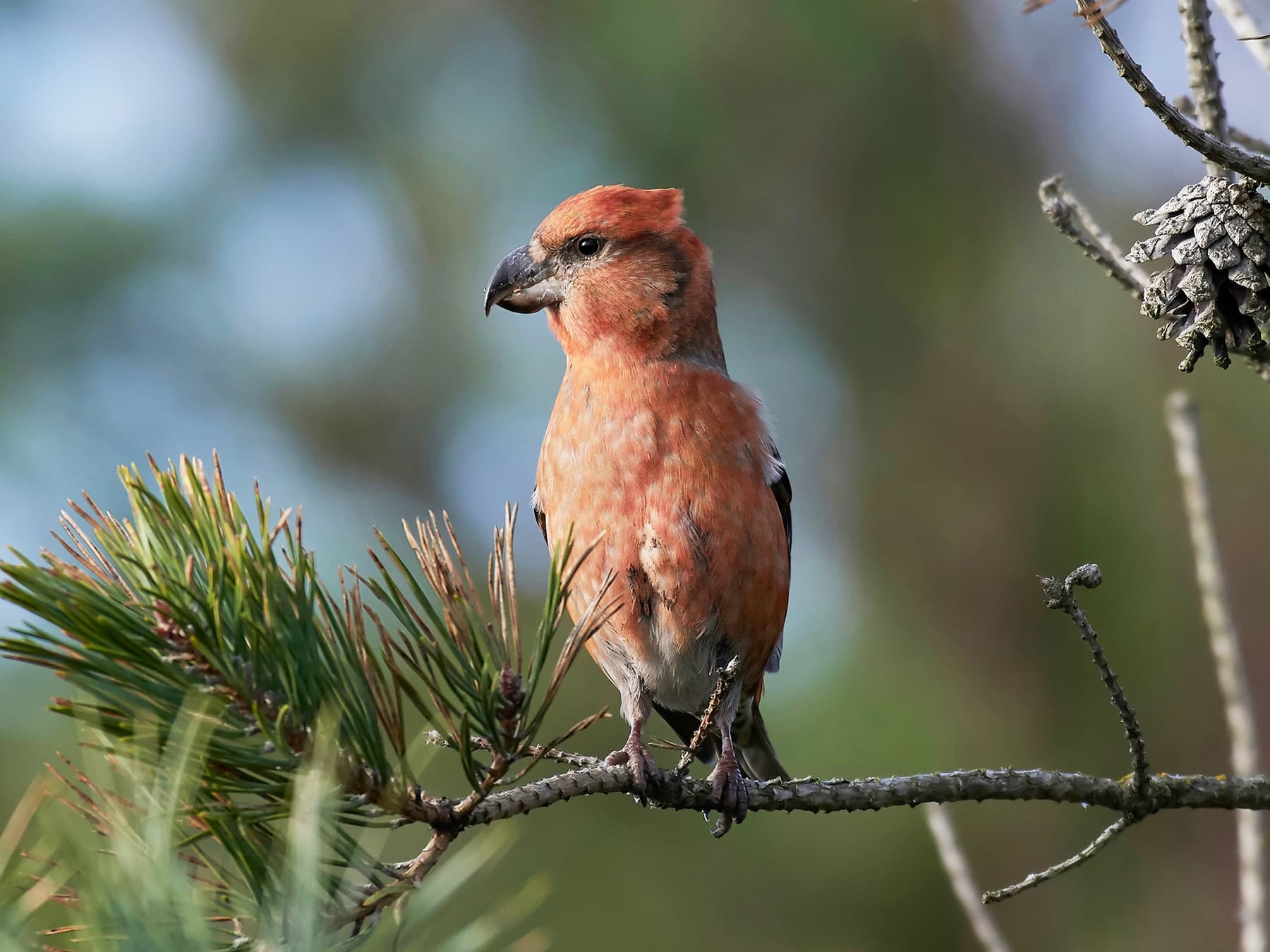
More photos
2 photos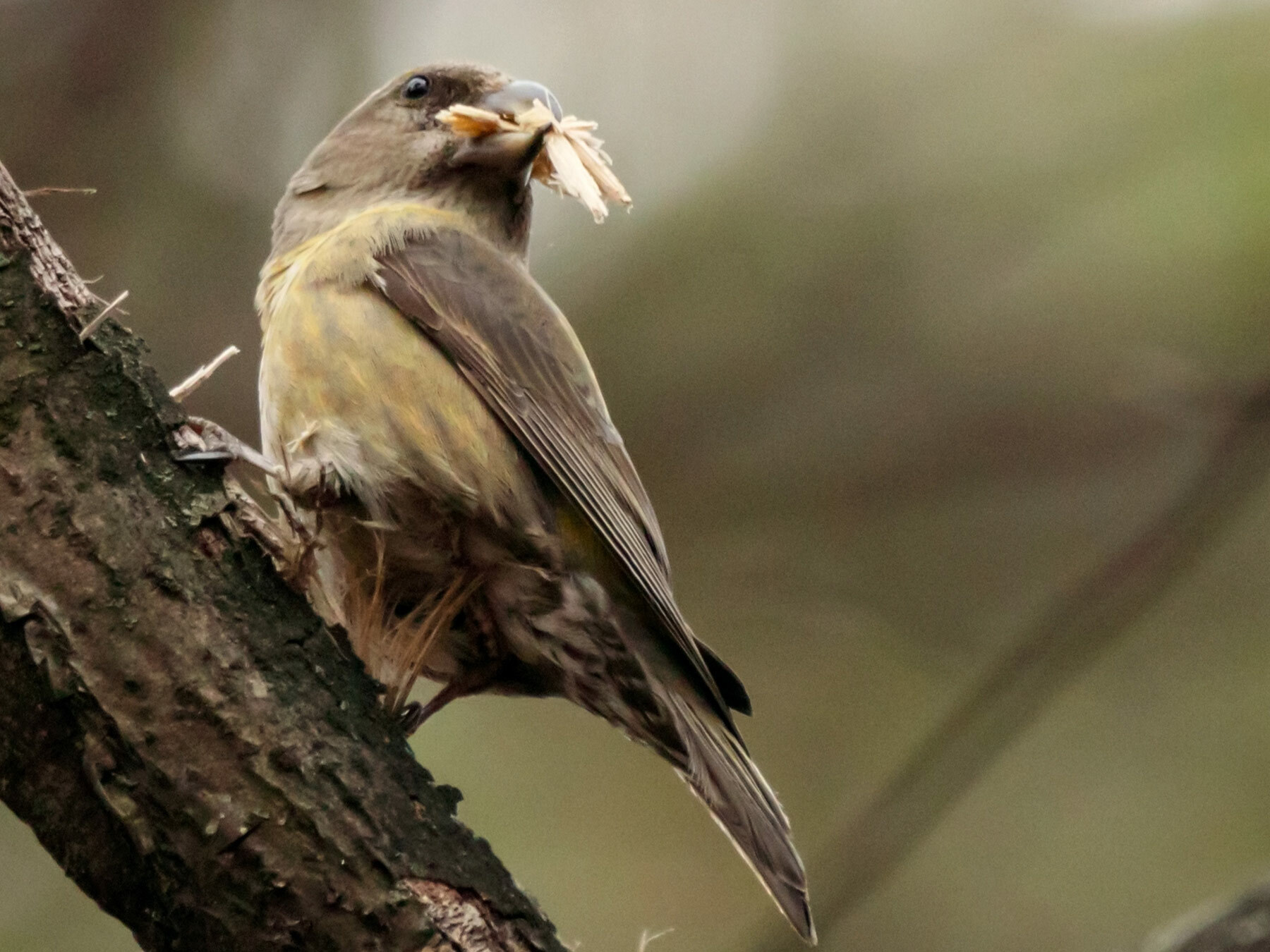
Red Crossbill guides
1 guidesQuick facts
- Length
- 15–17 cm
- Wingspan
- 25–28 cm
- Weight
- 30–53 g
- Lifespan
- 2–8 years · oldest recorded 16 years
- Family
- Finches
- Migration
- Irruptive migrant
- Global status (IUCN)
- Least Concern
- World population
- 91,000,000 - 173,000,000 mature individuals
- Population trend
- Overall population stable with local fluctuations
- Also called
- Common Crossbill
- Scientific name
- Loxia curvirostra
Sources
4- 1BirdLife International. 2017. Loxia curvirostra (amended version of 2016 assessment). The IUCN Red List of Threatened Species 2017: e.T22720646A111131604. Source (opens in a new tab)
- 2BirdLife International. 2017. Loxia curvirostra (amended version of 2016 assessment). The IUCN Red List of Threatened Species 2017: e.T22720646A111131604. Source (opens in a new tab)
- 3Breeding Bird Survey and/or Christmas Bird Count: Butcher and Niven (2007)
- 4BBL - Longevity Records of North American Birds Source (opens in a new tab)

Checked by
Nathan Cope, founder and editor
Nathan founded Birdfact and leads its writers and contributors in the UK, the US and Canada. He has watched and studied birds for more than ten years, and checks every article and species guide before it’s published.