


Boreal Owl
Tengmalm's Owl · Aegolius funereus
By the Birdfact teamChecked by Nathan Cope
On this page14 sections
How to recognise it
What do Boreal Owls look like?
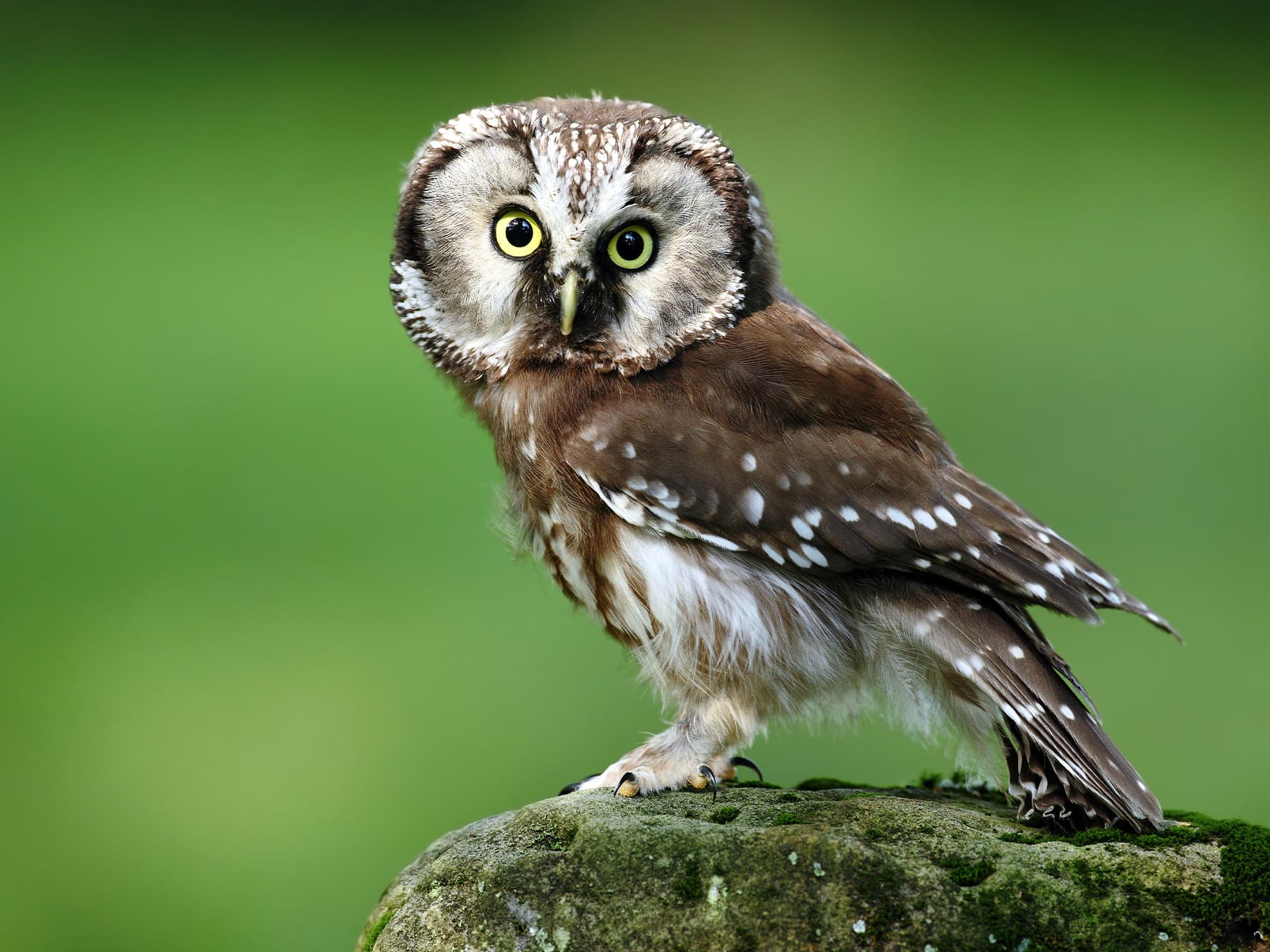
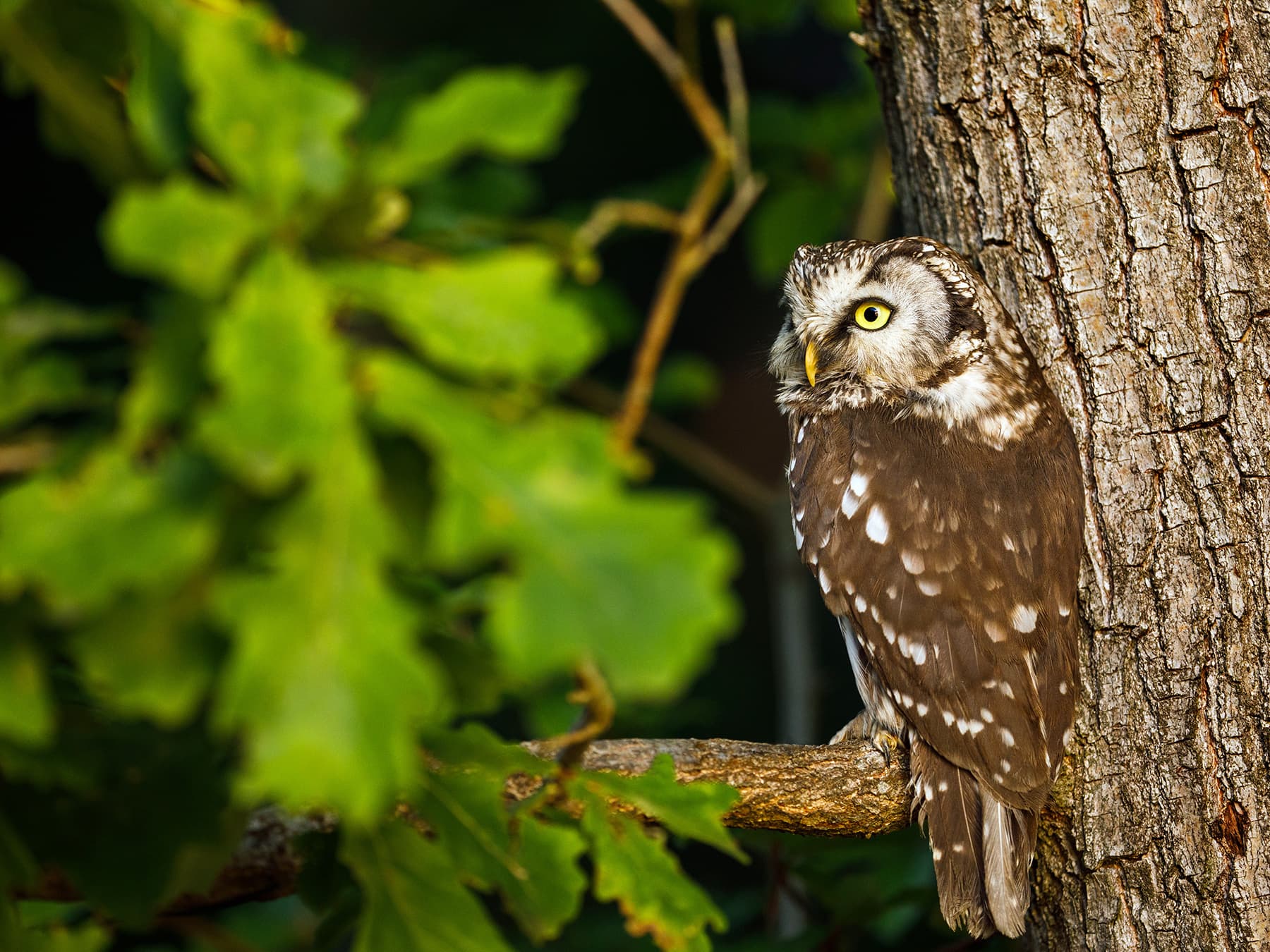
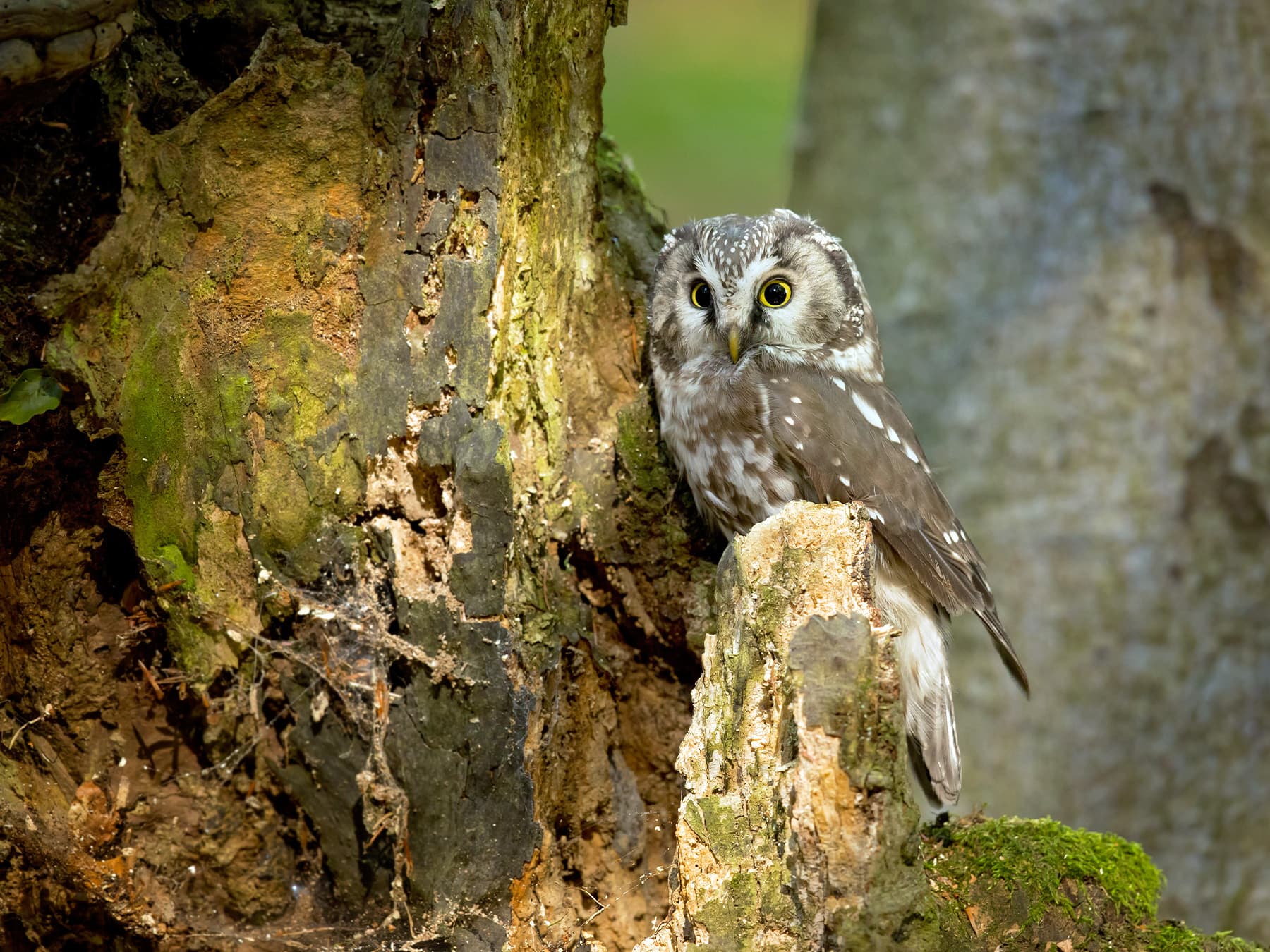
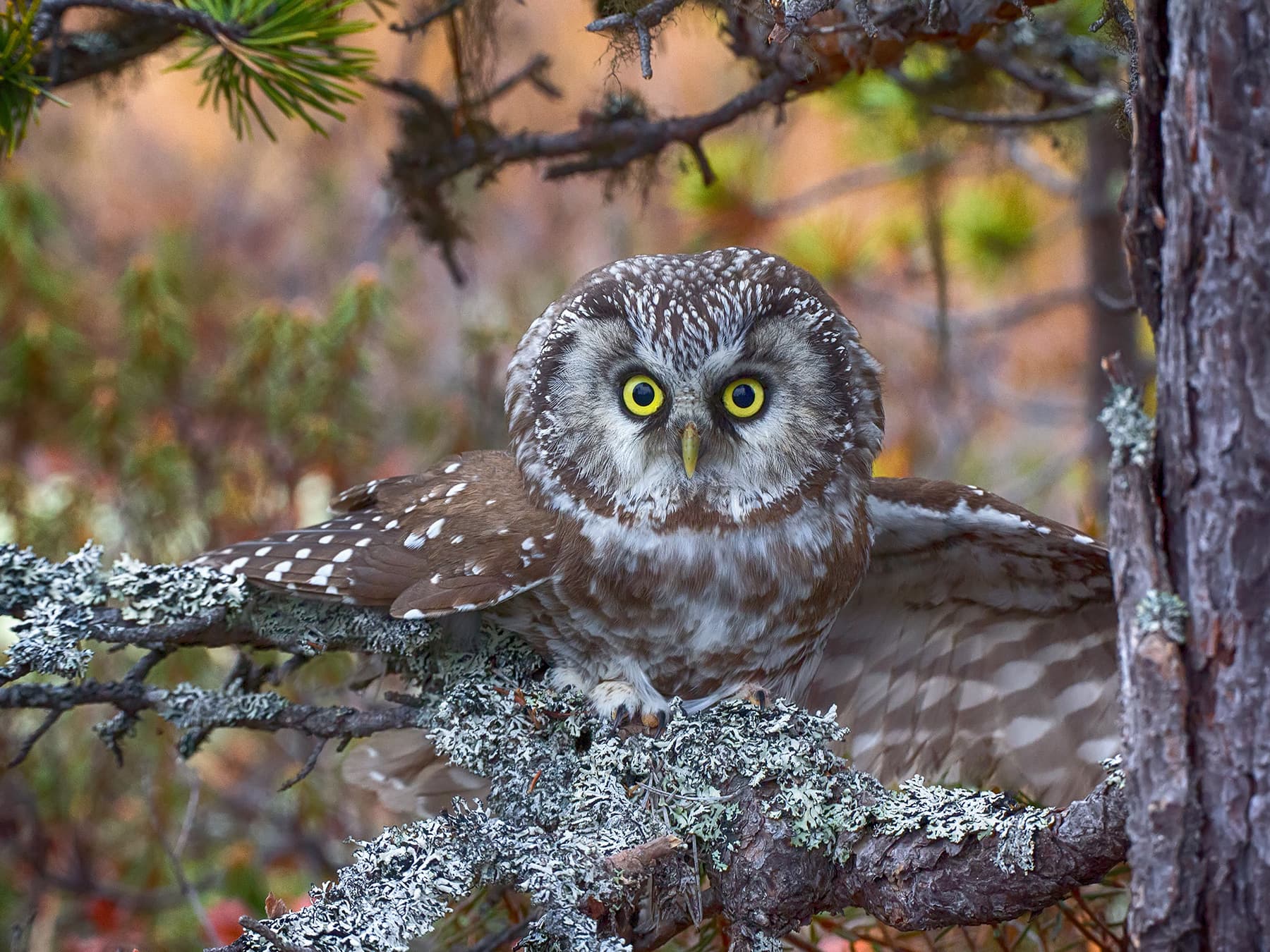
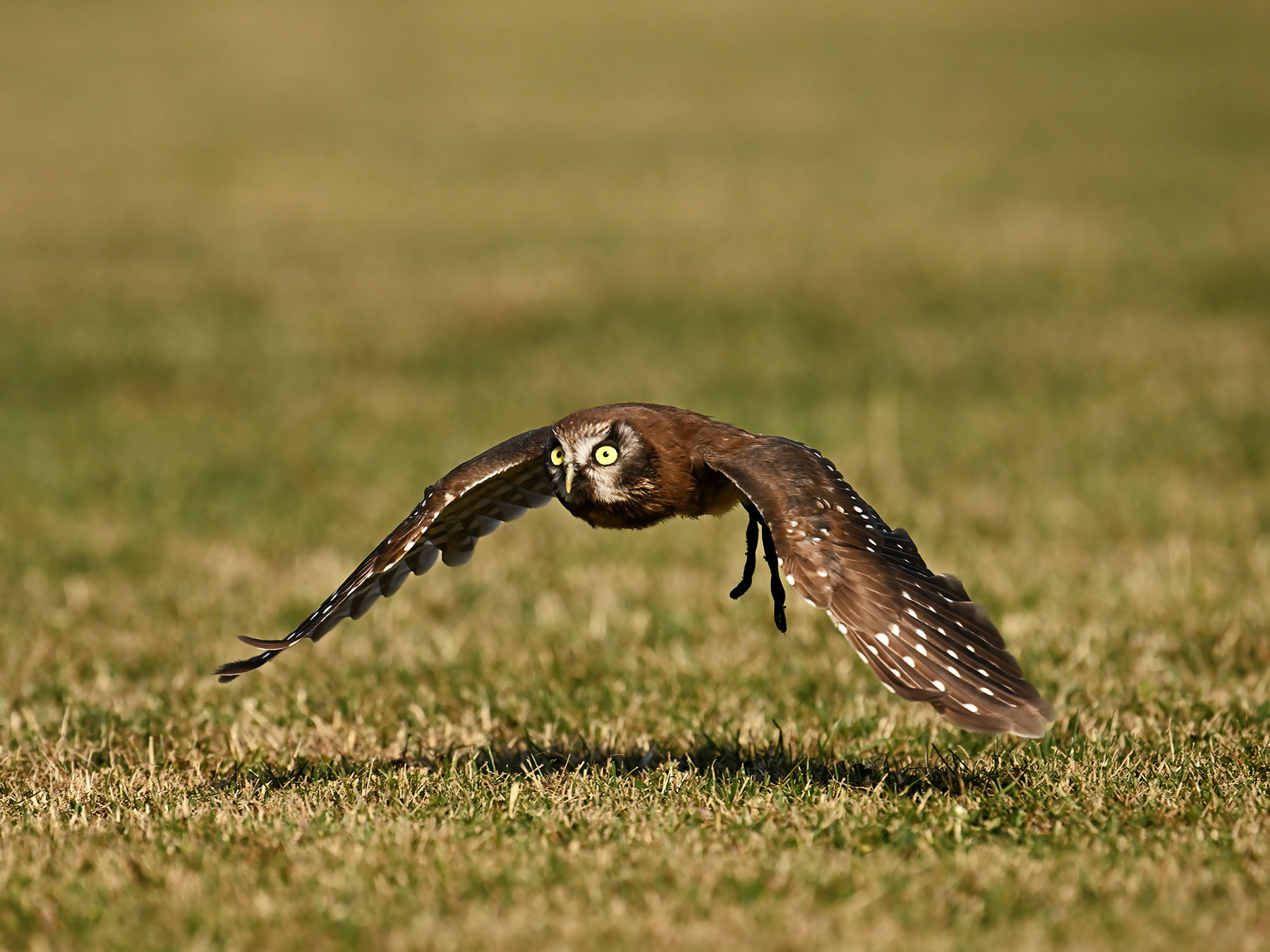
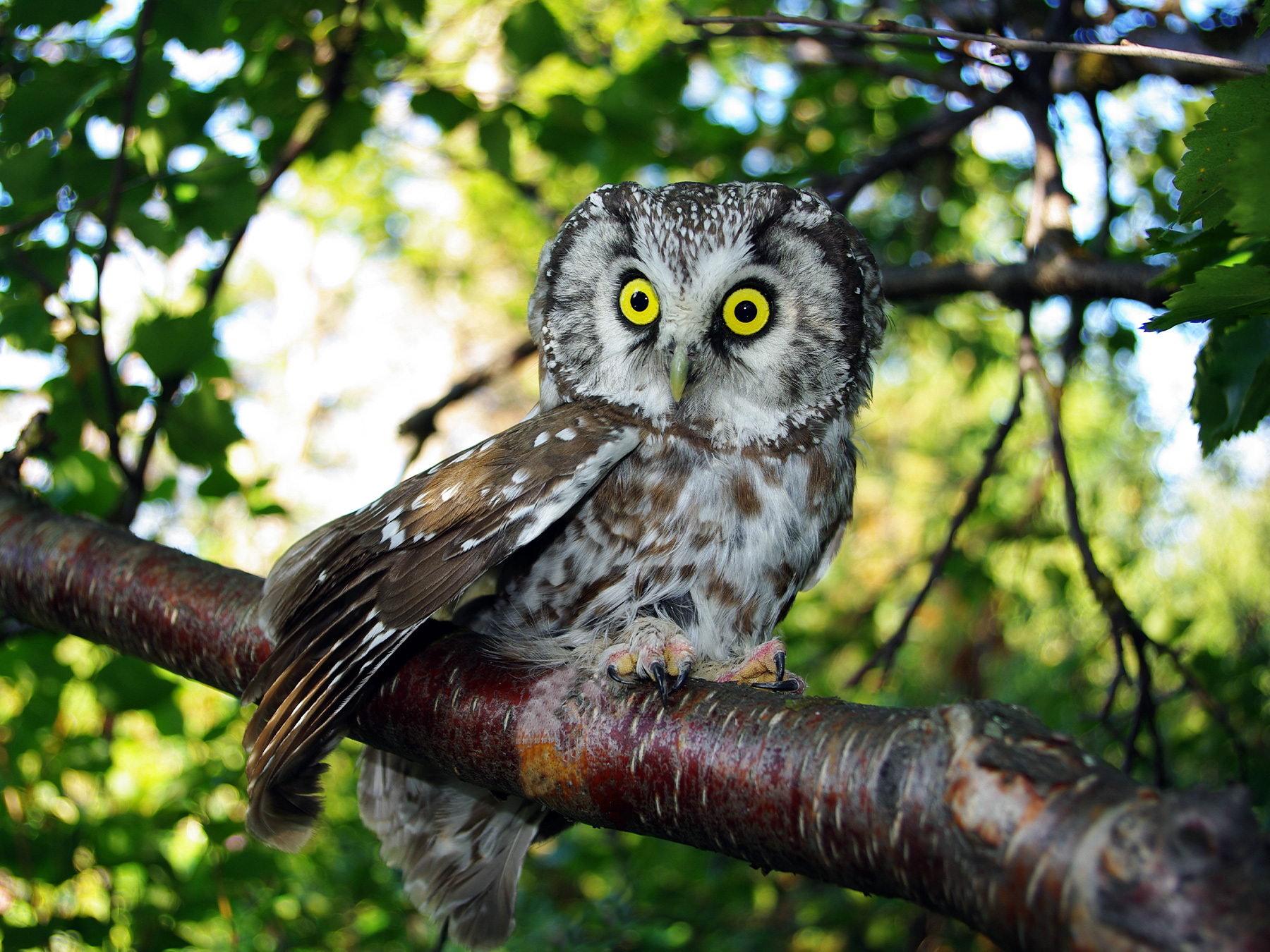
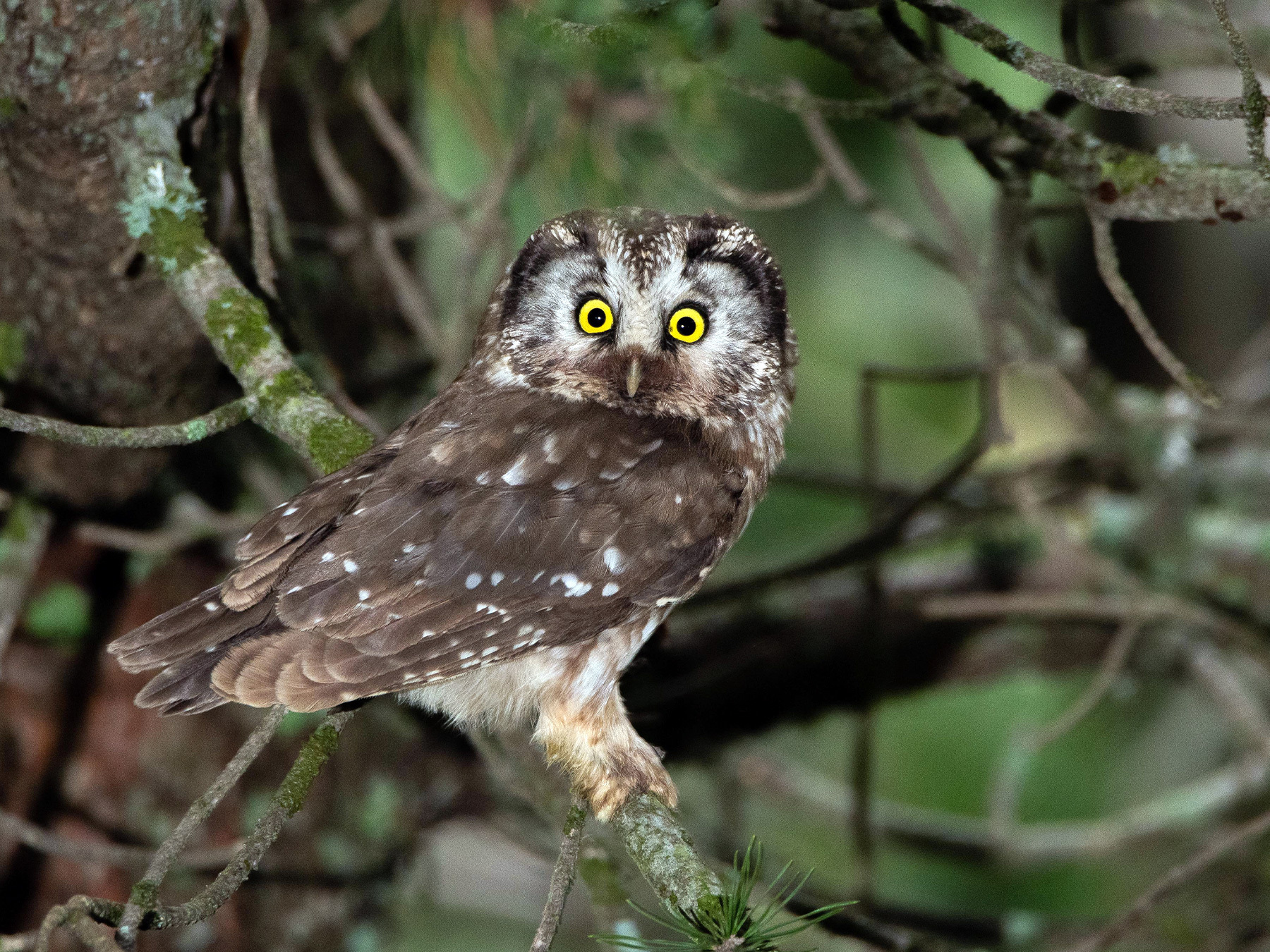
Relatively small and solid owls, with a large head and no ear tufts, boreal owls have mainly dark brown plumage, heavily marked with white blotches and spotting on their back and wings.
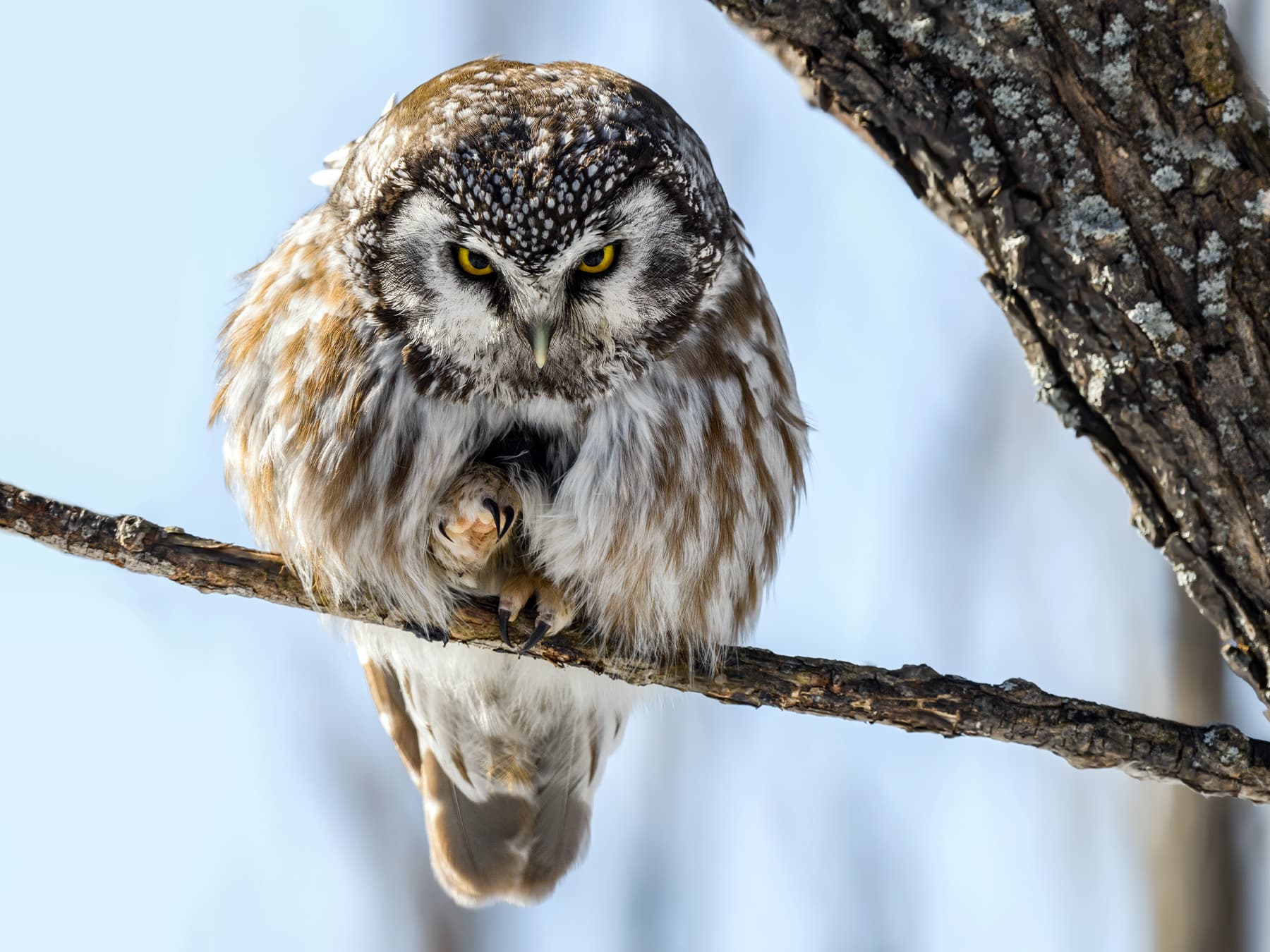
Their breast and belly are pale cream, streaked with orange-brown. Facial markings are quite distinct, with a chocolate brown crown that is heavily spotted with fine speckling, and gray-white facial feathers, bordered with a black facial disk. Prominent white eyebrows form a v-shape between the bright yellow eyes.
Female boreal owls look similar to males, with size being the main method of distinguishing between the sexes: as with most owl species, females are usually larger than their mates.
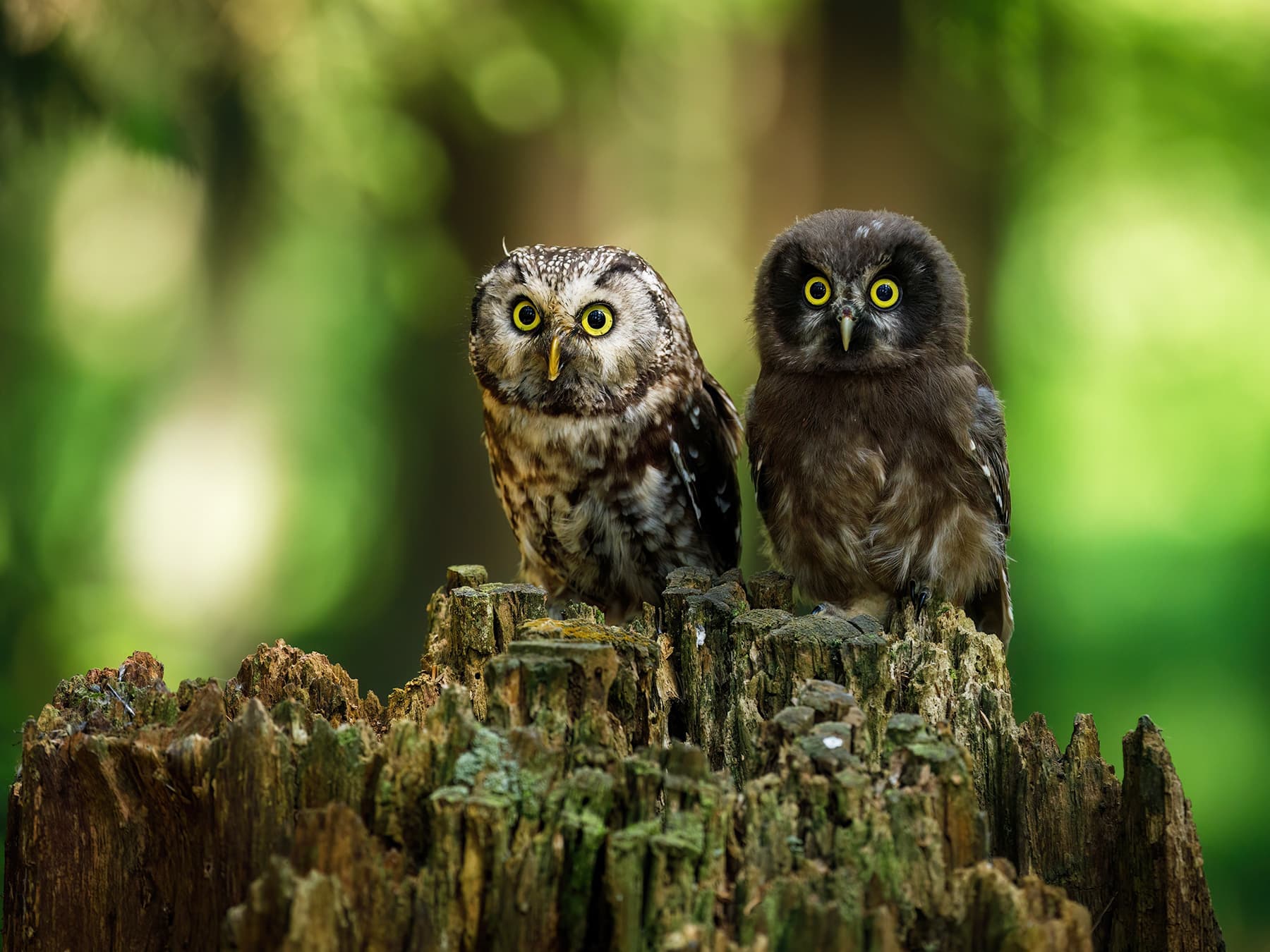
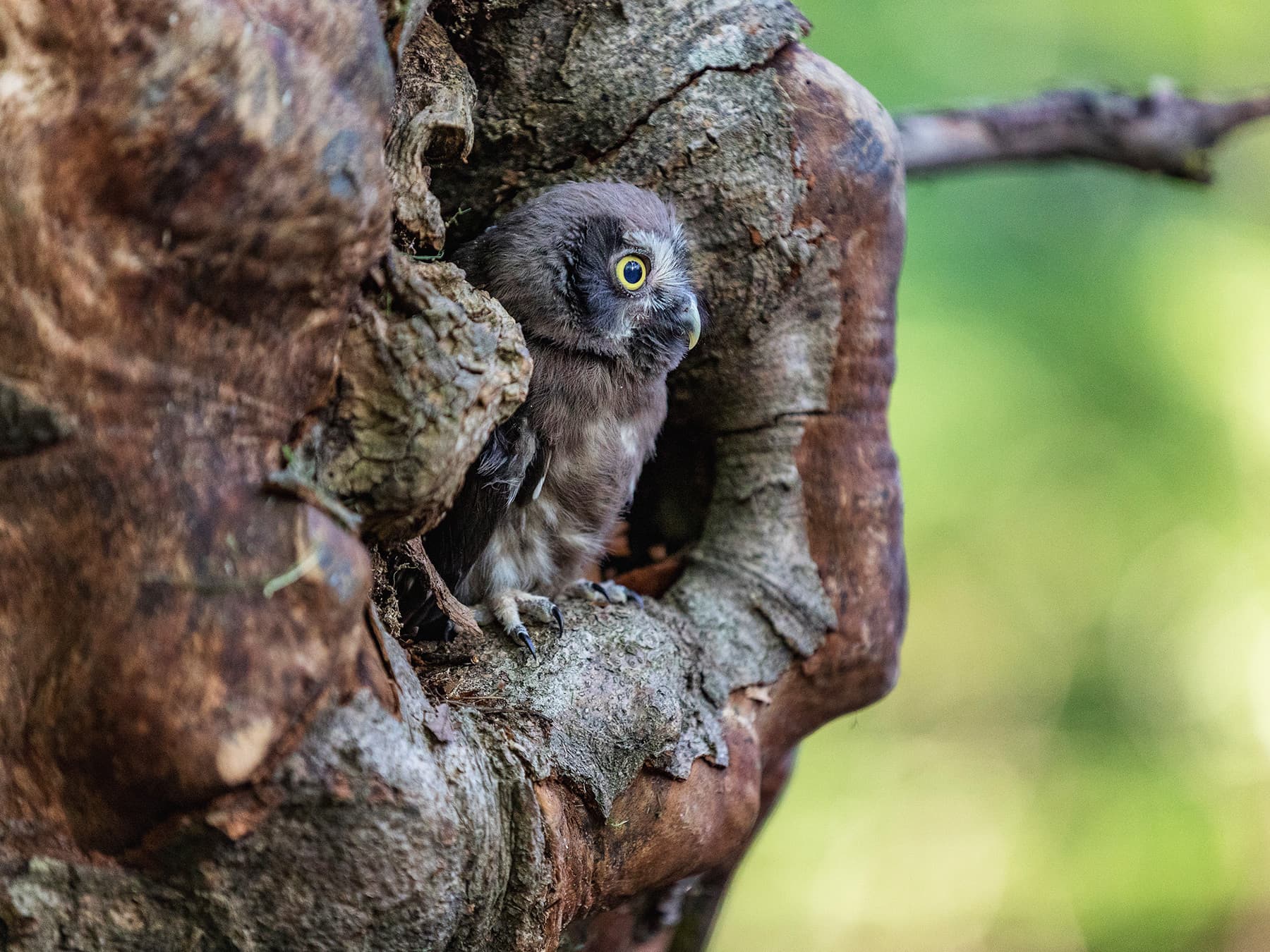
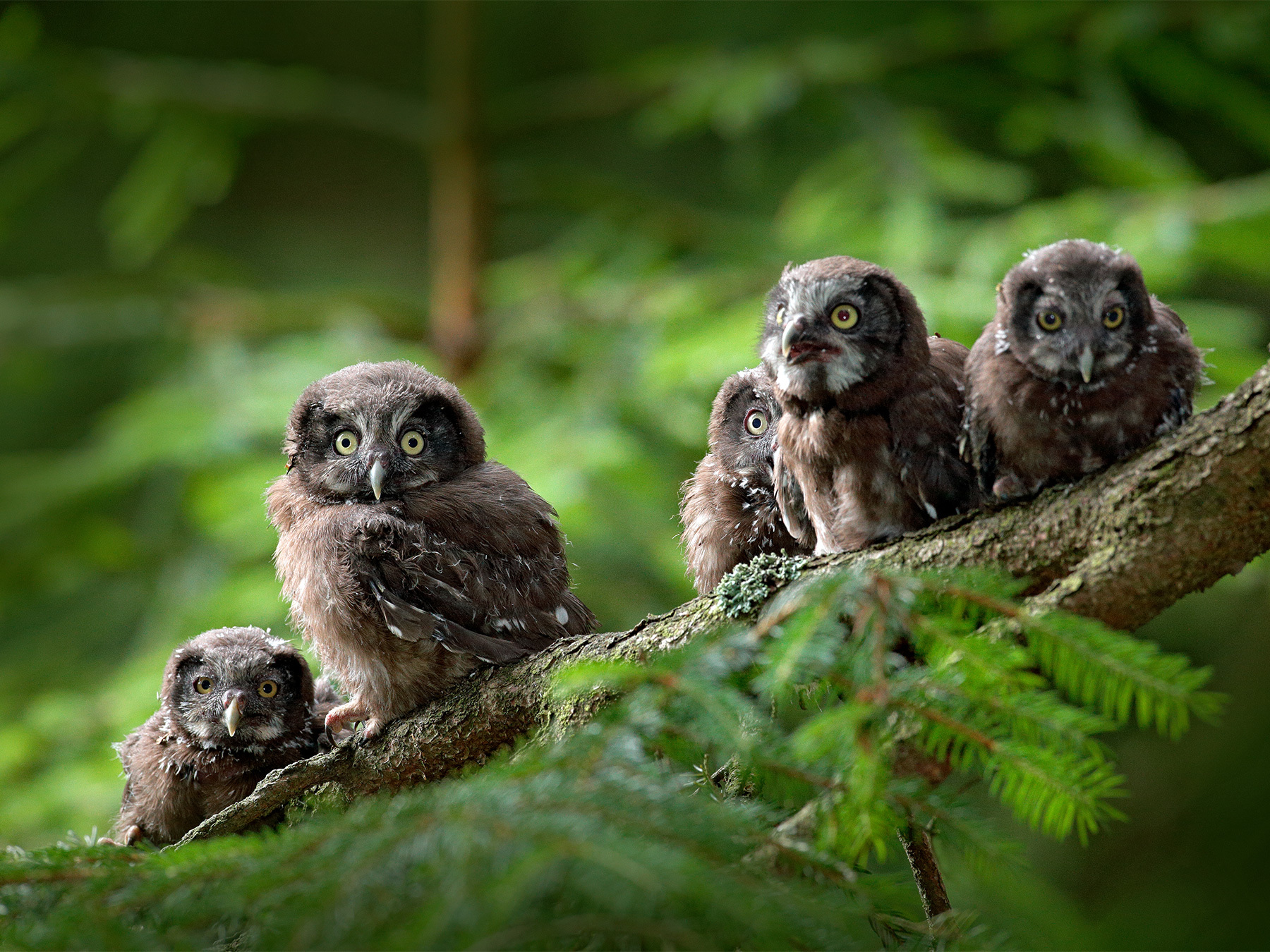
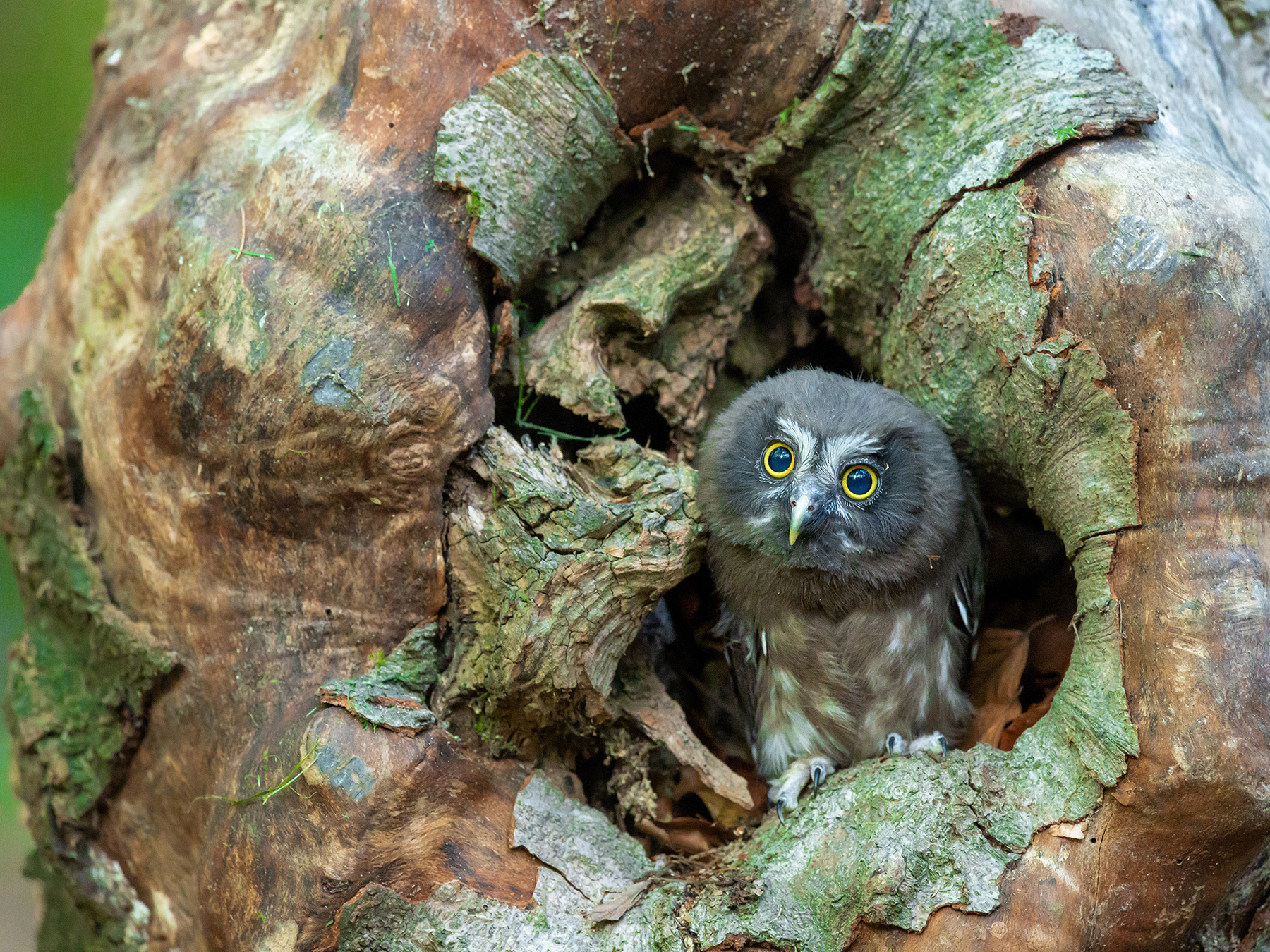
Juvenile boreal owls can be identified as their faces are mainly dark brown instead of white-gray, and their breast and belly are solid brown rather than streaked.
How big are Boreal Owls?
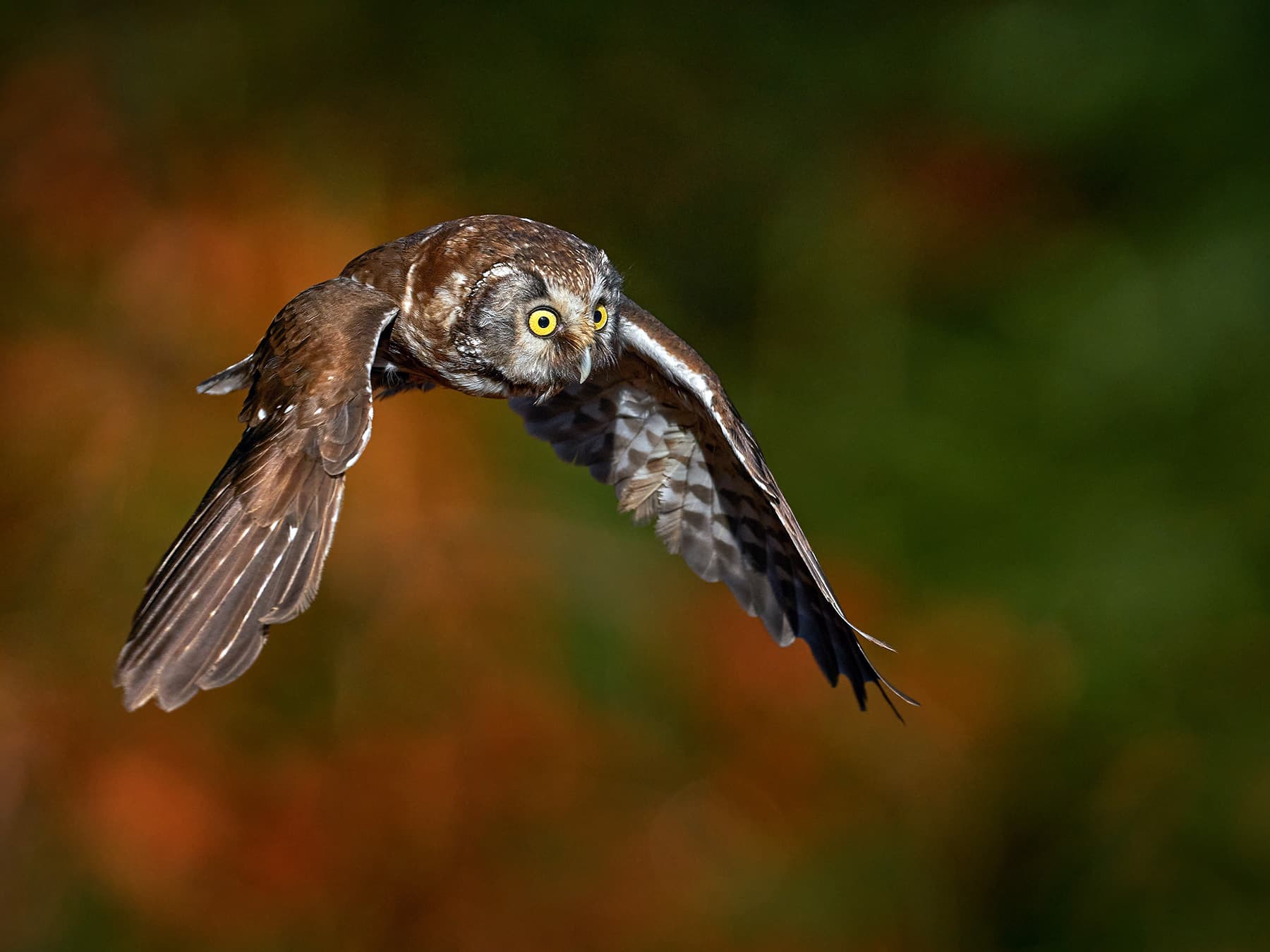
Boreal owls might be a small owl species, no bigger than an American robin, but they have a relatively wide wingspan. Females are usually much larger and heavier than males
- Length: 20 cm to 23 cm (8 in to 9 in)
- Wingspan: 55 cm to 62 cm (22 in to 24 in)
- Weight: 93 g to 215 g (3.3 oz to 7.6 oz)
Its size
Adults- Length
- 21–28 cm
- Wingspan
- 50–62 cm
- Weight
- 90–194 g
Its song and calls
What sound does a Boreal Owl make?
The advertising a call of a boreal owl is heard from winter until late spring, once the male has found a mate. It consists of a series of between 8 and 20 hollow, rapid hoots that get progressively louder.
- Song and calls0:00 / 0:39
Recorded in Województwo Śląskie, Poland · March 2025
- Flight call0:00 / 0:55
Recorded in Keski-Suomi, Finland · September 2025
When and where to see it
OctoberArriving
Most recorded in October
- 1. Northwest Territoriesunder 0.1%
- 2. Yukon Territoryunder 0.1%
- 3. Wyomingunder 0.1%
- 4. Utahunder 0.1%
- 5. Alaskaunder 0.1%
Each dot is a county, state or province: the bigger and darker, the larger the bird’s share of that place’s bird records that month. Grey dots: no regular records. The ringed point is the centre of the bird’s records this month; the arrow shows how it moved since last month, and the dashed loop its path through the year. “Arrivals” colours places where it becomes regular this month (orange) or is in its last regular month (grey). GBIF eBird Observation Dataset, 2019–2024. Map data: Natural Earth, US Census Bureau; place centres © OpenStreetMap contributors.
In your area
See when the Boreal Owl is recorded in your county, state or province.
How often the Boreal Owl turns up in Canada through the year, from birdwatchers' records.
Canada
Winter visitor · regularly Sep–Jun · most records in February
Show as a table
| Month | Canada |
|---|---|
| January | 0.016% (regular) |
| February | 0.019% (regular) |
| March | 0.010% (regular) |
| April | 0.003% (regular) |
| May | <0.001% |
| June | <0.001% (regular) |
| July | <0.001% |
| August | <0.001% |
| September | 0.002% (regular) |
| October | 0.004% (regular) |
| November | 0.002% (regular) |
| December | 0.010% (regular) |
Worldwide: recorded regularly in 27 countries
Countries where it was recorded in at least 3 of the 6 years 2019–2024. Linked countries have their own bird list.
Data: EOD – eBird Observation Dataset (Cornell Lab of Ornithology), accessed via GBIF.org, CC BY 4.0. Records from 2019–2024, aggregated and filtered by Birdfact. How these lists are made
What is the habitat of a Boreal Owl?
Boreal owls breed in coniferous forests across Eurasia and North America. Dense spruce forests are preferred but mixed species woodlands are also frequently used and the availability of woodpecker holes for nesting is a key factor. Hunting habitats include meadows and forest clearings.
What is the range of a Boreal Owl?
Boreal owls live in the northern regions of the world, across North America, Europe and Asia. Their distribution range is characterized by boreal forest landscapes and stretches from Alaska through central and southern Canada, with a localized presence in parts of the northwest US, including Colorado, Montana and Idaho.
Across the Atlantic, boreal owls are resident in Scandinavia, the Baltic states, and eastwards through northern Russia, including northern Kazakhstan, Mongolia and the Kuril Islands.
To the south of the main European range, boreal owls have a scattered distribution across the Pyrenees and the Alps and in parts of Central Europe.
Where do Boreal Owls live?
The population of boreal owls in the United States and Canada is estimated at around 500,000 individuals. Europe’s population is believed to be between 189,000 and 471,000 individuals, of which up to 40,000 pairs live in Sweden, up to 20,000 pairs in Finland, and up to 100,000 in European Russia.
How rare are Boreal Owls?
Boreal owls are resident in a wide geographic range across the northernmost regions of North America, Europe and Asia, with a global population of between 730,000 and 1.8 million individuals.
Their hard-to-access taiga habitats and nocturnal behavior make them particularly hard to spot, despite their relatively large population, and sightings are rarely recorded.
Where can you see Boreal Owls in the US?
Boreal owls are notoriously hard to spot, and sightings can never be guaranteed. However, the species is regularly recorded in the following locations: Cameron Pass and Grand Mesa, Colorado, Yale-Kilgore Road, to the west of Yellowstone National Park, Idaho, Sax-Zim Bog, Minnesota and Fairbanks, Alaska.
Where can you see Boreal Owls in Canada?
The range of boreal owls extends across a vast expanse of Canada from the west coast to the east coast. Despite their presence in a wide geographical area, they are always a challenging species to spot.
Two key sites that offer improved chances of a sighting include Sibbald Creek Trail, Alberta, and Hecla-Grindstone Provincial Park in Manitoba.
Migration
Do Boreal Owls migrate?
A nonmigratory species, boreal owls are resident in their home territories all year round although in winter poor availability of prey may trigger irruptions further afield.
Are Boreal Owls native to the US?
Boreal owls breed in Alaska and in the extreme north of Minnesota, as well as likely being present in the deep forested landscapes of Michigan, Maine and Wisconsin. Irruptions periodically occur further south across the eastern US.
Tips for seeing it
- Listen for their distinctive 'po-po-po-po' call at night, especially during breeding season
- Search for them in dense coniferous forests, particularly near clearings
- Look for whitewash and pellets at the base of large trees to locate potential roosting sites
- Use playback cautiously and sparingly to avoid disturbing the birds
What it eats
What do Boreal Owls eat?
Voles are the main prey of boreal owls, with other small mammals also caught, including mice, gophers, squirrels, shrews, moles, chipmunks and bats. Small birds and amphibians are also eaten, particularly common redpolls, American robins, and dark-eyed juncos. Boreal owls mainly hunt nocturnally, watching from perches.
What do Boreal Owl chicks eat?
Males bring prey to the nest, particularly small voles and mice, which are then torn into pieces by the female and fed to nestlings. After around two weeks, young are able to swallow prey whole and follow the same diet as their parents.
Nesting and breeding
Where do Boreal Owls nest?
Boreal owls are cavity nesters and seek out suitable hollows excavated by woodpeckers in mature or old-growth forests. Natural cavities in dead or dying trees are also used, and if available, boreal owls will readily nest in manmade nest boxes.
When do Boreal Owls nest?
Pairs form early in the spring, after a courtship ritual in which males show prospective mates between one and five potential cavities. Once the female has chosen her preferred nest site, laying commences, with April and May as the peak months for eggs to be laid. Only female boreal owls incubate the eggs, which hatch after between 26 and 32 days.
What do Boreal Owl eggs look like?
Boreal owls lay between 3 and 7 glossy white eggs, with no external patterns or markings. Eggs measure 33 mm × 26 mm (1.3 in × 1 in).
Do Boreal Owls mate for life?
Boreal owls are monogamous during the breeding season. Pairs remain together while raising their young but do not mate for life, although occasionally a pair will reunite and breed together again the following year.
Behaviour
Are Boreal Owls aggressive?
Known to be particularly territorial in defense of a feeding area as well as nest sites, boreal owls use aggressive vocalizations to drive intruders off their patch, including a harsh ‘zjuck’ call when threats are detected.
Boreal owls are a particularly secretive and nomadic species and do not tolerate the company of other birds, preferring instead to roost and forage alone.
Where do Boreal Owls sleep at night?
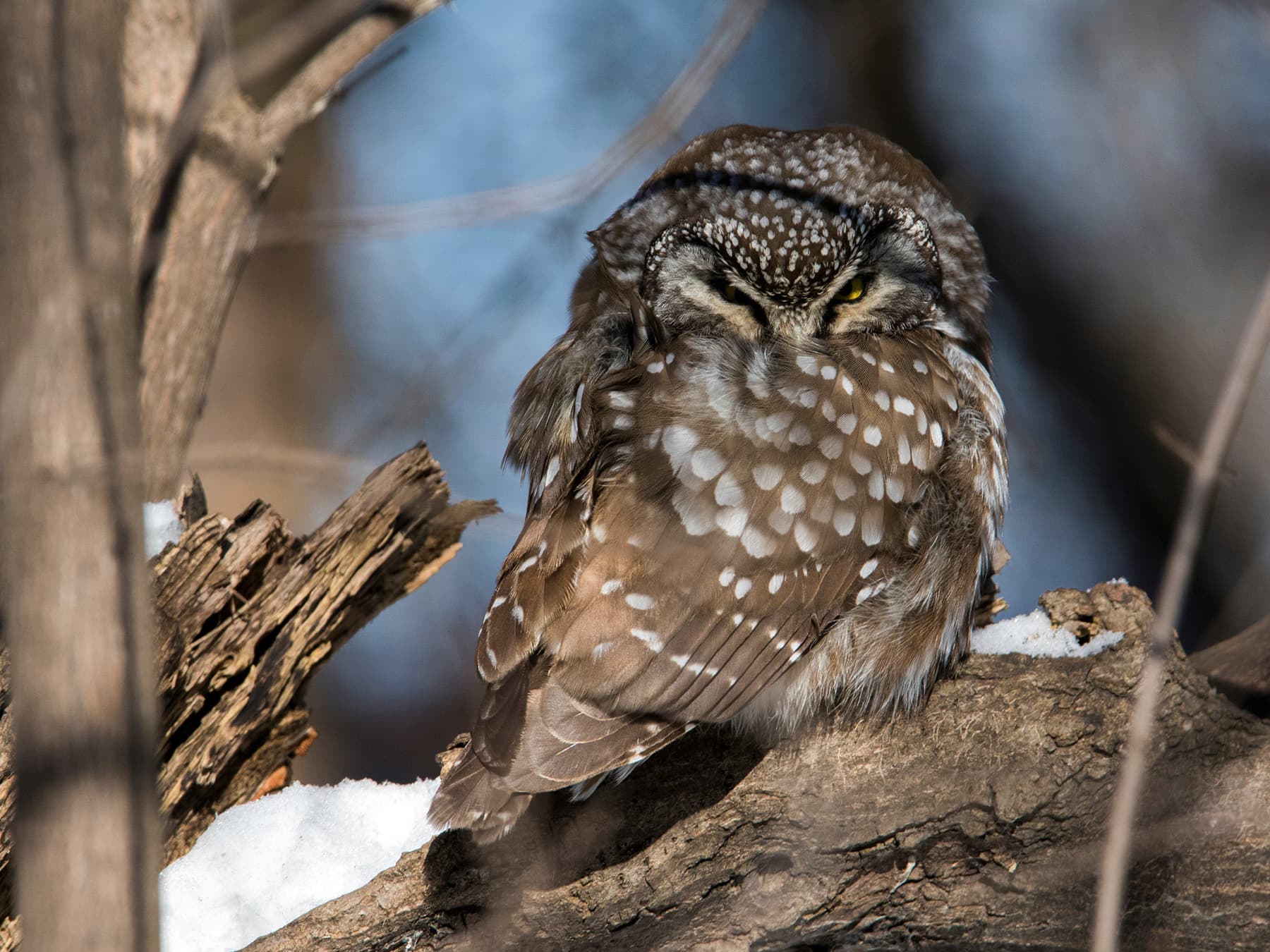
Boreal owls are nocturnal, hunting at night and roosting during the day. Concealed roosting spots are chosen near to tree trunks, covered by dense foliage.
Lifespan and predators
How long do Boreal Owls live?
Boreal owls are able to breed as yearlings, and breed annually, as long as there is sufficient prey available locally. The average lifespan of the species in the wild is around 7 to 8 years, with the oldest known banded individual identified as 11 years of age.
Life expectancy in captivity is longer, with a boreal owl at Finland’s Ranua Wildlife Park known to have reached 15 years.
What are the predators of Boreal Owls?
Martens and pine squirrels are known to prey on eggs from boreal owls’ nests, while larger owls and raptors have been observed to take both young birds and adults. Common avian predators include Ural, tawny, and great horned owls, northern goshawks, and Cooper’s hawks.
Are Boreal Owls protected?
In the United States, the Migratory Bird Treaty Act prohibits boreal owls from being killed, injured, taken into captivity without a license, or traded for sale. Similar legislation in Canada, the Migratory Birds Convention Act, offers the same level of protection to boreal owls there.
Are Boreal Owls endangered?
Boreal owls are not considered to be globally threatened and the IUCN has classified them as a species of least concern.
Conservation
While currently listed as Least Concern, Boreal Owls face threats from habitat loss due to logging and climate change.
Conservation efforts focus on preserving old-growth boreal forests and maintaining suitable nesting cavities. Monitoring programs are crucial for tracking population trends in this elusive species.
Similar birds
Often mistaken for
More photos
6 photos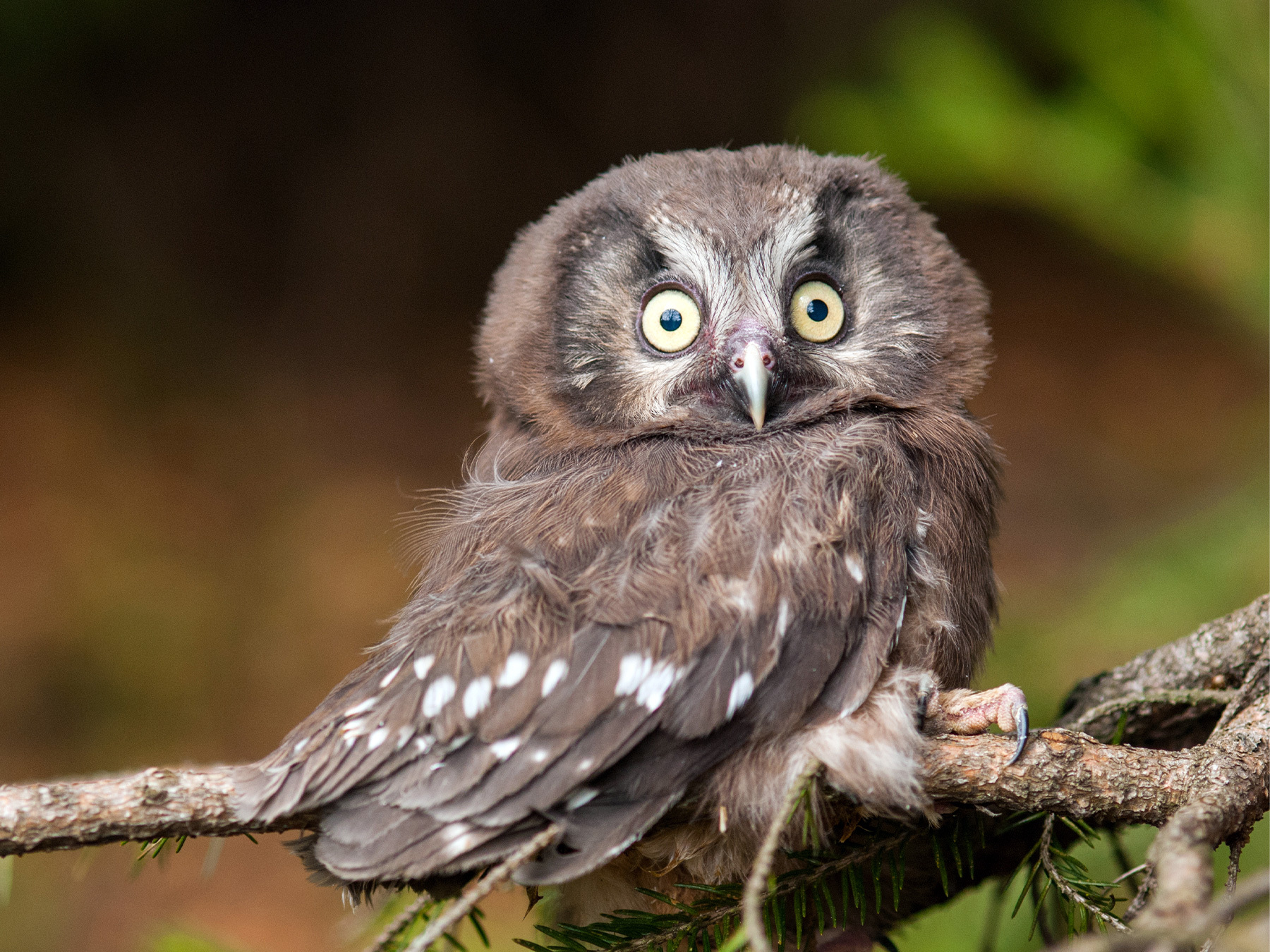
Quick facts
- Length
- 21–28 cm
- Wingspan
- 50–62 cm
- Weight
- 90–194 g
- Lifespan
- 7–8 years · oldest recorded 15.9 years
- Family
- Owls
- Migration
- Partial migrant
- Global status (IUCN)
- Least Concern
- World population
- 730,000 - 1,810,000 mature individuals
- Population trend
- Stable
- Also called
- Tengmalm's Owl
- Scientific name
- Aegolius funereus
Questions
2What does the Boreal Owl symbolize?
The scientific name for the boreal owl, Aegolius funereus, gives a hint to the symbolism of this species - and it isn’t a particularly positive meaning. Aegolius means ‘bird of ill omen’ in Greek and funereus is Latin for ‘bearing ill’, linking the species with foreboding and bad news on the horizon.
How to attract Boreal Owls?
If you live within the breeding range of boreal owls and have some tall trees on your land, it may be worth putting up a purpose-built owl nesting box. Leave trees to grow, without pruning the foliage, so that maximum shade and shelter and perching spots are available.
Sources
4- 1BirdLife International. 2021. Aegolius funereus. The IUCN Red List of Threatened Species 2021: e.T22689362A201898946. Source (opens in a new tab)
- 2BirdLife International. 2021. Aegolius funereus. The IUCN Red List of Threatened Species 2021: e.T22689362A201898946. Source (opens in a new tab)
- 3BirdLife International. 2021. Aegolius funereus. The IUCN Red List of Threatened Species 2021: e.T22689362A201898946. Source (opens in a new tab)
- 4John Terres, The Audubon Society Encyclopedia of North American Birds (1980)

Checked by
Nathan Cope, founder and editor
Nathan founded Birdfact and leads its writers and contributors in the UK, the US and Canada. He has watched and studied birds for more than ten years, and checks every article and species guide before it’s published.