


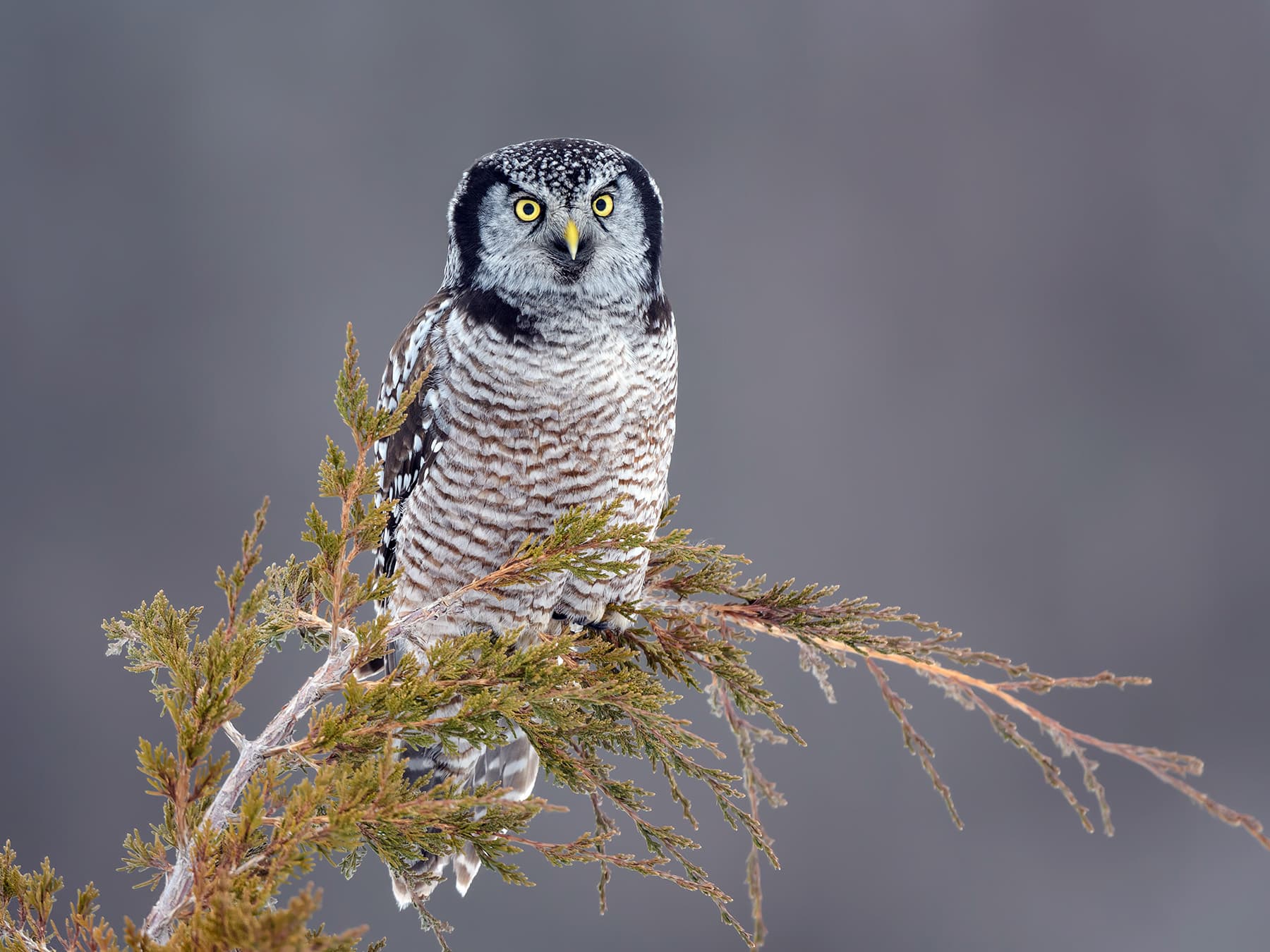
Northern Hawk-owl
Hawk Owl, Northern Hawk Owl · Surnia ulula
By the Birdfact teamChecked by Nathan Cope
On this page13 sections
How to recognise it
What do Northern Hawk Owls look like?
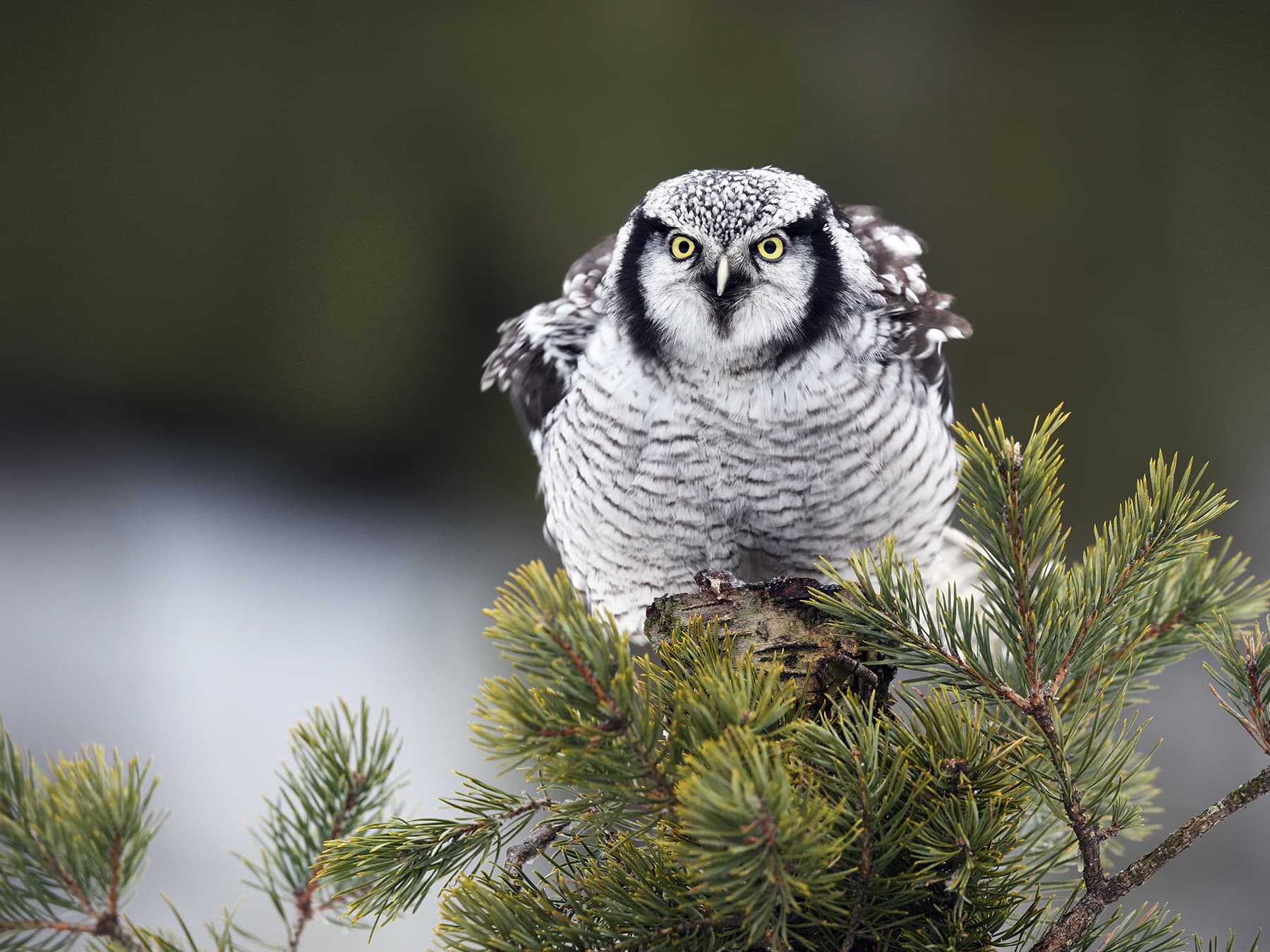
Despite resembling hawks in many aspects, northern hawk owls have features that definitely mark them out as members of the owl family.
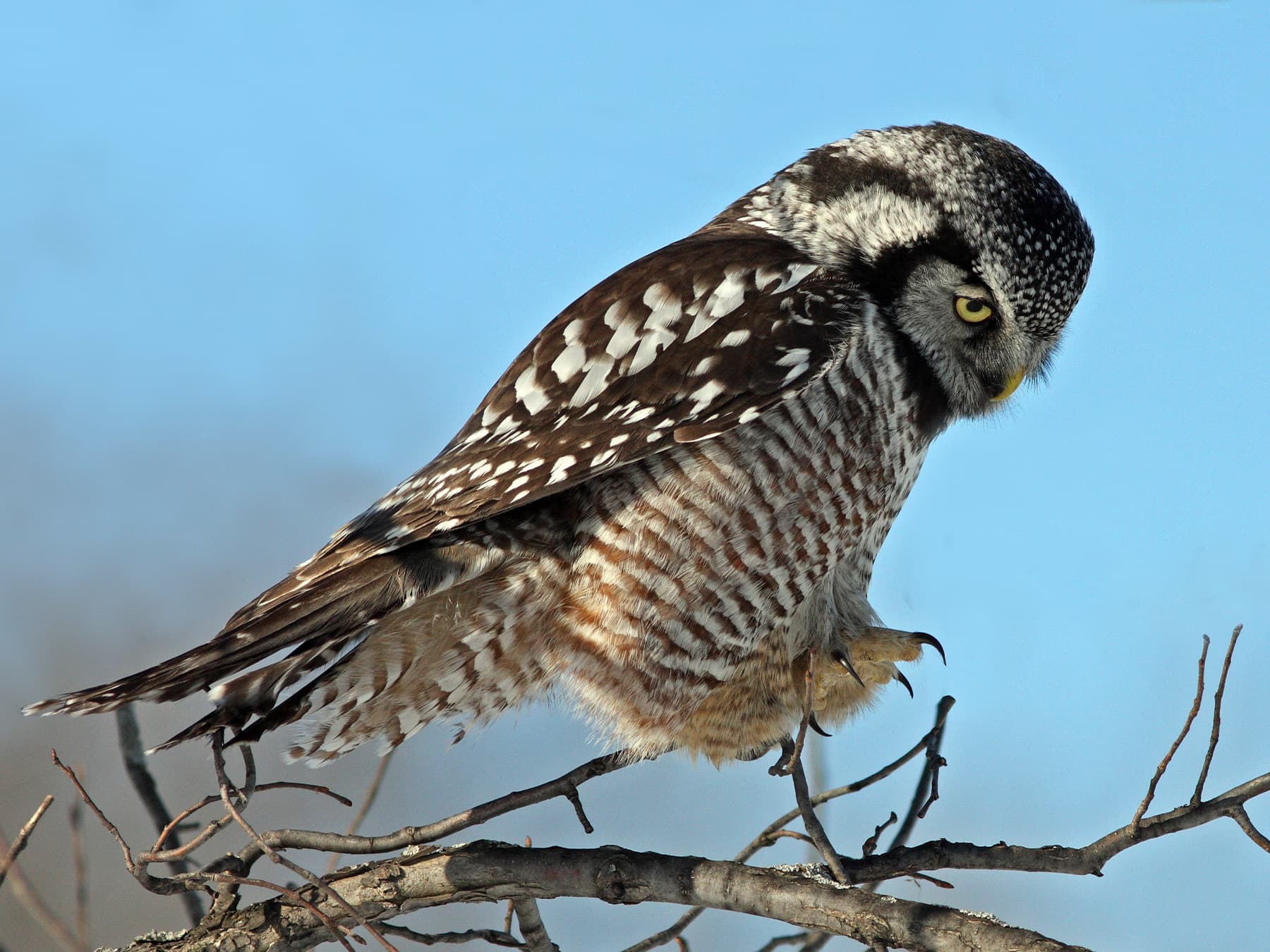
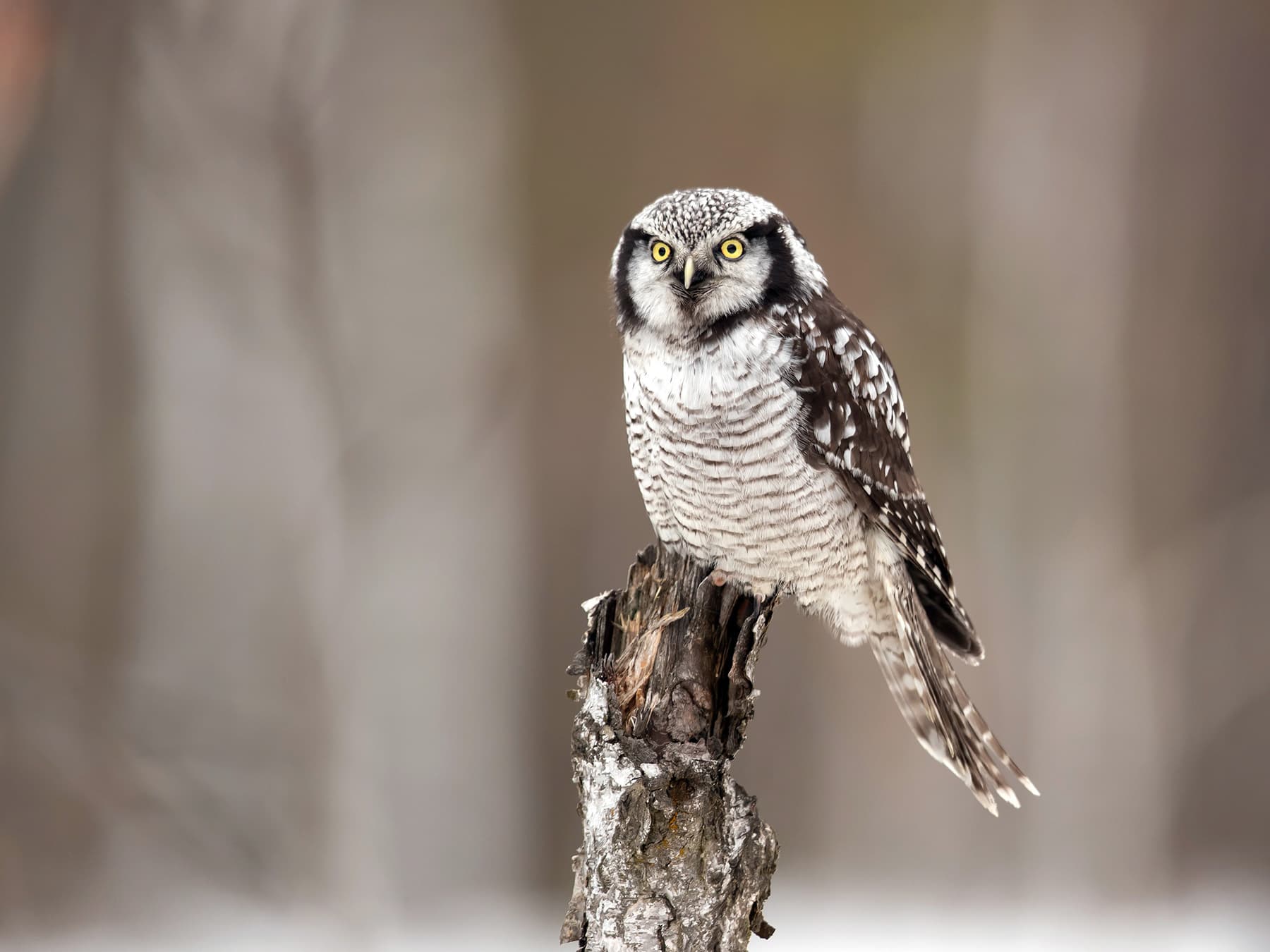
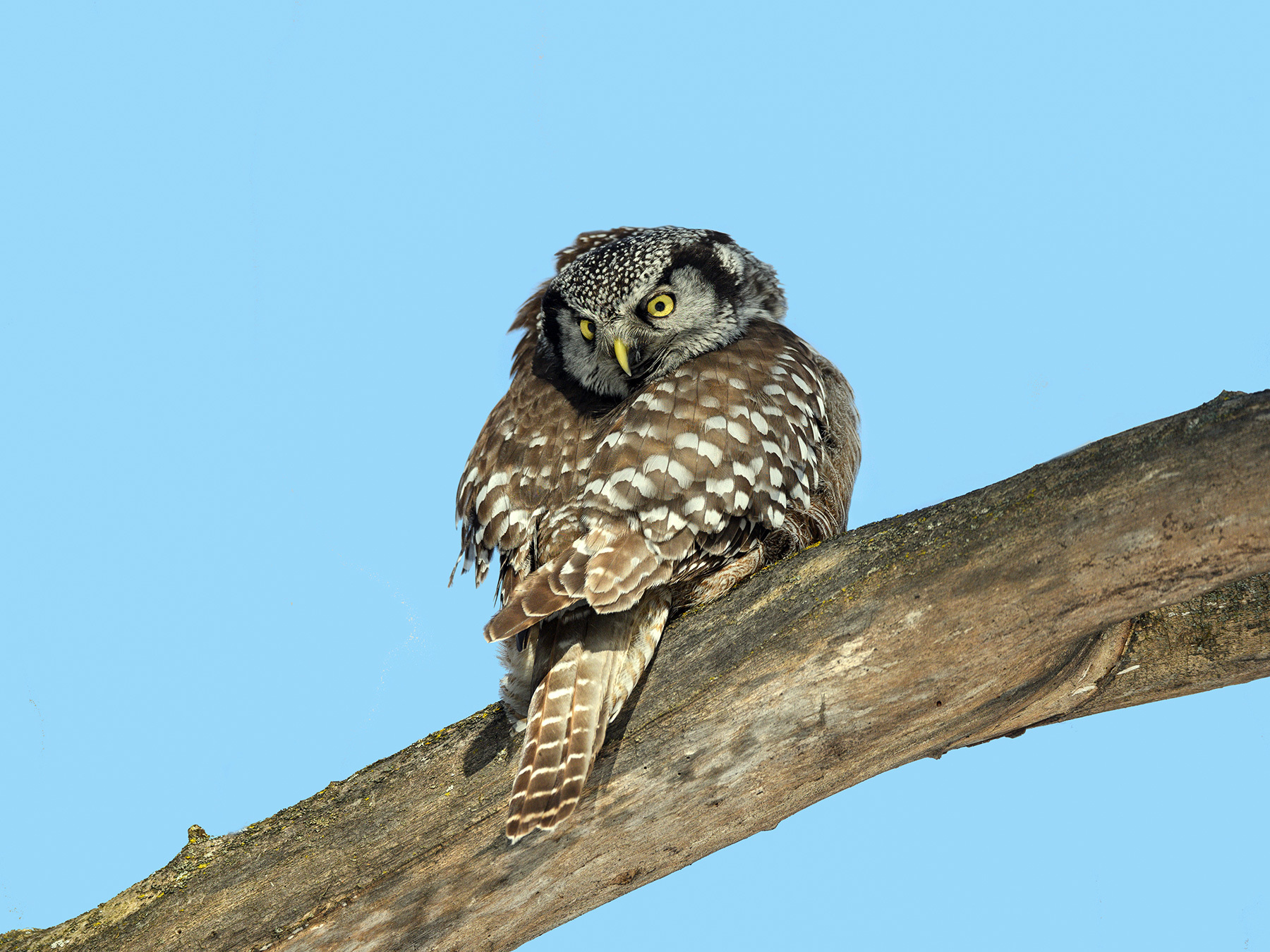
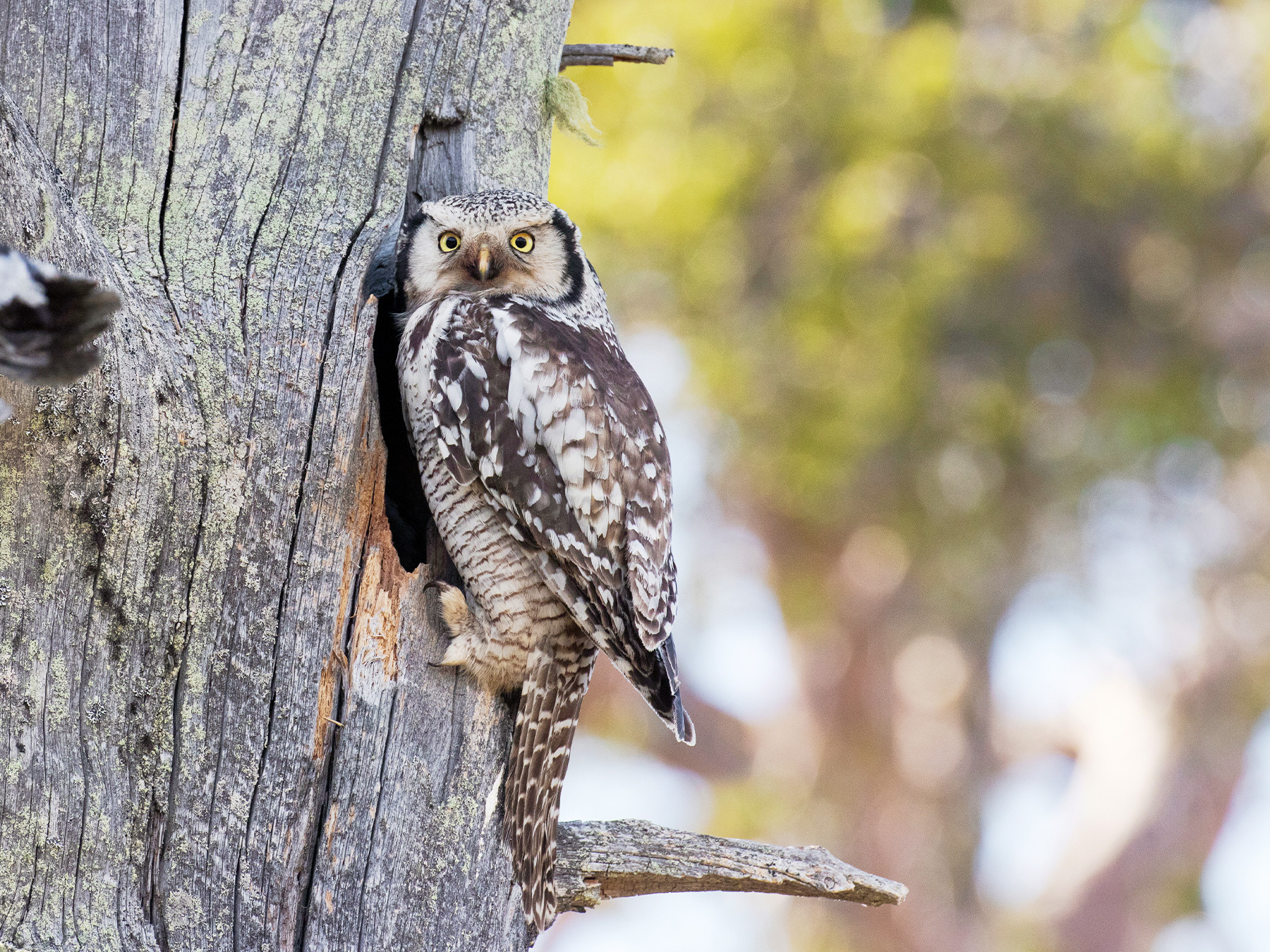
Their piercing yellow eyes and dark-bordered gray facial discs are unmistakable ‘owls’, and their dotted brown and white head pattern is similar to that of a boreal owl.
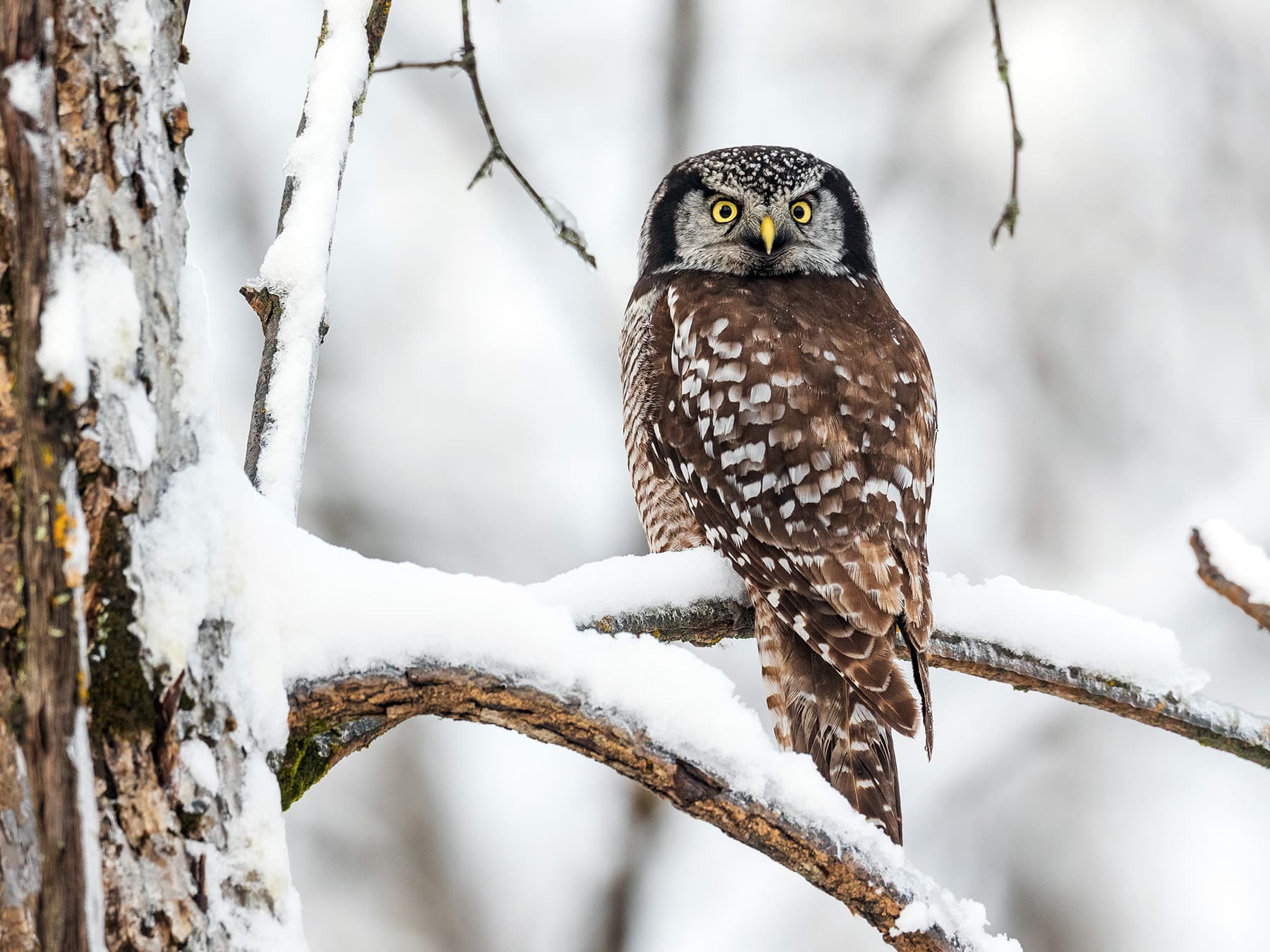
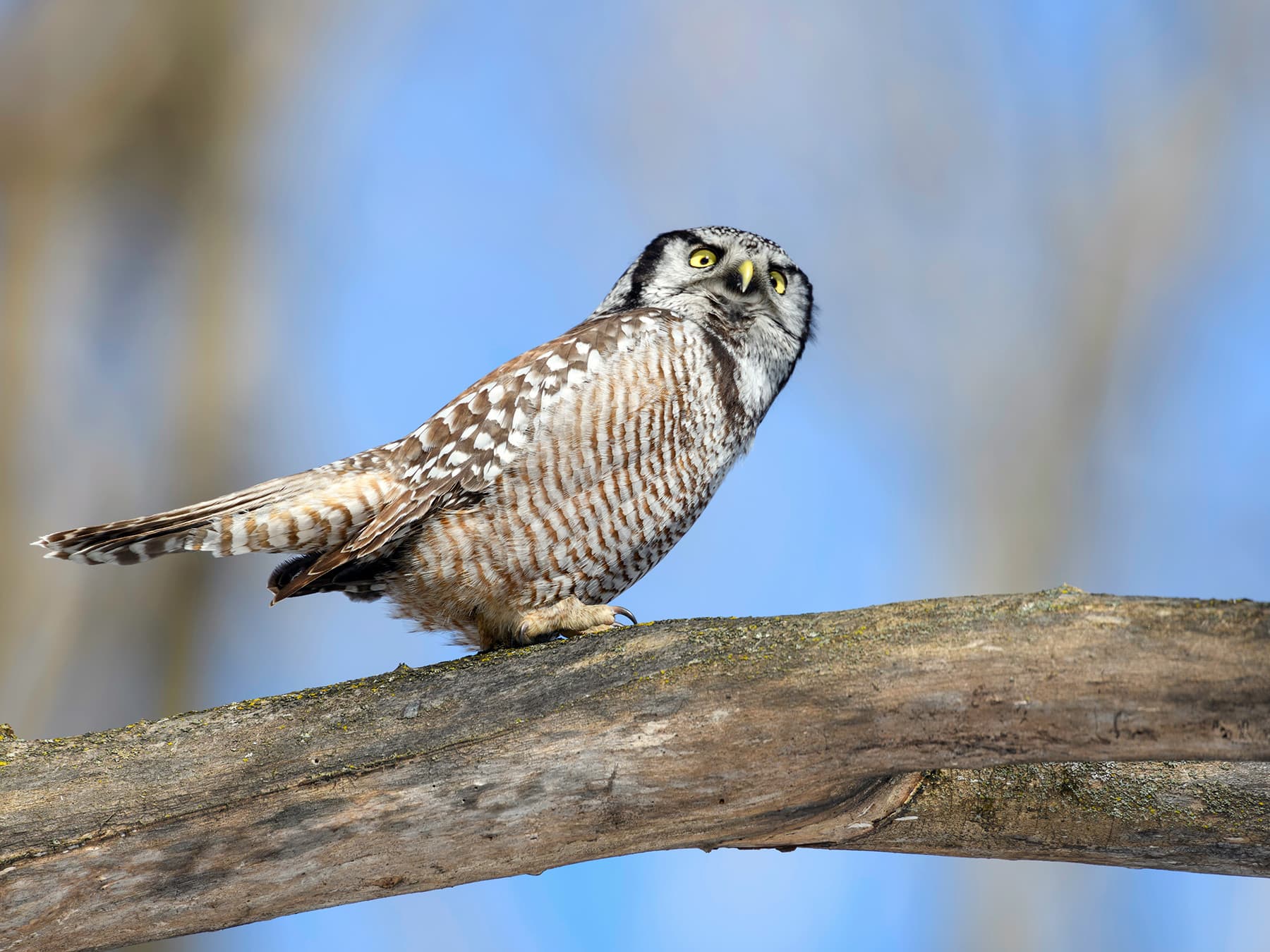
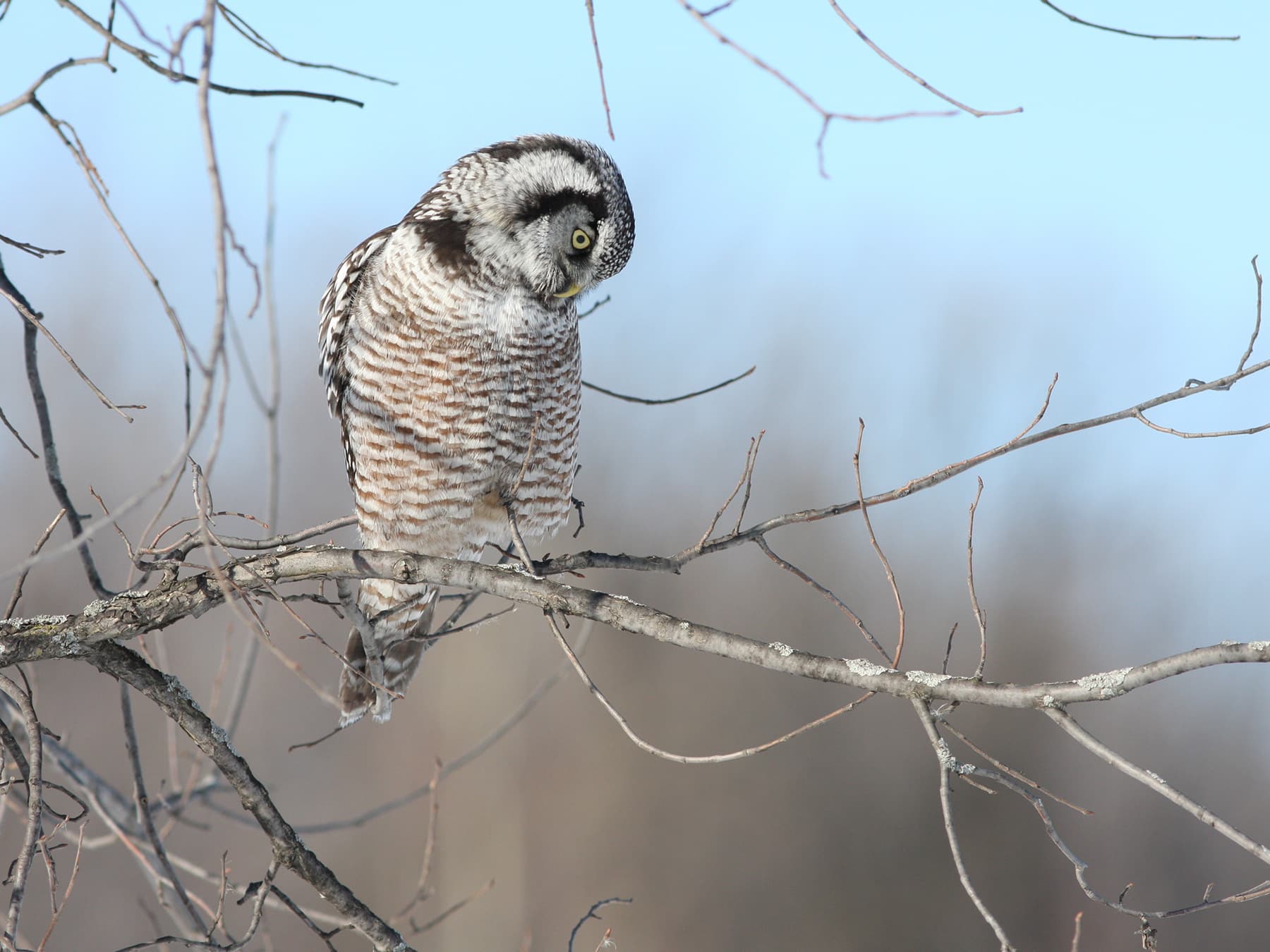
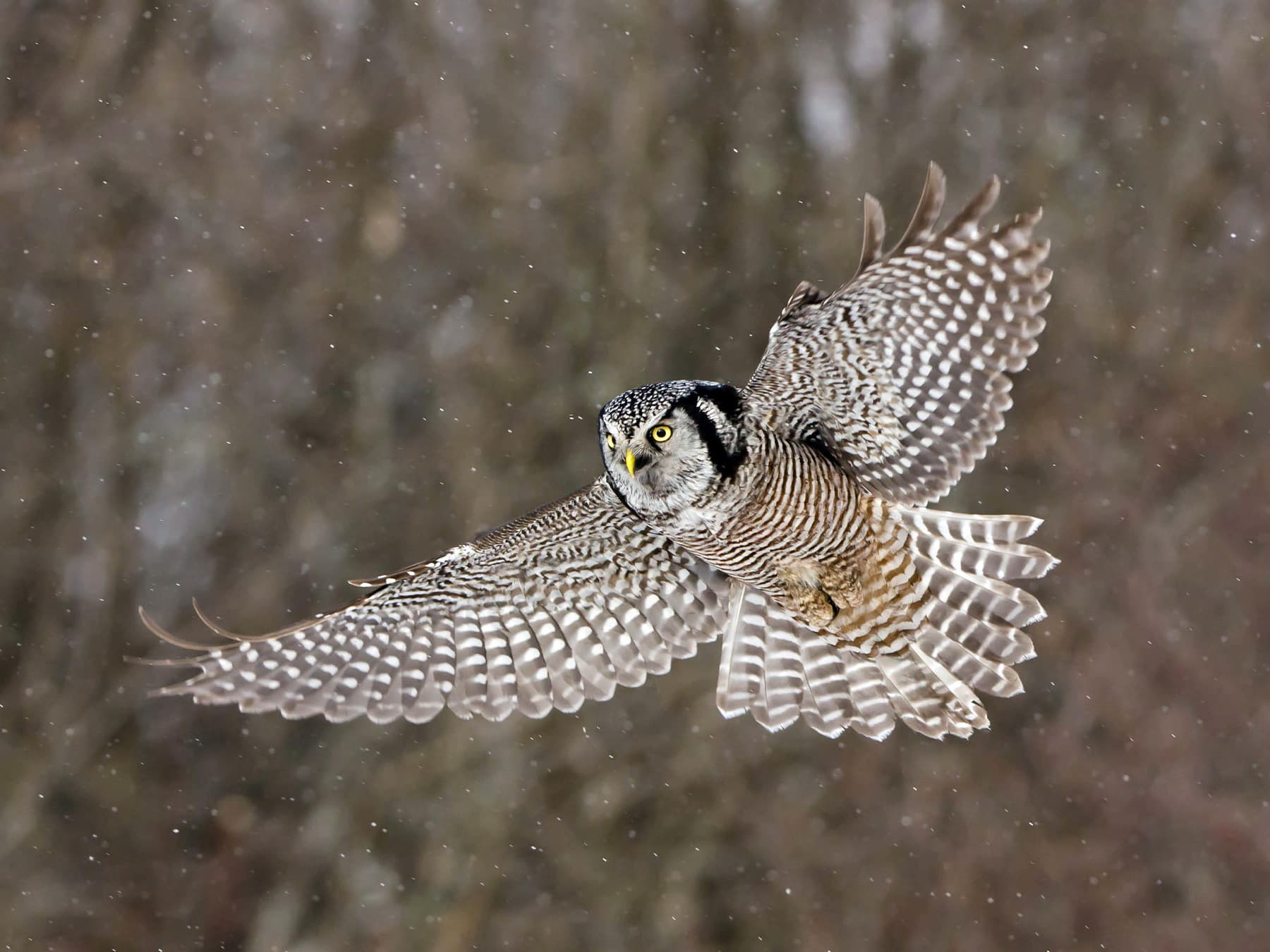
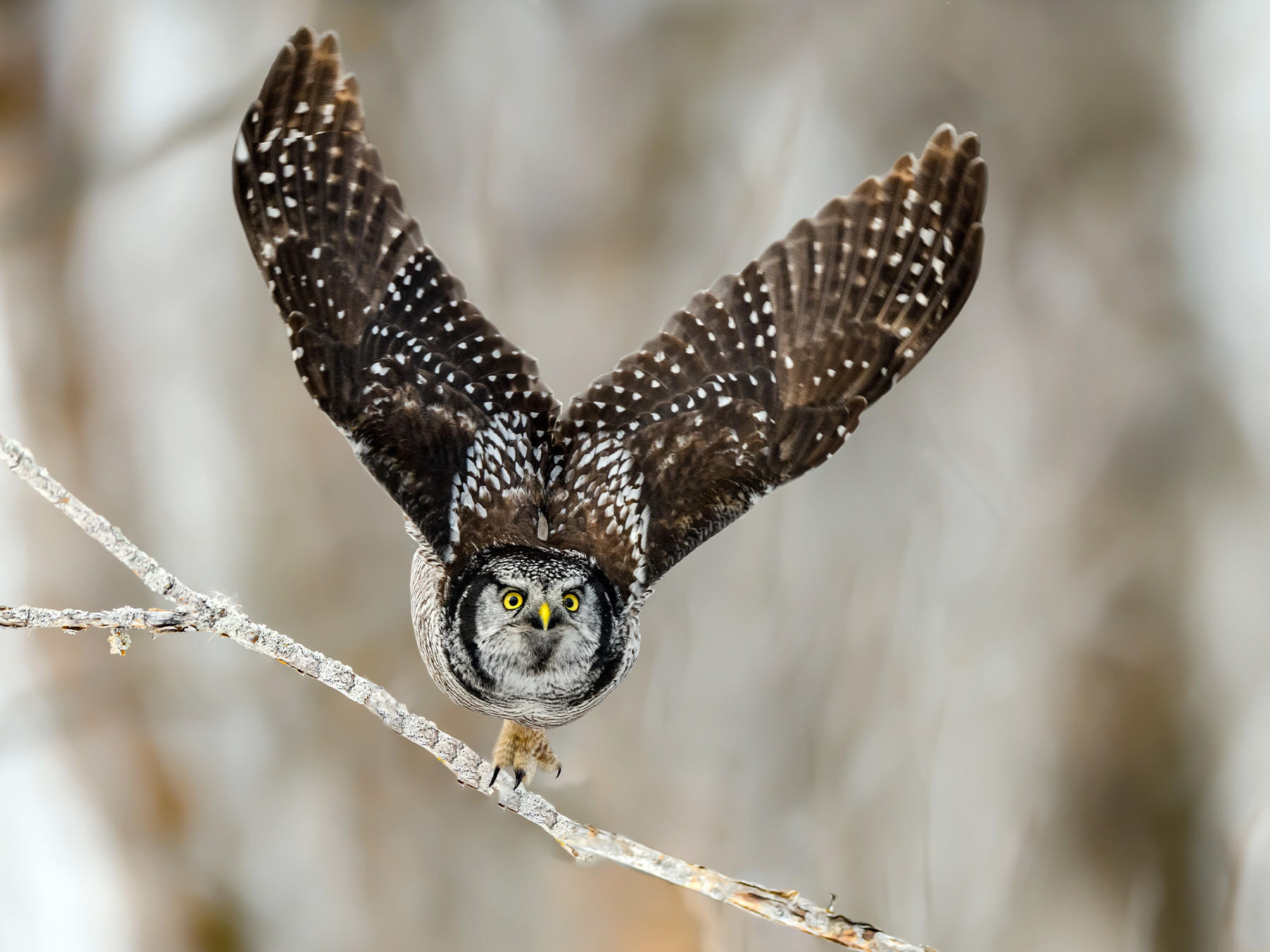
The underparts of a northern hawk owl are barred with narrow dark brown and white, and the tail is long, banded with dark brown and off-white. The wings and back are dark brown, heavily patterned with white spotting. The head is rather flat, with white eyebrows separated by a finely speckled brown forehead. The bill is hooked and yellow, and the feet are feathered with black talons.
Females and males share the same plumage coloring and markings, although it is relatively easy to identify the sexes in a pair: females are noticeably larger than males.
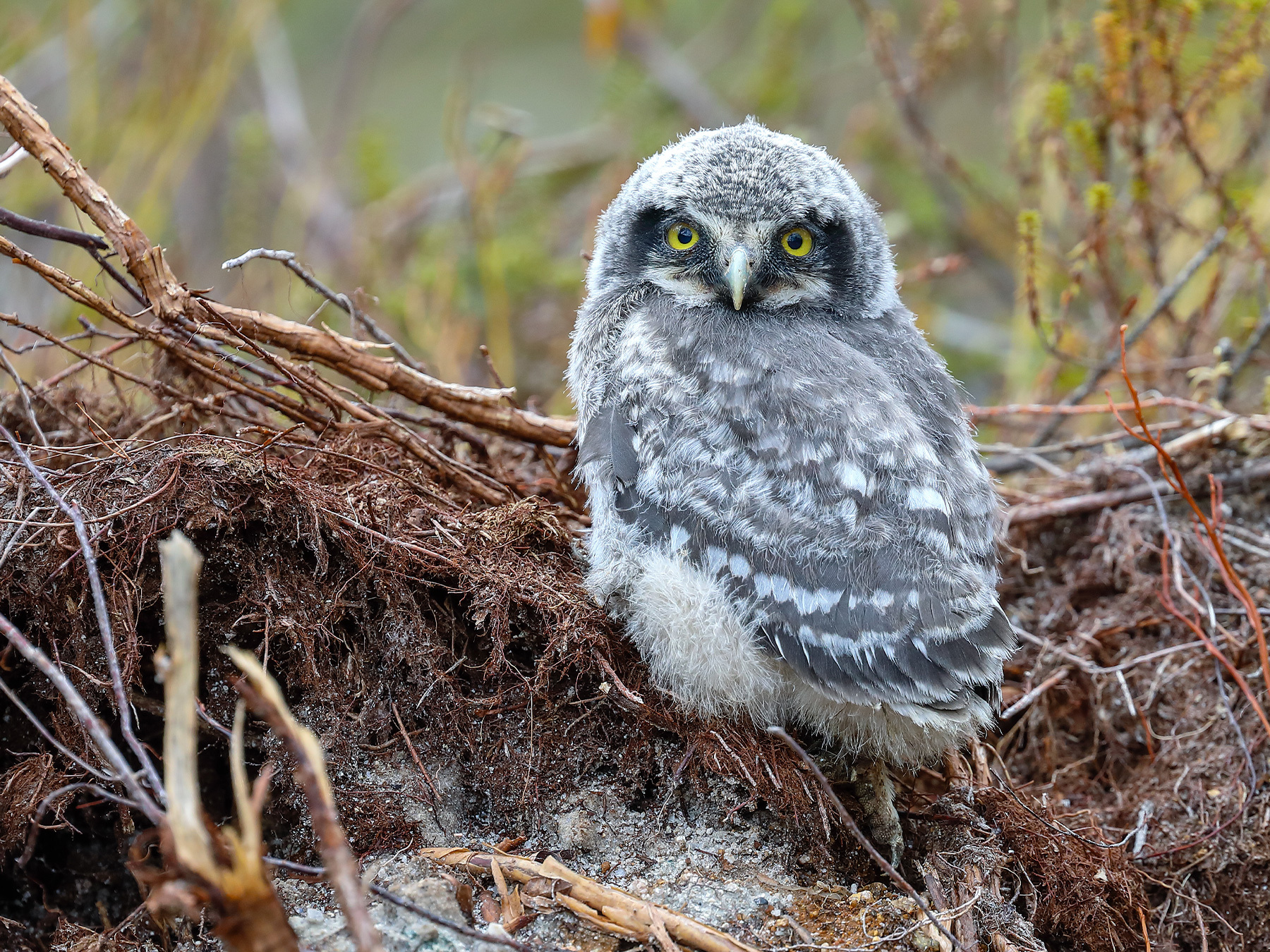
Juvenile northern hawk owls are similar in appearance to adults but with grayish-brown upperparts and less distinctive white markings on their back and wings.
How big are Northern Hawk Owls?
Roughly around the same size as a crow, northern hawk owls are larger than long-eared and short-eared owls but smaller than great-horned owls. Females are heavier and larger than males.
- Length: 36 cm to 44.7 cm (14.2 in to 17.6 in)
- Wingspan: 74 cm to 81 cm (29 in to 32 in)
- Weight: 300 g to 340 g (11 oz to 12 oz)
Its size
Adults- Length
- 36–43 cm
- Wingspan
- 69–84 cm
- Weight
- 220–350 g
Its song and calls
What sound does a Northern Hawk Owl make?
Early in the breeding season, the advertising call of males is heard, with a rolling ‘tu-wita-wit, tiwita-tu-wita, wita’ whistle. At night, a series of rapid whistles may be heard. Screeching ‘kee-kee-kee’ calls are used as contact between pairs and may be heard in flight and around the nest site when the male is bringing food to his mate.
Away from nest sites, northern hawk owls are usually silent.
When and where to see it
What is the habitat of a Northern Hawk Owl?
Semi-dense boreal forests and tundra landscapes to the treeline offer ideal year-round habitats for northern hawk owls. Both coniferous and mixed woodlands are used, particularly those with birch and pine.
Perches for hunting and open meadows for catching prey are both important. Burned forest environments are also popular, with deadwood snags and an increased number of abandoned woodpecker cavities presenting useful nesting possibilities.
What is the range of a Northern Hawk Owl?
Northern hawk owls have a vast geographical distribution range, covering around 36 million sq km, in North America, Europe, and Asia. The species is widely distributed across the whole of southern and central Canada from east to west, and into much of Alaska.
The range does spread into border regions of the United States, and further south, particularly in winter months, where they are rarely spotted as far south as Nebraska, northern Ohio, and West Virginia.
In Europe, their range extends from northern Scandinavia eastwards into northern Russia and northern Siberia, and to the south, the species is present in central Russia, northern Mongolia, and northern Manchuria.
Where do Northern Hawk Owls live?
Of the species’ worldwide population, up to around 130,000 northern hawk owls live in North America, with a further 20,800 to 94,200 mature individuals in Europe. Russia, Norway, and Sweden have the highest populations outside of North America.
How rare are Northern Hawk Owls?
The global population of northern hawk owls is estimated by Partners in Flight at around 250,000, so across their wide geographical range, they are relatively uncommon and rarely spotted, due to their preference for dense boreal forests.
Where can you see Northern Hawk Owls in the US?
Sightings of northern hawk owls in the US are rarer than to the north of the Canadian border and are never guaranteed, depending largely on the availability of prey. Unpredictable eruptions to the south of their northern range may occur in years with a low abundance of prey.
Alaska is the only state where breeding is well established, with sightings regularly reported in Denali National Park.
Where can you see Northern Hawk Owls in Canada?
Northern hawk owls are present in Canada from British Columbia in the west to Labrador in the east. Forests in the Canadian Rockies and the Coast Mountains are likely places for sightings, including Jasper National Park and Banff National Park in Alberta.
Migration
Do Northern Hawk Owls migrate?
Northern hawk owls are generally not a migratory species, although some movement may occur sporadically, particularly in years when prey is in short supply on their breeding grounds as winter approaches. Short-term irruptions may be observed in areas further south with more abundant prey, but individuals return to their regular breeding grounds after a brief absence.
Are Northern Hawk Owls native to the US?
Alaska has an established population of breeding northern hawk owls, and the species is also present in limited numbers all year round in border regions in the eastern and northern US, including northern Minnesota, northern Wisconsin, and northern Michigan.
Tips for seeing it
- Look for them perched on exposed treetops in open boreal forests
- Listen for their shrill, repeated 'ki-ki-ki' calls
- Observe during daylight hours, unlike most owl species
- In North America, watch for irruptions in winter when they may move south
What it eats
What do Northern Hawk Owls eat?
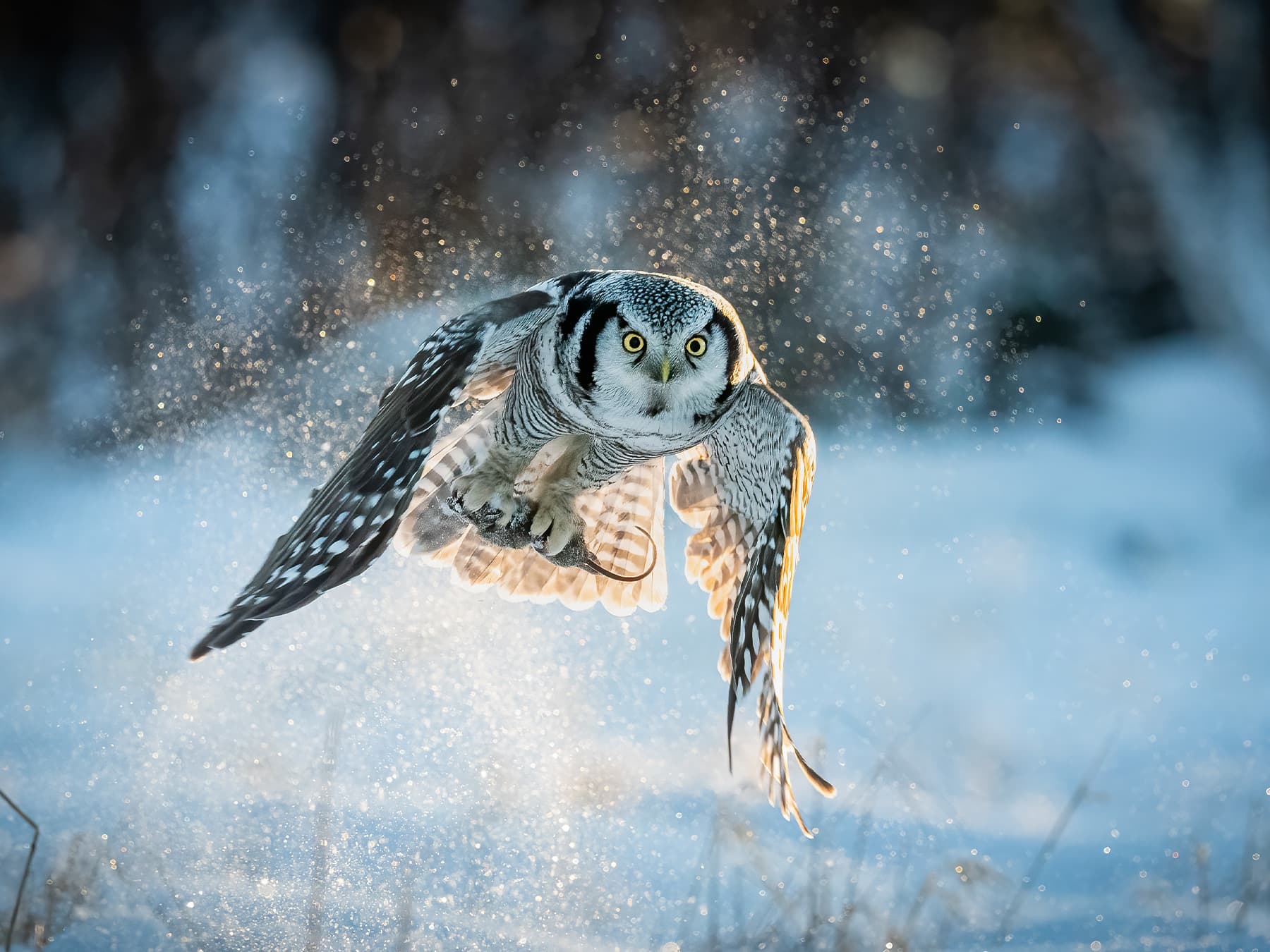
In summer, the diet of northern hawk owls typically consists of small mammals, particularly voles, squirrels, rats, mice, lemmings, and weasels.
Larger prey, including grouse, ptarmigans, and snowshoe hares are hunted in winter. Smaller birds, including robins, jays, starlings, and finches are also represented in their diet.
What do Northern Hawk Owl chicks eat?
Males bring prey to females at a nearby perch, which she then tears into smaller pieces and feeds to her young. Prey, including voles, mice, and shrews, may be cached while feeding nestlings to ensure there is a ready supply of food at hand.
Nesting and breeding
Where do Northern Hawk Owls nest?
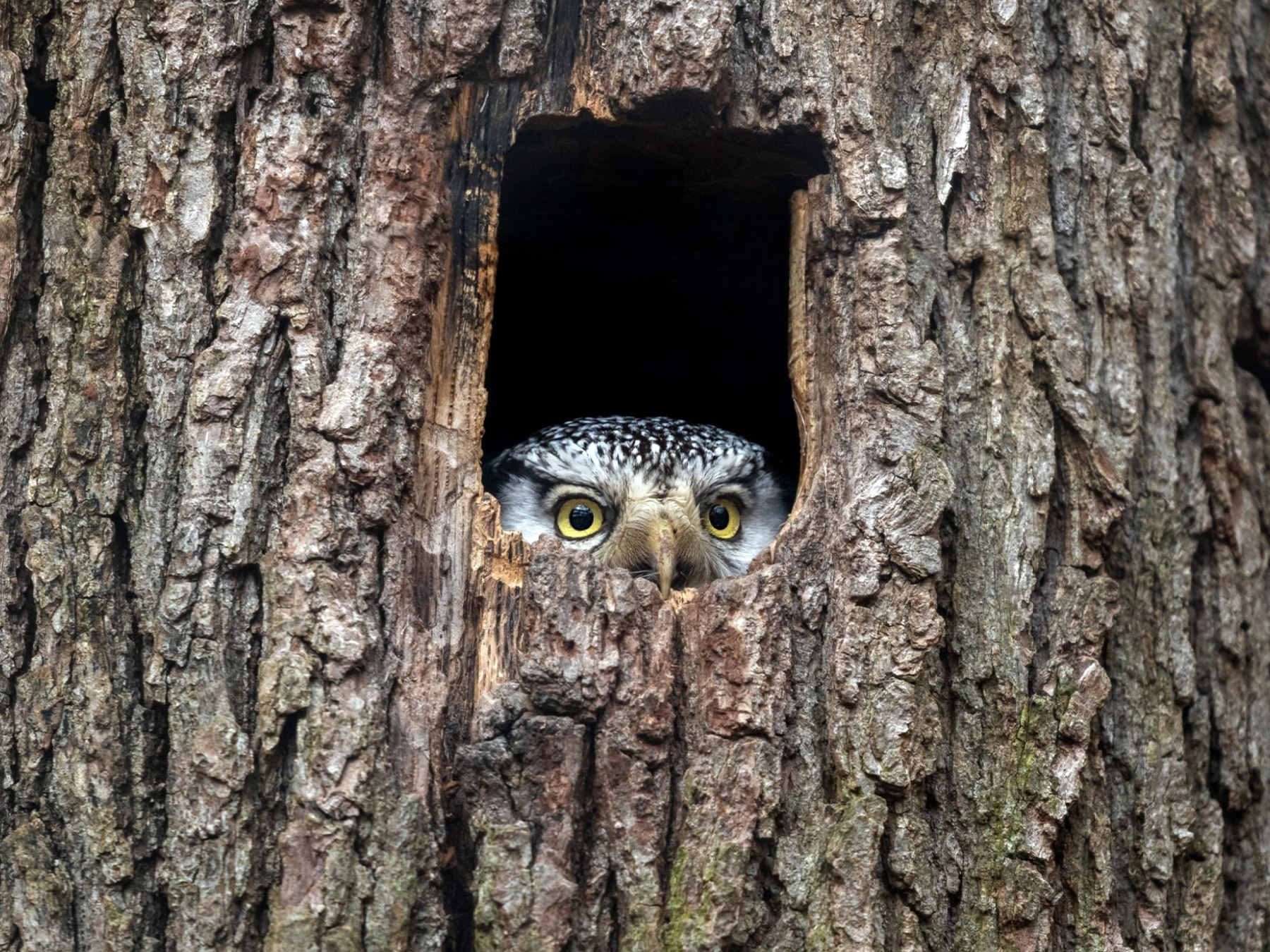
Northern hawk owls mostly nest in cavities, both naturally formed hollows and crevices in trees and chambers that have been excavated and since vacated by woodpeckers.
In parts of northern Europe, nest boxes are readily used, and occasionally pairs will reuse a large stick nest in the upper forks of tall trees or clifftop sites. No additional nesting material is brought to the nest and no lining is added.
When do Northern Hawk Owls nest?
Egg-laying has been recorded in North America from as early as late March until the end of June. April and May are the peak months, and one single brood is raised in a season. In years with poor availability of prey, breeding may be skipped entirely.
Incubation, by the female alone, begins when the first egg is laid and lasts for between 25 and 30 days.
What do Northern Hawk Owl eggs look like?
Northern hawk owls’ eggs are white and slightly rounded, measuring on average 32 mm by 40 mm (1.2 in by 1.6 in). A typical clutch contains between 3 and 13 eggs, with higher numbers laid in years with abundant prey.
Do Northern Hawk Owls mate for life?
Pair bonds between northern hawk owls form in the early spring, from February onwards, and they are monogamous for the length of the breeding season. Once their young have fledged and gained independence, usually by September to October, the pair bond dissolves, and males have been observed to aggressively drive their former mates from their territories.
Little information is available on whether former mates ever reunite and breed together again the following year.
Behaviour
Are Northern Hawk Owls aggressive?
Northern hawk owls are a highly aggressive species and have been known to inflict nasty injuries on the scalps of humans who approach their nest sites. Mammals and other birds will also be attacked, with a very vocal alarm call, particularly around the nest.
Both males and females will enter into vicious confrontation if they sense their nest, young or mate is under threat.
Where do Northern Hawk Owls sleep at night?
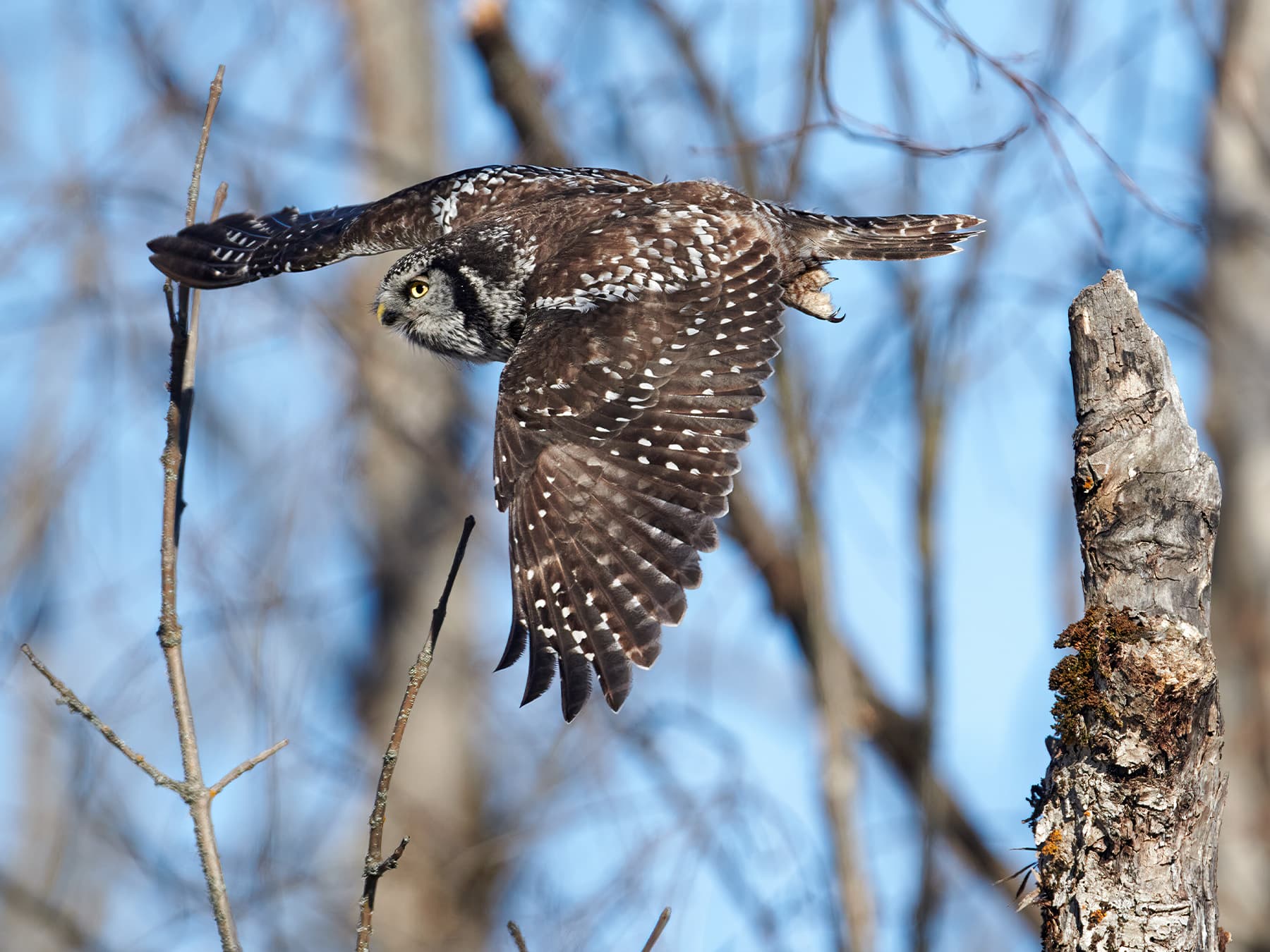
Unlike many owls, the northern hawk owl frequently hunts during the day as well as during the night, and hours of darkness are mostly spent resting or asleep. When resting, roosting spots are found on perches near the tops of trees, and close to the trunk. Cavities are not used for roosting.
Lifespan and predators
How long do Northern Hawk Owls live?
Northern hawk owls are estimated to have an average lifespan of around 10 years, with older individuals recorded to have lived significantly longer, including one identified through banding records that reached 16.2 years.
First-time breeding is thought to occur at 1 year old. However, when prey is scarce, many individuals do not attempt breeding or nests fail.
What are the predators of Northern Hawk Owls?
Nest cavities of northern hawk owls are a target for small mammals, including martens, fishers, and weasels. Owls and raptors are among the main prey of northern hawk owls, particularly northern goshawks and great horned owls, which commonly attack while the smaller owls are sleeping overnight.
Are Northern Hawk Owls protected?
Canada’s Migratory Birds Convention Act and the United States Migratory Bird Treaty Act offer northern hawk owls protection against being killed, injured, captured, or traded without a special permit or license. Their young, eggs, nest sites, and feathers are also protected.
Are Northern Hawk Owls endangered?
Although some moderate declines have been noted in parts of their range, northern hawk owls’ populations are generally considered secure and stable and they are considered a species of least concern. Logging reduces the availability of the perches needed for hunting, although their preferred habitat of Canadian taiga forests is not under significant threat.
Conservation
While the Northern Hawk-owl is currently listed as Least Concern, it faces threats from habitat loss due to deforestation and climate change.
Conservation efforts focus on preserving boreal forest habitats and monitoring population trends across its range.
More photos
6 photos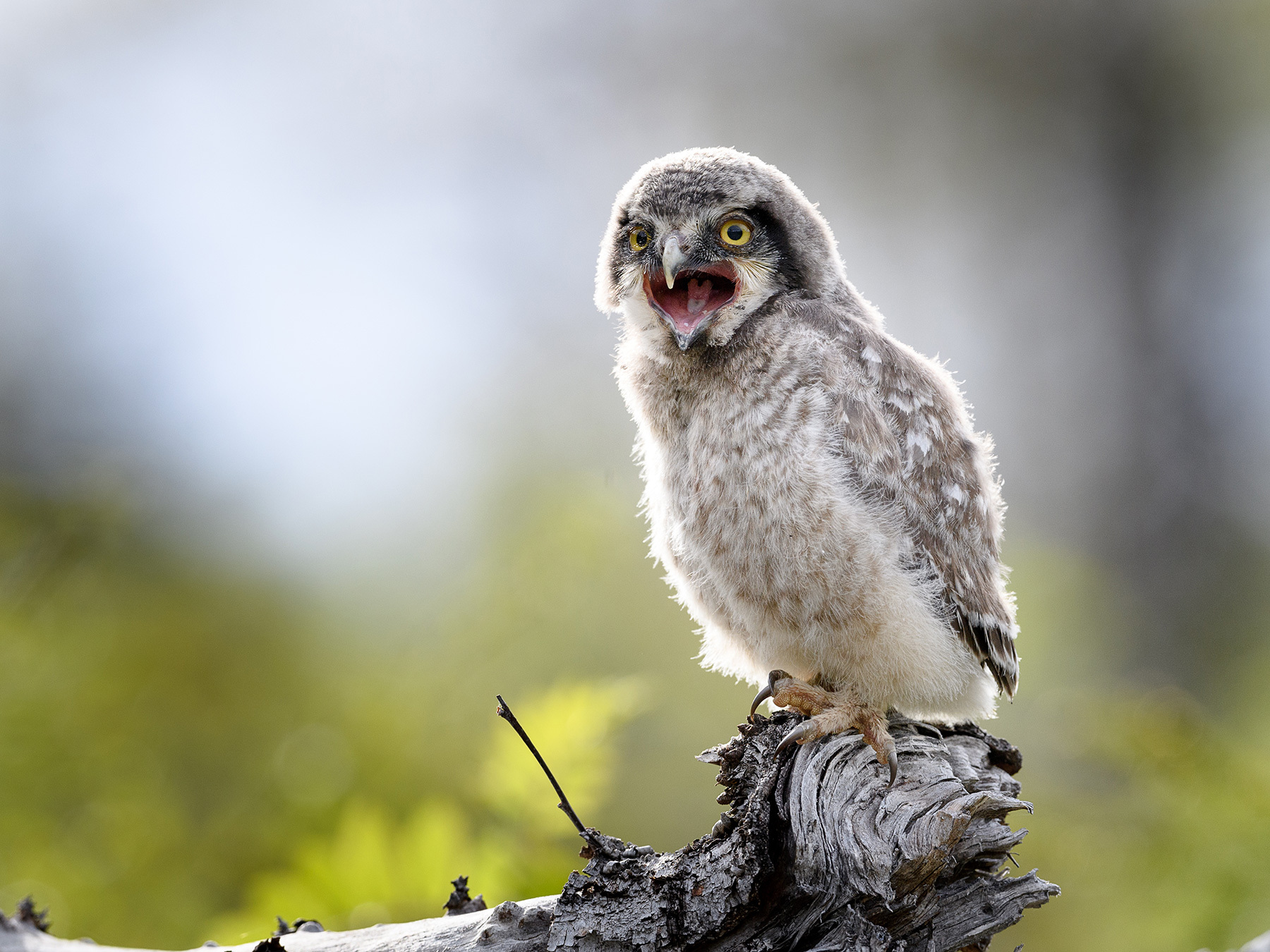
Quick facts
- Length
- 36–43 cm
- Wingspan
- 69–84 cm
- Weight
- 220–350 g
- Lifespan
- 10 years · oldest recorded 16 years
- Family
- Owls
- Migration
- Irruptive migrant
- Global status (IUCN)
- Least Concern
- World population
- 100,000 - 499,999 mature individuals
- Population trend
- Stable
- Also called
- Hawk Owl, Northern Hawk Owl
- Scientific name
- Surnia ulula
Questions
3Is a northern hawk owl an owl or hawk?
The northern hawk owl has a similar shape, flight style, and behavior to a hawk, but is classified as a member of the owl family, and has a number of typical ‘owl-like’ traits and physical characteristics. In Ontario, northern hawk owls are classed as falconry birds and licenced owners may use them in hunting.
What state does the Northern Hawk Owl live in?
Regular breeding occurs across much of Alaska, as well as in the northernmost extremes of the eastern and central US, including Washington, Montana, North and South Dakota, Minnesota, Wisconsin, and Michigan.
They are occasionally spotted in winter in Pennsylvania, New York, New Jersey, Connecticut, Massachusetts, and as far south as West Virginia and Nebraska, events which are greeted with much excitement in these states’ local birding communities.
Do Hawk owls hunt during the day?
Hawk owls are chiefly diurnal, actively hunting during daylight hours and sleeping overnight.
Sources
4- 1Fransson et al. - EURING list of longevity records for European birds (2010)
- 2BirdLife International. 2021. Surnia ulula. The IUCN Red List of Threatened Species 2021: e.T22689189A206518616. Source (opens in a new tab)
- 3BirdLife International. 2021. Surnia ulula. The IUCN Red List of Threatened Species 2021: e.T22689189A206518616. Source (opens in a new tab)
- 4Partners in Flight (2021)

Checked by
Nathan Cope, founder and editor
Nathan founded Birdfact and leads its writers and contributors in the UK, the US and Canada. He has watched and studied birds for more than ten years, and checks every article and species guide before it’s published.