
Black Redstart
Phoenicurus ochruros
By the Birdfact teamChecked by Nathan Cope
On this page14 sections
How to recognise it
What do Black Redstarts look like?
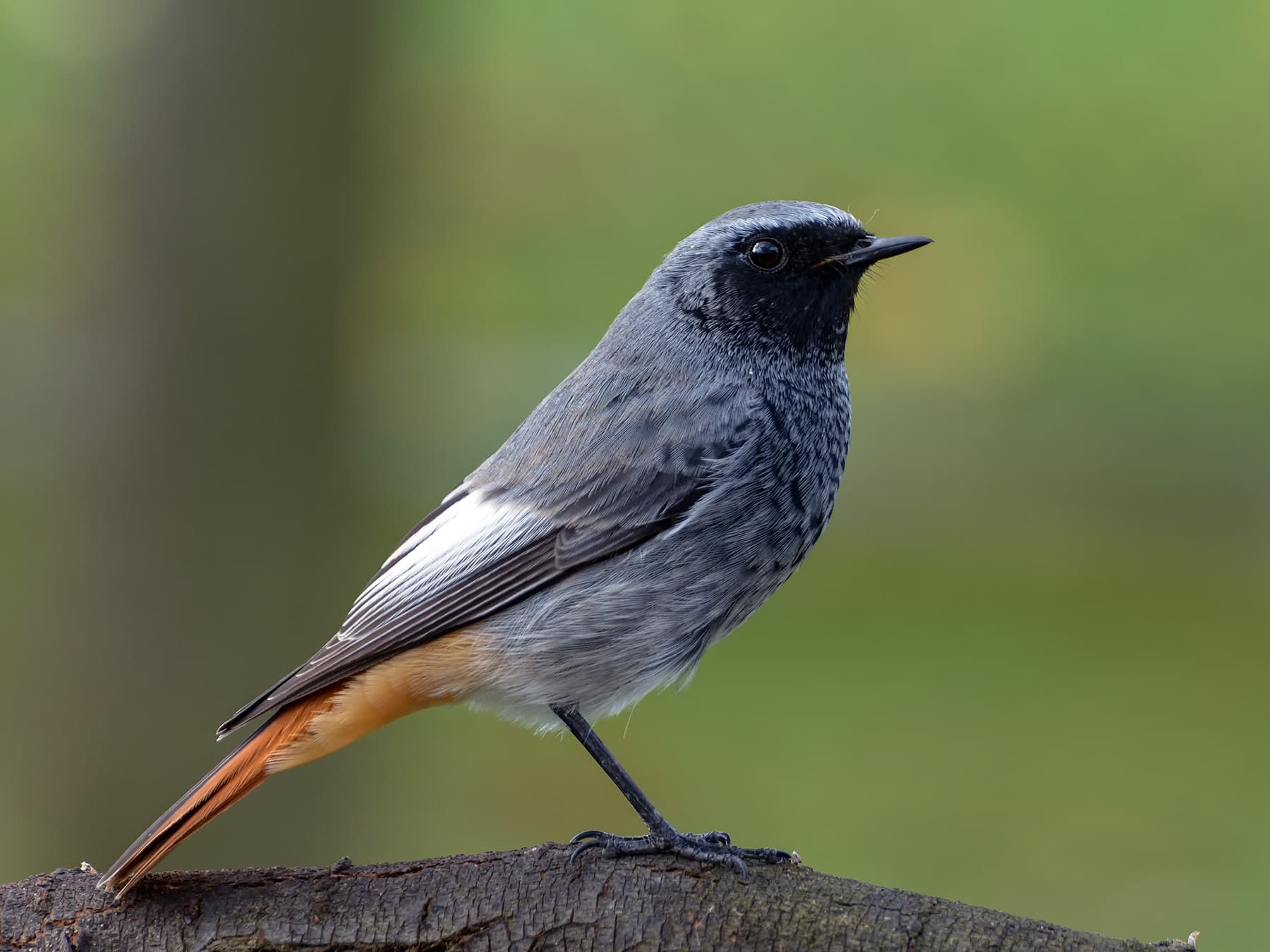
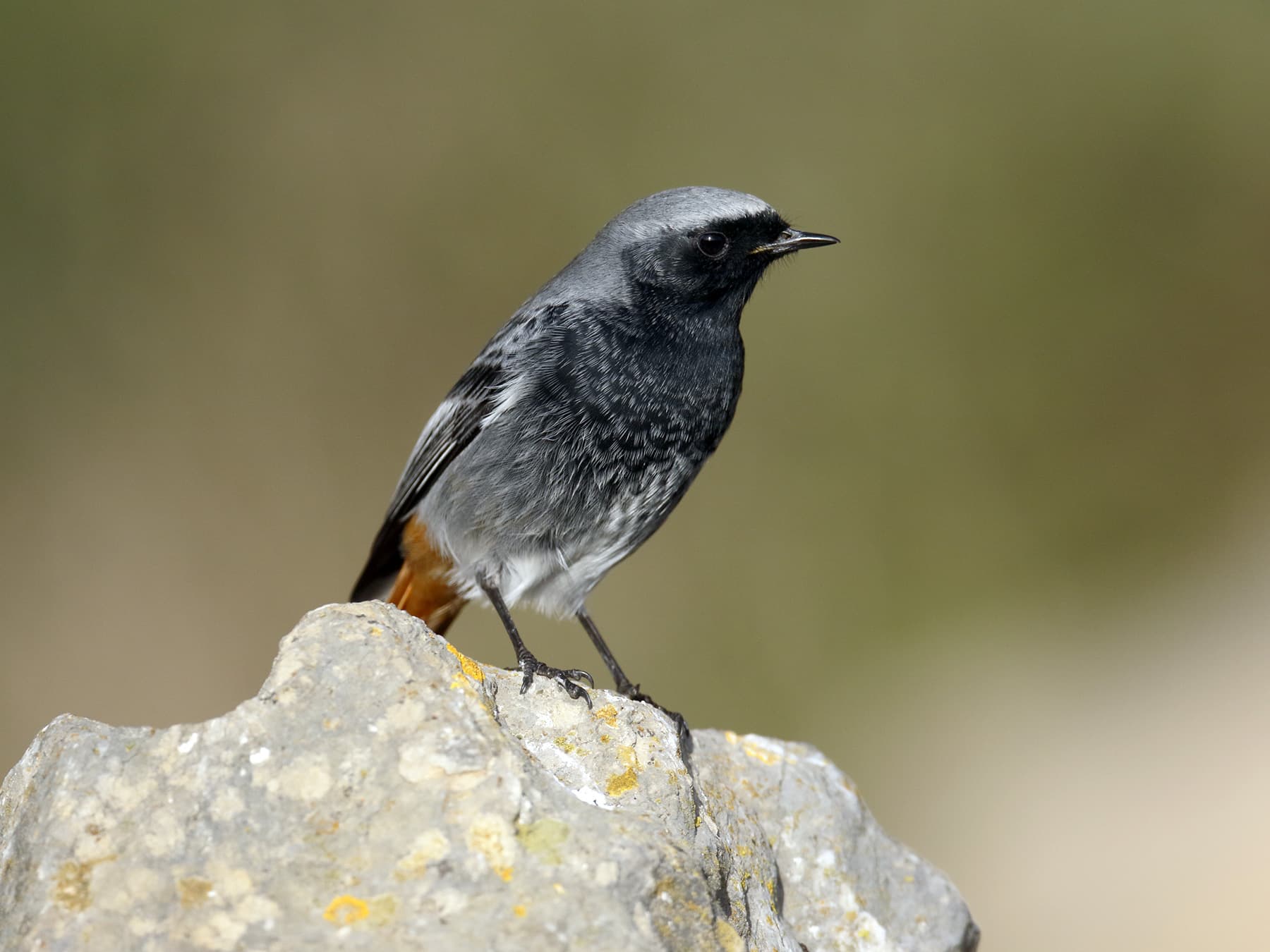
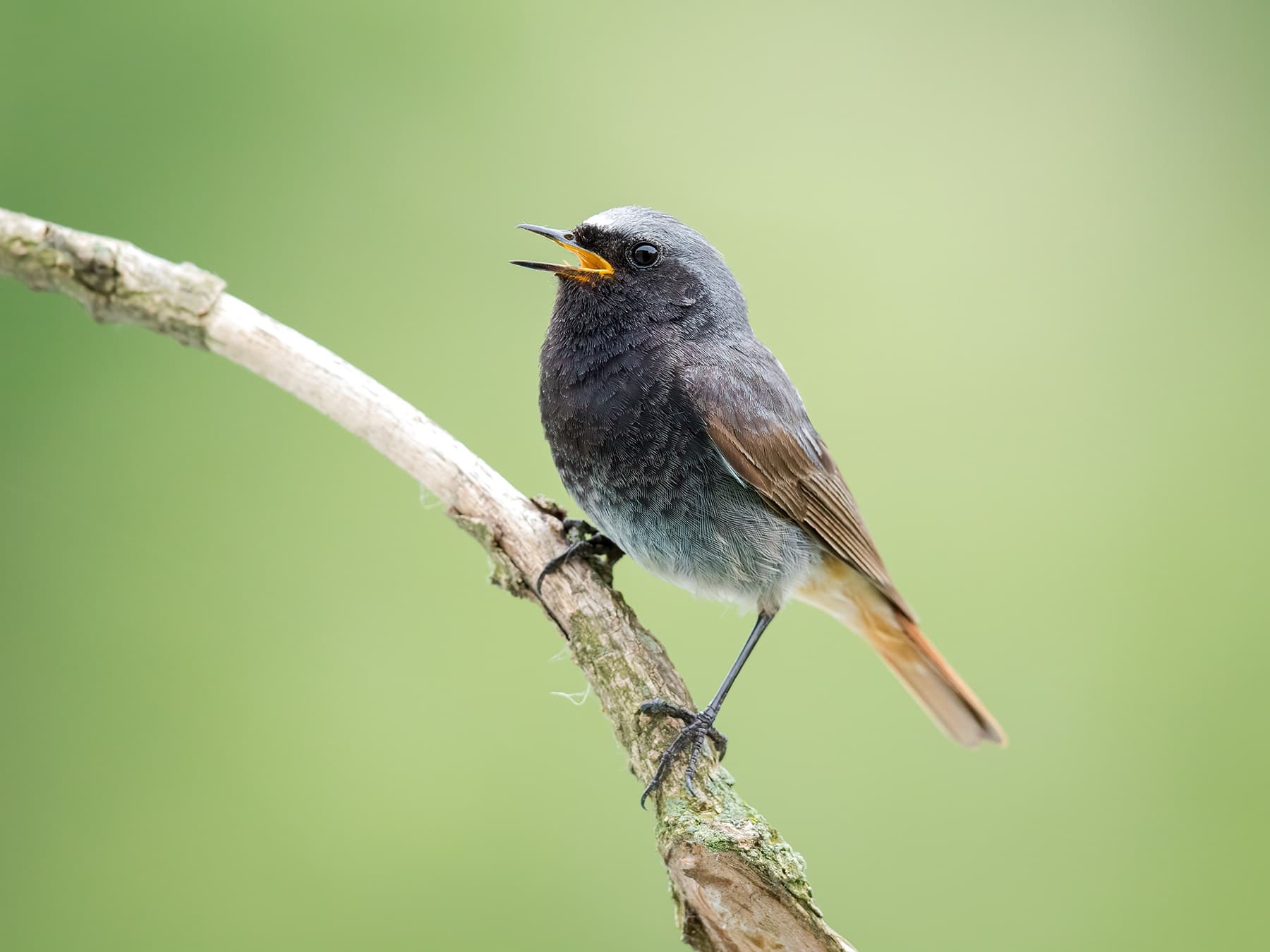
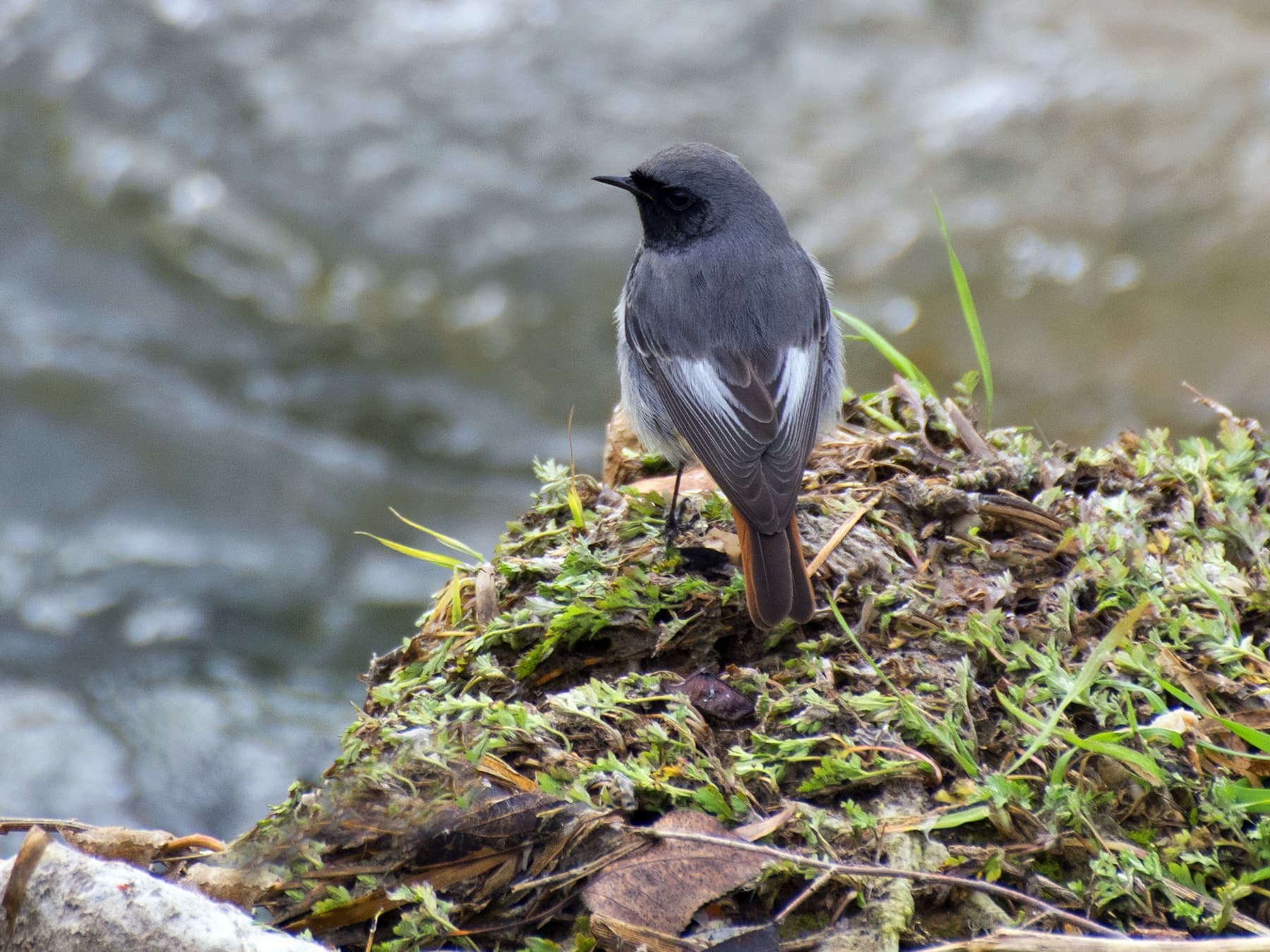
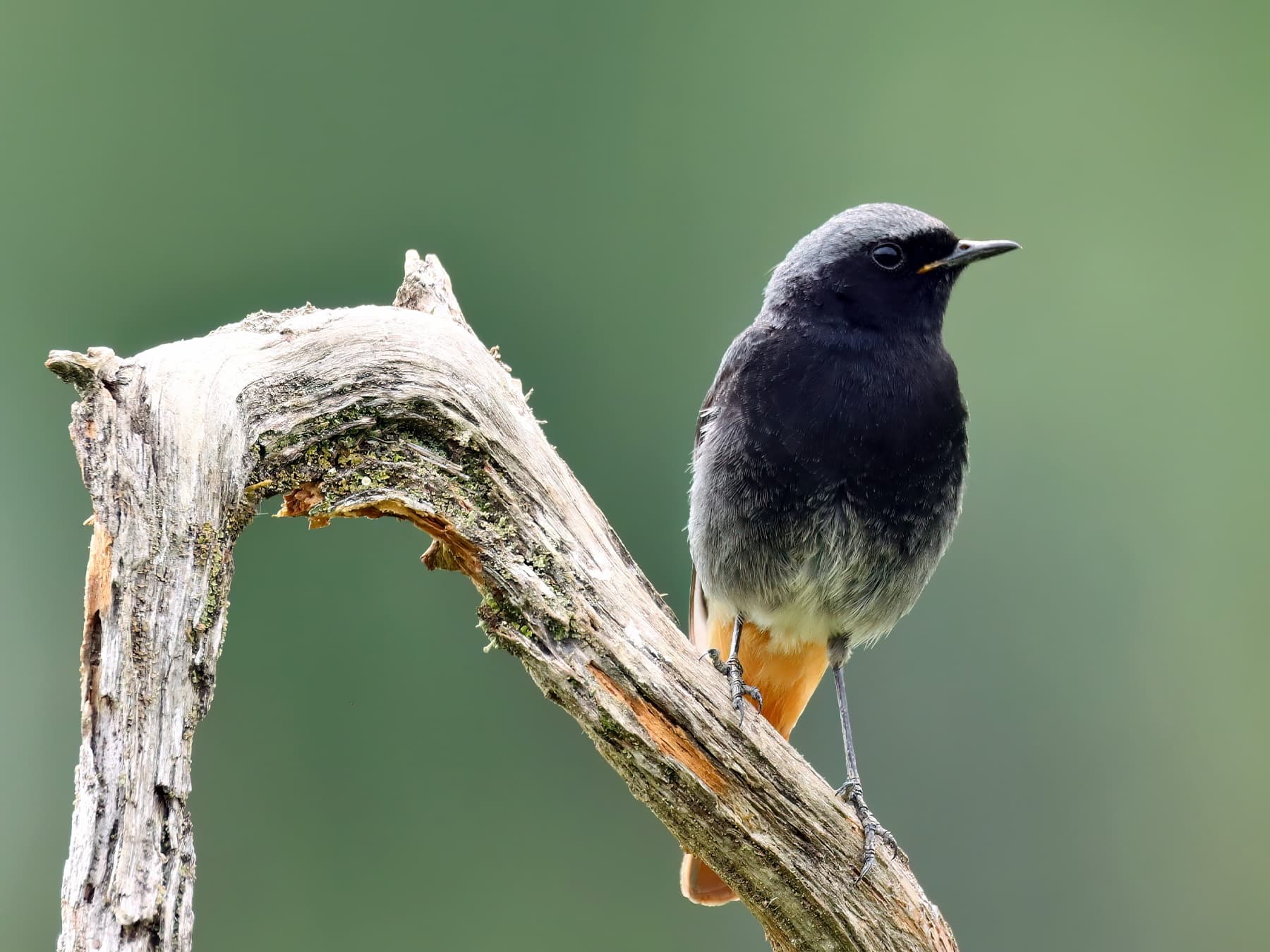
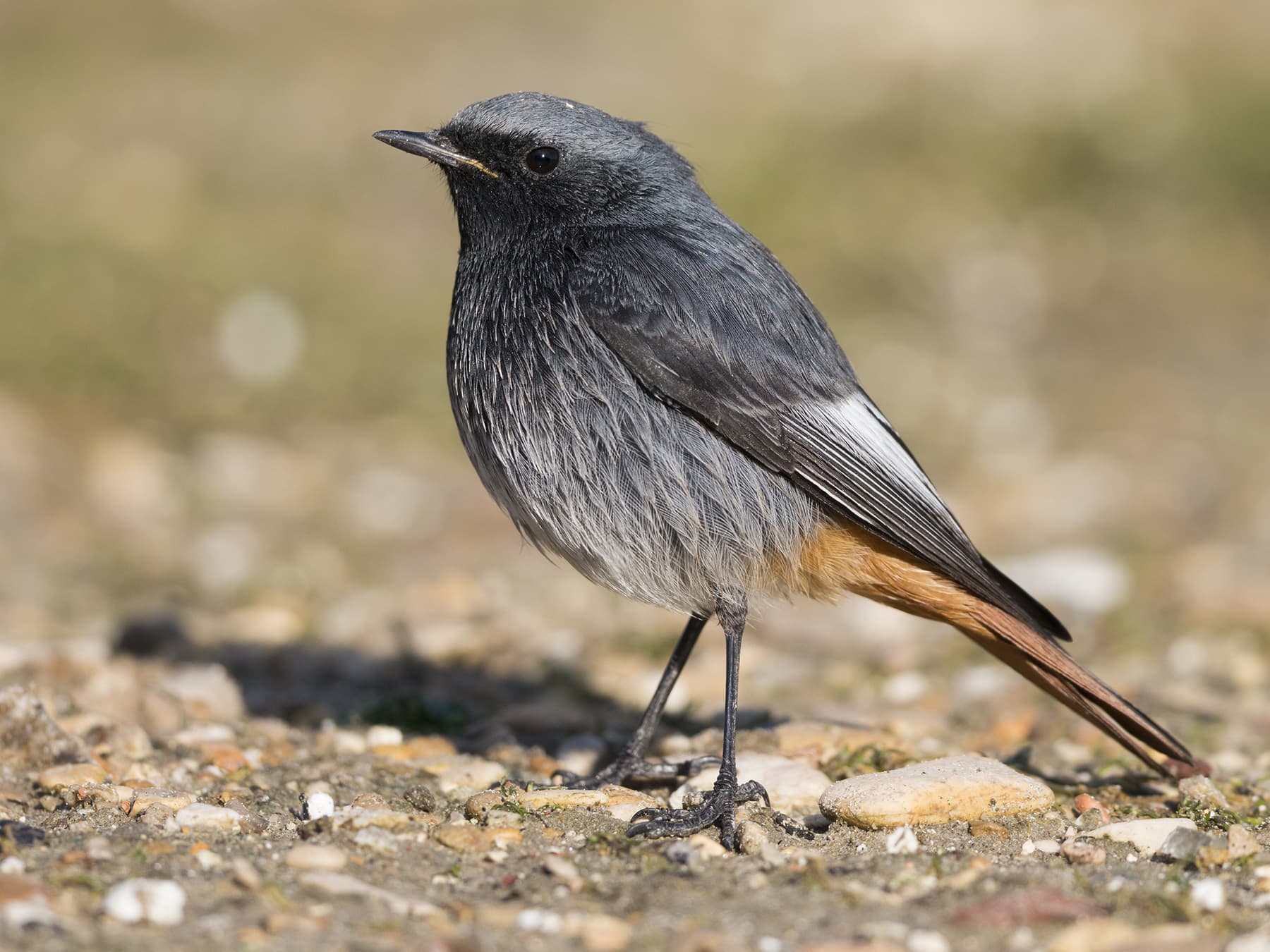
Adult male black redstarts have dark grey upperparts and almost black upper wings, with a white patch, which is visible when wings are folded. Upper tail feathers are black and edged with rust-red. Their deep black breast contrasts starkly with the chestnut-red colouring of the lower belly, rump, and outer tail feathers.
A black redstart’s facial features include a grey cap and a deep black face. Its thin bill is short and black, with a slightly hooked tip. Eyes and legs are both black, and it black legs.
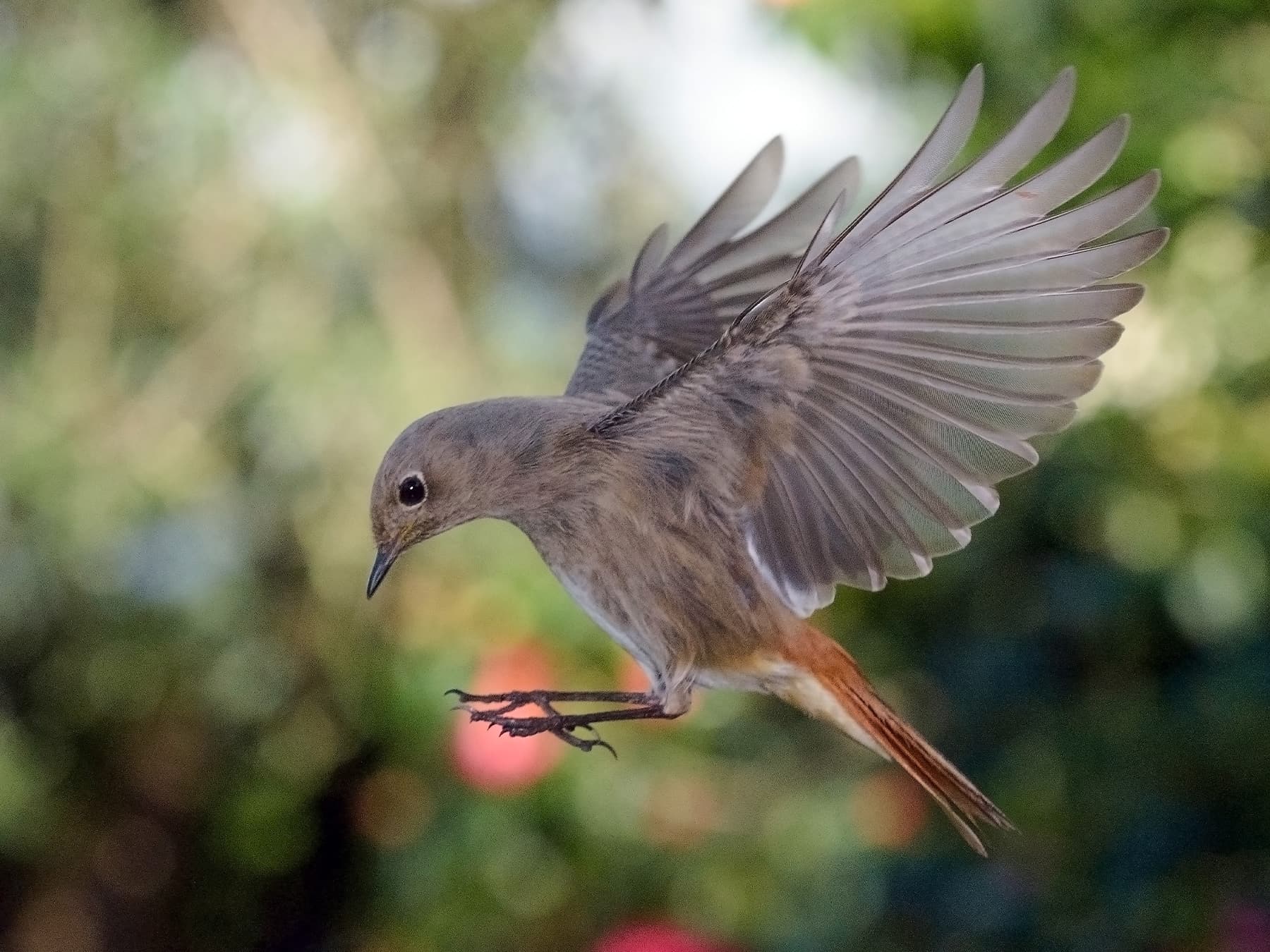
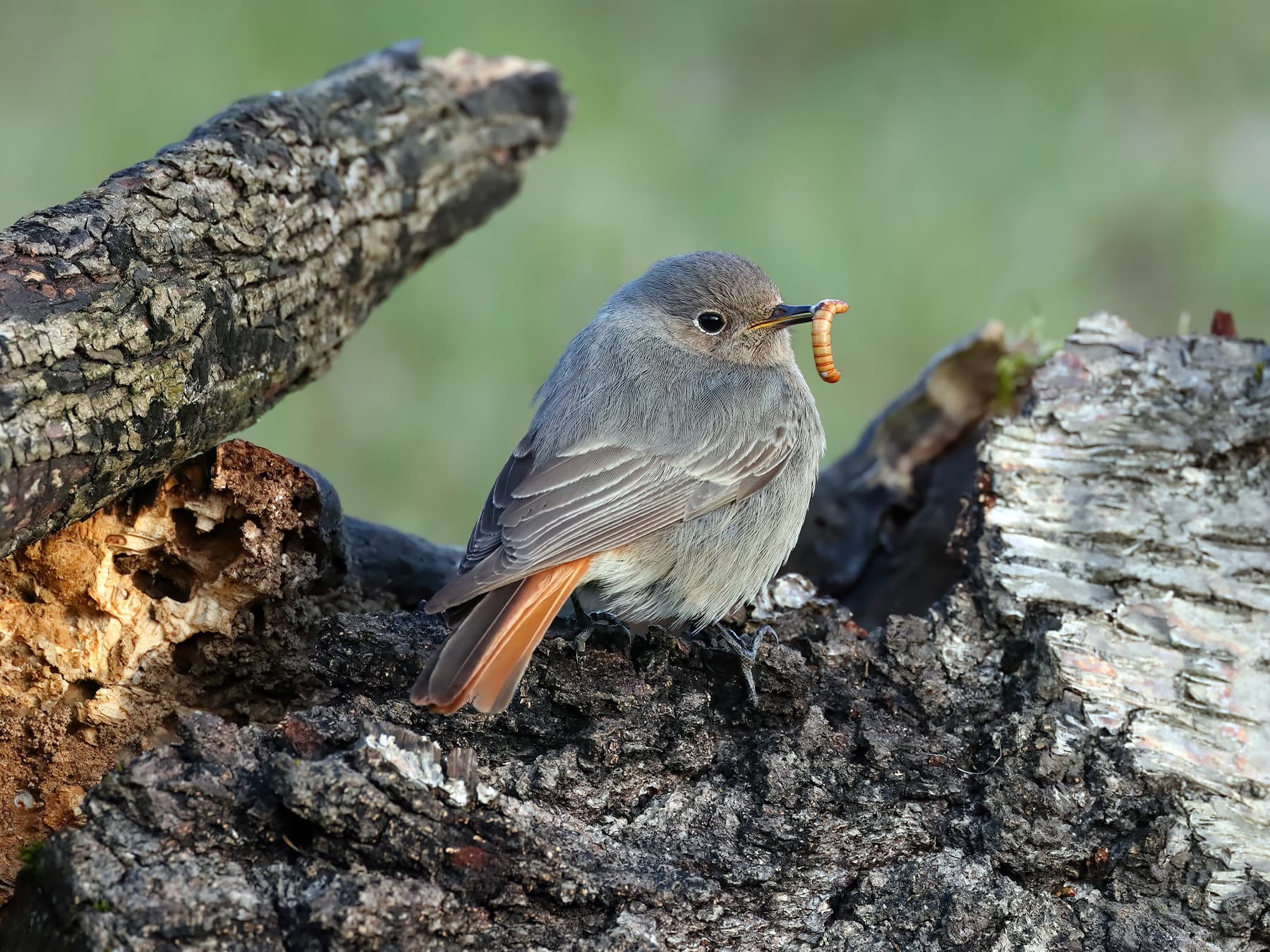
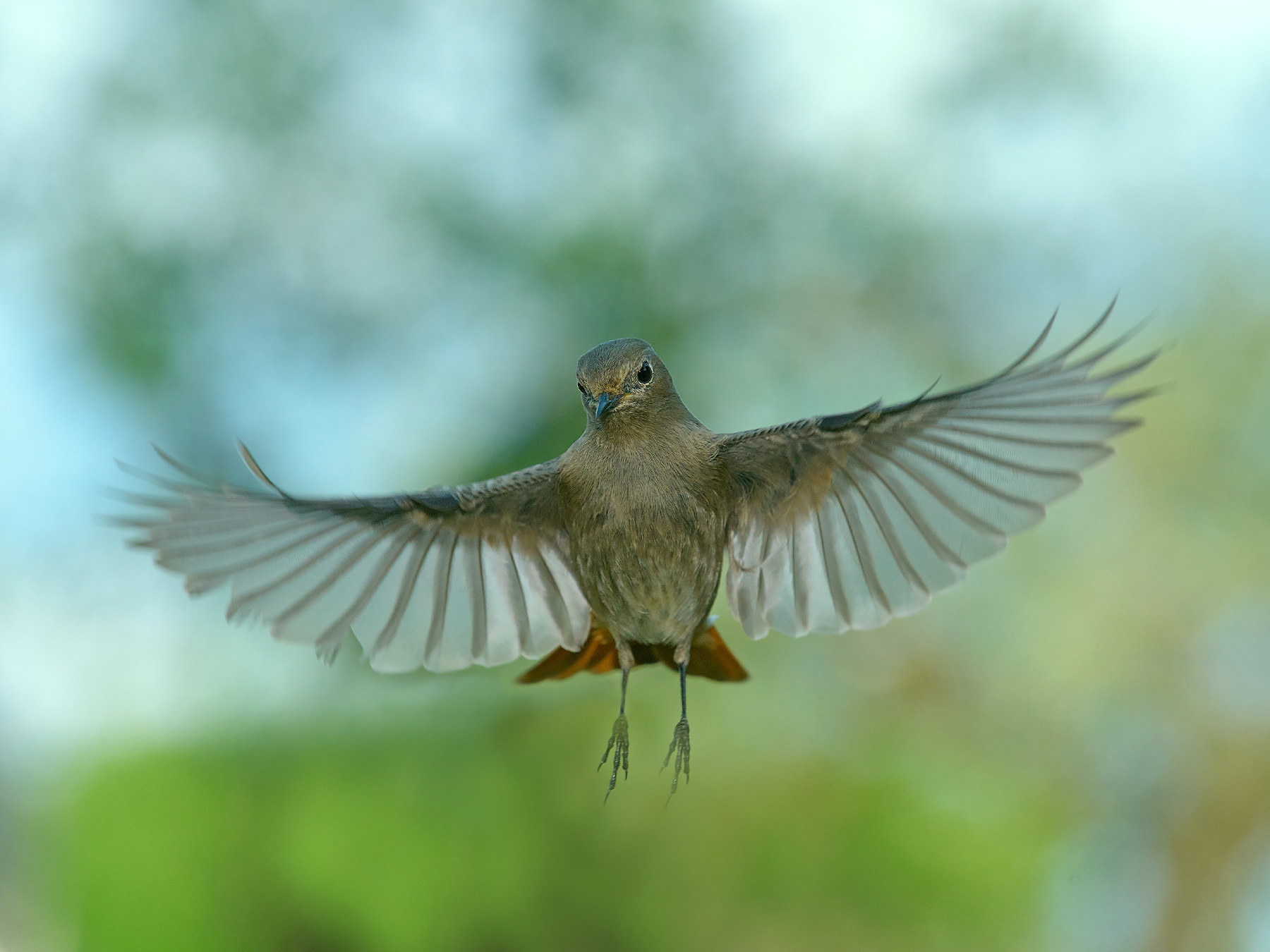
Adult females are a dull grey all over with brownish cheeks, dark upper wings, and a pale grey-brown belly. Their undertail is orange-red, similar to that of a male but less vibrant.
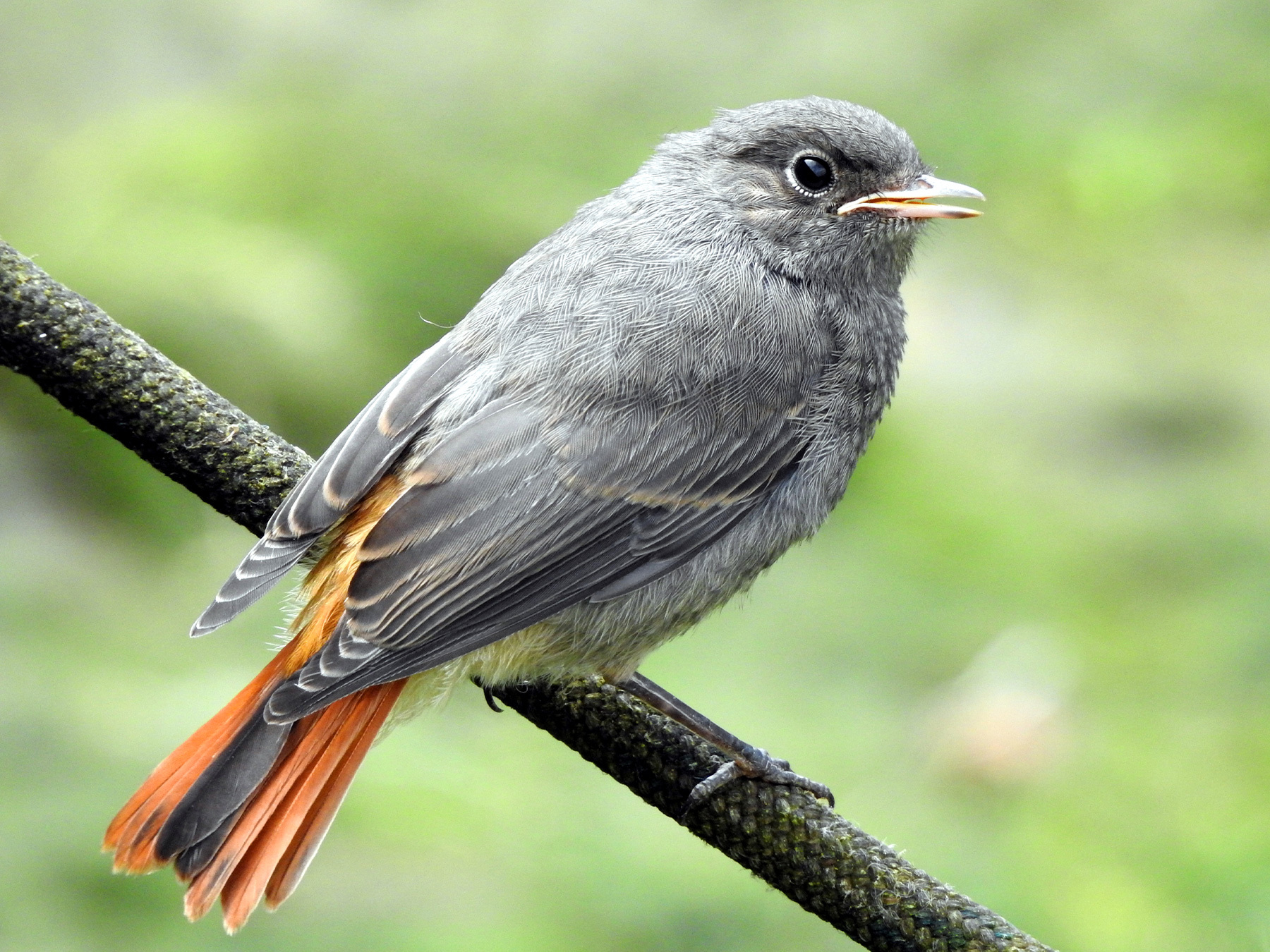
Juvenile black redstarts resemble females but are generally darker in colour, with scaling visible on their breast and belly and belly.
How big are Black Redstarts?
Black redstarts are small songbirds, around the same size as robins, but have longer tails. Males and females are the same size and weight.
- Length: 14.5 cm (5.7 in)
- Wingspan: 23 cm to 26 cm (9.1 in to 10.2in)
- Weight: 14 g to 20 g (0.5 oz to 0.7 oz)
Its size
Adults- Length
- 13–14.5 cm
- Wingspan
- 23–26 cm
- Weight
- 12–20 g
Its song and calls
What sound does a Black Redstart make?
The alarm call of a male black redstart is a short, harsh ‘tuc – tuc’ or ‘tsip’, used to defend a territory or deter intruders. The song of male black redstarts isn’t limited to the breeding season, with visiting passage migrants also heard singing with hesitant rattled ‘drrr-drrr-tawidu’ whistling notes.
- Song0:00 / 0:13
Recorded in Normandie, France · June 2023
- Call0:00 / 1:24
Recorded in Auvergne-Rhône-Alpes, France · May 2020
When and where to see it
OctoberArriving
Most recorded in October
- 1. Cornwall0.53%
- 2. Pembrokeshire0.25%
- 3. Isle of Wight0.16%
- 4. East Riding of Yorkshire0.15%
- 5. Scottish Borders0.15%
Each dot is a county, state or province: the bigger and darker, the larger the bird’s share of that place’s bird records that month. Grey dots: no regular records. The ringed point is the centre of the bird’s records this month; the arrow shows how it moved since last month, and the dashed loop its path through the year. “Arrivals” colours places where it becomes regular this month (orange) or is in its last regular month (grey). GBIF eBird Observation Dataset, 2019–2024. Map data: Natural Earth, US Census Bureau; place centres © OpenStreetMap contributors.
In your area
See when the Black Redstart is recorded in your county, state or province.
How often the Black Redstart turns up in the UK and Ireland through the year, from birdwatchers' records.
United Kingdom
Winter visitor · all year · most records in October
Ireland
Winter visitor · regularly Oct–Apr · most records in January
Show as a table
| Month | United Kingdom | Ireland |
|---|---|---|
| January | 0.030% (regular) | 0.056% (regular) |
| February | 0.024% (regular) | 0.032% (regular) |
| March | 0.032% (regular) | 0.036% (regular) |
| April | 0.022% (regular) | 0.004% (regular) |
| May | 0.011% (regular) | 0.002% |
| June | 0.010% (regular) | 0.002% |
| July | 0.007% (regular) | – |
| August | 0.006% (regular) | – |
| September | 0.010% (regular) | – |
| October | 0.064% (regular) | 0.015% (regular) |
| November | 0.047% (regular) | 0.050% (regular) |
| December | 0.027% (regular) | 0.034% (regular) |
Recorded regularly in
Worldwide: recorded regularly in 85 countries
Countries where it was recorded in at least 3 of the 6 years 2019–2024. Linked countries have their own bird list.
Europe (49)
- Åland Islands
- Albania
- Andorra
- Austria
- Belarus
- Belgium
- Bosnia & Herzegovina
- Bulgaria
- Croatia
- Czechia
- Denmark
- Estonia
- Finland
- France
- Germany
- Gibraltar
- Greece
- Guernsey
- Hungary
- Ireland
- Isle of Man
- Italy
- Jersey
- Kosovo
- Latvia
- Liechtenstein
- Lithuania
- Luxembourg
- Malta
- Moldova
- Monaco
- Montenegro
- Netherlands
- North Macedonia
- Norway
- Poland
- Portugal
- Romania
- Russia
- San Marino
- Serbia
- Slovakia
- Slovenia
- Spain
- Sweden
- Switzerland
- Ukraine
- United Kingdom
- Vatican City
Asia (31)
- Armenia
- Azerbaijan
- Bahrain
- Bangladesh
- Bhutan
- China
- Cyprus
- Georgia
- India
- Iran
- Iraq
- Israel
- Jordan
- Kazakhstan
- Kuwait
- Kyrgyzstan
- Lebanon
- Mongolia
- Myanmar (Burma)
- Nepal
- Oman
- Pakistan
- Palestinian Territories
- Qatar
- Saudi Arabia
- South Korea
- Taiwan
- Tajikistan
- Turkey
- United Arab Emirates
- Uzbekistan
Data: EOD – eBird Observation Dataset (Cornell Lab of Ornithology), accessed via GBIF.org, CC BY 4.0. Records from 2019–2024, aggregated and filtered by Birdfact. How these lists are made
What is the habitat of a Black Redstart?
Open expanses of wasteland with rubble and stony ground, with sparse vegetation offer an ideal habitat for black redstarts, especially urban landscapes with abandoned towers, buildings, or other tall disused structures close by. Rugged terrain, with rocky slopes and crevices and ledges, is favoured.
Parks, woodlands, and gardens are usually avoided in preference of environments that mimic natural rugged sites. Railway sidings, roadside laybys, industrial estates, and power stations are some examples of common urban sites where black redstarts are found.
What is the range of a Black Redstart?
Black redstarts breed in parts of Europe, Asia, and Africa. Their European range extends from the UK, France, Germany, and Poland, through southern Scandinavia and eastern Europe to Ukraine and the far southwestern corner of Russia.
These populations typically move south once breeding is complete, although black redstarts have a patchy distribution all year round in most southern European countries. Italy, Greece, and the Balkan States, as well as parts of North Africa’s coastline, welcome an influx of overwintering birds each autumn.
To the east, breeding takes place in Central Asia, distributed between Turkey, Iran, Afghanistan, Kazakhstan, and throughout the western half of China. Wintering grounds for eastern populations are found across India, Pakistan, the Arabian Peninsula, and into East Africa, as far south as Somalia and Ethiopia.
Where do Black Redstarts live?
Europe forms around 35 percent of the global population of black redstarts, with between 11.5 and 20 million individual birds. Germany, Spain, and Turkey are known to have the largest resident populations.
How rare are Black Redstarts?
Globally, black redstarts have a wide range and a large, increasing population of between 32 and 57 million individuals. However, in the UK, they are much more of a rarity, with only 58 breeding pairs recorded between 2013 and 2017.
Sightings outside of the breeding season are more common, with arrivals from northern Europe in the autumn and temporary passage migrants passing through en route to their wintering grounds further south.
Where can you see Black Redstarts in the UK?
Industrial areas, power stations, and urban settlements are locations most commonly associated with sightings of black redstarts.
Greater London, Birmingham, Liverpool, Nottingham, Ipswich and the eastern and southern coasts of England are all known sites where successful breeding has occurred in recent years. East Anglia offers improved chances of sightings of passage individuals during spring and autumn migration.
Migration
Do Black Redstarts migrate?
Black redstarts’ migratory status varies from region to region. In northern regions, they are mostly migratory, moving southwest from northern and eastern Europe into North Africa, and from central Asia into the Arabian Peninsula and Indian Subcontinent.
Southern European populations, including those in Spain, Portugal, Italy, and Greece, are non-migratory and remain in the same territories all year round.
Are Black Redstarts native to the UK?
Black redstarts do breed in the UK and are resident in the country all year round, although the population is incredibly low and their presence is limited to coastal regions.
UK numbers increase with winter arrivals from Europe each autumn, and passage sightings, particularly across East Anglia, are regularly reported between September and November.
Tips for seeing it
- Look for Black Redstarts on rooftops, chimneys, and other high urban structures
- Listen for their distinctive song, especially at dawn and dusk
- Observe their characteristic tail-wagging behaviour for easy identification
- In the UK, coastal areas and industrial sites are good spots for sightings, particularly during winter
What it eats
What do Black Redstarts eat?
Invertebrates and berries are both important in the diets of black redstarts. Insects, including grasshoppers, flies, earwigs, cockroaches, beetles, butterflies and moths, and ants, bees, and wasps are among their most common prey, as well as spiders, worms, millipedes, woodlice, and caterpillars.
Fruit, berries, and seeds increase in importance after the breeding season, with bramble, hawthorn, strawberry, bilberry, pea, buckthorn, and juniper among popular food sources.
What do Black Redstart chicks eat?
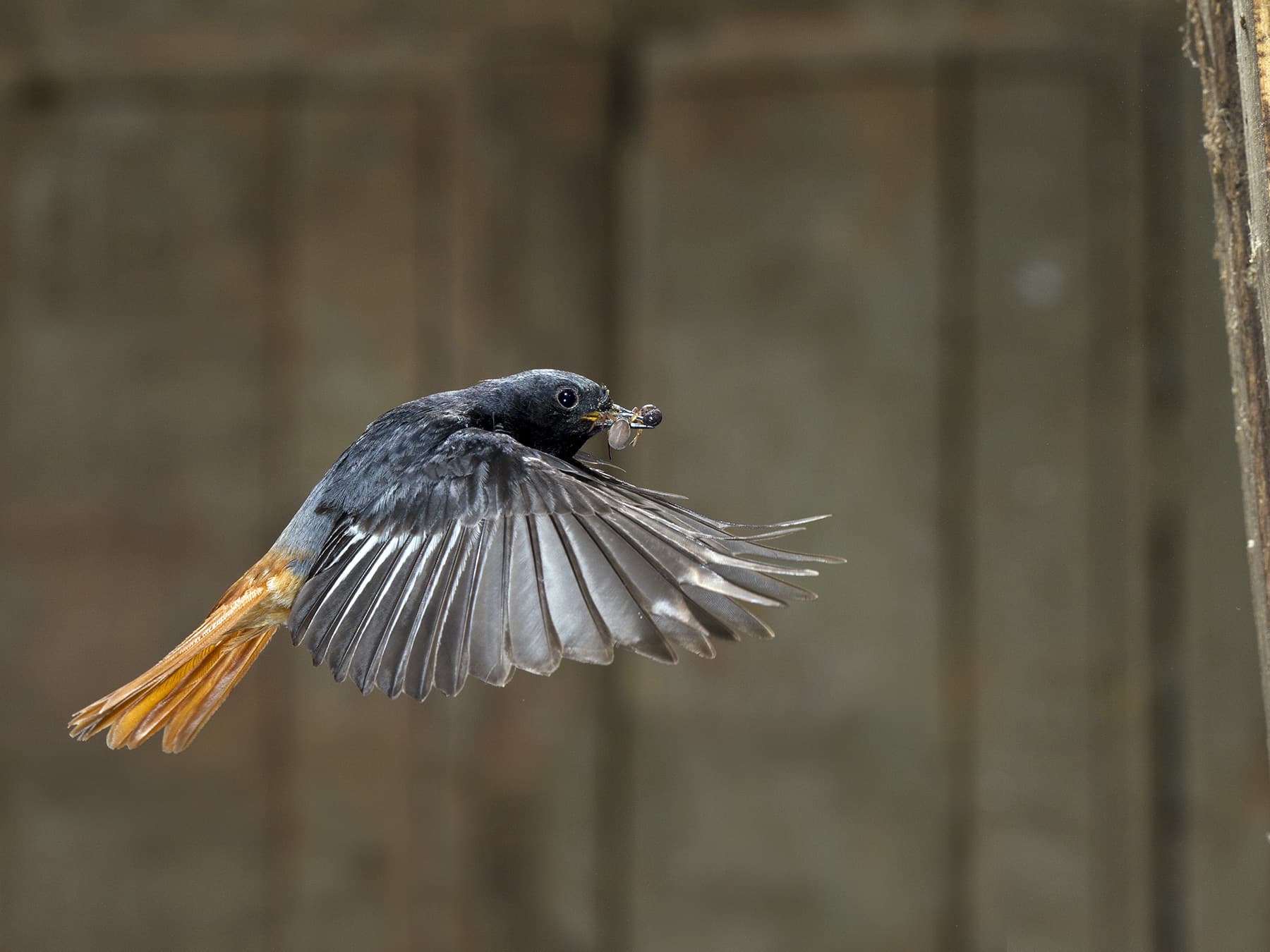
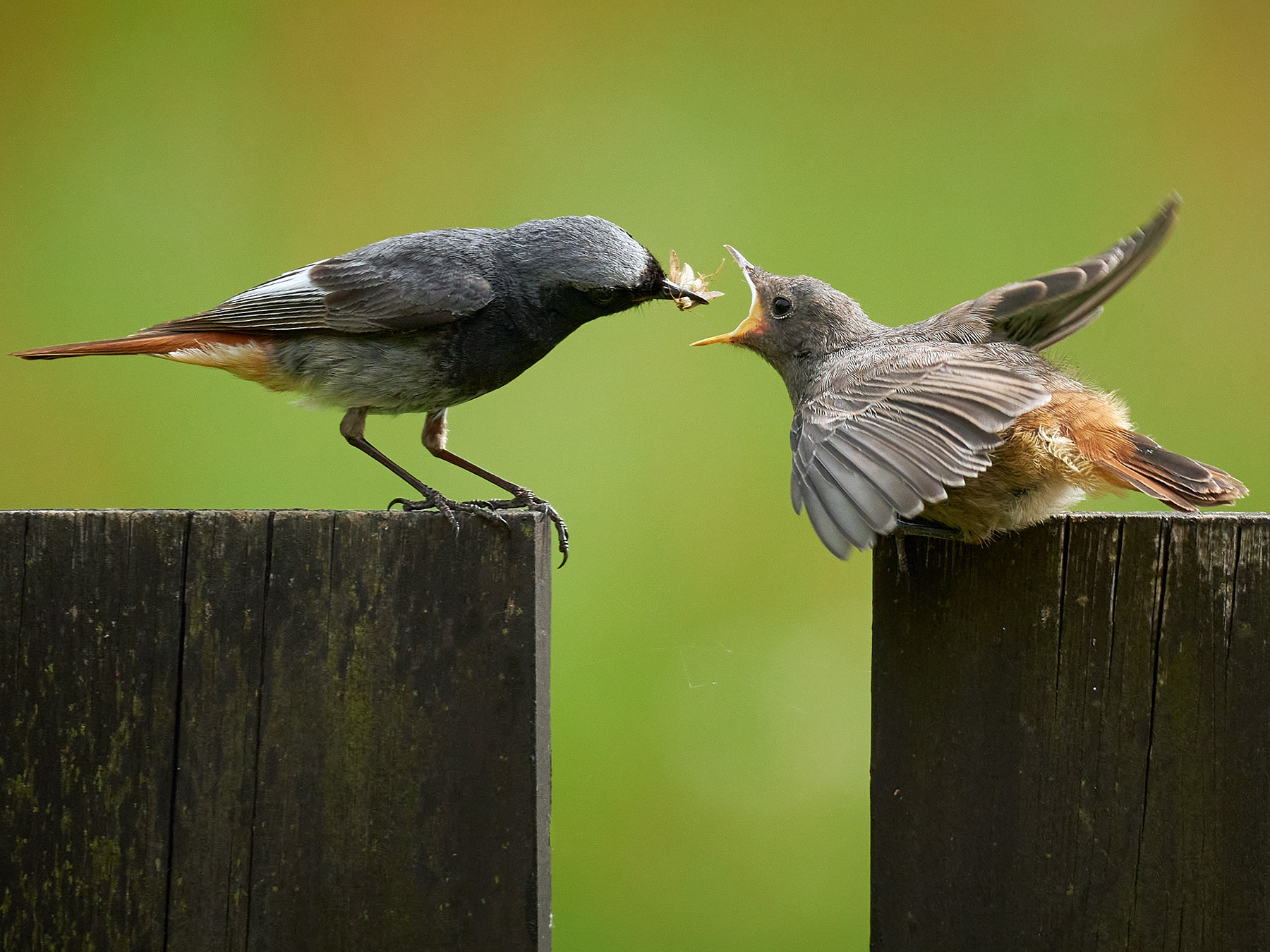
Both male and female redstarts feed young, bringing a mixture of insects and fruits to the nest site. Flies and ants are the most common insect prey and berries and seeds are also fed.
Nesting and breeding
Where do Black Redstarts nest?
Black redstarts’ nests are loose deep cups of grass and stems, lined with moss, hair, wool, and feathers. The female builds the nest structure in a crevice, rocky slope, or crag, or in an earth bank, a pile of stones, or on the ground.
When do Black Redstarts nest?
The breeding season for black redstarts begins in April and lasts until July. Pairs usually raise two broods together, and occasionally a third brood will be successfully attempted.
The first clutch is laid in April, and incubation lasts for 12 to 13 days, with only the female brooding the eggs. Young black redstarts are fed by both parents and fledge at between 12 and 17 days.
What do Black Redstart eggs look like?
Black redstarts lay four to six white or pale blue-green eggs. Their eggs, which are shiny and smooth, measure on average 19 mm by 14 mm (0.7 in by 0.6 in).
Do Black Redstarts mate for life?
Black redstarts usually mate for life, forming and maintaining a strong bond with their mate. In winter, black redstarts usually become solitary and do not closely associate with other birds, although occasionally pairs of groups of three or more may be spotted foraging together.
Behaviour
Are Black Redstarts aggressive?
Some territorial aggression is observed in male black redstarts during the breeding season, with intolerance shown to birds that approach their nest site too closely. The song is the main tactic used to warn potential intruders off.
Where do Black Redstarts sleep at night?
Black redstarts are thought to roost in branches of trees and shrubbery, concealed by foliage and out of sight or reach of nocturnal predators. Roosting spots in crevices and on ledges, as well as on power cables may also be used.
Lifespan and predators
How long do Black Redstarts live?
The oldest documented black redstart reached 5 years and 2 days, identified by a ringing programme in 2015. First-year birds are known to breed occasionally, although are more successful in their second year.
What are the predators of Black Redstarts?
Common predators of black redstarts include birds of prey, snakes, and domestic cats. Tail-flicking is used by the species to deter predators and avoid being attacked.
Are Black Redstarts protected?
Black redstarts are protected as Schedule I birds under the Wildlife and Countryside Act of 1981. This legislation prohibits any kind of interference with nest sites, eggs, and young, as well as making it an offence to knowingly kill, injure or take one into captivity.
Are Black Redstarts endangered?
In the UK, black redstarts have been classified with Amber status on the British Birds of Conservation Concern list, due to the low breeding numbers and concern over the long-term survival of the species if habitat loss and population decline continue. Globally, the black redstarts are rated as species of least concern.
Conservation
While the Black Redstart is listed as Least Concern globally, it faces localised threats from urban development and climate change.
In the UK, it's a protected species due to its small breeding population. Conservation efforts focus on creating suitable urban habitats and preserving traditional nesting sites.
Similar birds
Often mistaken for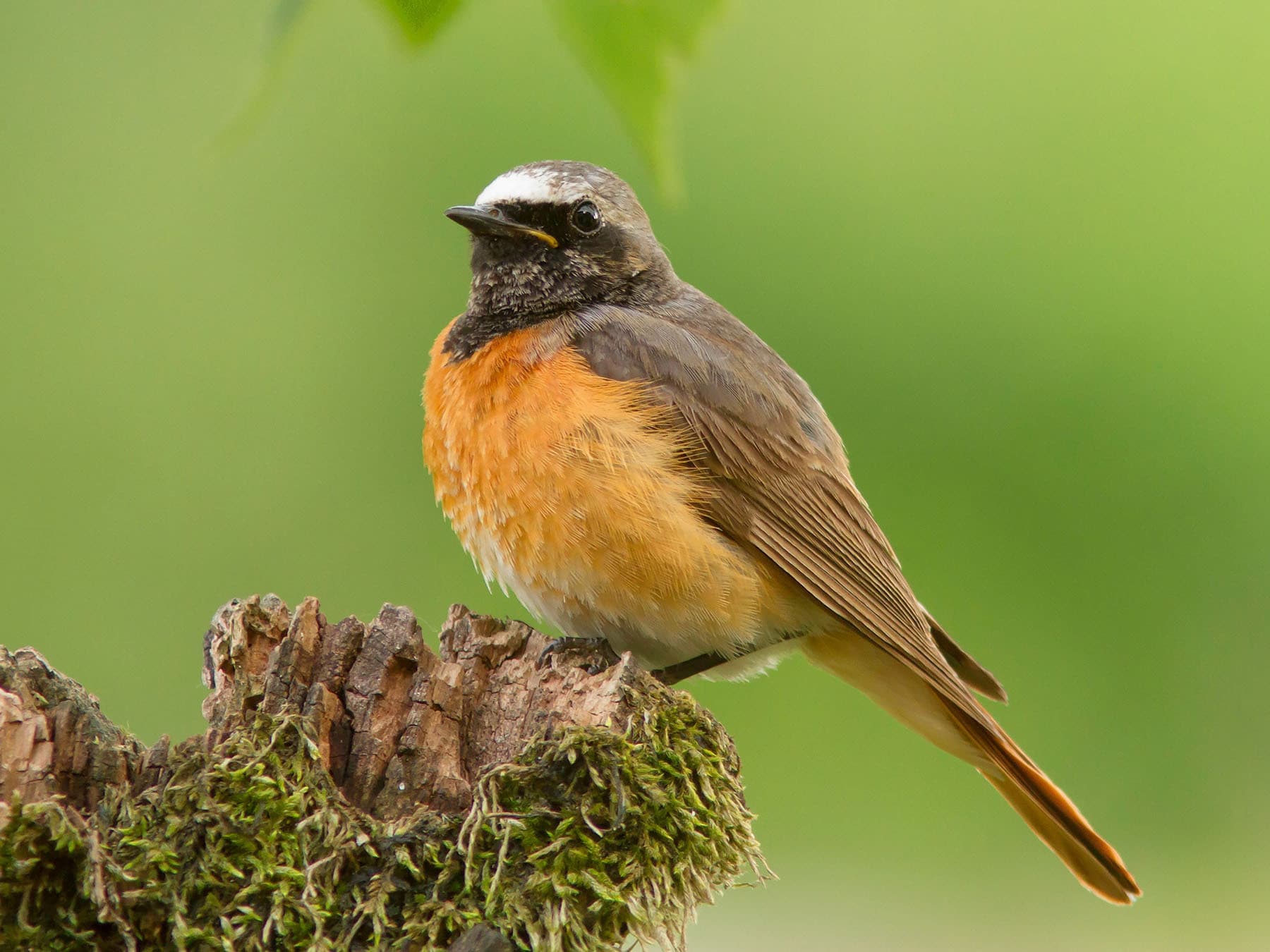
More photos
4 photos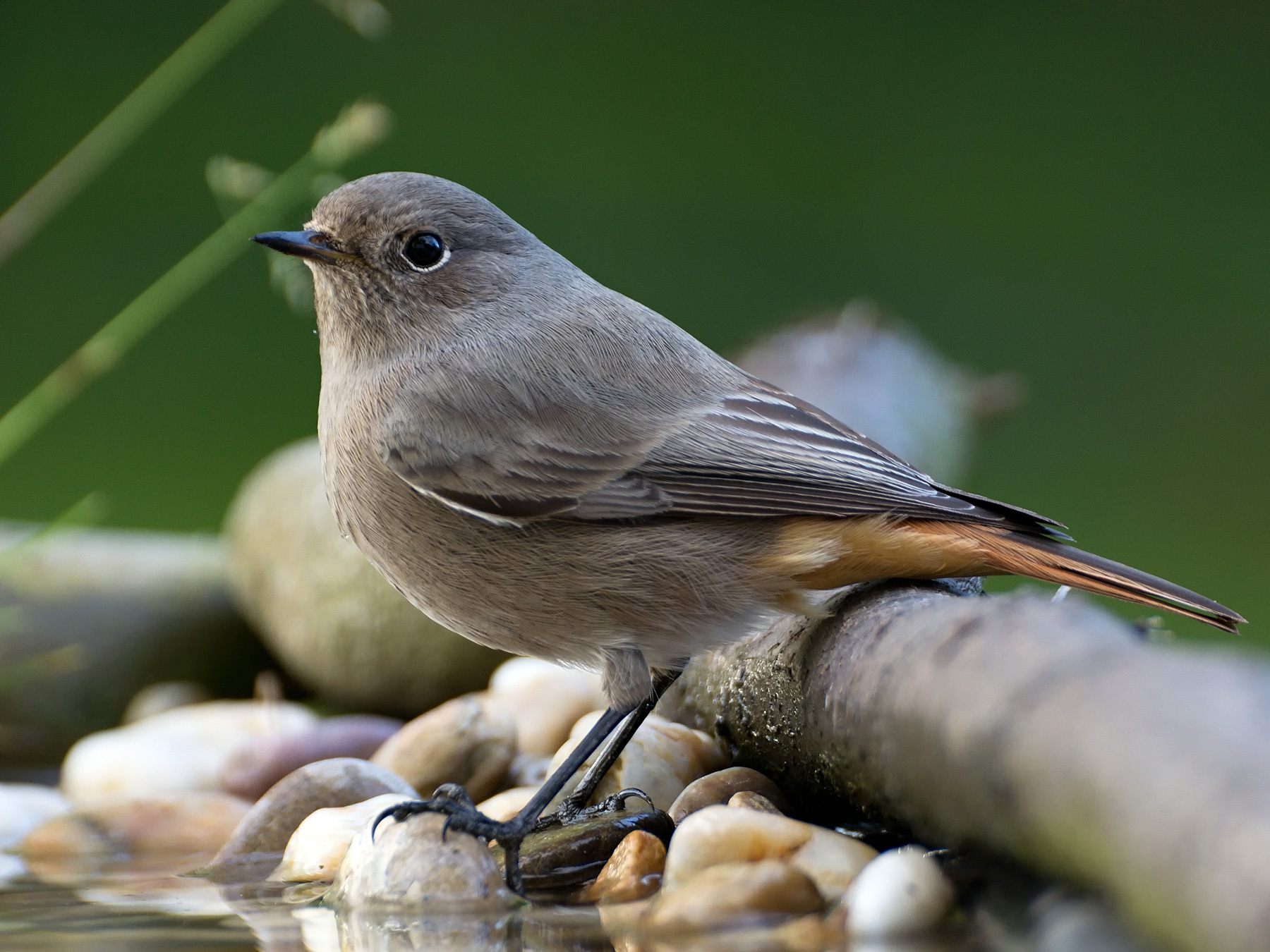
Quick facts
- Length
- 13–14.5 cm
- Wingspan
- 23–26 cm
- Weight
- 12–20 g
- Lifespan
- 5 years · oldest recorded 10.2 years
- Family
- Old World Flycatchers
- Migration
- Partial migrant
- Global status (IUCN)
- Least Concern
- World population
- 32,800,000 - 57,100,000 mature individuals
- Population trend
- Increasing
- Scientific name
- Phoenicurus ochruros
Questions
3What is the difference between Common Redstart and Black Redstart?
As you might expect from their name, common redstarts are a lot less rare than black redstarts and are widespread throughout the UK. Similar in size and shape, colouring is the key way to tell the difference between the species.
Male black redstarts’ plumage is dominated by black, with a black breast, an orange-red belly, and grey-black upperparts. Common redstarts have lighter grey-brown upperparts, a white forehead, and an orange-red breast and belly. Females are more similar, although female black redstarts are generally darker, and female common redstarts have faint reddish colouring visible on the breast.
What do you feed Black Redstart?
Black redstarts do not normally visit gardens and survive by foraging for insects and invertebrates and wild berries and seeds. Areas of wild vegetation where they have access to a diverse range of insect and plant species
Do Black Redstarts wag their tails?
Tail flicking is a common trait of black redstarts, and it’s observed to increase in frequency when they sense a predator nearby. Tail flicking is also part of the male black redstart’s courtship display, drawing attention to the bright rusty-orange tail feathers.
Sources
4- 1BirdLife International. 2019. Phoenicurus ochruros (amended version of 2018 assessment). The IUCN Red List of Threatened Species 2019: e.T22710051A155610899. Source (opens in a new tab)
- 2EBCC (2015)
- 3BirdLife International. 2019. Phoenicurus ochruros (amended version of 2018 assessment). The IUCN Red List of Threatened Species 2019: e.T22710051A155610899. Source (opens in a new tab)
- 4Fransson et al., EURING list of longevity records for European birds (2010) Source (opens in a new tab)

Checked by
Nathan Cope, founder and editor
Nathan founded Birdfact and leads its writers and contributors in the UK, the US and Canada. He has watched and studied birds for more than ten years, and checks every article and species guide before it’s published.