


Bearded Tit
Bearded Reedling, Bearded Parrotbill · Panurus biarmicus
By the Birdfact teamChecked by Nathan Cope
On this page13 sections
How to recognise it
What do Bearded Tits look like?
Male and female bearded tits are unalike, but both are easy to identify, due to their unique markings.
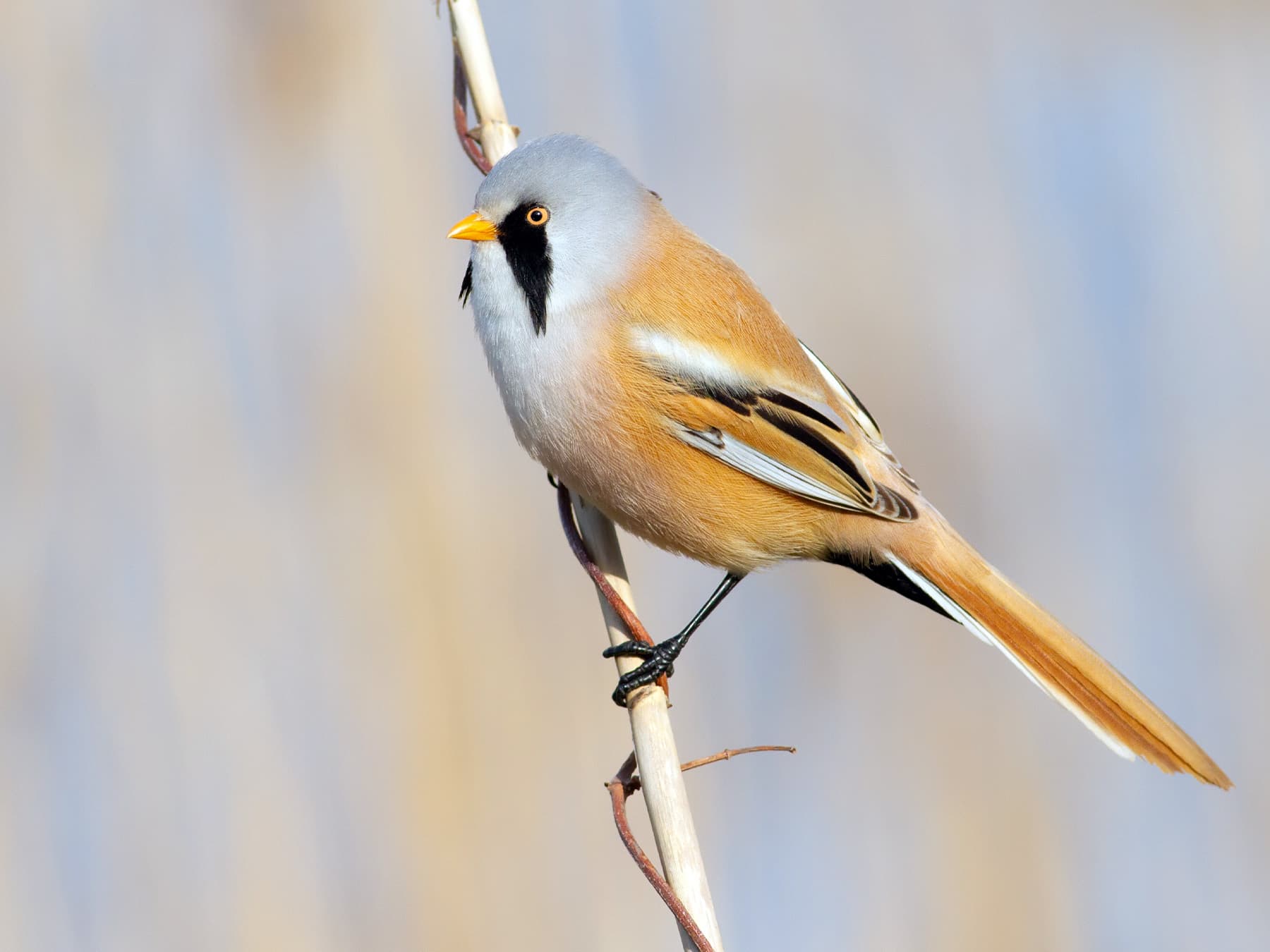
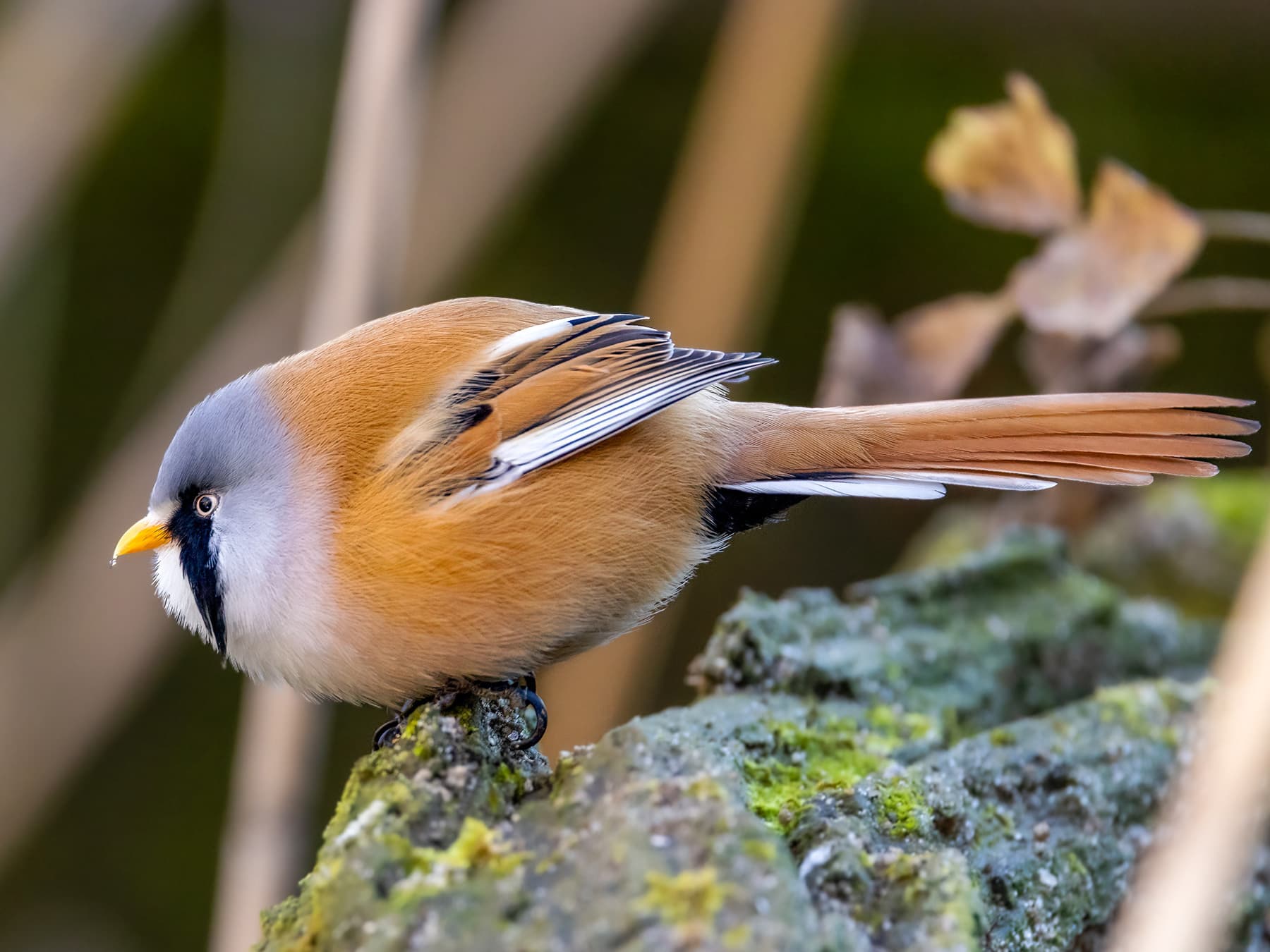
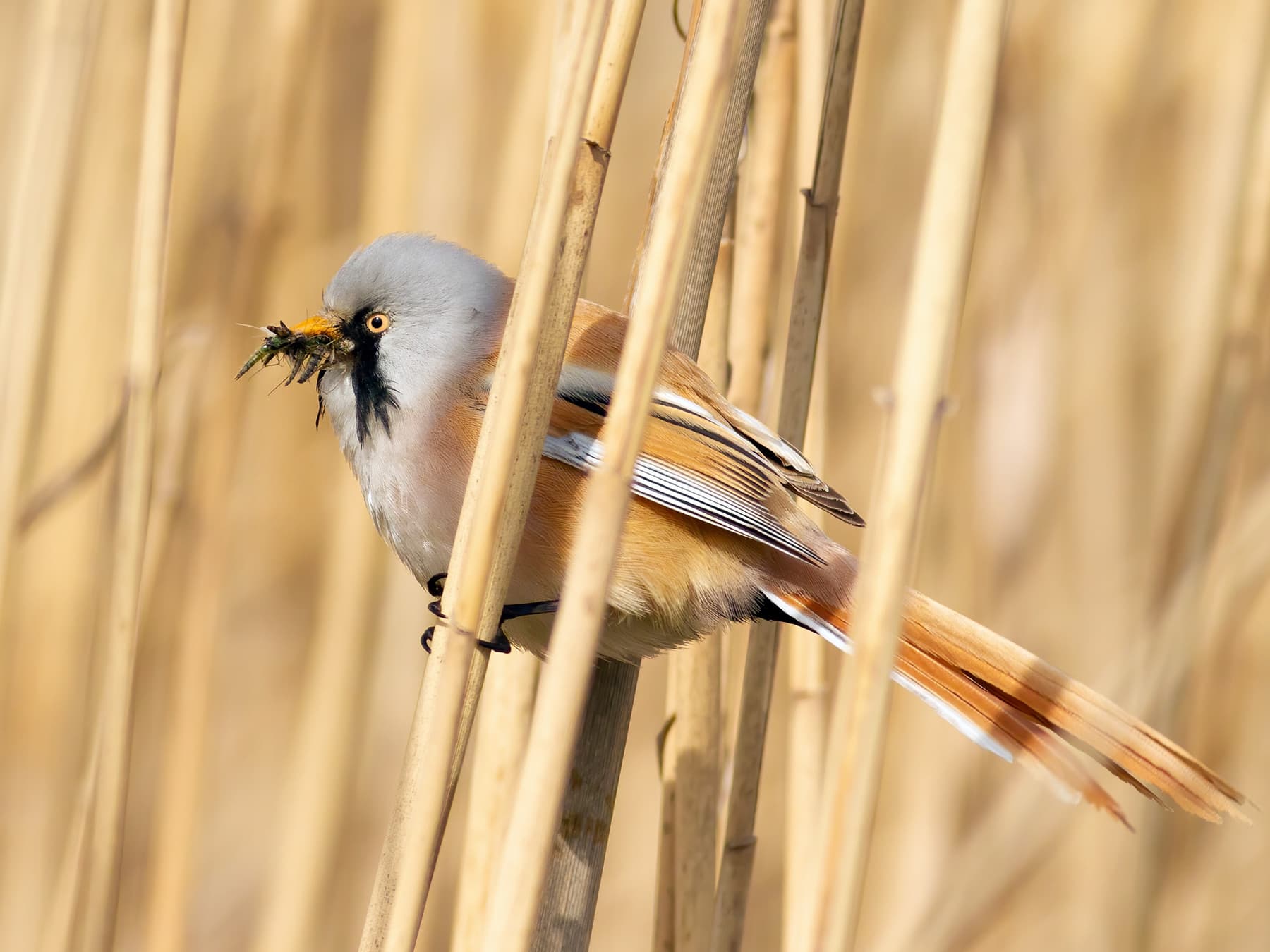
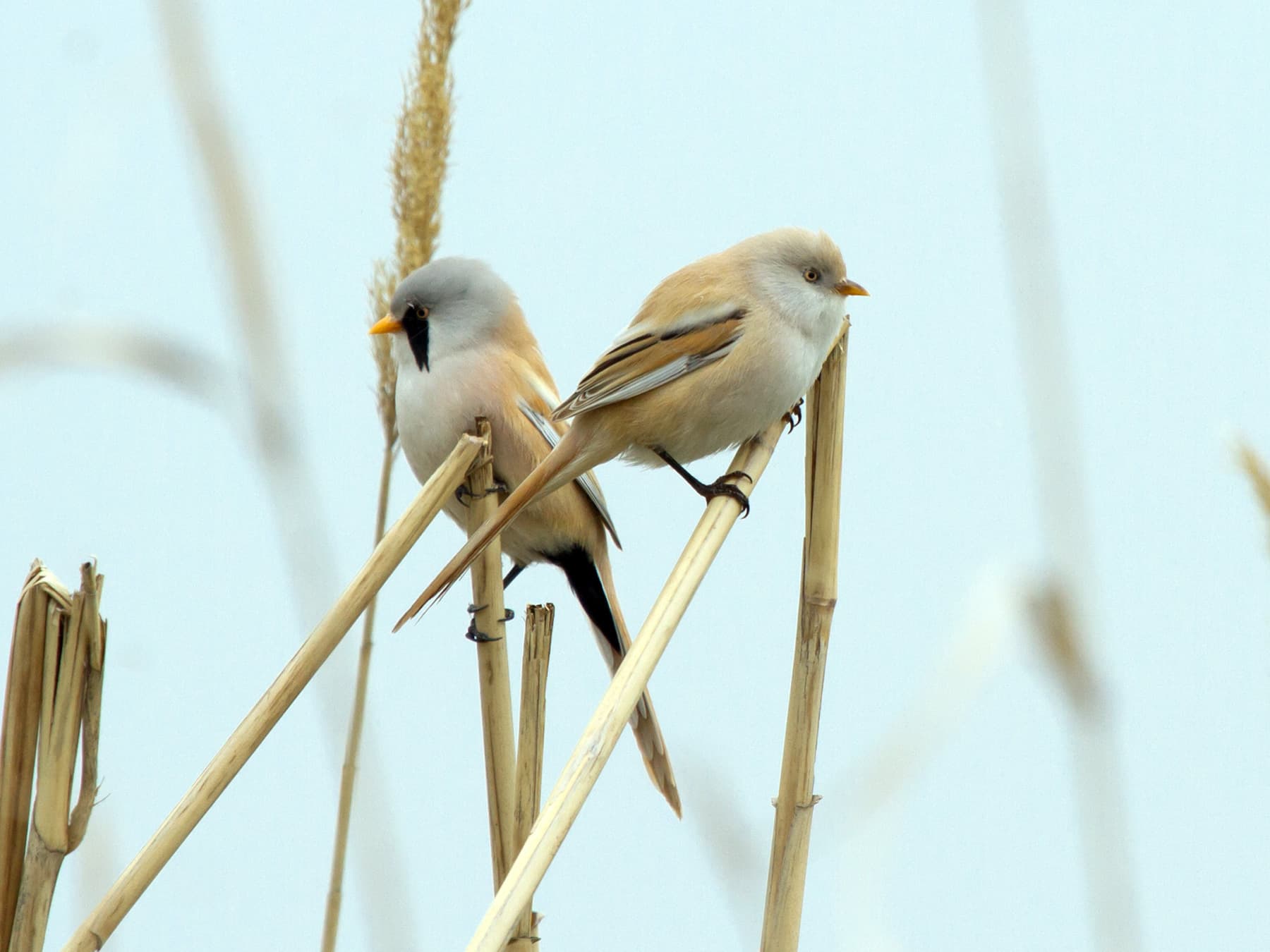
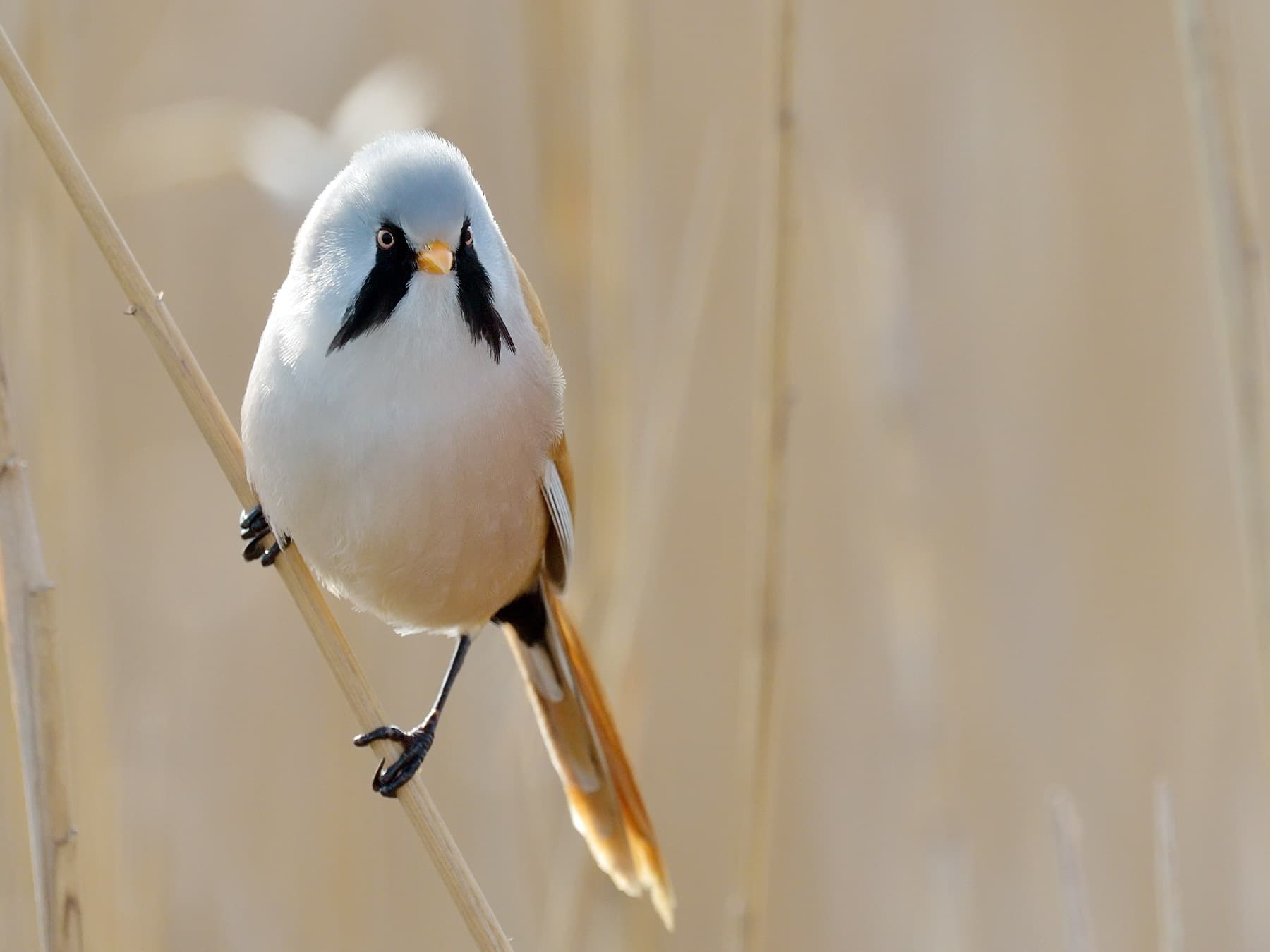
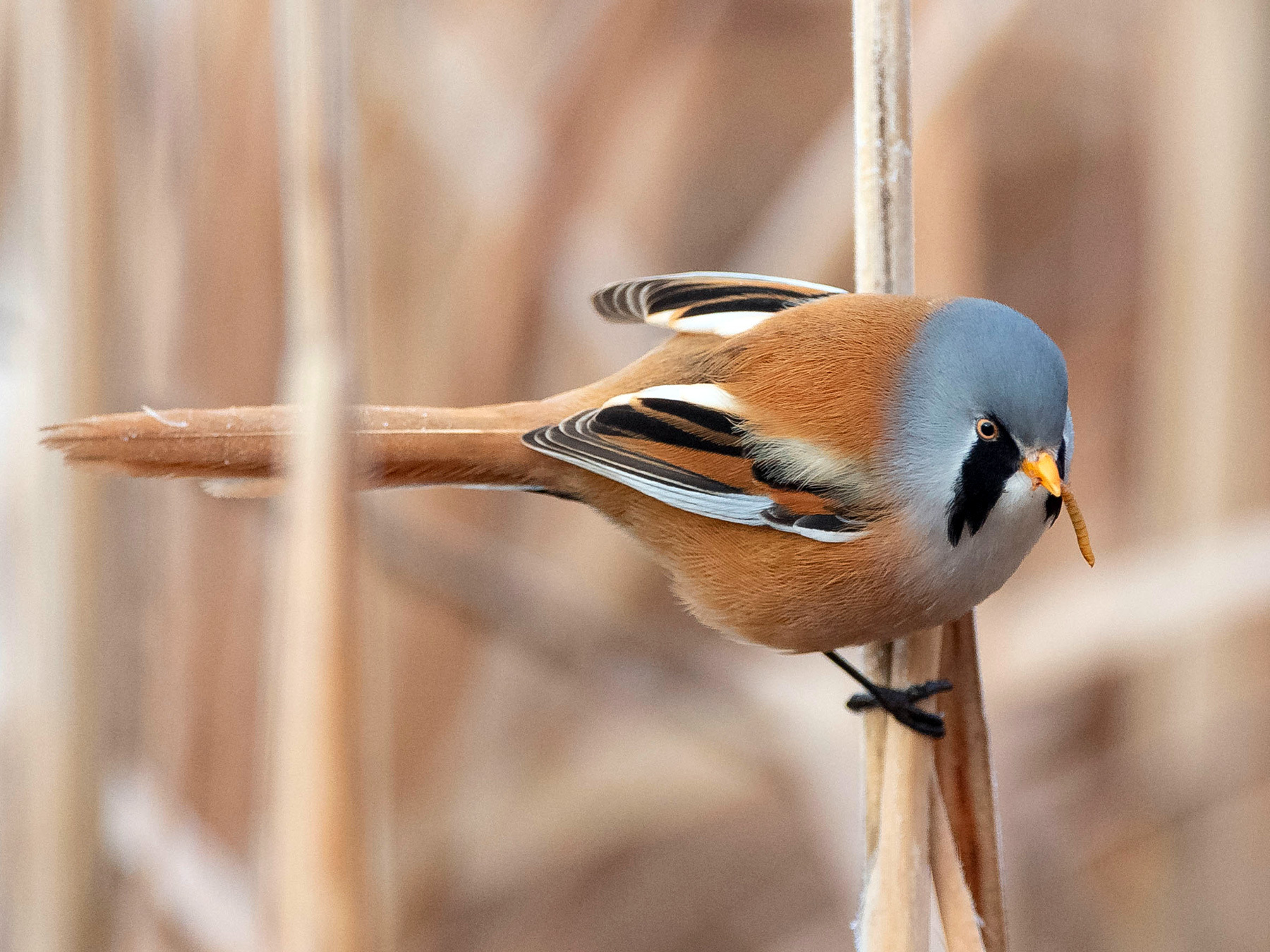
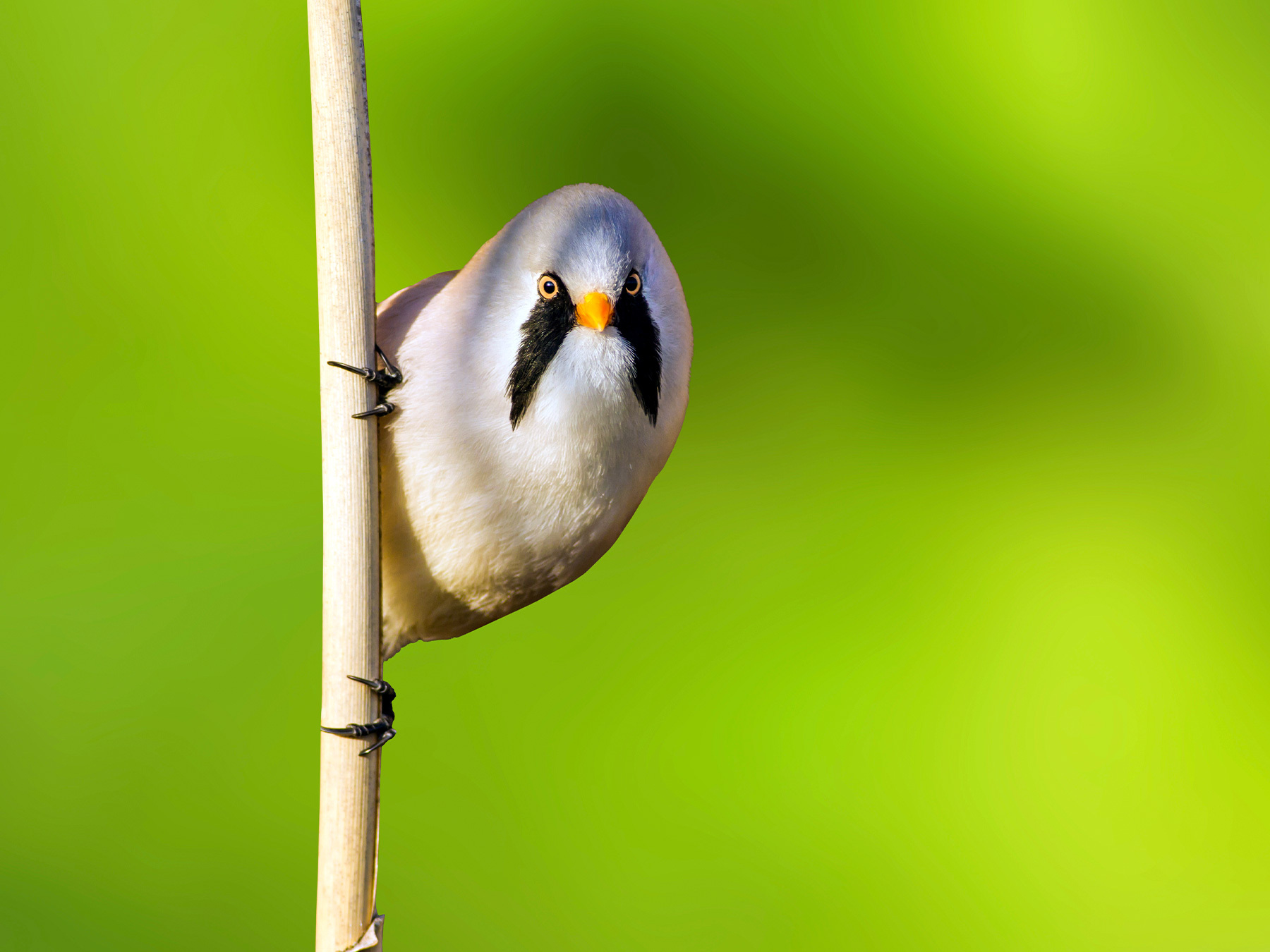
Males have a bluish-grey head, a pale grey breast, and a pale orange-brown belly and underparts.
The bearded tit’s upperparts are a darker shade of brown, mixed with orange, cream and black. Their upper tail feathers are orange-brown and the undertail has a prominent black patch, visible in flight. Wing markings include dark grey primary feathers and brown secondary feathers.
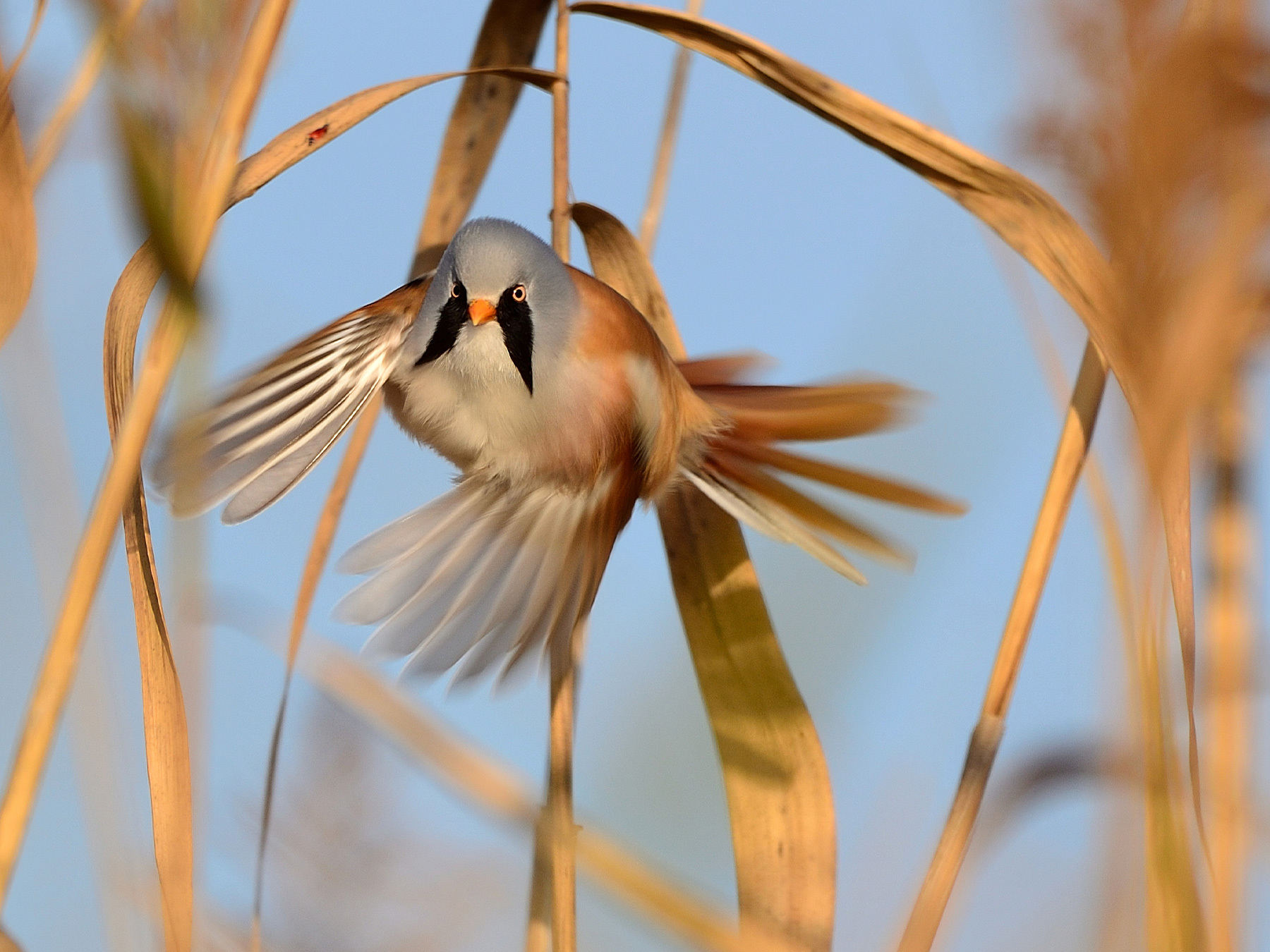
The bearded tit’s facial markings are perhaps its most striking features, with a bright yellow eye, a small yellow bill, and a bold, black moustache stripe that runs from below the eyes, across the cheeks, and onto the side of the chin.
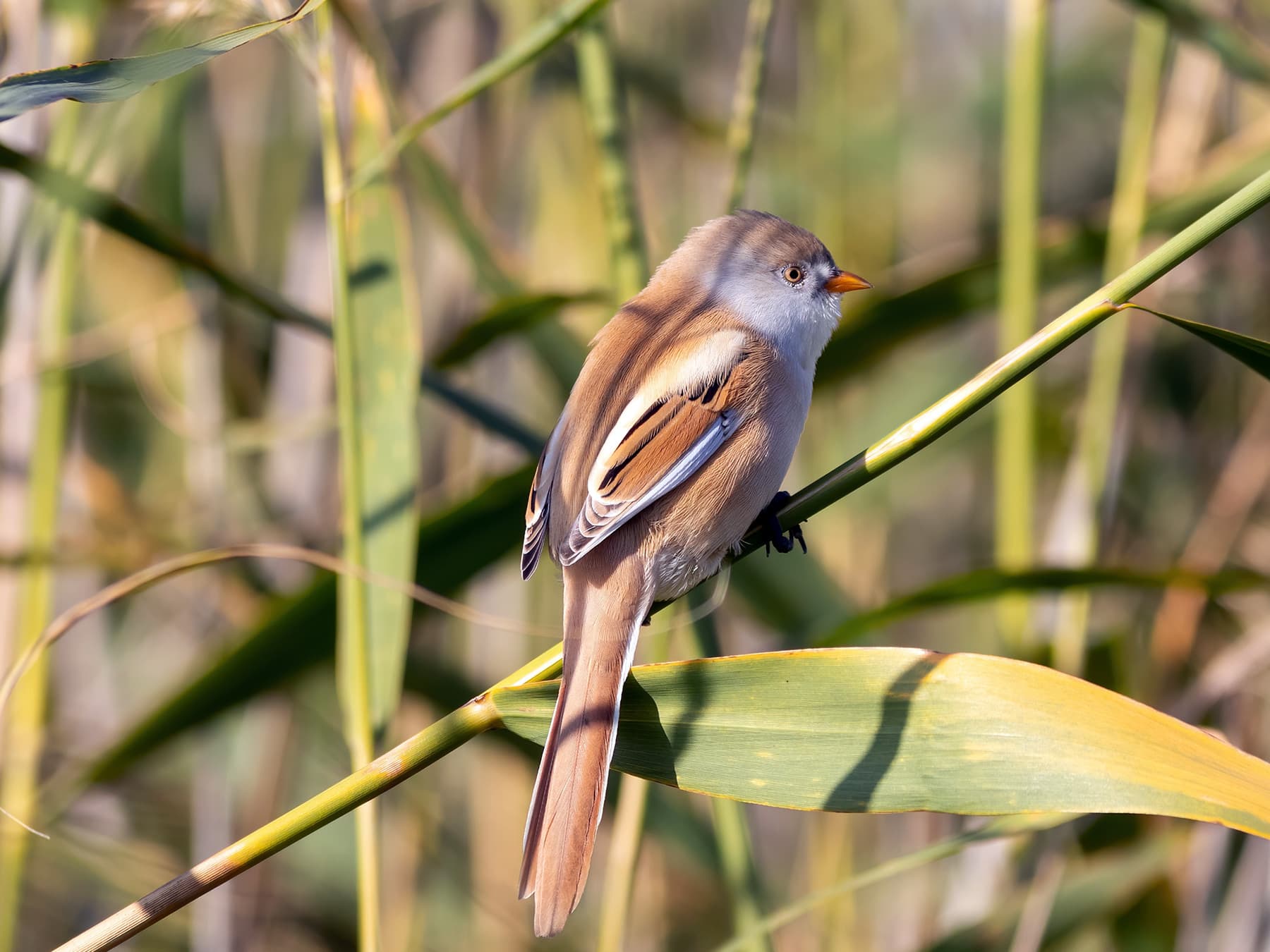
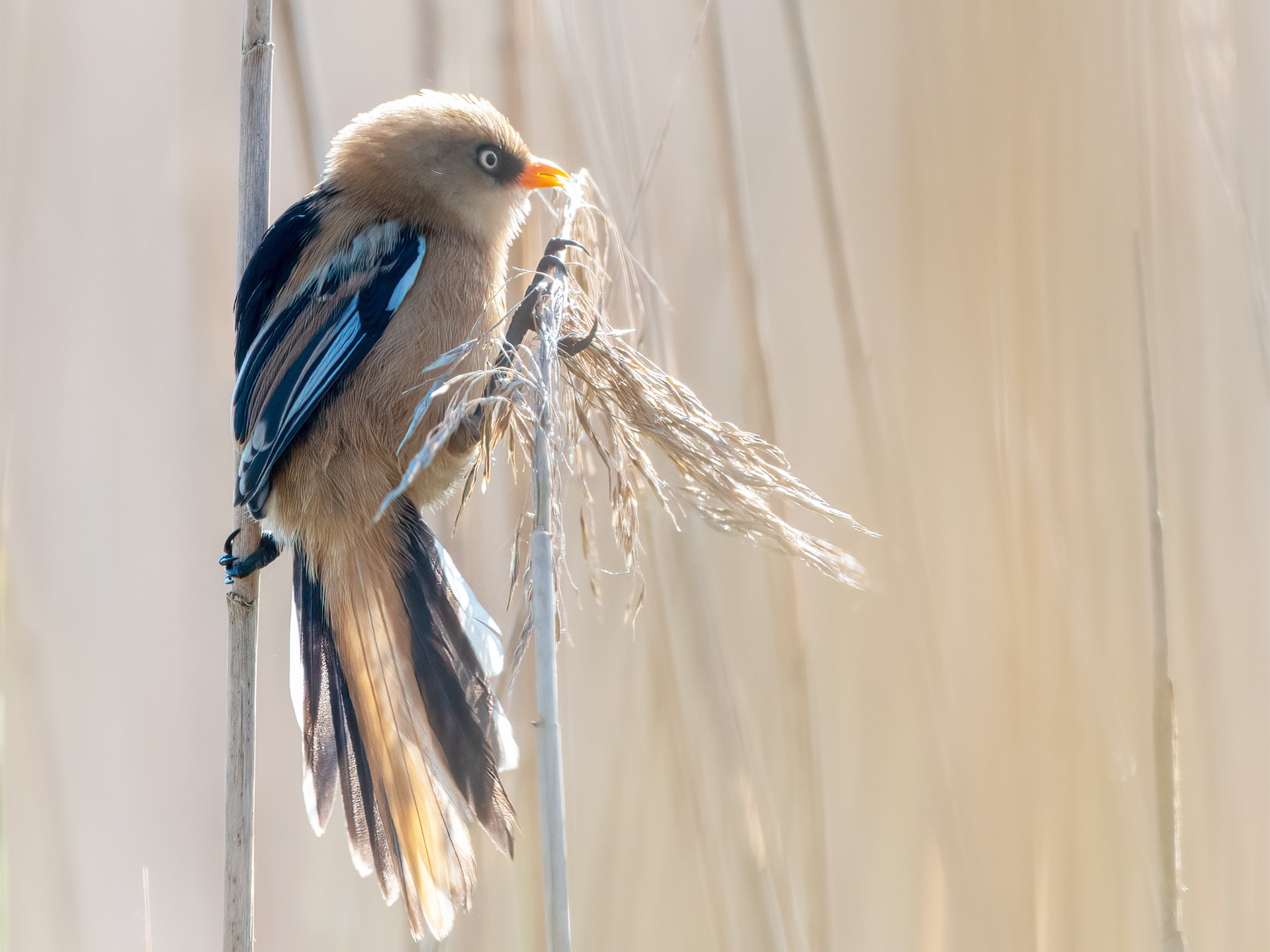
Female bearded tits are paler than males, with dull chestnut-brown heads. The face and crown are a dull shade of brown, mottled with darker brown. Their chin, throat, and sides of the neck are grey, and their bill and eyes are yellow, like those of the male.
Juvenile bearded tits are similar in appearance to females but have less chestnut on their flanks, upperparts, and tail. They have a black lower mantle and their wings are also black, edged with paler grey. Underparts are a duller grey-brown.
How big are Bearded Tits?
Bearded tits are small rounded birds with plump bodies and long tails, roughly the same size as blue tits.
- Length: 12.5 cm to 14.5 cm (4.9 in to 5.7 in)
- Wingspan: 16 cm to 18 cm (6.3 in to 7.1 in)
- Weight: 12 g to 18 g (0.4 oz to 0.8 oz)
Its size
Adults- Length
- 13–15 cm
- Wingspan
- 16–18 cm
- Weight
- 12–18 g
Its song and calls
What sound does a Bearded Tit make?
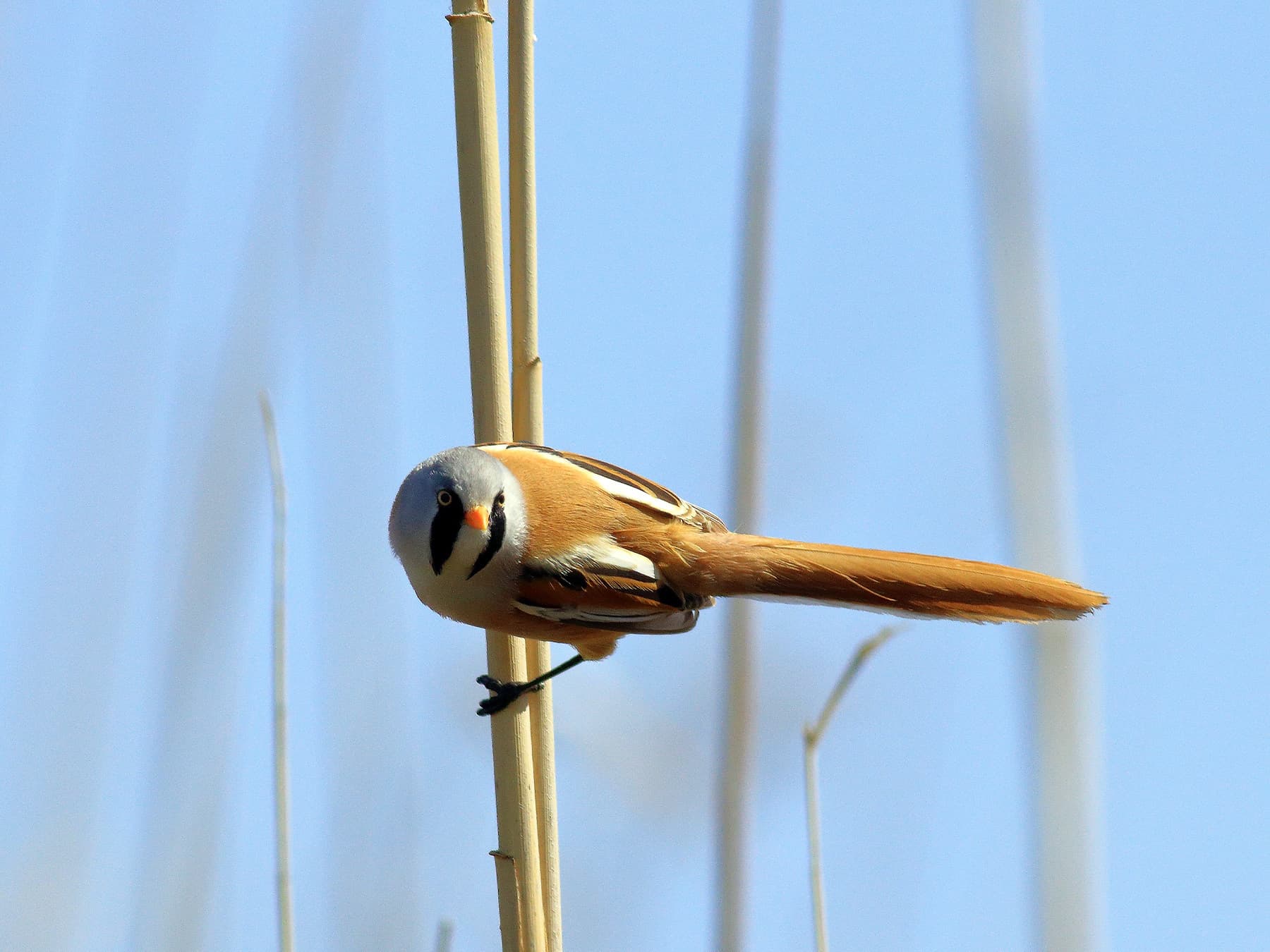
The effective camouflage of their plumage against their reedbed habitats makes it likely that the first indication you may have that a bearded tit is nearby is their call. A single tinny ‘ping’ note is heard as a contact call, and the male’s song is a tuneful ‘tschin-schik-schra’.
- Call0:00 / 3:08
Recorded in Norfolk, England
Lawrence Shove / The British Library Board · Wikimedia Commons · CC BY-SA 4.0
When and where to see it
OctoberPeak season
Most recorded in October
- 1. Suffolk0.50%
- 2. Clackmannanshire0.43%
- 3. Norfolk0.37%
- 4. Wexford0.36%
- 5. West Yorkshire0.35%
Each dot is a county, state or province: the bigger and darker, the larger the bird’s share of that place’s bird records that month. Grey dots: no regular records. The ringed point is the centre of the bird’s records this month; the arrow shows how it moved since last month, and the dashed loop its path through the year. “Arrivals” colours places where it becomes regular this month (orange) or is in its last regular month (grey). GBIF eBird Observation Dataset, 2019–2024. Map data: Natural Earth, US Census Bureau; place centres © OpenStreetMap contributors.
In your area
See when the Bearded Tit is recorded in your county, state or province.
How often the Bearded Tit turns up in the UK and Ireland through the year, from birdwatchers' records.
United Kingdom
Resident · all year · most records in October
Ireland
Summer visitor · all year · most records in May
Show as a table
| Month | United Kingdom | Ireland |
|---|---|---|
| January | 0.047% (regular) | 0.007% (regular) |
| February | 0.034% (regular) | 0.006% (regular) |
| March | 0.036% (regular) | 0.011% (regular) |
| April | 0.053% (regular) | 0.030% (regular) |
| May | 0.071% (regular) | 0.037% (regular) |
| June | 0.069% (regular) | 0.024% (regular) |
| July | 0.083% (regular) | 0.019% (regular) |
| August | 0.068% (regular) | 0.019% (regular) |
| September | 0.080% (regular) | 0.015% (regular) |
| October | 0.10% (regular) | 0.033% (regular) |
| November | 0.061% (regular) | 0.025% (regular) |
| December | 0.046% (regular) | 0.010% (regular) |
Recorded regularly in
Worldwide: recorded regularly in 43 countries
Countries where it was recorded in at least 3 of the 6 years 2019–2024. Linked countries have their own bird list.
Europe (33)
Asia (10)
- Armenia
- Azerbaijan
- China
- Georgia
- Iran
- Kazakhstan
- Kyrgyzstan
- Mongolia
- Turkey
- Uzbekistan
Data: EOD – eBird Observation Dataset (Cornell Lab of Ornithology), accessed via GBIF.org, CC BY 4.0. Records from 2019–2024, aggregated and filtered by Birdfact. How these lists are made
What is the habitat of a Bearded Tit?
Bearded tits depend heavily on reedbed environments, inhabiting reeds, and wetlands, including vegetation alongside fresh and brackish water. They are commonly found on the edges of marshes and swamps, camouflaged against the reeds and rushes.
What is the range of a Bearded Tit?
Bearded tits are found from the UK and Spain in the west, across central and northern Europe, through central Asia to northeastern China. Throughout much of Europe, the distribution is patchy, mirroring landscapes where wetlands with extensive reedbeds are dominant.
Into Asia, bearded tits have an unbroken presence, through Russia, Kazakhstan, Kyrgyzstan, Afghanistan, Uzbekistan, Turkmenistan and Tajikistan, throughout Mongolia into the northeastern regions of China.
Where do Bearded Tits live?
With a patchy distribution in western Europe, bearded tits become far more common towards the east, with the majority of the species resident across central Asia. Europe’s population of between 464,000 and 875,000 mature individuals represents 15 percent of the global total, so the entire population of bearded tits is believed to be between 3 and 5.8 million.
How rare are Bearded Tits?
Bearded tits were once far more widespread throughout the UK, but a series of cold winters in the mid-20th century saw a decline in numbers and contraction of breeding grounds, with the species becoming largely limited to parts of Kent and East Anglia.
Numbers have since started to increase and bearded tits are resident in more regions, although there are only an estimated 695 pairs in the UK, so sightings are memorable and unusual.
Where can you see Bearded Tits in the UK?
Fewer than 700 pairs of bearded tits are present in the UK, and they are not widespread or common, preferring coastal spots on the eastern and south coasts.
East Anglia has long been a stronghold, with the extensive reedbeds of the Norfolk Broads home to a large percentage of the UK’s breeding pairs.
Migration
Do Bearded Tits migrate?
Throughout most of their range, bearded tits are sedentary and remain in their home territories all year round. Some irregular and short-distance dispersal may occur in winter. In parts of central Europe, irruptions further south are fairly common, with birds returning to their original breeding grounds each spring.
Are Bearded Tits native to the UK?
Around 700 pairs of breeding tits are resident in the UK all year round, breeding in coastal marshes and wetlands on the south, east and west coasts of England and in parts of eastern Scotland.
Tips for seeing it
- Listen for their distinctive 'ping' calls in reedbeds
- Look for small groups moving through reeds, especially at dawn and dusk
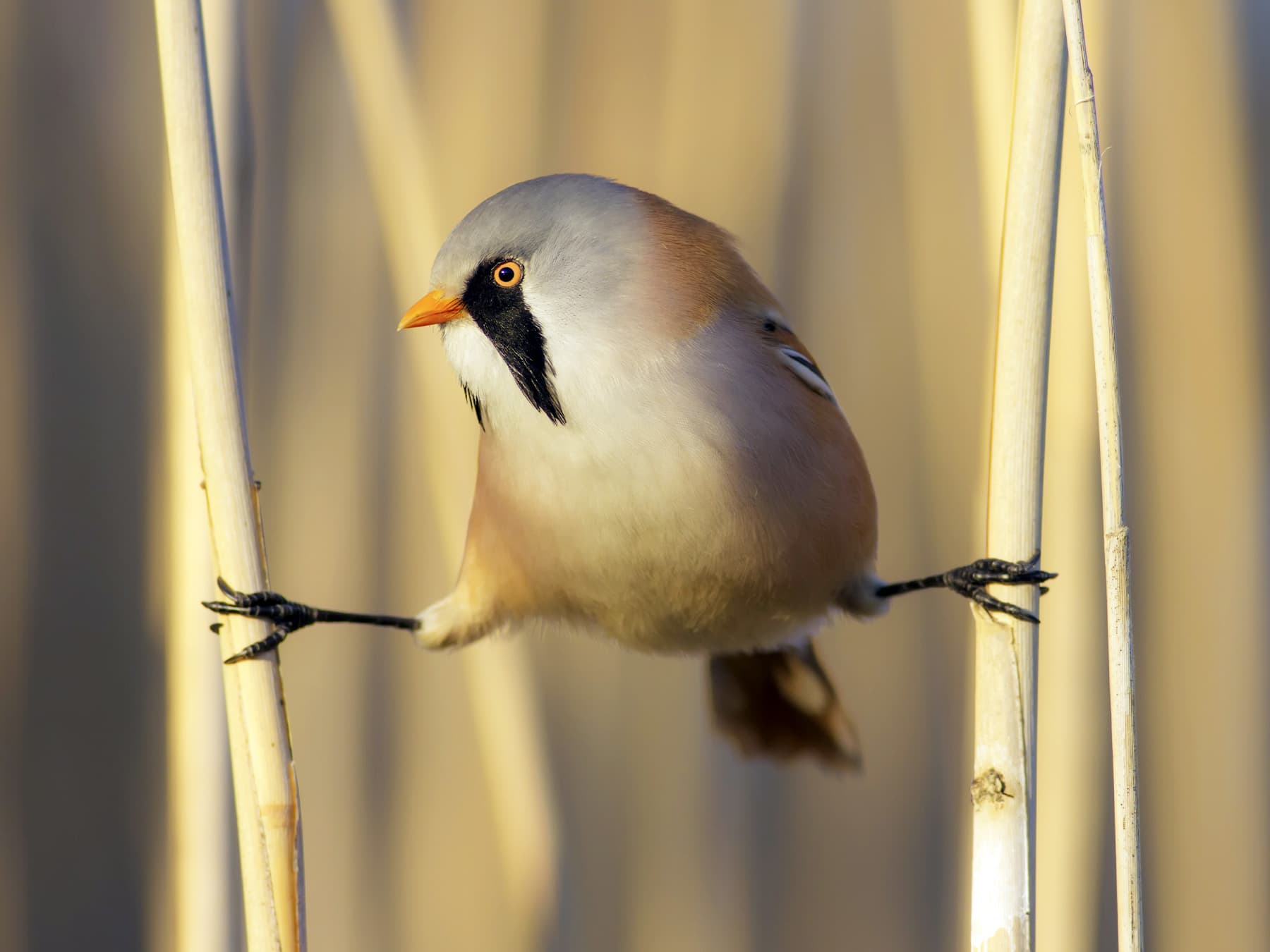
- Watch for their acrobatic movements as they cling to reed stems
- In the UK, visit coastal wetlands and inland marshes for the best chances of spotting them
What it eats
What do Bearded Tits eat?
In the summer bearded tits forage around the edges of wetlands and muddy wetland shores, where they catch invertebrates. Their main prey consists of mayflies, moths, beetles, mosquitoes, dragonflies, and their larvae. Spiders, slugs, and snails are also eaten.
A change in diet occurs in autumn and winter when seeds and aquatic plants become more important than insects and invertebrates. Seeds from grasses, nettles, willowherb, sedges, and rushes, are among the most popular.
What do Bearded Tit chicks eat?
The early diet of bearded tits is purely based on insects and larvae brought to the nest by both parents. Plant matter is gradually introduced once young become independent, from around 2 weeks after fledging.
Nesting and breeding
Where do Bearded Tits nest?
Pairs of bearded tits work together to create a deep cup-shaped nest among reed stems in marshy wetlands between 5 cm and 72 cm (2 in to 28 in) above the water level. Reed blades and other aquatic plant parts are woven into shape, usually with a roof canopy made of reeds. Flowering reed-heads and feathers are used as a lining.
Specially designed purpose-built nest boxes, positioned in reedbeds have been successfully used by breeding pairs of bearded tits, particularly when placed over water.
When do Bearded Tits nest?
The breeding season of bearded tits begins in March each year with pairs forming or previous bonds being renewed. In the most successful years, bearded tits can raise up to four broods, with the earliest eggs laid in April.
Incubation, which is shared between the female and the male, lasts for 10 to 13 days, and development is fairly rapid, with young bearded tits ready to fledge by between 12 and 16 days. Fledglings continue to rely on parental support for a further 2 weeks. By September, breeding is complete, once the final brood have reached independence from their parents.
What do Bearded Tit eggs look like?
Bearded tits usually lay between four and six cream-coloured eggs, lightly streaked with pale brown speckles. Some clutches may contain as few as three eggs or as many as eleven. On average, eggs measure 17 mm by 14 mm (0.7 in by 0.6 in).
Do Bearded Tits mate for life?
In a typical season, bearded tit pairs will raise four broods together, and form strong monogamous bonds early in the breeding season. If an initial breeding season is successful, the pair may well stay bonded for life. However, it’s not unheard of for females to mate with different males.
Behaviour
Are Bearded Tits aggressive?
Any aggressive behavior displayed by bearded tits is confined to the breeding season when they are defending nest sites, and a pecking order is established with a dominant male chasing others off its territory.
Once breeding is complete, they become far more sociable and tolerant of the company of other birds, feeding in ‘parties’ of up to 200 individuals.
Where do Bearded Tits sleep at night?
Bearded tits are diurnal, foraging among the reedbeds during the day, and choosing roosting spots clinging onto reed stems overnight. Individual bearded tits frequently crowd close together in a row to provide warmth and protection when roosting.
Lifespan and predators
How long do Bearded Tits live?
The average life expectancy of bearded tits is between two and three years. The oldest long-tailed tit on record reached 7 years and 3 months. Breeding occurs for the first time from one year of age onwards.
What are the predators of Bearded Tits?
Birds of prey are the chief predators of bearded tits, especially owls and hawks. Their reedbed nest locations are particularly vulnerable to raids from rats, weasels and stoats.
Are Bearded Tits protected?
Bearded tits are registered as Schedule I birds under the Wildlife and Countryside Act of 1981. This designation means that it is prohibited to interfere with their nest sites, eggs, or young, and to kill, injure, or take any bird of this species into captivity.
Are Bearded Tits endangered?
Despite their current classification globally as a species of least concern, numbers of bearded tits are precariously linked to the availability of wetland environments, and there are fears that habitat loss from the draining of marshlands may lead to population declines.
Conservation
While listed as Least Concern globally, Bearded Tits face localised threats due to habitat loss and degradation of wetlands.
Conservation efforts focus on preserving and managing reedbed habitats, particularly in countries like the UK, where they are a species of conservation concern.
Similar birds
Often mistaken for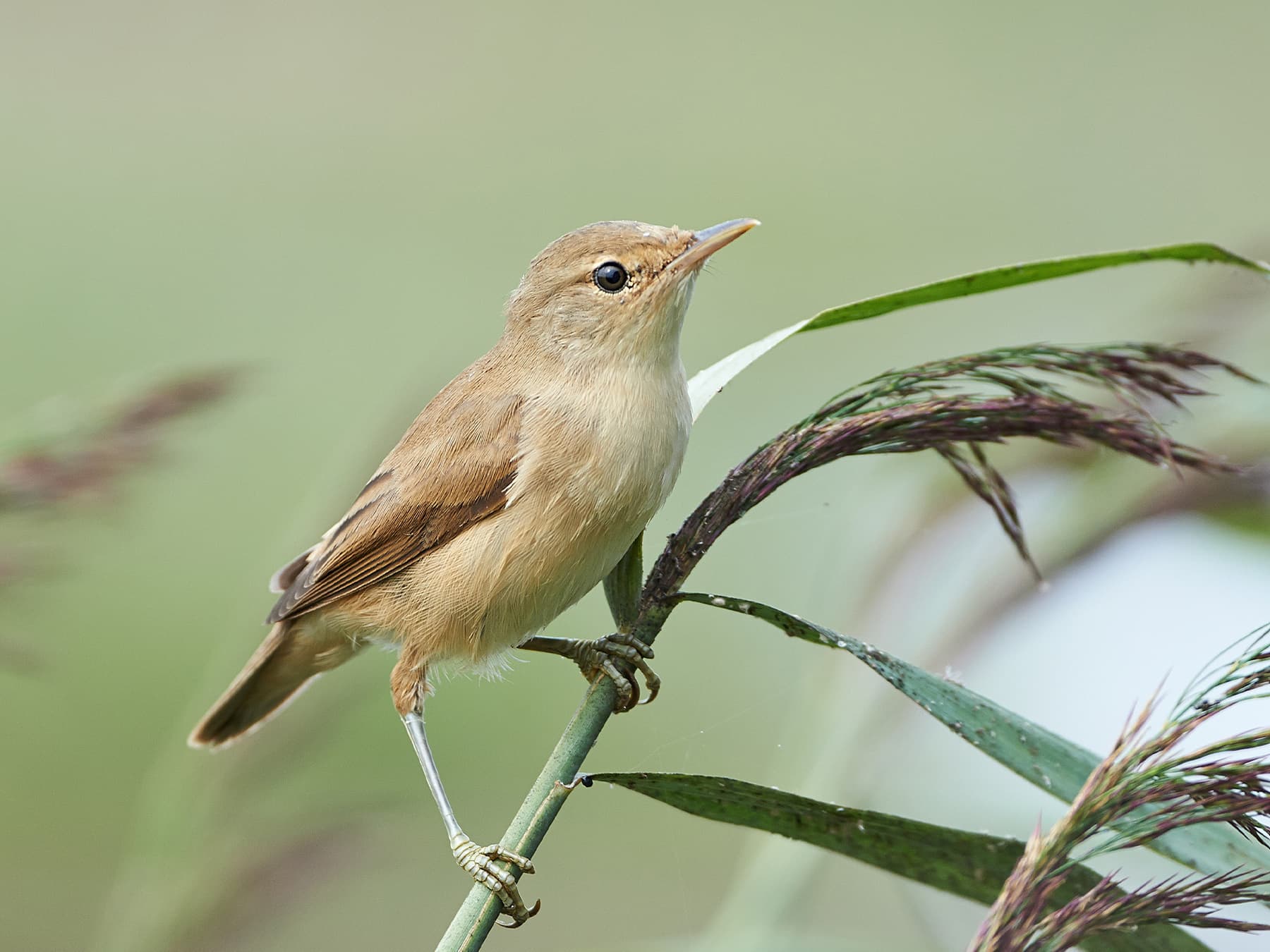
More photos
5 photos
Quick facts
- Length
- 13–15 cm
- Wingspan
- 16–18 cm
- Weight
- 12–18 g
- Lifespan
- 2–3 years · oldest recorded 7.2 years
- Family
- Bearded Reedlings
- Migration
- Partial migrant
- Global status (IUCN)
- Least Concern
- World population
- 3,000,000 - 5,800,000 mature individuals
- Population trend
- Unknown
- Also called
- Bearded Reedling, Bearded Parrotbill
- Scientific name
- Panurus biarmicus
Sources
3- 1BirdLife International. 2016. Panurus biarmicus. The IUCN Red List of Threatened Species 2016: e.T22716776A87767500. Source (opens in a new tab)
- 2BirdLife International. 2016. Panurus biarmicus. The IUCN Red List of Threatened Species 2016: e.T22716776A87767500. Source (opens in a new tab)
- 3BTO longevity records: maximum age from a ringed bird, 7 years, 3 months (set in 2009), BirdFacts: Bearded Tit (2009) Source (opens in a new tab)

Checked by
Nathan Cope, founder and editor
Nathan founded Birdfact and leads its writers and contributors in the UK, the US and Canada. He has watched and studied birds for more than ten years, and checks every article and species guide before it’s published.