Species Profile
White-winged Tern
Chlidonias leucopterus
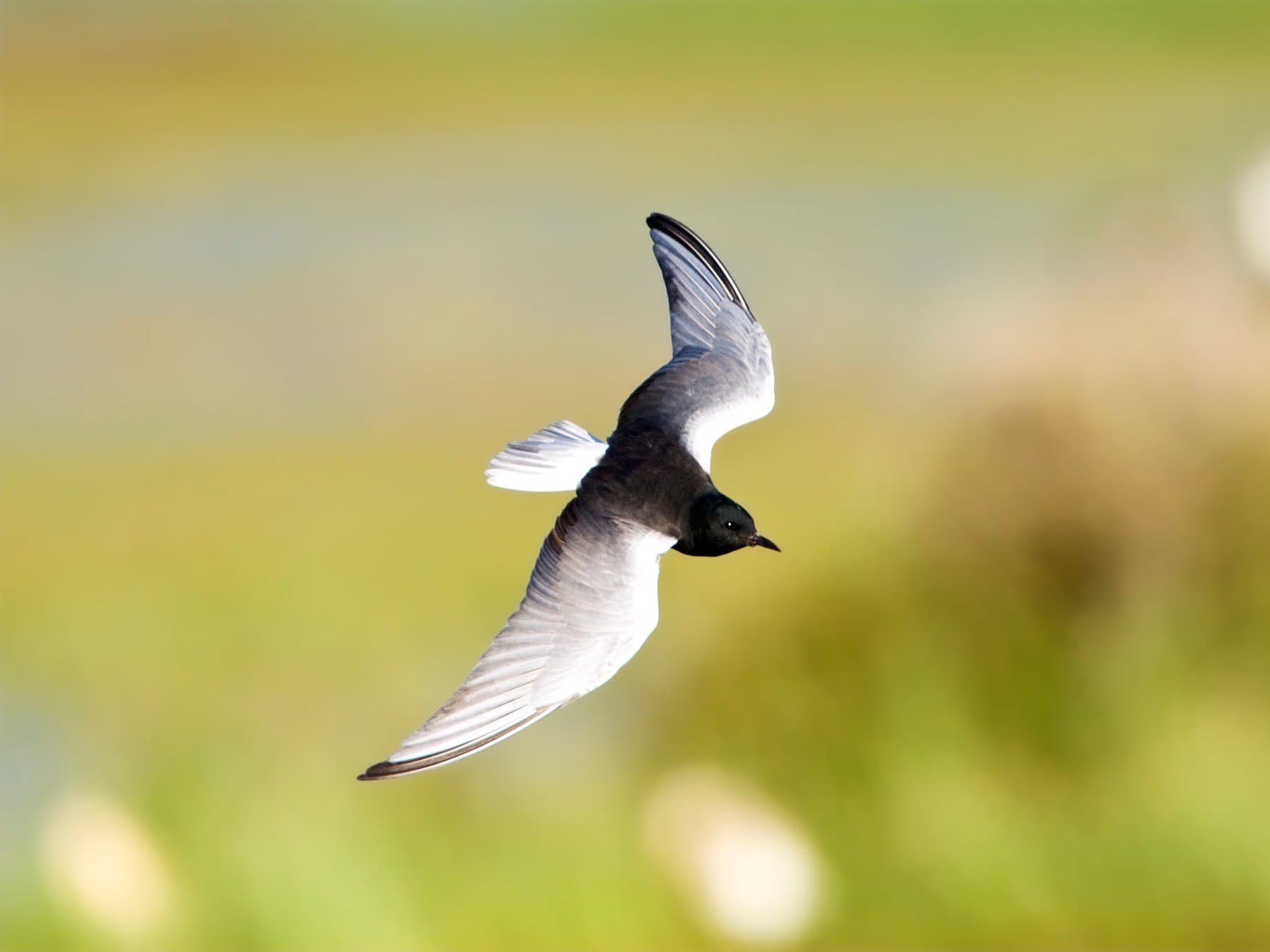
White-winged Tern in flight, showing black head and body with pale grey wings against a blurred green and brown background.
Quick Facts
Conservation
LCLeast ConcernLifespan
5–10 years
Length
20–27 cm
Weight
54–66 g
Wingspan
63–67 cm
Migration
Long-distance Migrant
Few small terns undergo a more dramatic seasonal transformation than the White-winged Tern — in breeding plumage, its jet-black body contrasts with brilliant white wings and rump in a pattern unlike any other marsh tern. A buoyant, swallow-like flier, it skims and dips over freshwater marshes from eastern Europe to the Russian Far East before embarking on one of the world's great long-distance migrations to Africa, Asia, and Australasia.
Also known as: White-winged Black Tern
Think you've spotted a White-winged Tern?
Upload a photo and we'll confirm it instantly
Confirm with a PhotoAppearance
The White-winged Tern is the smallest of the three Chlidonias marsh terns, measuring 20–27 cm in length with a wingspan of 63–67 cm and a weight of 54–66 g. In breeding plumage, adults are unmistakable: the head, neck, back, and belly are jet black, while the rump, undertail-coverts, and slightly forked tail are white. The upperwing is pale grey with a broad white leading edge formed by mostly white lesser and median coverts — the feature that gives the species its name. Crucially, the underwing-coverts and axillaries are strikingly black, a diagnostic feature clearly visible in flight and unlike any other tern.
The bill is short and stubby, measuring just 22–25 mm from the feathers — noticeably shorter than the head — and is reddish-black in breeding season. The legs and feet are red. The eyes are blackish-brown. The tail is slightly forked but often appears square-tipped, particularly in juveniles.
In non-breeding plumage, the transformation is near-total. The black is replaced by white and pale grey: the upperparts become pale grey, the head and underparts white. The crown turns brownish, and a distinctive dark auricular patch — often described as 'earmuffs' or 'headphones' — remains as the key identification feature. The bill becomes blackish and the legs dull reddish. Some birds retain a scattering of black underwing-coverts through winter. Moult back into breeding plumage begins in mid-March.
Male and female are identical in plumage — the species is not sexually dimorphic. The White-winged Tern is monotypic, with no recognised subspecies.
Identification & Characteristics
Colors
- Primary
- Black
- Secondary
- White
- Beak
- Black
- Legs
- Red
Markings
Jet-black body with white wings, white rump, and strikingly black underwing-coverts in breeding plumage; dark 'earmuff' auricular patch in non-breeding plumage
Tail: Slightly forked, white; often appears square-tipped especially in juveniles
Attributes
Understanding Attributes
Rated 0–100 based on research and observation. A score of 50 is average across all bird species. These attributes are relative and don't necessarily indicate superiority.
Habitat & Distribution
During the breeding season, White-winged Terns are closely tied to freshwater wetlands. They favour shallow lakes, ponds, marshes, and swamps with extensive emergent vegetation — reeds, sedges, and aquatic plants — over which they forage and on which they nest. Water depth at nest sites typically ranges from 30 to 120 cm. The species breeds across a broad Palearctic band from southeast Europe (including northwest Italy and central and eastern Europe) through Central Asia, Siberia, Transbaikalia, northern Mongolia, and southeast Russia to adjacent northeast China.
On migration and on the wintering grounds, the habitat range expands considerably. European and western Asian breeders winter mainly in sub-Saharan Africa — reaching Senegal as early as August–September — using open lakes, estuaries, coastal lagoons, mangrove swamps, tidal mudflats, and artificial wetlands including sewage ponds and salt pans. Central and eastern Asian populations winter from South Asia through Southeast Asia to New Guinea and Australia, where the species is a non-breeding summer migrant along the coastal and sub-coastal north, east, and southeast of the mainland and the north and east of Tasmania.
In New Zealand, the White-winged Tern is a native migrant, with fewer than 20 birds recorded annually. It occurs at coastal lagoons and estuaries from Northland to Southland, with the largest concentrations in Bay of Plenty, Hawke's Bay, Marlborough, and Canterbury. Remarkably, a small number of birds appear to have reversed their breeding cycle to match the southern hemisphere, developing breeding plumage in the austral summer and even attempting to nest — four confirmed breeding records exist (1917, 1973–74, 2012, and 2015), all involving single pairs on braided riverbeds.
In the United Kingdom, the White-winged Tern is a scarce but regular passage migrant, recorded mainly between May and September. It was formerly assessed by the British Birds Rarities Committee (BBRC) but was removed from the rare bird list on 31 December 2005 due to its increasing frequency of occurrence. Records come from across England — Norfolk, Suffolk, Kent, Lancashire, Cambridgeshire, and Gloucestershire among the most frequent counties — with occasional vagrant records from Scotland and Wales. In North America, it is a scarce vagrant, mainly on the Atlantic coast, with a handful of records from the Pacific coast and the Great Lakes region.
Diet
Aquatic and terrestrial insects form the backbone of the White-winged Tern's diet. The species takes Dipterans (flies), Odonata (dragonflies and damselflies), and Coleopterans (beetles) in large numbers, along with spiders, small fish, tadpoles, crabs, and shrimp. In southern Africa, wintering birds have been recorded eating sardines (Limnothrissa miodon) and fish trapped in drying pools during the dry season. The species is also opportunistic around fishing boats, taking discarded fish from the water surface.
Unlike the 'white' terns of genus Sterna, the White-winged Tern never plunge-dives. Instead it employs three main foraging techniques. Hawking involves catching insects in flight, often in flocks that use rising air to gain height before swooping. Dipping sees birds flying 2–4 metres above the water surface and dropping down to snatch prey from the surface film or just below it. Occasional shallow plunges are also recorded, though these are the exception rather than the rule.
Prey is sometimes carried to a secluded perch to be killed and eaten, particularly larger items such as dragonflies. Between feeding bouts, birds often rest on emergent branches or floating vegetation. The feeding style — graceful, buoyant, and surface-oriented — is far more reminiscent of a swallow or hirundine than a seabird, and it is this quality that makes the species so distinctive to watch over a freshwater marsh in summer.
Behaviour
White-winged Terns are gregarious birds, typically seen in loose flocks during migration and on their wintering grounds. They roost communally on emergent branches, fence posts, or floating vegetation, often in mixed-species groups alongside other terns and waders. At the breeding colony, the social dynamic shifts: pairs defend small territories vigorously, and the colony as a whole responds noisily to any perceived threat, mobbing intruders with persistent aerial dives and sharp alarm calls.
The flight style is the species' most immediately distinctive quality. Buoyant and swallow-like, with shallow, leisurely wingbeats, it bears little resemblance to the powerful, direct flight of the larger Sterna terns. The genus name Chlidonias derives from the Ancient Greek for 'swallow-like', and watching a feeding bird skim and dip over a marsh surface makes the comparison obvious. Birds often forage in loose flocks, using the wind to gain height before dipping down to snatch prey.
The species is notably adaptable in its use of habitat outside the breeding season, readily exploiting artificial wetlands including sewage ponds, salt pans, and flooded agricultural fields. In southern Africa, wintering birds frequent dams, riverine forests, and moist grasslands far from the coast. This flexibility is one reason the species maintains such a large and stable global population.
White-winged Terns have been recorded hybridising with the closely related Black Tern (Chlidonias niger) in Sweden and the Netherlands. Two juvenile hybrid birds showing a combination of the dark mantle of the White-winged Tern and the dark breast-side patches of the Black Tern were observed at Chew Valley Lake in Somerset, England, in September 1978 and September 1981 — a detail almost entirely absent from mainstream field guides.
Calls & Sounds
The White-winged Tern is a vocal species, particularly at the breeding colony and when alarmed. Its most characteristic call is a short, rapid 'kek-kek' or 'kik-kik-kik' — a buzzing series of sharp notes given in alarm or during social interactions within a flock. A harsher, creaking 'kesch' or 'kreek-kreek' is also frequently heard, particularly on the breeding grounds and riverbeds; New Zealand observers describe this rasping call becoming more frequent as birds moult into breeding plumage before spring migration. Additional calls include a loud 'kwek' or 'creek' and a more complex 'kvrr-kak' noted in Audubon's field guide.
The species is most vocal at the colony, where calls serve for communication between mates, alarm signalling against predators, and territorial interactions with neighbours. Both sexes vocalise similarly, and there is no evidence of a significant difference between male and female calls. The flight call — a short, sharp note — is audible at distance and can alert a birder to the presence of a bird passing overhead before it is seen.
Unlike passerines, the White-winged Tern has no complex song. Its vocal repertoire is functional rather than elaborate: sharp, carrying calls suited to open wetland environments where visual contact between birds may be intermittent. Recordings from Malaysia, Romania, and Poland (archived on Xeno-canto) confirm the consistency of the alarm and contact calls across the species' vast range.
Flight
The White-winged Tern's flight is its most immediately distinctive quality in the field. The wingbeats are shallow and leisurely — almost casual compared to the powerful, direct strokes of the larger Sterna terns — and the overall impression is of a bird that floats rather than drives itself through the air. The body is held relatively horizontal, and the slightly forked tail is often held closed, giving a square-tipped appearance. The combination of buoyancy and manoeuvrability is genuinely swallow-like, and birds can change direction rapidly when hawking insects in flight.
In breeding plumage, the flight pattern is unmistakable from above and below. From above, the broad white leading edge of the upperwing contrasts with the pale grey flight feathers and the jet-black body. From below, the pale grey underwing is bisected by the strikingly black underwing-coverts and axillaries — a diagnostic feature visible at considerable distance. The white rump and tail flash conspicuously against the black back as the bird banks and turns.
In non-breeding plumage, the flight silhouette remains distinctive: compact and buoyant, with a relatively large head and short, stubby bill compared to other terns of similar size. When feeding, birds typically fly 2–4 metres above the water surface before dipping down to snatch prey — a technique that produces the characteristic 'bouncing' flight path over marshes and lagoons. During migration, flocks may travel at greater height, using thermals and wind assistance to cover the vast distances between breeding and wintering grounds.
Nesting & Breeding
The breeding season runs from April to August, with peak activity in June. White-winged Terns nest in small colonies, typically of 20–40 pairs, occasionally reaching 100 pairs. Colonies are usually monospecific but may include other terns, gulls, or grebes nesting nearby. Both sexes defend a small territory within the colony, responding aggressively to neighbours and intruders.
Courtship involves aerial displays and courtship feeding, in which the male flies with a fish held in the bill to attract a female — a behaviour that functions as a direct assessment of the male's foraging ability and quality as a provider. Copulation typically follows a fish-transfer between the pair. Pair bonds may be re-established with previous partners or new pairs formed each season.
The nest is a shallow cup constructed from small reed stems and other aquatic vegetation, placed on a mound of floating plant material over water 30–120 cm deep. Occasionally nests are placed on dry shore or in very shallow water. The female lays 2–3 eggs (occasionally 4), creamy-white with dark brown markings. Both adults share incubation, which lasts 18–22 days. At hatching, the downy chicks have buffy upperparts with black streaks and paler underparts; the eye is surrounded by a pale patch. Both parents feed the young, and chicks fledge 20–25 days after hatching. The species can breed from 2 years of age.
In New Zealand, all four confirmed breeding records have involved single pairs nesting on braided riverbeds — often in association with Black-fronted Tern colonies — a strikingly different habitat from the floating-vegetation marshes used across Eurasia. The most recent confirmed breeding was in 2015.
Lifespan
Specific longevity data for the White-winged Tern is limited in the published literature — the species has not been as intensively ringed as some of the larger, more accessible terns. Based on the biology of comparable Chlidonias marsh terns, a typical lifespan of around 5–10 years in the wild is plausible, with older individuals likely reaching their teens. The closely related Black Tern has a confirmed maximum recorded age of around 17 years from European ringing data, which provides a reasonable upper reference point for the White-winged Tern.
The species can breed from 2 years of age, which is relatively early for a tern. Annual survival rates are influenced by the hazards of long-distance migration — the species crosses multiple ecological zones between its Palearctic breeding grounds and its wintering areas in sub-Saharan Africa, South Asia, and Australasia. Predation at the colony (Peregrine Falcons are documented predators), nest failure during dry breeding seasons, and wetland drainage on the breeding grounds are the primary mortality factors. The species' adaptability to artificial wetlands and its large global population of 3.1–4 million individuals suggest that overall survival rates are sufficient to maintain a stable population.
Conservation
The White-winged Tern is listed as Least Concern on the IUCN Red List. The global population is estimated at 3.1–4 million individuals (2015 estimate), with the European breeding population alone comprising 133,000–347,000 mature individuals. The overall population trend is stable, though regional declines have been noted in Russia and Ukraine, linked to dry breeding seasons causing nest failure and the ongoing drainage of freshwater wetland habitats.
The primary threats within the European breeding range are the destruction and drainage of freshwater marshes, water regulation in wetlands, and recreational disturbance at breeding colonies — the last of these particularly documented in Poland. Dry summers can devastate entire colony seasons when water levels drop below the threshold needed to support floating nest platforms.
The species benefits from protection under an unusually wide array of international instruments. It is listed under the Agreement on the Conservation of African-Eurasian Migratory Waterbirds (AEWA), which coordinates conservation across its African and European flyways. It is also listed under the Japan-Australia Migratory Bird Agreement (JAMBA), the China-Australia Migratory Bird Agreement (CAMBA), and the Republic of Korea-Australia Migratory Bird Agreement (ROKAMBA). In Australia, it is protected under the Environment Protection and Biodiversity Conservation (EPBC) Act as both a listed migratory and marine species. The breadth of these treaty listings reflects the species' extraordinary geographic range — it has been recorded in over 180 countries and territories.
Population
Estimated: 3,100,000–4,000,000 individuals globally (2015 estimate); European population 133,000–347,000 mature individuals
Trend: Stable
Stable overall; regional declines noted in Russia and Ukraine due to dry breeding seasons and wetland drainage
Elevation
Primarily lowland; breeds at low elevations in river valleys, lake basins, and coastal plains
Additional Details
- Family:
- Laridae (Gulls & Terns)
- Predators:
- Peregrine Falcon documented; nest predation by mammalian predators at colony sites
- Subspecies:
- Monotypic (no recognised subspecies)
- Similar species:
- Black Tern (Chlidonias niger), Whiskered Tern (Chlidonias hybrida)
Identification Tips
In breeding plumage, the White-winged Tern is straightforward to identify: no other small tern combines a jet-black body with white wings, white rump, and black underwing-coverts. The short, stubby reddish-black bill and red legs are additional confirmatory features. The key pitfall is confusion with the Black Tern in breeding plumage, which has a dark grey (not black) body, dark grey (not white) wings, and lacks the white leading edge to the upperwing. The Black Tern's underwing-coverts are pale, not black — a reliable distinction in flight.
In non-breeding and transitional plumage, identification requires more care. The White-winged Tern's 'earmuff' auricular patch is typically more compact and well-defined than the Black Tern's, and the White-winged Tern lacks the dark shoulder patches (carpal bars) that are a prominent feature of non-breeding Black Terns. The rump of the White-winged Tern is white in all plumages, contrasting with the pale grey rump of the Black Tern — a useful feature when a bird is flying away. The bill of the White-winged Tern is noticeably shorter and stubbier than that of the Black Tern.
Juvenile White-winged Terns show a dark brown saddle (mantle and scapulars) contrasting with pale grey wings — a 'saddle-back' pattern that is distinctive and unlike the more uniformly dark juvenile Black Tern. In all plumages, the buoyant, swallow-like flight style and the habit of dipping to the water surface (rather than plunge-diving) are behavioural features that confirm the bird is a marsh tern of genus Chlidonias.
Courtship & Display
Courtship in the White-winged Tern centres on aerial displays and a behaviour known as courtship feeding, in which the male flies with a fish held prominently in the bill. This fish-flight serves as a direct signal of the male's foraging ability — a female assessing a prospective mate can gauge his competence as a provider from the quality and size of the fish he presents. The display is performed over the colony and in the vicinity of the female, and copulation typically follows a successful fish-transfer between the pair.
Aerial displays involve both members of a pair flying in close formation, with the male often pursuing the female in swooping, twisting flights above the marsh. These displays are accompanied by frequent calling, and the colony as a whole becomes noticeably more vocal during the peak of courtship activity in May and June. Pair bonds may be re-established with previous partners from earlier seasons, or new pairs formed — the fish-transfer ritual appears to function as a quality assessment mechanism regardless of whether the birds have bred together before.
Territory defence within the colony is vigorous. Neighbouring pairs interact frequently at territory boundaries, and both sexes participate in aggressive posturing and calling directed at intruders. The combination of dense colony activity, persistent calling, and the dramatic breeding plumage of the adults makes an active White-winged Tern colony one of the more visually and acoustically striking spectacles of a European freshwater marsh in early summer.
Birdwatching Tips
In the UK, late May and June offer the best chance of encountering a White-winged Tern in breeding plumage — the jet-black body and white wings are unmistakable and unlike any other tern likely to be seen in Britain. Autumn birds (July–September) are in transitional or non-breeding plumage and require more care. The key feature to look for is the dark auricular patch ('earmuffs') on an otherwise white head, combined with a pale grey back and the absence of the dark shoulder bar shown by the similar Black Tern. Inland reservoirs, gravel pits, and coastal lagoons in East Anglia and the southeast are the most productive sites.
In Australia, the species arrives as a non-breeding summer migrant from around October and departs by April. Tidal estuaries, coastal lagoons, and sewage ponds in the north, east, and southeast of the mainland are the most reliable habitats. In New Zealand, coastal lagoons and estuaries from Northland to Canterbury are the best locations, with peak numbers in Bay of Plenty and Hawke's Bay. Numbers are small — fewer than 20 birds annually — so any sighting is notable.
In all regions, the flight style is the first thing to notice: buoyant and swallow-like, with shallow wingbeats and a habit of dipping gracefully to the water surface rather than plunge-diving. This immediately separates it from the larger Sterna terns. In breeding plumage, the black underwing-coverts visible from below are diagnostic — no other tern shows this combination of pale grey upperwing and black underwing lining. In winter, compare carefully with the Black Tern, which shows a dark shoulder patch that the White-winged Tern lacks.
Did You Know?
- The genus name Chlidonias comes from the Ancient Greek for 'swallow-like' — and watching a White-winged Tern skim and dip over a marsh, with its buoyant wingbeats and graceful turns, makes the comparison immediately obvious. It is a marsh tern, not a seabird, and its feeding style has more in common with a hirundine than a gannet.
- A small number of White-winged Terns in New Zealand appear to have reversed their biological clock to match the southern hemisphere, developing breeding plumage in the austral summer and even attempting to nest on braided riverbeds — four confirmed breeding records exist, the most recent in 2015, all in a completely different habitat from the floating-vegetation marshes used across Eurasia.
- The species has hybridised with the Black Tern in Sweden and the Netherlands, and two juvenile hybrids were identified at Chew Valley Lake in Somerset in September 1978 and September 1981 — showing the dark mantle of the White-winged Tern combined with the dark breast-side patches of the Black Tern.
- The White-winged Tern is protected under four separate international migratory bird agreements — AEWA, JAMBA, CAMBA, and ROKAMBA — reflecting a global range that spans over 180 countries and territories and flyways crossing three continents.
- An adult White-winged Tern once paired with a Black Tern in Quebec, Canada, and the pair successfully nested — one of the most westerly breeding records ever documented for the species, and a remarkable example of cross-species pair bonding in the wild.
Records & Accolades
Global Wanderer
180+ countries
Recorded in over 180 countries and territories — one of the widest distributions of any marsh tern.
Dramatic Transformer
Jet black to pale grey
Undergoes one of the most striking seasonal plumage changes of any small tern, from jet-black breeding dress to pale grey-and-white winter plumage.
Treaty Bird
4 international agreements
Protected under AEWA, JAMBA, CAMBA, and ROKAMBA — four separate international migratory bird agreements covering its flyways across Africa, Asia, and Australasia.
Community Photos
Be the first to share a photo of the White-winged Tern
Upload a PhotoIdentify Any Bird Instantly
- Upload a photo from your phone or camera
- Get an instant AI identification
- Ask follow-up questions about the bird
Monthly Birds in Your Area
- Personalised for your location
- Seasonal tips and garden advice
- Updated every month with new species