


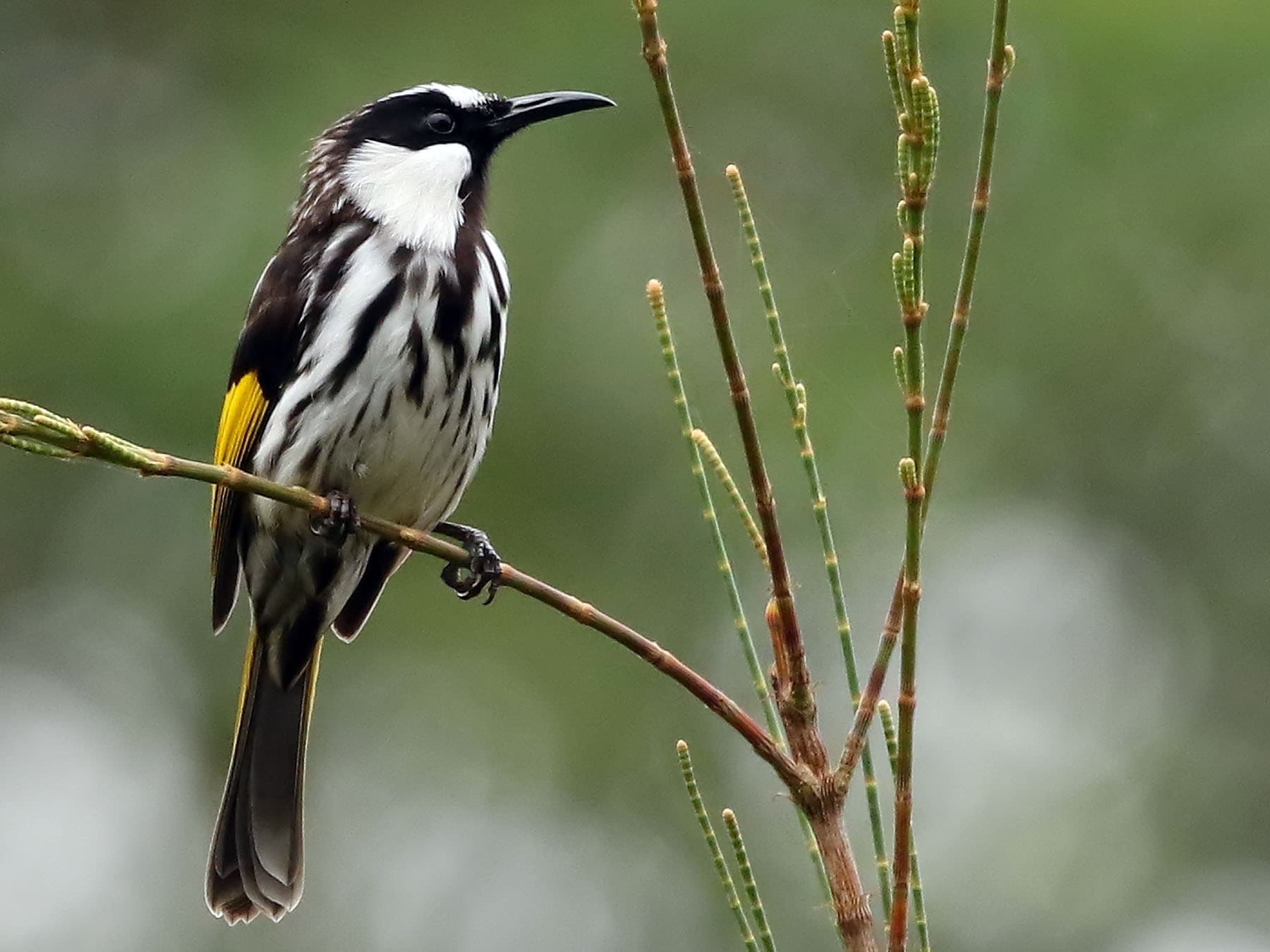
White-cheeked Honeyeater
Phylidonyris niger
By the Birdfact teamChecked by Nathan Cope
On this page12 sections
How to recognise it
The White-cheeked Honeyeater is a striking small bird with bold black and white plumage. Its back, wings, and tail are predominantly black, contrasting sharply with white cheeks and underparts. A distinctive yellow panel on the wing and yellow edges on the tail feathers add vibrant accents.
Both sexes look similar, with juveniles appearing duller and browner than adults. The bird's slender, curved bill is well-adapted for nectar feeding, while its strong legs support its active foraging behaviour.
Its size
Adults- Length
- 16–20 cm
- Wingspan
- 20–25 cm
- Weight
- 13–25 g
Its song and calls
White-cheeked Honeyeaters have a varied vocal repertoire. Their most common call is a sharp, repeated 'chik-chik' or 'check-check', often given while foraging or in flight.
During territorial disputes, they produce a more aggressive, rapid series of harsh chattering sounds. In the breeding season, males may sing a more melodious, warbling song from prominent perches.
When and where to see it
The White-cheeked Honeyeater is not recorded regularly in the UK, Ireland, the United States or Canada.
Worldwide: recorded regularly in 1 country
Countries where it was recorded in at least 3 of the 6 years 2019–2024. Linked countries have their own bird list.
Oceania (1)
Data: EOD – eBird Observation Dataset (Cornell Lab of Ornithology), accessed via GBIF.org, CC BY 4.0. Records from 2019–2024, aggregated and filtered by Birdfact. How these lists are made
Tips for seeing it
- Look for these birds in coastal heathlands and woodlands with abundant flowering plants.
- Listen for their distinctive 'chik-chik' call, which they often make while foraging.
- Observe flowering Banksia and Grevillea plants, which are favourite feeding spots.
- Visit coastal national parks in eastern and southern Australia for the best chances of spotting them.
What it eats
The White-cheeked Honeyeater primarily feeds on nectar from a variety of native plants, particularly Banksia, Grevillea, and Eucalyptus species. They supplement their diet with insects and spiders, which provide essential proteins.
These birds have been observed catching insects on the wing and gleaning them from foliage during their foraging activities.
Nesting and breeding
Breeding occurs mainly from July to December, with pairs forming strong bonds. White-cheeked Honeyeaters are monogamous during the breeding season, with both partners defending their territory vigorously.
The female constructs a cup-shaped nest using bark strips, grasses, and spider webs, typically placed low in dense shrubs for protection. The nest is lined with soft materials such as plant down or fur.
Usually, two to three pale pink eggs with reddish-brown spots are laid. The female incubates the eggs for about 14 days, and both parents care for the nestlings. Young birds fledge after approximately 14-16 days but continue to be fed by their parents for several weeks after leaving the nest.
Behaviour
White-cheeked Honeyeaters are energetic and agile, often seen darting between flowering plants in search of nectar. They are territorial during the breeding season, fiercely defending their chosen areas against other honeyeaters and even larger birds.
These birds are also known for their acrobatic feeding habits, often hanging upside down to reach nectar in tubular flowers.
Conservation
While the White-cheeked Honeyeater is currently listed as Least Concern, it faces threats from habitat loss due to urban development and changes in fire regimes.
Conservation efforts focus on preserving coastal heathlands and managing urban green spaces to maintain suitable habitats for these and other nectar-feeding birds.
Similar birds
Often mistaken for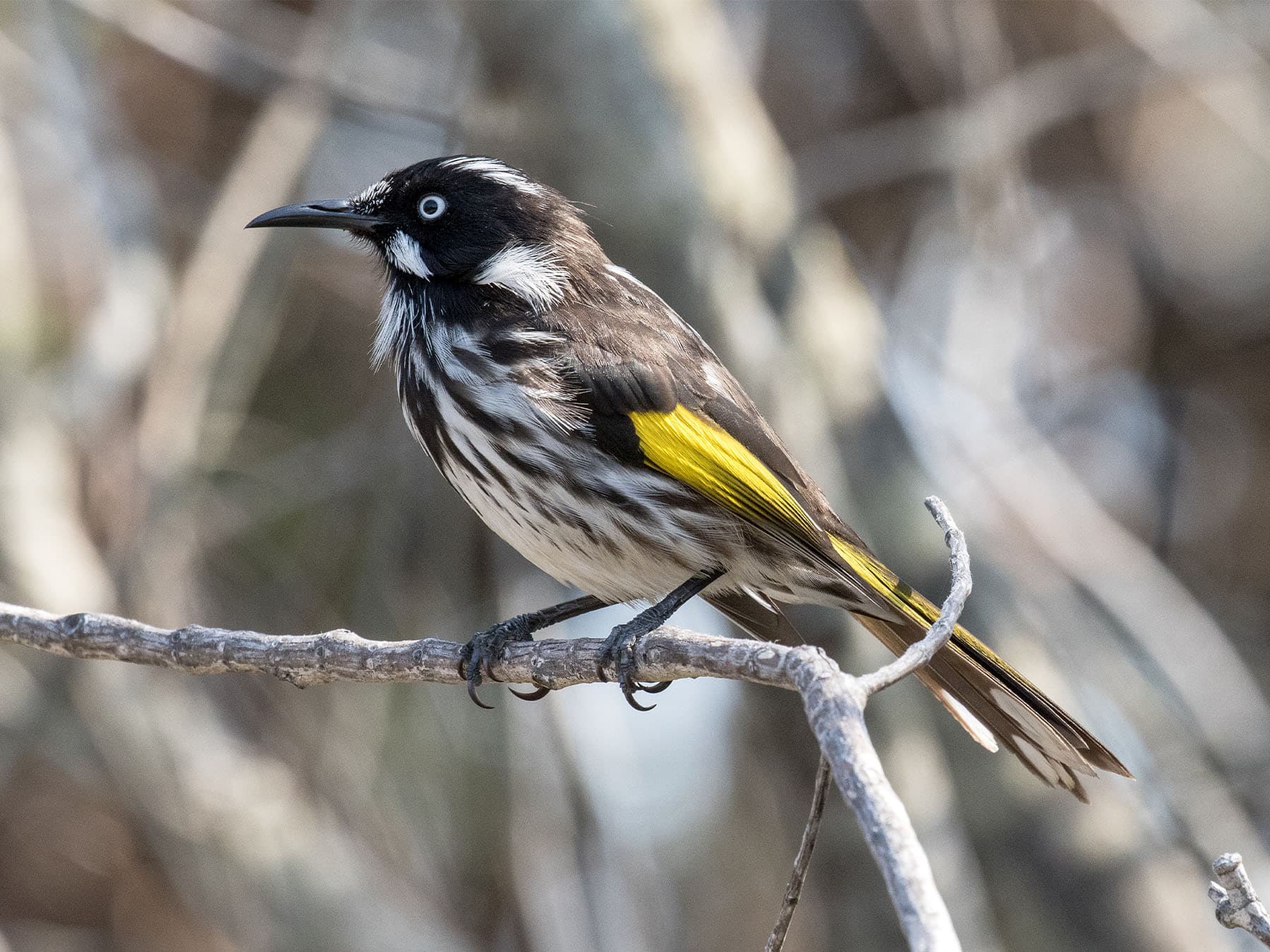
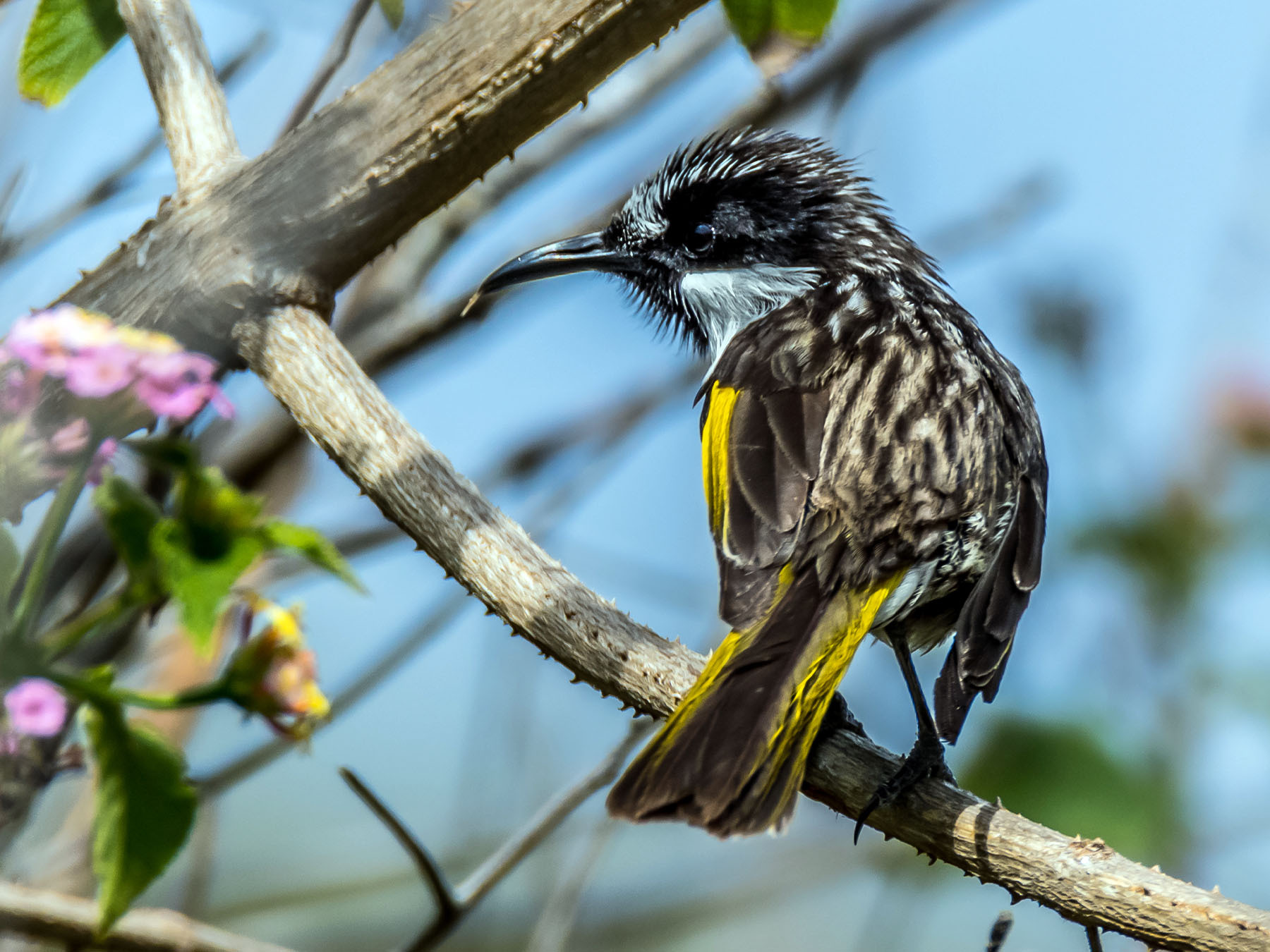
More photos
2 photos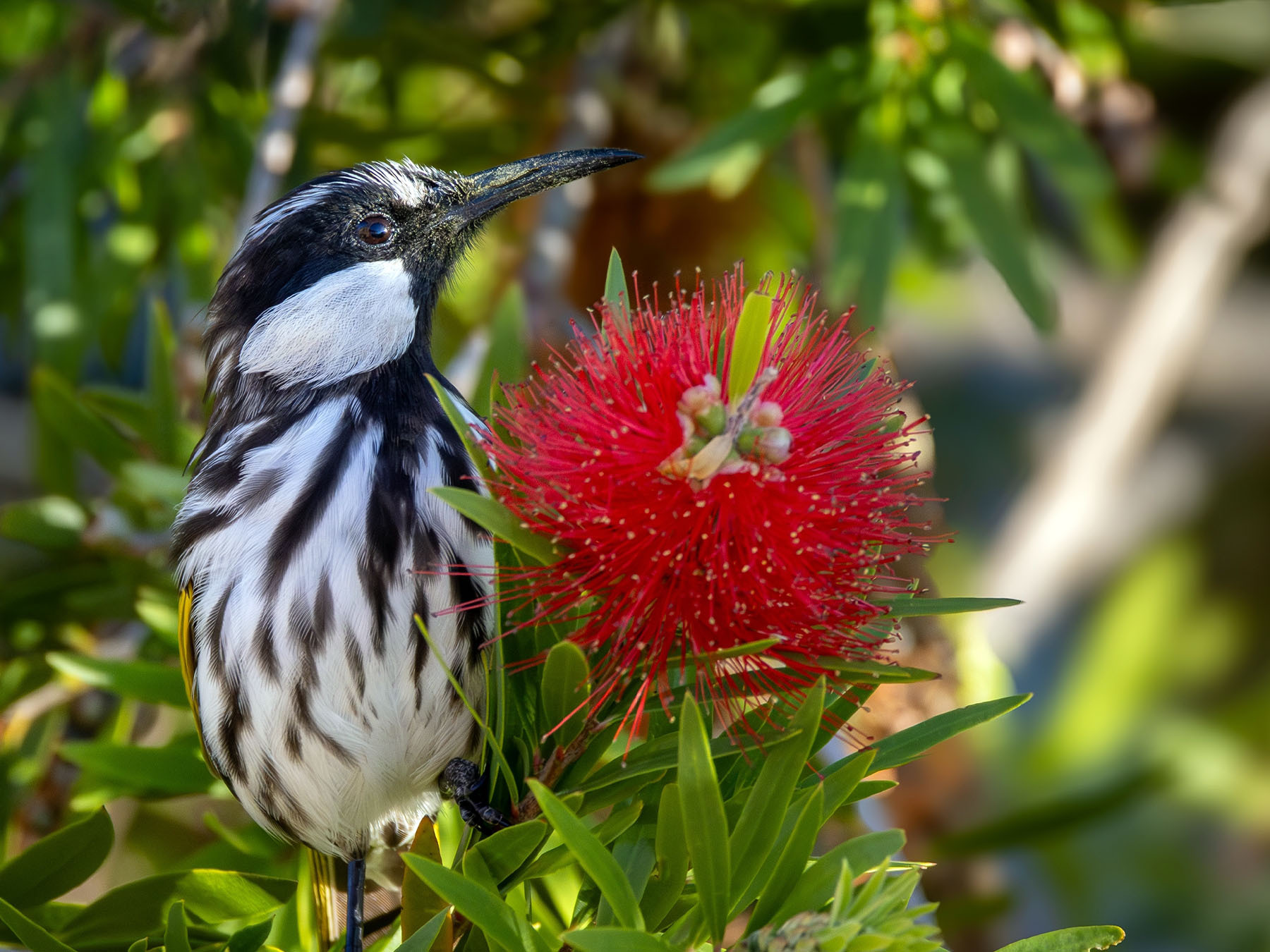
Quick facts
- Length
- 16–20 cm
- Wingspan
- 20–25 cm
- Weight
- 13–25 g
- Lifespan
- 5–10 years · oldest recorded 11.6 years
- Family
- Honeyeaters
- Migration
- Resident
- Global status (IUCN)
- Least Concern
- World population
- Not quantified, but common throughout its range
- Population trend
- Stable
- Scientific name
- Phylidonyris niger
Sources
4- 1BirdLife International. 2024. Phylidonyris niger. The IUCN Red List of Threatened Species 2024: e.T22704364A253977382. Source (opens in a new tab)
- 2BirdLife International. 2024. Phylidonyris niger. The IUCN Red List of Threatened Species 2024: e.T22704364A253977382. Source (opens in a new tab)
- 3Morcombe (2000)
- 4ABBBS - Australian Bird and Bat Banding Scheme Source (opens in a new tab)

Checked by
Nathan Cope, founder and editor
Nathan founded Birdfact and leads its writers and contributors in the UK, the US and Canada. He has watched and studied birds for more than ten years, and checks every article and species guide before it’s published.