


Whiskered Screech-owl
Trichopsis Screech-owl · Megascops trichopsis
By the Birdfact teamChecked by Nathan Cope
On this page14 sections
How to recognise it
What do Whiskered Screech-Owls look like?
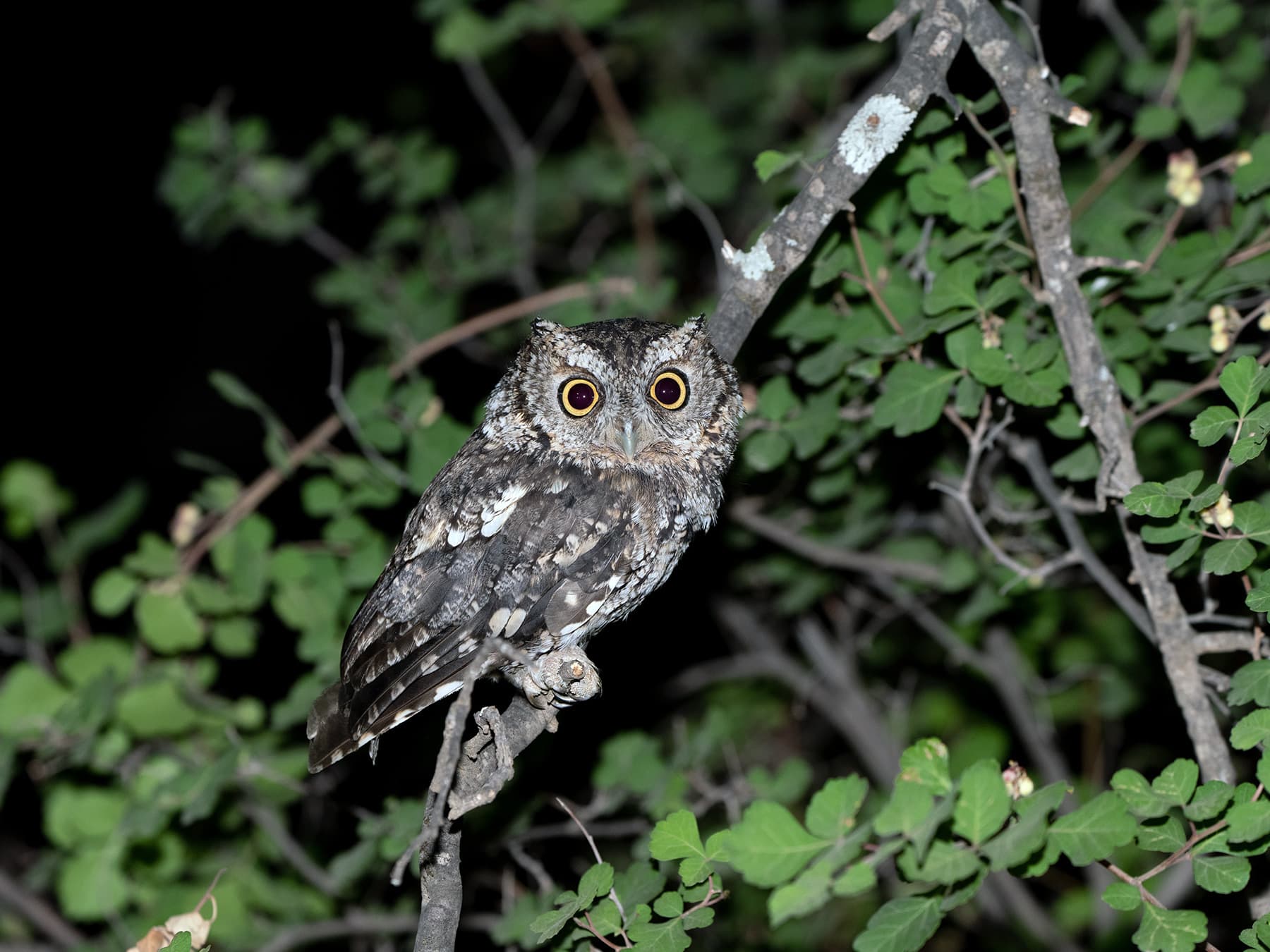
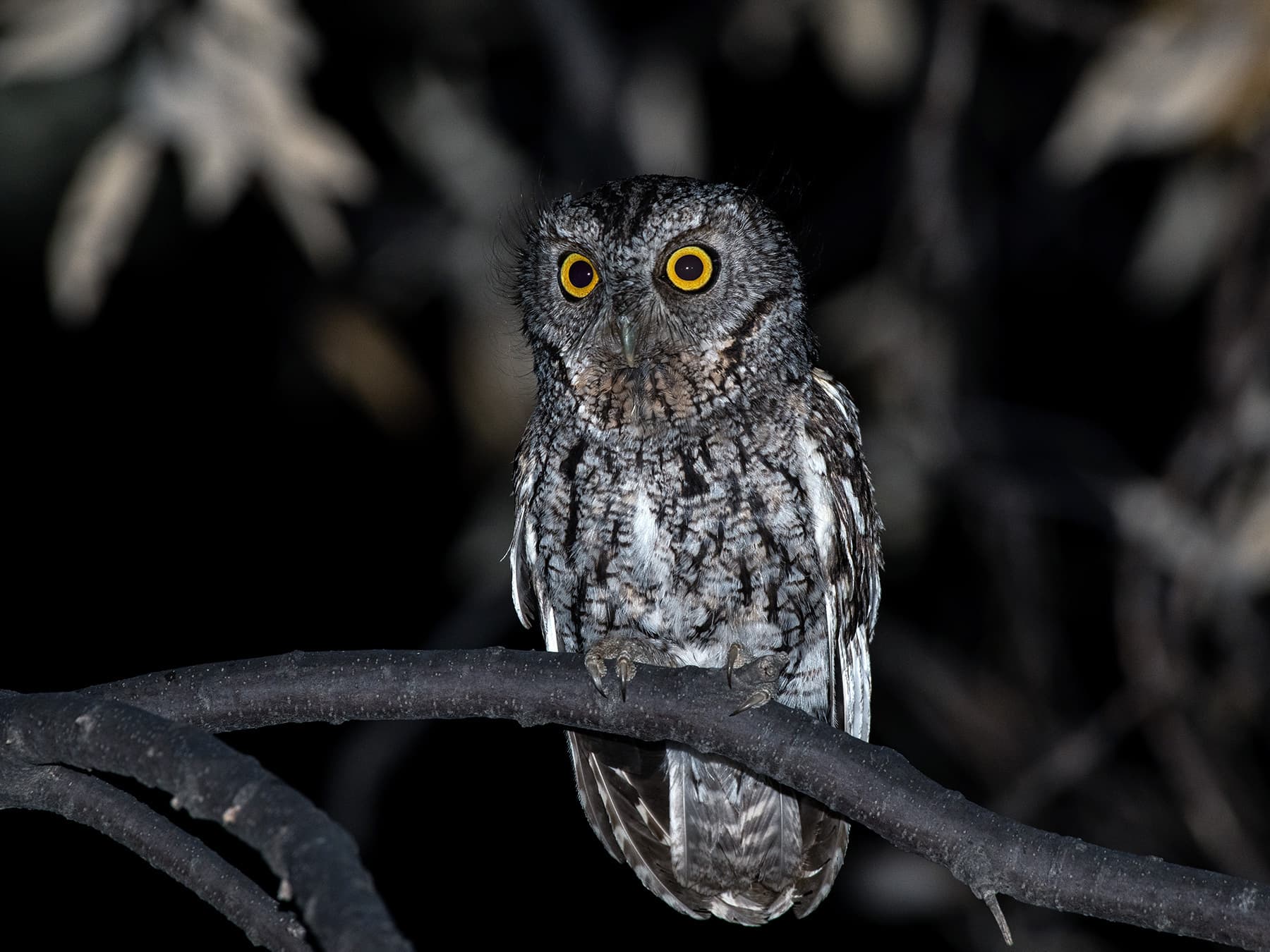
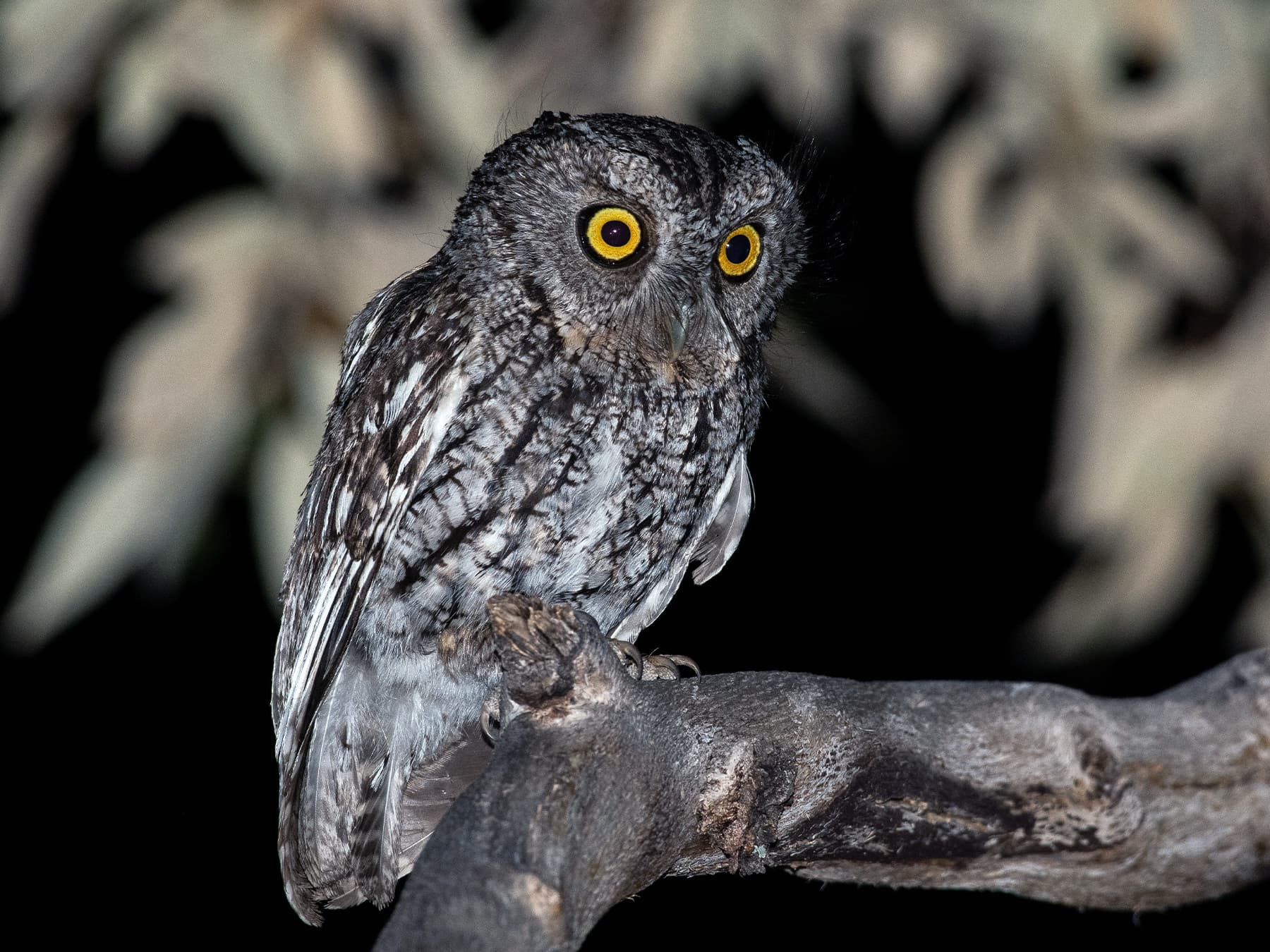
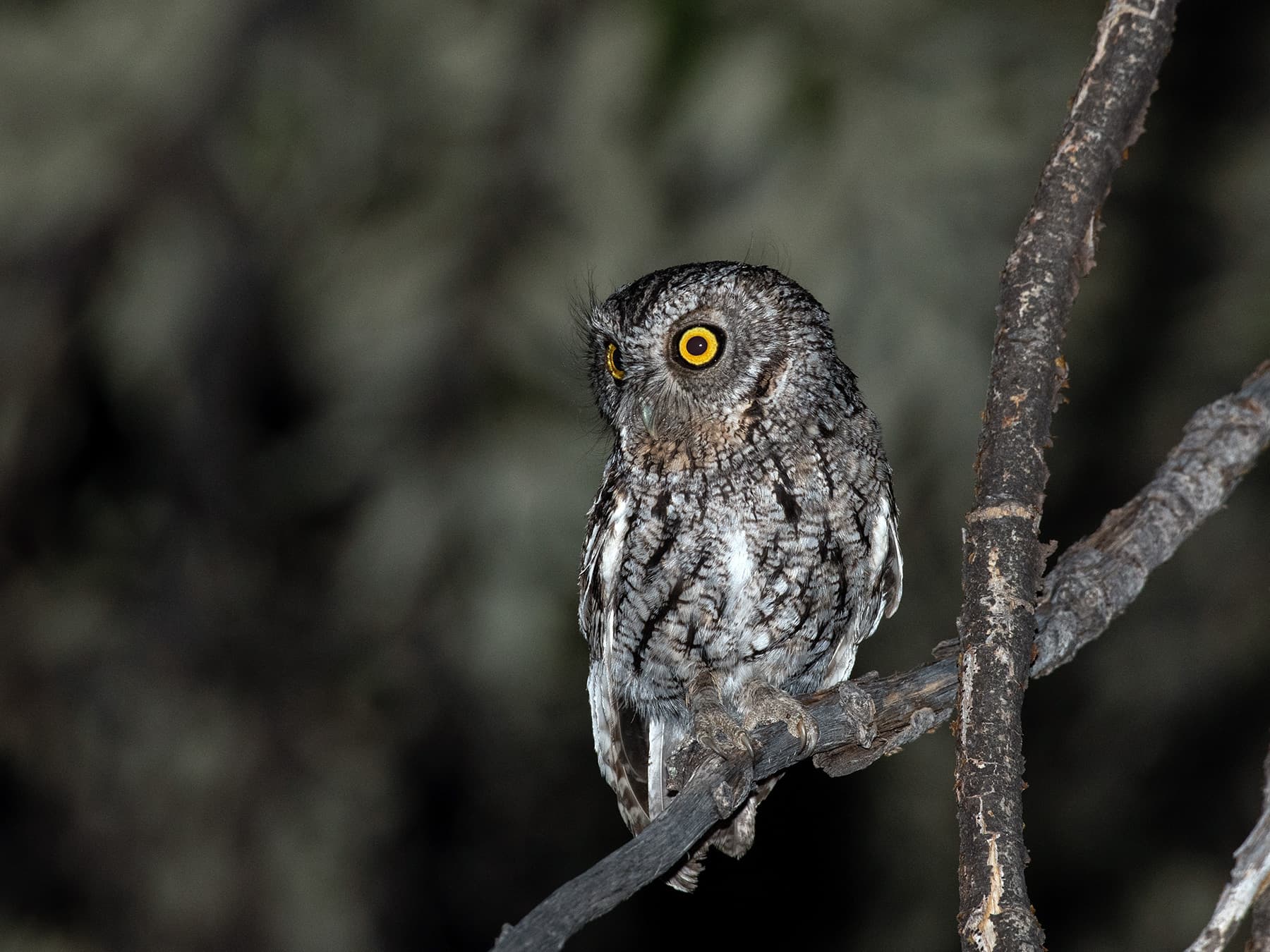
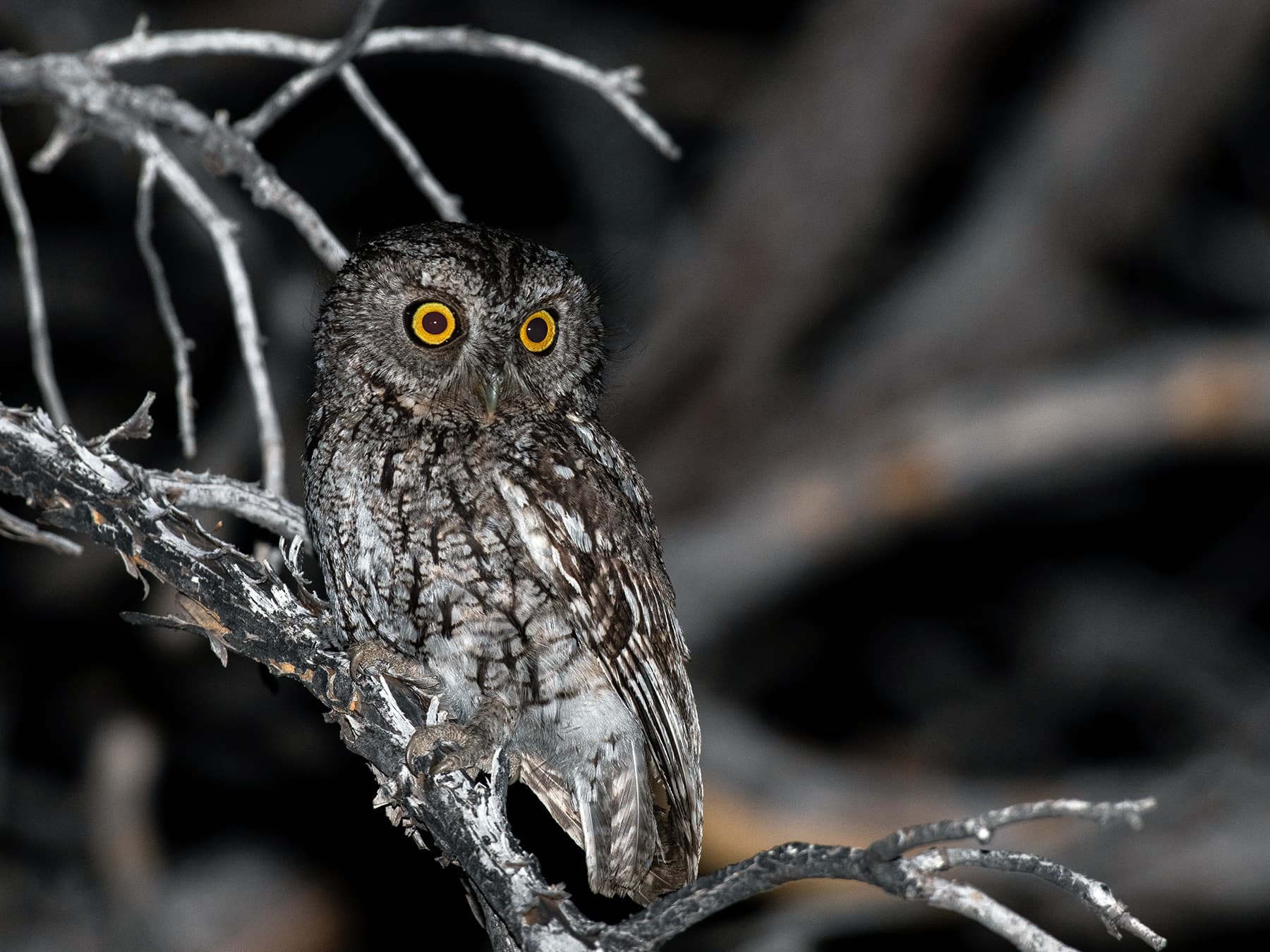
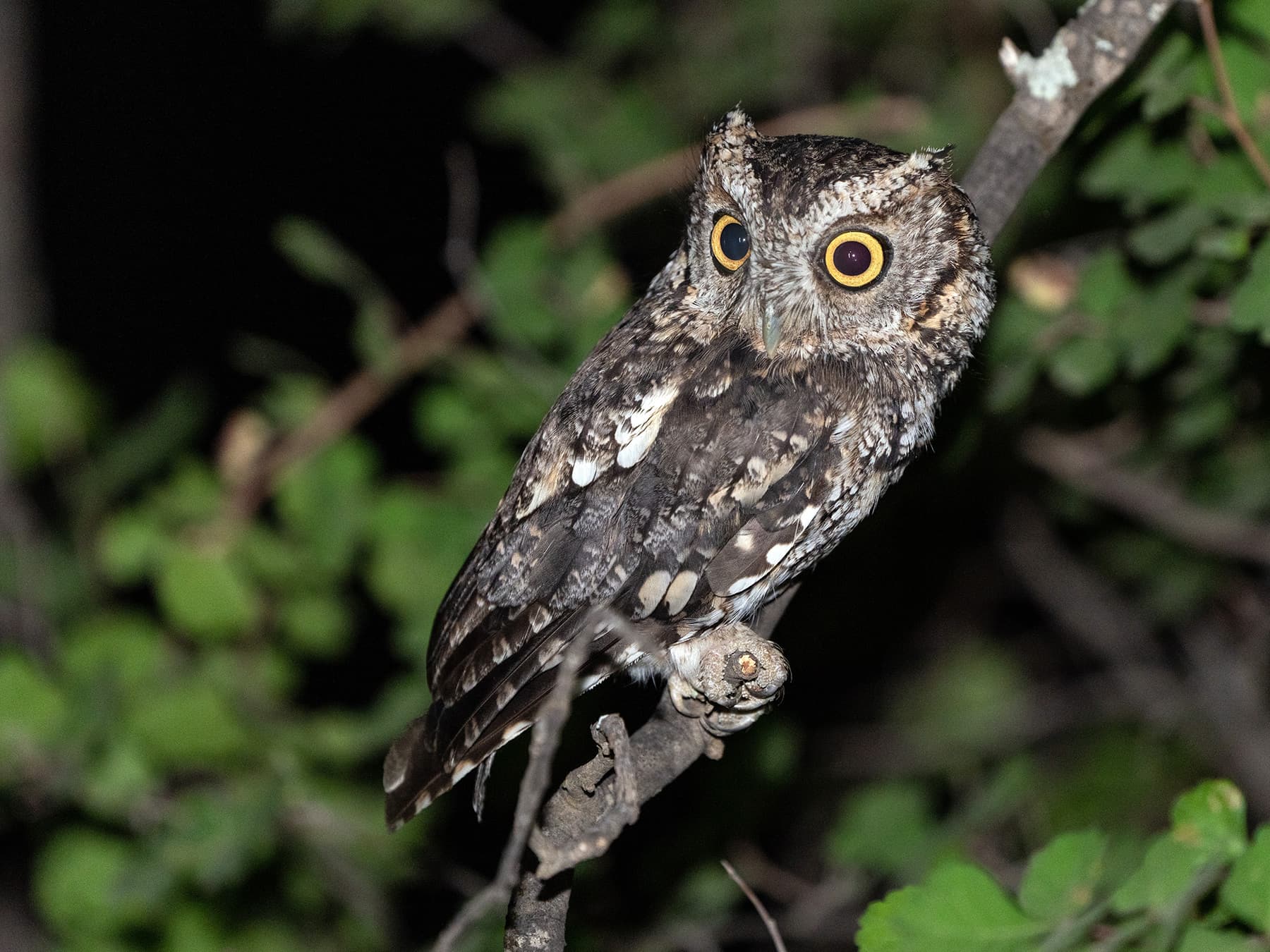
Whiskered screech-owls are small owls with prominent ear tufts. They are primarily dark gray with light rust-colored streaks and closely barred markings on their breast, belly, head, neck, back, wings, and tail.
In the shaded cloud forest landscapes of Latin America, a number of whiskered screech-owls are a rufous morph, which is a reddish-brown version of the more widespread gray coloring.
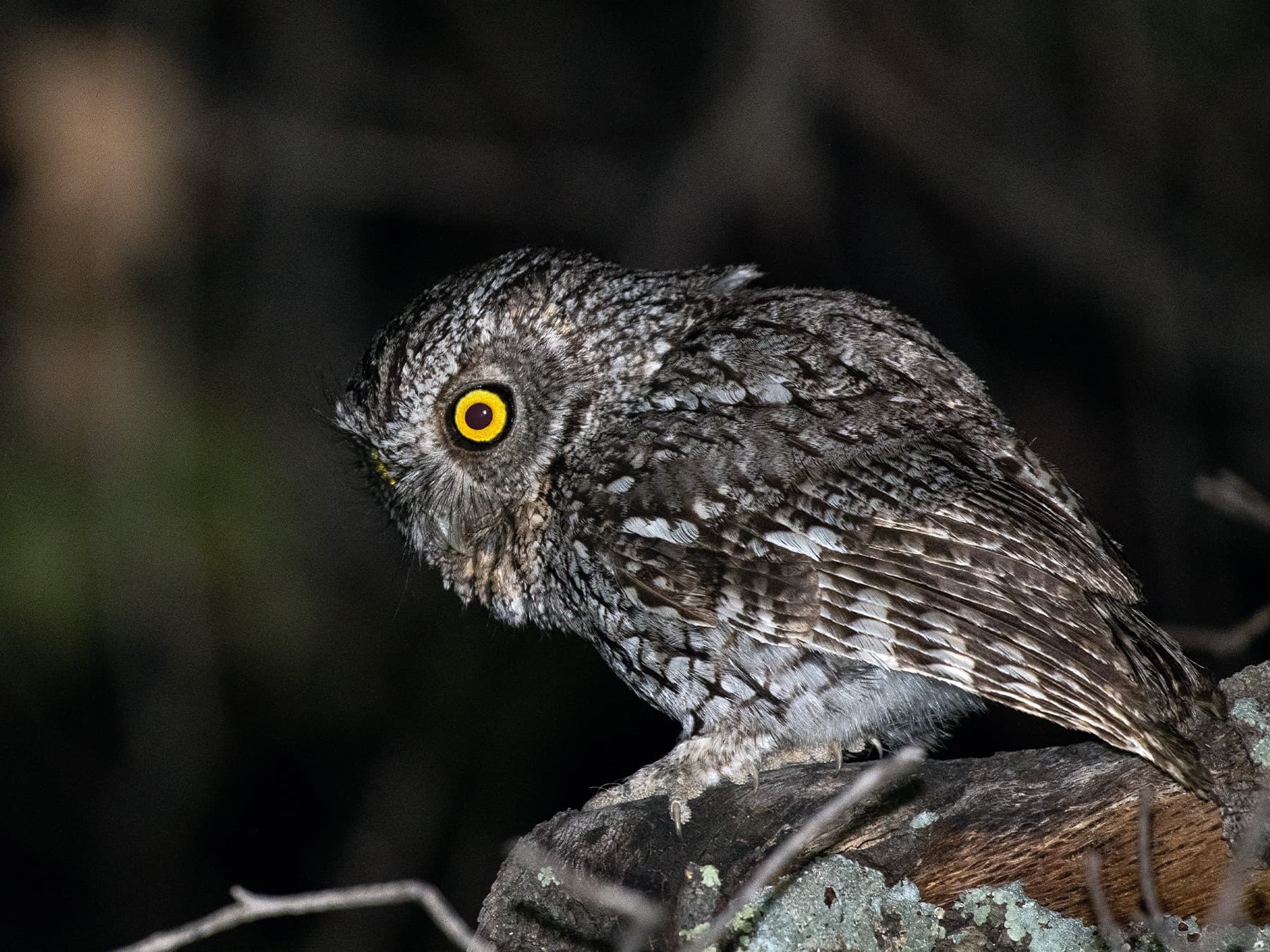
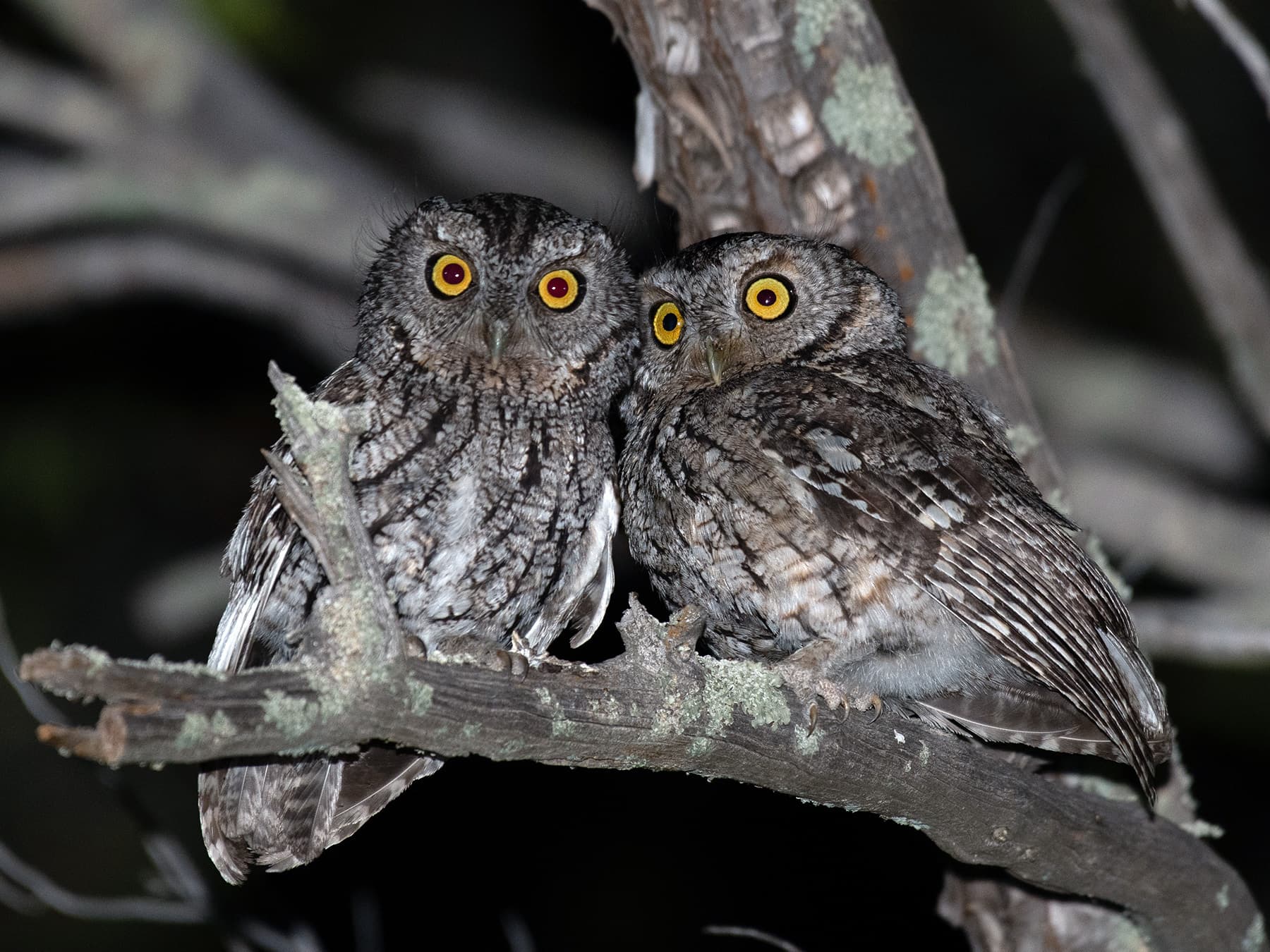
Unique adult features of this species include whisker-like bristle-tipped feathers on the facial disc, a yellow-olive bill, and vivid yellow-orange eyes. Feathering is present on the toes, which, like the feet, are small.
Female and male whiskered screech-owls are alike in appearance and coloring, with the only visual difference being that females are noticeably larger and heavier than males.
Initially, juvenile whiskered screech-owls have a downy covering and lighter coloring with their gray body feathers barred with narrow cinnamon stripes.
How big are Whiskered Screech-Owls?
Whiskered screech-owls are among North America’s smallest native owl species, slightly larger than an elf owl and the northern pygmy owl. Females are larger than males in length, weight and wingspan.
- Length: 15 cm to 19 cm (5.9 in to 7.5 in)
- Wingspan: 44 cm (17.5 in)
- Weight: 70 g to 120 g (2.5 oz to 4.3 oz)
Its size
Adults- Length
- 18–23 cm
- Wingspan
- 48–56 cm
- Weight
- 100–160 g
Its song and calls
What sound does a Whiskered Screech-Owl make?
Whiskered screech-owls have distinct calls, which can be used as a reliable way to identify the species. A series of short whistled notes on a single pitch are used as a territory marker.
Trilled songs that change pitch at the end, consisting of a series of irregular long and short hoots, are heard as a contact call and are often compared to Morse Code.
- Recording0:00 / 0:34
Recorded in Arizona, United States · May 2025
When and where to see it
How often the Whiskered Screech-owl turns up in the United States through the year, from birdwatchers' records.
United States
Summer visitor · all year · most records in August
Show as a table
| Month | United States |
|---|---|
| January | <0.001% (regular) |
| February | <0.001% (regular) |
| March | 0.001% (regular) |
| April | 0.002% (regular) |
| May | 0.002% (regular) |
| June | 0.002% (regular) |
| July | 0.003% (regular) |
| August | 0.004% (regular) |
| September | <0.001% (regular) |
| October | <0.001% (regular) |
| November | <0.001% (regular) |
| December | <0.001% (regular) |
Worldwide: recorded regularly in 5 countries
Countries where it was recorded in at least 3 of the 6 years 2019–2024. Linked countries have their own bird list.
North America (5)
- El Salvador
- Guatemala
- Honduras
- Mexico
- United States
Data: EOD – eBird Observation Dataset (Cornell Lab of Ornithology), accessed via GBIF.org, CC BY 4.0. Records from 2019–2024, aggregated and filtered by Birdfact. How these lists are made
What is the habitat of a Whiskered Screech-Owl?
Montane landscapes with forest-covered canyons are the habitat of choice for whiskered screech-owls. Evergreen and mixed-species woodlands at altitudes of 1200 m to 2500 m (4000 ft to 8200 ft), particularly those crossed by rivers or streams, and with dense canopy cover are preferred.
What is the range of a Whiskered Screech-Owl?
The extreme southwest of New Mexico and southeast of Arizona form the northernmost boundary of the whiskered screech-owl’s distribution, which continues through the upland forests of Mexico’s Sierra Madre Occidental range and into parts of the east and central-south of the country, across the border into the Guatemala highlands. The range continues into southern Honduras, northern El Salvador and ends in northern Nicaragua.
Where do Whiskered Screech-Owls live?
Whiskered screech-owls have a discontinuous range across parts of the United States, Mexico, and Central America. Countries with resident populations include the US, Mexico, Guatemala, Honduras, El Salvador, and Nicaragua.
How rare are Whiskered Screech-Owls?
Within their habitat, at elevations upwards of 1200 m (4000ft) whiskered screech-owls are relatively common, although their nocturnal habits and preference for densely vegetated forest landscapes make them challenging to spot.
Their distinctive calls offer the best way of confirming a possible sighting. Precise population figures for this species are unknown.
Where can you see Whiskered Screech-Owls in the US?
Only two states report regular sightings of whiskered screech-owls: New Mexico and Arizona.
Arizona’s mountain ranges from the Santa Catalinas south all have resident whiskered screech-owls, with good sighting spots at Bear Canyon, to the north of Tucson, Madera Canyon in the Santa Ritas, Miller Canyon in the Huachucas and Cave Creek Canyon in the Chiricahuas.
Where can you see Whiskered Screech-Owls in Canada?
Whiskered screech-owls are not resident in Canada and have not been recorded as a native or visiting species there.
Migration
Do Whiskered Screech-Owls migrate?
Whiskered screech-owls are non-migratory, remaining in the same territories all year round. In higher elevations, some temporary movement towards lower slopes and foothills may occur in winter.
Are Whiskered Screech-Owls native to the US?
Only a very limited area of the United States has a presence of whiskered screech-owls. The extreme southeast corner of Arizona, in Cochise, Pima, and Santa Cruz counties, and to the east, in the Peloncillo and Guadalupe Mountains of Hidalgo County in New Mexico.
Tips for seeing it
- Listen for their distinctive trill call at night, especially during breeding season
- Look for them perched motionless in dense foliage or near tree trunks
- Search for pellets or whitewash beneath potential roosting sites
- Use a flashlight to spot their reflective eyes in low-light conditions
What it eats
What do Whiskered Screech-Owls eat?
In the northern parts of their range, western screech-owls feed mainly on invertebrates, which represent 94 percent of their prey items, including caterpillars, centipedes, beetles, and larvae. Lizards, snakes, bats, and mice are also eaten, particularly further to the south.
What do Whiskered Screech-Owl chicks eat?
Beetles, moths, and caterpillars are among the most common prey brought to nestlings in Arizona. Larger prey, including mice and lizards, are often cached and fed at a later stage, having been ripped into smaller chunks by the parents.
Nesting and breeding
Where do Whiskered Screech-Owls nest?
Whiskered screech-owls do not build their own nests, relying instead on empty cavities deserted by other species. Natural cavities are used, as well as those excavated by northern flickers and acorn woodpeckers, which may have been previously enlarged by squirrels.
In Arizona, nests are commonly located in Arizona sycamore, Arizona oak, or Chihuahua pine; little information on nesting is available from other parts of their range.
Nestboxes are readily used where available, and the preferred height for cavities and boxes is between 5 m and 7 m (16 ft and 23 ft).
When do Whiskered Screech-Owls nest?
Pair formation for whiskered screech-owls begins in March each year, with eggs laid between April and May, although earlier clutches are often laid in southern parts of the range. The incubation period is not well-documented but is believed to be between three and four weeks. Females incubate alone, with males feeding them on the nest.
What do Whiskered Screech-Owl eggs look like?
Eggs laid by whiskered screech-owls are rounded and creamy white. A typical clutch contains 3 to 4 eggs, which measure around 28 mm by 34 mm (1.1 in by 1.3 in).
Do Whiskered Screech-Owls mate for life?
Whiskered screech-owls are a monogamous species during the breeding season, and pair bonds have been seen to last beyond one single year.
Behaviour
Are Whiskered Screech-Owls aggressive?
In their natural surroundings, whiskered screech-owls are typically unaggressive and tolerant of nearby birds, tending instead to usually ignore their presence or sing at them.
Aggression has been observed in research situations where decoys and birdsong were played nearby and their reactions recorded. In these scenarios, a higher degree of intolerance was shown, with hostile behavior witnessed.
Where do Whiskered Screech-Owls sleep at night?
A nocturnal species, whiskered screech-owls spend days roosting in trees and nights hunting from perches in forest landscapes. Females roost in the nest cavity overnight when brooding young, rarely accompanied by the male.
After fledging, males and females find suitable roosting spots in the same tree, initially positioning themselves beneath the branches where recent fledglings have chosen to settle for the night.
Lifespan and predators
How long do Whiskered Screech-Owls live?
Breeding occurs for the first time at one year of age and is annual. Few longevity records are available, with a female identified to have reached 4 years of age, although it is generally agreed that the average and maximum lifespans for the species are higher.
What are the predators of Whiskered Screech-Owls?
Spotted owls and Cooper’s hawks are known to prey on adult and fledgling whiskered screech-owls. Nests are raided by green rat snakes and gopher snakes, as well as coatis and raccoons.
Are Whiskered Screech-Owls protected?
The Migratory Bird Treaty Act of the United States protects whiskered screech-owls from being killed, injured, traded, or taken into captivity. The legislation also offers protection to their eggs, feathers, young, and nest sites.
Are Whiskered Screech-Owls endangered?
In New Mexico, whiskered screech-owls are registered as a Threatened Species, due to their limited range that does not go beyond the Peloncillo-Guadalupe Mountains.
On a wider scale, there are no urgent threats to survival although habitat loss in El Salvador is thought to have led to local population declines. Overall, they are rated as a species of least concern.
Conservation
While the Whiskered Screech-owl is currently listed as Least Concern, it faces threats from habitat loss due to deforestation in parts of its range.
Conservation efforts focus on preserving montane forest habitats and monitoring population trends across its distribution.
Similar birds
Often mistaken for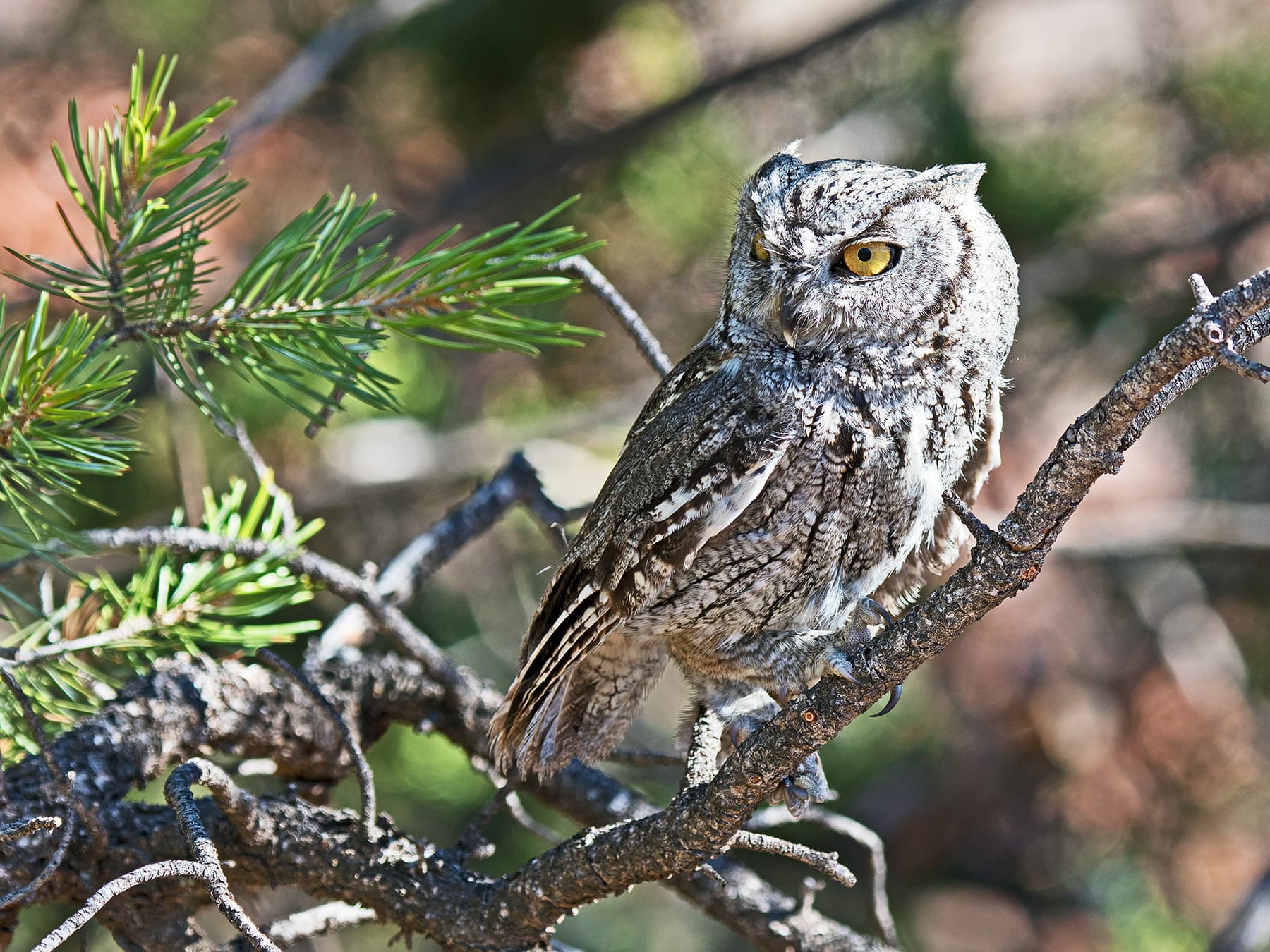
More photos
1 photos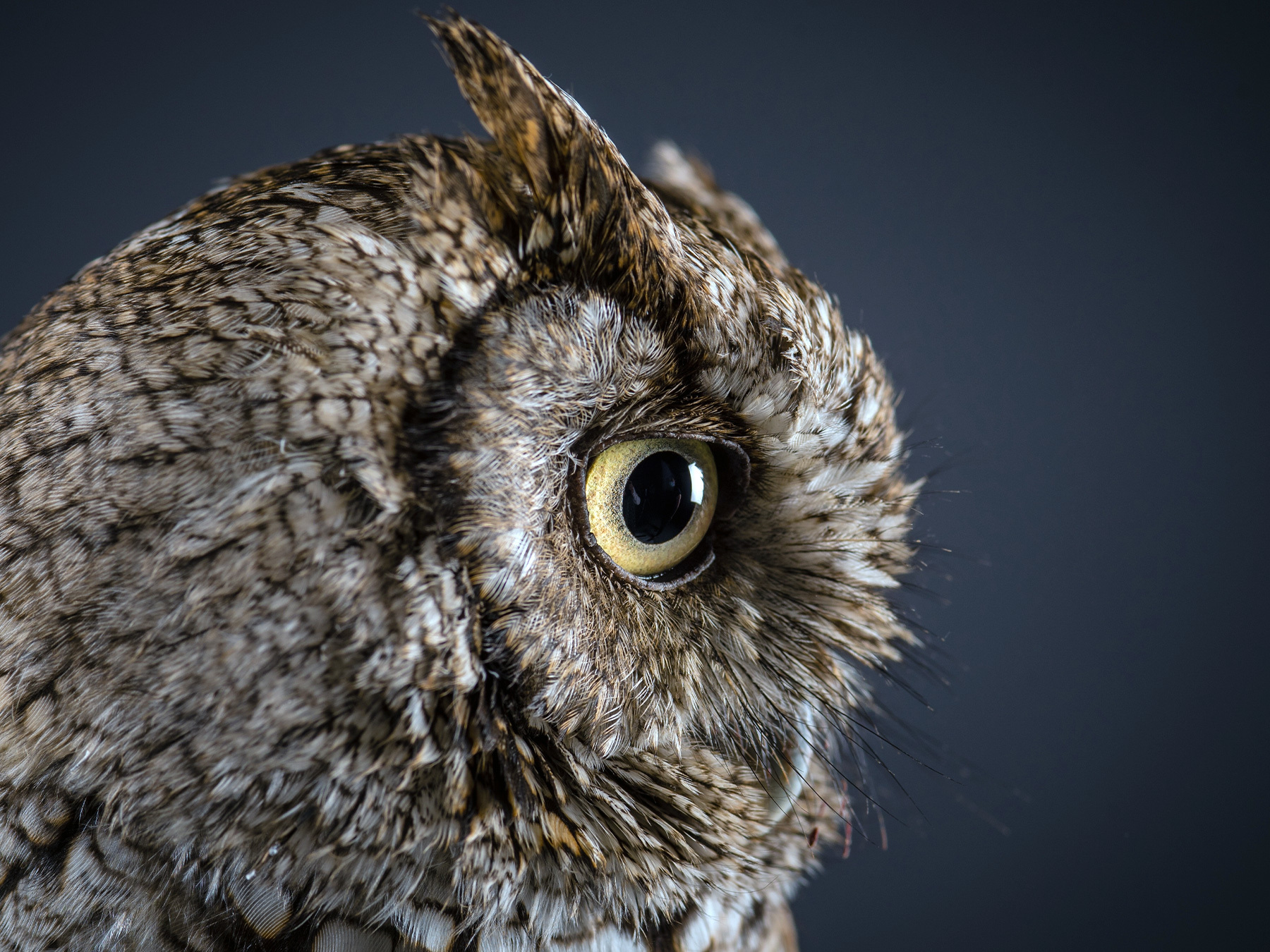
Quick facts
- Length
- 18–23 cm
- Wingspan
- 48–56 cm
- Weight
- 100–160 g
- Lifespan
- 8–12 years
- Family
- Owls
- Migration
- Resident
- Global status (IUCN)
- Least Concern
- World population
- 200,000 mature individuals
- Population trend
- Increasing
- Also called
- Trichopsis Screech-owl
- Scientific name
- Megascops trichopsis
Questions
2What is a Whiskered Screech-Owl?
Whiskered screech-owls are forest-dwelling owls, found in the extreme southern regions of New Mexico and Arizona, and into Mexico, spreading into Central America as far south as Nicaragua. Their name comes from the bristle-tipped feathers that are visible on their faces.
What is the difference between Whiskered and Western screech-owls?
Whiskered screech-owls resemble the gray morph western screech-owls, but are slightly smaller and have smaller feet. They also have bolder cross-barred markings on the breast, similar to those of eastern screech-owls.
The two species have a small overlap of ranges, although western screech-owls are found in a wider geographical area, while whiskered screech-owls are only present in a limited region of the United States, immediately across the borders of New Mexico and Arizona, but largely confined to a strip of central-northwestern Mexico.
Sources
3- 1BirdLife International. 2016. Megascops trichopsis. The IUCN Red List of Threatened Species 2016: e.T22688766A93208062. Source (opens in a new tab)
- 2BBS/CBC data: Butcher and Niven (2007)
- 3Partners in Flight (2022) Source (opens in a new tab)

Checked by
Nathan Cope, founder and editor
Nathan founded Birdfact and leads its writers and contributors in the UK, the US and Canada. He has watched and studied birds for more than ten years, and checks every article and species guide before it’s published.