Species Profile
Virginia Rail
Rallus limicola
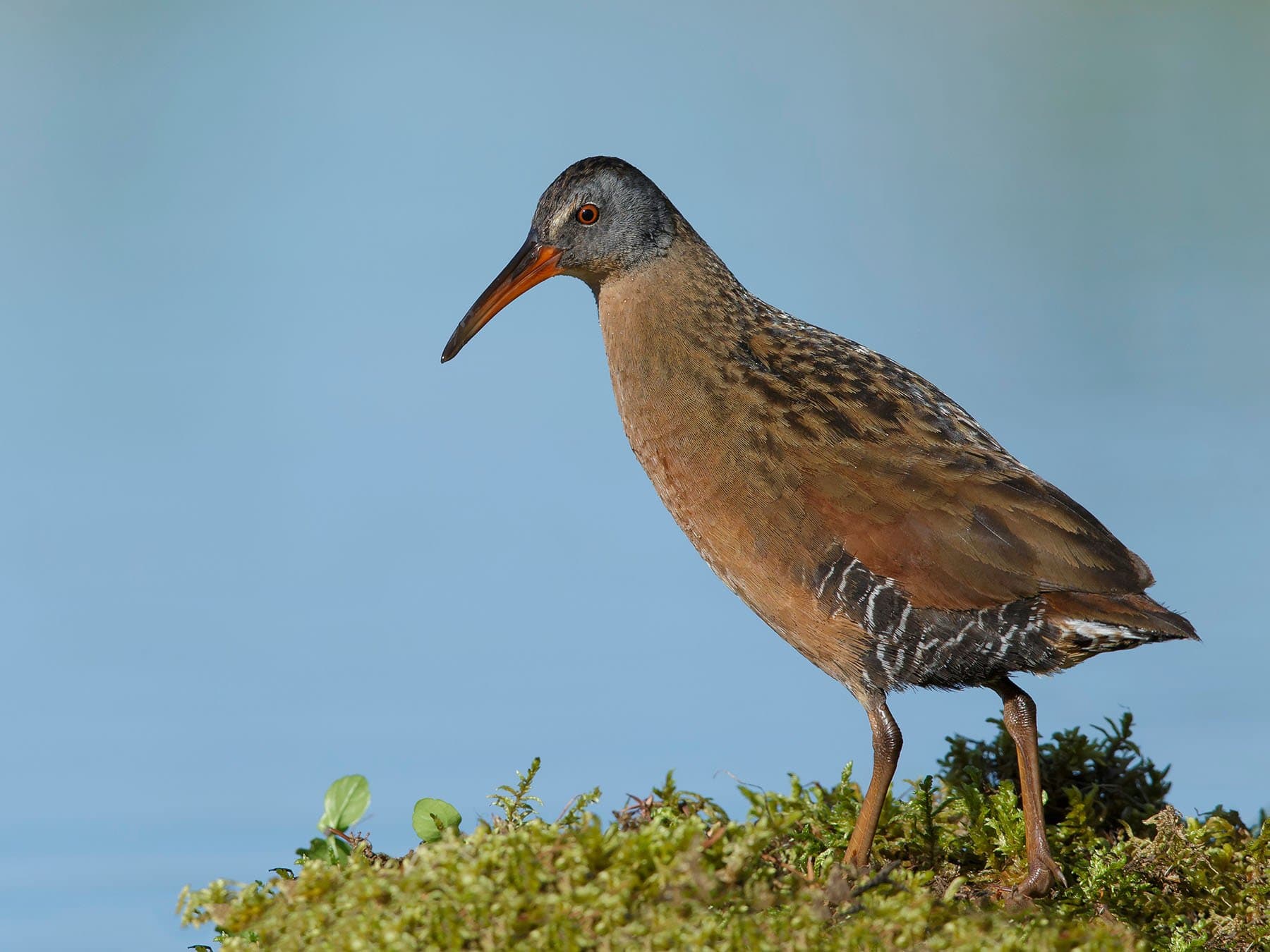
Virginia Rail standing on moss. Features brown plumage, grey head, long orange beak, and distinctive striped flanks against a blue background.
Quick Facts
Conservation
LCLeast ConcernLifespan
2–5 years
Length
20–27 cm
Weight
55–124 g
Wingspan
32–38 cm
Migration
Partial migrant
Heard far more often than seen, the Virginia Rail threads through cattail stems so dense that most observers never catch a glimpse. Its long reddish-orange bill, warm rusty-cinnamon breast, and boldly barred flanks make it one of the most richly coloured of North America's secretive marsh birds — if you can find one.
Think you've spotted a Virginia Rail?
Upload a photo and we'll confirm it instantly
Confirm with a PhotoAppearance
Laterally compressed side-to-side — an adaptation so effective it can squeeze through cattail stems with barely a rustle. The Virginia Rail is a compact marsh bird with surprisingly rich colouring. The breast and belly are a warm rusty-cinnamon, contrasting sharply with bold black-and-white barring along the flanks. The back and crown are dark brown, heavily streaked with black, providing excellent camouflage against the vertical lines of a reed marsh.
The face is the most distinctive feature. Grey cheeks are framed by a pale supercilium above and a whitish throat below, giving the head a clean, masked appearance. The bill is long, slim, and slightly decurved — reddish-orange in colour, and perfectly shaped for probing in mud and shallow water.
The iris is reddish-brown in adults. Legs and feet are reddish-brown, though they are frequently caked in mud. The tail is short and habitually held upright, flashing white undertail coverts. The wings are chestnut-coloured and carry a vestigial 1 mm claw on the fifth digit — a structural curiosity shared with few other birds. The forehead feathers are specially hardened to withstand the constant abrasion of pushing through sharp cattail stems, essentially forming a biological crash helmet.
Both sexes are very similar in plumage. The primary difference is size: males average 79–104 g with a wing chord of 99–113 mm, while females average 64–77 g with a wing chord of 89–106 mm. The female's bill is proportionally slightly shorter.
Juveniles are duller overall, with less distinct facial markings and a paler, less saturated breast.
Identification & Characteristics
Colors
- Primary
- Chestnut
- Secondary
- Grey
- Beak
- Red Orange
- Legs
- Rich Brown
Markings
Reddish-orange decurved bill; grey cheeks with pale supercilium; rusty-cinnamon breast; bold black-and-white barred flanks; chestnut wings; white undertail coverts; reddish-brown iris
Tail: Short, frequently held upright, revealing white undertail coverts
Attributes
Understanding Attributes
Rated 0–100 based on research and observation. A score of 50 is average across all bird species. These attributes are relative and don't necessarily indicate superiority.
Habitat & Distribution
Freshwater cattail marshes are the defining habitat of the Virginia Rail. Dense stands of cattail (Typha) and bulrush (Scirpus), typically in water 0–15 cm deep over a muddy bottom, are where this species is most reliably found. Brackish wetlands are also used, particularly in winter, but freshwater marsh is the core. The ideal marsh has 40–70% coverage of tall emergent vegetation (40–100 cm high), interspersed with open water, mudflats, and matted vegetation. Deeper open water (20–40 cm) is generally avoided unless floating or fallen vegetation provides a walking surface.
The breeding range spans most of North America — from Nova Scotia in the east to southern British Columbia in the west, south to California, Arizona, and North Carolina. In the United States, the species is a fairly common breeder in the Great Lakes states, New England, the upper Midwest, and the Pacific Northwest. Canadian populations breed from Nova Scotia west to southern British Columbia.
During migration, Virginia Rails can turn up almost anywhere with suitable wet habitat — including city streets and roadside ditches — making them one of the more surprising birds a North American birder might encounter.
Wintering populations occur along the Atlantic, Gulf, and Pacific coasts of the United States, in Mexico, and in Central America as far south as Guatemala. Some individuals travel considerably further: wintering records exist from Colombia, Ecuador, Peru, Chile, and Argentina. On the Pacific coast — particularly coastal California, parts of Arizona, and eastern Virginia — some populations are permanent year-round residents that do not migrate at all.
In winter, Virginia Rails often shift from freshwater marshes into saltmarshes and brackish coastal wetlands. In Arizona, wintering birds move away from open water into denser, taller emergent vegetation exceeding 100 cm. The elevation range extends from sea level to 2,370 m in the Peruvian Andes. There, a closely related subspecies, R. l. aequatorialis (the Ecuadorian Rail), is resident and sometimes treated as a separate species entirely. Wetlands invaded by reed canary grass (Phalaris arundinacea) make poor habitat: this monoculture lacks the structural diversity — the mix of open water, mudflat, and emergent cover — that Virginia Rails require.
Diet
Virginia Rails are primarily carnivorous, with aquatic invertebrates forming the bulk of their diet. Beetles — particularly aquatic species and their larvae — are a staple, alongside flies and dipteran larvae, dragonflies, true bugs, spiders, snails, slugs, earthworms, crayfish, and other crustaceans. They also take small vertebrates when the opportunity arises: frogs, small fish, and occasionally small snakes all feature in the diet.
Compared to the co-occurring Sora, Virginia Rails consume significantly more animal prey and far fewer seeds. Plant material does become more important in autumn and winter, when invertebrate availability declines, but the Virginia Rail remains more carnivorous than most of its rail relatives throughout the year.
Foraging is primarily crepuscular — most active at dawn and dusk — though birds will feed at any hour in undisturbed marshes. The long, slightly decurved bill is the key foraging tool: Virginia Rails probe in soft mud and shallow water, pick prey from the ground or vegetation surfaces, and stalk small creatures before capturing them with a swift, precise thrust. They wade in water up to a few centimetres deep along the margins of emergent vegetation, and also work mudflats and floating mats of dead plant material where invertebrates concentrate.
During migration, birds arriving at stopover sites in unexpected habitats — wet roadside ditches, flooded fields — will exploit whatever invertebrate prey is available, demonstrating a degree of dietary flexibility that helps them survive the rigours of long-distance travel.
Behaviour
Given the choice between running and flying, Virginia Rails run — every time. They spend the vast majority of their time hidden within dense emergent vegetation, moving through the marsh on foot rather than taking to the air. Laterally compressed bodies allow them to navigate cattail stems at speed, and a flushed bird typically flutters a short distance before dropping back into cover — a flight style that looks weak and laboured, though it belies their capacity for long-distance nocturnal migration.
Activity peaks at dawn and dusk. During the day, Virginia Rails rest in dense cover, emerging to forage along mudflats, shallow water edges, and floating mats of vegetation. They are largely solitary outside the breeding season, though pairs defend territories vigorously during spring and summer using a repertoire of grunting calls and duets.
Virginia Rails occasionally share marsh habitat with the closely related Sora, and the two species can be found foraging in the same wetland. However, Virginia Rails tend to occupy slightly wetter, deeper sections of marsh and consume significantly more animal prey than the more seed-dependent Sora. Interactions between the two are generally tolerant rather than aggressive.
One unusual behavioural trait is the construction of multiple "dummy nests" — up to 30 per breeding season — scattered around the marsh in addition to the real nest. These decoy structures are thought to confuse predators such as mink, raccoon, and great horned owls, which are among the most significant nest predators the species faces.
Calls & Sounds
Spend a spring evening beside a cattail marsh and you may hear a Virginia Rail without ever seeing one. The primary advertising call — often described as the species' "song" — is a rapid, metallic series of doubled notes: "kid-ick, kid-ick, kid-ick" or "kiddik, kiddik, kiddik", delivered in a rhythmic staccato. This call is most commonly heard in spring and serves for territorial advertisement and mate attraction.
The most frequently heard call, however, is a descending, accelerating series of grunts — rendered as "kuk-kuk-kuk" or likened to a pig-like oinking — that drops in both pitch and speed toward the end. This grunting call is often heard at night and has a social effect that can trigger a chorus of responses from every Virginia Rail in the marsh.
The female has a distinct song of her own: a rapid "ki-ki-ki-ki-ki-kedew" that descends at the end. Both sexes produce grunting duets to defend territory jointly. The species also produces shorter grunts, squeaks, and a trill described as "k-k-k-kerrrrrr" that can be mistaken for a spring peeper frog by the unwary. Rails are most vocal at dawn and dusk, and throughout the spring breeding season.
The most unusual entry in the Virginia Rail's vocal repertoire is the "kicker call" — a complex vocalisation apparently produced only by unmated females, and only in spring.
This call went unrecognised for decades. First described in the early 1900s, it was misidentified as the call of the elusive Yellow Rail for nearly 70 years. The mystery was finally solved in 1967 by ornithologist George Reynard and colleagues, who traced the call definitively to Virginia Rails. It remains one of the more entertaining cases of mistaken identity in North American ornithology.
Flight
Virginia Rails are notoriously reluctant to fly. When disturbed, they almost always run rather than take to the air, and when they do flush, the flight is typically short — a low, fluttering dash of a few metres before the bird drops back into cover. In the air, the legs dangle loosely beneath the body, the wingbeats are rapid and shallow, and the overall impression is of a bird that would rather be anywhere else. This apparent feebleness is deceptive.
Despite their reluctant daytime flight, Virginia Rails are capable long-distance nocturnal migrants. Northern and interior breeding populations travel from Canada and the northern United States to wintering grounds in Mexico, Central America, and beyond. Migration occurs almost entirely at night: birds depart approximately one hour after civil twilight, with more departures recorded on clear, dark nights. Motus radio-telemetry tracking of spring migrants in Illinois found that birds staging in central Illinois were primarily travelling northwest toward the Prairie Pothole region. Average stopover duration was around 13 days — slightly longer than the 10-day average recorded for co-migrating Soras at the same sites.
In flight, the chestnut wing patch is visible and distinctive. The wings are short and rounded, suited to manoeuvring through dense vegetation rather than sustained soaring. The combination of dangling legs, rapid wingbeats, and low trajectory makes a flushed Virginia Rail fairly easy to identify even in brief flight views.
Nesting & Breeding
The breeding season runs from early April through early September, with peak egg-laying in May or June depending on latitude. Nest construction begins roughly one week before the first egg is laid. Both sexes build the nest — a loosely woven basket of cattails, reeds, and grasses, typically placed a few inches above the water surface in dense emergent vegetation. Living plants are pulled down overhead to form a canopy, concealing the nest from above. The outer diameter averages 17.3 cm. Alongside the real nest, pairs construct up to 30 dummy nests scattered around their territory — a level of decoy-building that rivals the famously paranoid Marsh Wren.
Clutch size ranges from 4 to 13 eggs, with a mean of 8.5; northern populations tend toward larger clutches. Eggs are white or pale buff with sparse, irregular grey or brown spotting, measuring approximately 32 × 24 mm. One egg is laid per day. Both parents share incubation, alternating in shifts every 1–2 hours, though females take the larger share at 60–80% of incubation time. The incubation period lasts 18–22 days.
Chicks are precocial and covered in black down, with eyes open at hatching. They weigh approximately 5.4 g at birth — barely more than a large grape.
Development is rapid: chicks can stand, preen, drink, and swim within their first day of life, with some individuals recorded swimming just 11 hours after hatching. They leave the nest within 3–4 days and are foraging independently within a week. Both parents feed and brood the young for 2–3 weeks. Young can fly at approximately 25 days, reaching full independence at 4–6 weeks, at which point the pair bond dissolves. Pairs may raise one or two broods per season.
Lifespan
Virginia Rails typically live 2–5 years in the wild, with the maximum recorded age standing at 9 years. Annual survivorship is approximately 52–53% — meaning that in any given year, roughly half of all Virginia Rails alive will not survive to the following year, a figure that reflects the cumulative pressures of migration, winter displacement, and year-round predation. Mortality is highest during winter — when birds are displaced from familiar territories and may face food shortages in coastal marshes — and before chicks reach fledging stage, when predation pressure on nests and broods is intense.
Predation drives much of this mortality, with mammalian and avian predators taking a significant toll on both nests and adults throughout the year.
The secretive lifestyle of rails — spending most of their time hidden in dense vegetation — likely provides some protection against aerial predators. It offers little defence, however, against mammalian nest predators that hunt by scent.
Conservation
The Virginia Rail is listed as Least Concern on the IUCN Red List, and the global population is estimated at approximately 240,000 individuals. North American Breeding Bird Survey data from 1966 to 2021 show overall stable populations, though the species' secretive nature makes accurate monitoring genuinely difficult — population estimates carry wide uncertainty margins. Partners in Flight rates the species 9 out of 20 on the Continental Concern Score, placing it in the low conservation concern category.
The primary threat is loss and degradation of wetland habitat. Drainage for agriculture and urban development has eliminated vast areas of suitable marsh across North America, and prolonged droughts — increasingly frequent under climate change — can render remaining wetlands temporarily unsuitable.
Invasion by reed canary grass (Phalaris arundinacea) is a growing concern: this aggressive monoculture replaces the structurally diverse emergent vegetation that Virginia Rails depend on, effectively turning productive marsh into poor-quality habitat without the wetland being drained at all.
Predation is a significant source of mortality, particularly for nests and pre-fledging chicks. Known nest predators include mink, otter, raccoon, striped skunk, ermine, muskrat, great horned owls, northern harriers, cranes, egrets, raptors, snakes, and predatory fish.
Annual survivorship across all seasons and age groups is approximately 52–53%, meaning roughly half of all Virginia Rails alive in any given year will not survive to the next. Mortality is highest in winter and before chicks reach fledging stage. The Virginia Rail is classified as a game bird in many US states and Canadian provinces, though it is rarely hunted in practice. Conservation efforts focus primarily on wetland protection and restoration — maintaining and creating the shallow, vegetated marshes the species requires is the single most effective action for sustaining populations long-term.
Population
Estimated: Approximately 240,000 individuals
Trend: Stable
Stable overall based on North American Breeding Bird Survey data (1966–2021), though the species' secretive nature makes accurate monitoring difficult. Partners in Flight Continental Concern Score: 9/20 (low concern).
Elevation
Sea level to 2,370 m
Additional Details
- Predators:
- Known nest and adult predators include mink, otter, raccoon, striped skunk, ermine, muskrat, great horned owls, northern harriers, cranes, egrets, raptors, snakes, and predatory fish. Mortality is highest in winter and before chicks reach fledging stage. Annual survivorship is approximately 52–53%.
Similar Species
In the cattail marshes where Virginia Rails breed, two confusion species are worth knowing well — and the Sora tops the list. Sharing the same freshwater marsh habitat across much of North America, the Sora is smaller and stockier, with a short, stubby yellow bill — the opposite of the Virginia Rail's long, decurved reddish-orange bill. The Sora's face is black, not grey, and its underparts are grey rather than rusty-cinnamon. In flight, the Sora shows a yellow-buff wing stripe absent in the Virginia Rail.
Roughly twice the weight of a Virginia Rail, the King Rail (Rallus elegans) is the closest relative and can overlap in habitat along the Atlantic and Gulf coasts and in the Mississippi Valley. Its underparts are brighter and more saturated rusty-orange, and the flanks are barred in a similar pattern, but the grey cheek patch so prominent in the Virginia Rail is far less pronounced — the King Rail shows more uniform warm tones on the face. Where the two species co-occur, size is the most reliable field mark.
Saltmarsh rather than freshwater marsh is the usual home of the Clapper Rail, which separates it from the Virginia Rail in most situations. It is larger and greyer overall, with less rusty colouration on the breast. In the small zone of overlap — where freshwater and brackish marshes meet — bill length and overall size remain the most useful features.
Juvenile Virginia Rails, which are duller and less distinctly marked than adults, can occasionally cause confusion with other small rails, but the long reddish bill is present from an early age and remains the single most reliable identification feature at any age.
Courtship & Display
Courtship in Virginia Rails begins around May and can be initiated by either sex. The male's primary display is visually striking: he runs in circles around the female with his wings raised above his body, flitting his tail and bowing before her with each pass. Both sexes bow repeatedly, engage in allopreening — mutual preening of each other's feathers — and the male feeds the female as part of pair bonding, a behaviour that likely signals his quality as a provider during the energetically demanding nesting period.
Courtship can last up to two weeks. During this period, pairs spend extended time standing silently side-by-side — sometimes for 30-minute stretches — a behaviour that appears to consolidate the pair bond before nesting begins. Before copulation, the male approaches the female while producing a low grunting call. Virginia Rails are monogamous; the pair bond typically lasts through the breeding season and dissolves after the young become independent or just before autumn migration.
Vocalisation plays a central role in pair formation. The male's "kid-ick" advertising call attracts females to his territory, and once a pair has formed, both sexes engage in grunting duets that serve the dual function of reinforcing the pair bond and advertising joint territorial ownership to neighbouring birds.
The intensity of calling peaks in the weeks immediately before and during nest construction, then gradually declines as incubation begins.
Birdwatching Tips
The Virginia Rail's secretive habits mean that your ears are far more useful than your eyes. Learn the calls — particularly the rapid, descending "kuk-kuk-kuk" grunt series and the metallic "kid-ick, kid-ick" advertising call — and you will detect far more birds than you ever see. Dawn and dusk are the best times, when rails are most active and most vocal. Spring, from late April through June, is peak season: males are calling constantly, and the marsh can seem to erupt with sound after dark.
In the United States and Canada, look for Virginia Rails in freshwater marshes with dense cattail or bulrush stands. Productive sites include the Great Lakes marshes, the Prairie Pothole region, coastal California wetlands, and New England marshes. During migration — particularly in late April and again from August through October — birds can appear in surprisingly small and marginal wetlands, including flooded fields and roadside ditches. If you find a likely marsh, walk slowly along the edge and pause frequently. Rails often betray themselves by calling from cover, and occasionally step briefly into the open at the marsh edge.
Distinguishing Virginia Rails from other marsh birds is straightforward if you get a clear view: the combination of reddish-orange bill, grey cheeks, rusty-cinnamon breast, and barred flanks is unique. The most likely confusion species is the Sora, which shares the same habitat but is smaller, has a short yellow bill, and lacks the rusty underparts.
King Rails are larger and brighter, with a longer bill and less distinct grey on the face. In poor light or brief views, the long decurved bill is the single most reliable feature to look for.
Playback of Virginia Rail calls can be effective at drawing birds to the marsh edge during the breeding season, but should be used sparingly and responsibly — repeated playback can disrupt territorial behaviour and cause unnecessary stress, particularly during nesting.
Did You Know?
- A Virginia Rail's legs account for roughly 25% of its body weight — compared to just 15% for the flight muscles. That inverted ratio explains why these birds almost always run rather than fly when disturbed.
- Virginia Rail chicks are swimming within 11 hours of hatching. By day seven they are foraging independently — all while still covered in black natal down.
- A single breeding pair may scatter up to 30 dummy nests around the marsh in one season. Predators investigating decoys waste time while the real clutch is incubated elsewhere.
- For nearly 70 years, ornithologists attributed the Virginia Rail's "kicker call" to the Yellow Rail — a far rarer and more elusive species. George Reynard finally cracked the case in 1967 by recording the call back to its true source.
- The idiom "thin as a rail" almost certainly traces back to rails like this species. Their bodies are so laterally compressed that they can slip through a gap in dense cattail stems that looks far too narrow for any bird.
Records & Accolades
Leg Muscle Champion
~25% of body weight
Virginia Rails have the highest ratio of leg muscle to body weight of any bird group — their legs account for roughly 25% of total body weight, compared to just 15% for flight muscles.
Speed Developer
Swimming at 11 hours old
Virginia Rail chicks have been recorded swimming just 11 hours after hatching, making them among the most precocial chicks of any North American bird.
Decoy Builder
Up to 30 dummy nests per season
A single breeding pair of Virginia Rails may construct up to 30 dummy nests in one season to confuse predators and protect the real clutch.
Community Photos
Be the first to share a photo of the Virginia Rail
Upload a PhotoIdentify Any Bird Instantly
- Upload a photo from your phone or camera
- Get an instant AI identification
- Ask follow-up questions about the bird
Monthly Birds in Your Area
- Personalised for your location
- Seasonal tips and garden advice
- Updated every month with new species