


European Storm-petrel
British Storm-petrel, Storm Petrel · Hydrobates pelagicus
By the Birdfact teamChecked by Nathan Cope
On this page12 sections
How to recognise it
What do Storm Petrels look like?
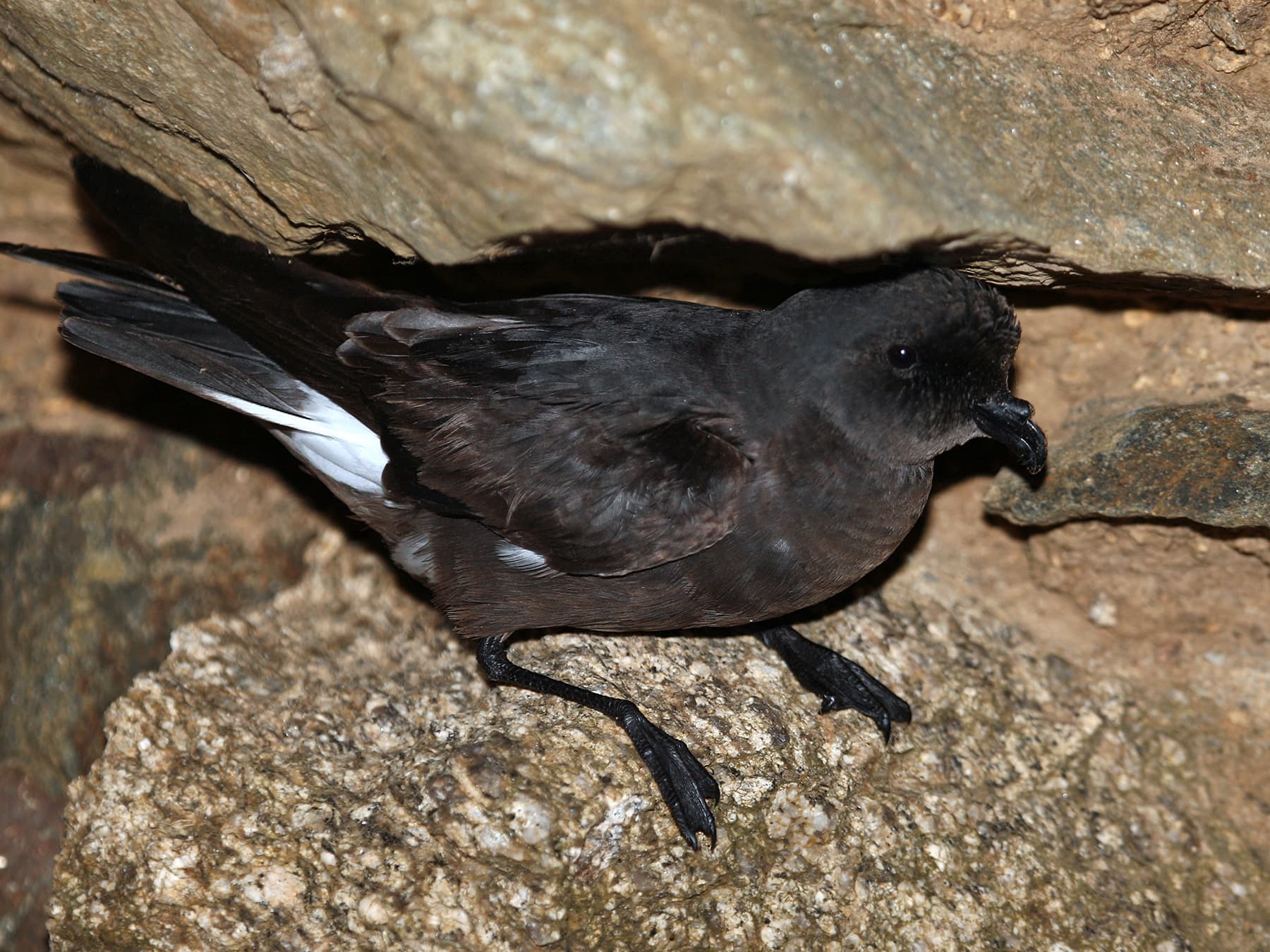
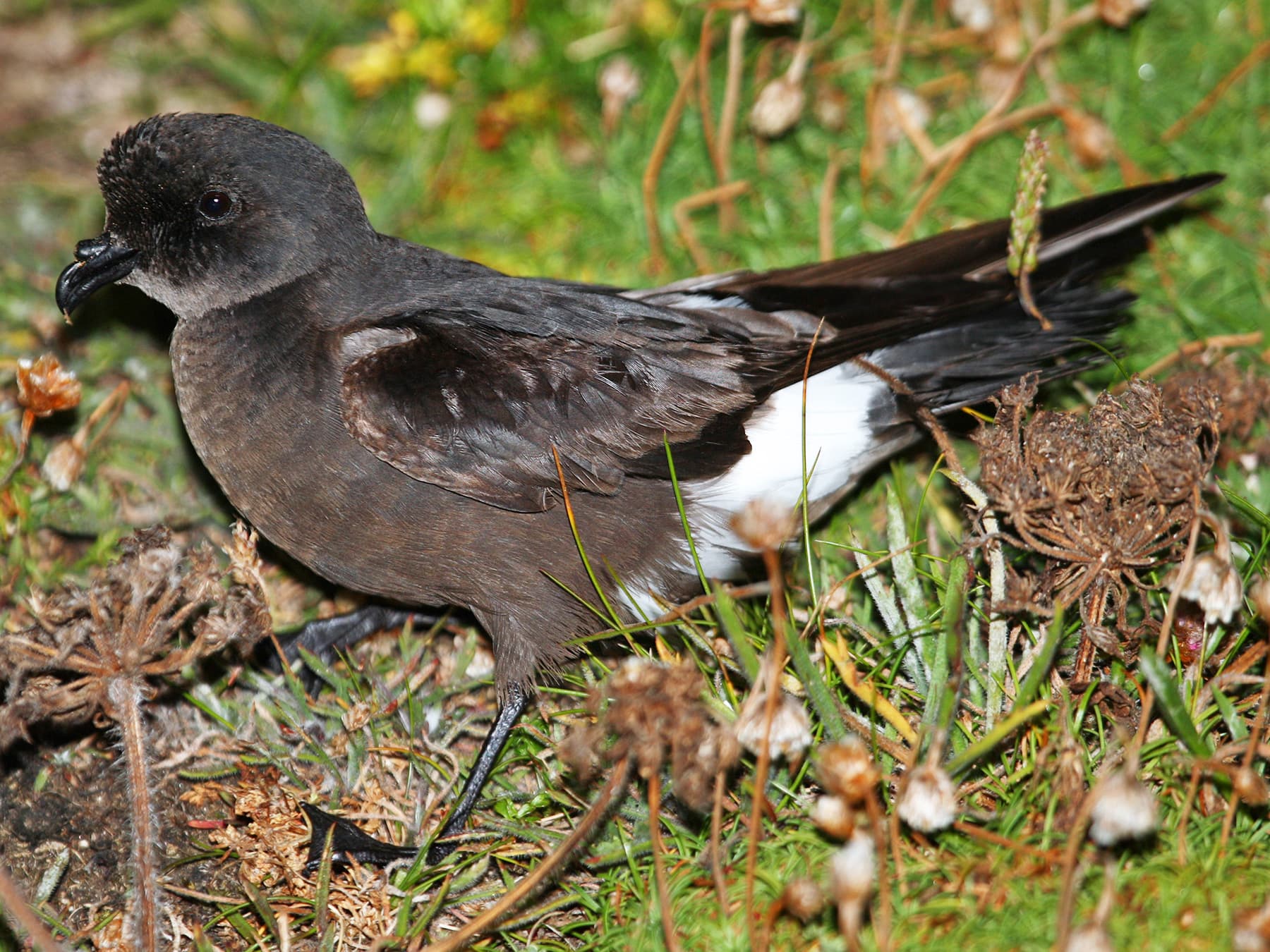
Sooty black seabirds with boxy square tails, storm petrels are rarely seen inland, and identification is commonly needed in flight over large expanses of seawater. A white band across the base of the tail, and a white stripe across the centre of the underside of the wing help to positively confirm a sighting. A narrow pale bar may also be visible on the upper wing. Their plumage may take on a brownish tinge at later points of the year, once feathers are a bit more worn.
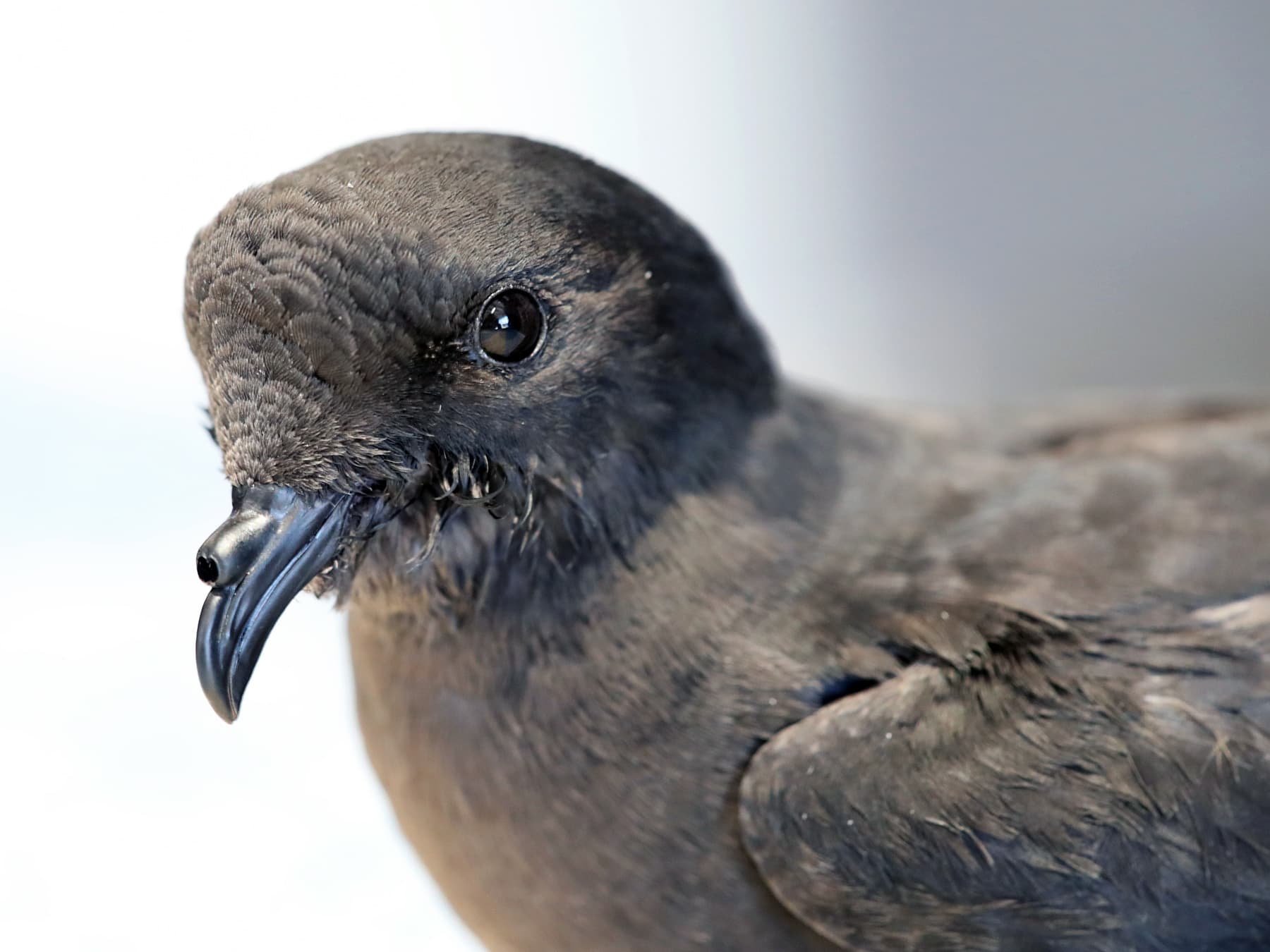
Storm petrels have black legs and feet and dark brown irises. They have a heavy black bill, which is relatively short, with a hooked tip and tubelike nostrils at the base.
Female and male storm petrels are alike in colouring, although in some Mediterranean populations females are observed to have a wider tail band and longer wings, although these differences are impossible to verify from a long distance away.
Juveniles are similar in plumage to adult birds, but the narrow bar that runs across their upper wing is usually more marked and easier to spot.
How big are Storm Petrels?
European storm petrels are relatively small seabirds, barely larger than a robin or sparrow. Females are slightly larger than males, although any differences are not especially obvious from a distance.
- Length: 14 cm to 18 cm (5.5 in to 7.1 in)
- Wingspan: 36 cm to 39 cm (14.2 in to 15.4 in)
- Weight: 23 g to 30 g (0.8 oz to 1.1 oz)
Its size
Adults- Length
- 14–18 cm
- Wingspan
- 36–39 cm
- Weight
- 20–38 g
Its song and calls
What sound does a Storm Petrel make?
At sea, storm petrels are a silent species, but males can be heard on their breeding grounds making purring calls to attract other birds. A chattering contact call may also be heard later in the season, particularly from hatchlings and juveniles ahead of fledging.
- Song0:00 / 2:05
Recorded in Pembrokeshire, Wales
Lawrence Shove / The British Library Board · Wikimedia Commons · CC BY-SA 4.0
When and where to see it
OctoberLeaving
Most recorded in October
- 1. Clare0.18%
- 2. Clackmannanshireunder 0.1%
- 3. Dundeeunder 0.1%
- 4. Pembrokeshireunder 0.1%
- 5. East Lothianunder 0.1%
Each dot is a county, state or province: the bigger and darker, the larger the bird’s share of that place’s bird records that month. Grey dots: no regular records. The ringed point is the centre of the bird’s records this month; the arrow shows how it moved since last month, and the dashed loop its path through the year. “Arrivals” colours places where it becomes regular this month (orange) or is in its last regular month (grey). GBIF eBird Observation Dataset, 2019–2024. Map data: Natural Earth, US Census Bureau; place centres © OpenStreetMap contributors.
In your area
See when the European Storm-petrel is recorded in your county, state or province.
How often the European Storm-petrel turns up in the UK and Ireland through the year, from birdwatchers' records.
United Kingdom
Summer visitor · regularly May–Nov · most records in August
Ireland
Summer visitor · regularly May–Oct · most records in August
Show as a table
| Month | United Kingdom | Ireland |
|---|---|---|
| January | <0.001% | – |
| February | – | – |
| March | <0.001% | – |
| April | <0.001% | <0.001% |
| May | 0.003% (regular) | 0.026% (regular) |
| June | 0.009% (regular) | 0.045% (regular) |
| July | 0.026% (regular) | 0.14% (regular) |
| August | 0.054% (regular) | 0.35% (regular) |
| September | 0.014% (regular) | 0.088% (regular) |
| October | 0.007% (regular) | 0.031% (regular) |
| November | 0.003% (regular) | 0.003% |
| December | <0.001% | 0.001% |
Recorded regularly in
Worldwide: recorded regularly in 19 countries
Countries where it was recorded in at least 3 of the 6 years 2019–2024. Linked countries have their own bird list.
Europe (16)
- Denmark
- Faroe Islands
- France
- Greece
- Guernsey
- Iceland
- Ireland
- Isle of Man
- Italy
- Jersey
- Malta
- Netherlands
- Norway
- Portugal
- Spain
- United Kingdom
Africa (2)
Asia (1)
Data: EOD – eBird Observation Dataset (Cornell Lab of Ornithology), accessed via GBIF.org, CC BY 4.0. Records from 2019–2024, aggregated and filtered by Birdfact. How these lists are made
What is the habitat of a Storm Petrel?
Only coming inland to breed, storm petrels spend their entire lives at sea, feeding on fish from open marine waters. Breeding habitats are isolated rocky headlands and uninhabited islands, where nests are made on stony ground, in crevices and disused burrows of rabbits or puffins, caves or underneath abandoned buildings.
What is the range of a Storm Petrel?
The breeding range of storm petrels extends across the north-eastern waters of the Atlantic Ocean, from Iceland in the west to Norway and the Barents Sea in the east.
Breeding also occurs as far west as the Canary Islands, the Channel Islands, the British Isles and north-western France and northern Spain.
Further south, Mediterranean populations also occur, from southern Spain to Croatia, Italy, Greece and Turkey, as well as small numbers along the north African coast.
Storm petrels that breed in the Atlantic regions spend winters in South Africa and Namibia, with migration beginning in September.
Where do Storm Petrels live?
The Faroe Isles are home to the largest population of breeding storm petrels, with up to 275,000 pairs. Increases are being recorded in the British Isles, Iceland, Norway and France. Winter populations are largest off the coasts of South Africa and Namibia.
How rare are Storm Petrels?
Figures for the British Isles’ population of breeding storm petrels vary massively, from a conservative estimate of 25,500 pairs to a more generous figure of 160,000 pairs (many of which are in Ireland). As storm petrels rarely come into close proximity with inhabited areas or inland settings, sightings are uncommon. Total global population estimates stand at around 1.5 million birds.
Where can you see Storm Petrels in the UK?
Storm petrels only come inland during the breeding season and are limited to isolated, uninhabited islands off the western coasts of England, Wales, Scotland and Ireland, as well as in the Northern Isles of Scotland.
As storm petrels are active during the day far out at sea, sightings on or near land are scarce. Spring and autumn are the best seasons for potential sightings, particularly out at sea during stormy weather, and in west-facing locations.
Migration
Do Storm Petrels migrate?
Storm petrels are a fully migrational species, breeding in Atlantic and Mediterranean waters and spending winters in the southern African destinations along the coasts of Namibia and South Africa.
Are Storm Petrels native to the UK?
Storm petrels breed on isolated islands off the western coasts of parts of the UK, but are not widespread or found anywhere inland on British shores. They are a migratory species, and pairs that breed around the UK coasts depart on lengthy migrations to southern Africa in September and October.
Tips for seeing it
- Look for them far offshore, especially during pelagic birding trips
- Watch for their characteristic 'butterfly-like' flight low over the waves
- Listen for their purring calls at night near breeding colonies
- In the UK, best observed from headlands in southwest England and Wales during autumn storms
What it eats
What do Storm Petrels eat?
Storm petrels survive on a diet of fish and other marine creatures that live near the surface of the sea waters they hunt over. Key elements include small fish, zooplankton, squid, crustaceans and jellyfish, as well as offal and oily foods that they find floating near the water’s surface.
Fluttering batlike flight is another helpful factor in identifying a storm petrel – when feeding, they patter across the surface of the waves with their wings held in a V position. They frequently follow ships and trawlers to opportunistically find fish and may also gather around fish farms.
What do Storm Petrel chicks eat?
Fish and marine life form the main diet of storm petrels for their entire lives once they are able to hunt for themselves. While they are dependent on their parents for food, a young storm petrel is fed on an oily substance produced in the stomach of adult birds, which is then regurgitated into the mouths of their chicks.
Nesting and breeding
Where do Storm Petrels nest?
Storm petrels are colonial breeders, with large colonies forming on rocky isolated headlands, where they either form their own tunnels in the earth or make use of disused hollows used by rabbits, shearwaters or puffins. Artificial nest tubes have had occasional success in attracting successful nesting pairs, and alternative nest sites that have been observed include cracks and crevices under buildings or beneath stone steps.
Storm petrels’ nests are usually unlined chambers that are dug into earthy tunnels, with excess soil removed by birds kicking it out with their feet after loosening it with their beaks. Some bracken, grasses or scraps of seaweed may be added.
When do Storm Petrels nest?
Arrival at nesting colonies begins from March onwards each year, with the earliest eggs laid from late May until August, with June being by far the most common month for clutches to be laid.
What do Storm Petrel eggs look like?
Storm petrels’ eggs measure around 28 mm by 21 mm (1.1 in by 0.8 in), and are pure white in colour. Some reddish spotting may be visible just after laying, although this fades during the incubation period.
Only one egg is laid, which is then incubated for between 38 and 50 days. Both parents share incubation duties, with the absent parent spending three days feeding at sea before returning and switching roles.
Do Storm Petrels mate for life?
Long-term pair bonds are formed between storm petrels from around the age of 4 years, with pairs showing strong fidelity to nest colonies, returning to reuse previous breeding sites in subsequent years. A single brood is raised each season, although a replacement clutch may be attempted if the first clutch fails.
Behaviour
Are Storm Petrels aggressive?
Outside of the breeding season, storm petrels do not have a reputation as being aggressive, and all year round are observed to forage for food in groups, particularly concentrated in waters around trawlers out at sea. On land, while not highly aggressive, territorial behaviour is shown in defence of nest sites when young are being raised.
Where do Storm Petrels sleep at night?
Storm petrels display nocturnal behaviour during the breeding season, coming to shore under cover of darkness and are rarely seen in daylight. It is thought that they can rest on the wing, rather than fully stopping to sleep for long periods.
Lifespan and predators
How long do Storm Petrels live?
The average lifespan of a storm petrel is around 11 years, although individuals can live much longer lives.
The oldest recorded European storm petrel reached 38 years, identified from ringing records in 2017. Breeding occurs for the first time at around 4 or 5 years.
What are the predators of Storm Petrels?
The main threats from predators come from barn owls, peregrine falcons and other seabirds, including great skuas and yellow-legged and great black-backed gulls.
Storm petrels are unable to survive on islands that have resident populations of rats, cats and American mink due to the high levels of nest predation. They are unable to walk on land, instead shuffling from a sitting position, or stepping lightly on the ground until they are able to take off.
Are Storm Petrels protected?
The Wildlife and Countryside Act, 1981, protects storm petrels from being intentionally killed, injured or taken into captivity. They are also listed as an Annex I species in the EU Bird Directive that safeguards wild and migratory birds.
Are Storm Petrels endangered?
Globally, storm petrels are classified as a species of least concern, and have Amber status on the British Birds of Conservation Concern list due to their restricted breeding grounds.
Numbers in the British Isles are on the rise, and there are no fears for significant declines. However, the species survival in certain geographical locations is linked to the presence of dominant predators, and in the Scottish island of St Kilda, for example, up to 7,500 storm petrels are lost each year to predation by great skuas.
Conservation
While currently listed as Least Concern, European Storm-petrels face threats from introduced predators at breeding sites and marine pollution.
Conservation efforts focus on protecting breeding colonies, particularly on small islands, and reducing plastic pollution in their feeding areas.
Quick facts
- Length
- 14–18 cm
- Wingspan
- 36–39 cm
- Weight
- 20–38 g
- Lifespan
- 11 years · oldest recorded 33.8 years
- Family
- Storm Petrels
- Migration
- Long-distance Migrant
- Global status (IUCN)
- Least Concern
- World population
- 876,000 - 1,030,000 mature individuals
- Population trend
- Unknown
- Also called
- British Storm-petrel, Storm Petrel
- Scientific name
- Hydrobates pelagicus
Questions
3Why are they called storm petrels?
The word ‘petrel’ is thought to have derived from the species’ ‘pitter-pattering’ stepping movements across the surface of ocean waves.
Another explanation, that the name has links to St Peter, due to stories that tell of his ability to walk on water, have been added at a later stage.
‘Storm’ comes from these small seabirds having a reputation for being able to withstand spells of severe weather at sea and frequently being spotted ahead of the arrival of major storms.
What was the sailors name for Stormy petrel?
Ancient sailors once used the nickname ‘Mother Carey’s chickens’ for storm petrels, believing that the birds signalled the arrival of a spell of stormy weather at sea. ‘Mother Carey’ was the name given to a mythical sea witch in 19th-century folklore.
What is the superstition about storm petrels?
Storm petrels were seen by some to forecast death, due to their association with severe storms and bad weather at sea. Sightings of storm petrels were viewed as a bad omen by most sailors.
Sources
3- 1BirdLife International. 2018. Hydrobates pelagicus. The IUCN Red List of Threatened Species 2018: e.T22698477A132650209. Source (opens in a new tab)
- 2BirdLife International. 2018. Hydrobates pelagicus. The IUCN Red List of Threatened Species 2018: e.T22698477A132650209. Source (opens in a new tab)
- 3Robinson and Clark, The Online Ringing Report: Bird ringing in Britain & Ireland in 2011 (2012) Source (opens in a new tab)

Checked by
Nathan Cope, founder and editor
Nathan founded Birdfact and leads its writers and contributors in the UK, the US and Canada. He has watched and studied birds for more than ten years, and checks every article and species guide before it’s published.