


Eurasian Stone-curlew
Stone-curlew, Thick-knee · Burhinus oedicnemus
By the Birdfact teamChecked by Nathan Cope
On this page12 sections
How to recognise it
What do stone curlews look like?
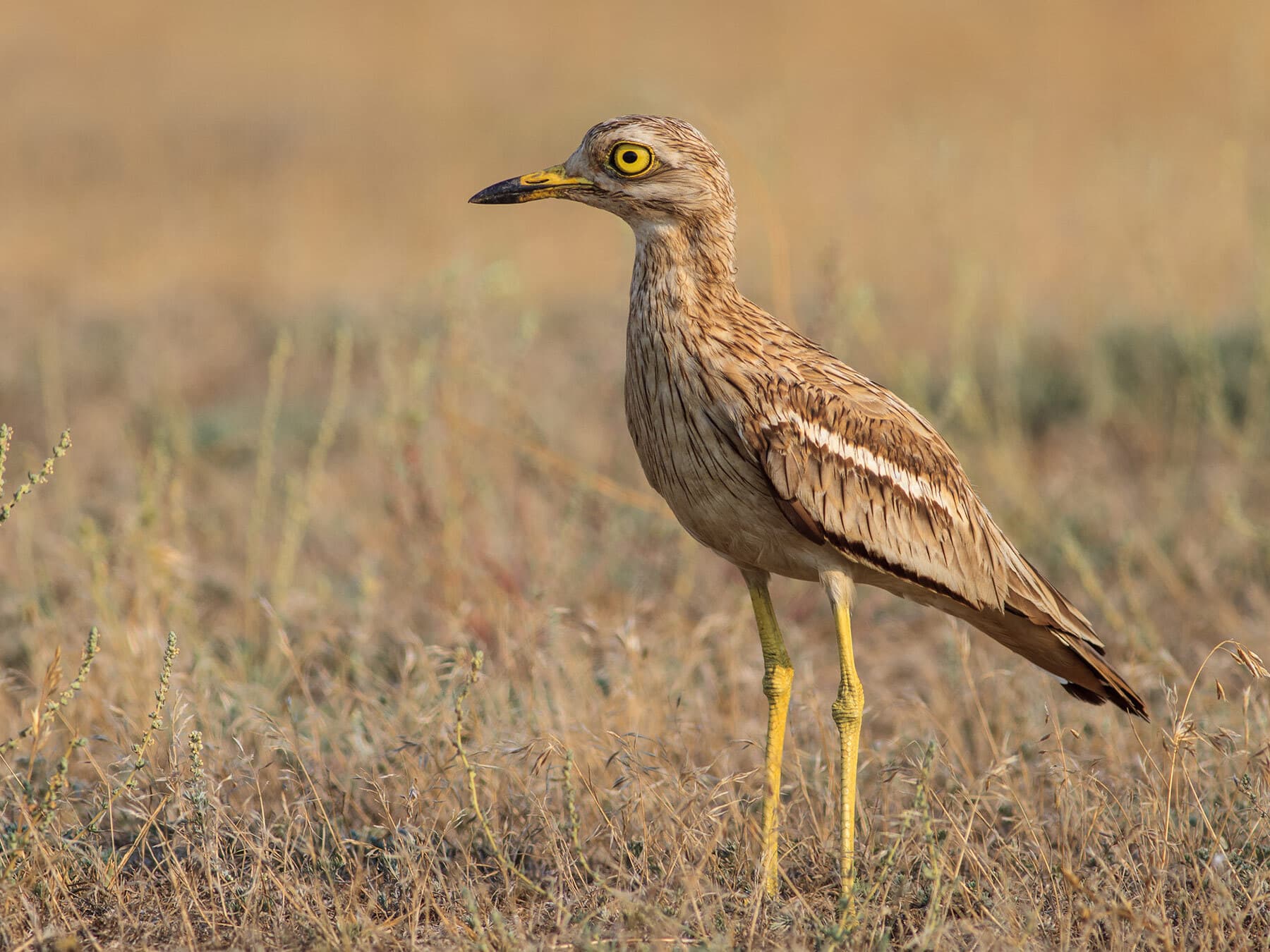
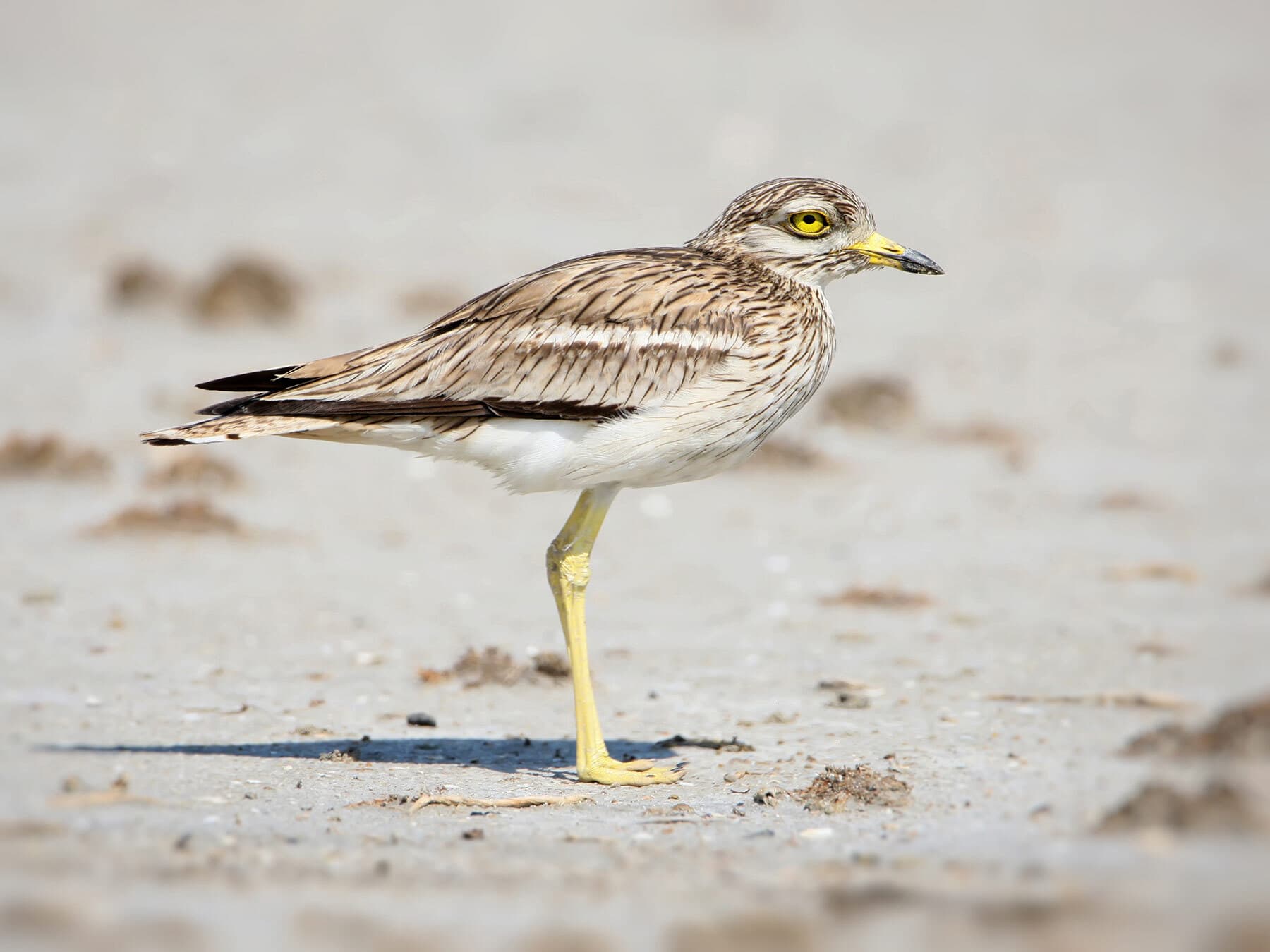
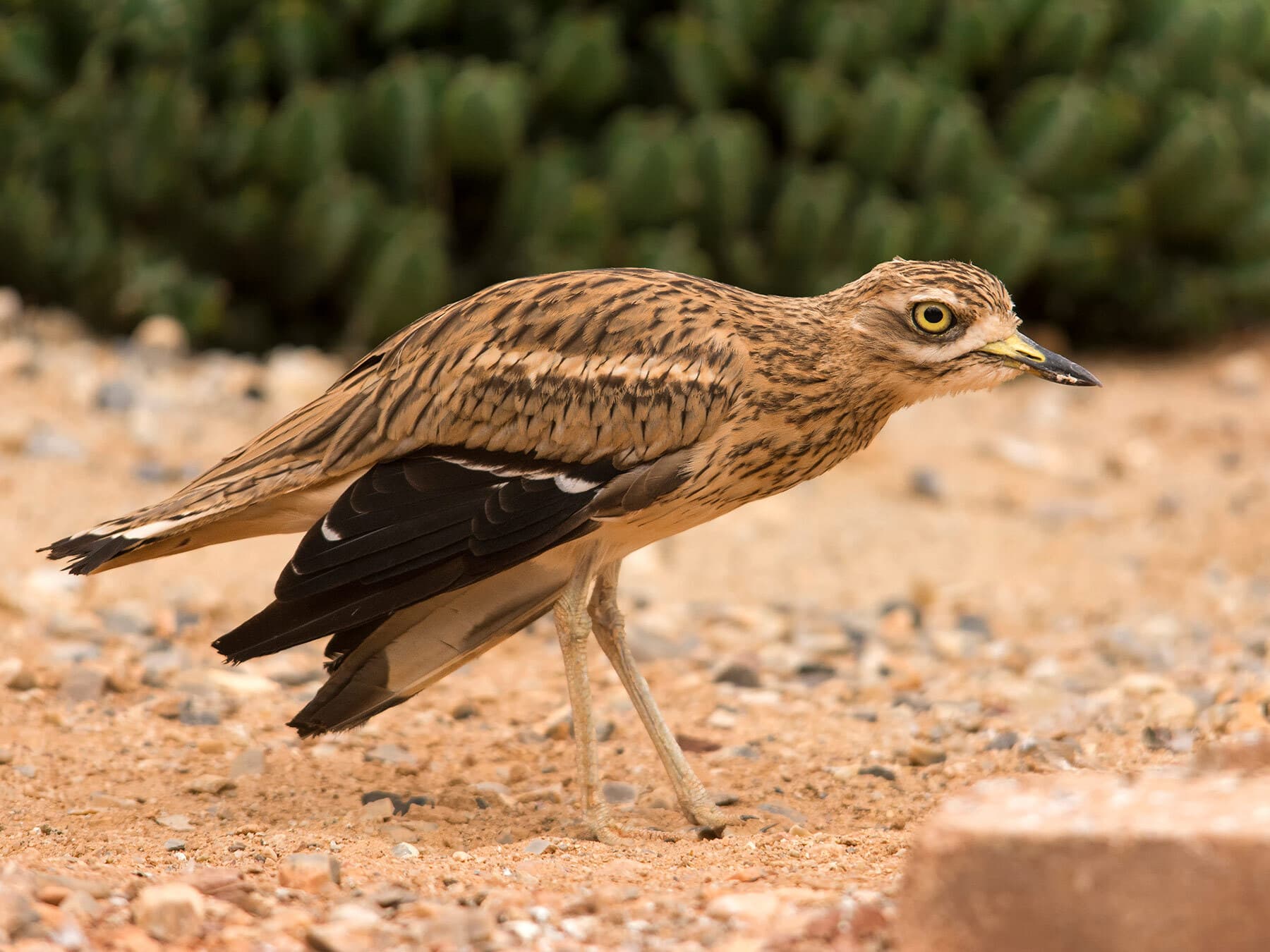
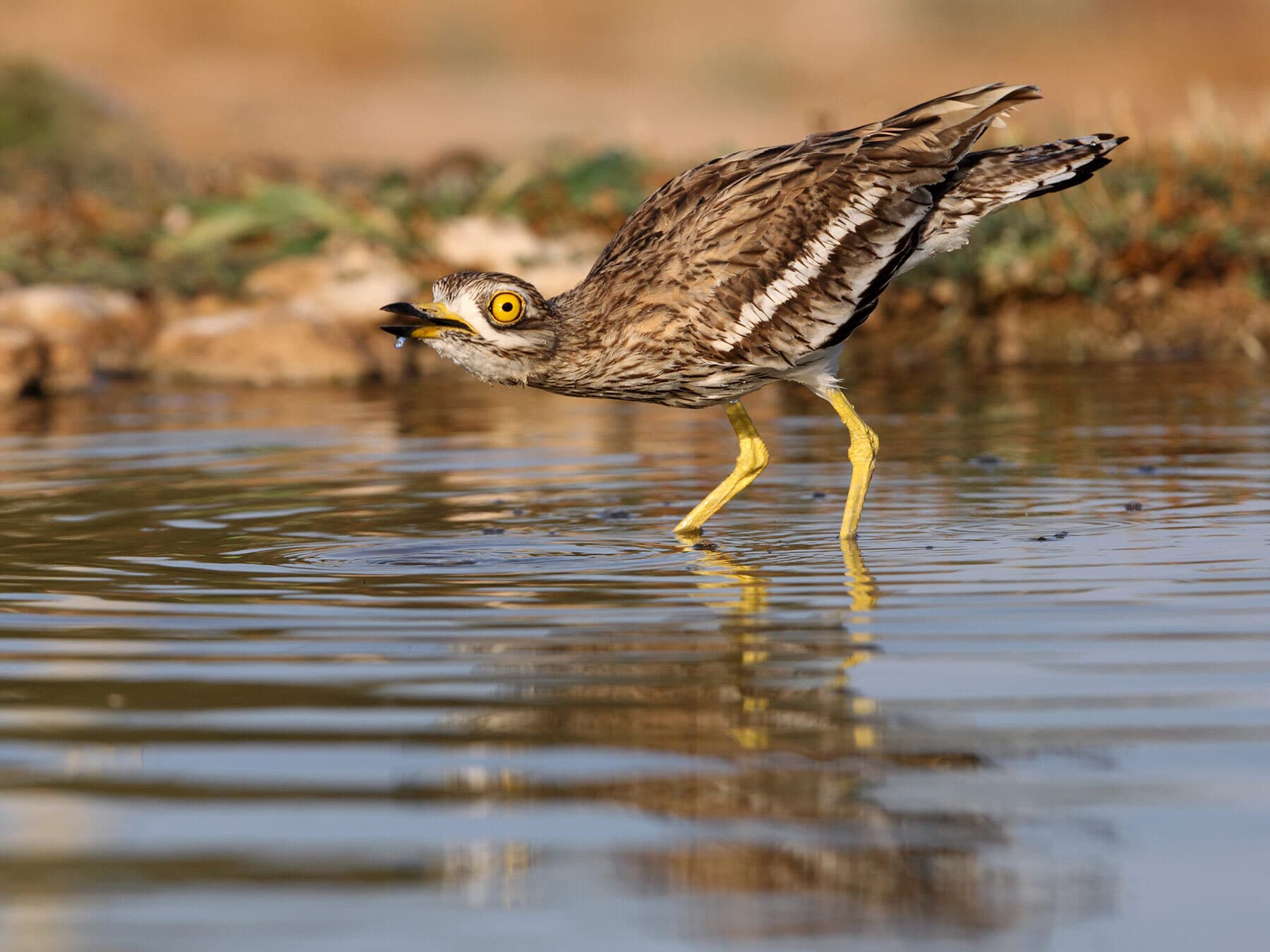
Eurasian stone-curlews are fairly large wading birds. Their plumage is predominantly brown, light brown, and white, with some small dark-brown to black patches. This plumage is described as cryptic, aka. camouflaged. Stone-curlew plumage is quite owl-like in colour and pattern.
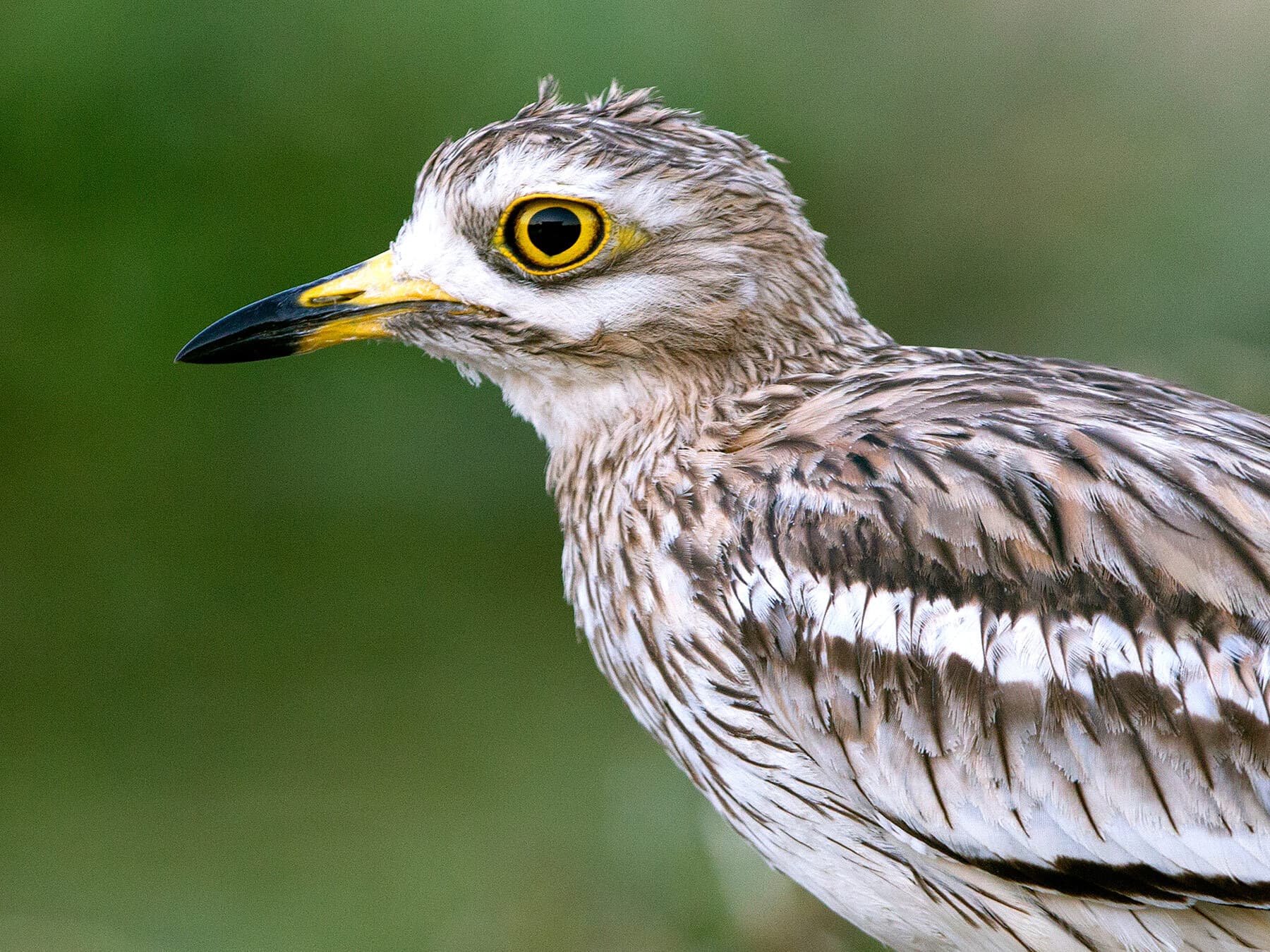
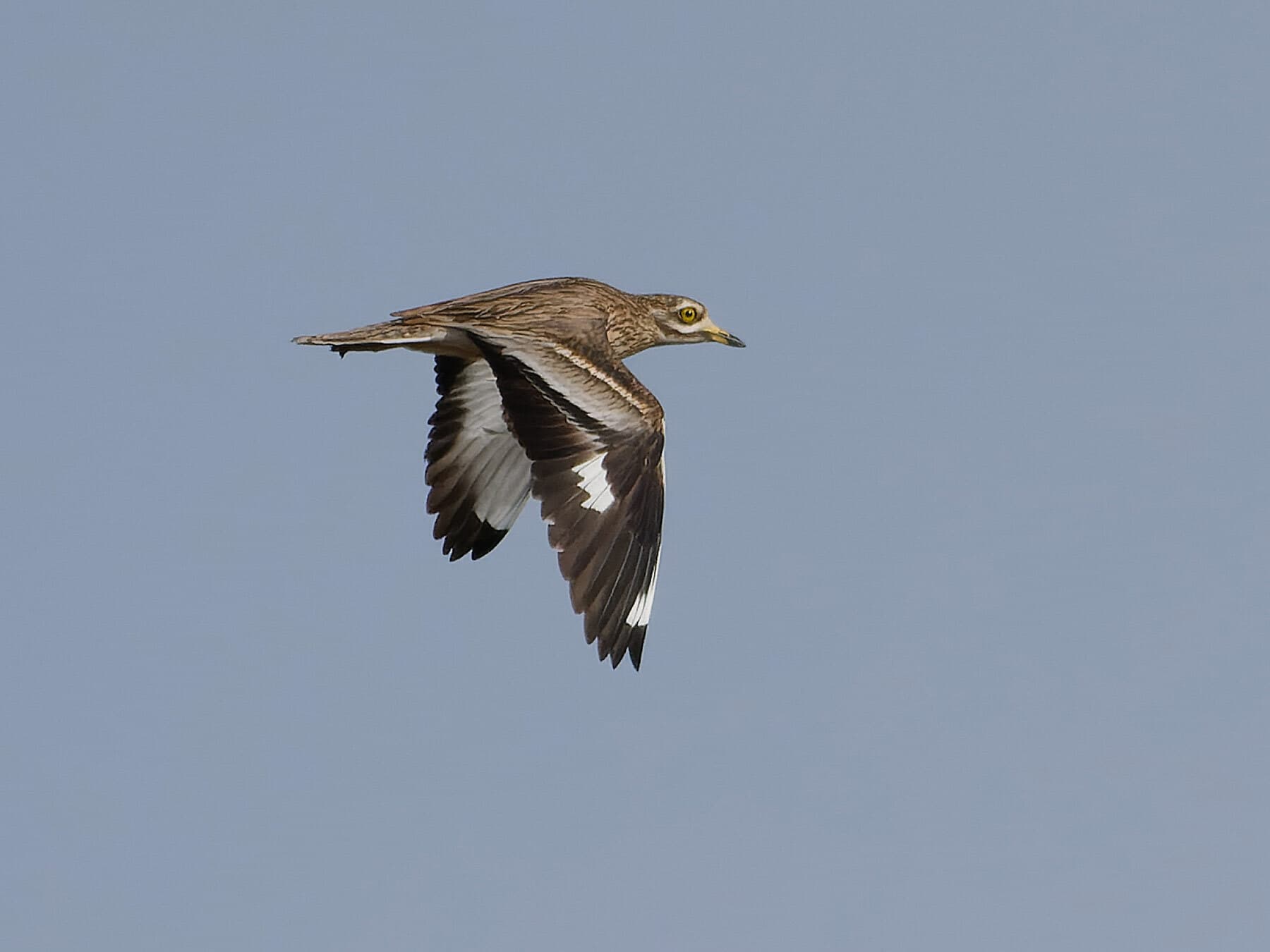
They have finely streaked heads, lines above the eye and a band at the bottom of the face. Their breasts are very streaky, as are their wings, with a fine light-brown-to-white dividing line. Wings have dark tips, with darker underwings. Their undertail is a pale cream.
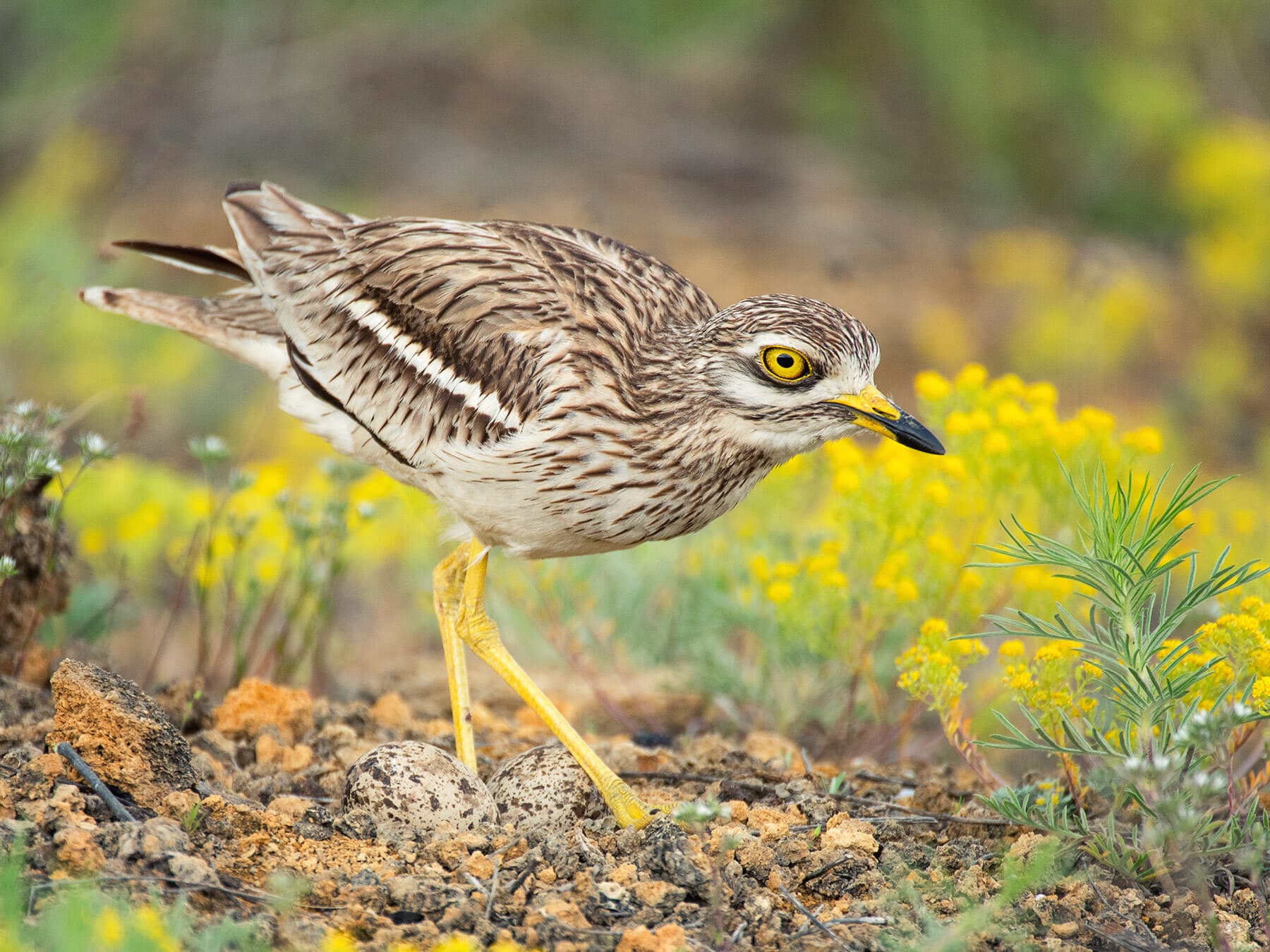
The Eurasian stone-curlew has a yellow beak with a black tip. Legs are long, thin and yellow.
One of the most distinctive features of this bird is its large yellow goggle-eyes. Most stone-curlews are predominantly nocturnal, and these large eyes enable them to see in the dark.
How big are stone curlews?
The Eurasian stone-curlew is medium-sized for the genus. They’re fairly large birds, measuring 38 to 46cm (15 to 18in) long with a wingspan of 76 to 88cm (30 to 35in). They weigh between 290 to 535g (10.2 to 18.9oz). They’re a similar size to a Wood pigeon.
Its size
Adults- Length
- 40–44 cm
- Wingspan
- 76–88 cm
- Weight
- 290–535 g
Its song and calls
Stone-curlews are named as such because they sound like curlews. They’re a very vocal species, with some 11 songs in their repertoire and numerous other calls. At night, the stone-curlew song can carry for some 800m!
The main song consists of a loud, repetitive kurr-leee, which is similar to the curlew. The second syllable is whistely, whereas the first is much harsher. In the breeding season, their main calls are a rapid series of pee-pee-wee, which is similar to when they’re alarmed.
Another common vocalization is a raspy kchhhhh-wit!”. Calls are melodically and structurally diverse, often undulating in volume. Multiple birds join songs to form large choruses that can sing for some 30-minutes.
- Song0:00 / 0:17
Recorded in Pays de la Loire, France · May 2026
- Call0:00 / 0:17
Recorded in Hauts-de-France, France · March 2026
When and where to see it
How often the Eurasian Stone-curlew turns up in the UK through the year, from birdwatchers' records.
Recorded in United Kingdom, but eBird withholds many records of this sensitive species to protect it, so no months are shown.
Recorded regularly in
Worldwide: recorded regularly in 40 countries
Countries where it was recorded in at least 3 of the 6 years 2019–2024. Linked countries have their own bird list.
Europe (20)
Africa (7)
- Algeria
- Egypt
- Morocco
- Senegal
- Tunisia
- Uganda
- Western Sahara
Asia (13)
- China
- Cyprus
- Georgia
- Iran
- Israel
- Jordan
- Kazakhstan
- Oman
- Palestinian Territories
- Saudi Arabia
- Turkey
- United Arab Emirates
- Uzbekistan
Data: EOD – eBird Observation Dataset (Cornell Lab of Ornithology), accessed via GBIF.org, CC BY 4.0. Records from 2019–2024, aggregated and filtered by Birdfact. How these lists are made
What is the range of a stone curlew?
The Eurasian stone-curlew is distributed throughout most of Europe, North Africa and western and southwestern Asia. Many populations migrate, especially from Europe, heading south to Asia, Africa and the Mediterranean.
What is the habitat of a stone curlew?
Despite being classed as a wading bird, the Eurasian stone-curlew is rarely found near water. They prefer wide, open grasslands with sparse vegetation. Semi-arid, dune, woodland and farmland habitats are amongst the most common.
Where do stone curlews live?
The ten species of stone-curlews are distributed in every continent except North America and Antarctica. The Eurasian stone-curlew lives across northern and western Europe, southwestern Asia and North Africa. Most populations north of the Mediterranean migrate.
How rare are stone curlews?
The total population of Eurasian stone-curlews is large, and they’re not considered a vulnerable species globally. However, western and northern populations are declining. For example, the UK’s population has declined by some 85% between 1940 and 1985, and they’re placed on the UK’s Amber List for Birds.
Where to see stone curlews in the UK?
Stone-curlews are rare in the UK, with just around 300 breeding pairs. Around 72% of those are distributed in Norfolk and Suffolk. There are strongholds in Wiltshire, on the Salisbury Plain and Brecks, in Norfolk. You can find special viewing areas at Minsmere reserve in Suffolk and Weeting Heath in Norfolk.
Migration
Do stone curlews migrate?
Stone curlews in north Europe and Central Asia migrate. Those in the Middle East, North Africa and parts of the Mediterranean are often residents and don’t migrate.
Migratory stone-curlews leave their breeding grounds from late August until October. They arrive in their breeding grounds in October.
After winter, stone-curlews leave in March and April. Almost all of the UK’s population of stone-curlews have returned by April.
Tips for seeing it
- Look for Stone-curlews in open, dry habitats with short vegetation or bare ground.
- Listen for their distinctive wailing call at night, especially during the breeding season.
- Use binoculars to spot their large yellow eyes, which can be visible even at a distance.
- In the UK, visit areas like the Brecks in East Anglia or Salisbury Plain for better chances of sighting.
What it eats
What do stone curlews eat?
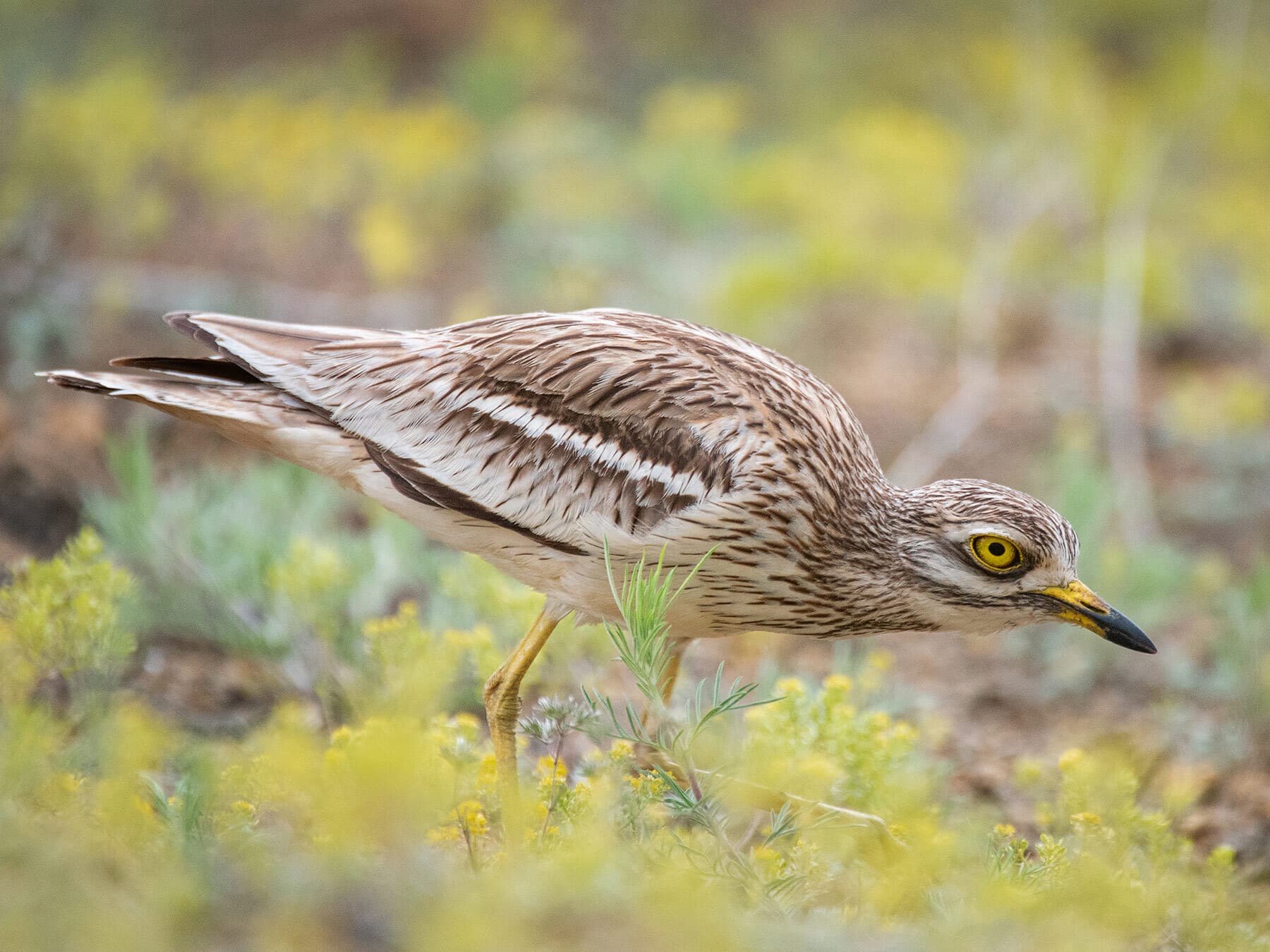
Stone-curlews eat almost solely insects and invertebrates, including larvae of various kinds. Some main food items include beetles, crickets, caterpillars, ants, flies, earthworms, slugs, snails and earwigs. They also eat small reptiles and snakes. Rarely, the Eurasian stone-curlew consumes seeds and limited plant matter.
Stone-curlews mainly forage at night. They walk through their habitat, taking prey they encounter. Main method of capture is a swift lunge with the beak.
Stone-curlews forage alone or with up to six or so other birds.
What do baby stone curlews eat?
The young birds are fed almost solely on soft invertebrates. Parents usually feed the chicks directly by mouth.
Nesting and breeding
Where do stone curlews nest?
Stone curlews stick to the traditional spring breeding season across most of their range. In the UK, this starts around April. In North Africa, the breeding season is earlier, starting in March. However, in some parts of the Mediterranean, breeding ranges from January to as late as July.
What are stone curlew nests like?
Stone curlews nest on the ground, scraping out a nest hole of around 16 to 22cm across and 5 to 7cm deep. The hole is lined with small quantities of grass and occasionally fenced with a ring of stones or shells. Nests are typically placed near rocks or small shrubberies.
Do stone curlews mate for life?
Stone curlews are typically monogamous, mating for life. The pair usually isolate themselves from others during the breeding season.
What do stone curlew eggs look like?
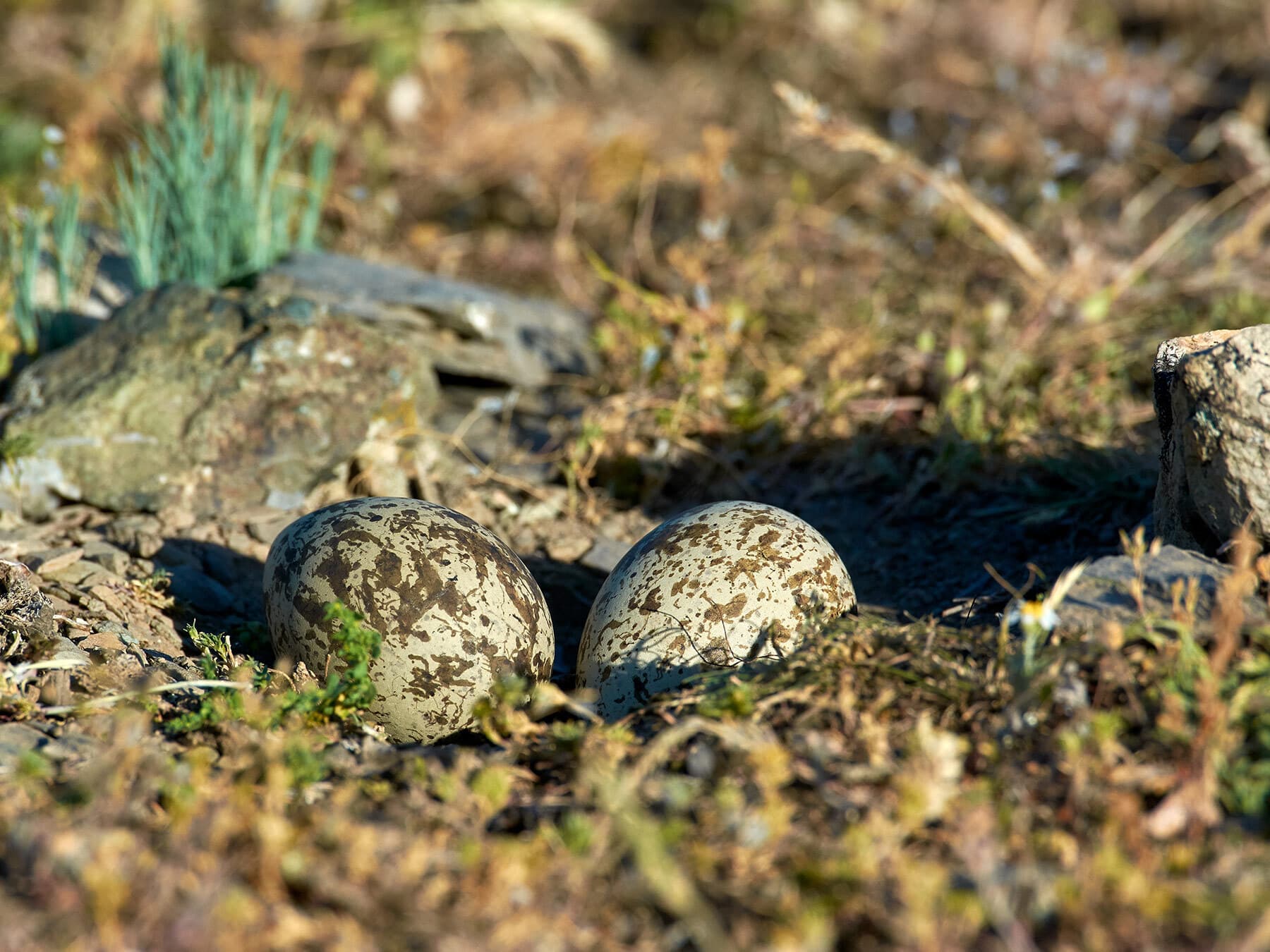
Stone-curlew eggs are stone-coloured or brown, with purple-grey blotches. They measure around 50 x 38mm, weighing 35 to 40g.
Behaviour
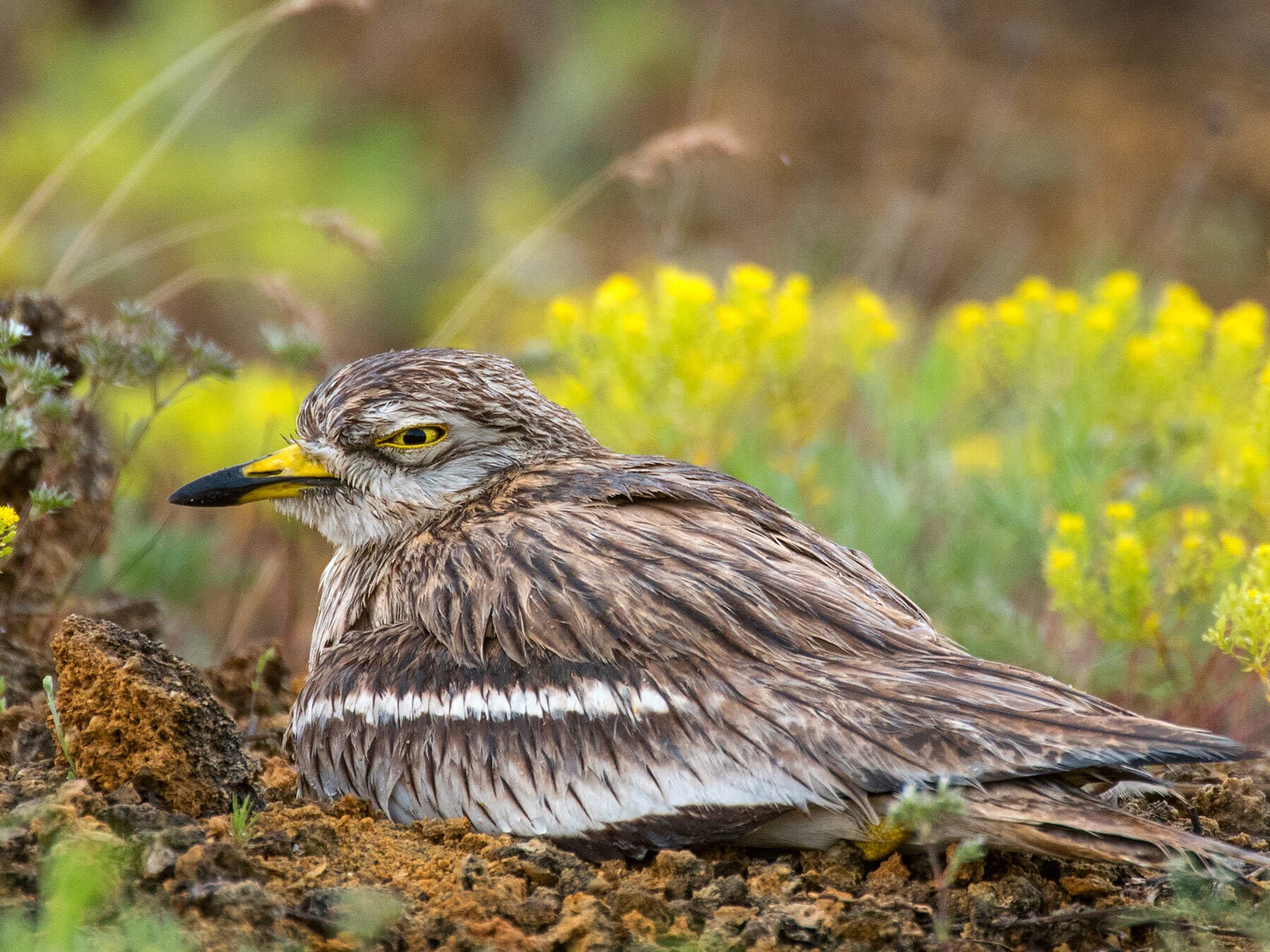
Stone-curlews are generally shy, isolating themselves from other animals when possible. They typically detect humans from over 100m away, making themselves scarce long before contact. These are shy, nocturnal birds that usually rest in vegetation during the day.
Are stone curlews aggressive?
Stone-curlews become territorial during the breeding season, but aren’t otherwise known for aggression. They’re generally shy birds that isolate themselves from humans and other animals.
Lifespan and predators
How long do stone-curlews live?
The maximum recorded lifespan of a Eurasian stone-curlew is 22 years and 4 months. The typical lifespan is around 6 years. Stone-curlews are vulnerable to land predators, including foxes which commonly predate their nests.
What are the predators of stone curlews?
Eurasian stone-curlews are predated by many land mammals, particularly foxes. Though not predators, stone-curlew nests are often stampeded and crushed by cattle and other livestock.
Are stone curlews protected?
The Eurasian stone-curlew is protected under Schedule 1 of Wildlife and Countryside Act 1981. They’re also protected under Annex 1 of 1979 EC Birds Directive and Appendix II of the Bern Convention. There are three protected stone-curlew habitats, including Brecks farmland. Conservationists work with farmers to reduce damage to these birds’ habitats.
Stone-curlews are also protected by three internationally important Special Protection Areas, including the Brecks farmland.
Are stone curlews endangered?
Stone curlews aren’t considered endangered, with a European population exceeding 150,000 pairs. However, their habitats are being slowly eroded, and their populations are dwindling in many European regions.
Conservation
While listed as Least Concern globally, Eurasian Stone-curlews face regional challenges. In the UK, they are amber-listed due to historical declines.
Conservation efforts focus on habitat management, including maintaining suitable nesting areas and reducing disturbance during breeding season.
Quick facts
- Length
- 40–44 cm
- Wingspan
- 76–88 cm
- Weight
- 290–535 g
- Lifespan
- 6 years · oldest recorded 17.9 years
- Family
- Thick-knees
- Migration
- Partial migrant
- Global status (IUCN)
- Least Concern
- World population
- 360,000 - 590,000 mature individuals
- Population trend
- Decreasing
- Also called
- Stone-curlew, Thick-knee
- Scientific name
- Burhinus oedicnemus
Questions
1Why are they called stone curlews?
Stone curlews are called curlews due to the similarity of their calls. However, there’s no convincing explanation for why they’re called “stone”-curlews. It might be due to their preferred rocky, semi-arid habitats, or the fact their eggs are somewhat stone-like in colour.
Sources
4- 1BirdLife International. 2018. Burhinus oedicnemus. The IUCN Red List of Threatened Species 2018: e.T45111439A132038252. Source (opens in a new tab)
- 2Wetlands International (2015)
- 3BirdLife International. 2018. Burhinus oedicnemus. The IUCN Red List of Threatened Species 2018: e.T45111439A132038252. Source (opens in a new tab)
- 4Fransson et al., EURING list of longevity records for European birds (2010) Source (opens in a new tab)

Checked by
Nathan Cope, founder and editor
Nathan founded Birdfact and leads its writers and contributors in the UK, the US and Canada. He has watched and studied birds for more than ten years, and checks every article and species guide before it’s published.