


Southern Rockhopper Penguin
Rockhopper Penguin · Eudyptes chrysocome
By the Birdfact teamChecked by Nathan Cope
On this page11 sections
How to recognise it
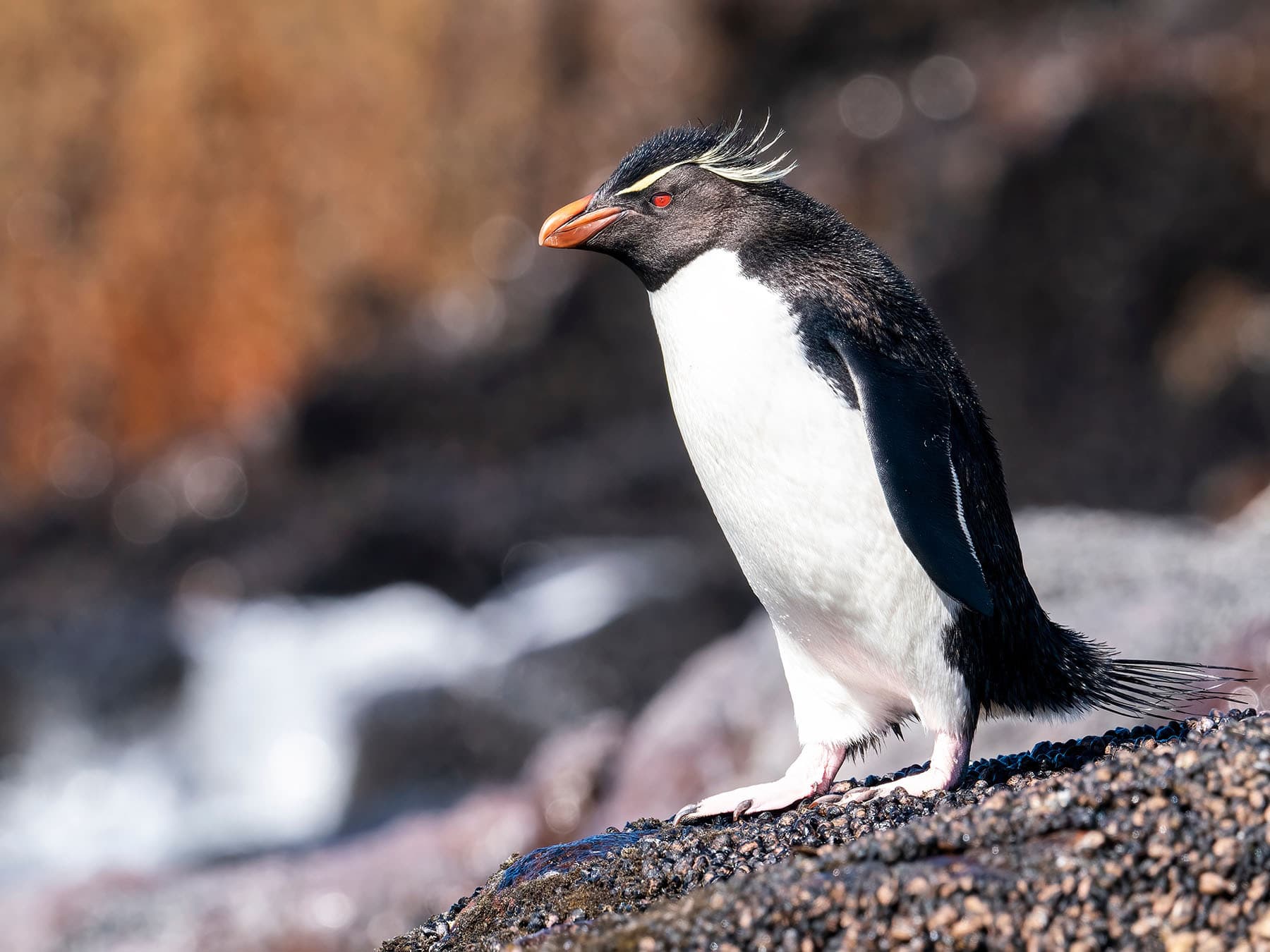
The Southern Rockhopper Penguin is a small, distinctive penguin with a black back, white belly, and bright yellow crest feathers above red eyes. Its robust red-orange beak and pink feet contrast with its sleek black and white plumage.
Males are slightly larger than females, with more pronounced crests. Juveniles lack the yellow crest, instead having a grayish-white face. The species does not exhibit seasonal plumage changes.
Its size
Adults- Length
- 45–58 cm
- Wingspan
- 66–77 cm
- Weight
- 2000–3400 g
Its song and calls
Southern Rockhopper Penguins are vocal birds, especially in their breeding colonies. Their calls include a loud, harsh 'caa-caa-caa' used for territorial defence and mate recognition.
During courtship, pairs engage in a duet of braying calls, often described as a donkey-like 'haw-haw-haw'.
When and where to see it
The Southern Rockhopper Penguin is not recorded regularly in the UK, Ireland, the United States or Canada.
Worldwide: recorded regularly in 7 countries
Countries where it was recorded in at least 3 of the 6 years 2019–2024. Linked countries have their own bird list.
South America (3)
- Argentina
- Chile
- Falkland Islands
Oceania (2)
Antarctica (2)
- Antarctica
- French Southern Territories
Data: EOD – eBird Observation Dataset (Cornell Lab of Ornithology), accessed via GBIF.org, CC BY 4.0. Records from 2019–2024, aggregated and filtered by Birdfact. How these lists are made
Tips for seeing it
- Look for their distinctive yellow crests and red eyes
- Observe their unique hopping movement on land
- Visit known breeding colonies during the summer months
- Watch for their porpoising behaviour when swimming
What it eats
Southern Rockhopper Penguins primarily feed on small marine creatures. Their diet consists mainly of krill, small fish, and squid.
They are pursuit divers, catching prey by swimming at high speeds and manoeuvring skilfully underwater, often diving to depths of 100 meters or more.
Nesting and breeding
Southern Rockhopper Penguins form monogamous pairs and return to the same breeding sites annually. The breeding season typically begins in October. Males arrive first to establish territories and prepare nests.
Nests are simple depressions in the ground, often lined with small stones and vegetation. Females usually lay two eggs, with the second egg being larger and more likely to hatch successfully.
Both parents take turns incubating the eggs for about 33 days. The chicks are brooded for about 25 days and fledge at 65-75 days old. After they fledge, the parents continue to feed them for several weeks.
Behaviour
Southern Rockhopper Penguins are known for their remarkable hopping ability, using both feet to bound over rocky terrain. They are highly social, forming large breeding colonies.
These penguins are excellent swimmers, using their flippers to 'fly' underwater at speeds up to 25 km/h when foraging.
Conservation
Southern Rockhopper Penguins are classified as Vulnerable due to population declines. Major threats include climate change, which affects food availability, and marine pollution.
Conservation efforts focus on protecting breeding sites and marine foraging areas, as well as monitoring population trends.
Similar birds
Often mistaken for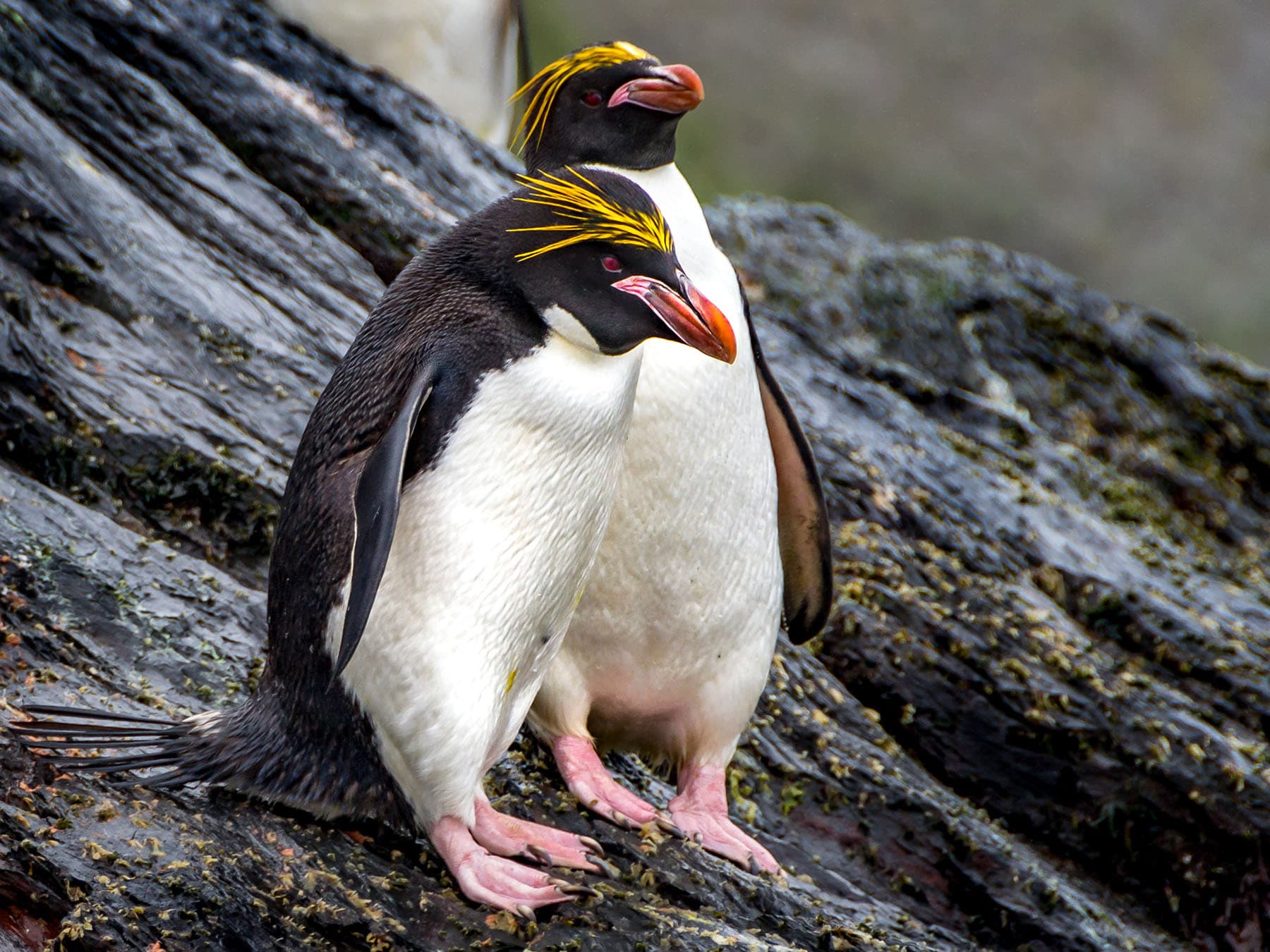
Quick facts
- Length
- 45–58 cm
- Wingspan
- 66–77 cm
- Weight
- 2000–3400 g
- Lifespan
- 10 years · oldest recorded 29.4 years
- Family
- Penguins
- Migration
- Partial migrant
- Global status (IUCN)
- Vulnerable
- World population
- 2,500,000 mature individuals
- Population trend
- Decreasing
- Also called
- Rockhopper Penguin
- Scientific name
- Eudyptes chrysocome
Sources
4- 1BirdLife International. 2020. Eudyptes chrysocome. The IUCN Red List of Threatened Species 2020: e.T22735250A182762377. Source (opens in a new tab)
- 2BirdLife International. 2020. Eudyptes chrysocome. The IUCN Red List of Threatened Species 2020: e.T22735250A182762377. Source (opens in a new tab)
- 3BirdLife International. 2020. Eudyptes chrysocome. The IUCN Red List of Threatened Species 2020: e.T22735250A182762377. Source (opens in a new tab)
- 4Glenday, Craig. Guinness World Records 2008. Guinness Media, Inc. (2008)

Checked by
Nathan Cope, founder and editor
Nathan founded Birdfact and leads its writers and contributors in the UK, the US and Canada. He has watched and studied birds for more than ten years, and checks every article and species guide before it’s published.