


Macaroni Penguin
Eudyptes chrysolophus
By the Birdfact teamChecked by Nathan Cope
On this page10 sections
How to recognise it
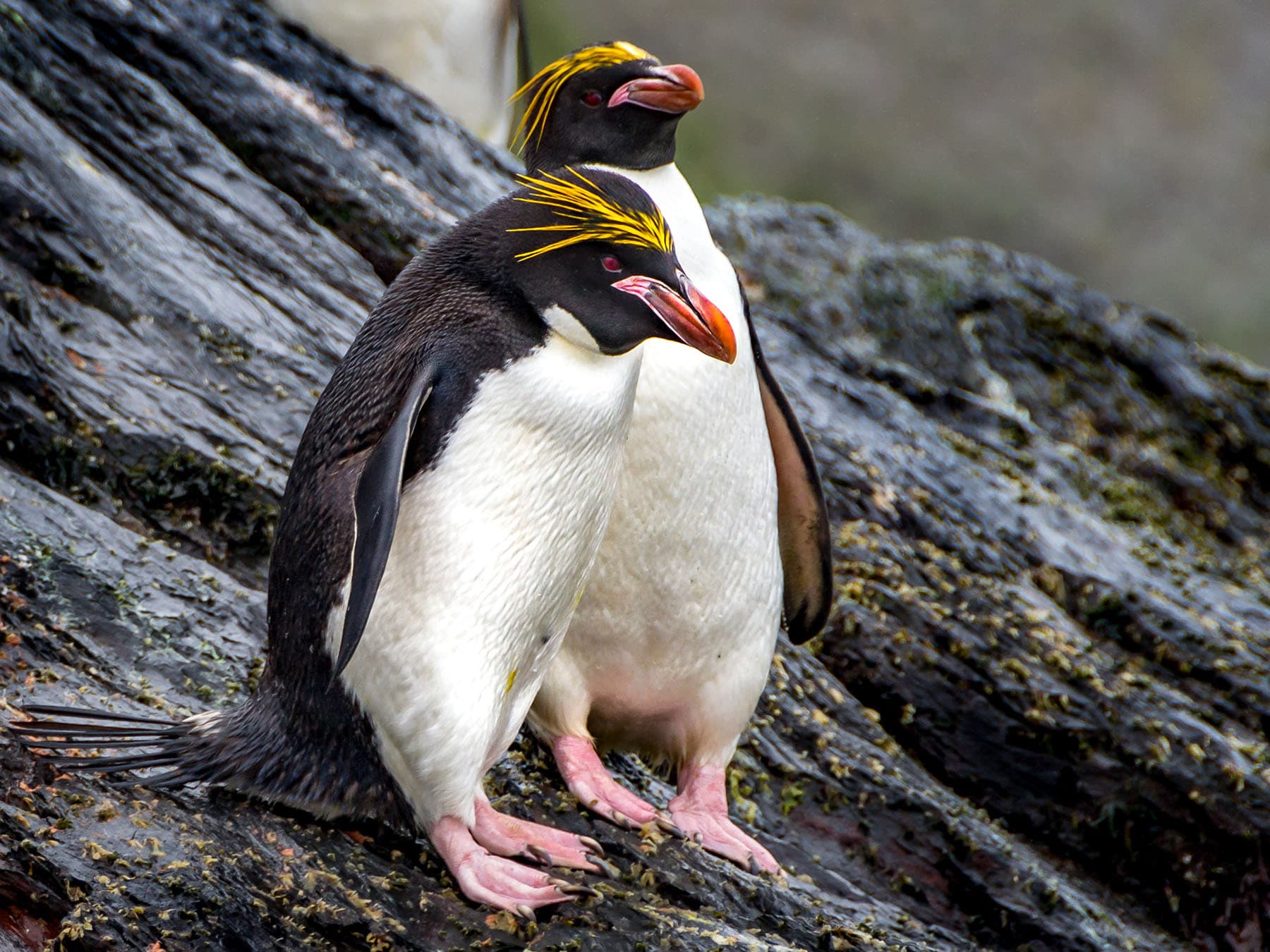
Macaroni Penguins are characterised by their distinctive golden-orange crest feathers extending from their bill to the back of their head. They have a black back, white belly, and a robust orange-red bill. Their eyes are red, adding to their striking appearance.
Both males and females look similar, with males typically being slightly larger. Juveniles lack the prominent crest and have a smaller, darker bill. During the moulting season, adults may appear dishevelled as they shed their old feathers.
Its size
Adults- Length
- 70–76 cm
- Wingspan
- 71–81 cm
- Weight
- 3000–6000 g
Its song and calls
Macaroni Penguins are known for their loud, trumpeting calls, crucial for communication in large, noisy colonies. Their vocalisations include a variety of brays, growls, and trumpeting sounds.
During courtship, pairs engage in an 'ecstatic display' accompanied by a series of loud, rhythmic calls that sound like 'ah-ah-ah-ah'.
When and where to see it
The Macaroni Penguin is not recorded regularly in the UK, Ireland, the United States or Canada.
Worldwide: recorded regularly in 6 countries
Countries where it was recorded in at least 3 of the 6 years 2019–2024. Linked countries have their own bird list.
South America (3)
- Argentina
- Chile
- Falkland Islands
Antarctica (3)
- Antarctica
- French Southern Territories
- South Georgia & South Sandwich Islands
Data: EOD – eBird Observation Dataset (Cornell Lab of Ornithology), accessed via GBIF.org, CC BY 4.0. Records from 2019–2024, aggregated and filtered by Birdfact. How these lists are made
Tips for seeing it
- Visit subantarctic islands during the breeding season (October to March) for the best viewing opportunities
- Look for large colonies on rocky, coastal slopes
- Observe from a distance to avoid disturbing nesting birds
- Use binoculars to spot their distinctive golden crests
- Listen for their loud, trumpeting calls in colonies
What it eats
Macaroni Penguins primarily feed on small crustaceans, particularly krill, which make up about 90% of their diet. They also consume small fish and squid.
These penguins are pursuit divers, catching prey during underwater 'flights' that can last several minutes. They typically forage within 50 km (31 miles) of their breeding colonies.
Nesting and breeding
Macaroni Penguins form monogamous pairs and return to the same breeding sites annually. The breeding season begins in October when males arrive to establish nesting territories. Females join shortly after, and courtship involves mutual preening and vocalisations.
Nests are simple depressions in the ground, sometimes lined with pebbles or vegetation. Females typically lay two eggs, but usually, only the second, larger egg is incubated and hatches. The first egg is often pushed out of the nest.
Both parents take turns incubating the egg for about 35 days. After hatching, the male guards the chick for about 23 days while the female forages. Chicks fledge at around 70 days old.
Behaviour
Macaroni Penguins are highly social, forming large colonies during breeding season. They are excellent swimmers, using their flippers to 'fly' underwater at speeds up to 15 km/h.
On land, they waddle or hop over rocks, using their tails for balance. During foraging trips, they can dive to depths of 100 meters in search of food.
Conservation
Macaroni Penguins are classified as Vulnerable due to population declines. Climate change affects their food sources, while introduced predators on breeding islands pose a threat.
Conservation efforts focus on protecting breeding habitats, controlling invasive species, and monitoring population trends to guide management strategies.
Quick facts
- Length
- 70–76 cm
- Wingspan
- 71–81 cm
- Weight
- 3000–6000 g
- Lifespan
- 10–15 years · oldest recorded 20 years
- Family
- Penguins
- Migration
- Partial migrant
- Global status (IUCN)
- Vulnerable
- World population
- 12,600,000 mature individuals
- Population trend
- Decreasing
- Scientific name
- Eudyptes chrysolophus
Sources
3- 1BirdLife International. 2020. Eudyptes chrysolophus. The IUCN Red List of Threatened Species 2020: e.T22697793A184720991. Source (opens in a new tab)
- 2BirdLife International. 2020. Eudyptes chrysolophus. The IUCN Red List of Threatened Species 2020: e.T22697793A184720991. Source (opens in a new tab)
- 3Crossin et al. (2013)

Checked by
Nathan Cope, founder and editor
Nathan founded Birdfact and leads its writers and contributors in the UK, the US and Canada. He has watched and studied birds for more than ten years, and checks every article and species guide before it’s published.