


Eurasian Scops-owl
European Scops-owl, Common Scops-owl, Eurasian Scops Owl · Otus scops
By the Birdfact teamChecked by Nathan Cope
On this page14 sections
How to recognise it
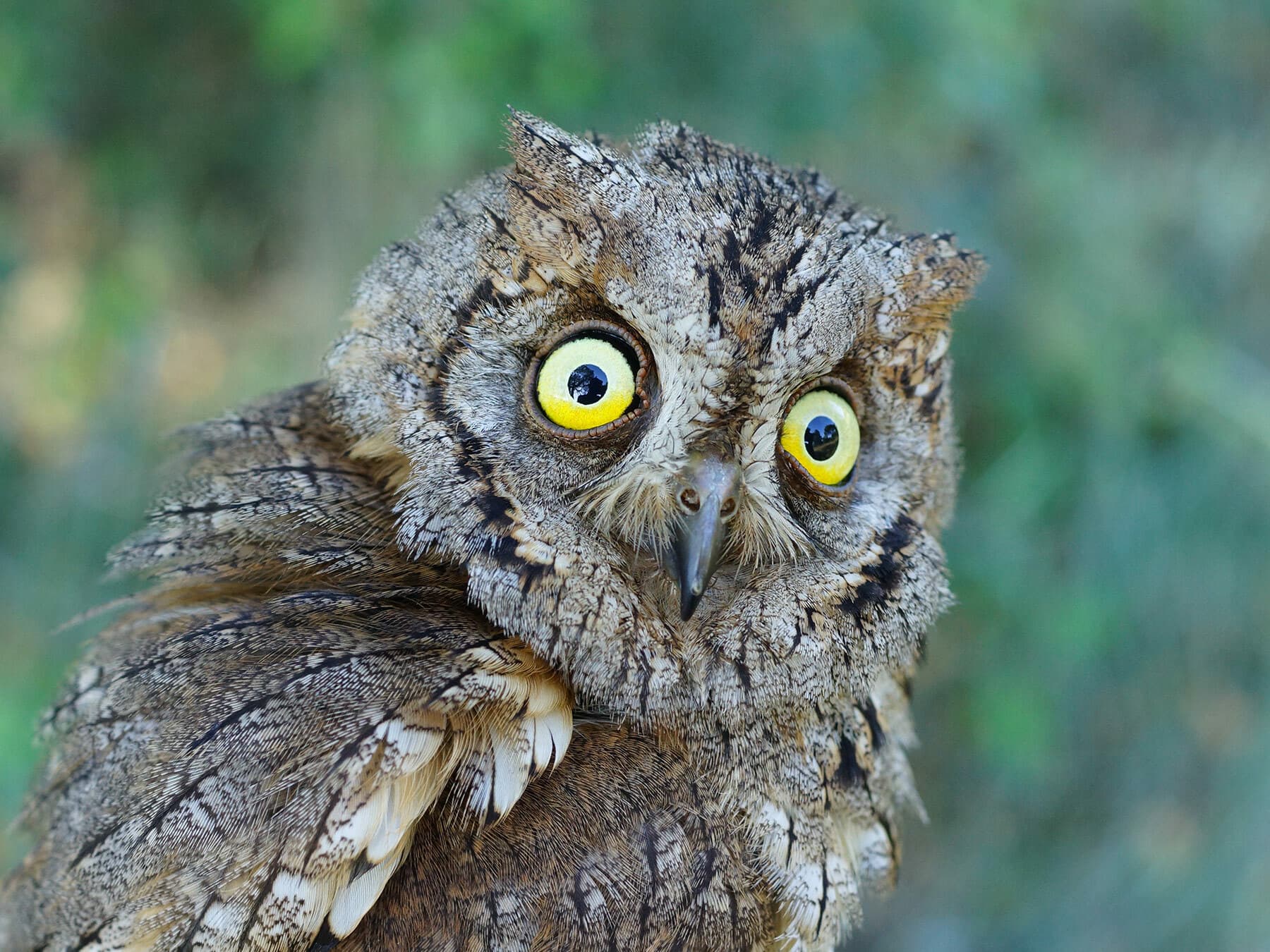
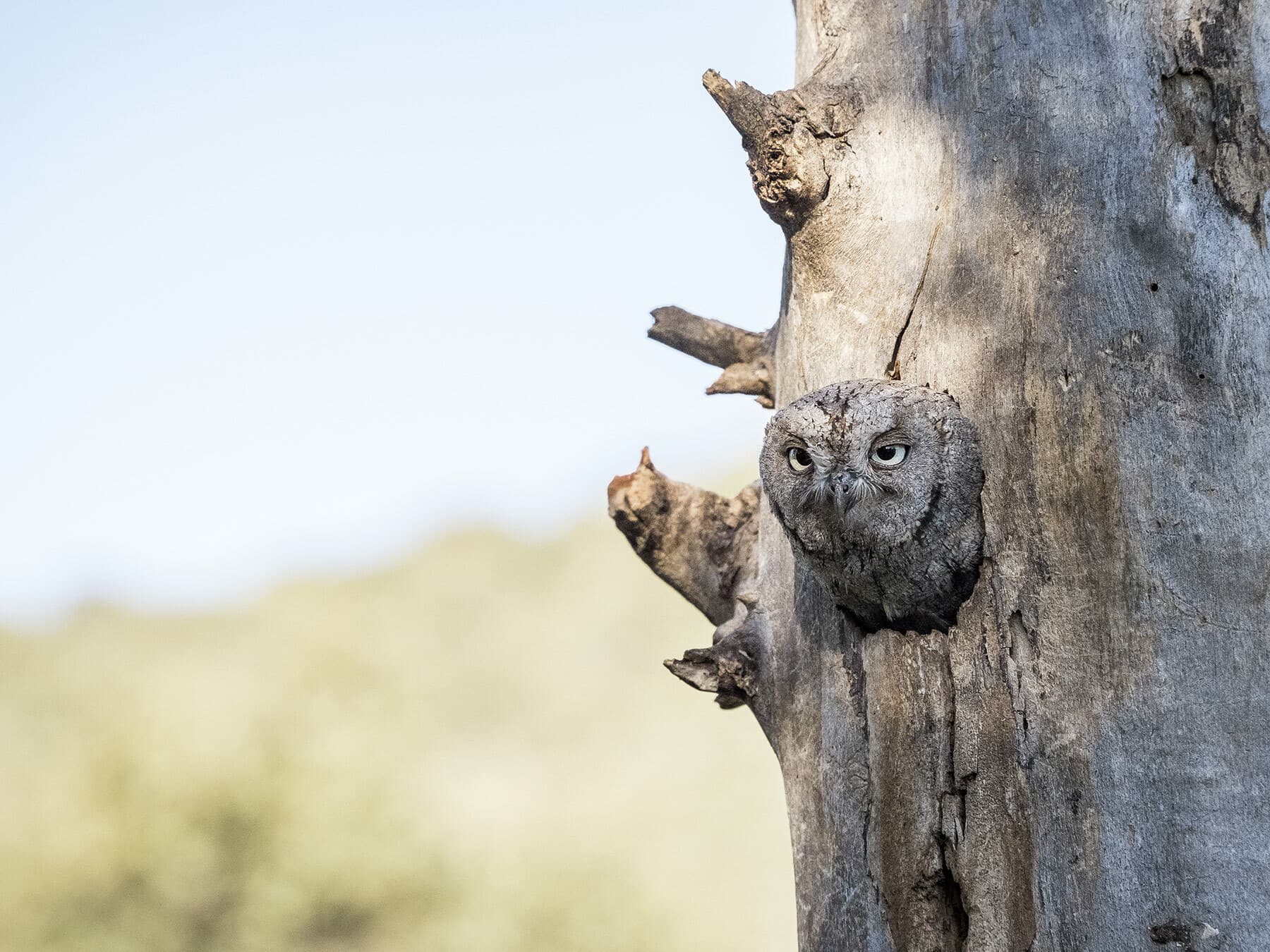
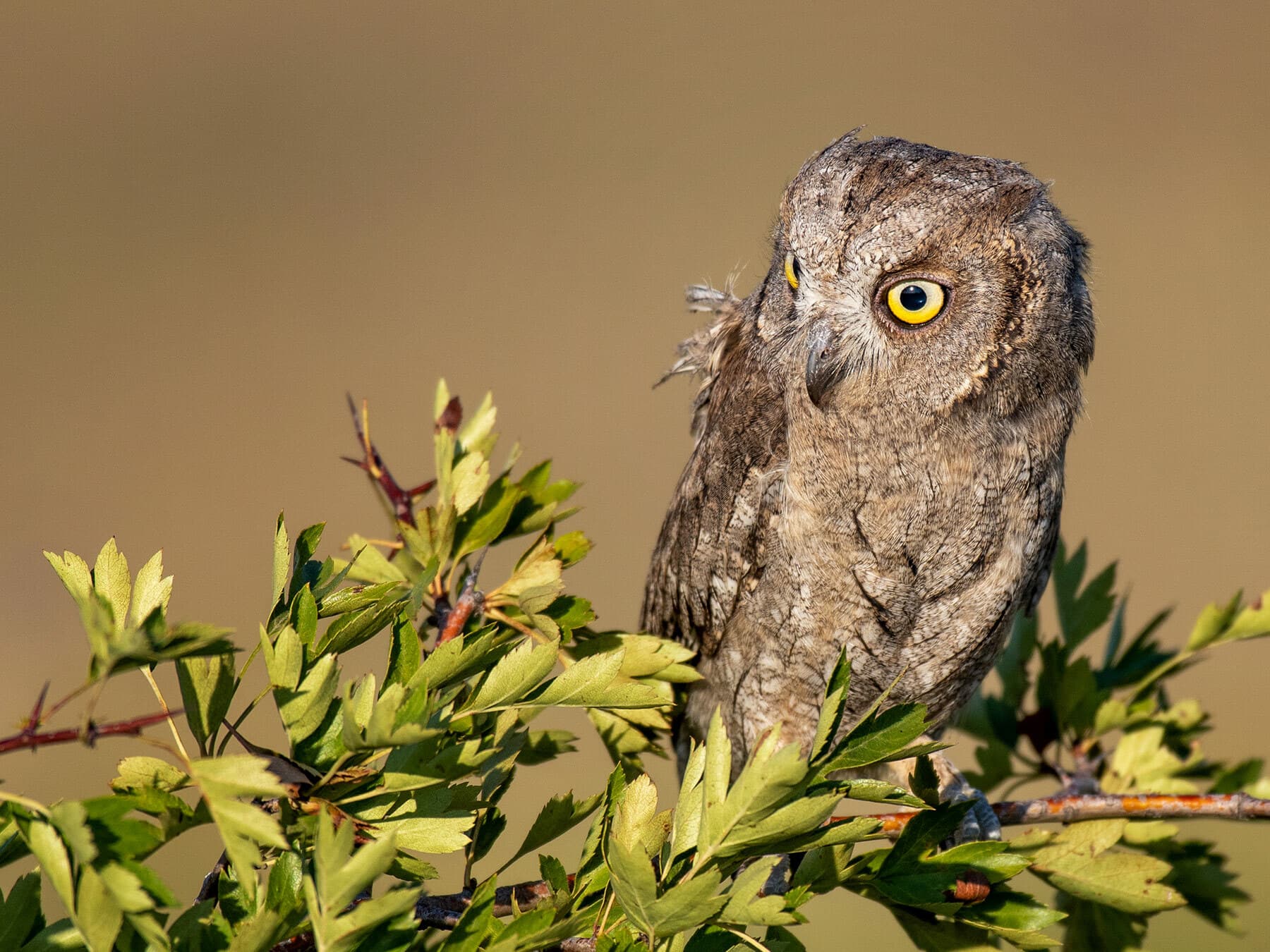
The Eurasian Scops-owl is a small owl with prominent ear-tufts and large yellow eyes. Its plumage is mottled grey or brown, providing excellent camouflage against tree bark. Fine black streaks run vertically down its body.
Both sexes look similar, with subtle variations in overall colouration. Juveniles resemble adults but may have a slightly fluffier appearance and less defined markings.
There are two different morphs, the most common being predominantly grey-brown in colour with a paler face and underparts.
Its size
Adults- Length
- 19–21 cm
- Wingspan
- 47–54 cm
- Weight
- 60–135 g
Its song and calls
Males and females vocalise often calling to each other with a mid to low toned single or repeated note of ‘kyo – kyo’. One of the best descriptions of this relatively unique sound is to liken it to the sonar ping heard in submarine films when the vessel is being tracked by a surface ship, although the bird’s call is not always pitched as high.
- Song0:00 / 0:13
Recorded in Auvergne-Rhône-Alpes, France · August 2025
- Call0:00 / 0:29
Recorded in Nouvelle-Aquitaine, France · September 2024
When and where to see it
The Eurasian Scops-owl is not recorded regularly in the UK, Ireland, the United States or Canada.
United Kingdom: recorded in 1 of the 6 years; Ireland: recorded in 1 of the 6 years. Too few years to count as a regular visitor.
Worldwide: recorded regularly in 46 countries
Countries where it was recorded in at least 3 of the 6 years 2019–2024. Linked countries have their own bird list.
Europe (23)
Asia (20)
- Armenia
- Azerbaijan
- China
- Georgia
- India
- Iran
- Israel
- Jordan
- Kazakhstan
- Kuwait
- Kyrgyzstan
- Mongolia
- Oman
- Palestinian Territories
- Qatar
- Saudi Arabia
- Tajikistan
- Turkey
- United Arab Emirates
- Uzbekistan
Data: EOD – eBird Observation Dataset (Cornell Lab of Ornithology), accessed via GBIF.org, CC BY 4.0. Records from 2019–2024, aggregated and filtered by Birdfact. How these lists are made
The Eurasian scops owl (otus scops) breeds in southern Europe, particularly around the Mediterranean and eastwards into west and central Asia. It is polytypic in that it has four subspecies mainly limited to specific geographical areas as follows:
- Otus scops cycladum - Greece, S Asia Minor, Jordan & Israel
- Otus scops mallorcae - Mainland Spain, Balearic Islands, N W Africa
- Otus scops pulchellus - Russia, Kazakhstan & N W China
- Otus scops turanicus - Iraq, Iran, Turkey, Turkmenistan, N W Pakistan
There is a further member of the family of the Eurasian Scops Owl, namely the Eurasian Scops Owl (Cyprus) – (otus scops cyprius), that is monotypic, which is to say it has no subspecies neither is it itself a subspecies and is found only on the island of Cyprus. Apart from a limited number of birds breeding around southern coastal regions of the Mediterranean and its islands, scops owls migrate during the winter to sub-Saharan Africa and western Indian (dependent upon their breeding location).
Signs and Spotting tips
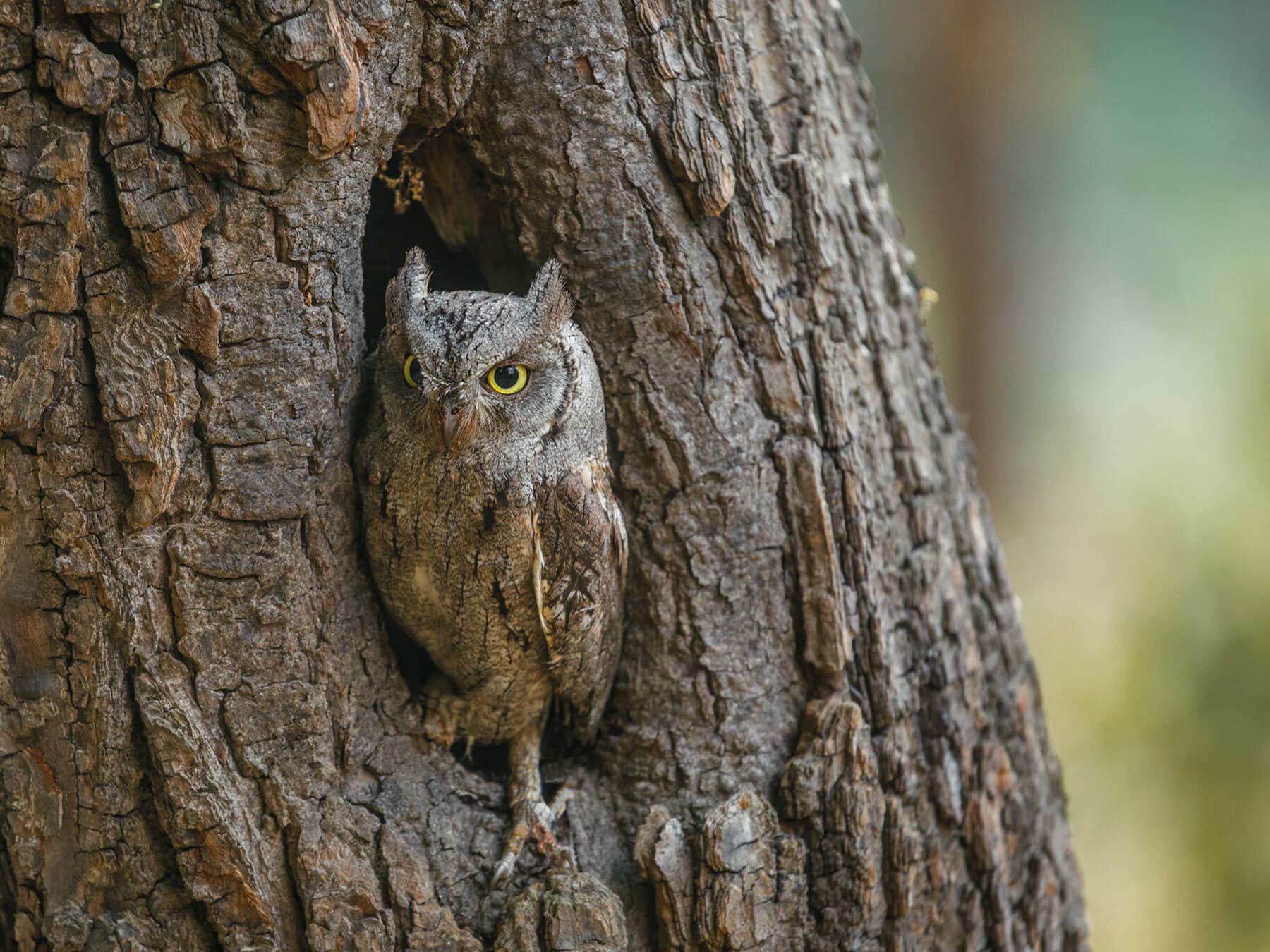
As previously stated, the call of the scops owl is very distinctive and easily recognisable albeit that the sound may be heard, but the creature may well remain hidden. They prefer to frequent fairly open wooded broadleaf areas or coniferous forests and will even populate orchards or parks in suburban regions. They are predominantly nocturnal and are more likely to be seen at dusk during the summer within their breeding grounds.
What it eats
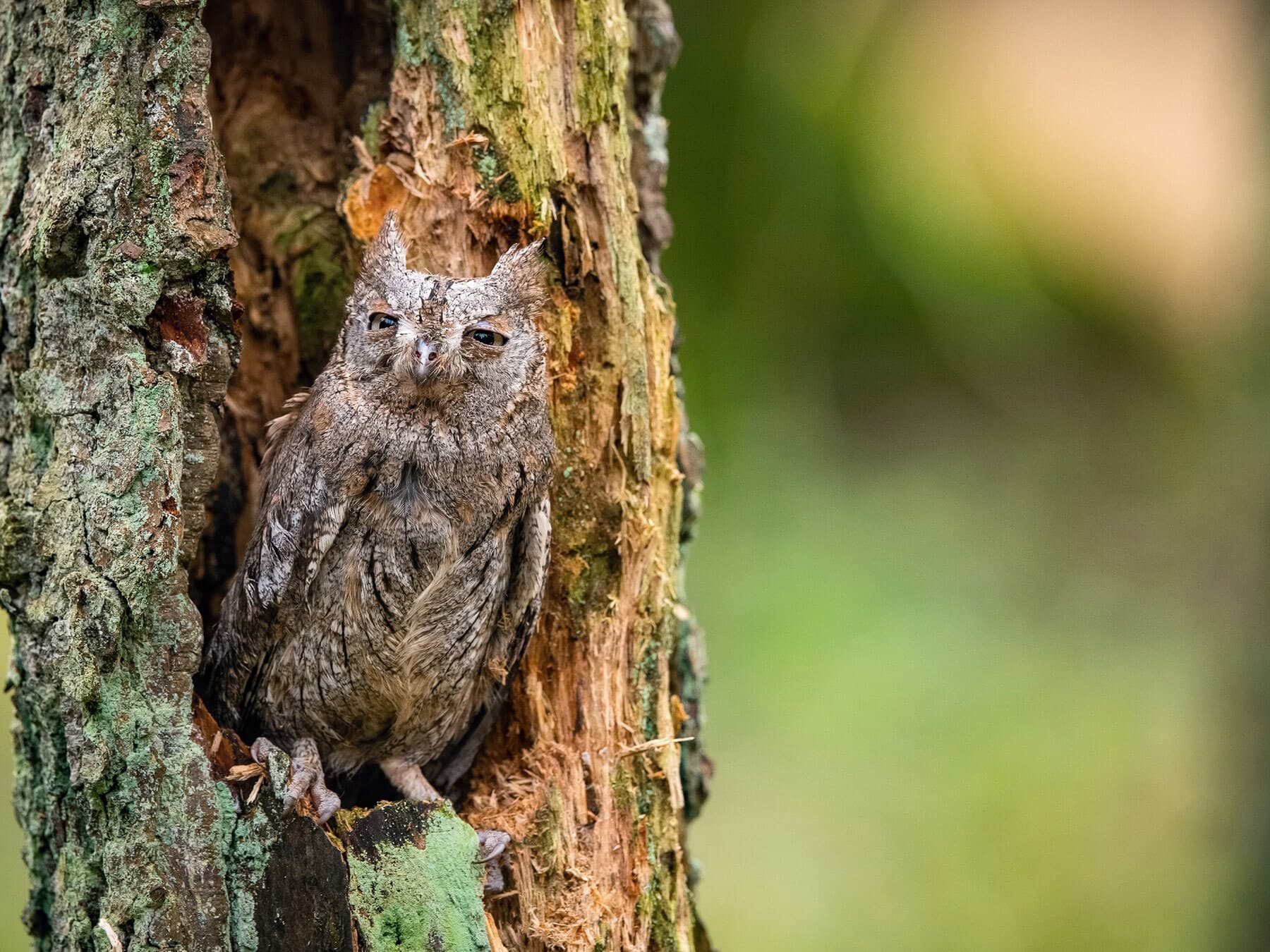
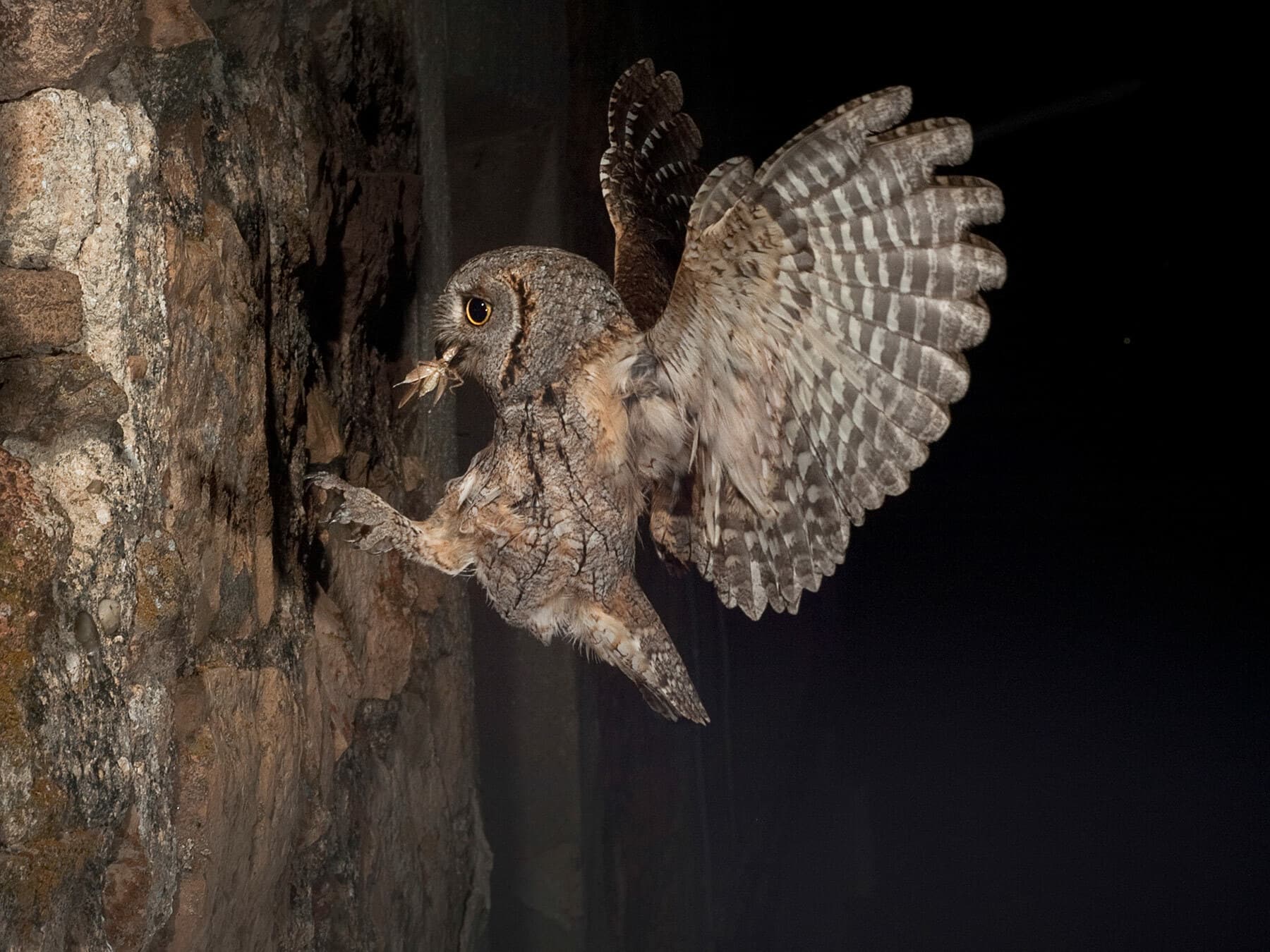
The scops owl will sometimes forage for food whilst on the ground but more commonly will swoop down from its perch and grab its prey with its claws. A diet of large insects is its favourite meal although it will also take earthworms and small reptiles, mammals and birds.
Nesting and breeding
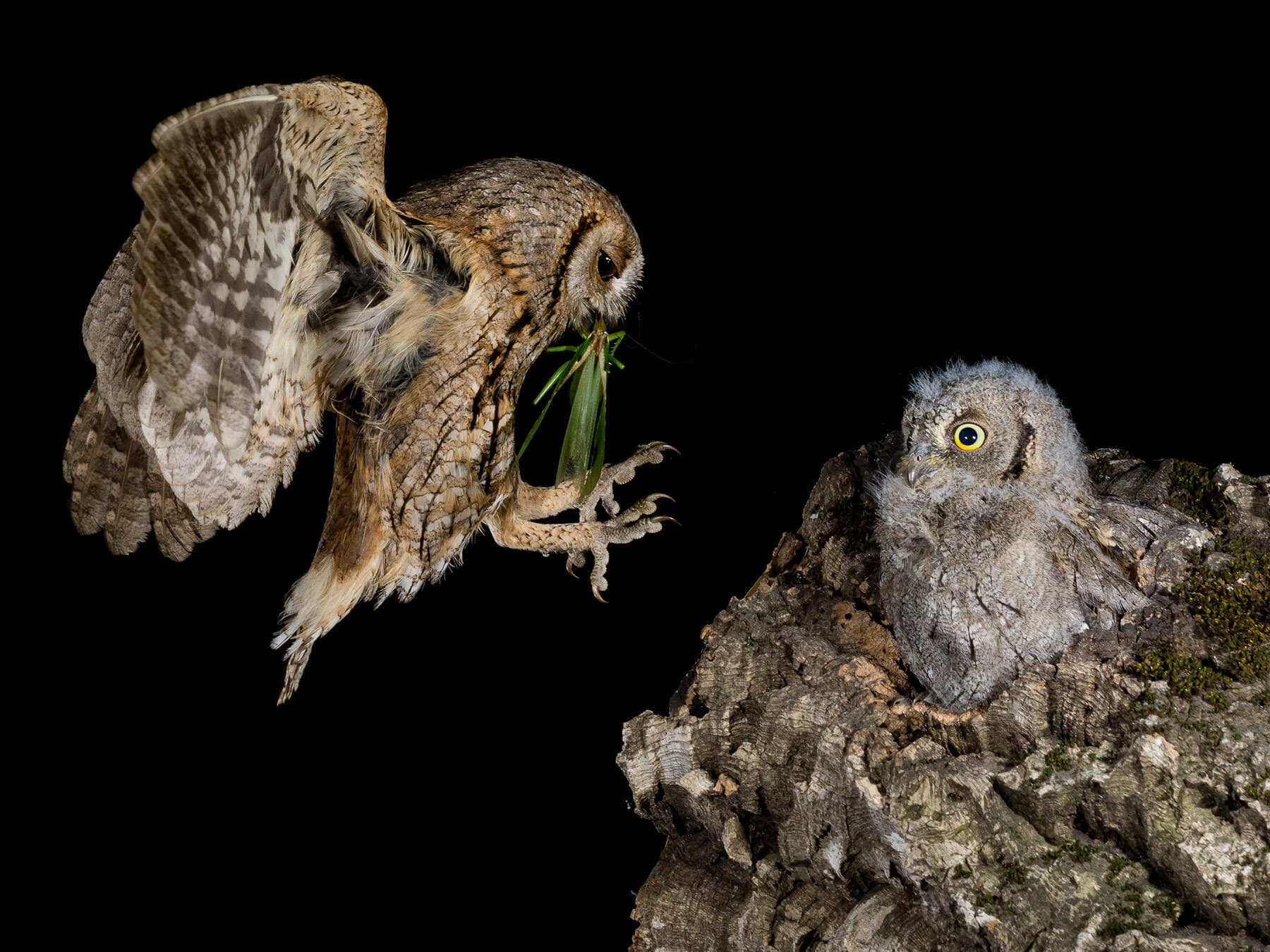
Nesting takes place in tree cavities, buildings or walls and occasionally old nests abandoned by other bird species. One brood of between 2 – 6 plain white eggs is laid between March to August, dependent upon location, and incubated by the female for an average of twenty five days. The young leave the nest up to thirty days later.
Behaviour
This nocturnal owl is remarkably cryptic, often perching motionless against tree trunks to avoid detection. It hunts from low perches, swooping down to catch prey on the ground or in mid-air.
During the day, it roosts in dense foliage or tree cavities, relying on its camouflage for protection.
Lifespan and predators
Life expectancy for a Eurasian scops owl is up to ten years.
Conservation
While listed as Least Concern globally, the Eurasian Scops-owl faces localised threats from habitat loss and pesticide use.
Conservation efforts focus on preserving old-growth forests and promoting sustainable agricultural practices to maintain suitable hunting grounds.
What does a Scops Owl look like?
The scops owl has two different morphs with the most common being predominantly grey brown in colour with a paler face and underparts. The facial disc is grey with dark brown edging and a pale grey V shape above the bill and between the eyes, extending upwards towards the back of the crown, to the ear tufts. Bisecting this grey V shape is a narrow dark brown stripe running from the cere, where the beak meets the face, up to the cap and beyond. There is a dark grey brown area immediately surrounding the bright yellow eyes with pale almost white thin eyebrows above. The breast, belly and flanks are a pale greyish brown with a randomly patterned light buff mottling and prominent black or dark brown vertical streaks. The upper parts are mainly grey brown with streaks and bars. The overall patternation and colour of the grey morph scops owl provides an excellent camouflage for the bird, particularly when set against a backdrop of tree bark. The rufous morphed variant is similar in patternation and markings but with the grey brown colouration substituted for the reddish brown or rufous hue.
Similar birds
Often mistaken for
Eurasian Scops-owl guides
4 guidesQuick facts
- Length
- 19–21 cm
- Wingspan
- 47–54 cm
- Weight
- 60–135 g
- Lifespan
- 5 years · oldest recorded 6.9 years
- Family
- Owls
- Migration
- Long-distance Migrant
- Global status (IUCN)
- Least Concern
- World population
- 795,000 - 1,332,000 mature individuals
- Population trend
- Decreasing
- Also called
- European Scops-owl, Common Scops-owl, Eurasian Scops Owl
- Scientific name
- Otus scops
Sources
4- 1BirdLife International. 2021. Otus scops. The IUCN Red List of Threatened Species 2021: e.T155019854A206523296. Source (opens in a new tab)
- 2BirdLife International. 2021. Otus scops. The IUCN Red List of Threatened Species 2021: e.T155019854A206523296. Source (opens in a new tab)
- 3BirdLife International. 2021. Otus scops. The IUCN Red List of Threatened Species 2021: e.T155019854A206523296. Source (opens in a new tab)
- 4Fransson et al., EURING list of longevity records for European birds (2010) Source (opens in a new tab)

Checked by
Nathan Cope, founder and editor
Nathan founded Birdfact and leads its writers and contributors in the UK, the US and Canada. He has watched and studied birds for more than ten years, and checks every article and species guide before it’s published.